
Silvio Cesare silvio.cesare@gmail.com
          http://www.foocodechu.com
    Ph.D. Candidate, Deakin University
   Ph.D. Candidate at Deakin University.
   Research
    ◦ Malware detection.
    ◦ Automated vulnerability discovery (check out my
      other talk in the main conference).
   Did a Masters by research in malware
    ◦ “Fast automated unpacking and classification of
      malware”.
    ◦ Presented last year at Ruxcon 2010.
   This current work extends last year’s work.
   Traditional AV works well on known samples.

   Doesn’t detect unknown samples.

   Doesn’t detect “suspiciously similar” samples.

   Uses strings as a signature or “birthmark”.

   Compares birthmarks by equality.
   Birthmarks can be program structure.

   More static among malware variants.

   Birthmarks can be compared using “approximate
    similarity”.

   Able to detect unknown samples that are
    suspiciously similar to known malware.

   Vastly reduce number of required signatures.
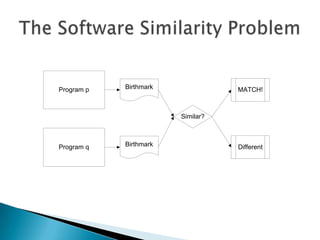
Program p   Birthmark              MATCH!


                        Similar?


Program q   Birthmark              Different
   Control flow is more invariant among
    polymorphic and metamorphic malware.

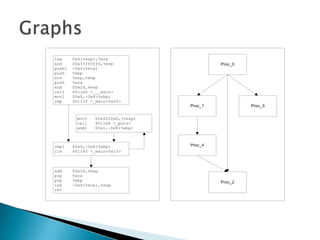
   A directed graph representing control flow.

   A control flow graph for every procedure.

   One call graph per program.
lea     0x4(%esp),%ecx
and     $0xfffffff0,%esp                    Proc_0
pushl   -0x4(%ecx)
push    %ebp
mov     %esp,%ebp
push    %ecx
sub     $0x24,%esp
call    4011b0 <___main>
movl    $0x0,-0x8(%ebp)
jmp     40115f <_main+0x2f>
                                   Proc_1            Proc_3


         movl   $0x4020a0,(%esp)
         call   4011b8 <_puts>
         addl   $0x1,-0x8(%ebp)


cmpl    $0x9,-0x8(%ebp)            Proc_4
jle     40114f <_main+0x1f>


add     $0x24,%esp
pop     %ecx
pop     %ebp                                Proc_2
lea     -0x4(%ecx),%esp
ret
   Known as the “Graph Isomorphism” problem.

   Identifies equivalent “structure”.

   Not proven to be in NP, but no polynomial
    time algorithm known.
   The number of basic operations applied to a
    graph to transform it to another graph.

   If you know the distance between two
    objects, you know the similarity.

   Complexity in NP and infeasible.
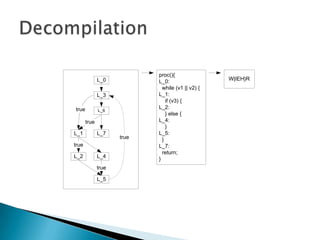
proc(){
              L_0           L_0:                   W|IEH}R
                              while (v1 || v2) {
              L_3           L_1:
                                if (v3) {
true                        L_2:
              L_6
                                } else {
       true                 L_4:
                                }
L_1           L_7           L_5:
                     true     }
true                        L_7:
                              return;
L_2           L_4
                            }
              true

              L_5
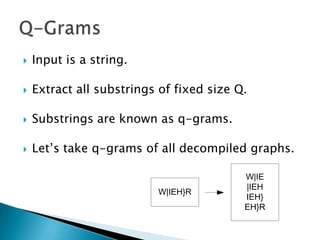
   Input is a string.

   Extract all substrings of fixed size Q.

   Substrings are known as q-grams.

   Let’s take q-grams of all decompiled graphs.

                                          W|IE
                                          |IEH
                          W|IEH}R
                                          IEH}
                                          EH}R
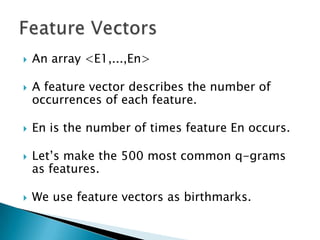
   An array <E1,...,En>

   A feature vector describes the number of
    occurrences of each feature.

   En is the number of times feature En occurs.

   Let’s make the 500 most common q-grams
    as features.

   We use feature vectors as birthmarks.
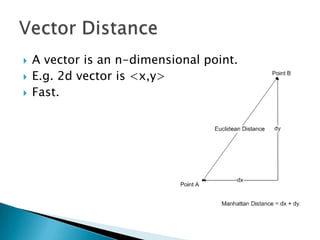
   A vector is an n-dimensional point.
   E.g. 2d vector is <x,y>
   Fast.
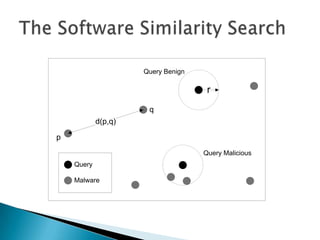
   Software similarity problem extended to
    similarity search over a database.

   Find nearest neighbours (by distance) of a
    query.

   Or find neighbours within a distance of the
    query.
Query Benign

                                     r
                      q
            d(p,q)

p
                                    Query Malicious
    Query

    Malware
   Vector distances here are “metric”.

   It has the mathematical properties of a
    metric.

   This means you can do a nearest neighbour
    search without brute forcing the entire
    database!
   System is 100,000 lines of code of C++.

   The modules for this work < 3000 lines of code.

   System translates x86 into an intermediate
    language (IL).

   Performs analysis on architecture independent IL.

   Unpacks malware using an application level
    emulator.
   Database of 10,000 malware.

   Scanned 1,601 benign binaries.

   10 false positives. Less than 1%.

   Using additional refinement algorithm,
    reduced to 7 false positives.

   Very small binaries have small signatures and
    cause weak matching.
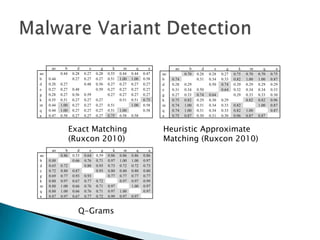
   Calculated similarity between Roron malware
    variants.

   Compared results to Ruxcon 2010 work.

   In tables, highlighted cells indicates a positive
    match.

   The more matches the more effective it is.
ao       b      d       e      g      k     m       q      a         ao       b      d      e      g      k      m      q      a
ao          0.44   0.28    0.27   0.28   0.55   0.44   0.44   0.47   ao          0.70   0.28   0.28   0.27   0.75   0.70   0.70   0.75
b    0.44          0.27    0.27   0.27   0.51   1.00   1.00   0.58   b    0.74          0.31   0.34   0.33   0.82   1.00   1.00   0.87
d    0.28   0.27           0.48   0.56   0.27   0.27   0.27   0.27   d    0.28   0.29          0.50   0.74   0.29   0.29   0.29   0.29
e    0.27   0.27   0.48           0.59   0.27   0.27   0.27   0.27   e    0.31   0.34   0.50          0.64   0.32   0.34   0.34   0.33
g    0.28   0.27   0.56    0.59          0.27   0.27   0.27   0.27   g    0.27   0.33   0.74   0.64          0.29   0.33   0.33   0.30
k    0.55   0.51   0.27    0.27   0.27          0.51   0.51   0.75   k    0.75   0.82   0.29   0.30   0.29          0.82   0.82   0.96
m    0.44   1.00   0.27    0.27   0.27   0.51          1.00   0.58   m    0.74   1.00   0.31   0.34   0.33   0.82          1.00   0.87
q    0.44   1.00   0.27    0.27   0.27   0.51   1.00          0.58   q    0.74   1.00   0.31   0.34   0.33   0.82   1.00          0.87
a    0.47   0.58   0.27    0.27   0.27   0.75   0.58   0.58          a    0.75   0.87   0.30   0.31   0.30   0.96   0.87   0.87


                   Exact Matching                                    Heuristic Approximate
                   (Ruxcon 2010)                                     Matching (Ruxcon 2010)
      ao       b       d      e      g      k     m       q      a
ao          0.86    0.53   0.64   0.59   0.86   0.86   0.86   0.86
b    0.88           0.66   0.76   0.71   0.97   1.00   1.00   0.97
d    0.65   0.72           0.88   0.93   0.73   0.72   0.72   0.73
e    0.72   0.80    0.87          0.93   0.80   0.80   0.80   0.80
g    0.69   0.77    0.93   0.93          0.77   0.77   0.77   0.77
k    0.88   0.97    0.67   0.77   0.72          0.97   0.97   0.99
m    0.88   1.00    0.66   0.76   0.71   0.97          1.00   0.97
q    0.88   1.00    0.66   0.76   0.71   0.97   1.00          0.97
a    0.87   0.97    0.67   0.77   0.72   0.99   0.97   0.97


                       Q-Grams
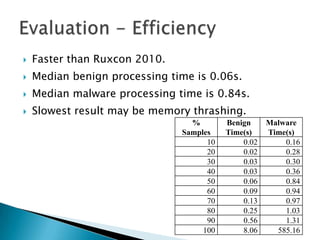
   Faster than Ruxcon 2010.
   Median benign processing time is 0.06s.
   Median malware processing time is 0.84s.
   Slowest result may be memory thrashing.
                                 %        Benign     Malware
                               Samples    Time(s)    Time(s)
                                     10       0.02       0.16
                                     20       0.02       0.28
                                     30       0.03       0.30
                                     40       0.03       0.36
                                     50       0.06       0.84
                                     60       0.09       0.94
                                     70       0.13       0.97
                                     80       0.25       1.03
                                     90       0.56       1.31
                                    100       8.06     585.16
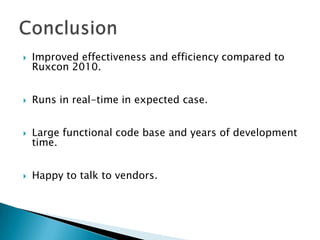
   Improved effectiveness and efficiency compared to
    Ruxcon 2010.


   Runs in real-time in expected case.


   Large functional code base and years of development
    time.


   Happy to talk to vendors.
   Full academic paper at IEEE Trustcom.


   Research page http://www.foocodechu.com


   Book on “Software similarity and classification”
    available in 2012.


   Wiki on software similarity and classification
    http://www.foocodechu.com/wiki

Faster, More Effective Flowgraph-based Malware Classification

  • 1.
    Silvio Cesare silvio.cesare@gmail.com http://www.foocodechu.com Ph.D. Candidate, Deakin University
  • 2.
    Ph.D. Candidate at Deakin University.  Research ◦ Malware detection. ◦ Automated vulnerability discovery (check out my other talk in the main conference).  Did a Masters by research in malware ◦ “Fast automated unpacking and classification of malware”. ◦ Presented last year at Ruxcon 2010.  This current work extends last year’s work.
  • 3.
    Traditional AV works well on known samples.  Doesn’t detect unknown samples.  Doesn’t detect “suspiciously similar” samples.  Uses strings as a signature or “birthmark”.  Compares birthmarks by equality.
  • 4.
    Birthmarks can be program structure.  More static among malware variants.  Birthmarks can be compared using “approximate similarity”.  Able to detect unknown samples that are suspiciously similar to known malware.  Vastly reduce number of required signatures.
  • 5.
    Program p Birthmark MATCH! Similar? Program q Birthmark Different
  • 6.
    Control flow is more invariant among polymorphic and metamorphic malware.  A directed graph representing control flow.  A control flow graph for every procedure.  One call graph per program.
  • 7.
    lea 0x4(%esp),%ecx and $0xfffffff0,%esp Proc_0 pushl -0x4(%ecx) push %ebp mov %esp,%ebp push %ecx sub $0x24,%esp call 4011b0 <___main> movl $0x0,-0x8(%ebp) jmp 40115f <_main+0x2f> Proc_1 Proc_3 movl $0x4020a0,(%esp) call 4011b8 <_puts> addl $0x1,-0x8(%ebp) cmpl $0x9,-0x8(%ebp) Proc_4 jle 40114f <_main+0x1f> add $0x24,%esp pop %ecx pop %ebp Proc_2 lea -0x4(%ecx),%esp ret
  • 8.
    Known as the “Graph Isomorphism” problem.  Identifies equivalent “structure”.  Not proven to be in NP, but no polynomial time algorithm known.
  • 9.
    The number of basic operations applied to a graph to transform it to another graph.  If you know the distance between two objects, you know the similarity.  Complexity in NP and infeasible.
  • 10.
    proc(){ L_0 L_0: W|IEH}R while (v1 || v2) { L_3 L_1: if (v3) { true L_2: L_6 } else { true L_4: } L_1 L_7 L_5: true } true L_7: return; L_2 L_4 } true L_5
  • 11.
    Input is a string.  Extract all substrings of fixed size Q.  Substrings are known as q-grams.  Let’s take q-grams of all decompiled graphs. W|IE |IEH W|IEH}R IEH} EH}R
  • 12.
    An array <E1,...,En>  A feature vector describes the number of occurrences of each feature.  En is the number of times feature En occurs.  Let’s make the 500 most common q-grams as features.  We use feature vectors as birthmarks.
  • 13.
    A vector is an n-dimensional point.  E.g. 2d vector is <x,y>  Fast.
  • 14.
    Software similarity problem extended to similarity search over a database.  Find nearest neighbours (by distance) of a query.  Or find neighbours within a distance of the query.
  • 15.
    Query Benign r q d(p,q) p Query Malicious Query Malware
  • 16.
    Vector distances here are “metric”.  It has the mathematical properties of a metric.  This means you can do a nearest neighbour search without brute forcing the entire database!
  • 17.
    System is 100,000 lines of code of C++.  The modules for this work < 3000 lines of code.  System translates x86 into an intermediate language (IL).  Performs analysis on architecture independent IL.  Unpacks malware using an application level emulator.
  • 18.
    Database of 10,000 malware.  Scanned 1,601 benign binaries.  10 false positives. Less than 1%.  Using additional refinement algorithm, reduced to 7 false positives.  Very small binaries have small signatures and cause weak matching.
  • 19.
    Calculated similarity between Roron malware variants.  Compared results to Ruxcon 2010 work.  In tables, highlighted cells indicates a positive match.  The more matches the more effective it is.
  • 20.
    ao b d e g k m q a ao b d e g k m q a ao 0.44 0.28 0.27 0.28 0.55 0.44 0.44 0.47 ao 0.70 0.28 0.28 0.27 0.75 0.70 0.70 0.75 b 0.44 0.27 0.27 0.27 0.51 1.00 1.00 0.58 b 0.74 0.31 0.34 0.33 0.82 1.00 1.00 0.87 d 0.28 0.27 0.48 0.56 0.27 0.27 0.27 0.27 d 0.28 0.29 0.50 0.74 0.29 0.29 0.29 0.29 e 0.27 0.27 0.48 0.59 0.27 0.27 0.27 0.27 e 0.31 0.34 0.50 0.64 0.32 0.34 0.34 0.33 g 0.28 0.27 0.56 0.59 0.27 0.27 0.27 0.27 g 0.27 0.33 0.74 0.64 0.29 0.33 0.33 0.30 k 0.55 0.51 0.27 0.27 0.27 0.51 0.51 0.75 k 0.75 0.82 0.29 0.30 0.29 0.82 0.82 0.96 m 0.44 1.00 0.27 0.27 0.27 0.51 1.00 0.58 m 0.74 1.00 0.31 0.34 0.33 0.82 1.00 0.87 q 0.44 1.00 0.27 0.27 0.27 0.51 1.00 0.58 q 0.74 1.00 0.31 0.34 0.33 0.82 1.00 0.87 a 0.47 0.58 0.27 0.27 0.27 0.75 0.58 0.58 a 0.75 0.87 0.30 0.31 0.30 0.96 0.87 0.87 Exact Matching Heuristic Approximate (Ruxcon 2010) Matching (Ruxcon 2010) ao b d e g k m q a ao 0.86 0.53 0.64 0.59 0.86 0.86 0.86 0.86 b 0.88 0.66 0.76 0.71 0.97 1.00 1.00 0.97 d 0.65 0.72 0.88 0.93 0.73 0.72 0.72 0.73 e 0.72 0.80 0.87 0.93 0.80 0.80 0.80 0.80 g 0.69 0.77 0.93 0.93 0.77 0.77 0.77 0.77 k 0.88 0.97 0.67 0.77 0.72 0.97 0.97 0.99 m 0.88 1.00 0.66 0.76 0.71 0.97 1.00 0.97 q 0.88 1.00 0.66 0.76 0.71 0.97 1.00 0.97 a 0.87 0.97 0.67 0.77 0.72 0.99 0.97 0.97 Q-Grams
  • 21.
    Faster than Ruxcon 2010.  Median benign processing time is 0.06s.  Median malware processing time is 0.84s.  Slowest result may be memory thrashing. % Benign Malware Samples Time(s) Time(s) 10 0.02 0.16 20 0.02 0.28 30 0.03 0.30 40 0.03 0.36 50 0.06 0.84 60 0.09 0.94 70 0.13 0.97 80 0.25 1.03 90 0.56 1.31 100 8.06 585.16
  • 22.
    Improved effectiveness and efficiency compared to Ruxcon 2010.  Runs in real-time in expected case.  Large functional code base and years of development time.  Happy to talk to vendors.
  • 23.
    Full academic paper at IEEE Trustcom.  Research page http://www.foocodechu.com  Book on “Software similarity and classification” available in 2012.  Wiki on software similarity and classification http://www.foocodechu.com/wiki