http://www.iaeme.com/IJCIET/index.asp 104 editor@iaeme.com
International Journal of Civil Engineering and Technology (IJCIET)
Volume 7, Issue 1, Jan-Feb 2016, pp. 104-112, Article ID: IJCIET_07_01_009
Available online at
http://www.iaeme.com/IJCIET/issues.asp?JType=IJCIET&VType=7&IType=1
Journal Impact Factor (2016): 9.7820 (Calculated by GISI) www.jifactor.com
ISSN Print: 0976-6308 and ISSN Online: 0976-6316
© IAEME Publication
EFFECT OF NANO-SILICA ON CONCRETE
CONTAINING METAKAOLIN
Dr. D. V. Prasada Rao
Associate Professor, Department of Civil Engineering,
Sri Venkateswara University College of Engineering, Tirupati-517 502, Andhra
Pradesh, India
S. Venkata Maruthi
PG Student, Department of Civil Engineering,
Sri Venkateswara University College of Engineering, Tirupati-517 502, Andhra
Pradesh, India
ABSTRACT
In this paper the results of an experimental investigation on the use of
Metakaolin (MK) and Nano-Silica (NS) on various properties of
concrete are presented. Metakaolin and Nano-Silica are used as partial
replacement of cement for the preparation of concrete. In the present
investigation initially cement is partially replaced by Metakaolin 5% and
10% by weight. Further investigation is carried out by combined
replacement of Metakaolin at 5% and 10% with Nano-Silica at 1%, 2% and
3% by weight of cement. For structural applications the various
properties, such as compressive strength, split tensile strength,
modulus of elasticity and flexural strength of M25 grade concrete
containing MK and NS are evaluated and the results are compared
with the controlled concrete. Based on the test results, it can be observed
that concrete prepared with a combination of 5% M K and 2% NS
indicated increased strength compared to the controlled concrete. Hence,
it can be concluded that concrete prepared with 5% MK and 2% NS
combination can be recommended for the structural applications. The
increase in the strength properties of concrete is due to the availability of
additional binder in the presence of MK and NS.
Key words: Metakaolin, Nano-Silica, Cement Replacement, Modulus
of Elasticity and compressive Strength.
Cite this Article: Dr. D. V. Prasada Rao and S. Venkata Maruthi. Effect of
Nano-Silica on Concrete Containing Metakaolin. International Journal of
Civil Engineering and Technology, 7(1), 2016, pp. 104-112.
http://www.iaeme.com/IJCIET/issues.asp?JType=IJCIET&VType=7&IType=1
Effect of Nano-Silica on Concrete Containing Metakaolin
http://www.iaeme.com/IJCIET/index.asp 105 editor@iaeme.com
1. INTRODUCTION
The construction industry uses concrete to a very large extent. Cement is one of the
important components of concrete. The demand for Portland cement is increasing in
developing countries. Portland cement production is one of the major reasons for
CO2 emissions into atmosphere. It is due to the use of fossil fuels, including the
fuels required to generate electricity during cement manufacturing process. Hence to
reduce the consumption of cement, the application of pozzolana materials is
increasing day-by-day in the form of partial replacement for concrete preparation.
The use of pozzolana’s for making concrete is considered efficient, as it allows the
reduction of the cement consumption while improving the strength and durability
properties of the concrete.
Cement is one of main constituents of concrete and its main product of
hydration i.e. C-S-H is of nano structure. The strength and durability
characteristics of concrete depend on the quality of C-S-H gel. Silica is one of the
most important components in concrete’s micro-structure quality improvement.
Therefore, extensive research is directed towards the performance of pozzolana
concrete in recent years.
Metakaolin when used as a partial replacement substance for cement in concrete,
it reacts with Ca(OH)2 one of the by-products of hydration reaction and results in
additional C-S-H gel leading to increase in various strength properties of concrete. It
also reduces the hardened concrete permeability. Hence by partially replacing
Portland cement with Metakaolin not only reduces carbon dioxide emissions into the
atmosphere during the production of cement but also increases the service life of
buildings.
The mechanical and durability properties of concrete are mainly dependent on
the gradually refining the structure of hardened cement paste and the gradually
improving paste–aggregate interface. Nano-Silica, a new pozzolanic material
produced synthetically, in the form of water emulsion of Ultra-Fine Amorphous
Colloidal Silica (UFACS), is better than silica fume due to the higher content of
amorphous silica. Impermeability and strength characteristics of concrete can be
improved by using Nano-Silica. In the present research work, an attempt has been
made to assess the combined application of Metakaolin and Nano-Silica on the
performance of concrete
2. OBJECTIVE
The main objective of the present experimental investigation is to obtain the influence
of the combined application of Metakaolin and Nano-Silica on various strength
properties of M25 grade concrete. Combination of 5% and 10% of Metakaolin and 1%,
2% and 3% of Nano-Silica by weight of cement replacement is adopted. Using different
proportions of Metakaolin and Nano-Silica compressive strength, split tensile strength,
modulus of elasticity and flexural strength tests were performed on concrete specimens
and the results were compared with the controlled concrete.
3. EXPERIMENTAL INVESTIGATION
3.1 Materials
3.1.1 Cement
In the present investigation Ordinary Portland Cement (OPC) of 43 Grade
confirming to IS specifications was used. The specific gravity of the cement is 3.15.
Dr. D. V. Prasada Rao and S. Venkata Maruthi
http://www.iaeme.com/IJCIET/index.asp 106 editor@iaeme.com
3.1.2 Fine aggregate
Locally available river sand (Zone - II) confirming to IS specifications with
fineness modulus of 2.94 was used as the fine aggregate in the concrete mix.
3.1.3 Coarse Aggregate
Machine crushed aggregate confirming to IS 383-1970 obtained from the local
quarry is used as coarse aggregate. The nominal sizes of coarse aggregate adopted
in the present investigation were 20 mm and 12 mm. The properties of coarse
aggregate and fine aggregate used in the present investigation are shown in the
Table. 1
Table.1: Properties of CA and FA
Property Coarse Aggregate Fine Aggregate
Specific Gravity 2.64 2.66
Water Absorption (%) 0.25 1.10
3.1.4 Metakaolin
Metakaolin is a refined kaolin clay that is fired (Calcinated) under carefully
controlled conditions to create an amorphous alumina silicate that is reactive in
concrete. Compared to cement, the particle size of Metakaolin is very finer. It
acts as an excellent pore-filling material. Metakaolin is known as supplementary
cementitious material. The properties of Metakaolin used in the present
investigation are shown in the Table. 2
Table.2: Properties of Metakaolin
S.No. Characteristics Actual Analysis Result
1 Sio2 52-55%
2 Alumina (Al2O3) 40-43%
3 Ferric oxide(Fe2O3) <1
4 Bulk density 350 gm/liter
5 Moisture 0.23%
6 Appearance white powder
7 PH 6.59
8 Residue on 325 Mesh 0.1%
9 50% particles below 1.74µ
10 Specific gravity 2.61
3.1.5 Nano-Silica
Nano-Silica is a new pozzolanic material in the form of water emulsion of colloidal
silica. It appears to be potentially better than silica fume for the higher content of
amorphous silica (> 99%) and the reduced size of its spherical particles (1-50 nm).
In the present experimental investigation cement is replaced by 1%, 2% and 3% of
Nano-Silica by weight. The properties of Nano-Silica are shown in the Table.3.
Effect of Nano-Silica on Concrete Containing Metakaolin
http://www.iaeme.com/IJCIET/index.asp 107 editor@iaeme.com
Table 3 Properties of Nano-Silica
S.No. Characteristics Actual Analysis
1 Nano solids 30-32%
2 PH 9.0-10
3 Specific Gravity 1.20-1.22
4 Texture White Milky Liquid
5 Dispersion Water
3.1.6 Water
Potable water is used for casting and curing concrete test specimens. Water used is
free from acids, organic matter, suspended solids and impurities which when
present can adversely affect the strength of concrete.
3.2 Concrete Mix Proportion
In the present experimental investigation the influence of Metakaolin as partial
replacement of cement and combined application of Metakaolin and Nano-Silica as
partial replacement of cement on M25 grade of concrete is studied.
M25 grade of concrete was designed as per the Indian Standard code of Practice.
The various ingredients for one cubic meter of M25 grade concrete is shown in
Table 4. As the Nano-Silica is available in the colloidal form, the quantity of water
required for making concrete is adjusted to account for the water available in
colloidal Nano-Silica.
Table 4 Quantities of Ingredients per cum of M25 Grade Concrete
Concrete Cement
(Kg)
Metakaolin
(Kg)
Colloidal
Nano-
Silica
(lit)
Water (lit) w/c Fine
Aggregate
(Kg)
Coarse
Aggregate
(Kg)
water
available
in NS
Added
water
Control 326 0 0 0 163 0.5 742 1210
MK 5% 309.7 16.3 0 0 163 0.5 742 1210
MK 10% 293.4 32.6 0 0 163 0.5 742 1210
MK 5%
+NS 1%
306.44 16.3 10.52 7.26 155.74 0.5 742 1210
MK 5%
+NS 2%
303.18 16.3 21.03 14.51 148.49 0.5 742 1210
MK 5%
+NS 3%
299.92 16.3 31.55 21.77 141.23 0.5 742 1210
MK 10%
+NS 1%
290.14 32.6 10.52 7.26 155.74 0.5 742 1210
MK 10%
+NS 2%
286.88 32.6 21.03 14.51 148.49 0.5 742 1210
MK 10%
+NS 3%
283.62 32.6 31.55 21.77 141.23 0.5 742 1210
Dr. D. V. Prasada Rao and S. Venkata Maruthi
http://www.iaeme.com/IJCIET/index.asp 108 editor@iaeme.com
3.3 Test Specimens
Concrete test specimens consist of 150mm x 150mm x150mm cubes, cylinders of
150mm diameter and 300mm height and Prisms of 150mm x 150mm x 700mm.
Concrete cube specimens were tested at 3, 7, 28, 56 and 90 days of curing to obtain
the compressive strength of concrete. Cylindrical specimens of 150mm diameter and
300mm height were tested at the age of 28 days to obtain the split tensile strength of
concrete and modulus of elasticity of concrete. The prisms were tested at the age of
28 days to obtain the flexural strength of concrete.
4. RESULTS AND DISCUSSION
4.1 Compressive Strength
The variation of the cube compressive strength at different periods of curing of M25
grade concrete prepared using the various proportions of Metakaolin and Nano-
Silica is shown in Fig.1. Each value of the cube compressive strength indicates the
average of three test results. It can be observed that the compressive strength of
Metakaolin and Nano-Silica concrete exhibits more than that of controlled concrete.
(i) MK (5%) (ii) MK(10%)
Figure 1 Variation of Cube compressive strength of M25 grade concrete with age for
different percentages of Metakaolin(MK) and Nano-Silica(NS).
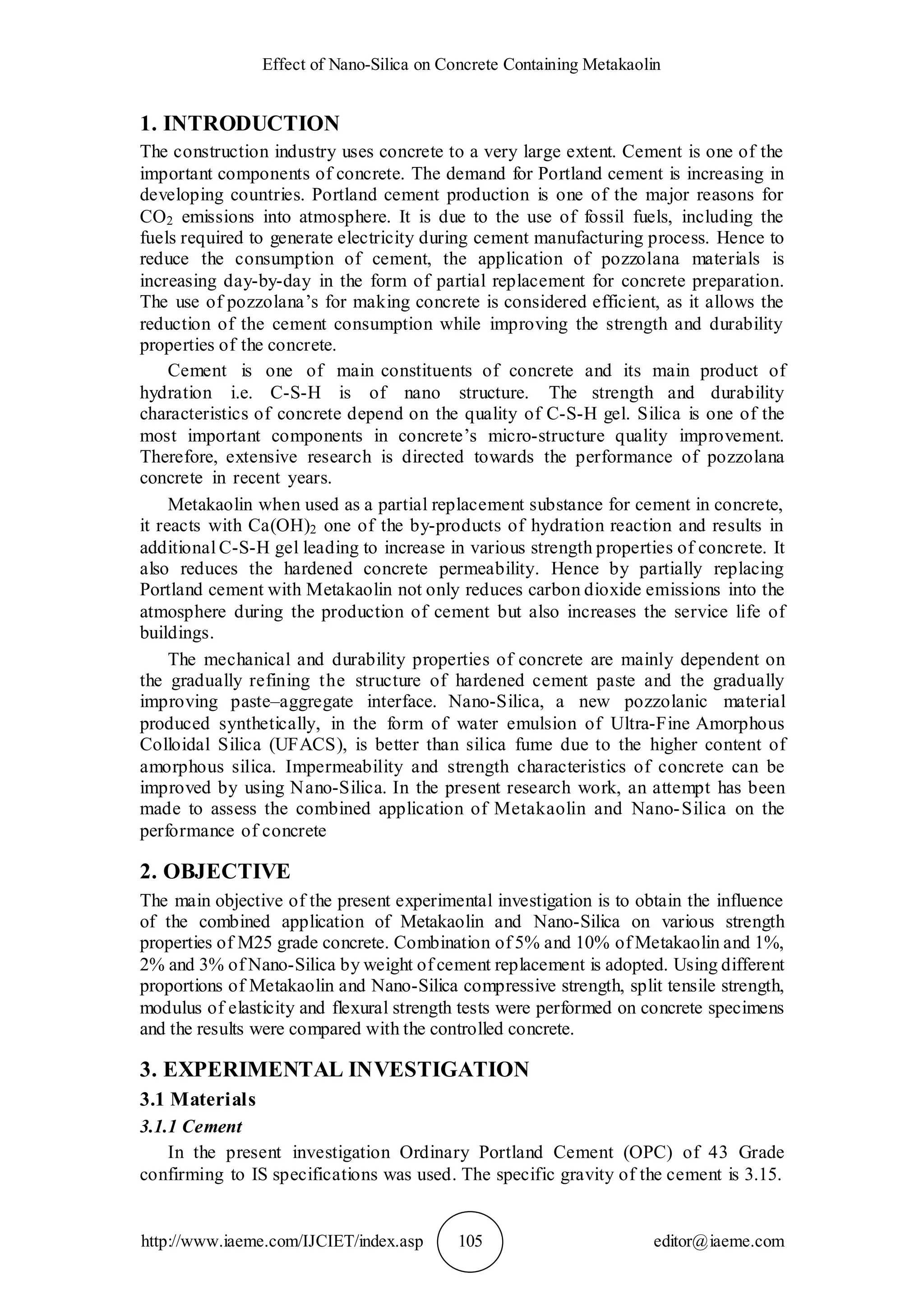
The variation of 7 days and 28 days cube compressive strength of M25 grade
concrete prepared with Nano-Silica containing different percentages of Metakaolin
is also shown in Fig.2 The compressive strength of concrete initially increases up to
2% of Nano-Silica and then the strength decreased with increase in Nano-Silica for
5% and 10% Metakaolin. This can be attributed to the non-availability of sufficient
quantity of C-S-H gel. The 7 days and 28 days cube compressive strength of M25
grade control concrete is 25.48 N/mm2
and 31.63 N/mm2
respectively. The increase
in 7 days and 28 days cube compressive strength of concrete with 2% Nano-Silica
and 5% Metakaolin combination is 9.34% and 8.90% respectively.
Effect of Nano-Silica on Concrete Containing Metakaolin
http://www.iaeme.com/IJCIET/index.asp 109 editor@iaeme.com
(a) 7 days Cube compressive Strength (b) 28 days Cube compressive Strength.
Figure 2 Variation of 7 days and 28 days Cube Compressive Strength of M25 grade
concrete with different percentages of Metakaolin(MK) and Nano-Silica(NS).
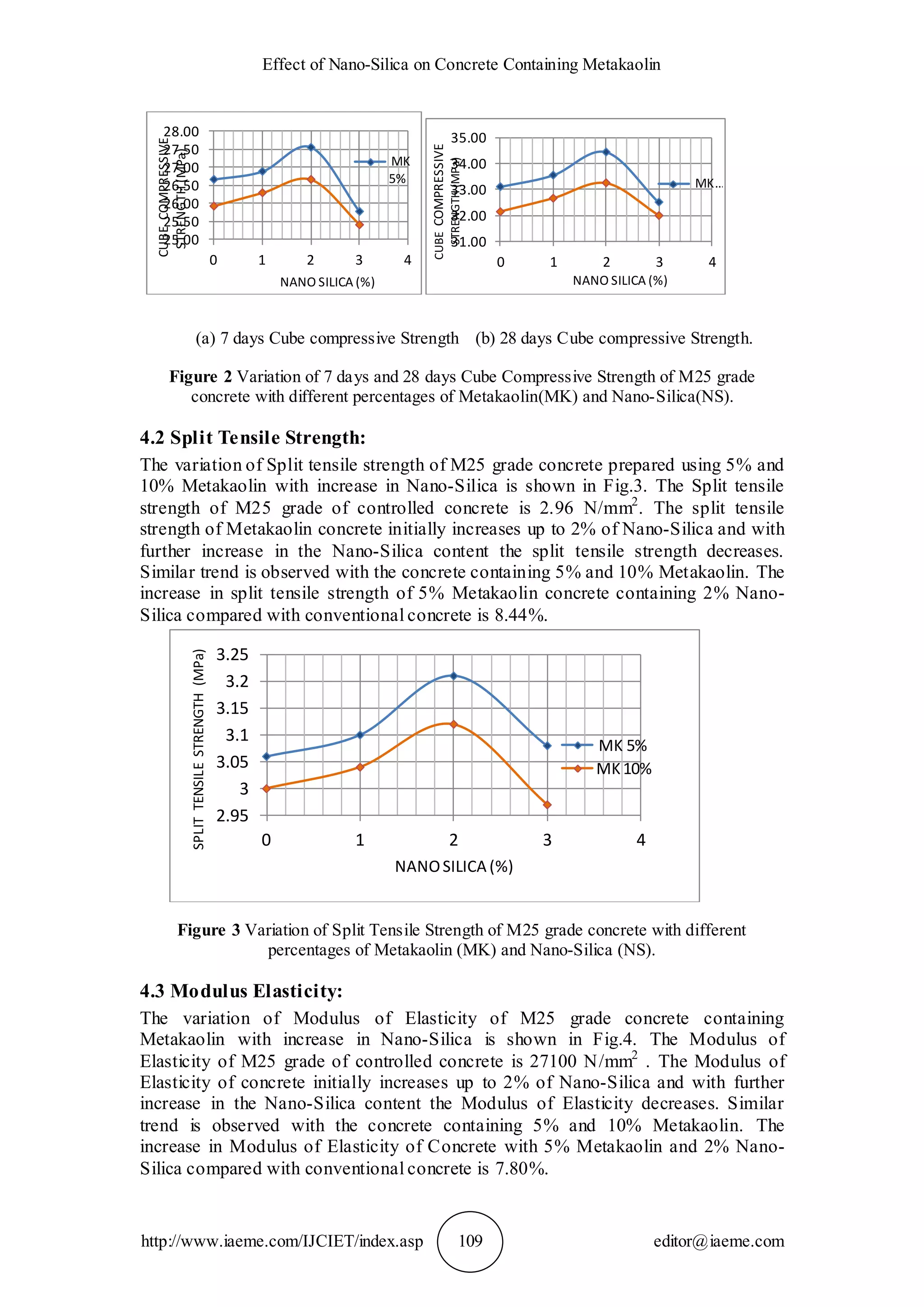
4.2 Split Tensile Strength:
The variation of Split tensile strength of M25 grade concrete prepared using 5% and
10% Metakaolin with increase in Nano-Silica is shown in Fig.3. The Split tensile
strength of M25 grade of controlled concrete is 2.96 N/mm2
. The split tensile
strength of Metakaolin concrete initially increases up to 2% of Nano-Silica and with
further increase in the Nano-Silica content the split tensile strength decreases.
Similar trend is observed with the concrete containing 5% and 10% Metakaolin. The
increase in split tensile strength of 5% Metakaolin concrete containing 2% Nano-
Silica compared with conventional concrete is 8.44%.
Figure 3 Variation of Split Tensile Strength of M25 grade concrete with different
percentages of Metakaolin (MK) and Nano-Silica (NS).
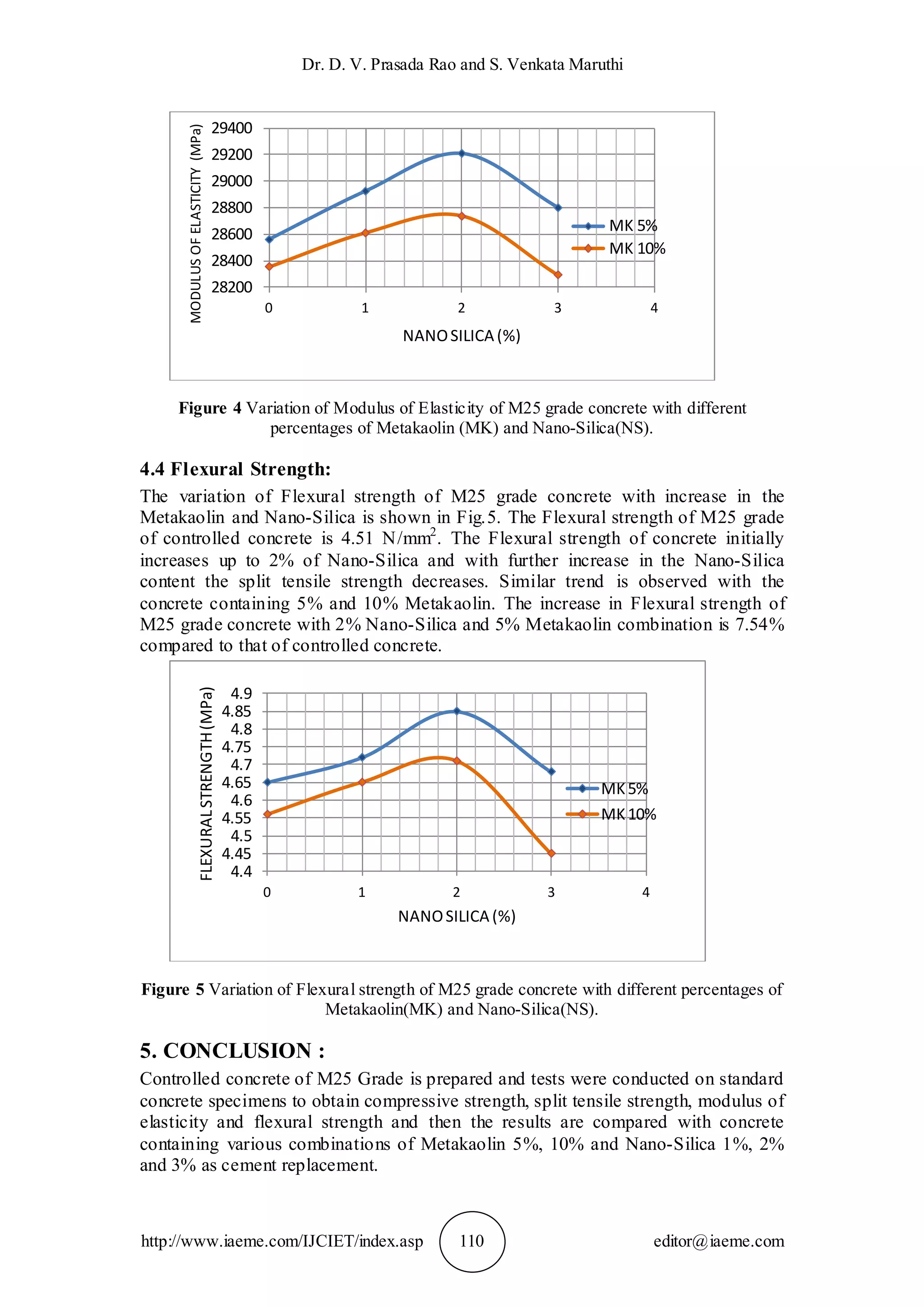
4.3 Modulus Elasticity:
The variation of Modulus of Elasticity of M25 grade concrete containing
Metakaolin with increase in Nano-Silica is shown in Fig.4. The Modulus of
Elasticity of M25 grade of controlled concrete is 27100 N/mm2
. The Modulus of
Elasticity of concrete initially increases up to 2% of Nano-Silica and with further
increase in the Nano-Silica content the Modulus of Elasticity decreases. Similar
trend is observed with the concrete containing 5% and 10% Metakaolin. The
increase in Modulus of Elasticity of Concrete with 5% Metakaolin and 2% Nano-
Silica compared with conventional concrete is 7.80%.
25.00
25.50
26.00
26.50
27.00
27.50
28.00
0 1 2 3 4
CUBECOMPRESSIVE
STRENGTH(MPa)
NANO SILICA (%)
MK
5%
31.00
32.00
33.00
34.00
35.00
0 1 2 3 4
CUBECOMPRESSIVE
STRENGTH(MPa)
NANO SILICA (%)
MK…
2.95
3
3.05
3.1
3.15
3.2
3.25
0 1 2 3 4
SPLITTENSILESTRENGTH(MPa)
NANOSILICA (%)
MK 5%
MK10%
Dr. D. V. Prasada Rao and S. Venkata Maruthi
http://www.iaeme.com/IJCIET/index.asp 110 editor@iaeme.com
Figure 4 Variation of Modulus of Elasticity of M25 grade concrete with different
percentages of Metakaolin (MK) and Nano-Silica(NS).
4.4 Flexural Strength:
The variation of Flexural strength of M25 grade concrete with increase in the
Metakaolin and Nano-Silica is shown in Fig.5. The Flexural strength of M25 grade
of controlled concrete is 4.51 N/mm2
. The Flexural strength of concrete initially
increases up to 2% of Nano-Silica and with further increase in the Nano-Silica
content the split tensile strength decreases. Similar trend is observed with the
concrete containing 5% and 10% Metakaolin. The increase in Flexural strength of
M25 grade concrete with 2% Nano-Silica and 5% Metakaolin combination is 7.54%
compared to that of controlled concrete.
Figure 5 Variation of Flexural strength of M25 grade concrete with different percentages of
Metakaolin(MK) and Nano-Silica(NS).
5. CONCLUSION :
Controlled concrete of M25 Grade is prepared and tests were conducted on standard
concrete specimens to obtain compressive strength, split tensile strength, modulus of
elasticity and flexural strength and then the results are compared with concrete
containing various combinations of Metakaolin 5%, 10% and Nano-Silica 1%, 2%
and 3% as cement replacement.
28200
28400
28600
28800
29000
29200
29400
0 1 2 3 4
MODULUSOFELASTICITY(MPa)
NANOSILICA (%)
MK 5%
MK 10%
4.4
4.45
4.5
4.55
4.6
4.65
4.7
4.75
4.8
4.85
4.9
0 1 2 3 4
FLEXURALSTRENGTH(MPa)
NANOSILICA (%)
MK5%
MK10%
Effect of Nano-Silica on Concrete Containing Metakaolin
http://www.iaeme.com/IJCIET/index.asp 111 editor@iaeme.com
Tests were conducted on concrete specimens containing Metakaolin at 5% and
10 % as cement replacement to obtain compressive strength. Using the test results, it
can be concluded that for a given Metakaolin content, the compressive strength of
concrete increases as the percentage of Metakaolin is increased up to 5% and then
decreases with increase in Metakaolin content. The variation of split tensile strength,
modulus of elasticity, flexural strength test results of M25 grade concrete prepared
with 5% and 10% Metakaolin content exhibited the similar trend. The higher surface
area of Metakaolin yielded the highest strength and the fastest rate of strength gain.
Further investigation is carried out by conducting tests on standard concrete
specimens to obtain compressive strength for combined replacement of cement with
Metakaolin and Nano-Silica using different combinations of Metakaolin at 5%, 10
% and Nano-Silica at 1%, 2% and 3%. From the test results, it can be concluded that
for a given Metakaolin content, the compressive strength of concrete increases as
the percentage of Nano-Silica is increased up to 2% and then decreases. The
variation of split tensile strength, modulus of elasticity and flexural strength test
results of M25 grade concrete prepared with various combinations of 5%, 10%
Metakaolin and 1%, 2% and 3% Nano-Silica content exhibited the similar trend.
The increase in the strength of concrete containing Metakaolin and Nano-Silica
can be attributed to the availability of additional binder. Nano-Silica has high
amorphous silicon dioxide content and is a very reactive pozzolanic material. As the
Portland cement in concrete begins to react chemically, it releases calcium
hydroxide. The Nano-Silica and Metakaolin reacts with the calcium hydroxide to
form additional binder material. The availability of additional binder enhances the
paste-aggregate bond which results in the concrete with Metakaolin and Nano-Silica
that has improved strength properties. The decrease in the various strength
properties of concrete with increase in the Nano-Silica content beyond 2% is due to
the fact that the strength of the additional binder formed in the presence of
Metakaolin decreases due to excessive Nano-Silica content. The combined
replacement of Nano-Silica and Metakaolin exhibited increased strength properties
compared to the replacement of only Metakaolin.
Hence it can be concluded that, the various strength properties of concrete can
be improved by the addition of a specified percentage (2%) of Nano-Silica and (5%)
of Metakaolin content.
REFERENCES
[1] “Effect of Metakaolin Content on the Properties of High Strength” ,
International Journal of Concrete Structures and Materials (Vol.7, No.3,
September 2013).
[2] “Metakaolin Inclusion: Effect On Mechanical Properties Of Concrete” J. Acad.
Indus. Res. Vol. 1(5) October 2012.
[3] “Metakaolin- Pozzolanic Material For Cement in High Strength Concrete”,
IOSR Journal of Mechanical and Civil Engineering (IOSR-JMCE) ISSN: 2278-
1684, PP: 46-49.
[4] “Strength and Durability Properties of High Performance Concrete
incorporating High Reactivity Metakaolin”, International Journal of Modern
Engineering Research (IJMER), Vol.2, Issue.3, May-June 2012 pp-1099-1104.
[5] “A Critical Study on High Reactive Metakaolin Modified Concrete”, IOSR
Journal of Engineering (IOSRJEN) e-ISSN: 2250-3021, p-ISSN: 2278-8719,
www.iosrjen.org Volume 2, Issue 10 (October 2012), PP 01-04.
Dr. D. V. Prasada Rao and S. Venkata Maruthi
http://www.iaeme.com/IJCIET/index.asp 112 editor@iaeme.com
[6] “IOSR Journal of Engineering (IOSRJEN) e-ISSN: 2250-3021, p-ISSN: 2278-
8719, www.iosrjen.org Volume 2, Issue 11 (November 2012), PP 18-23.
[7] “Using Metakaolin to improve the compressive strength and the durability of fly
ash based concrete”, Invaco2: International Seminar, Innovation & Valorization
in Civil Engineering & Construction Materials. “An Overview On The
Influence Of Nano-Silica In Concrete And A Research Initiative”, Research
Journal of Recent Sciences, Vol. 2(ISC-2012), 17-24 (2013)
[8] “Effect of Nano-Silica De-agglomeration, and Methods of Adding Super-
plasticizer on the Compressive Strength, and Workability of Nano-Silica
Concrete”, Civil and Environmental Research ISSN 2222-1719 (Paper) ISSN
2222-2863 (Online), Vol.3, No.2, 2013
[9] “Experimental Research On Improvement Of Concrete Strength And Enhancing
the Property Of Corrosion And Permeability By The Use Of Nano-Silica Fly
ashed Concrete”, International Journal of Emerging Technology and Advanced
Engineering Website: www.ijetae.com (ISSN 2250-2459, Volume 2, Issue 6,
June 2012)
[10] “Comparative Studies On High Strength Concrete Mixes Using Micro Silica
And Nano-Silica”, International Journal of Engineering and Technical Research
(IJETR) ISSN: 2321-0869, Volume-1, Issue-7, September 2013
[11] “A review on use of Metakaolin in concrete, IRACST – Engineering Science
and Technology: An International Journal (ESTIJ), ISSN: 2250-3498, Vol.3,
No.3, June 2013
[12] “An Overview on the Influence of Nano-Silica in Concrete and a Research
Initiative”, Research Journal of Recent Sciences ISSN 2277-2502 Vol. 2(ISC-
2012), 17-24 (2013) Res. J. Recent. Sci. International
[13] IS: 383-1970, “Specification for coarse and fine aggregates from natural sources
for concrete”, Bureau of Indian Standards, New Delhi.
[14] IS: 456-2000, “Plain and reinforced concrete code for practice”, Bureau of
Indian Standards, New Delhi.
[15] IS: 516-1991, “Methods of tests for strength of concrete”, Bureau of Indian
Standards, New Delhi.
[16] IS: 10262-2009, “Concrete Mix Proportioning-Guidelines”, Bureau of Indian
Standards, New Delhi.
[17] Vinod B Shikhare and L. G. Kalurkar. Effect of Different Types of Steel Fibers
with Metakaolin & Fly Ash on Mechanical Properties of High Strength Concrete.
International Journal of Civil Engineering and Technology, 4(3), 2013, pp. 73-
79.
[18] S.Kesavraman and Dr.G.Ramakrishna. Studies on Metakaolin based Coir Fibre
Reinforced Concrete. International Journal of Civil Engineering and Technology,
5(9), 2014, pp. 190-220.

EFFECT OF NANO-SILICA ON CONCRETE CONTAINING METAKAOLIN

  • 1.
    http://www.iaeme.com/IJCIET/index.asp 104 editor@iaeme.com InternationalJournal of Civil Engineering and Technology (IJCIET) Volume 7, Issue 1, Jan-Feb 2016, pp. 104-112, Article ID: IJCIET_07_01_009 Available online at http://www.iaeme.com/IJCIET/issues.asp?JType=IJCIET&VType=7&IType=1 Journal Impact Factor (2016): 9.7820 (Calculated by GISI) www.jifactor.com ISSN Print: 0976-6308 and ISSN Online: 0976-6316 © IAEME Publication EFFECT OF NANO-SILICA ON CONCRETE CONTAINING METAKAOLIN Dr. D. V. Prasada Rao Associate Professor, Department of Civil Engineering, Sri Venkateswara University College of Engineering, Tirupati-517 502, Andhra Pradesh, India S. Venkata Maruthi PG Student, Department of Civil Engineering, Sri Venkateswara University College of Engineering, Tirupati-517 502, Andhra Pradesh, India ABSTRACT In this paper the results of an experimental investigation on the use of Metakaolin (MK) and Nano-Silica (NS) on various properties of concrete are presented. Metakaolin and Nano-Silica are used as partial replacement of cement for the preparation of concrete. In the present investigation initially cement is partially replaced by Metakaolin 5% and 10% by weight. Further investigation is carried out by combined replacement of Metakaolin at 5% and 10% with Nano-Silica at 1%, 2% and 3% by weight of cement. For structural applications the various properties, such as compressive strength, split tensile strength, modulus of elasticity and flexural strength of M25 grade concrete containing MK and NS are evaluated and the results are compared with the controlled concrete. Based on the test results, it can be observed that concrete prepared with a combination of 5% M K and 2% NS indicated increased strength compared to the controlled concrete. Hence, it can be concluded that concrete prepared with 5% MK and 2% NS combination can be recommended for the structural applications. The increase in the strength properties of concrete is due to the availability of additional binder in the presence of MK and NS. Key words: Metakaolin, Nano-Silica, Cement Replacement, Modulus of Elasticity and compressive Strength. Cite this Article: Dr. D. V. Prasada Rao and S. Venkata Maruthi. Effect of Nano-Silica on Concrete Containing Metakaolin. International Journal of Civil Engineering and Technology, 7(1), 2016, pp. 104-112. http://www.iaeme.com/IJCIET/issues.asp?JType=IJCIET&VType=7&IType=1
  • 2.
    Effect of Nano-Silicaon Concrete Containing Metakaolin http://www.iaeme.com/IJCIET/index.asp 105 editor@iaeme.com 1. INTRODUCTION The construction industry uses concrete to a very large extent. Cement is one of the important components of concrete. The demand for Portland cement is increasing in developing countries. Portland cement production is one of the major reasons for CO2 emissions into atmosphere. It is due to the use of fossil fuels, including the fuels required to generate electricity during cement manufacturing process. Hence to reduce the consumption of cement, the application of pozzolana materials is increasing day-by-day in the form of partial replacement for concrete preparation. The use of pozzolana’s for making concrete is considered efficient, as it allows the reduction of the cement consumption while improving the strength and durability properties of the concrete. Cement is one of main constituents of concrete and its main product of hydration i.e. C-S-H is of nano structure. The strength and durability characteristics of concrete depend on the quality of C-S-H gel. Silica is one of the most important components in concrete’s micro-structure quality improvement. Therefore, extensive research is directed towards the performance of pozzolana concrete in recent years. Metakaolin when used as a partial replacement substance for cement in concrete, it reacts with Ca(OH)2 one of the by-products of hydration reaction and results in additional C-S-H gel leading to increase in various strength properties of concrete. It also reduces the hardened concrete permeability. Hence by partially replacing Portland cement with Metakaolin not only reduces carbon dioxide emissions into the atmosphere during the production of cement but also increases the service life of buildings. The mechanical and durability properties of concrete are mainly dependent on the gradually refining the structure of hardened cement paste and the gradually improving paste–aggregate interface. Nano-Silica, a new pozzolanic material produced synthetically, in the form of water emulsion of Ultra-Fine Amorphous Colloidal Silica (UFACS), is better than silica fume due to the higher content of amorphous silica. Impermeability and strength characteristics of concrete can be improved by using Nano-Silica. In the present research work, an attempt has been made to assess the combined application of Metakaolin and Nano-Silica on the performance of concrete 2. OBJECTIVE The main objective of the present experimental investigation is to obtain the influence of the combined application of Metakaolin and Nano-Silica on various strength properties of M25 grade concrete. Combination of 5% and 10% of Metakaolin and 1%, 2% and 3% of Nano-Silica by weight of cement replacement is adopted. Using different proportions of Metakaolin and Nano-Silica compressive strength, split tensile strength, modulus of elasticity and flexural strength tests were performed on concrete specimens and the results were compared with the controlled concrete. 3. EXPERIMENTAL INVESTIGATION 3.1 Materials 3.1.1 Cement In the present investigation Ordinary Portland Cement (OPC) of 43 Grade confirming to IS specifications was used. The specific gravity of the cement is 3.15.
  • 3.
    Dr. D. V.Prasada Rao and S. Venkata Maruthi http://www.iaeme.com/IJCIET/index.asp 106 editor@iaeme.com 3.1.2 Fine aggregate Locally available river sand (Zone - II) confirming to IS specifications with fineness modulus of 2.94 was used as the fine aggregate in the concrete mix. 3.1.3 Coarse Aggregate Machine crushed aggregate confirming to IS 383-1970 obtained from the local quarry is used as coarse aggregate. The nominal sizes of coarse aggregate adopted in the present investigation were 20 mm and 12 mm. The properties of coarse aggregate and fine aggregate used in the present investigation are shown in the Table. 1 Table.1: Properties of CA and FA Property Coarse Aggregate Fine Aggregate Specific Gravity 2.64 2.66 Water Absorption (%) 0.25 1.10 3.1.4 Metakaolin Metakaolin is a refined kaolin clay that is fired (Calcinated) under carefully controlled conditions to create an amorphous alumina silicate that is reactive in concrete. Compared to cement, the particle size of Metakaolin is very finer. It acts as an excellent pore-filling material. Metakaolin is known as supplementary cementitious material. The properties of Metakaolin used in the present investigation are shown in the Table. 2 Table.2: Properties of Metakaolin S.No. Characteristics Actual Analysis Result 1 Sio2 52-55% 2 Alumina (Al2O3) 40-43% 3 Ferric oxide(Fe2O3) <1 4 Bulk density 350 gm/liter 5 Moisture 0.23% 6 Appearance white powder 7 PH 6.59 8 Residue on 325 Mesh 0.1% 9 50% particles below 1.74µ 10 Specific gravity 2.61 3.1.5 Nano-Silica Nano-Silica is a new pozzolanic material in the form of water emulsion of colloidal silica. It appears to be potentially better than silica fume for the higher content of amorphous silica (> 99%) and the reduced size of its spherical particles (1-50 nm). In the present experimental investigation cement is replaced by 1%, 2% and 3% of Nano-Silica by weight. The properties of Nano-Silica are shown in the Table.3.
  • 4.
    Effect of Nano-Silicaon Concrete Containing Metakaolin http://www.iaeme.com/IJCIET/index.asp 107 editor@iaeme.com Table 3 Properties of Nano-Silica S.No. Characteristics Actual Analysis 1 Nano solids 30-32% 2 PH 9.0-10 3 Specific Gravity 1.20-1.22 4 Texture White Milky Liquid 5 Dispersion Water 3.1.6 Water Potable water is used for casting and curing concrete test specimens. Water used is free from acids, organic matter, suspended solids and impurities which when present can adversely affect the strength of concrete. 3.2 Concrete Mix Proportion In the present experimental investigation the influence of Metakaolin as partial replacement of cement and combined application of Metakaolin and Nano-Silica as partial replacement of cement on M25 grade of concrete is studied. M25 grade of concrete was designed as per the Indian Standard code of Practice. The various ingredients for one cubic meter of M25 grade concrete is shown in Table 4. As the Nano-Silica is available in the colloidal form, the quantity of water required for making concrete is adjusted to account for the water available in colloidal Nano-Silica. Table 4 Quantities of Ingredients per cum of M25 Grade Concrete Concrete Cement (Kg) Metakaolin (Kg) Colloidal Nano- Silica (lit) Water (lit) w/c Fine Aggregate (Kg) Coarse Aggregate (Kg) water available in NS Added water Control 326 0 0 0 163 0.5 742 1210 MK 5% 309.7 16.3 0 0 163 0.5 742 1210 MK 10% 293.4 32.6 0 0 163 0.5 742 1210 MK 5% +NS 1% 306.44 16.3 10.52 7.26 155.74 0.5 742 1210 MK 5% +NS 2% 303.18 16.3 21.03 14.51 148.49 0.5 742 1210 MK 5% +NS 3% 299.92 16.3 31.55 21.77 141.23 0.5 742 1210 MK 10% +NS 1% 290.14 32.6 10.52 7.26 155.74 0.5 742 1210 MK 10% +NS 2% 286.88 32.6 21.03 14.51 148.49 0.5 742 1210 MK 10% +NS 3% 283.62 32.6 31.55 21.77 141.23 0.5 742 1210
  • 5.
    Dr. D. V.Prasada Rao and S. Venkata Maruthi http://www.iaeme.com/IJCIET/index.asp 108 editor@iaeme.com 3.3 Test Specimens Concrete test specimens consist of 150mm x 150mm x150mm cubes, cylinders of 150mm diameter and 300mm height and Prisms of 150mm x 150mm x 700mm. Concrete cube specimens were tested at 3, 7, 28, 56 and 90 days of curing to obtain the compressive strength of concrete. Cylindrical specimens of 150mm diameter and 300mm height were tested at the age of 28 days to obtain the split tensile strength of concrete and modulus of elasticity of concrete. The prisms were tested at the age of 28 days to obtain the flexural strength of concrete. 4. RESULTS AND DISCUSSION 4.1 Compressive Strength The variation of the cube compressive strength at different periods of curing of M25 grade concrete prepared using the various proportions of Metakaolin and Nano- Silica is shown in Fig.1. Each value of the cube compressive strength indicates the average of three test results. It can be observed that the compressive strength of Metakaolin and Nano-Silica concrete exhibits more than that of controlled concrete. (i) MK (5%) (ii) MK(10%) Figure 1 Variation of Cube compressive strength of M25 grade concrete with age for different percentages of Metakaolin(MK) and Nano-Silica(NS). The variation of 7 days and 28 days cube compressive strength of M25 grade concrete prepared with Nano-Silica containing different percentages of Metakaolin is also shown in Fig.2 The compressive strength of concrete initially increases up to 2% of Nano-Silica and then the strength decreased with increase in Nano-Silica for 5% and 10% Metakaolin. This can be attributed to the non-availability of sufficient quantity of C-S-H gel. The 7 days and 28 days cube compressive strength of M25 grade control concrete is 25.48 N/mm2 and 31.63 N/mm2 respectively. The increase in 7 days and 28 days cube compressive strength of concrete with 2% Nano-Silica and 5% Metakaolin combination is 9.34% and 8.90% respectively.
  • 6.
    Effect of Nano-Silicaon Concrete Containing Metakaolin http://www.iaeme.com/IJCIET/index.asp 109 editor@iaeme.com (a) 7 days Cube compressive Strength (b) 28 days Cube compressive Strength. Figure 2 Variation of 7 days and 28 days Cube Compressive Strength of M25 grade concrete with different percentages of Metakaolin(MK) and Nano-Silica(NS). 4.2 Split Tensile Strength: The variation of Split tensile strength of M25 grade concrete prepared using 5% and 10% Metakaolin with increase in Nano-Silica is shown in Fig.3. The Split tensile strength of M25 grade of controlled concrete is 2.96 N/mm2 . The split tensile strength of Metakaolin concrete initially increases up to 2% of Nano-Silica and with further increase in the Nano-Silica content the split tensile strength decreases. Similar trend is observed with the concrete containing 5% and 10% Metakaolin. The increase in split tensile strength of 5% Metakaolin concrete containing 2% Nano- Silica compared with conventional concrete is 8.44%. Figure 3 Variation of Split Tensile Strength of M25 grade concrete with different percentages of Metakaolin (MK) and Nano-Silica (NS). 4.3 Modulus Elasticity: The variation of Modulus of Elasticity of M25 grade concrete containing Metakaolin with increase in Nano-Silica is shown in Fig.4. The Modulus of Elasticity of M25 grade of controlled concrete is 27100 N/mm2 . The Modulus of Elasticity of concrete initially increases up to 2% of Nano-Silica and with further increase in the Nano-Silica content the Modulus of Elasticity decreases. Similar trend is observed with the concrete containing 5% and 10% Metakaolin. The increase in Modulus of Elasticity of Concrete with 5% Metakaolin and 2% Nano- Silica compared with conventional concrete is 7.80%. 25.00 25.50 26.00 26.50 27.00 27.50 28.00 0 1 2 3 4 CUBECOMPRESSIVE STRENGTH(MPa) NANO SILICA (%) MK 5% 31.00 32.00 33.00 34.00 35.00 0 1 2 3 4 CUBECOMPRESSIVE STRENGTH(MPa) NANO SILICA (%) MK… 2.95 3 3.05 3.1 3.15 3.2 3.25 0 1 2 3 4 SPLITTENSILESTRENGTH(MPa) NANOSILICA (%) MK 5% MK10%
  • 7.
    Dr. D. V.Prasada Rao and S. Venkata Maruthi http://www.iaeme.com/IJCIET/index.asp 110 editor@iaeme.com Figure 4 Variation of Modulus of Elasticity of M25 grade concrete with different percentages of Metakaolin (MK) and Nano-Silica(NS). 4.4 Flexural Strength: The variation of Flexural strength of M25 grade concrete with increase in the Metakaolin and Nano-Silica is shown in Fig.5. The Flexural strength of M25 grade of controlled concrete is 4.51 N/mm2 . The Flexural strength of concrete initially increases up to 2% of Nano-Silica and with further increase in the Nano-Silica content the split tensile strength decreases. Similar trend is observed with the concrete containing 5% and 10% Metakaolin. The increase in Flexural strength of M25 grade concrete with 2% Nano-Silica and 5% Metakaolin combination is 7.54% compared to that of controlled concrete. Figure 5 Variation of Flexural strength of M25 grade concrete with different percentages of Metakaolin(MK) and Nano-Silica(NS). 5. CONCLUSION : Controlled concrete of M25 Grade is prepared and tests were conducted on standard concrete specimens to obtain compressive strength, split tensile strength, modulus of elasticity and flexural strength and then the results are compared with concrete containing various combinations of Metakaolin 5%, 10% and Nano-Silica 1%, 2% and 3% as cement replacement. 28200 28400 28600 28800 29000 29200 29400 0 1 2 3 4 MODULUSOFELASTICITY(MPa) NANOSILICA (%) MK 5% MK 10% 4.4 4.45 4.5 4.55 4.6 4.65 4.7 4.75 4.8 4.85 4.9 0 1 2 3 4 FLEXURALSTRENGTH(MPa) NANOSILICA (%) MK5% MK10%
  • 8.
    Effect of Nano-Silicaon Concrete Containing Metakaolin http://www.iaeme.com/IJCIET/index.asp 111 editor@iaeme.com Tests were conducted on concrete specimens containing Metakaolin at 5% and 10 % as cement replacement to obtain compressive strength. Using the test results, it can be concluded that for a given Metakaolin content, the compressive strength of concrete increases as the percentage of Metakaolin is increased up to 5% and then decreases with increase in Metakaolin content. The variation of split tensile strength, modulus of elasticity, flexural strength test results of M25 grade concrete prepared with 5% and 10% Metakaolin content exhibited the similar trend. The higher surface area of Metakaolin yielded the highest strength and the fastest rate of strength gain. Further investigation is carried out by conducting tests on standard concrete specimens to obtain compressive strength for combined replacement of cement with Metakaolin and Nano-Silica using different combinations of Metakaolin at 5%, 10 % and Nano-Silica at 1%, 2% and 3%. From the test results, it can be concluded that for a given Metakaolin content, the compressive strength of concrete increases as the percentage of Nano-Silica is increased up to 2% and then decreases. The variation of split tensile strength, modulus of elasticity and flexural strength test results of M25 grade concrete prepared with various combinations of 5%, 10% Metakaolin and 1%, 2% and 3% Nano-Silica content exhibited the similar trend. The increase in the strength of concrete containing Metakaolin and Nano-Silica can be attributed to the availability of additional binder. Nano-Silica has high amorphous silicon dioxide content and is a very reactive pozzolanic material. As the Portland cement in concrete begins to react chemically, it releases calcium hydroxide. The Nano-Silica and Metakaolin reacts with the calcium hydroxide to form additional binder material. The availability of additional binder enhances the paste-aggregate bond which results in the concrete with Metakaolin and Nano-Silica that has improved strength properties. The decrease in the various strength properties of concrete with increase in the Nano-Silica content beyond 2% is due to the fact that the strength of the additional binder formed in the presence of Metakaolin decreases due to excessive Nano-Silica content. The combined replacement of Nano-Silica and Metakaolin exhibited increased strength properties compared to the replacement of only Metakaolin. Hence it can be concluded that, the various strength properties of concrete can be improved by the addition of a specified percentage (2%) of Nano-Silica and (5%) of Metakaolin content. REFERENCES [1] “Effect of Metakaolin Content on the Properties of High Strength” , International Journal of Concrete Structures and Materials (Vol.7, No.3, September 2013). [2] “Metakaolin Inclusion: Effect On Mechanical Properties Of Concrete” J. Acad. Indus. Res. Vol. 1(5) October 2012. [3] “Metakaolin- Pozzolanic Material For Cement in High Strength Concrete”, IOSR Journal of Mechanical and Civil Engineering (IOSR-JMCE) ISSN: 2278- 1684, PP: 46-49. [4] “Strength and Durability Properties of High Performance Concrete incorporating High Reactivity Metakaolin”, International Journal of Modern Engineering Research (IJMER), Vol.2, Issue.3, May-June 2012 pp-1099-1104. [5] “A Critical Study on High Reactive Metakaolin Modified Concrete”, IOSR Journal of Engineering (IOSRJEN) e-ISSN: 2250-3021, p-ISSN: 2278-8719, www.iosrjen.org Volume 2, Issue 10 (October 2012), PP 01-04.
  • 9.
    Dr. D. V.Prasada Rao and S. Venkata Maruthi http://www.iaeme.com/IJCIET/index.asp 112 editor@iaeme.com [6] “IOSR Journal of Engineering (IOSRJEN) e-ISSN: 2250-3021, p-ISSN: 2278- 8719, www.iosrjen.org Volume 2, Issue 11 (November 2012), PP 18-23. [7] “Using Metakaolin to improve the compressive strength and the durability of fly ash based concrete”, Invaco2: International Seminar, Innovation & Valorization in Civil Engineering & Construction Materials. “An Overview On The Influence Of Nano-Silica In Concrete And A Research Initiative”, Research Journal of Recent Sciences, Vol. 2(ISC-2012), 17-24 (2013) [8] “Effect of Nano-Silica De-agglomeration, and Methods of Adding Super- plasticizer on the Compressive Strength, and Workability of Nano-Silica Concrete”, Civil and Environmental Research ISSN 2222-1719 (Paper) ISSN 2222-2863 (Online), Vol.3, No.2, 2013 [9] “Experimental Research On Improvement Of Concrete Strength And Enhancing the Property Of Corrosion And Permeability By The Use Of Nano-Silica Fly ashed Concrete”, International Journal of Emerging Technology and Advanced Engineering Website: www.ijetae.com (ISSN 2250-2459, Volume 2, Issue 6, June 2012) [10] “Comparative Studies On High Strength Concrete Mixes Using Micro Silica And Nano-Silica”, International Journal of Engineering and Technical Research (IJETR) ISSN: 2321-0869, Volume-1, Issue-7, September 2013 [11] “A review on use of Metakaolin in concrete, IRACST – Engineering Science and Technology: An International Journal (ESTIJ), ISSN: 2250-3498, Vol.3, No.3, June 2013 [12] “An Overview on the Influence of Nano-Silica in Concrete and a Research Initiative”, Research Journal of Recent Sciences ISSN 2277-2502 Vol. 2(ISC- 2012), 17-24 (2013) Res. J. Recent. Sci. International [13] IS: 383-1970, “Specification for coarse and fine aggregates from natural sources for concrete”, Bureau of Indian Standards, New Delhi. [14] IS: 456-2000, “Plain and reinforced concrete code for practice”, Bureau of Indian Standards, New Delhi. [15] IS: 516-1991, “Methods of tests for strength of concrete”, Bureau of Indian Standards, New Delhi. [16] IS: 10262-2009, “Concrete Mix Proportioning-Guidelines”, Bureau of Indian Standards, New Delhi. [17] Vinod B Shikhare and L. G. Kalurkar. Effect of Different Types of Steel Fibers with Metakaolin & Fly Ash on Mechanical Properties of High Strength Concrete. International Journal of Civil Engineering and Technology, 4(3), 2013, pp. 73- 79. [18] S.Kesavraman and Dr.G.Ramakrishna. Studies on Metakaolin based Coir Fibre Reinforced Concrete. International Journal of Civil Engineering and Technology, 5(9), 2014, pp. 190-220.