NANO CONCRETE
Made By: Mukul Srivastava
Roll No. : 18202112
SUBMITTED TO:
Dr. KANISH KAPOOR
INTRODUCTION
Nano-technology is one of the most active research
areas which has wide applications in almost all the
fields.
As concrete is most usable material in construction
industry it’s been required to improve it’s quality.
Improving concrete properties by addition of nano
particles have shown significant improvement than
conventional concrete.
Why nanotechnology for concrete?
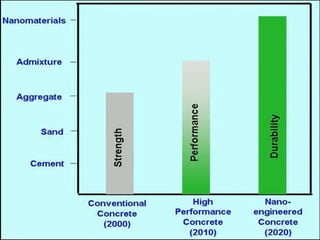
Improves the material’s bulk properties.
To obtain thinner final products and faster setting
time.
Lowered levels of environmental contamination.
Cement saving upto 35-45%.
Building made By Nano Technology
Building made by self
cleaning concrete
(“Church Dives in
Misericordia”,Rome,Italy)
TiO2 Coating on Roads for
Pollution Reduction
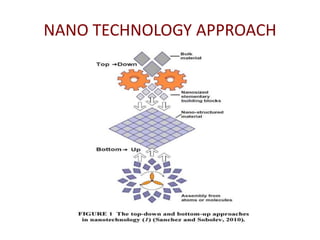
NANO TECHNOLOGY APPROACH
What is nano concrete?
A concrete made with portland cement particles
that are less than 500nm as cementing agent.
In addition to cement some nano particles also
used to obtain nano concrete.
Currently cement particle sizes range from a few
nano-meters to a maximum of about 100 micro
meters.
NANO MATERIALS
Carbon Nanotubes.
Nano-silica.
CARBON NANO TUBES
Nano tubes are the members of the fullerene
structural family. They align themselves into “ropes”
held together by van der Waals forces.
Carbon nanotubes are molecular-scale tubes of
graphitic carbon with outstanding properties.
They can be several millimeters in length and they
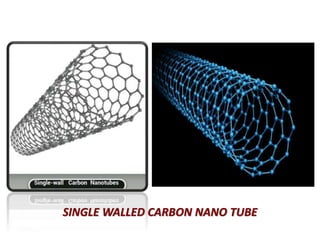
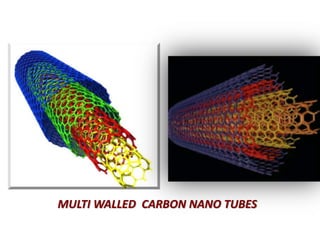
can have one “layer” or wall (single walled nanotube)
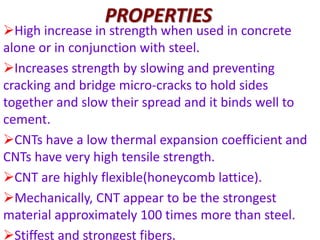
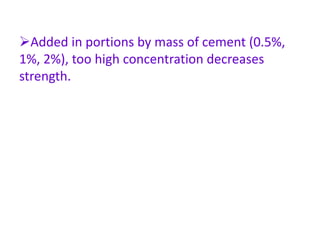
or more than one wall (multi walled nanotube)
Diameter: 2-100nm
SINGLE WALLED CARBON NANO TUBE
MULTI WALLED CARBON NANO TUBES
PROPERTIES
High increase in strength when used in concrete
alone or in conjunction with steel.
Increases strength by slowing and preventing
cracking and bridge micro-cracks to hold sides
together and slow their spread and it binds well to
cement.
CNTs have a low thermal expansion coefficient and
CNTs have very high tensile strength.
CNT are highly flexible(honeycomb lattice).
Mechanically, CNT appear to be the strongest
material approximately 100 times more than steel.
Stiffest and strongest fibers.
Added in portions by mass of cement (0.5%,
1%, 2%), too high concentration decreases
strength.
CEMENT HYDRATION KINETICS
Scientists from National Institute for Standards &
Technology's (NIST) Center for Cold Neutron Research
and Federal Highway Administration (FHWA) using
nuclear resonance reaction analysis (NRRA) to
investigate what takes place on the surface of the
cement particle as it hydrates.
A beam of nitrogen atoms is used to probe a reacting
cement grain to locate hydrogen atoms, a necessary
component of water, or reaction by-products. Location
of these hydrogen atoms are used to create a hydrogen
depth profile, which shows the rate of water
penetration as well as the arrangement of various
surface layers formed during the reaction.
NANO SILICA
Advancement made by the study of concrete at
nano scale have proved nano silica much better than
silica used in conventional concrete because of more
hydration product are formed at early stages and
degree of hydration is 71% improved.
Reduced amount of about 15 to 20 kg of Nano-silica
was found to provide same strength as 60 kg of
regular or micro silica.
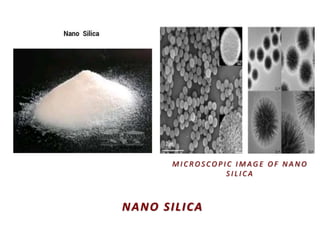
NANO SILICA
M I C R O S C O P I C I M AG E O F N A N O
S I L I C A
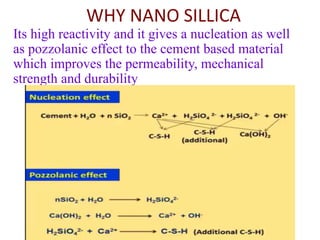
WHY NANO SILLICA
Its high reactivity and it gives a nucleation as well
as pozzolanic effect to the cement based material
which improves the permeability, mechanical
strength and durability
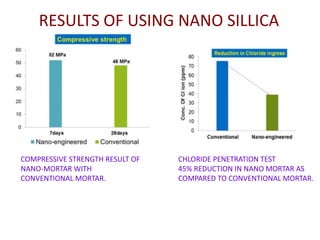
RESULTS OF USING NANO SILLICA
COMPRESSIVE STRENGTH RESULT OF
NANO-MORTAR WITH
CONVENTIONAL MORTAR.
CHLORIDE PENETRATION TEST
45% REDUCTION IN NANO MORTAR AS
COMPARED TO CONVENTIONAL MORTAR.
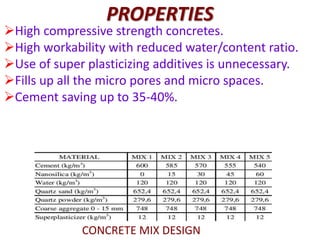
PROPERTIES
High compressive strength concretes.
High workability with reduced water/content ratio.
Use of super plasticizing additives is unnecessary.
Fills up all the micro pores and micro spaces.
Cement saving up to 35-40%.
CONCRETE MIX DESIGN
POLYCARBOXYLATES
Polycarboxylates or polymer based concrete
admixtures are high range water reducing admixture
(HRWR) without affecting workability.
Used where admixtures where well-dispersed
particle suspension is required. These polymers are
used as dispersants to avoid particle segregation
(gravel, coarse and fine sands), and to improve the
flow characteristics of suspensions such as in concrete
applications.
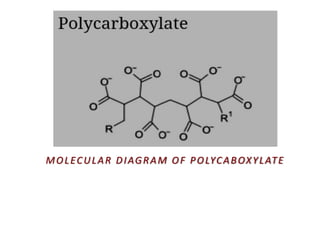
MOLECULAR DIAGRAM OF POLYCABOXYLATE
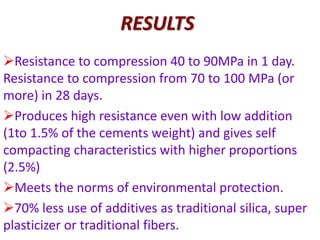
RESULTS
Resistance to compression 40 to 90MPa in 1 day.
Resistance to compression from 70 to 100 MPa (or
more) in 28 days.
Produces high resistance even with low addition
(1to 1.5% of the cements weight) and gives self
compacting characteristics with higher proportions
(2.5%)
Meets the norms of environmental protection.
70% less use of additives as traditional silica, super
plasticizer or traditional fibers.
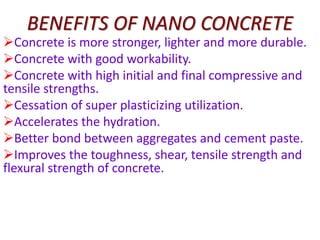
BENEFITS OF NANO CONCRETE
Concrete is more stronger, lighter and more durable.
Concrete with good workability.
Concrete with high initial and final compressive and
tensile strengths.
Cessation of super plasticizing utilization.
Accelerates the hydration.
Better bond between aggregates and cement paste.
Improves the toughness, shear, tensile strength and
flexural strength of concrete.
CHALLENGES
The primary challenge is to manufacture Nano-size
cement particles. Other avenue is high tech grinding.
The second challenge is the heat of hydration(As
the surface area per mass of a material increases, a
greater amount of the material can come into contact
with surrounding materials, thus affecting reactivity.
Special organic and inorganic additives need to be
developed to control the setting and heat of
hydration.
THANK YOU

Nano concrete

  • 1.
    NANO CONCRETE Made By:Mukul Srivastava Roll No. : 18202112 SUBMITTED TO: Dr. KANISH KAPOOR
  • 2.
    INTRODUCTION Nano-technology is oneof the most active research areas which has wide applications in almost all the fields. As concrete is most usable material in construction industry it’s been required to improve it’s quality. Improving concrete properties by addition of nano particles have shown significant improvement than conventional concrete.
  • 3.
    Why nanotechnology forconcrete? Improves the material’s bulk properties. To obtain thinner final products and faster setting time. Lowered levels of environmental contamination. Cement saving upto 35-45%.
  • 5.
    Building made ByNano Technology Building made by self cleaning concrete (“Church Dives in Misericordia”,Rome,Italy) TiO2 Coating on Roads for Pollution Reduction
  • 6.
  • 7.
    What is nanoconcrete? A concrete made with portland cement particles that are less than 500nm as cementing agent. In addition to cement some nano particles also used to obtain nano concrete. Currently cement particle sizes range from a few nano-meters to a maximum of about 100 micro meters.
  • 8.
  • 9.
    CARBON NANO TUBES Nanotubes are the members of the fullerene structural family. They align themselves into “ropes” held together by van der Waals forces. Carbon nanotubes are molecular-scale tubes of graphitic carbon with outstanding properties. They can be several millimeters in length and they can have one “layer” or wall (single walled nanotube) or more than one wall (multi walled nanotube) Diameter: 2-100nm
  • 10.
  • 11.
  • 12.
    PROPERTIES High increase instrength when used in concrete alone or in conjunction with steel. Increases strength by slowing and preventing cracking and bridge micro-cracks to hold sides together and slow their spread and it binds well to cement. CNTs have a low thermal expansion coefficient and CNTs have very high tensile strength. CNT are highly flexible(honeycomb lattice). Mechanically, CNT appear to be the strongest material approximately 100 times more than steel. Stiffest and strongest fibers.
  • 13.
    Added in portionsby mass of cement (0.5%, 1%, 2%), too high concentration decreases strength.
  • 14.
    CEMENT HYDRATION KINETICS Scientistsfrom National Institute for Standards & Technology's (NIST) Center for Cold Neutron Research and Federal Highway Administration (FHWA) using nuclear resonance reaction analysis (NRRA) to investigate what takes place on the surface of the cement particle as it hydrates. A beam of nitrogen atoms is used to probe a reacting cement grain to locate hydrogen atoms, a necessary component of water, or reaction by-products. Location of these hydrogen atoms are used to create a hydrogen depth profile, which shows the rate of water penetration as well as the arrangement of various surface layers formed during the reaction.
  • 15.
    NANO SILICA Advancement madeby the study of concrete at nano scale have proved nano silica much better than silica used in conventional concrete because of more hydration product are formed at early stages and degree of hydration is 71% improved. Reduced amount of about 15 to 20 kg of Nano-silica was found to provide same strength as 60 kg of regular or micro silica.
  • 16.
    NANO SILICA M IC R O S C O P I C I M AG E O F N A N O S I L I C A
  • 17.
    WHY NANO SILLICA Itshigh reactivity and it gives a nucleation as well as pozzolanic effect to the cement based material which improves the permeability, mechanical strength and durability
  • 18.
    RESULTS OF USINGNANO SILLICA COMPRESSIVE STRENGTH RESULT OF NANO-MORTAR WITH CONVENTIONAL MORTAR. CHLORIDE PENETRATION TEST 45% REDUCTION IN NANO MORTAR AS COMPARED TO CONVENTIONAL MORTAR.
  • 19.
    PROPERTIES High compressive strengthconcretes. High workability with reduced water/content ratio. Use of super plasticizing additives is unnecessary. Fills up all the micro pores and micro spaces. Cement saving up to 35-40%. CONCRETE MIX DESIGN
  • 20.
    POLYCARBOXYLATES Polycarboxylates or polymerbased concrete admixtures are high range water reducing admixture (HRWR) without affecting workability. Used where admixtures where well-dispersed particle suspension is required. These polymers are used as dispersants to avoid particle segregation (gravel, coarse and fine sands), and to improve the flow characteristics of suspensions such as in concrete applications.
  • 21.
    MOLECULAR DIAGRAM OFPOLYCABOXYLATE
  • 23.
    RESULTS Resistance to compression40 to 90MPa in 1 day. Resistance to compression from 70 to 100 MPa (or more) in 28 days. Produces high resistance even with low addition (1to 1.5% of the cements weight) and gives self compacting characteristics with higher proportions (2.5%) Meets the norms of environmental protection. 70% less use of additives as traditional silica, super plasticizer or traditional fibers.
  • 24.
    BENEFITS OF NANOCONCRETE Concrete is more stronger, lighter and more durable. Concrete with good workability. Concrete with high initial and final compressive and tensile strengths. Cessation of super plasticizing utilization. Accelerates the hydration. Better bond between aggregates and cement paste. Improves the toughness, shear, tensile strength and flexural strength of concrete.
  • 25.
    CHALLENGES The primary challengeis to manufacture Nano-size cement particles. Other avenue is high tech grinding. The second challenge is the heat of hydration(As the surface area per mass of a material increases, a greater amount of the material can come into contact with surrounding materials, thus affecting reactivity. Special organic and inorganic additives need to be developed to control the setting and heat of hydration.
  • 26.