EFFECT MODIFICATION IN
EPIDEMIOLOGICAL STUDIES: A
BIAS OR AN INTERACTION?
OPEYEMI ABDULAHI
P21DLPH80148
COMM 818: ADVANCED EPIDEMIOLOGY
OUTLINE
• INTRODUCTION
• ILLUSTRATION
• EFFECT MODIFICATION VS BIAS
• EFFECT MODIFICATION VS CONFOUNDING
• CONCLUSION
INTRODUCTION
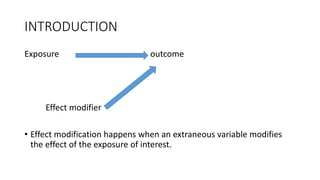
Exposure outcome
Effect modifier
• Effect modification happens when an extraneous variable modifies
the effect of the exposure of interest.
INTRODUCTION contd
• Consider exposure to asbestos and lung cancer
• Asbestos (no smoking) 3X risk of lung cancer
• Asbestos (plus smoking) 64X risk of lung cancer
• Smoking an effect modifier
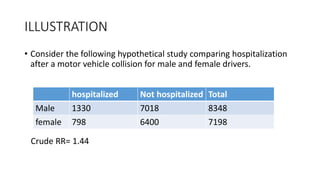
ILLUSTRATION
• Consider the following hypothetical study comparing hospitalization
after a motor vehicle collision for male and female drivers.
Crude RR= 1.44
hospitalized Not hospitalized Total
Male 1330 7018 8348
female 798 6400 7198
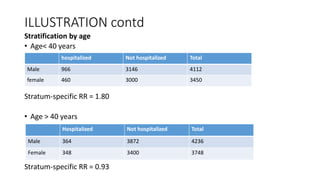
ILLUSTRATION contd
Stratification by age
• Age< 40 years
Stratum-specific RR = 1.80
• Age > 40 years
Stratum-specific RR = 0.93
hospitalized Not hospitalized Total
Male 966 3146 4112
female 460 3000 3450
Hospitalized Not hospitalized Total
Male 364 3872 4236
Female 348 3400 3748
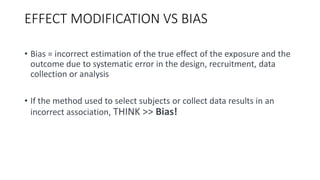
EFFECT MODIFICATION VS BIAS
• Bias = incorrect estimation of the true effect of the exposure and the
outcome due to systematic error in the design, recruitment, data
collection or analysis
• If the method used to select subjects or collect data results in an
incorrect association, THINK >> Bias!
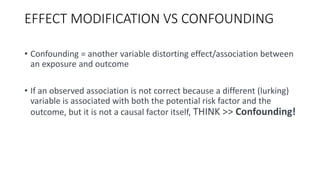
EFFECT MODIFICATION VS CONFOUNDING
• Confounding = another variable distorting effect/association between
an exposure and outcome
• If an observed association is not correct because a different (lurking)
variable is associated with both the potential risk factor and the
outcome, but it is not a causal factor itself, THINK >> Confounding!
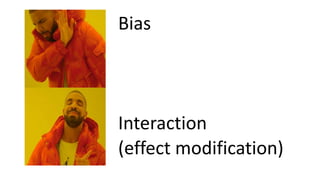
Bias
Interaction
(effect modification)
CONCLUSION
• Bias vs Confounding vs Effect Modification
• Effect modification is an interaction rather than a bias
• Effect modification is to be sought and reported
THANK YOU FOR YOUR ATTENTION!
REFERENCES
• Bovbjerg, M.L. (October, 2020) Foundations of Epidemiology.
Retrieved [August 7, 2022], from
https://open.oregonstate.education/epidemiology/
• Wayne, W. L & Sullivan, L. . Confounding and Effect Measure
Modification. Boston University School of Publich Health Retrieved
[August 7, 2022], from https://sphweb.bumc.bu.edu/otlt/mph-
modules/bs/bs704-ep713_confounding-em/bs704-
ep713_confounding-em_print.html

EFFECT MODIFICATION IN EPIDEMIOLOGICAL STUDIES COMM 818.pptx

  • 1.
    EFFECT MODIFICATION IN EPIDEMIOLOGICALSTUDIES: A BIAS OR AN INTERACTION? OPEYEMI ABDULAHI P21DLPH80148 COMM 818: ADVANCED EPIDEMIOLOGY
  • 2.
    OUTLINE • INTRODUCTION • ILLUSTRATION •EFFECT MODIFICATION VS BIAS • EFFECT MODIFICATION VS CONFOUNDING • CONCLUSION
  • 3.
    INTRODUCTION Exposure outcome Effect modifier •Effect modification happens when an extraneous variable modifies the effect of the exposure of interest.
  • 4.
    INTRODUCTION contd • Considerexposure to asbestos and lung cancer • Asbestos (no smoking) 3X risk of lung cancer • Asbestos (plus smoking) 64X risk of lung cancer • Smoking an effect modifier
  • 5.
    ILLUSTRATION • Consider thefollowing hypothetical study comparing hospitalization after a motor vehicle collision for male and female drivers. Crude RR= 1.44 hospitalized Not hospitalized Total Male 1330 7018 8348 female 798 6400 7198
  • 6.
    ILLUSTRATION contd Stratification byage • Age< 40 years Stratum-specific RR = 1.80 • Age > 40 years Stratum-specific RR = 0.93 hospitalized Not hospitalized Total Male 966 3146 4112 female 460 3000 3450 Hospitalized Not hospitalized Total Male 364 3872 4236 Female 348 3400 3748
  • 7.
    EFFECT MODIFICATION VSBIAS • Bias = incorrect estimation of the true effect of the exposure and the outcome due to systematic error in the design, recruitment, data collection or analysis • If the method used to select subjects or collect data results in an incorrect association, THINK >> Bias!
  • 8.
    EFFECT MODIFICATION VSCONFOUNDING • Confounding = another variable distorting effect/association between an exposure and outcome • If an observed association is not correct because a different (lurking) variable is associated with both the potential risk factor and the outcome, but it is not a causal factor itself, THINK >> Confounding!
  • 9.
  • 10.
    CONCLUSION • Bias vsConfounding vs Effect Modification • Effect modification is an interaction rather than a bias • Effect modification is to be sought and reported
  • 11.
    THANK YOU FORYOUR ATTENTION!
  • 12.
    REFERENCES • Bovbjerg, M.L.(October, 2020) Foundations of Epidemiology. Retrieved [August 7, 2022], from https://open.oregonstate.education/epidemiology/ • Wayne, W. L & Sullivan, L. . Confounding and Effect Measure Modification. Boston University School of Publich Health Retrieved [August 7, 2022], from https://sphweb.bumc.bu.edu/otlt/mph- modules/bs/bs704-ep713_confounding-em/bs704- ep713_confounding-em_print.html