Factor Analysis
By, Prakash Poddar
Student Id: 382b42ccf1a611e9bf7437325bd8c735
Affiliation: Banaras Hindu University
Course Name: Academic Writing
Acknowledgement
◉ Academic Writing
◉ Advisor: Dr. Satya Gopal Jee
2
Factor Analysis
◉ Factor Analysis is class of procedure that use for reduction
and summarization of data. Factor analysis attempts to
bring inter-correlated variables together under more
general, underlying variables.
◉ It is an independent technique no distinction between
independent and dependent variable.
3
Historical Background of Factor Analysis
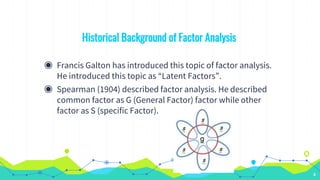
◉ Francis Galton has introduced this topic of factor analysis.
He introduced this topic as “Latent Factors”.
◉ Spearman (1904) described factor analysis. He described
common factor as G (General Factor) factor while other
factor as S (specific Factor).
4
Goals of Factor Analysis
◉ Identify underlying dimensions, or factors, that explain the
correlations among a set of variables.
◉ To identify a new, smaller, set of uncorrelated variables to
replace the original set of correlated variables.
◉ Facilitates in data summarization, data reduction, and data
analysis.
5
Types of Variance in Factor Analysis
◉ Common Variance: Is that portion of the variance which
correlated with other variance.
◉ Specific Variance: Is that portion of the variance which
doesn’t correlate with other variables
◉ Error Variance: Is chance of variance due to sampling
error.
6
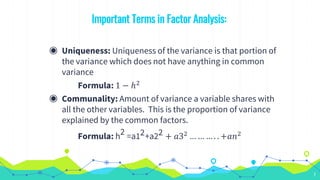
Important Terms in Factor Analysis:
◉ Uniqueness: Uniqueness of the variance is that portion of
the variance which does not have anything in common
variance
Formula: 1 − ℎ2
◉ Communality: Amount of variance a variable shares with
all the other variables. This is the proportion of variance
explained by the common factors.
Formula: h2 =a12+a22 + 𝑎32
… … … . . +𝑎𝑛2
7
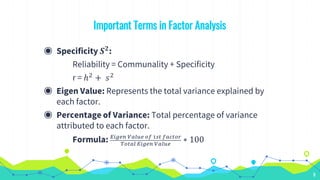
Important Terms in Factor Analysis
◉ Specificity 𝑺 𝟐
:
Reliability = Communality + Specificity
r = ℎ2 + 𝑠2
◉ Eigen Value: Represents the total variance explained by
each factor.
◉ Percentage of Variance: Total percentage of variance
attributed to each factor.
Formula: 𝐸𝑖𝑔𝑒𝑛 𝑉𝑎𝑙𝑢𝑒 𝑜𝑓 1𝑠𝑡 𝑓𝑎𝑐𝑡𝑜𝑟
𝑇𝑜𝑡𝑎𝑙 𝐸𝑖𝑔𝑒𝑛 𝑉𝑎𝑙𝑢𝑒
∗ 100
8
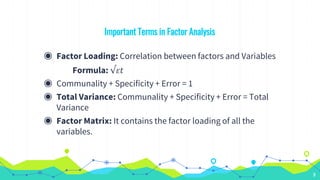
Important Terms in Factor Analysis
◉ Factor Loading: Correlation between factors and Variables
Formula: √𝜀𝑡
◉ Communality + Specificity + Error = 1
◉ Total Variance: Communality + Specificity + Error = Total
Variance
◉ Factor Matrix: It contains the factor loading of all the
variables.
9
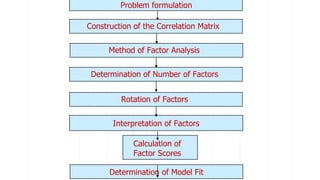
Construction of the Correlation Matrix
Method of Factor Analysis
Determination of Number of Factors
Determination of Model Fit
Problem formulation
Calculation of
Factor Scores
Interpretation of Factors
Rotation of Factors
Formulate the Problem
◉ The objectives of factor analysis should be identified.
◉ The variables to be included in the factor analysis should be
specified. The variables should be measured on an interval
or ratio scale.
◉ An appropriate sample size should be used. As a rough
guideline, there should be at least four or five times as
many observations (sample size) as there are variables.
◉ The analytical process is based on a matrix of correlations between the
variables.
◉ If the Bartlett's test of sphericity is not rejected, then factor analysis is not
appropriate.
◉ If the Kaiser-Meyer-Olkin (KMO) measure of sampling adequacy is small,
then the correlations between pairs of variables cannot be explained by
other variables and factor analysis may not be appropriate.
Construct the Correlation Matrix
◉ In Principal components analysis, the total variance in the data is
considered.
-Used to determine the min number of factors that will account for max
variance in the data.
◉ In Common factor analysis, the factors are estimated based only on the
common variance.
-Communalities are inserted in the diagonal of the correlation matrix.
-Used to identify the underlying dimensions and when the common
variance is of interest.
Determine the Method of Factor Analysis
◉ A Priori Determination. Use prior knowledge.
◉ Determination Based on Eigenvalues. Only factors with
Eigenvalues greater than 1.0 are retained.
◉ Determination Based on Scree Plot. A scree plot is a plot of
the Eigenvalues against the number of factors in order of
extraction. The point at which the scree begins denotes the true
number of factors.
Determine the Number of Factors
◉ Through rotation the factor matrix is transformed into a simpler one that
is easier to interpret.
◉ After rotation each factor should have nonzero, or significant, loadings for
only some of the variables. Each variable should have nonzero or
significant loadings with only a few factors, if possible with only one.
◉ The rotation is called orthogonal rotation if the axes are maintained at
right angles.
Rotation of Factors
◉ Varimax procedure. Axes maintained at right angles
-Most common method for rotation.
-An orthogonal method of rotation that minimizes the
number of variables with high loadings on a factor.
-Orthogonal rotation results in uncorrelated factors.
◉ Oblique rotation. Axes not maintained at right angles
-Factors are correlated.
Rotation of Factors
◉ A factor can be interpreted in terms of the variables
that load high on it.
◉ Another useful aid in interpretation is to plot the
variables, using the factor loadings as coordinates.
Variables at the end of an axis are those that have
high loadings on only that factor, and hence describe
the factor.
Interpret Factors
THANKS!
18

Factor Analysis Prakash Poddar

  • 1.
    Factor Analysis By, PrakashPoddar Student Id: 382b42ccf1a611e9bf7437325bd8c735 Affiliation: Banaras Hindu University Course Name: Academic Writing
  • 2.
    Acknowledgement ◉ Academic Writing ◉Advisor: Dr. Satya Gopal Jee 2
  • 3.
    Factor Analysis ◉ FactorAnalysis is class of procedure that use for reduction and summarization of data. Factor analysis attempts to bring inter-correlated variables together under more general, underlying variables. ◉ It is an independent technique no distinction between independent and dependent variable. 3
  • 4.
    Historical Background ofFactor Analysis ◉ Francis Galton has introduced this topic of factor analysis. He introduced this topic as “Latent Factors”. ◉ Spearman (1904) described factor analysis. He described common factor as G (General Factor) factor while other factor as S (specific Factor). 4
  • 5.
    Goals of FactorAnalysis ◉ Identify underlying dimensions, or factors, that explain the correlations among a set of variables. ◉ To identify a new, smaller, set of uncorrelated variables to replace the original set of correlated variables. ◉ Facilitates in data summarization, data reduction, and data analysis. 5
  • 6.
    Types of Variancein Factor Analysis ◉ Common Variance: Is that portion of the variance which correlated with other variance. ◉ Specific Variance: Is that portion of the variance which doesn’t correlate with other variables ◉ Error Variance: Is chance of variance due to sampling error. 6
  • 7.
    Important Terms inFactor Analysis: ◉ Uniqueness: Uniqueness of the variance is that portion of the variance which does not have anything in common variance Formula: 1 − ℎ2 ◉ Communality: Amount of variance a variable shares with all the other variables. This is the proportion of variance explained by the common factors. Formula: h2 =a12+a22 + 𝑎32 … … … . . +𝑎𝑛2 7
  • 8.
    Important Terms inFactor Analysis ◉ Specificity 𝑺 𝟐 : Reliability = Communality + Specificity r = ℎ2 + 𝑠2 ◉ Eigen Value: Represents the total variance explained by each factor. ◉ Percentage of Variance: Total percentage of variance attributed to each factor. Formula: 𝐸𝑖𝑔𝑒𝑛 𝑉𝑎𝑙𝑢𝑒 𝑜𝑓 1𝑠𝑡 𝑓𝑎𝑐𝑡𝑜𝑟 𝑇𝑜𝑡𝑎𝑙 𝐸𝑖𝑔𝑒𝑛 𝑉𝑎𝑙𝑢𝑒 ∗ 100 8
  • 9.
    Important Terms inFactor Analysis ◉ Factor Loading: Correlation between factors and Variables Formula: √𝜀𝑡 ◉ Communality + Specificity + Error = 1 ◉ Total Variance: Communality + Specificity + Error = Total Variance ◉ Factor Matrix: It contains the factor loading of all the variables. 9
  • 10.
    Construction of theCorrelation Matrix Method of Factor Analysis Determination of Number of Factors Determination of Model Fit Problem formulation Calculation of Factor Scores Interpretation of Factors Rotation of Factors
  • 11.
    Formulate the Problem ◉The objectives of factor analysis should be identified. ◉ The variables to be included in the factor analysis should be specified. The variables should be measured on an interval or ratio scale. ◉ An appropriate sample size should be used. As a rough guideline, there should be at least four or five times as many observations (sample size) as there are variables.
  • 12.
    ◉ The analyticalprocess is based on a matrix of correlations between the variables. ◉ If the Bartlett's test of sphericity is not rejected, then factor analysis is not appropriate. ◉ If the Kaiser-Meyer-Olkin (KMO) measure of sampling adequacy is small, then the correlations between pairs of variables cannot be explained by other variables and factor analysis may not be appropriate. Construct the Correlation Matrix
  • 13.
    ◉ In Principalcomponents analysis, the total variance in the data is considered. -Used to determine the min number of factors that will account for max variance in the data. ◉ In Common factor analysis, the factors are estimated based only on the common variance. -Communalities are inserted in the diagonal of the correlation matrix. -Used to identify the underlying dimensions and when the common variance is of interest. Determine the Method of Factor Analysis
  • 14.
    ◉ A PrioriDetermination. Use prior knowledge. ◉ Determination Based on Eigenvalues. Only factors with Eigenvalues greater than 1.0 are retained. ◉ Determination Based on Scree Plot. A scree plot is a plot of the Eigenvalues against the number of factors in order of extraction. The point at which the scree begins denotes the true number of factors. Determine the Number of Factors
  • 15.
    ◉ Through rotationthe factor matrix is transformed into a simpler one that is easier to interpret. ◉ After rotation each factor should have nonzero, or significant, loadings for only some of the variables. Each variable should have nonzero or significant loadings with only a few factors, if possible with only one. ◉ The rotation is called orthogonal rotation if the axes are maintained at right angles. Rotation of Factors
  • 16.
    ◉ Varimax procedure.Axes maintained at right angles -Most common method for rotation. -An orthogonal method of rotation that minimizes the number of variables with high loadings on a factor. -Orthogonal rotation results in uncorrelated factors. ◉ Oblique rotation. Axes not maintained at right angles -Factors are correlated. Rotation of Factors
  • 17.
    ◉ A factorcan be interpreted in terms of the variables that load high on it. ◉ Another useful aid in interpretation is to plot the variables, using the factor loadings as coordinates. Variables at the end of an axis are those that have high loadings on only that factor, and hence describe the factor. Interpret Factors
  • 18.