Name: Abhilesh Patwal
Email ID: abhilesh09@gmai.com
Introduction
We can’t see them. We can’t hear them or feel them, but they
are with us. There are 10 trillion (10 x 1,000,000,000,000 or a
million million) cells in the average body. For every cell, we
have 10 times as many microorganisms – that’s 100 trillion
microorganisms on and in our bodies! We are a walking,
talking ecosystem.
But don’t worry – without microorganisms, we wouldn’t
survive.
Microorganisms are small
A microorganism is a living organism that is so tiny it can only be seen
with the aid of a microscope.
Consider that the largest human cells are about the diameter of a
human hair. Bacteria cells are one-hundredth the size of a human cell
and viruses are much, much smaller again. If you imagine that a
single virus was the size of an adult human, a bacterium (single cell)
would be over 10 storeys high by comparison. A bacterium next to a
human cell is like a tiny boat next to a big ship. Hundreds of thousands
of bacteria could fit onto a pinhead.
Microorganisms (Microbes)
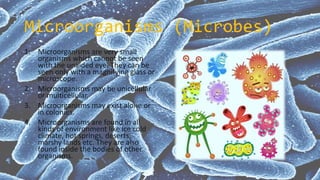
1. Microorganisms are very small
organisms which cannot be seen
with the unaided eye. They can be
seen only with a magnifying glass or
microscope.
2. Microorganisms may be unicellular
or multicellular.
3. Microorganisms may exist alone or
in colonies.
4. Microorganisms are found in all
kinds of environment like ice cold
climate, hot springs, deserts,
marshy lands etc. They are also
found inside the bodies of other
organisms.
Types of microorganisms
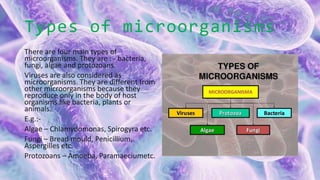
There are four main types of
microorganisms. They are : - bacteria,
fungi, algae and protozoans.
Viruses are also considered as
microorganisms. They are different from
other microorganisms because they
reproduce only in the body of host
organisms like bacteria, plants or
animals.
E.g.:-
Algae – Chlamydomonas, Spirogyra etc.
Fungi – Bread mould, Penicillium,
Aspergilles etc.
Protozoans – Amoeba, Paramaeciumetc.
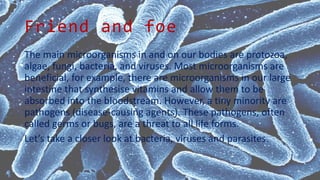
Friend and foe
The main microorganisms in and on our bodies are protozoa,
algae, fungi, bacteria, and viruses. Most microorganisms are
beneficial, for example, there are microorganisms in our large
intestine that synthesise vitamins and allow them to be
absorbed into the bloodstream. However, a tiny minority are
pathogens (disease-causing agents). These pathogens, often
called germs or bugs, are a threat to all life forms.
Let’s take a closer look at bacteria, viruses and parasites.
Bacteria
You cannot escape bacteria. They are
everywhere! The good thing is that they are
mostly harmless, but
the pathogenic bacteria can make you sick.
They thrive in unhygienic conditions and can
grow very quickly by dividing in half and then
the two halves grow and then divide again
and so on.
A bacterium is a very simple form of life – just
a single cell. They have different shapes –
some look like balls, rods or spirals. They have
a tough cell wall that protects them. They are
like all living organisms and need to ‘eat’
(ingest) for energy and growth. They ingest
starches and sugars that are found on
all organic matter.
Viruses
Viruses are microorganisms that are so basic (and tiny)
that they are not even cells and are not classified as
living. Viruses are just genetic material (DNA or RNA)
wrapped up inside a strong ‘coat’ made of protein. They
cannot survive by themselves, so they need a host that
will enable them to multiply. A virus will hijack a cell in
your body and change the instructions of the cell so that,
instead of doing what it was designed to do, the cell
begins to produce copies of the virus.
Eventually, it makes so many that the cell bursts open
and releases all the viruses, which then hijack many,
many more cells. Some viruses hibernate
(become dormant) while they wait for the right
conditions to come along.
Viruses have different shapes – rods, spheres or many-
sided spheres. Some are even shaped like a spaceship!
Pathogenic viruses can be very dangerous, but there are
a few good viruses that are not harmful. Researchers and
scientists are trying to find ways of using these viruses to
fight bacterial infections.
Parasites
A parasite lives on or inside its host
organism in a very unequal
relationship – it takes all its food
from its host and doesn’t give
anything back. Parasites can live on
our bodies (like lice) or in our bodies
and cause lots of different diseases.
Parasitic worms (including
hookworms – see Professor Le Gros’s
research) can live in our bodies and
make us sick. Some parasites are
microorganisms like protozoa– a
single-celled parasite. Diseases
like malaria and giardia are protozoa.
Microorganisms and Us
Friendly Microorganisms
The environment is incomplete
without microorganisms. They are
a crucial part of the ecosystem
and take part in activities like
production of minerals like
nitrogen, gases like oxygen,
carbon dioxide, cleaning by action
on dead matters etc. In various
industries, microbes are used
intentionally due to their role in
human welfare.
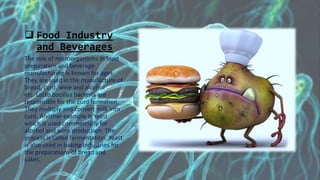
 Food Industry
and Beverages
The role of microorganisms in food
preparation and beverage
manufacturing is known for ages.
They are used in the manufacture of
bread, curd, wine and alcohol
etc. Lacto bacillus bacteria are
responsible for the curd formation.
They multiply and convert milk into
curd. Another example is Yeast
which is used commercially for
alcohol and wine production. The
process is called fermentation. Yeast
is also used in baking industries for
the preparations of bread and
cakes.
 Micro-flora
Bacteria are not only outside
the human body, they live inside
the body. Bacteria which persist
in the digestive system are
collectively known as microflora.
They support the process of
digestion by releasing certain
enzymes. They live in symbiotic
association with a human. Other
tasks of microflora are vitamin K
production and thus help in
blood clotting. They also prevent
the invasion of the body by
other fatal microbes.
 Pharmaceutical
Industry
Antibiotics are well-known
examples of the role of microbes in
the medical field. Antibiotics are
obtained from microorganisms i.e.
one strain of bacteria or fungi is
used against another strain.
Recently many drugs for a variety of
diseases are obtained from
microorganisms.
Another example for this is
vaccines. Vaccines are partially
killed or weakened microorganisms
used to produce antibodies against
an antigen (foreign particles)
entering the body.
Environment
In the environment,
microorganisms have two
vital roles- one is an
enhancement of soil fertility
another is cleaning. Nitrogen
fixing bacteria such as
Rhizobium, Azotobacter etc.
nourish soil with a mineral
like nitrogen. As cleaners,
they decompose the dead
and organic matter and result
in the decay of toxic
substances.
Microorganisms our friends

Microorganisms our friends

  • 1.
    Name: Abhilesh Patwal EmailID: abhilesh09@gmai.com
  • 2.
    Introduction We can’t seethem. We can’t hear them or feel them, but they are with us. There are 10 trillion (10 x 1,000,000,000,000 or a million million) cells in the average body. For every cell, we have 10 times as many microorganisms – that’s 100 trillion microorganisms on and in our bodies! We are a walking, talking ecosystem. But don’t worry – without microorganisms, we wouldn’t survive.
  • 3.
    Microorganisms are small Amicroorganism is a living organism that is so tiny it can only be seen with the aid of a microscope. Consider that the largest human cells are about the diameter of a human hair. Bacteria cells are one-hundredth the size of a human cell and viruses are much, much smaller again. If you imagine that a single virus was the size of an adult human, a bacterium (single cell) would be over 10 storeys high by comparison. A bacterium next to a human cell is like a tiny boat next to a big ship. Hundreds of thousands of bacteria could fit onto a pinhead.
  • 4.
    Microorganisms (Microbes) 1. Microorganismsare very small organisms which cannot be seen with the unaided eye. They can be seen only with a magnifying glass or microscope. 2. Microorganisms may be unicellular or multicellular. 3. Microorganisms may exist alone or in colonies. 4. Microorganisms are found in all kinds of environment like ice cold climate, hot springs, deserts, marshy lands etc. They are also found inside the bodies of other organisms.
  • 5.
    Types of microorganisms Thereare four main types of microorganisms. They are : - bacteria, fungi, algae and protozoans. Viruses are also considered as microorganisms. They are different from other microorganisms because they reproduce only in the body of host organisms like bacteria, plants or animals. E.g.:- Algae – Chlamydomonas, Spirogyra etc. Fungi – Bread mould, Penicillium, Aspergilles etc. Protozoans – Amoeba, Paramaeciumetc.
  • 6.
    Friend and foe Themain microorganisms in and on our bodies are protozoa, algae, fungi, bacteria, and viruses. Most microorganisms are beneficial, for example, there are microorganisms in our large intestine that synthesise vitamins and allow them to be absorbed into the bloodstream. However, a tiny minority are pathogens (disease-causing agents). These pathogens, often called germs or bugs, are a threat to all life forms. Let’s take a closer look at bacteria, viruses and parasites.
  • 7.
    Bacteria You cannot escapebacteria. They are everywhere! The good thing is that they are mostly harmless, but the pathogenic bacteria can make you sick. They thrive in unhygienic conditions and can grow very quickly by dividing in half and then the two halves grow and then divide again and so on. A bacterium is a very simple form of life – just a single cell. They have different shapes – some look like balls, rods or spirals. They have a tough cell wall that protects them. They are like all living organisms and need to ‘eat’ (ingest) for energy and growth. They ingest starches and sugars that are found on all organic matter.
  • 8.
    Viruses Viruses are microorganismsthat are so basic (and tiny) that they are not even cells and are not classified as living. Viruses are just genetic material (DNA or RNA) wrapped up inside a strong ‘coat’ made of protein. They cannot survive by themselves, so they need a host that will enable them to multiply. A virus will hijack a cell in your body and change the instructions of the cell so that, instead of doing what it was designed to do, the cell begins to produce copies of the virus. Eventually, it makes so many that the cell bursts open and releases all the viruses, which then hijack many, many more cells. Some viruses hibernate (become dormant) while they wait for the right conditions to come along. Viruses have different shapes – rods, spheres or many- sided spheres. Some are even shaped like a spaceship! Pathogenic viruses can be very dangerous, but there are a few good viruses that are not harmful. Researchers and scientists are trying to find ways of using these viruses to fight bacterial infections.
  • 9.
    Parasites A parasite liveson or inside its host organism in a very unequal relationship – it takes all its food from its host and doesn’t give anything back. Parasites can live on our bodies (like lice) or in our bodies and cause lots of different diseases. Parasitic worms (including hookworms – see Professor Le Gros’s research) can live in our bodies and make us sick. Some parasites are microorganisms like protozoa– a single-celled parasite. Diseases like malaria and giardia are protozoa.
  • 10.
    Microorganisms and Us FriendlyMicroorganisms The environment is incomplete without microorganisms. They are a crucial part of the ecosystem and take part in activities like production of minerals like nitrogen, gases like oxygen, carbon dioxide, cleaning by action on dead matters etc. In various industries, microbes are used intentionally due to their role in human welfare.
  • 11.
     Food Industry andBeverages The role of microorganisms in food preparation and beverage manufacturing is known for ages. They are used in the manufacture of bread, curd, wine and alcohol etc. Lacto bacillus bacteria are responsible for the curd formation. They multiply and convert milk into curd. Another example is Yeast which is used commercially for alcohol and wine production. The process is called fermentation. Yeast is also used in baking industries for the preparations of bread and cakes.
  • 12.
     Micro-flora Bacteria arenot only outside the human body, they live inside the body. Bacteria which persist in the digestive system are collectively known as microflora. They support the process of digestion by releasing certain enzymes. They live in symbiotic association with a human. Other tasks of microflora are vitamin K production and thus help in blood clotting. They also prevent the invasion of the body by other fatal microbes.
  • 13.
     Pharmaceutical Industry Antibiotics arewell-known examples of the role of microbes in the medical field. Antibiotics are obtained from microorganisms i.e. one strain of bacteria or fungi is used against another strain. Recently many drugs for a variety of diseases are obtained from microorganisms. Another example for this is vaccines. Vaccines are partially killed or weakened microorganisms used to produce antibodies against an antigen (foreign particles) entering the body.
  • 14.
    Environment In the environment, microorganismshave two vital roles- one is an enhancement of soil fertility another is cleaning. Nitrogen fixing bacteria such as Rhizobium, Azotobacter etc. nourish soil with a mineral like nitrogen. As cleaners, they decompose the dead and organic matter and result in the decay of toxic substances.