MICROORGANISMS
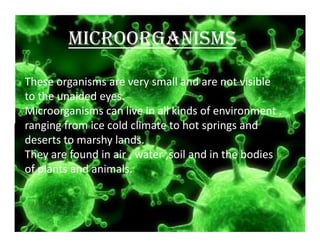
These organisms are very small and are not visible
to the unaided eyes.
Microorganisms can live in all kinds of environment ,
ranging from ice cold climate to hot springs andranging from ice cold climate to hot springs and
deserts to marshy lands.
They are found in air , water ,soil and in the bodies
of plants and animals.
MICROORGANISMS
All of the living things, plant and animal, in earth's environmental communities of forests,
deserts, tundra, water, air, and all of the rest depend on the crypto biotic crust or micro biotic
layer in the soil. This is the layer of soil that most microbes live in. These microbe communities
are made up of fungi, cyanobacteria and lichens. They look like a grayish cover on the ground
when they are first forming, but do form in clumps of lichen that look like little hills after about
50 years of growth.
The cyanobacteria called Nostoc helps lichen
produce food during photosynthesis.
CLASSIFICATION OF MICROORGANISMS
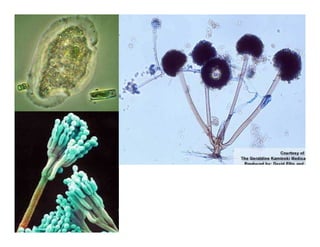
Microorganisms can be unicellular like Amoeba or
multicellular like Rhizopus.
Microorganisms are classified broadly into 4 groups:
i. Bacteriai. Bacteria
ii. Algae
iii. Protozoa
iv. Fungi
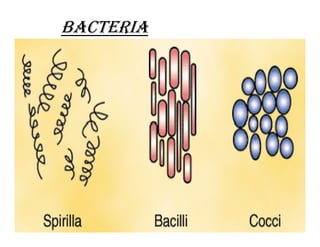
BACTERIA
BACTERIA
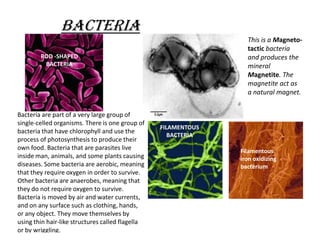
ROD -SHAPED
BACTERIA
This is a Magneto-
tactic bacteria
and produces the
mineral
Magnetite. The
magnetite act as
a natural magnet.
Bacteria are part of a very large group of
single-celled organisms. There is one group of
FILAMENTOUS
single-celled organisms. There is one group of
bacteria that have chlorophyll and use the
process of photosynthesis to produce their
own food. Bacteria that are parasites live
inside man, animals, and some plants causing
diseases. Some bacteria are aerobic, meaning
that they require oxygen in order to survive.
Other bacteria are anaerobes, meaning that
they do not require oxygen to survive.
Bacteria is moved by air and water currents,
and on any surface such as clothing, hands,
or any object. They move themselves by
using thin hair-like structures called flagella
or by wriggling.
FILAMENTOUS
BACTERIA
Filamentous
iron oxidizing
bacterium
ALGAE
PROTOZOA
FUNGI
FUNGI
Fungi is a group of simple plants that have no chlorophyll. There are some species of fungi that are single celled
organisms, and there are other kinds of fungi that are multi-cellular organisms. Fungi are made up of filaments
called hyphe that are stacked together from end to end. Some kinds of fungi live on land and other types of fungi
live in water environments. Since fungi has no chlorophyll, it can not make its own food. Some types of fungi lives
off of other organisms and are parasites, but other fungi species feed off of dead and decaying matter. A third kind
of fungi lives with other organisms and neither the fungi or the organism is hurt. This kind of relationship is called
positive symbiosis When reproductive hyphae cells are made by the fungus, a mushroom shape forms at the top.
The scientific name for the mushroom shape is the sporocarp. It has one purpose, that is to release reproductive
spores. The sporocarp is not part of the live fungi. Reproduction in fungi is sexual,
but the spores which contain the reproductive cells must somehow come in
contact with one another before fungi can reproduce.
Spores are released from the
underside of mushroom caps
during the reproductive cycle
of mushrooms
Hyphae
Trichoderma is a good
fungi, it attacks bad fungus
that destroys crops.
Witches Broom Fungi
attacks cacao trees
that produce chocolate
Fungus in caves
VIRUS
Viruses are non-living microscopic particles that attack healthy cells within living things. They do not have
the characteristics of living things and are not able to change food energy into chemical energy that the body
can use. Viruses are not alive, so they do not have a need for food like living organisms. Viruses do not have
an organized cell structure. They are so light that they can float in the air or water, be passed on to other
organisms if touched, and fit anywhere. The virus injects its own DNA structure into healthy cells where new
virus cells grow. Viruses can not reproduce by themselves like bacteria or cells. They must attach themselves
VIRUS
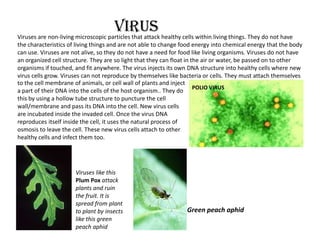
POLIO VIRUS
to the cell membrane of animals, or cell wall of plants and inject
a part of their DNA into the cells of the host organism.. They do
this by using a hollow tube structure to puncture the cell
wall/membrane and pass its DNA into the cell. New virus cells
are incubated inside the invaded cell. Once the virus DNA
reproduces itself inside the cell, it uses the natural process ofreproduces itself inside the cell, it uses the natural process of
osmosis to leave the cell. These new virus cells attach to other
healthy cells and infect them too.
Viruses like this
Plum Pox attack
plants and ruin
the fruit. It is
spread from plant
to plant by insects
like this green
peach aphid
Green peach aphid

Microorganisms

  • 2.
    MICROORGANISMS These organisms arevery small and are not visible to the unaided eyes. Microorganisms can live in all kinds of environment , ranging from ice cold climate to hot springs andranging from ice cold climate to hot springs and deserts to marshy lands. They are found in air , water ,soil and in the bodies of plants and animals.
  • 3.
    MICROORGANISMS All of theliving things, plant and animal, in earth's environmental communities of forests, deserts, tundra, water, air, and all of the rest depend on the crypto biotic crust or micro biotic layer in the soil. This is the layer of soil that most microbes live in. These microbe communities are made up of fungi, cyanobacteria and lichens. They look like a grayish cover on the ground when they are first forming, but do form in clumps of lichen that look like little hills after about 50 years of growth. The cyanobacteria called Nostoc helps lichen produce food during photosynthesis.
  • 4.
    CLASSIFICATION OF MICROORGANISMS Microorganismscan be unicellular like Amoeba or multicellular like Rhizopus. Microorganisms are classified broadly into 4 groups: i. Bacteriai. Bacteria ii. Algae iii. Protozoa iv. Fungi
  • 6.
  • 7.
    BACTERIA ROD -SHAPED BACTERIA This isa Magneto- tactic bacteria and produces the mineral Magnetite. The magnetite act as a natural magnet. Bacteria are part of a very large group of single-celled organisms. There is one group of FILAMENTOUS single-celled organisms. There is one group of bacteria that have chlorophyll and use the process of photosynthesis to produce their own food. Bacteria that are parasites live inside man, animals, and some plants causing diseases. Some bacteria are aerobic, meaning that they require oxygen in order to survive. Other bacteria are anaerobes, meaning that they do not require oxygen to survive. Bacteria is moved by air and water currents, and on any surface such as clothing, hands, or any object. They move themselves by using thin hair-like structures called flagella or by wriggling. FILAMENTOUS BACTERIA Filamentous iron oxidizing bacterium
  • 8.
  • 9.
  • 10.
  • 11.
    FUNGI Fungi is agroup of simple plants that have no chlorophyll. There are some species of fungi that are single celled organisms, and there are other kinds of fungi that are multi-cellular organisms. Fungi are made up of filaments called hyphe that are stacked together from end to end. Some kinds of fungi live on land and other types of fungi live in water environments. Since fungi has no chlorophyll, it can not make its own food. Some types of fungi lives off of other organisms and are parasites, but other fungi species feed off of dead and decaying matter. A third kind of fungi lives with other organisms and neither the fungi or the organism is hurt. This kind of relationship is called positive symbiosis When reproductive hyphae cells are made by the fungus, a mushroom shape forms at the top. The scientific name for the mushroom shape is the sporocarp. It has one purpose, that is to release reproductive spores. The sporocarp is not part of the live fungi. Reproduction in fungi is sexual, but the spores which contain the reproductive cells must somehow come in contact with one another before fungi can reproduce. Spores are released from the underside of mushroom caps during the reproductive cycle of mushrooms Hyphae Trichoderma is a good fungi, it attacks bad fungus that destroys crops. Witches Broom Fungi attacks cacao trees that produce chocolate Fungus in caves
  • 12.
  • 13.
    Viruses are non-livingmicroscopic particles that attack healthy cells within living things. They do not have the characteristics of living things and are not able to change food energy into chemical energy that the body can use. Viruses are not alive, so they do not have a need for food like living organisms. Viruses do not have an organized cell structure. They are so light that they can float in the air or water, be passed on to other organisms if touched, and fit anywhere. The virus injects its own DNA structure into healthy cells where new virus cells grow. Viruses can not reproduce by themselves like bacteria or cells. They must attach themselves VIRUS POLIO VIRUS to the cell membrane of animals, or cell wall of plants and inject a part of their DNA into the cells of the host organism.. They do this by using a hollow tube structure to puncture the cell wall/membrane and pass its DNA into the cell. New virus cells are incubated inside the invaded cell. Once the virus DNA reproduces itself inside the cell, it uses the natural process ofreproduces itself inside the cell, it uses the natural process of osmosis to leave the cell. These new virus cells attach to other healthy cells and infect them too. Viruses like this Plum Pox attack plants and ruin the fruit. It is spread from plant to plant by insects like this green peach aphid Green peach aphid