EEG
NORMAL EEG NEVER RULES OUT EPILEPSY
"abnormal" EEG does not define epilepsy
INTRODUCTION
• The diagnosis of epilepsy is often not straightforward, and misdiagnosis is
not rare.
• A detailed and reliable account of the event by an eyewitness is the most
important part.
• Electroencephalography (EEG) is an important diagnostic test in evaluating

a patient with possible epilepsy. It can provide support for the diagnosis of
epilepsy and also assists in classifying the underlying epileptic syndrome.
• However, there are several reasons why EEG alone cannot be used to
make or refute a specific diagnosis of epilepsy:
– Most EEG patterns can be caused by a wide variety of different neurologic
diseases.
– Many diseases can cause more than one type of EEG pattern.
– Intermittent EEG changes, including interictal epileptiform discharges (IEDs),
can be infrequent and may not appear during the relatively brief period of
routine EEG recording.
– The EEG can be abnormal in some persons with no other evidence of disease.
– Not all cases of brain disease are associated with an EEG abnormality,
particularly if the pathology is small, chronic, or located deep in the brain.
ROUTINE EEG TECHNIQUE
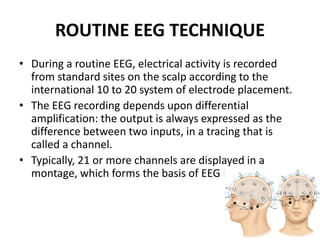
• During a routine EEG, electrical activity is recorded
from standard sites on the scalp according to the
international 10 to 20 system of electrode placement.
• The EEG recording depends upon differential
amplification: the output is always expressed as the
difference between two inputs, in a tracing that is
called a channel.
• Typically, 21 or more channels are displayed in a
montage, which forms the basis of EEG interpretation.
Types of montages
There are two main types of montages:
• Referential montage – In of the referential montage, each channel
consists of the difference between a specific electrode and a
reference. There are several types of references that can be used:
– Common reference: Each electrode is compared with a common
electrode, such as Cz, ipsilateral or contralateral ear, or a noncephalic
reference (eg, the rarely used "balanced neck-chest" reference).
– Common average reference: Each electrode is compared with a
weighted average of the signal from all other head electrodes.
Generally, electrode positions most susceptible to artifact (Fp1, Fp2,
O1, O2) are excluded from the average.
– Laplacian and weighted average references: Each electrode is
compared with a reference, which may consist of an average of the
closest electrodes (Laplacian) or an average in which different
electrodes are given different weights (weighted average), and so they
are not in common usage.
• Bipolar montage – In the bipolar montage, each channel
consists of a comparison of two adjacent electrodes. There
are several types of bipolar montages, including:
– Anterior-posterior longitudinal bipolar: The electrode pairs are
arranged in an anterior-posterior pattern in temporal and
parasagittal chains, as well as a midline chain. This is the most
versatile montage, and is the most commonly used montage for
interpretation of routine EEG recordings.
– Transverse bipolar: Electrode pairs are arranged in a left-right
pattern, starting in the front of the head and moving posteriorly.
This is also called a "coronal" montage.
– Others, such as hatband, mandibular notch montage, and
institution-specific bipolar montages: These montages are in
much less frequent use, but may be chosen in order to display
particular patterns.
Amplitude and frequency
• The electrical activity in each EEG channel can be
described in terms of amplitude and frequency.
• The amplitude of typical EEG recordings ranges from 5
to 200 microvolts, but most awake background EEG
recordings are in the range of 20 to 50 microvolts.
• Frequency of EEG activity is expressed according to the
following terminology:
– Delta – 0 to 4 Hz
– Theta – 4 to 8 Hz
– Alpha – 8 to 13 Hz
– Beta – 13 to 30 Hz
– Gamma – Greater than 30 Hz
Normal EEG findings
• In the normal awake adult with eyes closed, there is an 8.5 to 12 Hz alpha
rhythm, maximal in the posterior part of the head.
• This is also referred to as the posterior-dominant rhythm.
• The amplitude of the alpha falls off anteriorly, where there is lower-
voltage beta activity.
• The alpha rhythm becomes lower voltage (attenuates) or disappears
altogether when the eyes open, and becomes higher voltage (augments)
when the eyes close.
• In some patients (eg, children, patients with mild cerebral dysfunction),
the frequency of the "alpha" rhythm may be in the theta range, which
introduces semantic confusion. Some electroencephalographers therefore
prefer to use the term "posterior-dominant rhythm" instead.
• With drowsiness (i.e, stage N1 sleep), the alpha rhythm gradually
disappears, fronto-central beta activity may become more prominent,
and diffuse theta activity emerges.
EEG FINDINGS IN PATIENTS WITH
EPILEPSY
• Different EEG findings are variably associated with
epilepsy.
– Examples of epileptiform activity include interictal
epileptiform discharges (IEDs), lateralized periodic
discharges (LPDs; previously known as periodic lateralized
epileptiform discharges [PLEDs], and generalized periodic
discharges (GPDs).
– Nonepileptiform abnormalities include slowing, which may
be diffuse, regional, or localized; amplitude changes or
asymmetries; and other deviations from normal patterns.
• Only epileptiform discharges are associated with
epilepsy at rates sufficient to be clinically useful, and
only when benign variants have been excluded.
Nonspecific (nonepileptiform) EEG abnormalities are
relatively common, especially in older individuals,
patients with migraine, and those on centrally acting
medications.
• These should not be interpreted as supporting a
diagnosis of epilepsy.
Interictal epileptiform discharges
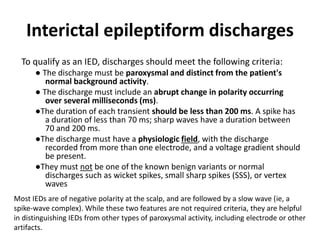
To qualify as an IED, discharges should meet the following criteria:
● The discharge must be paroxysmal and distinct from the patient's
normal background activity.
● The discharge must include an abrupt change in polarity occurring
over several milliseconds (ms).
●The duration of each transient should be less than 200 ms. A spike has
a duration of less than 70 ms; sharp waves have a duration between
70 and 200 ms.
●The discharge must have a physiologic field, with the discharge
recorded from more than one electrode, and a voltage gradient should
be present.
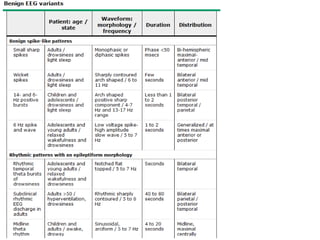
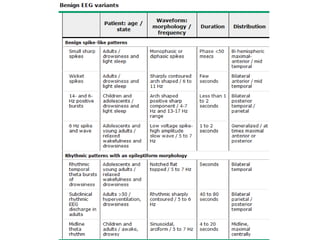
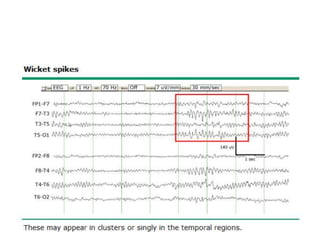
●They must not be one of the known benign variants or normal
discharges such as wicket spikes, small sharp spikes (SSS), or vertex
waves
Most IEDs are of negative polarity at the scalp, and are followed by a slow wave (ie, a
spike-wave complex). While these two features are not required criteria, they are helpful
in distinguishing IEDs from other types of paroxysmal activity, including electrode or other
artifacts.
Sensitivity
An IED is found in 20 to 55 percent of persons with epilepsy on a first "routine" EEG.
A number of factors can influence the sensitivity of a finding of IED for the diagnosis of
epilepsy.
1. The number of EEG studies – With repeated recordings, the likelihood of finding
IEDs increases from 20 to 50 percent to as high as 80 to 90 percent when four or
more EEGs are obtained .
2. EEG duration – A routine EEG is 30 to 45 minutes in length. Longer EEG
monitoring increases the yield of the study.
3. Seizure frequency – More frequent seizures are associated with a higher
frequency of IEDs on an EEG tracing. In this regard, a finding of IEDs may also be
predictive of seizure recurrence. studies of EEG after a first unprovoked seizure in
adults, the probability of seizure recurrence in patients with epileptiform EEG
abnormalities was 50 percent compared with 27 percent in those with normal
EEGs. Patients with an estimated risk of recurrent seizure of ≥60 percent after a
single unprovoked seizure are considered to have epilepsy.
4. Timing of EEG in relation to recent seizure – Clinical seizures are temporally
associated with more frequent IEDs, the chance of finding epileptiform discharges
on EEG decreased as time elapsed since the last seizure: 62 percent if ≤24 hours,
51 percent if 25 to 48 hours, 40 percent if 49 to 72 hours, and 31 percent if >72
hours.
5. Antiseizure drug therapy – There is limited information regarding the
suppressant effect of antiseizure drugs on IED detection. Treatment
with valproate, levetiracetam, and probably ethosuximide reduces the rate of
generalized IEDs. Diazepam and phenobarbital can suppress IEDs acutely, but
chronic therapy may have little impact.
6. Epilepsy syndrome – The EEG is more likely to be abnormal in certain epilepsy
syndromes. As examples, IEDs are almost invariably present in children with
untreated infantile spasms, Landau-Kleffner syndrome, and benign rolandic
epilepsy. While medial temporal lobe epilepsy is usually associated with an
abnormal interictal EEG, patients with frontal lobe epilepsy may have a normal
interictal EEG. However, the presence of IEDs often influences both the diagnosis
of epilepsy itself, as well as the specific epilepsy syndrome; as a result, this may
be a source of substantial bias.
7. Specialized techniques – The use of activation procedures (hyperventilation,
photic stimulation, sleep deprivation, induced sleep, and medication withdrawal)
and special electrode placement can increase the yield of IEDs on an interictal
EEG. Their use is recommended on most follow-up EEGs in order to improve the
sensitivity of the test.
8. Age – Factors that are variably reported to be associated with the prevalence of
IEDs in persons with epilepsy include a younger age at the time of EEG, a longer
duration of epilepsy, and an earlier age at epilepsy onset
SPECIFICITY
IEDs are rare (0.5 %)in patients without a history of seizures.
The prevalence of IEDs has been recorded to be somewhat higher in healthy children (3.5 to 6.5
percent) and in hospitalized adults with neurologic or psychiatric illness (2.0 to 2.6 percent).
A finding of IEDs is most helpful if the clinical history strongly suggests epileptic seizure :
• Spikes and sharp waves are common in normal neonates during quiet (non-REM) sleep, but
disappear over the first six to eight weeks of life. By contrast, focal or multifocal IEDs in adults
are almost always associated with epilepsy. In children, IEDs are less specific for epilepsy. In
particular, central-midtemporal discharges, generalized spike-wave discharges, and
photoparoxysmal responses may be asymptomatic manifestations of genetic traits.
• Some conditions are associated with the presence of IEDs on EEG, but do not imply epilepsy.
These include occipital spikes seen in CONGENITALLY blind people.
• Withdrawal from short-acting barbiturates and benzodiazepines, certain metabolic
derangements (eg, hypocalcemia, uremia, dialysis disequilibrium), as well as high drug levels
of lithium, neuroleptics (especially clozapine), bupropion, and tricyclic antidepressants have
been associated with IEDs even in the absence of accompanying seizures. These conditions
are also associated with a lower seizure threshold.
• Inexperienced interpreters of EEG, unaware of benign variants and normal fluctuations that
are commonly seen on EEG, can misread EEGs and limit the specificity of the findings.
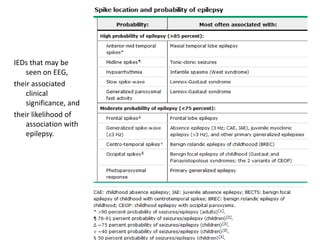
IEDs that may be
seen on EEG,
their associated
clinical
significance, and
their likelihood of
association with
epilepsy.
LATERALIZED PERIODIC DISCHARGES
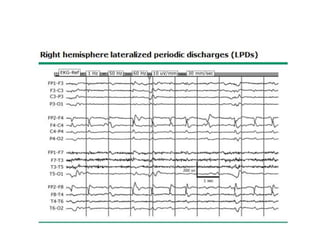
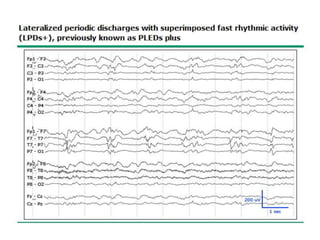
• Lateralized periodic discharges (LPDs; previously known as PLEDs) are
defined by lateralized, persistent spikes, sharp waves, or sharply
contoured slow waves that occur with an almost regular repetition rate,
typically 0.5 to 2 Hz.
• These are most often seen in the setting of acute, relatively large,
destructive lesions, such as cerebral infarction or hemorrhage,
encephalitis, abscess, or rapidly growing cerebral malignancy . In
children, LPDs are also associated with chronic diffuse encephalopathies .
• LPDs are highly associated with seizures, especially nonconvulsive
seizures in critically ill patients. Clinical seizures have also been reported
in the majority of patients with LPDs (50 to 100 %). Focal motor seizures
are the most common seizure type associated with LPDs.
• LPDs usually resolve over several days to weeks with recovery from the
acute illness, but their presence increases the risk of developing remote
symptomatic epilepsy.
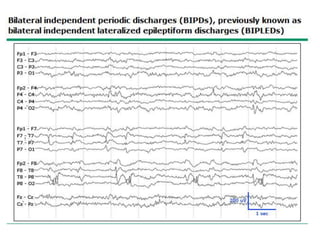
BILATERAL INDEPENDENT PERIODIC
DISCHARGES
• Bilateral independent periodic discharges (BIPDs;
previously known as BIPLEDs) are most often observed
in association with acute central nervous system (CNS)
infections (especially herpes simplex encephalitis),
anoxic encephalopathy, and severe chronic epilepsy.
• This pattern is also highly associated with seizures.
• Compared with LPDs, BIPDs are associated with more
severe cerebral injury, worse neurologic status, and
higher mortality, probably related to the severity of the
underlying illness.
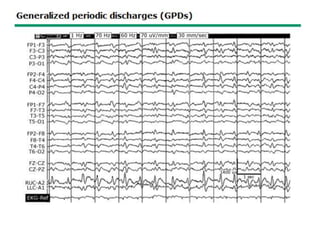
GENERALIZED PERIODIC DISCHARGES
• GPDs are less common than LPDs, but are still
often observed in critically ill patients.
• They are associated with seizures, especially
when seen in combination with superimposed
rhythmic delta or fast activity (GPDs-plus).
Slowing
• Focal slow-wave activity and generalized slowing of
background rhythms are common postictal and
interictal findings in patients with partial seizures and
symptomatic epilepsies. However, they are also
frequently seen in other neurologic disorders,
especially focal structural lesions, regardless of
whether there are associated seizures. As an example,
two-thirds of patients with continuous, focal,
polymorphic delta activity have a structural lesion,
but seizures occur in only approximately 20 percent.
• In patients with no clinical history of neurologic injury
and a normal neuroimaging study, focal slowing is
more likely to suggest epilepsy.
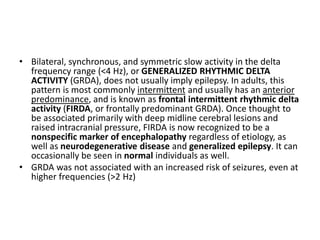
• Bilateral, synchronous, and symmetric slow activity in the delta
frequency range (<4 Hz), or GENERALIZED RHYTHMIC DELTA
ACTIVITY (GRDA), does not usually imply epilepsy. In adults, this
pattern is most commonly intermittent and usually has an anterior
predominance, and is known as frontal intermittent rhythmic delta
activity (FIRDA, or frontally predominant GRDA). Once thought to
be associated primarily with deep midline cerebral lesions and
raised intracranial pressure, FIRDA is now recognized to be a
nonspecific marker of encephalopathy regardless of etiology, as
well as neurodegenerative disease and generalized epilepsy. It can
occasionally be seen in normal individuals as well.
• GRDA was not associated with an increased risk of seizures, even at
higher frequencies (>2 Hz)
• Occipital intermittent rhythmic delta activity (OIRDA) is more
common in young children and is rarely seen in patients older than
15 years. It is a frequent interictal finding in generalized epilepsy
syndromes, occurring in 15 to 38 percent of all patients with
childhood absence epilepsy, and implies a good prognosis.
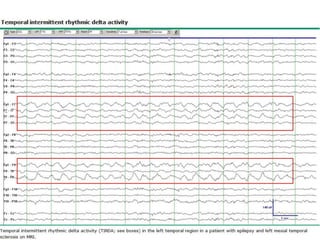
• Temporal intermittent rhythmic delta activity (TIRDA) is a
particular form of focal slowing (and a subtype of lateralized
rhythmic delta activity [LRDA]; that is specific for temporal lobe
localization in patients with refractory epilepsy. TIRDA is observed in
as many as 25 to 40 percent of patients being evaluated for
temporal lobe resection. TIRDA is often associated with temporal
IEDs and has a high positive predictive value for temporal lobe
localization in patients with refractory epilepsy.
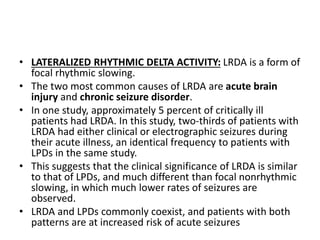
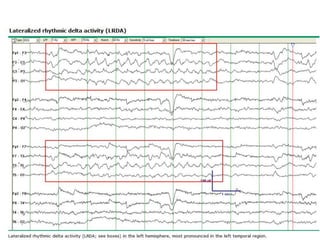
• LATERALIZED RHYTHMIC DELTA ACTIVITY: LRDA is a form of
focal rhythmic slowing.
• The two most common causes of LRDA are acute brain
injury and chronic seizure disorder.
• In one study, approximately 5 percent of critically ill
patients had LRDA. In this study, two-thirds of patients with
LRDA had either clinical or electrographic seizures during
their acute illness, an identical frequency to patients with
LPDs in the same study.
• This suggests that the clinical significance of LRDA is similar
to that of LPDs, and much different than focal nonrhythmic
slowing, in which much lower rates of seizures are
observed.
• LRDA and LPDs commonly coexist, and patients with both
patterns are at increased risk of acute seizures
EPILEPSY SYNDROME DIAGNOSIS
• The classification of seizures and epilepsy can be important for prognosis and
treatment, most important distinction is between primary-generalized and partial
epilepsy.
• Ex: a patient with staring spells may have absence or complex partial seizures, and
a patient with generalized convulsions may have primary or secondarily
generalized epilepsy. Although the presence of an aura strongly suggests partial-
onset seizures, one study reported that symptoms interpreted by the patient as a
seizure aura (often brief, nonspecific dizziness) occurred in up to 70 percent of
those with primary generalized epilepsy.
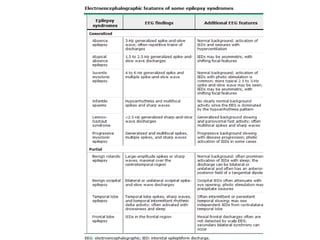
• Specific interictal EEG findings that are associated with specific epilepsy syndromes
are listed in the table. Clinical correlation between the clinical seizure type and
EEG findings is also important.
• In addition, when focal IEDs are strongly lateralized (more than 90 to 95 percent),
they predict the side of seizure onset.
• However, focal IEDs can manifest as secondary bilateral synchronous discharges,
while generalized epilepsy can have fragmentary expression and appear more
focal.
• As a result, it is important to consider the clinical as well as the EEG
manifestations.
SPECIALIZED TECHNIQUES
To improve the detection of interictal epileptiform discharges (IEDs)
• Hyperventilation increases the rate of generalized
discharges in childhood absence epilepsy and other
generalized epilepsies, less productive in partial
epilepsies, increasing the yield of focal IEDs by less
than 10 percent. Two studies have suggested that the
yield of hyperventilation in generalized epilepsy may
also be low, approximately 12 percent.
• However, this activation procedure is very effort
dependent, and yield may vary as a result.
• Hyperventilation had an activating effect on EEG
recording, but only in those patients whose antiseizure
drugs were being tapered.
• Photic stimulation induces IEDs in some individuals with idiopathic
generalized epilepsy, and infrequently in patients with focal
seizures arising from the occipital lobe.
• A trait of photoparoxysmal response can also run in families, and in
this setting in particular, is a less specific finding for epilepsy than
spontaneous IEDs.
• A photoparoxysmal response that is both generalized and sustained
(outlasting the period of photic stimulation) and occurs at a
different frequency than the photic stimulation is more likely to be
associated with epilepsy than when these features are absent.
• In order to maximize the yield of photic stimulation, each
laboratory should have a protocol that includes testing at a number
of frequencies between 1 and 60 Hz, and patients should be tested
with eyes both opened and closed at each frequency, if possible.
Sleep and sleep deprivation
• Sleep is a neurophysiologic activator of epilepsy; 20 to 40 percent
of epilepsy patients with an initial normal recording will have IEDs
on a subsequent recording that includes sleep.
• Sleep is sometimes captured on a routine EEG, but sleep
deprivation increases this likelihood.
• Sleep is also usually captured on prolonged EEG monitoring and,
alternatively, can be induced by administration of a sedative,
usually chloral hydrate.
• Sleep deprivation appears to increase IEDs to an extent not fully
explained by the greater chance of recording sleep. One study
found that the additional yield of a sleep-deprived EEG was similar
whether or not sleep was recorded [83].
• The sleep-deprived patients were also more likely to have a seizure
during the EEG compared with the sedated patients.
NORMAL EEG NEVER RULES OUT EPILEPSY
"abnormal" EEG does not define epilepsy
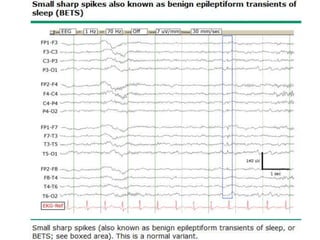
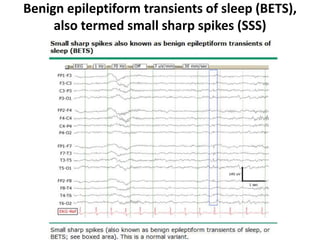
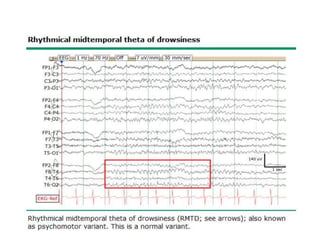
Benign epileptiform transients of sleep (BETS),
also termed small sharp spikes (SSS)
Eeg basics, part 1
Eeg basics, part 1
Eeg basics, part 1
Eeg basics, part 1
Eeg basics, part 1
Eeg basics, part 1
Eeg basics, part 1
Eeg basics, part 1
Eeg basics, part 1
Eeg basics, part 1
Eeg basics, part 1
Eeg basics, part 1
Eeg basics, part 1
Eeg basics, part 1
Eeg basics, part 1
Eeg basics, part 1
Eeg basics, part 1
Eeg basics, part 1
Eeg basics, part 1
Eeg basics, part 1
Eeg basics, part 1
Eeg basics, part 1
Eeg basics, part 1
Eeg basics, part 1
Eeg basics, part 1
Eeg basics, part 1
Eeg basics, part 1
Eeg basics, part 1
Eeg basics, part 1
Eeg basics, part 1
Eeg basics, part 1
Eeg basics, part 1
Eeg basics, part 1
Eeg basics, part 1
Eeg basics, part 1
Eeg basics, part 1
Eeg basics, part 1
Eeg basics, part 1
Eeg basics, part 1
Eeg basics, part 1
Eeg basics, part 1
Eeg basics, part 1
Eeg basics, part 1
Eeg basics, part 1
Eeg basics, part 1
Eeg basics, part 1

Eeg basics, part 1

  • 1.
    EEG NORMAL EEG NEVERRULES OUT EPILEPSY "abnormal" EEG does not define epilepsy
  • 2.
    INTRODUCTION • The diagnosisof epilepsy is often not straightforward, and misdiagnosis is not rare. • A detailed and reliable account of the event by an eyewitness is the most important part. • Electroencephalography (EEG) is an important diagnostic test in evaluating a patient with possible epilepsy. It can provide support for the diagnosis of epilepsy and also assists in classifying the underlying epileptic syndrome. • However, there are several reasons why EEG alone cannot be used to make or refute a specific diagnosis of epilepsy: – Most EEG patterns can be caused by a wide variety of different neurologic diseases. – Many diseases can cause more than one type of EEG pattern. – Intermittent EEG changes, including interictal epileptiform discharges (IEDs), can be infrequent and may not appear during the relatively brief period of routine EEG recording. – The EEG can be abnormal in some persons with no other evidence of disease. – Not all cases of brain disease are associated with an EEG abnormality, particularly if the pathology is small, chronic, or located deep in the brain.
  • 3.
    ROUTINE EEG TECHNIQUE •During a routine EEG, electrical activity is recorded from standard sites on the scalp according to the international 10 to 20 system of electrode placement. • The EEG recording depends upon differential amplification: the output is always expressed as the difference between two inputs, in a tracing that is called a channel. • Typically, 21 or more channels are displayed in a montage, which forms the basis of EEG interpretation.
  • 4.
    Types of montages Thereare two main types of montages: • Referential montage – In of the referential montage, each channel consists of the difference between a specific electrode and a reference. There are several types of references that can be used: – Common reference: Each electrode is compared with a common electrode, such as Cz, ipsilateral or contralateral ear, or a noncephalic reference (eg, the rarely used "balanced neck-chest" reference). – Common average reference: Each electrode is compared with a weighted average of the signal from all other head electrodes. Generally, electrode positions most susceptible to artifact (Fp1, Fp2, O1, O2) are excluded from the average. – Laplacian and weighted average references: Each electrode is compared with a reference, which may consist of an average of the closest electrodes (Laplacian) or an average in which different electrodes are given different weights (weighted average), and so they are not in common usage.
  • 5.
    • Bipolar montage– In the bipolar montage, each channel consists of a comparison of two adjacent electrodes. There are several types of bipolar montages, including: – Anterior-posterior longitudinal bipolar: The electrode pairs are arranged in an anterior-posterior pattern in temporal and parasagittal chains, as well as a midline chain. This is the most versatile montage, and is the most commonly used montage for interpretation of routine EEG recordings. – Transverse bipolar: Electrode pairs are arranged in a left-right pattern, starting in the front of the head and moving posteriorly. This is also called a "coronal" montage. – Others, such as hatband, mandibular notch montage, and institution-specific bipolar montages: These montages are in much less frequent use, but may be chosen in order to display particular patterns.
  • 6.
    Amplitude and frequency •The electrical activity in each EEG channel can be described in terms of amplitude and frequency. • The amplitude of typical EEG recordings ranges from 5 to 200 microvolts, but most awake background EEG recordings are in the range of 20 to 50 microvolts. • Frequency of EEG activity is expressed according to the following terminology: – Delta – 0 to 4 Hz – Theta – 4 to 8 Hz – Alpha – 8 to 13 Hz – Beta – 13 to 30 Hz – Gamma – Greater than 30 Hz
  • 7.
    Normal EEG findings •In the normal awake adult with eyes closed, there is an 8.5 to 12 Hz alpha rhythm, maximal in the posterior part of the head. • This is also referred to as the posterior-dominant rhythm. • The amplitude of the alpha falls off anteriorly, where there is lower- voltage beta activity. • The alpha rhythm becomes lower voltage (attenuates) or disappears altogether when the eyes open, and becomes higher voltage (augments) when the eyes close. • In some patients (eg, children, patients with mild cerebral dysfunction), the frequency of the "alpha" rhythm may be in the theta range, which introduces semantic confusion. Some electroencephalographers therefore prefer to use the term "posterior-dominant rhythm" instead. • With drowsiness (i.e, stage N1 sleep), the alpha rhythm gradually disappears, fronto-central beta activity may become more prominent, and diffuse theta activity emerges.
  • 8.
    EEG FINDINGS INPATIENTS WITH EPILEPSY • Different EEG findings are variably associated with epilepsy. – Examples of epileptiform activity include interictal epileptiform discharges (IEDs), lateralized periodic discharges (LPDs; previously known as periodic lateralized epileptiform discharges [PLEDs], and generalized periodic discharges (GPDs).
  • 9.
    – Nonepileptiform abnormalitiesinclude slowing, which may be diffuse, regional, or localized; amplitude changes or asymmetries; and other deviations from normal patterns. • Only epileptiform discharges are associated with epilepsy at rates sufficient to be clinically useful, and only when benign variants have been excluded. Nonspecific (nonepileptiform) EEG abnormalities are relatively common, especially in older individuals, patients with migraine, and those on centrally acting medications. • These should not be interpreted as supporting a diagnosis of epilepsy.
  • 11.
    Interictal epileptiform discharges Toqualify as an IED, discharges should meet the following criteria: ● The discharge must be paroxysmal and distinct from the patient's normal background activity. ● The discharge must include an abrupt change in polarity occurring over several milliseconds (ms). ●The duration of each transient should be less than 200 ms. A spike has a duration of less than 70 ms; sharp waves have a duration between 70 and 200 ms. ●The discharge must have a physiologic field, with the discharge recorded from more than one electrode, and a voltage gradient should be present. ●They must not be one of the known benign variants or normal discharges such as wicket spikes, small sharp spikes (SSS), or vertex waves Most IEDs are of negative polarity at the scalp, and are followed by a slow wave (ie, a spike-wave complex). While these two features are not required criteria, they are helpful in distinguishing IEDs from other types of paroxysmal activity, including electrode or other artifacts.
  • 13.
    Sensitivity An IED isfound in 20 to 55 percent of persons with epilepsy on a first "routine" EEG. A number of factors can influence the sensitivity of a finding of IED for the diagnosis of epilepsy. 1. The number of EEG studies – With repeated recordings, the likelihood of finding IEDs increases from 20 to 50 percent to as high as 80 to 90 percent when four or more EEGs are obtained . 2. EEG duration – A routine EEG is 30 to 45 minutes in length. Longer EEG monitoring increases the yield of the study. 3. Seizure frequency – More frequent seizures are associated with a higher frequency of IEDs on an EEG tracing. In this regard, a finding of IEDs may also be predictive of seizure recurrence. studies of EEG after a first unprovoked seizure in adults, the probability of seizure recurrence in patients with epileptiform EEG abnormalities was 50 percent compared with 27 percent in those with normal EEGs. Patients with an estimated risk of recurrent seizure of ≥60 percent after a single unprovoked seizure are considered to have epilepsy. 4. Timing of EEG in relation to recent seizure – Clinical seizures are temporally associated with more frequent IEDs, the chance of finding epileptiform discharges on EEG decreased as time elapsed since the last seizure: 62 percent if ≤24 hours, 51 percent if 25 to 48 hours, 40 percent if 49 to 72 hours, and 31 percent if >72 hours.
  • 14.
    5. Antiseizure drugtherapy – There is limited information regarding the suppressant effect of antiseizure drugs on IED detection. Treatment with valproate, levetiracetam, and probably ethosuximide reduces the rate of generalized IEDs. Diazepam and phenobarbital can suppress IEDs acutely, but chronic therapy may have little impact. 6. Epilepsy syndrome – The EEG is more likely to be abnormal in certain epilepsy syndromes. As examples, IEDs are almost invariably present in children with untreated infantile spasms, Landau-Kleffner syndrome, and benign rolandic epilepsy. While medial temporal lobe epilepsy is usually associated with an abnormal interictal EEG, patients with frontal lobe epilepsy may have a normal interictal EEG. However, the presence of IEDs often influences both the diagnosis of epilepsy itself, as well as the specific epilepsy syndrome; as a result, this may be a source of substantial bias. 7. Specialized techniques – The use of activation procedures (hyperventilation, photic stimulation, sleep deprivation, induced sleep, and medication withdrawal) and special electrode placement can increase the yield of IEDs on an interictal EEG. Their use is recommended on most follow-up EEGs in order to improve the sensitivity of the test. 8. Age – Factors that are variably reported to be associated with the prevalence of IEDs in persons with epilepsy include a younger age at the time of EEG, a longer duration of epilepsy, and an earlier age at epilepsy onset
  • 15.
    SPECIFICITY IEDs are rare(0.5 %)in patients without a history of seizures. The prevalence of IEDs has been recorded to be somewhat higher in healthy children (3.5 to 6.5 percent) and in hospitalized adults with neurologic or psychiatric illness (2.0 to 2.6 percent). A finding of IEDs is most helpful if the clinical history strongly suggests epileptic seizure : • Spikes and sharp waves are common in normal neonates during quiet (non-REM) sleep, but disappear over the first six to eight weeks of life. By contrast, focal or multifocal IEDs in adults are almost always associated with epilepsy. In children, IEDs are less specific for epilepsy. In particular, central-midtemporal discharges, generalized spike-wave discharges, and photoparoxysmal responses may be asymptomatic manifestations of genetic traits. • Some conditions are associated with the presence of IEDs on EEG, but do not imply epilepsy. These include occipital spikes seen in CONGENITALLY blind people. • Withdrawal from short-acting barbiturates and benzodiazepines, certain metabolic derangements (eg, hypocalcemia, uremia, dialysis disequilibrium), as well as high drug levels of lithium, neuroleptics (especially clozapine), bupropion, and tricyclic antidepressants have been associated with IEDs even in the absence of accompanying seizures. These conditions are also associated with a lower seizure threshold. • Inexperienced interpreters of EEG, unaware of benign variants and normal fluctuations that are commonly seen on EEG, can misread EEGs and limit the specificity of the findings.
  • 16.
    IEDs that maybe seen on EEG, their associated clinical significance, and their likelihood of association with epilepsy.
  • 17.
    LATERALIZED PERIODIC DISCHARGES •Lateralized periodic discharges (LPDs; previously known as PLEDs) are defined by lateralized, persistent spikes, sharp waves, or sharply contoured slow waves that occur with an almost regular repetition rate, typically 0.5 to 2 Hz. • These are most often seen in the setting of acute, relatively large, destructive lesions, such as cerebral infarction or hemorrhage, encephalitis, abscess, or rapidly growing cerebral malignancy . In children, LPDs are also associated with chronic diffuse encephalopathies . • LPDs are highly associated with seizures, especially nonconvulsive seizures in critically ill patients. Clinical seizures have also been reported in the majority of patients with LPDs (50 to 100 %). Focal motor seizures are the most common seizure type associated with LPDs. • LPDs usually resolve over several days to weeks with recovery from the acute illness, but their presence increases the risk of developing remote symptomatic epilepsy.
  • 20.
    BILATERAL INDEPENDENT PERIODIC DISCHARGES •Bilateral independent periodic discharges (BIPDs; previously known as BIPLEDs) are most often observed in association with acute central nervous system (CNS) infections (especially herpes simplex encephalitis), anoxic encephalopathy, and severe chronic epilepsy. • This pattern is also highly associated with seizures. • Compared with LPDs, BIPDs are associated with more severe cerebral injury, worse neurologic status, and higher mortality, probably related to the severity of the underlying illness.
  • 22.
    GENERALIZED PERIODIC DISCHARGES •GPDs are less common than LPDs, but are still often observed in critically ill patients. • They are associated with seizures, especially when seen in combination with superimposed rhythmic delta or fast activity (GPDs-plus).
  • 24.
    Slowing • Focal slow-waveactivity and generalized slowing of background rhythms are common postictal and interictal findings in patients with partial seizures and symptomatic epilepsies. However, they are also frequently seen in other neurologic disorders, especially focal structural lesions, regardless of whether there are associated seizures. As an example, two-thirds of patients with continuous, focal, polymorphic delta activity have a structural lesion, but seizures occur in only approximately 20 percent. • In patients with no clinical history of neurologic injury and a normal neuroimaging study, focal slowing is more likely to suggest epilepsy.
  • 25.
    • Bilateral, synchronous,and symmetric slow activity in the delta frequency range (<4 Hz), or GENERALIZED RHYTHMIC DELTA ACTIVITY (GRDA), does not usually imply epilepsy. In adults, this pattern is most commonly intermittent and usually has an anterior predominance, and is known as frontal intermittent rhythmic delta activity (FIRDA, or frontally predominant GRDA). Once thought to be associated primarily with deep midline cerebral lesions and raised intracranial pressure, FIRDA is now recognized to be a nonspecific marker of encephalopathy regardless of etiology, as well as neurodegenerative disease and generalized epilepsy. It can occasionally be seen in normal individuals as well. • GRDA was not associated with an increased risk of seizures, even at higher frequencies (>2 Hz)
  • 26.
    • Occipital intermittentrhythmic delta activity (OIRDA) is more common in young children and is rarely seen in patients older than 15 years. It is a frequent interictal finding in generalized epilepsy syndromes, occurring in 15 to 38 percent of all patients with childhood absence epilepsy, and implies a good prognosis. • Temporal intermittent rhythmic delta activity (TIRDA) is a particular form of focal slowing (and a subtype of lateralized rhythmic delta activity [LRDA]; that is specific for temporal lobe localization in patients with refractory epilepsy. TIRDA is observed in as many as 25 to 40 percent of patients being evaluated for temporal lobe resection. TIRDA is often associated with temporal IEDs and has a high positive predictive value for temporal lobe localization in patients with refractory epilepsy.
  • 28.
    • LATERALIZED RHYTHMICDELTA ACTIVITY: LRDA is a form of focal rhythmic slowing. • The two most common causes of LRDA are acute brain injury and chronic seizure disorder. • In one study, approximately 5 percent of critically ill patients had LRDA. In this study, two-thirds of patients with LRDA had either clinical or electrographic seizures during their acute illness, an identical frequency to patients with LPDs in the same study. • This suggests that the clinical significance of LRDA is similar to that of LPDs, and much different than focal nonrhythmic slowing, in which much lower rates of seizures are observed. • LRDA and LPDs commonly coexist, and patients with both patterns are at increased risk of acute seizures
  • 30.
    EPILEPSY SYNDROME DIAGNOSIS •The classification of seizures and epilepsy can be important for prognosis and treatment, most important distinction is between primary-generalized and partial epilepsy. • Ex: a patient with staring spells may have absence or complex partial seizures, and a patient with generalized convulsions may have primary or secondarily generalized epilepsy. Although the presence of an aura strongly suggests partial- onset seizures, one study reported that symptoms interpreted by the patient as a seizure aura (often brief, nonspecific dizziness) occurred in up to 70 percent of those with primary generalized epilepsy. • Specific interictal EEG findings that are associated with specific epilepsy syndromes are listed in the table. Clinical correlation between the clinical seizure type and EEG findings is also important. • In addition, when focal IEDs are strongly lateralized (more than 90 to 95 percent), they predict the side of seizure onset. • However, focal IEDs can manifest as secondary bilateral synchronous discharges, while generalized epilepsy can have fragmentary expression and appear more focal. • As a result, it is important to consider the clinical as well as the EEG manifestations.
  • 32.
    SPECIALIZED TECHNIQUES To improvethe detection of interictal epileptiform discharges (IEDs) • Hyperventilation increases the rate of generalized discharges in childhood absence epilepsy and other generalized epilepsies, less productive in partial epilepsies, increasing the yield of focal IEDs by less than 10 percent. Two studies have suggested that the yield of hyperventilation in generalized epilepsy may also be low, approximately 12 percent. • However, this activation procedure is very effort dependent, and yield may vary as a result. • Hyperventilation had an activating effect on EEG recording, but only in those patients whose antiseizure drugs were being tapered.
  • 33.
    • Photic stimulationinduces IEDs in some individuals with idiopathic generalized epilepsy, and infrequently in patients with focal seizures arising from the occipital lobe. • A trait of photoparoxysmal response can also run in families, and in this setting in particular, is a less specific finding for epilepsy than spontaneous IEDs. • A photoparoxysmal response that is both generalized and sustained (outlasting the period of photic stimulation) and occurs at a different frequency than the photic stimulation is more likely to be associated with epilepsy than when these features are absent. • In order to maximize the yield of photic stimulation, each laboratory should have a protocol that includes testing at a number of frequencies between 1 and 60 Hz, and patients should be tested with eyes both opened and closed at each frequency, if possible.
  • 34.
    Sleep and sleepdeprivation • Sleep is a neurophysiologic activator of epilepsy; 20 to 40 percent of epilepsy patients with an initial normal recording will have IEDs on a subsequent recording that includes sleep. • Sleep is sometimes captured on a routine EEG, but sleep deprivation increases this likelihood. • Sleep is also usually captured on prolonged EEG monitoring and, alternatively, can be induced by administration of a sedative, usually chloral hydrate. • Sleep deprivation appears to increase IEDs to an extent not fully explained by the greater chance of recording sleep. One study found that the additional yield of a sleep-deprived EEG was similar whether or not sleep was recorded [83]. • The sleep-deprived patients were also more likely to have a seizure during the EEG compared with the sedated patients.
  • 35.
    NORMAL EEG NEVERRULES OUT EPILEPSY "abnormal" EEG does not define epilepsy
  • 37.
    Benign epileptiform transientsof sleep (BETS), also termed small sharp spikes (SSS)