ESSENTIAL QUESTIONS:
THE BIG IDEAS
EDUU 551
ESSENTIAL QUESTIONS
BLOOM'S TAXONOMY
DEPTH OF KNOWLEDGE (DOK)
UNDERSTANDING BY DESIGN
BACKWARDS DESIGN
ESSENTIAL QUESTIONS
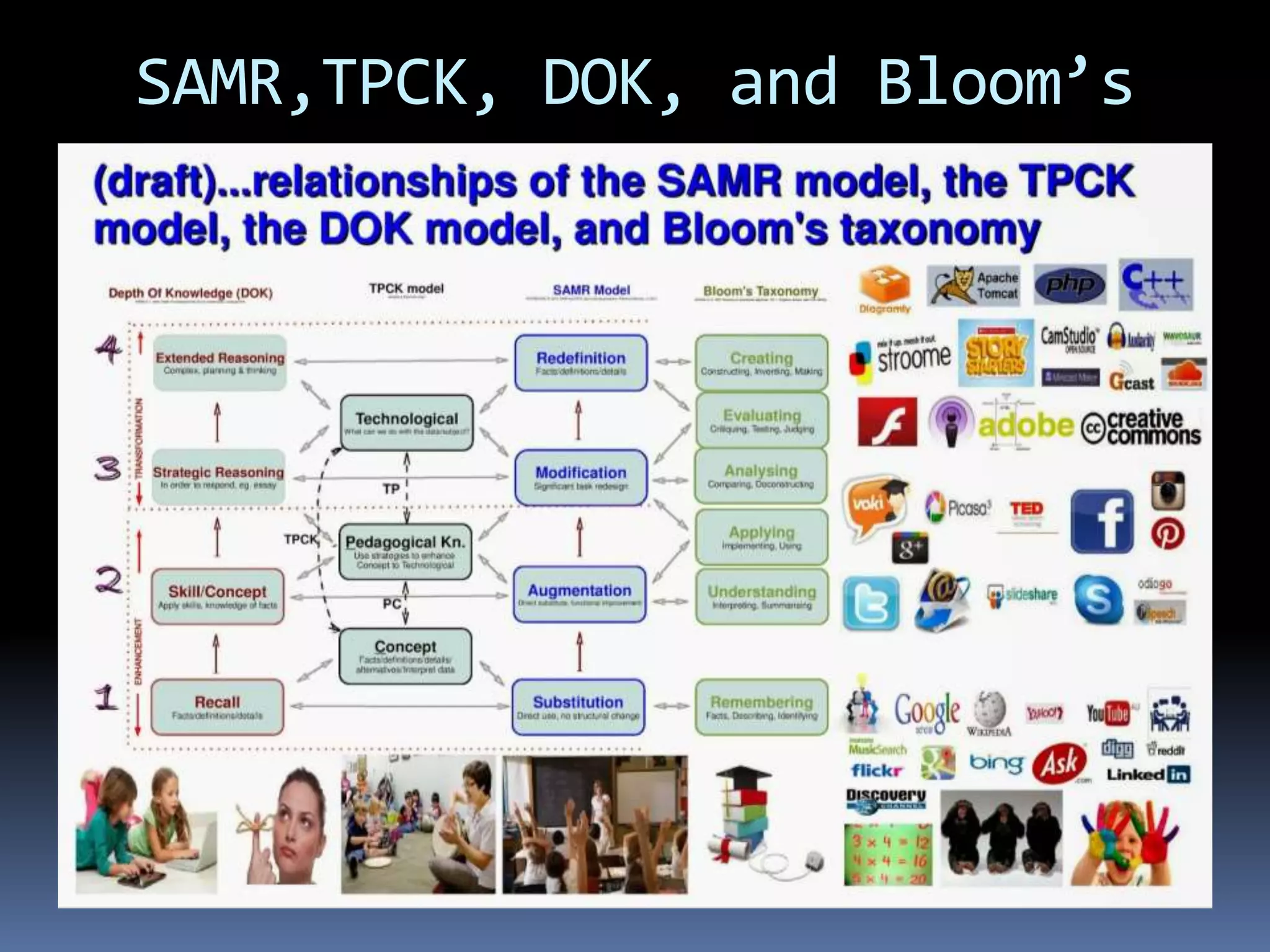
SAMR, TPACK, DOK, AND BLOOM’S
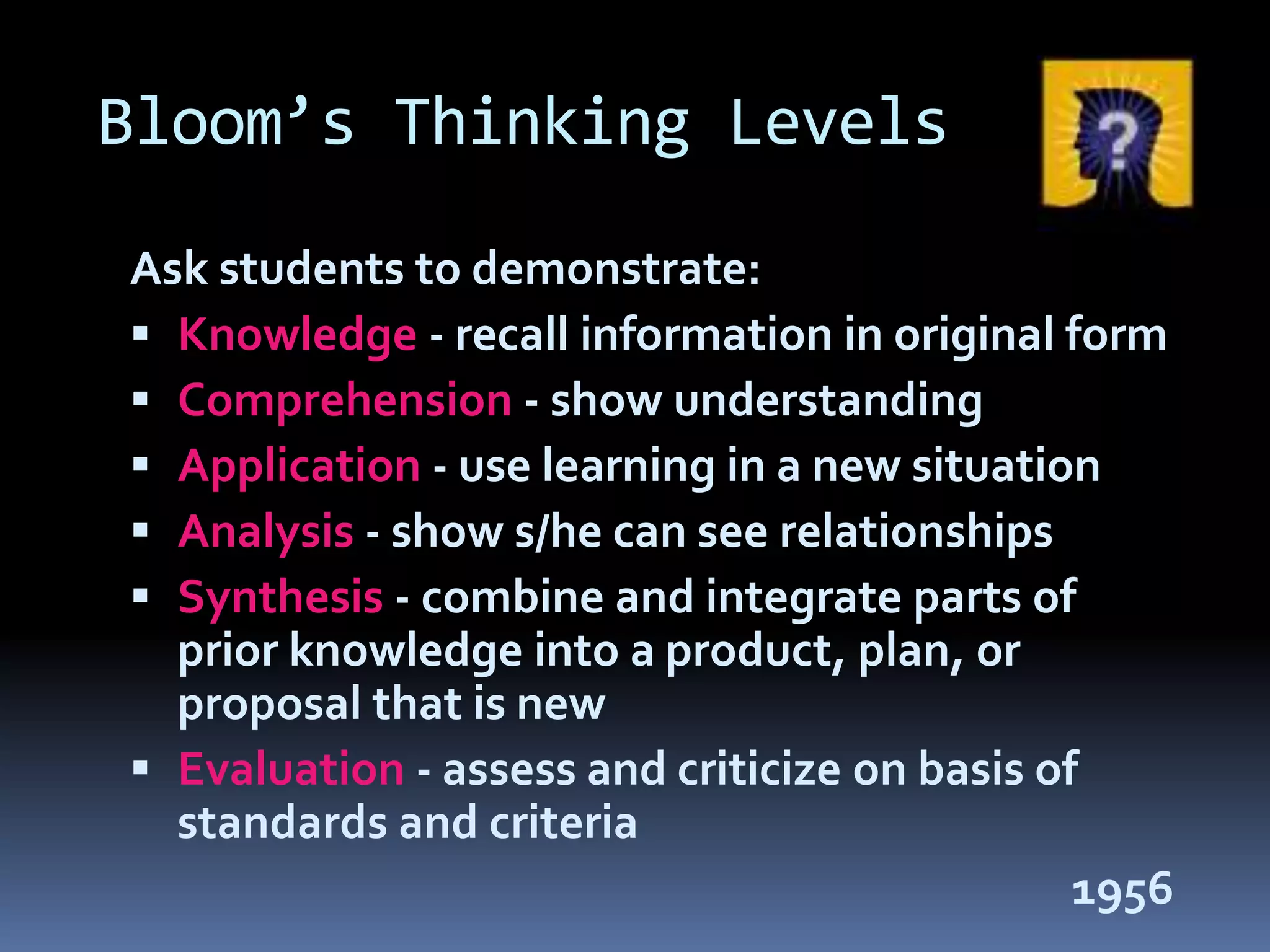
Bloom’s Thinking Levels
Ask students to demonstrate:
 Knowledge - recall information in original form
 Comprehension - show understanding
 Application - use learning in a new situation
 Analysis - show s/he can see relationships
 Synthesis - combine and integrate parts of
prior knowledge into a product, plan, or
proposal that is new
 Evaluation - assess and criticize on basis of
standards and criteria
1956
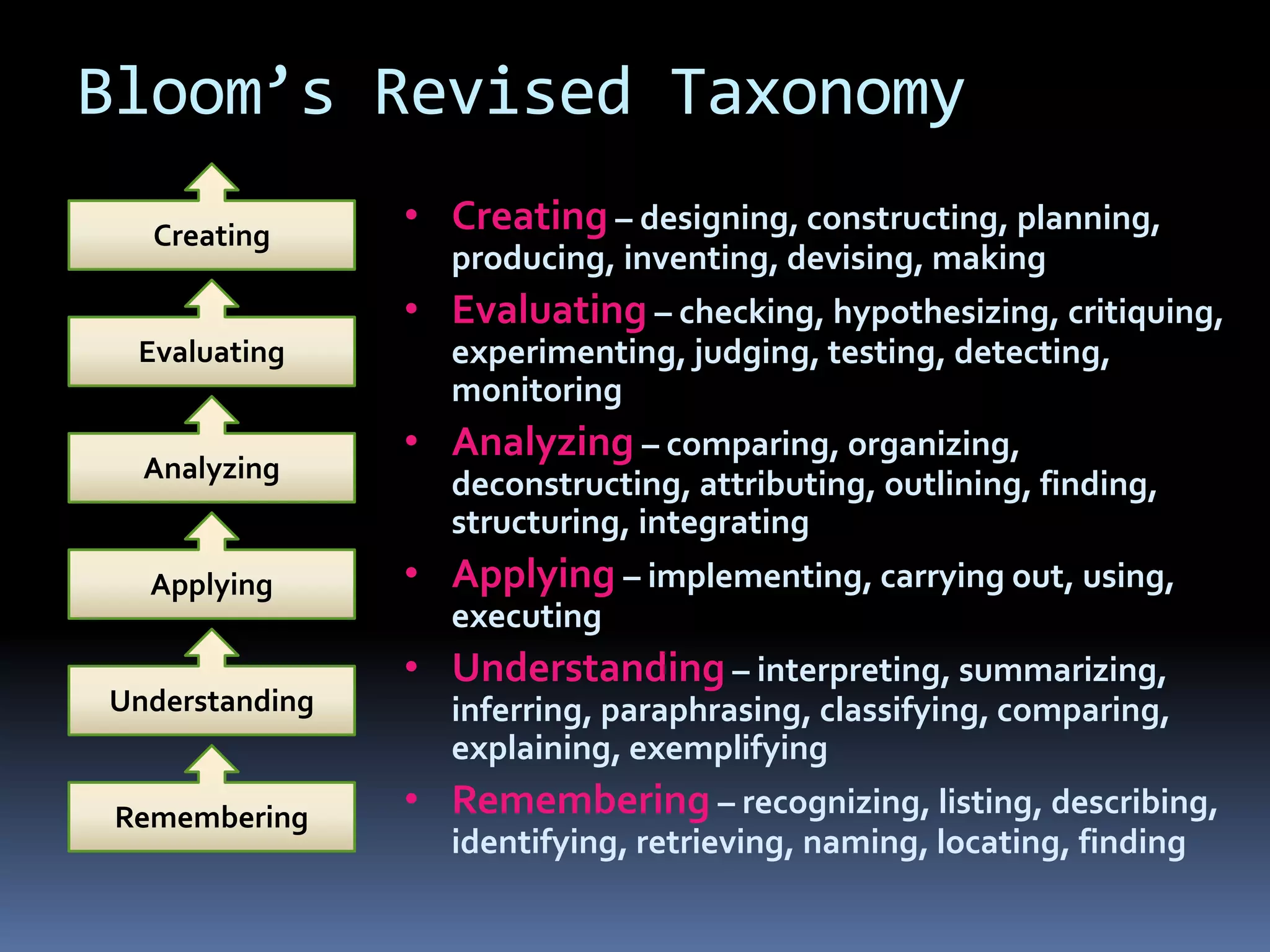
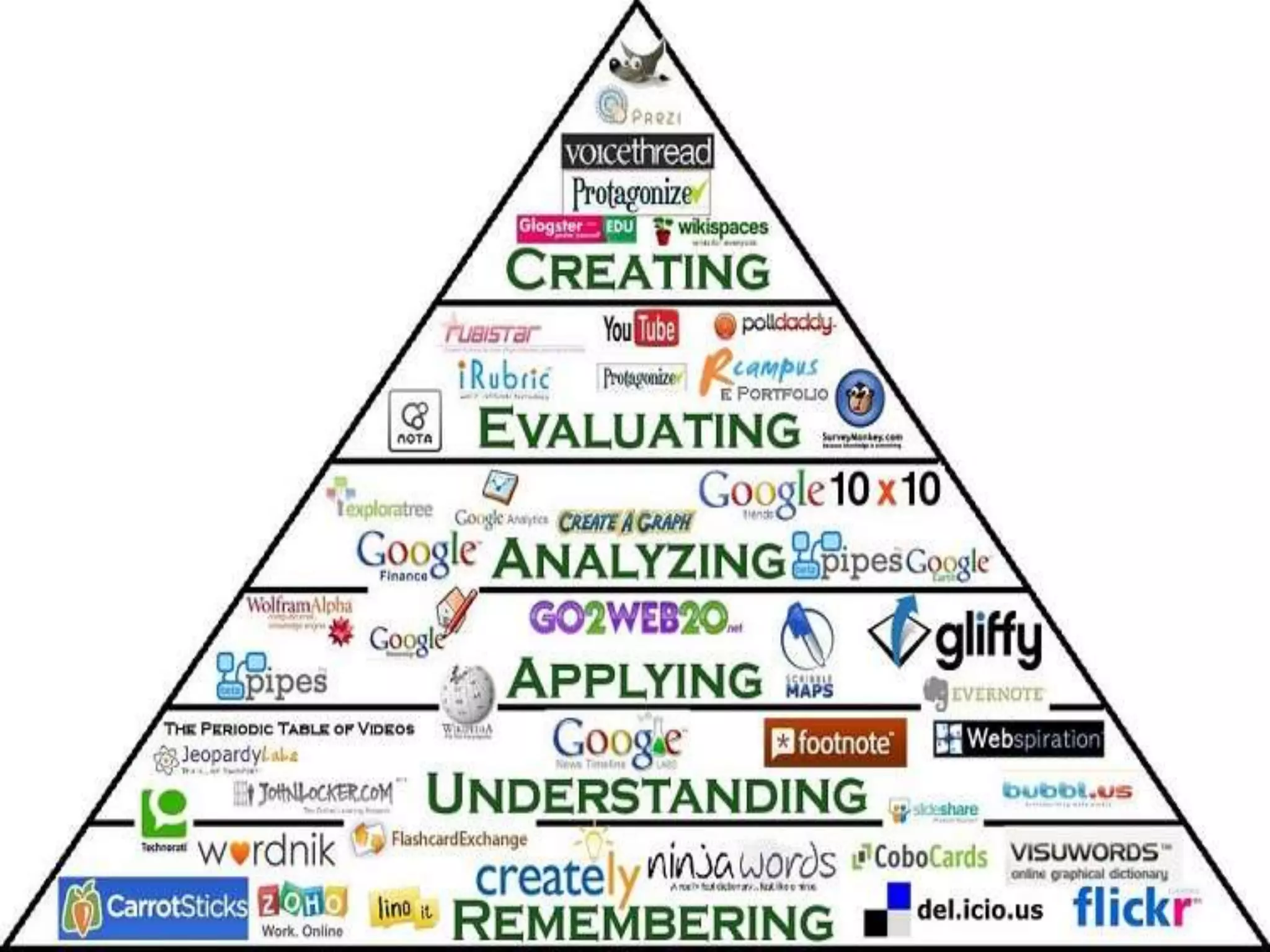
Remembering
Understanding
Applying
Analyzing
Evaluating
Creating
• Creating – designing, constructing, planning,
producing, inventing, devising, making
• Evaluating – checking, hypothesizing, critiquing,
experimenting, judging, testing, detecting,
monitoring
• Analyzing – comparing, organizing,
deconstructing, attributing, outlining, finding,
structuring, integrating
• Applying – implementing, carrying out, using,
executing
• Understanding – interpreting, summarizing,
inferring, paraphrasing, classifying, comparing,
explaining, exemplifying
• Remembering – recognizing, listing, describing,
identifying, retrieving, naming, locating, finding
Bloom’s Revised Taxonomy
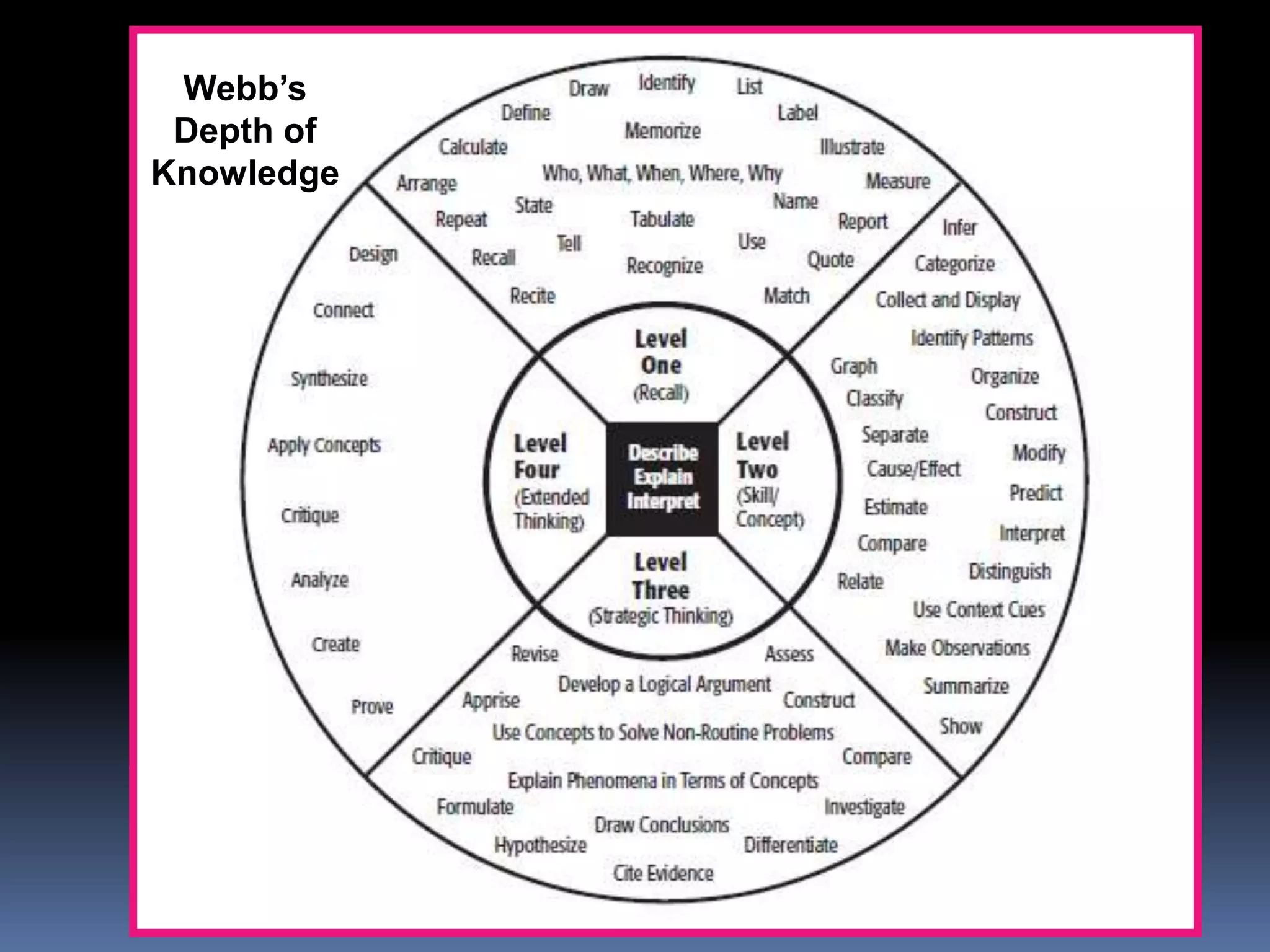
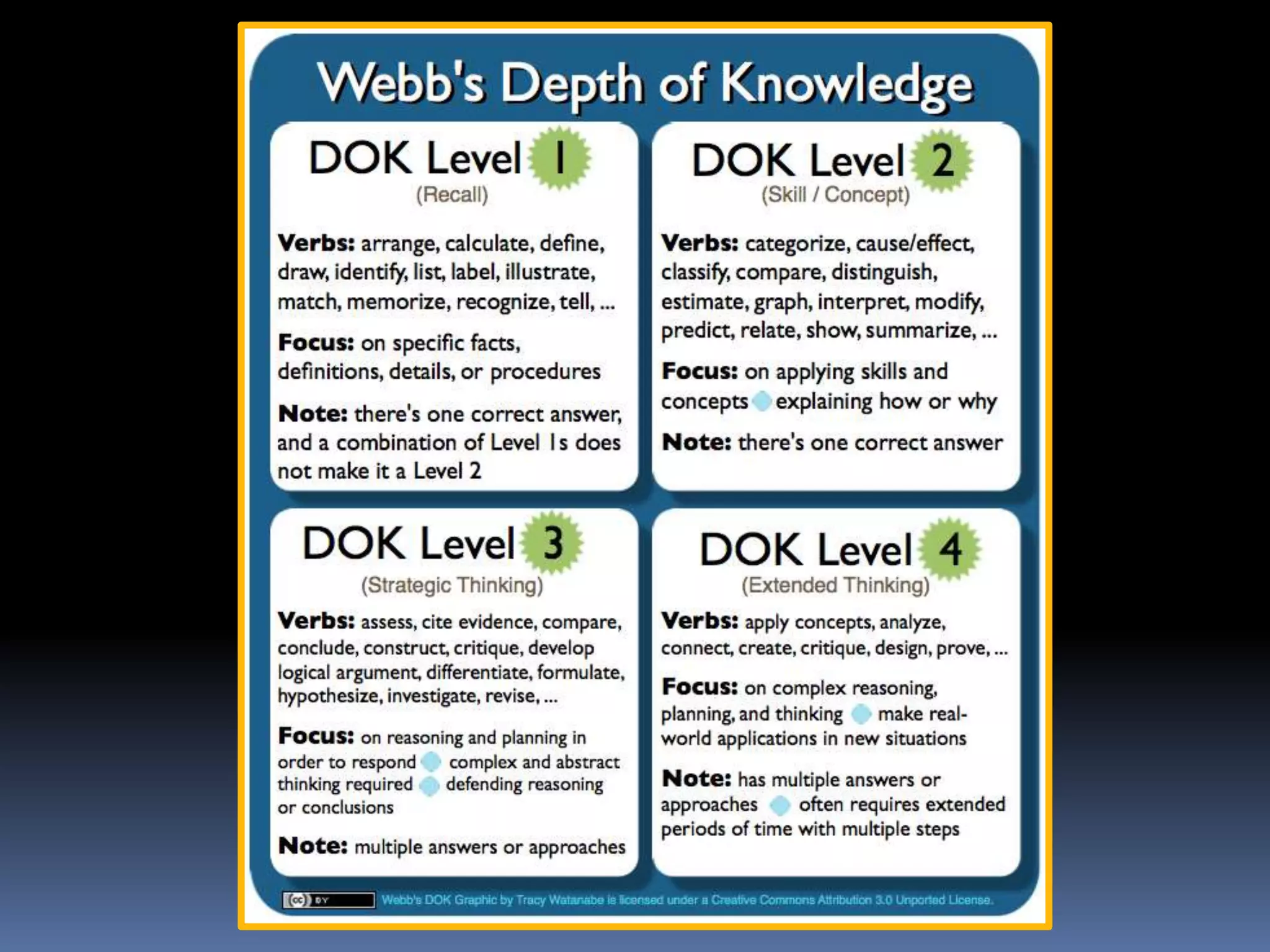
Webb’s
Depth of
Knowledge
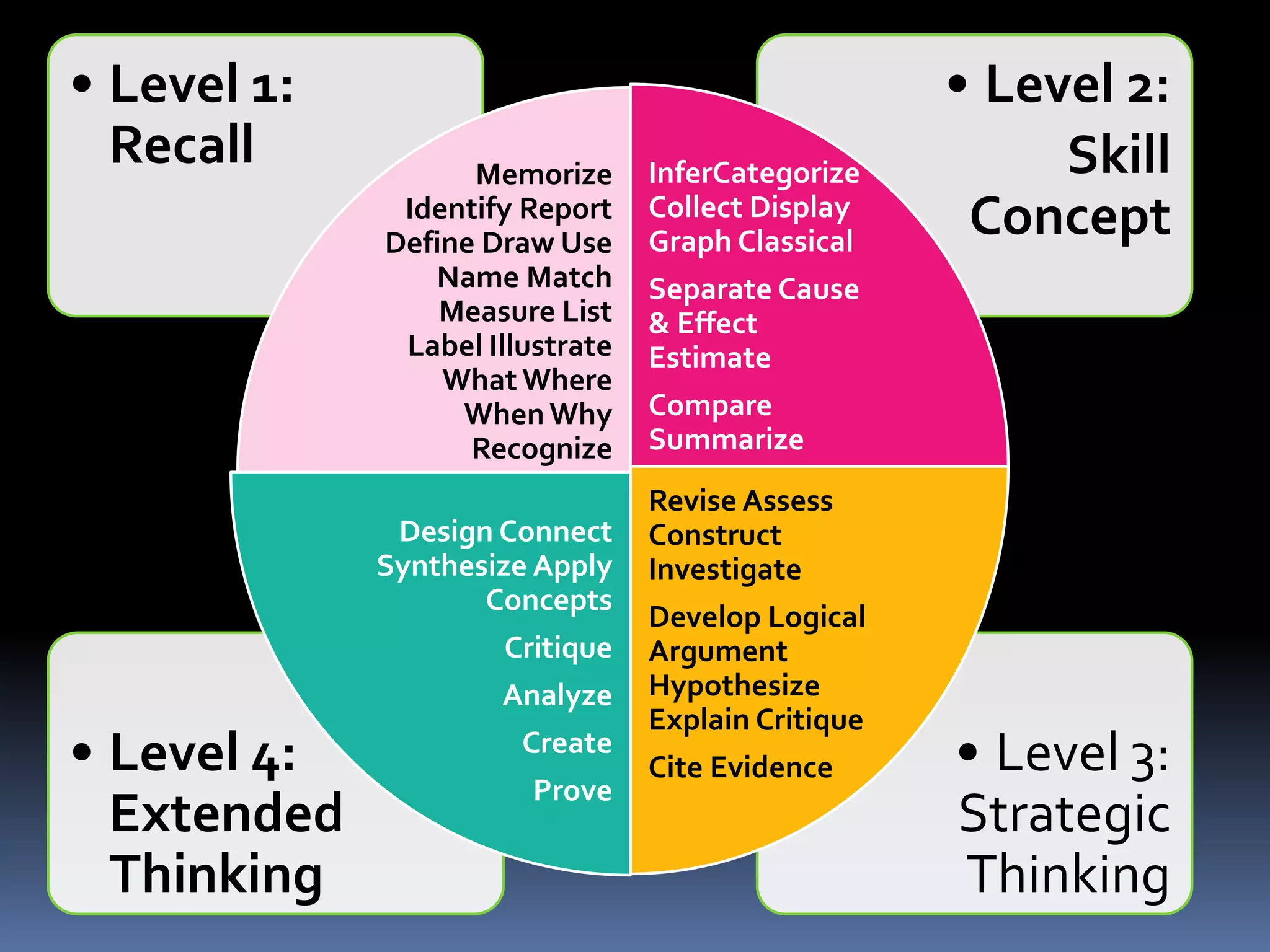
• Level 3:
Strategic
Thinking
• Level 4:
Extended
Thinking
• Level 2:
Skill
Concept
• Level 1:
Recall Memorize
Identify Report
Define Draw Use
Name Match
Measure List
Label Illustrate
What Where
When Why
Recognize
Repeat Recite
InferCategorize
Collect Display
Graph Classical
Separate Cause
& Effect
Estimate
Compare
Summarize
Revise Assess
Construct
Investigate
Develop Logical
Argument
Hypothesize
Explain Critique
Cite Evidence
Design Connect
Synthesize Apply
Concepts
Critique
Analyze
Create
Prove
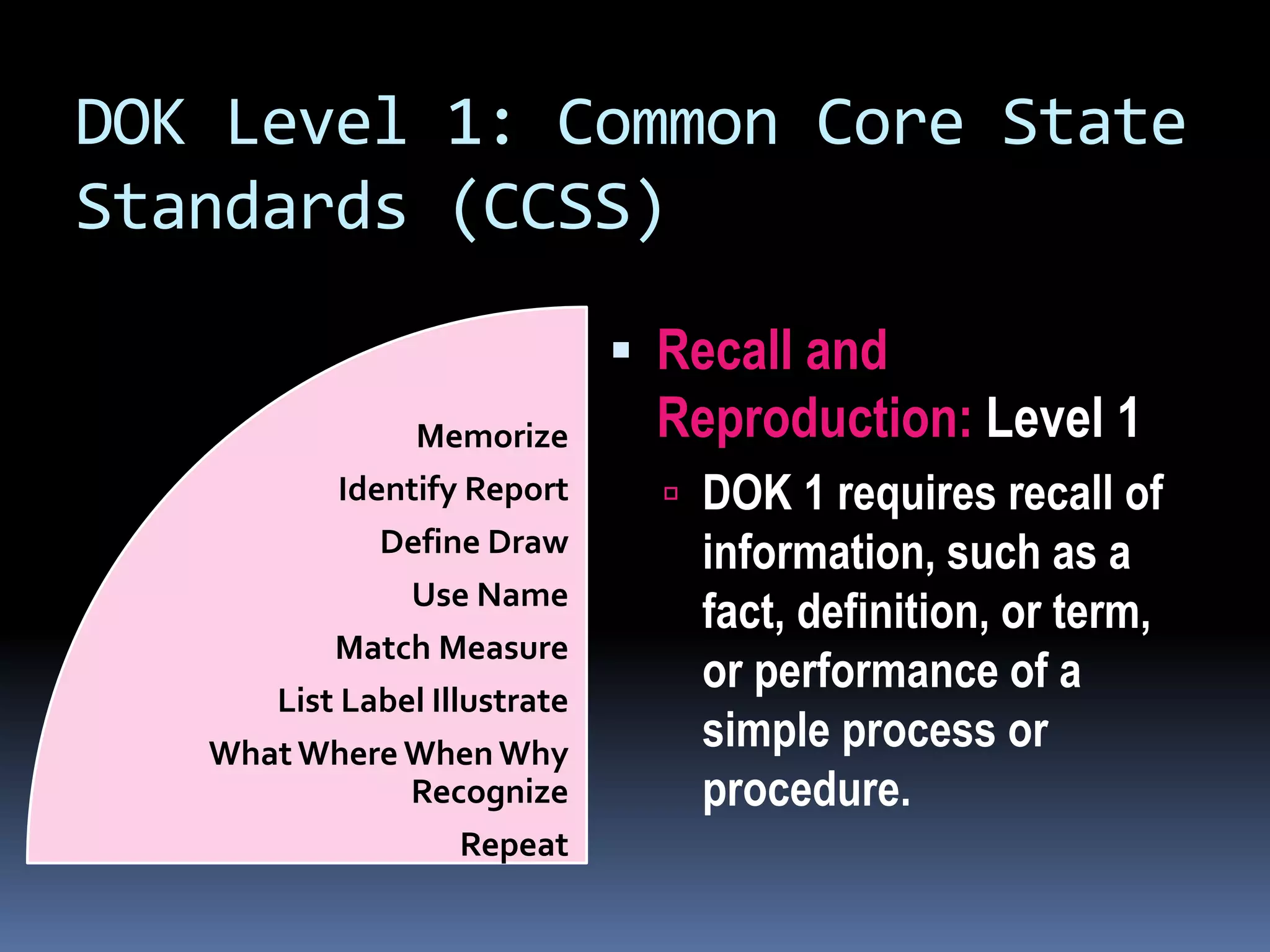
DOK Level 1: Common Core State
Standards (CCSS)
 Recall and
Reproduction: Level 1
 DOK 1 requires recall of
information, such as a
fact, definition, or term,
or performance of a
simple process or
procedure.
Memorize
Identify Report
Define Draw
Use Name
Match Measure
List Label Illustrate
What Where When Why
Recognize
Repeat
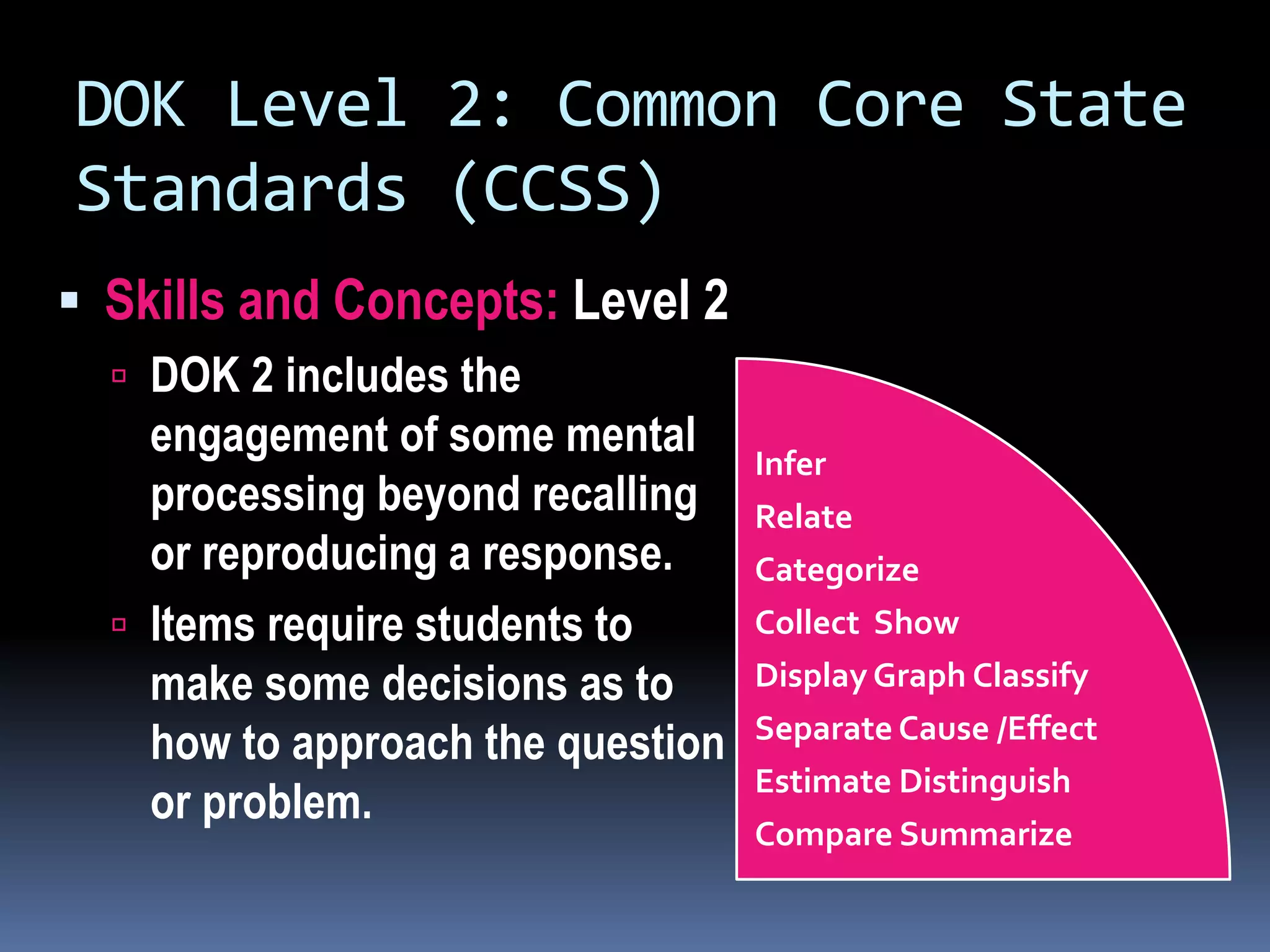
DOK Level 2: Common Core State
Standards (CCSS)
 Skills and Concepts: Level 2
 DOK 2 includes the
engagement of some mental
processing beyond recalling
or reproducing a response.
 Items require students to
make some decisions as to
how to approach the question
or problem.
Infer
Relate
Categorize
Collect Show
Display Graph Classify
Separate Cause /Effect
Estimate Distinguish
Compare Summarize
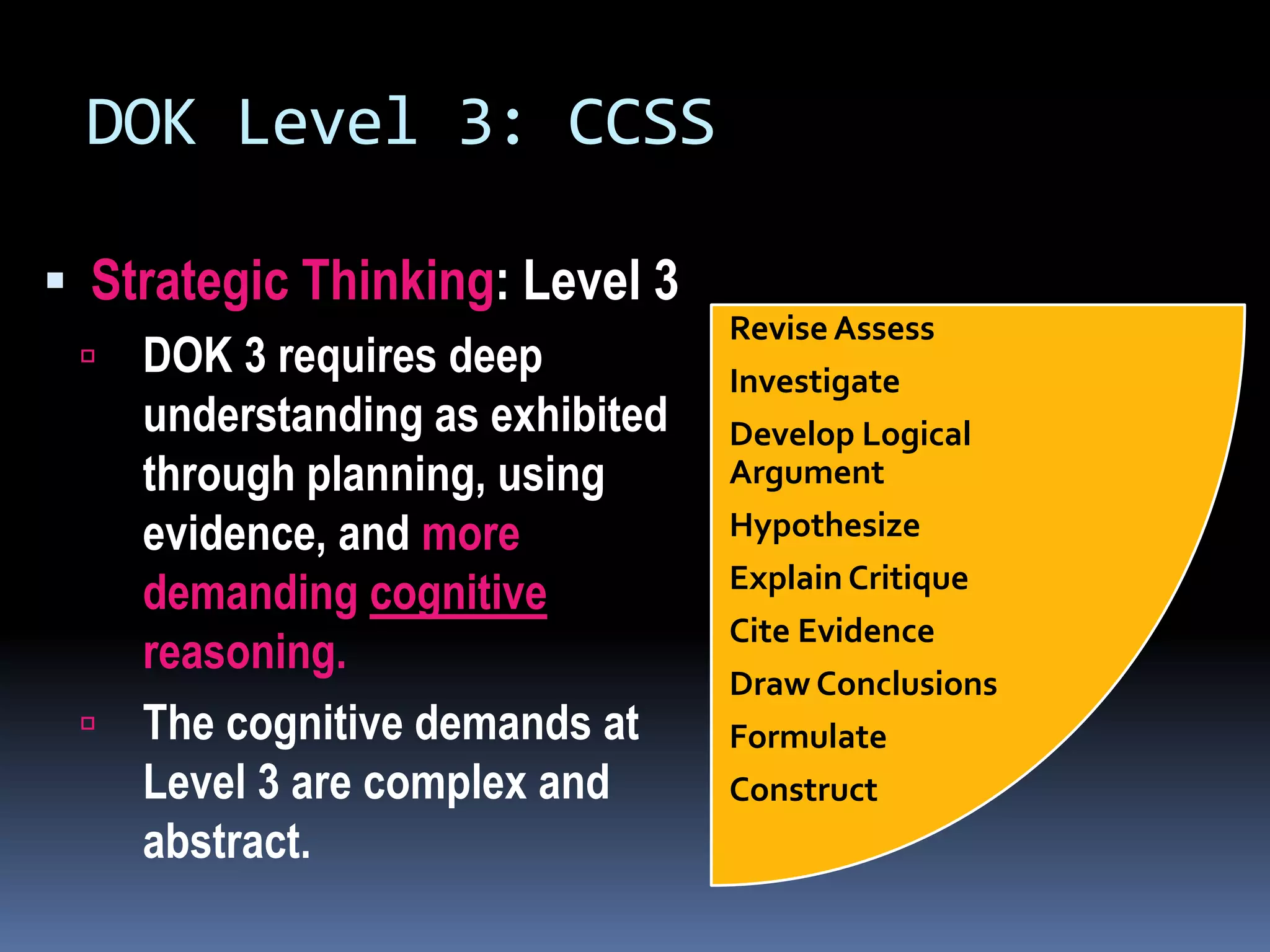
DOK Level 3: CCSS
 Strategic Thinking: Level 3
 DOK 3 requires deep
understanding as exhibited
through planning, using
evidence, and more
demanding cognitive
reasoning.
 The cognitive demands at
Level 3 are complex and
abstract.
Revise Assess
Investigate
Develop Logical
Argument
Hypothesize
Explain Critique
Cite Evidence
Draw Conclusions
Formulate
Construct
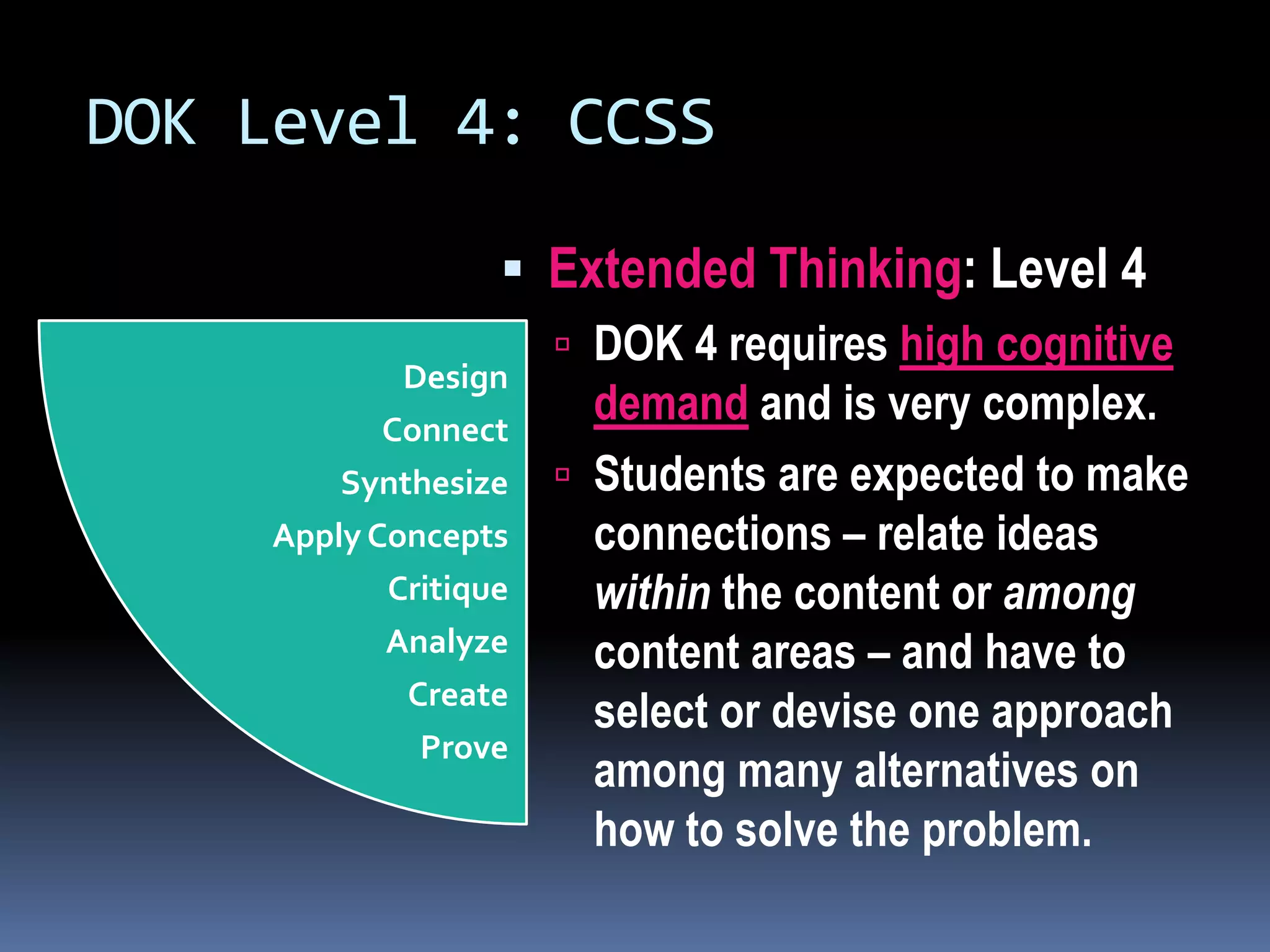
DOK Level 4: CCSS
 Extended Thinking: Level 4
 DOK 4 requires high cognitive
demand and is very complex.
 Students are expected to make
connections – relate ideas
within the content or among
content areas – and have to
select or devise one approach
among many alternatives on
how to solve the problem.
Design
Connect
Synthesize
Apply Concepts
Critique
Analyze
Create
Prove
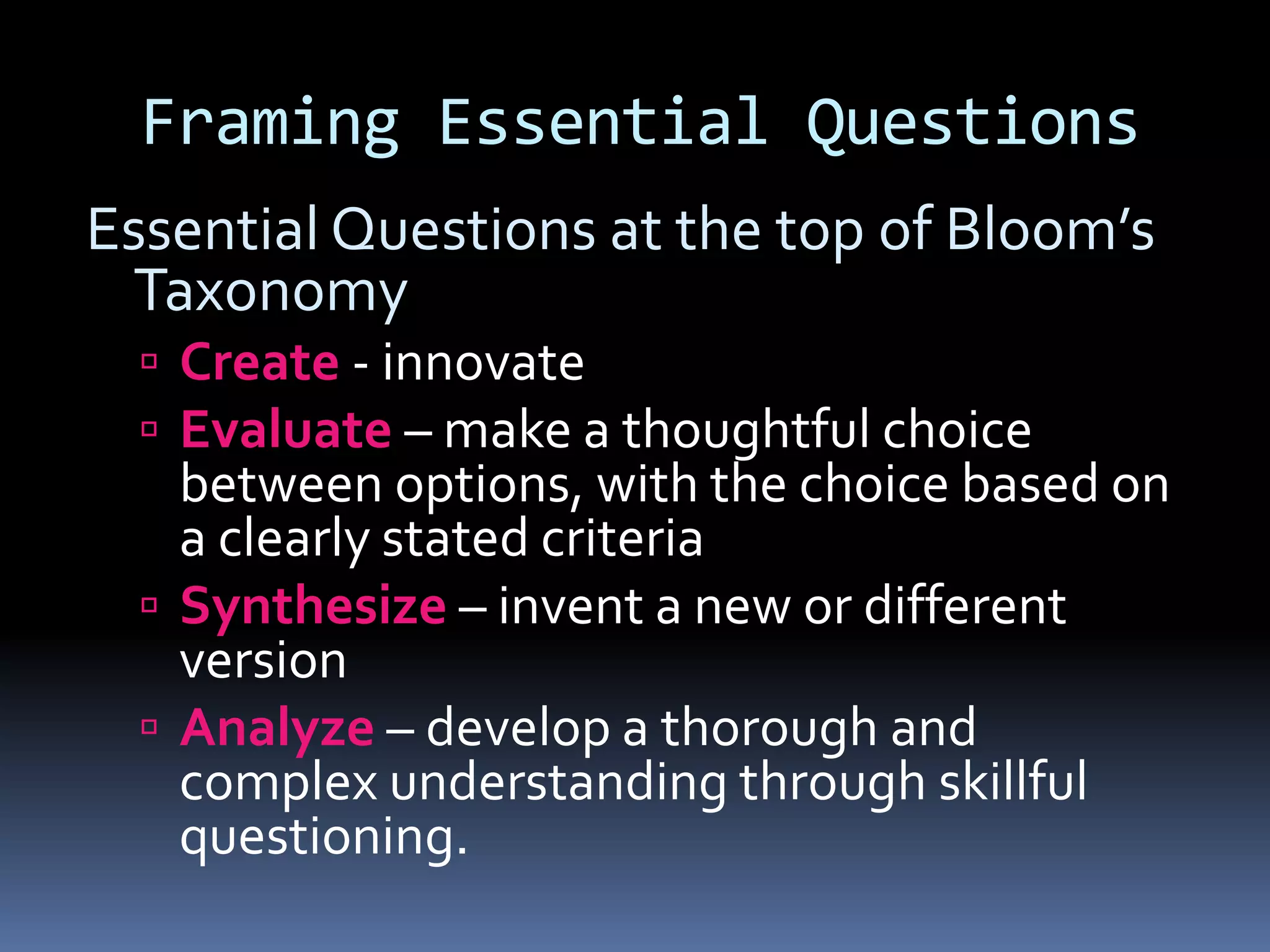
Framing Essential Questions
Essential Questions at the top of Bloom’s
Taxonomy
 Create - innovate
 Evaluate – make a thoughtful choice
between options, with the choice based on
a clearly stated criteria
 Synthesize – invent a new or different
version
 Analyze – develop a thorough and
complex understanding through skillful
questioning.
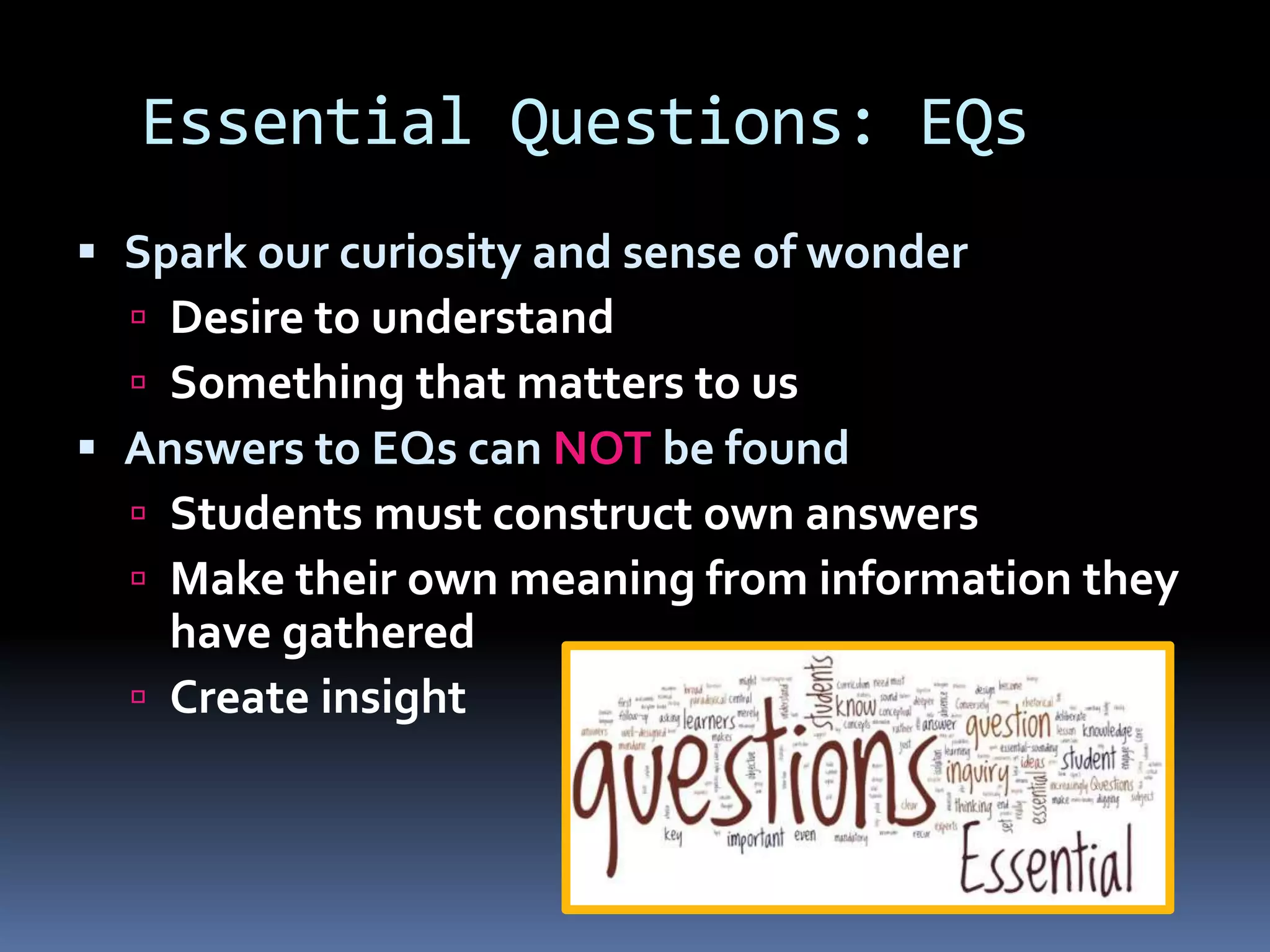
Essential Questions: EQs
 Spark our curiosity and sense of wonder
 Desire to understand
 Something that matters to us
 Answers to EQs can NOT be found
 Students must construct own answers
 Make their own meaning from information they
have gathered
 Create insight
Essential Questions
 Answering such questions may
take a lifetime!
 Answers may only be tentative
 Information gathering may take
place outside of formal learning
environments
 Engage students in real life applied
problem solving
 EQs lend themselves to
multidisciplinary investigations.
Ideal Essential Questions
 Framed by students themselves
 Best to start with subsidiary
questions that might help support
the main question
 Formulate categories of related
questions
 “What else do we need to know?
 State suppositions
 Hypothesizing and Predicting
 Thought process helps provide a basis
for construction of meaning.
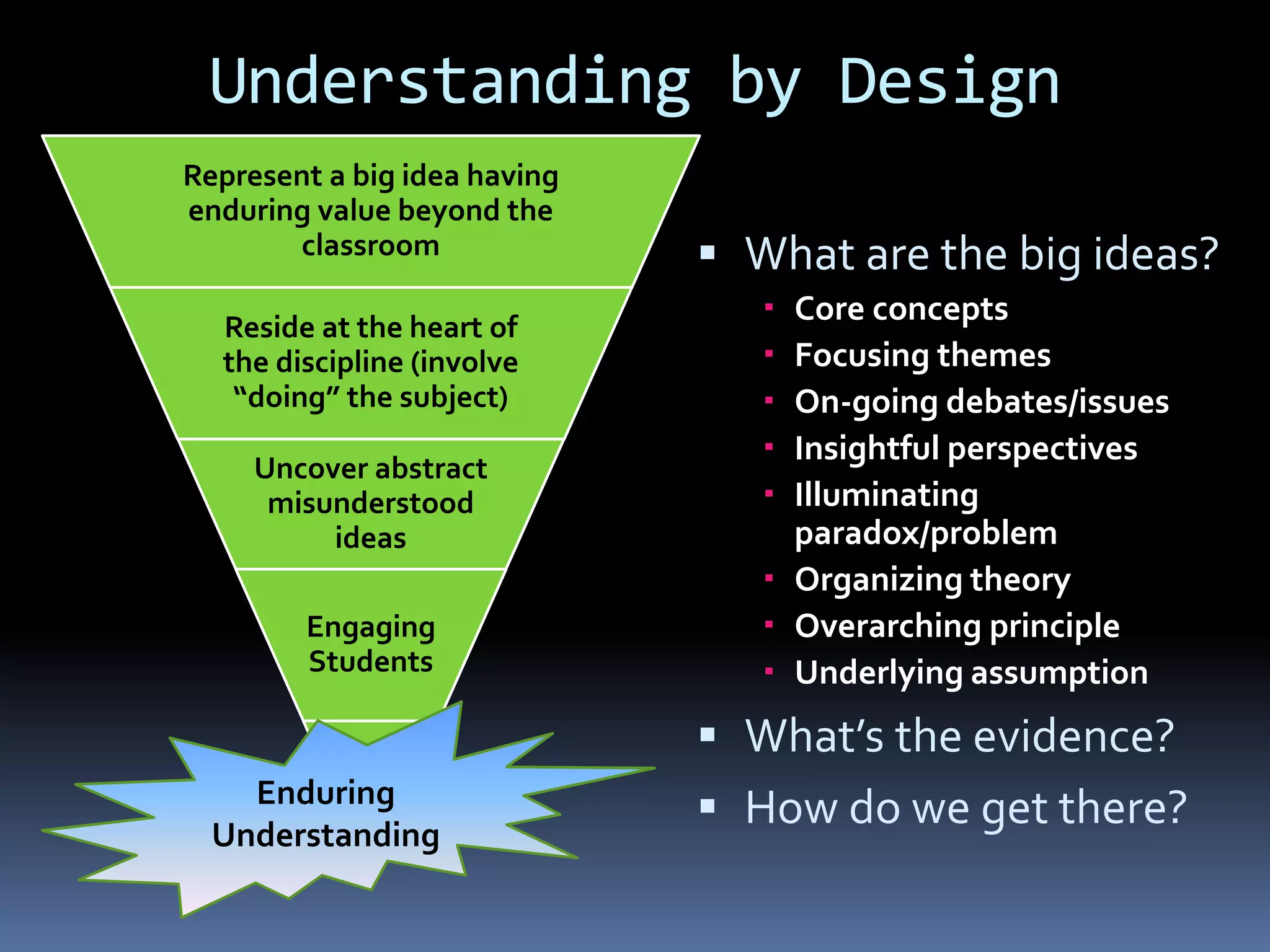
Understanding by Design
 What are the big ideas?
 Core concepts
 Focusing themes
 On-going debates/issues
 Insightful perspectives
 Illuminating
paradox/problem
 Organizing theory
 Overarching principle
 Underlying assumption
 What’s the evidence?
 How do we get there?
Represent a big idea having
enduring value beyond the
classroom
Reside at the heart of
the discipline (involve
“doing” the subject)
Uncover abstract
misunderstood
ideas
Engaging
Students
Enduring
Understanding
Understanding by Design
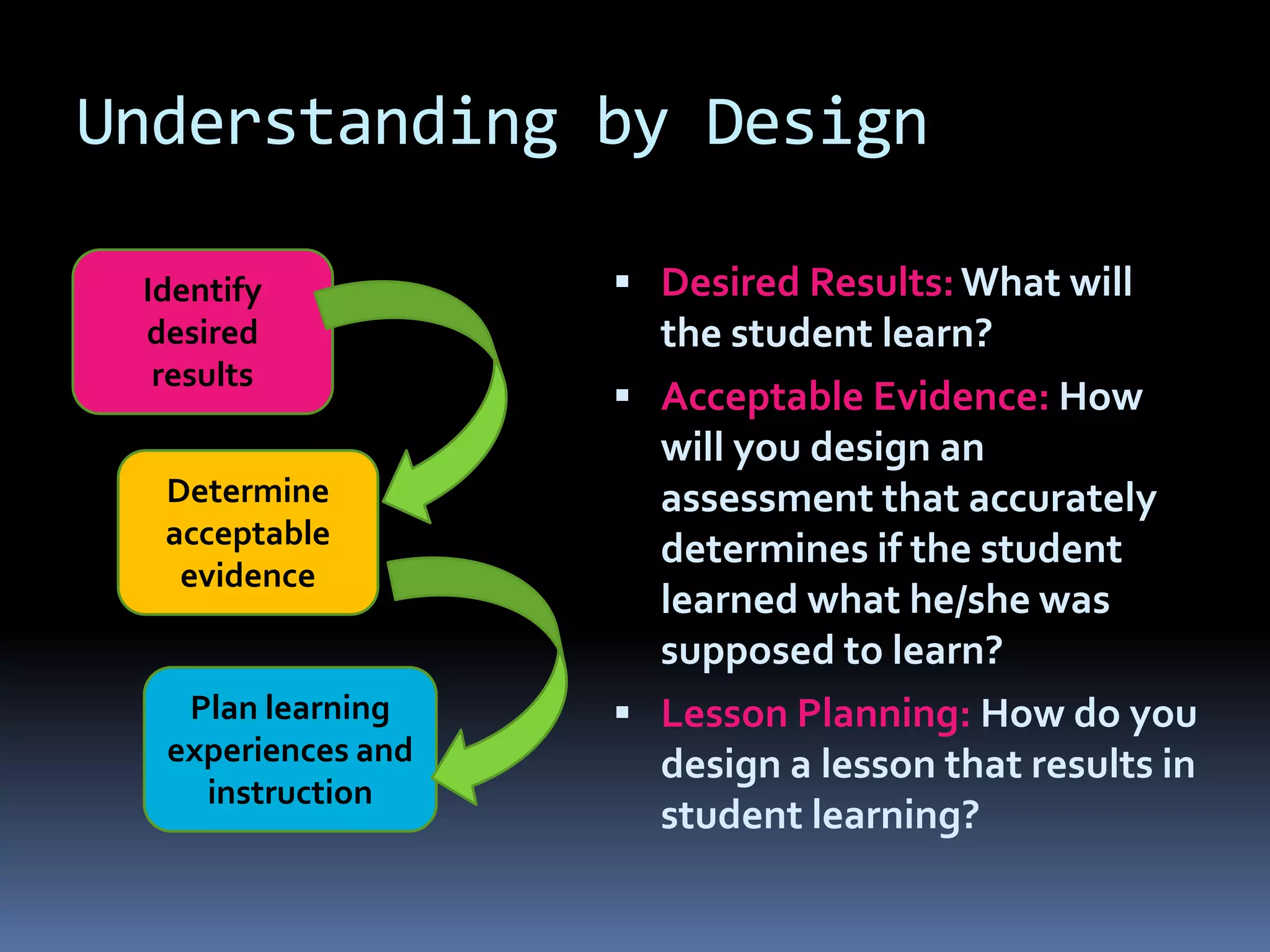
 Desired Results:What will
the student learn?
 Acceptable Evidence: How
will you design an
assessment that accurately
determines if the student
learned what he/she was
supposed to learn?
 Lesson Planning: How do you
design a lesson that results in
student learning?
Identify
desired
results
Determine
acceptable
evidence
Plan learning
experiences and
instruction
Understanding by Design
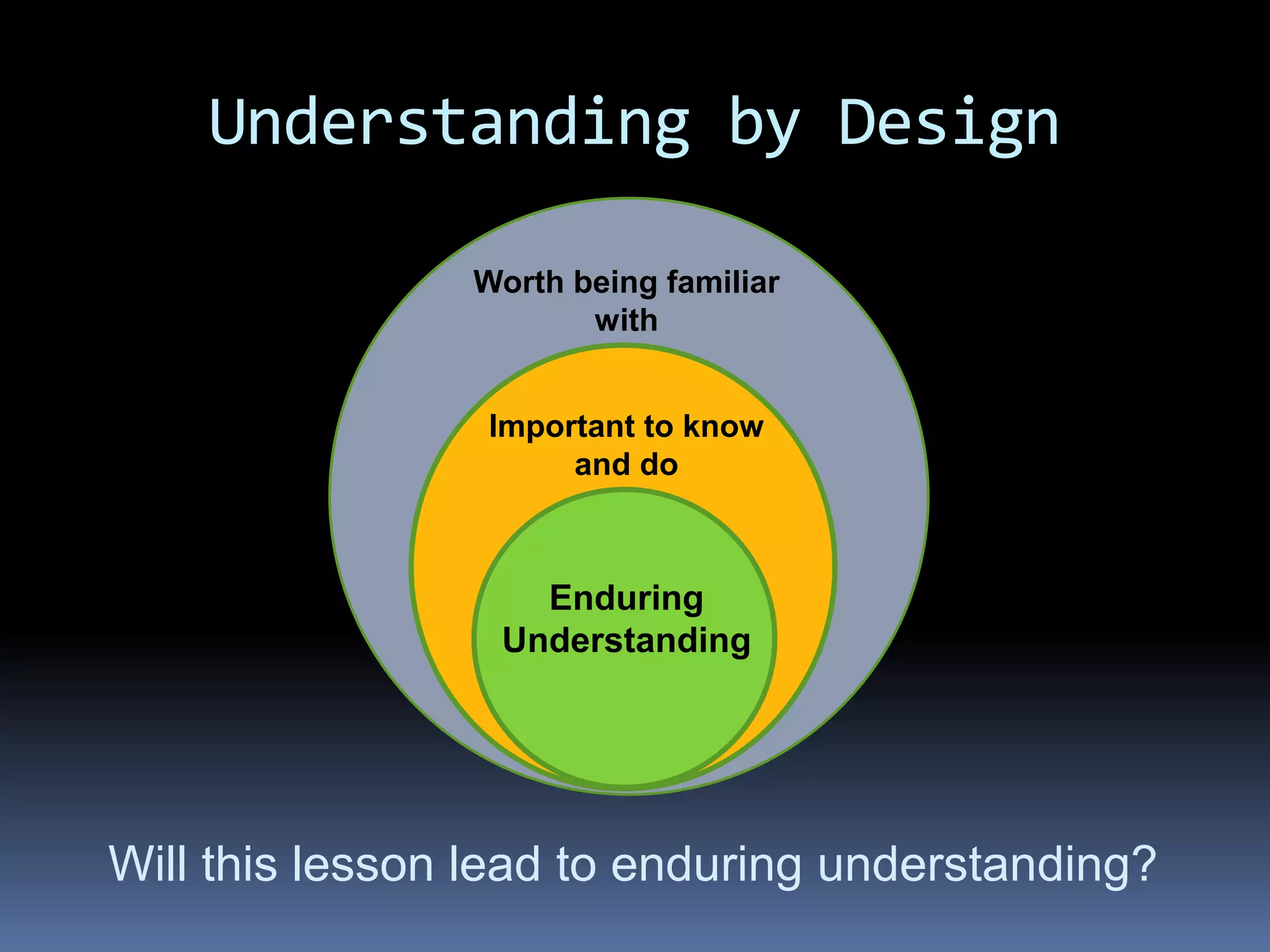
Will this lesson lead to enduring understanding?
Worth being familiar
with
Important to know
and do
Enduring
Understanding
Understanding by Design
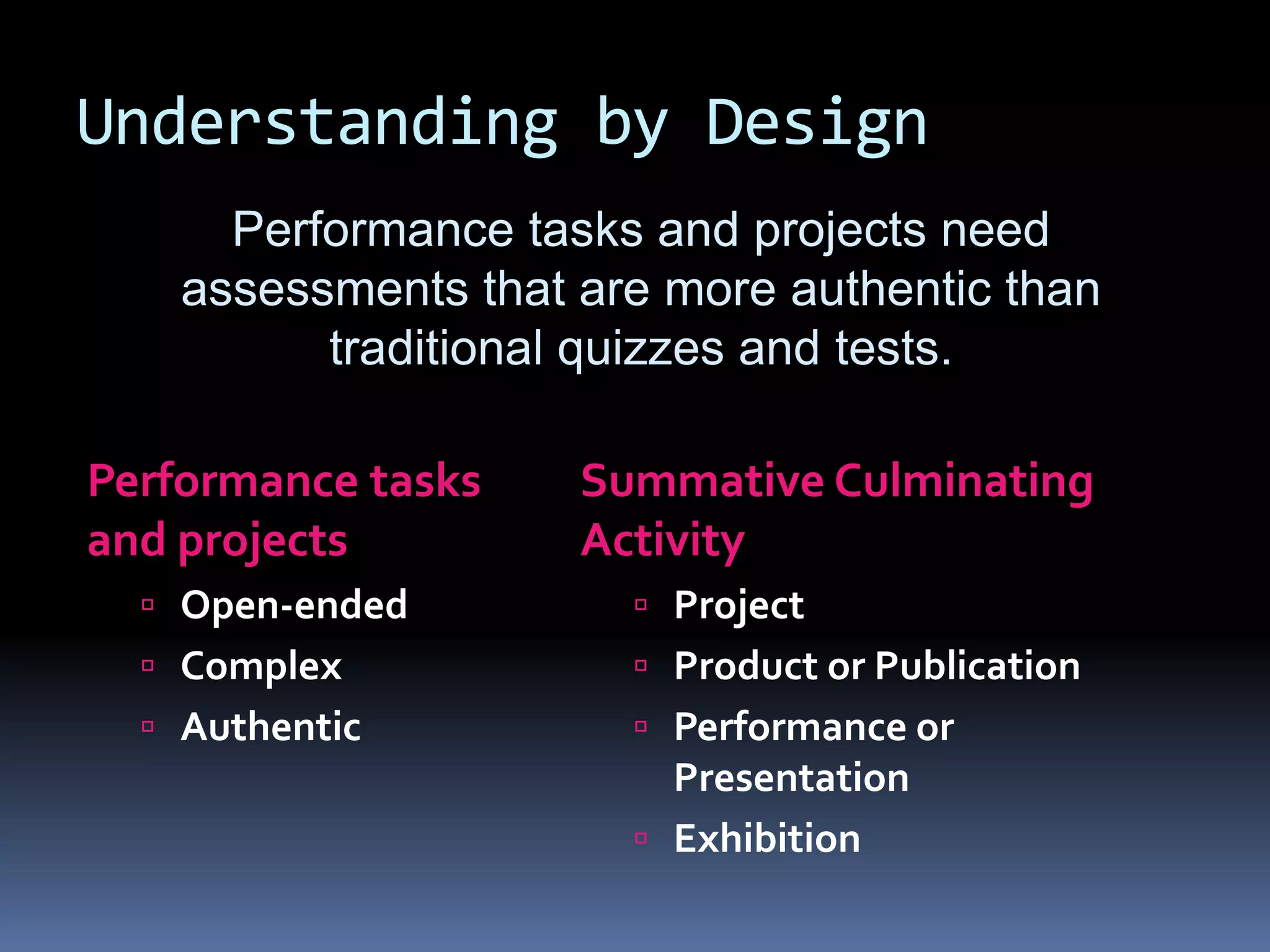
Performance tasks
and projects
 Open-ended
 Complex
 Authentic
Summative Culminating
Activity
 Project
 Product or Publication
 Performance or
Presentation
 Exhibition
Performance tasks and projects need
assessments that are more authentic than
traditional quizzes and tests.
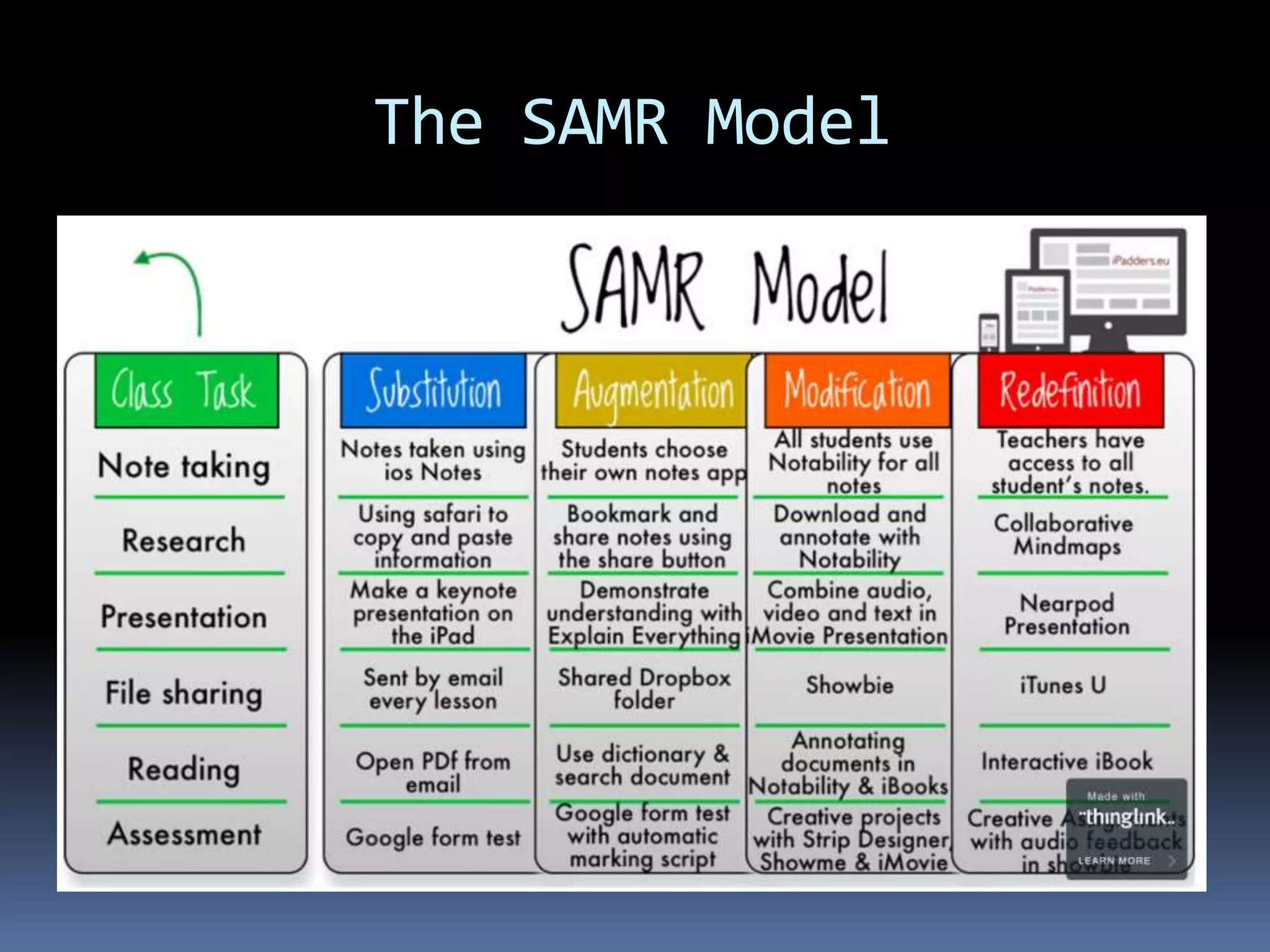
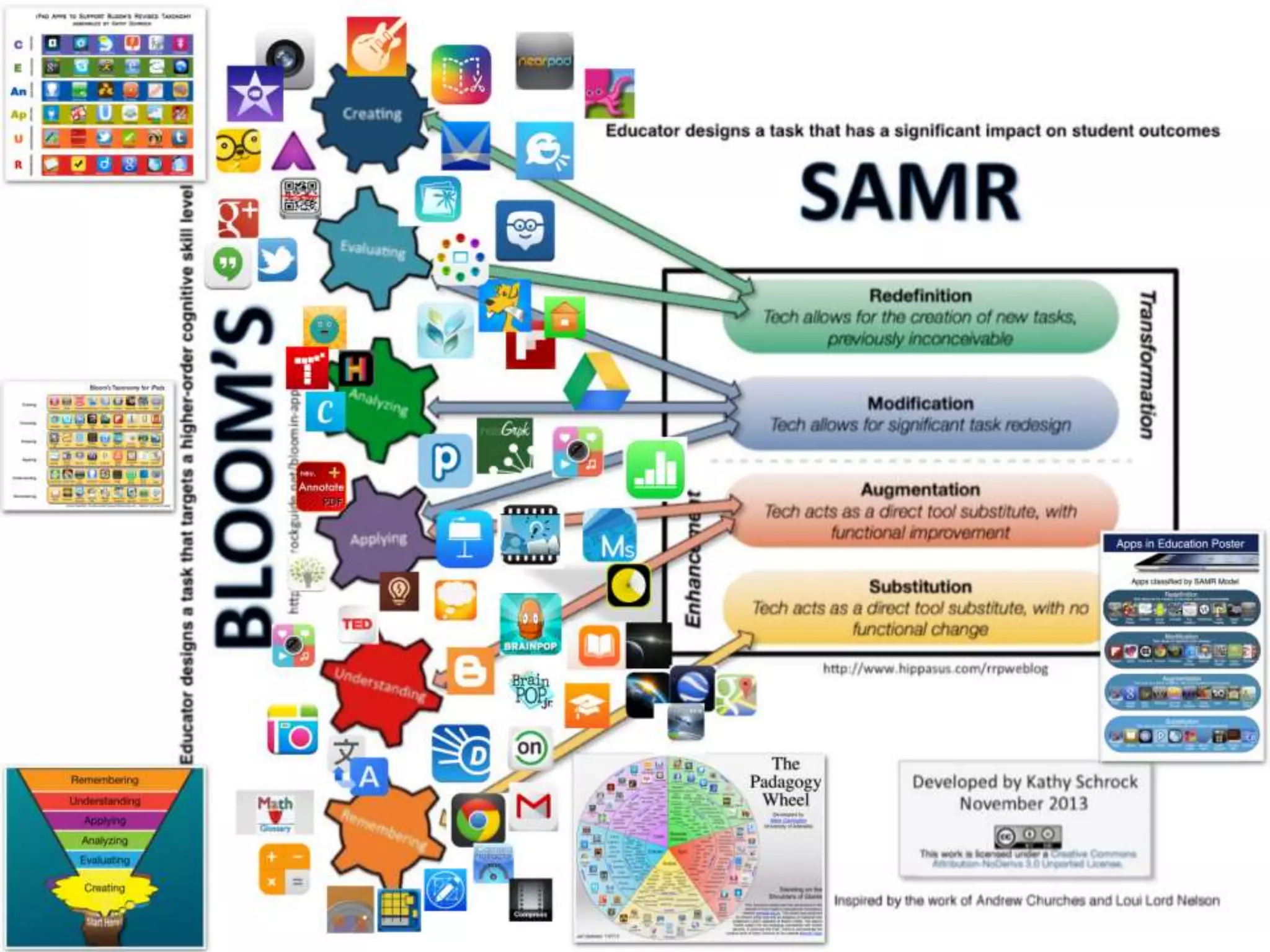
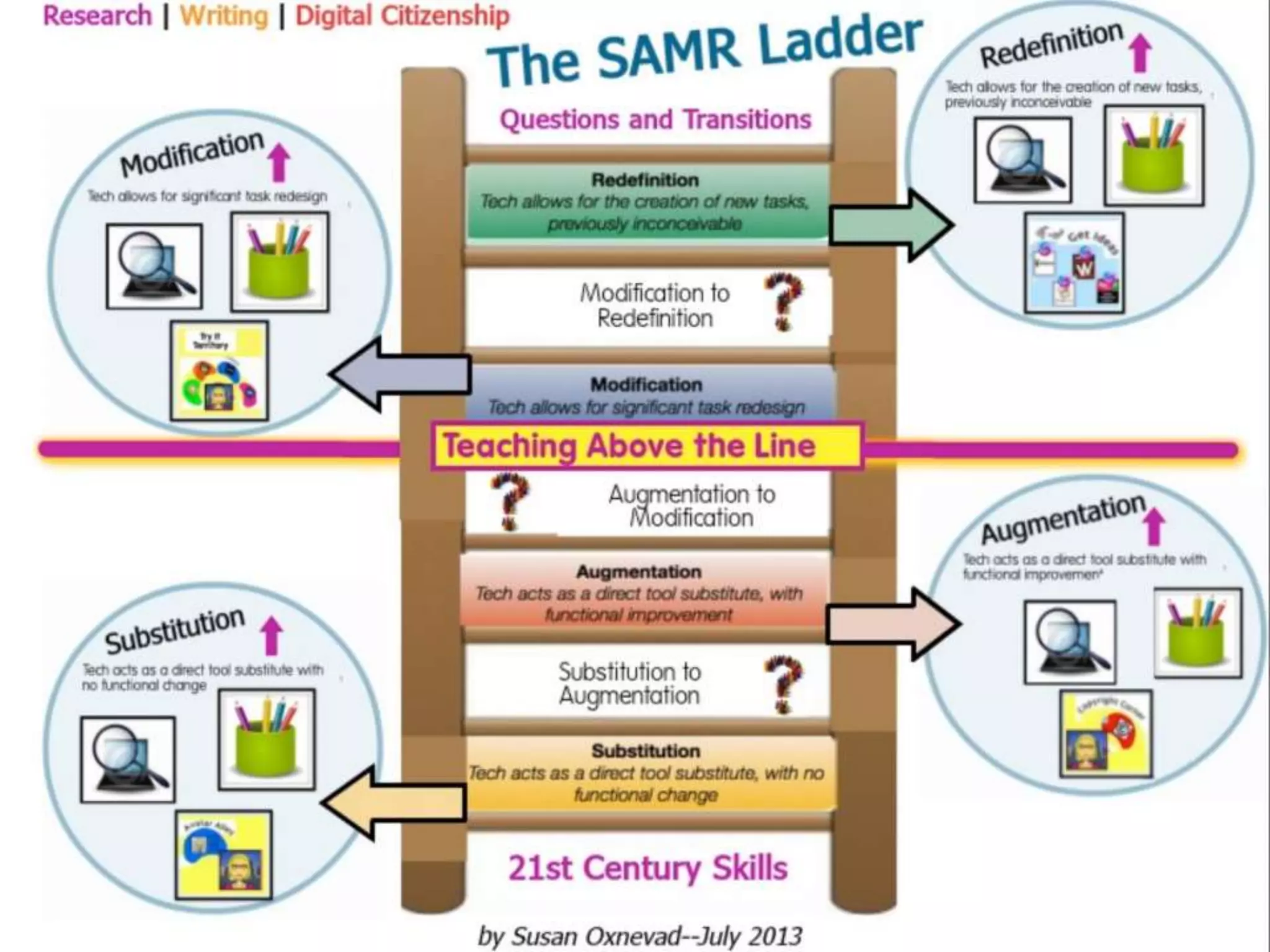
The SAMR Model
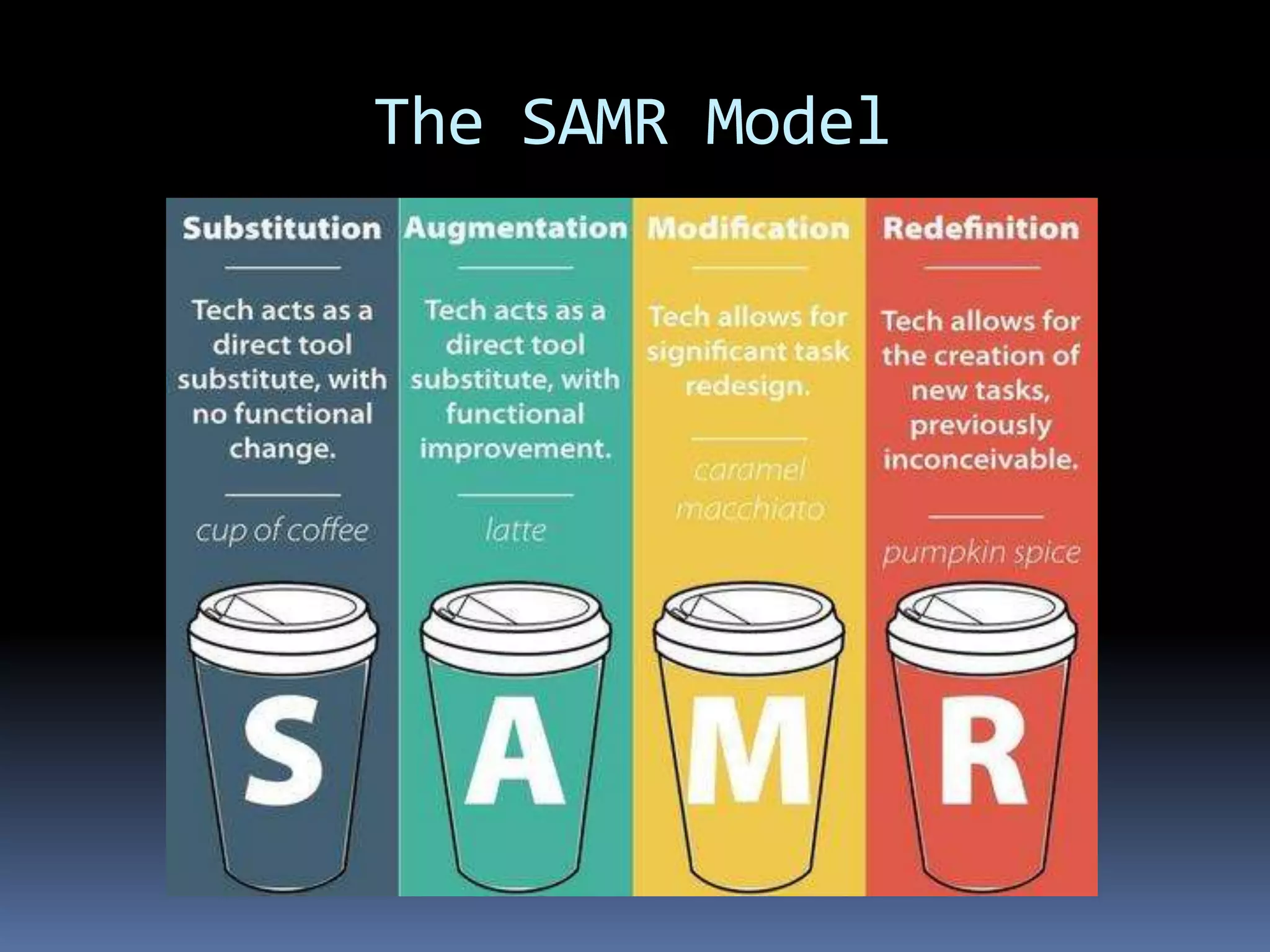
The SAMR Model
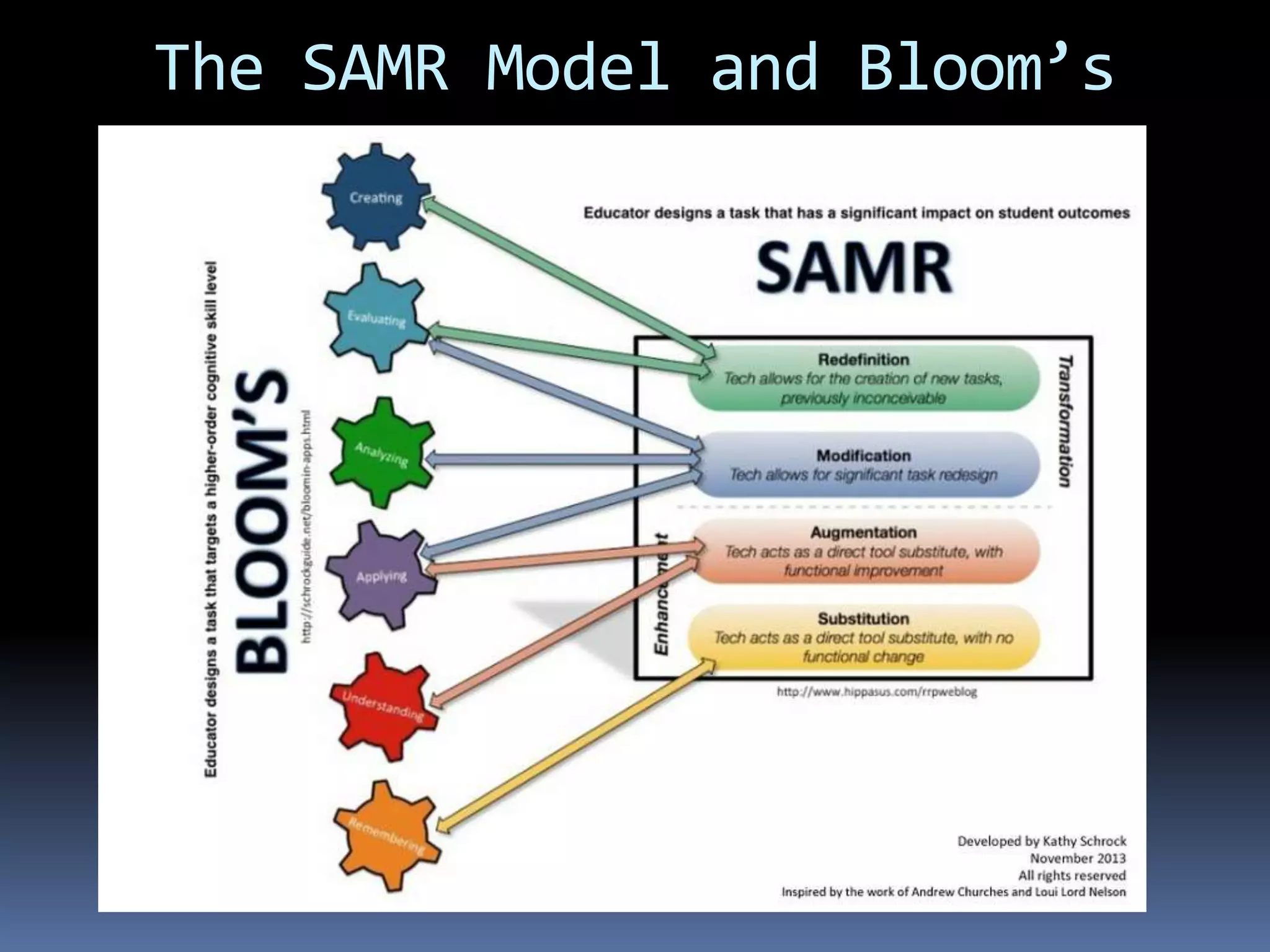
The SAMR Model and Bloom’s
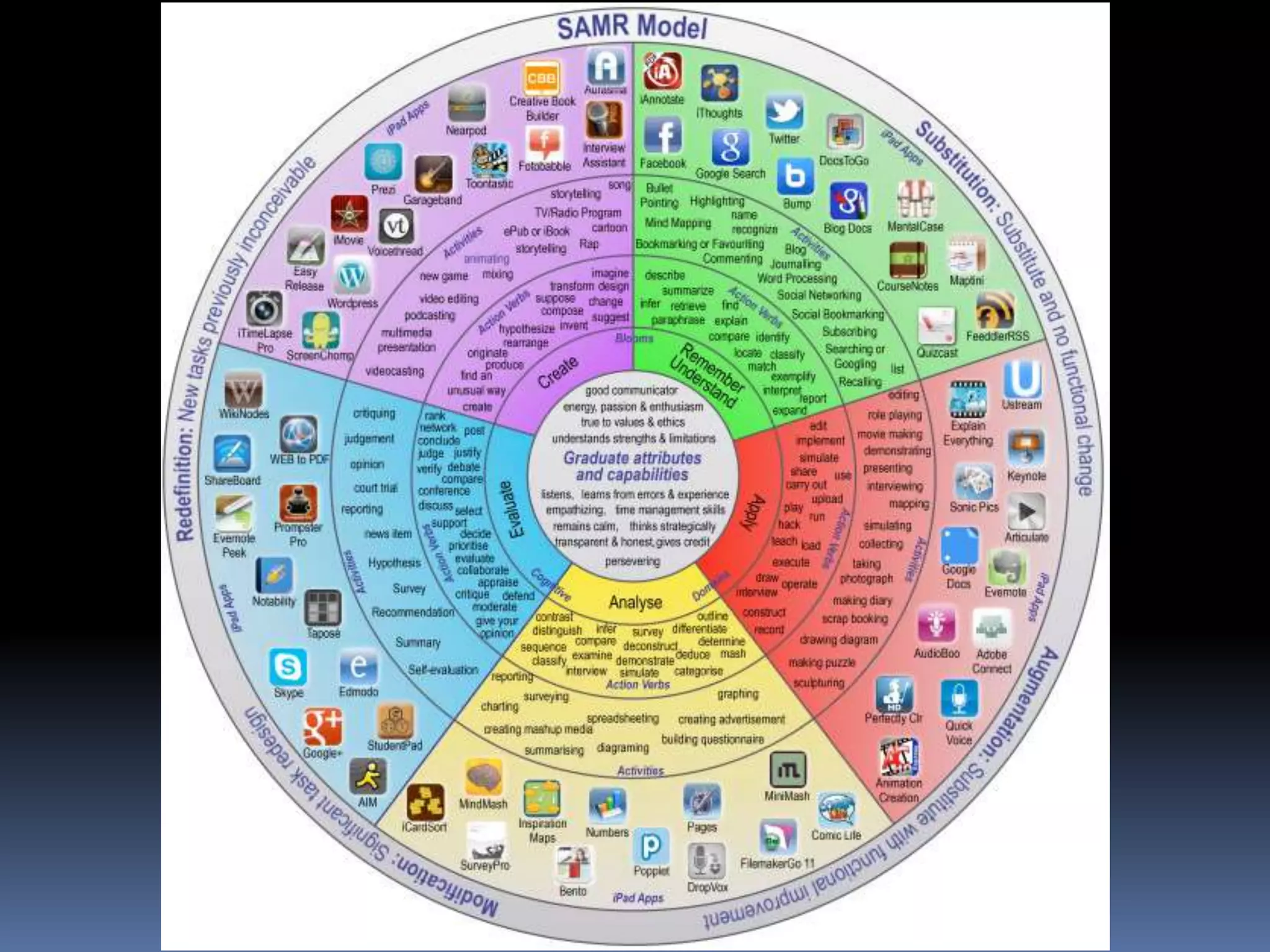
SAMR,TPCK, DOK, and Bloom’s
Eduu 551 Essential Questions and Integrating Technology

Eduu 551 Essential Questions and Integrating Technology

  • 1.
  • 2.
    ESSENTIAL QUESTIONS BLOOM'S TAXONOMY DEPTHOF KNOWLEDGE (DOK) UNDERSTANDING BY DESIGN BACKWARDS DESIGN ESSENTIAL QUESTIONS SAMR, TPACK, DOK, AND BLOOM’S
  • 3.
    Bloom’s Thinking Levels Askstudents to demonstrate:  Knowledge - recall information in original form  Comprehension - show understanding  Application - use learning in a new situation  Analysis - show s/he can see relationships  Synthesis - combine and integrate parts of prior knowledge into a product, plan, or proposal that is new  Evaluation - assess and criticize on basis of standards and criteria 1956
  • 4.
    Remembering Understanding Applying Analyzing Evaluating Creating • Creating –designing, constructing, planning, producing, inventing, devising, making • Evaluating – checking, hypothesizing, critiquing, experimenting, judging, testing, detecting, monitoring • Analyzing – comparing, organizing, deconstructing, attributing, outlining, finding, structuring, integrating • Applying – implementing, carrying out, using, executing • Understanding – interpreting, summarizing, inferring, paraphrasing, classifying, comparing, explaining, exemplifying • Remembering – recognizing, listing, describing, identifying, retrieving, naming, locating, finding Bloom’s Revised Taxonomy
  • 5.
  • 7.
    • Level 3: Strategic Thinking •Level 4: Extended Thinking • Level 2: Skill Concept • Level 1: Recall Memorize Identify Report Define Draw Use Name Match Measure List Label Illustrate What Where When Why Recognize Repeat Recite InferCategorize Collect Display Graph Classical Separate Cause & Effect Estimate Compare Summarize Revise Assess Construct Investigate Develop Logical Argument Hypothesize Explain Critique Cite Evidence Design Connect Synthesize Apply Concepts Critique Analyze Create Prove
  • 8.
    DOK Level 1:Common Core State Standards (CCSS)  Recall and Reproduction: Level 1  DOK 1 requires recall of information, such as a fact, definition, or term, or performance of a simple process or procedure. Memorize Identify Report Define Draw Use Name Match Measure List Label Illustrate What Where When Why Recognize Repeat
  • 9.
    DOK Level 2:Common Core State Standards (CCSS)  Skills and Concepts: Level 2  DOK 2 includes the engagement of some mental processing beyond recalling or reproducing a response.  Items require students to make some decisions as to how to approach the question or problem. Infer Relate Categorize Collect Show Display Graph Classify Separate Cause /Effect Estimate Distinguish Compare Summarize
  • 10.
    DOK Level 3:CCSS  Strategic Thinking: Level 3  DOK 3 requires deep understanding as exhibited through planning, using evidence, and more demanding cognitive reasoning.  The cognitive demands at Level 3 are complex and abstract. Revise Assess Investigate Develop Logical Argument Hypothesize Explain Critique Cite Evidence Draw Conclusions Formulate Construct
  • 11.
    DOK Level 4:CCSS  Extended Thinking: Level 4  DOK 4 requires high cognitive demand and is very complex.  Students are expected to make connections – relate ideas within the content or among content areas – and have to select or devise one approach among many alternatives on how to solve the problem. Design Connect Synthesize Apply Concepts Critique Analyze Create Prove
  • 12.
    Framing Essential Questions EssentialQuestions at the top of Bloom’s Taxonomy  Create - innovate  Evaluate – make a thoughtful choice between options, with the choice based on a clearly stated criteria  Synthesize – invent a new or different version  Analyze – develop a thorough and complex understanding through skillful questioning.
  • 13.
    Essential Questions: EQs Spark our curiosity and sense of wonder  Desire to understand  Something that matters to us  Answers to EQs can NOT be found  Students must construct own answers  Make their own meaning from information they have gathered  Create insight
  • 14.
    Essential Questions  Answeringsuch questions may take a lifetime!  Answers may only be tentative  Information gathering may take place outside of formal learning environments  Engage students in real life applied problem solving  EQs lend themselves to multidisciplinary investigations.
  • 15.
    Ideal Essential Questions Framed by students themselves  Best to start with subsidiary questions that might help support the main question  Formulate categories of related questions  “What else do we need to know?  State suppositions  Hypothesizing and Predicting  Thought process helps provide a basis for construction of meaning.
  • 16.
    Understanding by Design What are the big ideas?  Core concepts  Focusing themes  On-going debates/issues  Insightful perspectives  Illuminating paradox/problem  Organizing theory  Overarching principle  Underlying assumption  What’s the evidence?  How do we get there? Represent a big idea having enduring value beyond the classroom Reside at the heart of the discipline (involve “doing” the subject) Uncover abstract misunderstood ideas Engaging Students Enduring Understanding
  • 17.
    Understanding by Design Desired Results:What will the student learn?  Acceptable Evidence: How will you design an assessment that accurately determines if the student learned what he/she was supposed to learn?  Lesson Planning: How do you design a lesson that results in student learning? Identify desired results Determine acceptable evidence Plan learning experiences and instruction
  • 18.
    Understanding by Design Willthis lesson lead to enduring understanding? Worth being familiar with Important to know and do Enduring Understanding
  • 19.
    Understanding by Design Performancetasks and projects  Open-ended  Complex  Authentic Summative Culminating Activity  Project  Product or Publication  Performance or Presentation  Exhibition Performance tasks and projects need assessments that are more authentic than traditional quizzes and tests.
  • 21.
  • 22.
  • 24.
    The SAMR Modeland Bloom’s
  • 26.