Strategic Planning
      in Education

         Cristopher C. Midea
                    Reporter
Strategic Planning in Education


Planning
      is a process whereby a direction is
 mapped and then the ways and means for
 following that direction are specified.


Plan
      is the product of the planning
process and can be defined as a set of
decisions about what to do, why, and how
to do it.
Strategic Planning in Education

Reasons for Strategic Planning
• First, one may wish to plan and carry out all
  the activities that people deem necessary,
  but without achieving the ultimate goals and
  results.
• Furthermore,      more    resources    do  not
  necessarily stand for the best results. The
  way one uses these resources can lead to
  different levels of benefits and results.
• Thirdly, it has become more and more
  difficult to plan everything one would wish to
  do. One ought to make choices, often tough
  ones, through a balanced decision-making,
  tradeoffs across the education system and
  through a consensus building process.
Strategic Planning in Education

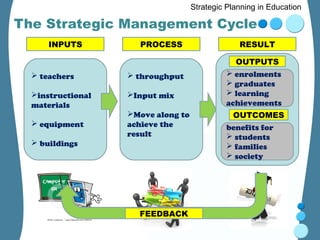
The Strategic Management Cycle
      INPUTS         PROCESS                     RESULT

                                                OUTPUTS
   teachers        throughput               enrolments
                                              graduates
  instructional   Input mix                 learning
  materials                                  achievements
                   Move along to              OUTCOMES
   equipment      achieve the               benefits for
                   result                     students
   buildings                                 families
                                              society


                     FEEDBACK
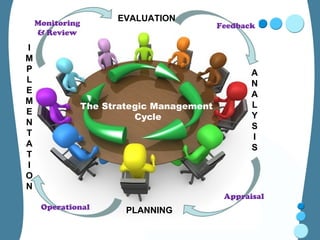
EVALUATION
    Monitoring                              Feedback
    & Review
I
M
P                                                  A
L                                                  N
E                                                  A
M
                 The Strategic Management          L
E
                           Cycle                   Y
N                                                  S
T                                                  I
A                                                  S
T
I
O
N
                                             Appraisal
     Operational         PLANNING
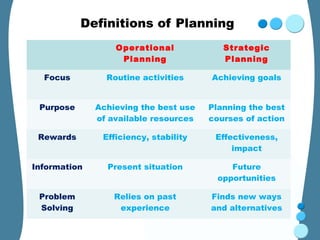
Definitions of Planning
                  Operational             Strategic
                   Planning               Planning

  Focus         Routine activities     Achieving goals


 Purpose      Achieving the best use   Planning the best
              of available resources   courses of action

 Rewards       Efficiency, stability    Effectiveness,
                                            impact

Information     Present situation           Future
                                         opportunities

 Problem          Relies on past       Finds new ways
 Solving           experience          and alternatives
Strategic Planning in Education

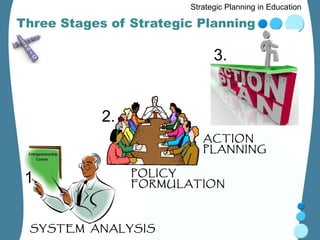
Three Stages of Strategic Planning

                              3.


            2.
                           ACTION
                           PLANNING

                 POLICY
 1.              FORMULATION


 SYSTEM ANALYSIS
Strategic Planning in Education

Three Stages of Strategic Planning
1. SYSTEM
ANALYSIS
      Sector analysis consists of
 conducting data collection on and
 critical analysis of how the education
 system functions (internal dynamics)
 and examining various contextual
 factors (the environment of the
 system).
Aspects to be considered in ESA
 • Macro-economic and socio-
   demographic frameworks
 • Access to and participation in
   education
 • Equity
 • Quality and relevance of education
 • External efficiency
 • Costs and financing in education
 • Managerial and institutional aspects
Strategic Planning in Education

Three Stages of Strategic Planning
2. POLICY FORMULATION

       Critical analysis of the educational
 system undertaken during the sector analysis
 leads to questions about what the education
 sector must do in order to address the major
 issues, challenges and opportunities. These
 questions include what overall results
 (strategic goals) the system should achieve
 and the overall methods (or strategies) to
 implement policies.
Threefold Dimensions in
          Education Policies
 Access
 - access, participation, including gender and
 equity issues

 Quality
 - quality, internal efficiency, relevance and
 external effectiveness

 Management
 - governance, decentralization, resource
 management
Indicatives in an Educational Policy
and the implementation Strategies:
 Access to and participation in education
 Equity and the reduction of disparities in terms of
  genders, regional, rural/urban and social disparities
 Quality and the relevance of education at different
  levels of education
 The place that the private sector and local groups
  occupy in the organization of education
 Regulation of student flow
 Institutional aspects such as governance,
  management and planning
 Partnership and communication between actors and
  partners, the level and forms of participation and
  communication
 Cost control in reccurent and capital expenditure
 Mobilize resources in connection with decentralization
Strategic Planning in Education

Three Stages of Strategic Planning
3. ACTION
PLANNING
      Action planning is a process whereby
 one translates the policy directions into
 executable, measurable and accountable
 actions. In a broader sense, action planning
 includes specifying objectives, outputs,
 strategies, responsibilities and timelines
 (what, what for, how, who and when).
strategic planning in education

strategic planning in education

  • 1.
    Strategic Planning in Education Cristopher C. Midea Reporter
  • 2.
    Strategic Planning inEducation Planning is a process whereby a direction is mapped and then the ways and means for following that direction are specified. Plan is the product of the planning process and can be defined as a set of decisions about what to do, why, and how to do it.
  • 3.
    Strategic Planning inEducation Reasons for Strategic Planning • First, one may wish to plan and carry out all the activities that people deem necessary, but without achieving the ultimate goals and results. • Furthermore, more resources do not necessarily stand for the best results. The way one uses these resources can lead to different levels of benefits and results. • Thirdly, it has become more and more difficult to plan everything one would wish to do. One ought to make choices, often tough ones, through a balanced decision-making, tradeoffs across the education system and through a consensus building process.
  • 4.
    Strategic Planning inEducation The Strategic Management Cycle INPUTS PROCESS RESULT OUTPUTS  teachers  throughput  enrolments  graduates instructional Input mix  learning materials achievements Move along to OUTCOMES  equipment achieve the benefits for result  students  buildings  families  society FEEDBACK
  • 5.
    EVALUATION Monitoring Feedback & Review I M P A L N E A M The Strategic Management L E Cycle Y N S T I A S T I O N Appraisal Operational PLANNING
  • 6.
    Definitions of Planning Operational Strategic Planning Planning Focus Routine activities Achieving goals Purpose Achieving the best use Planning the best of available resources courses of action Rewards Efficiency, stability Effectiveness, impact Information Present situation Future opportunities Problem Relies on past Finds new ways Solving experience and alternatives
  • 7.
    Strategic Planning inEducation Three Stages of Strategic Planning 3. 2. ACTION PLANNING POLICY 1. FORMULATION SYSTEM ANALYSIS
  • 8.
    Strategic Planning inEducation Three Stages of Strategic Planning 1. SYSTEM ANALYSIS Sector analysis consists of conducting data collection on and critical analysis of how the education system functions (internal dynamics) and examining various contextual factors (the environment of the system).
  • 9.
    Aspects to beconsidered in ESA • Macro-economic and socio- demographic frameworks • Access to and participation in education • Equity • Quality and relevance of education • External efficiency • Costs and financing in education • Managerial and institutional aspects
  • 10.
    Strategic Planning inEducation Three Stages of Strategic Planning 2. POLICY FORMULATION Critical analysis of the educational system undertaken during the sector analysis leads to questions about what the education sector must do in order to address the major issues, challenges and opportunities. These questions include what overall results (strategic goals) the system should achieve and the overall methods (or strategies) to implement policies.
  • 11.
    Threefold Dimensions in Education Policies  Access - access, participation, including gender and equity issues  Quality - quality, internal efficiency, relevance and external effectiveness  Management - governance, decentralization, resource management
  • 12.
    Indicatives in anEducational Policy and the implementation Strategies:  Access to and participation in education  Equity and the reduction of disparities in terms of genders, regional, rural/urban and social disparities  Quality and the relevance of education at different levels of education  The place that the private sector and local groups occupy in the organization of education  Regulation of student flow  Institutional aspects such as governance, management and planning  Partnership and communication between actors and partners, the level and forms of participation and communication  Cost control in reccurent and capital expenditure  Mobilize resources in connection with decentralization
  • 13.
    Strategic Planning inEducation Three Stages of Strategic Planning 3. ACTION PLANNING Action planning is a process whereby one translates the policy directions into executable, measurable and accountable actions. In a broader sense, action planning includes specifying objectives, outputs, strategies, responsibilities and timelines (what, what for, how, who and when).