Educational
System
in Great
Britain
Children's education in England is
normally divided into two separate
stages. They begin with primary
education at the age of five and it
usually lasts until they are eleven.
Then they move to there they stay
until they reach secondary school
at sixteen,seventeen or eighteen
years of age.
Primary schools
(5 - 11 year olds)
In the UK, the first level of education
is known as primary education. They
are almost always mixed sex and
usually located close to the child's
home. Children tend to be with the
same group throughout the day and
one teacher has responsibility for
most of the work they do.
Secondary schools
(11 - 16 year olds)
Most children transfer at the
age of 11 - usually to their
nearest secondary school,
though the law allows parents
in England and Wales to
express preferences for other
schools too.
Types of Schools in Britain
There are two different types of school :
state schools
private schools
State Schools
There are schools run by the
Government. These schools are
known as State Schools and parents
do not pay. It means that the money
comes from the national and local
taxes. Ninety percent of children in
England and Wales attend a state
school.
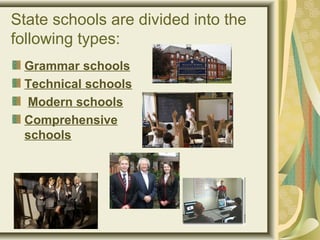
State schools are divided into the
following types:
Grammar schools
Technical schools
Modern schools
Comprehensive
schools
Grammar schools
Children who go to
grammar schools
are usually those
who show a
preference for
academic subjects,
although many
grammar schools
now also have
some technical
courses.
Technical schools
Some children go
to technical
schools. Most
courses there are
either commercial
or technical.
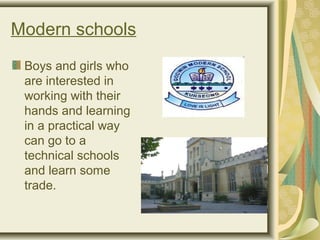
Modern schools
Boys and girls who
are interested in
working with their
hands and learning
in a practical way
can go to a
technical schools
and learn some
trade.
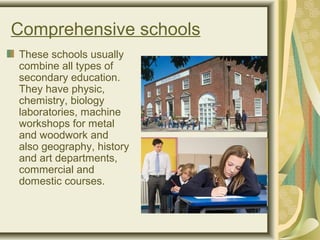
Comprehensive schools
These schools usually
combine all types of
secondary education.
They have physic,
chemistry, biology
laboratories, machine
workshops for metal
and woodwork and
also geography, history
and art departments,
commercial and
domestic courses.
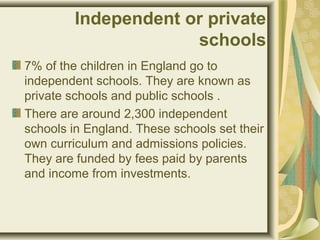
Independent or private
schools
7% of the children in England go to
independent schools. They are known as
private schools and public schools .
There are around 2,300 independent
schools in England. These schools set their
own curriculum and admissions policies.
They are funded by fees paid by parents
and income from investments.
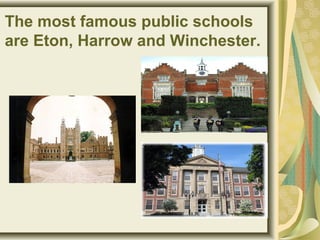
The most famous public schools
are Eton, Harrow and Winchester.
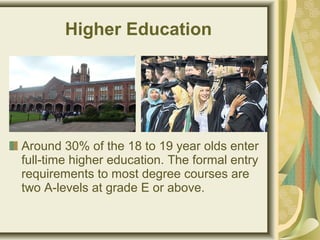
Higher Education
Around 30% of the 18 to 19 year olds enter
full-time higher education. The formal entry
requirements to most degree courses are
two A-levels at grade E or above.
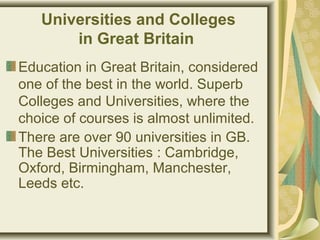
Universities and Colleges
in Great Britain
Education in Great Britain, considered
one of the best in the world. Superb
Colleges and Universities, where the
choice of courses is almost unlimited.
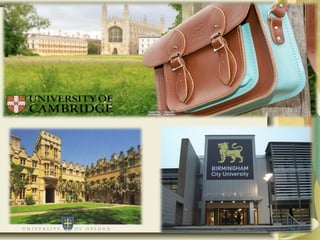
There are over 90 universities in GB.
The Best Universities : Cambridge,
Oxford, Birmingham, Manchester,
Leeds etc.
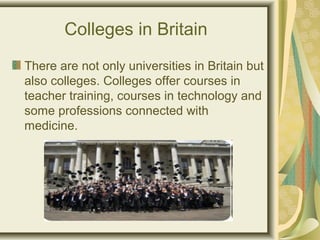
Colleges in Britain
There are not only universities in Britain but
also colleges. Colleges offer courses in
teacher training, courses in technology and
some professions connected with
medicine.
Thanks for
attention !

Educational System in England

  • 1.
  • 2.
    Children's education inEngland is normally divided into two separate stages. They begin with primary education at the age of five and it usually lasts until they are eleven. Then they move to there they stay until they reach secondary school at sixteen,seventeen or eighteen years of age.
  • 3.
    Primary schools (5 -11 year olds) In the UK, the first level of education is known as primary education. They are almost always mixed sex and usually located close to the child's home. Children tend to be with the same group throughout the day and one teacher has responsibility for most of the work they do.
  • 4.
    Secondary schools (11 -16 year olds) Most children transfer at the age of 11 - usually to their nearest secondary school, though the law allows parents in England and Wales to express preferences for other schools too.
  • 5.
    Types of Schoolsin Britain There are two different types of school : state schools private schools
  • 6.
    State Schools There areschools run by the Government. These schools are known as State Schools and parents do not pay. It means that the money comes from the national and local taxes. Ninety percent of children in England and Wales attend a state school.
  • 7.
    State schools aredivided into the following types: Grammar schools Technical schools Modern schools Comprehensive schools
  • 8.
    Grammar schools Children whogo to grammar schools are usually those who show a preference for academic subjects, although many grammar schools now also have some technical courses.
  • 9.
    Technical schools Some childrengo to technical schools. Most courses there are either commercial or technical.
  • 10.
    Modern schools Boys andgirls who are interested in working with their hands and learning in a practical way can go to a technical schools and learn some trade.
  • 11.
    Comprehensive schools These schoolsusually combine all types of secondary education. They have physic, chemistry, biology laboratories, machine workshops for metal and woodwork and also geography, history and art departments, commercial and domestic courses.
  • 12.
    Independent or private schools 7%of the children in England go to independent schools. They are known as private schools and public schools . There are around 2,300 independent schools in England. These schools set their own curriculum and admissions policies. They are funded by fees paid by parents and income from investments.
  • 13.
    The most famouspublic schools are Eton, Harrow and Winchester.
  • 14.
    Higher Education Around 30%of the 18 to 19 year olds enter full-time higher education. The formal entry requirements to most degree courses are two A-levels at grade E or above.
  • 15.
    Universities and Colleges inGreat Britain Education in Great Britain, considered one of the best in the world. Superb Colleges and Universities, where the choice of courses is almost unlimited. There are over 90 universities in GB. The Best Universities : Cambridge, Oxford, Birmingham, Manchester, Leeds etc.
  • 17.
    Colleges in Britain Thereare not only universities in Britain but also colleges. Colleges offer courses in teacher training, courses in technology and some professions connected with medicine.
  • 18.