A Primer on the U.S. Higher Education System  Structure, Types of Institutions, Admissions, Financial Aid, and Campus Life
Quality U.S. colleges are known worldwide for the quality of their facilities, resources, and faculty. Accreditation systems ensure that institutions continue to maintain these standards.
Value A U.S. degree offers excellent value for the money. A wide range of tuition fees and living costs, plus some financial help from colleges, make study in the United States affordable for hundreds of thousands of international students each year.
Choice The U.S. education system features many types of institutions, academic and social environments, entry requirements, degree programs, and subjects in which you can specialize.
Flexibility U.S. universities and colleges offer flexibility in choice of courses, but more importantly there is also the option for students to move from institution to another. Completing the first two years of a degree at one institution, usually a community college, and then moving to another, is very common.
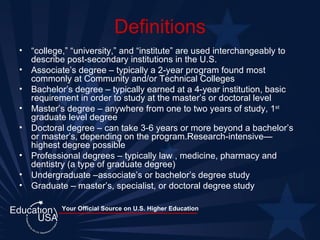
Definitions “ college,” “university,” and “institute” are used interchangeably to describe post-secondary institutions in the U.S. Associate’s degree – typically a 2-year program found most commonly at Community and/or Technical Colleges Bachelor’s degree – typically earned at a 4-year institution, basic requirement in order to study at the master’s or doctoral level Master’s degree – anywhere from one to two years of study, 1 st  graduate level degree Doctoral degree – can take 3-6 years or more beyond a bachelor’s or master’s, depending on the program.Research-intensive—highest degree possible Professional degrees – typically law , medicine, pharmacy and dentistry (a type of graduate degree) Undergraduate –associate’s or bachelor’s degree study Graduate – master’s, specialist, or doctoral degree study
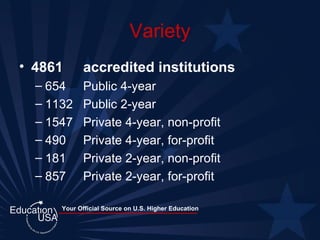
Variety 4861 accredited institutions 654 Public 4-year  1132 Public 2-year  1547 Private 4-year, non-profit 490  Private 4-year, for-profit 181 Private 2-year, non-profit 857 Private 2-year, for-profit
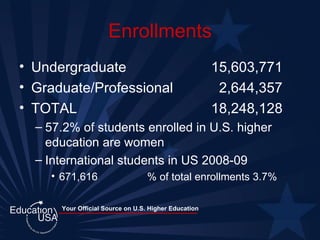
Enrollments Undergraduate 15,603,771 Graduate/Professional    2,644,357 TOTAL 18,248,128 57.2% of students enrolled in U.S. higher education are women International students in US 2008-09 671,616  % of total enrollments 3.7%
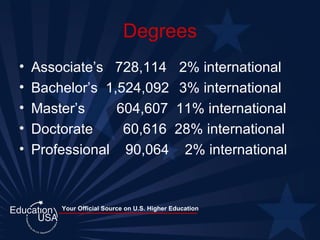
Degrees Associate’s 728,114  2% international Bachelor’s  1,524,092 3% international Master’s  604,607  11% international Doctorate   60,616  28% international Professional  90,064  2% international
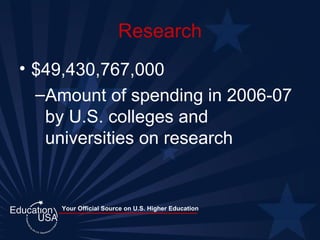
Research $49,430,767,000  Amount of spending in 2006-07 by U.S. colleges and universities on research
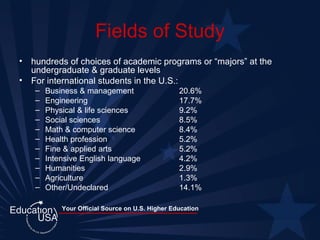
Fields of Study hundreds of choices of academic programs or “majors” at the undergraduate & graduate levels For international students in the U.S.: Business & management 20.6% Engineering 17.7% Physical & life sciences 9.2% Social sciences 8.5% Math & computer science 8.4% Health profession 5.2% Fine & applied arts 5.2% Intensive English language 4.2% Humanities 2.9% Agriculture 1.3% Other/Undeclared 14.1%
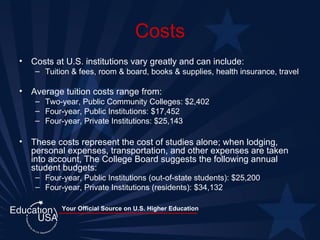
Costs Costs at U.S. institutions vary greatly and can include: Tuition & fees, room & board, books & supplies, health insurance, travel Average tuition costs range from: Two-year, Public Community Colleges: $2,402 Four-year, Public Institutions: $17,452 Four-year, Private Institutions: $25,143 These costs represent the cost of studies alone; when lodging, personal expenses, transportation, and other expenses are taken into account, The College Board suggests the following annual student budgets: Four-year, Public Institutions (out-of-state students): $25,200 Four-year, Private Institutions (residents): $34,132
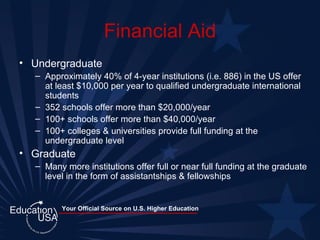
Financial Aid Undergraduate Approximately 40% of 4-year institutions (i.e. 886) in the US offer at least $10,000 per year to qualified undergraduate international students 352 schools offer more than $20,000/year 100+ schools offer more than $40,000/year 100+ colleges & universities provide full funding at the undergraduate level Graduate Many more institutions offer full or near full funding at the graduate level in the form of assistantships & fellowships

EducationUSA U S Higher Education System Explained

  • 1.
    A Primer onthe U.S. Higher Education System Structure, Types of Institutions, Admissions, Financial Aid, and Campus Life
  • 2.
    Quality U.S. collegesare known worldwide for the quality of their facilities, resources, and faculty. Accreditation systems ensure that institutions continue to maintain these standards.
  • 3.
    Value A U.S.degree offers excellent value for the money. A wide range of tuition fees and living costs, plus some financial help from colleges, make study in the United States affordable for hundreds of thousands of international students each year.
  • 4.
    Choice The U.S.education system features many types of institutions, academic and social environments, entry requirements, degree programs, and subjects in which you can specialize.
  • 5.
    Flexibility U.S. universitiesand colleges offer flexibility in choice of courses, but more importantly there is also the option for students to move from institution to another. Completing the first two years of a degree at one institution, usually a community college, and then moving to another, is very common.
  • 6.
    Definitions “ college,”“university,” and “institute” are used interchangeably to describe post-secondary institutions in the U.S. Associate’s degree – typically a 2-year program found most commonly at Community and/or Technical Colleges Bachelor’s degree – typically earned at a 4-year institution, basic requirement in order to study at the master’s or doctoral level Master’s degree – anywhere from one to two years of study, 1 st graduate level degree Doctoral degree – can take 3-6 years or more beyond a bachelor’s or master’s, depending on the program.Research-intensive—highest degree possible Professional degrees – typically law , medicine, pharmacy and dentistry (a type of graduate degree) Undergraduate –associate’s or bachelor’s degree study Graduate – master’s, specialist, or doctoral degree study
  • 7.
    Variety 4861 accreditedinstitutions 654 Public 4-year 1132 Public 2-year 1547 Private 4-year, non-profit 490 Private 4-year, for-profit 181 Private 2-year, non-profit 857 Private 2-year, for-profit
  • 8.
    Enrollments Undergraduate 15,603,771Graduate/Professional 2,644,357 TOTAL 18,248,128 57.2% of students enrolled in U.S. higher education are women International students in US 2008-09 671,616 % of total enrollments 3.7%
  • 9.
    Degrees Associate’s 728,114 2% international Bachelor’s 1,524,092 3% international Master’s 604,607 11% international Doctorate 60,616 28% international Professional 90,064 2% international
  • 10.
    Research $49,430,767,000 Amount of spending in 2006-07 by U.S. colleges and universities on research
  • 11.
    Fields of Studyhundreds of choices of academic programs or “majors” at the undergraduate & graduate levels For international students in the U.S.: Business & management 20.6% Engineering 17.7% Physical & life sciences 9.2% Social sciences 8.5% Math & computer science 8.4% Health profession 5.2% Fine & applied arts 5.2% Intensive English language 4.2% Humanities 2.9% Agriculture 1.3% Other/Undeclared 14.1%
  • 12.
    Costs Costs atU.S. institutions vary greatly and can include: Tuition & fees, room & board, books & supplies, health insurance, travel Average tuition costs range from: Two-year, Public Community Colleges: $2,402 Four-year, Public Institutions: $17,452 Four-year, Private Institutions: $25,143 These costs represent the cost of studies alone; when lodging, personal expenses, transportation, and other expenses are taken into account, The College Board suggests the following annual student budgets: Four-year, Public Institutions (out-of-state students): $25,200 Four-year, Private Institutions (residents): $34,132
  • 13.
    Financial Aid UndergraduateApproximately 40% of 4-year institutions (i.e. 886) in the US offer at least $10,000 per year to qualified undergraduate international students 352 schools offer more than $20,000/year 100+ schools offer more than $40,000/year 100+ colleges & universities provide full funding at the undergraduate level Graduate Many more institutions offer full or near full funding at the graduate level in the form of assistantships & fellowships