HISTORY:
 Education For All (EFA) is a global movement led by
UNESCO (United Nation Educational, Scientific and
Cultural Organization), aiming to meet the learning
needs of all children, youth and adults by 2015.
 The movement was launched at the World Conference
on Education for All in 1990 by UNESCO, UNDP,
UNICEF and the World Bank.
 UNESCO has been mandated to lead the movement and
coordinate the international efforts to reach Education
for All. Governments, development agencies, civil
society, non-government organizations and the media
are but some of the partners working toward reaching
these goals.
 Ten years later (2000), with many countries far from
having reached this goal, the international community
met again in Dakar. They identified six key education
goals which aim to meet the learning needs of all
children, youth and adults by 2015.
The Six EFA Goals:
 Goal 1: Expand early childhood care and education
 Goal 2: Provide free and compulsory primary
education for all
 Goal 3: Promote learning and life skills for young
people and adults
 Goal 4: Increase adult literacy
 Goal 5: Achieve gender parity
 Goal 6: Improve the quality of education
 Goal 1
Expanding and improving comprehensive early
childhood care and education, especially for the most
vulnerable and disadvantaged children.
 Goal 2
Ensuring that by 2015 all children, particularly girls,
children in difficult circumstances and those belonging
to ethnic minorities, have access to, and complete, free
and compulsory primary education of good quality.
 Goal 3
Ensuring that the learning needs of all young people
and adults are met through equitable access to
appropriate learning and life-skills programmes.
 Goal 4
Achieving a 50 per cent improvement in levels of adult
literacy by 2015, especially for women, and equitable
access to basic and continuing education for all adults.
 Goal 5
Eliminating gender disparities in primary and secondary
education by 2005, and achieving gender equality in
education by 2015, with a focus on ensuring girls’ full
and equal access to and achievement in basic education
of good quality.
 Goal 6
Improving all aspects of the quality of education and
ensuring excellence of all so that recognized and
measurable learning outcomes are achieved by all,
especially in literacy, numeracy and essential life skills.
Why Education is Important?
 Education beats poverty: one extra year of schooling
increases a person’s earnings by up to 10%. 171 million
people could be lifted out of poverty if all students in
low-income countries left school with basic reading
skills.
 Education promotes gender equality by helping
women control how many children they have. In Mali,
women with secondary education or higher have an
average of three children, while those with no education
have an average of seven children.
 Education contributes to improved maternal
health: women with higher levels of education are
most likely to delay and space out pregnancies, and to
seek health care and support.
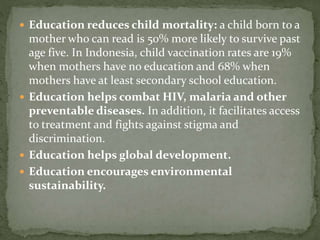
 Education reduces child mortality: a child born to a
mother who can read is 50% more likely to survive past
age five. In Indonesia, child vaccination rates are 19%
when mothers have no education and 68% when
mothers have at least secondary school education.
 Education helps combat HIV, malaria and other
preventable diseases. In addition, it facilitates access
to treatment and fights against stigma and
discrimination.
 Education helps global development.
 Education encourages environmental
sustainability.
EDUCATION FOR ALL

EDUCATION FOR ALL

  • 2.
    HISTORY:  Education ForAll (EFA) is a global movement led by UNESCO (United Nation Educational, Scientific and Cultural Organization), aiming to meet the learning needs of all children, youth and adults by 2015.  The movement was launched at the World Conference on Education for All in 1990 by UNESCO, UNDP, UNICEF and the World Bank.  UNESCO has been mandated to lead the movement and coordinate the international efforts to reach Education for All. Governments, development agencies, civil society, non-government organizations and the media are but some of the partners working toward reaching these goals.
  • 3.
     Ten yearslater (2000), with many countries far from having reached this goal, the international community met again in Dakar. They identified six key education goals which aim to meet the learning needs of all children, youth and adults by 2015.
  • 4.
    The Six EFAGoals:  Goal 1: Expand early childhood care and education  Goal 2: Provide free and compulsory primary education for all  Goal 3: Promote learning and life skills for young people and adults  Goal 4: Increase adult literacy  Goal 5: Achieve gender parity  Goal 6: Improve the quality of education
  • 5.
     Goal 1 Expandingand improving comprehensive early childhood care and education, especially for the most vulnerable and disadvantaged children.  Goal 2 Ensuring that by 2015 all children, particularly girls, children in difficult circumstances and those belonging to ethnic minorities, have access to, and complete, free and compulsory primary education of good quality.  Goal 3 Ensuring that the learning needs of all young people and adults are met through equitable access to appropriate learning and life-skills programmes.
  • 6.
     Goal 4 Achievinga 50 per cent improvement in levels of adult literacy by 2015, especially for women, and equitable access to basic and continuing education for all adults.  Goal 5 Eliminating gender disparities in primary and secondary education by 2005, and achieving gender equality in education by 2015, with a focus on ensuring girls’ full and equal access to and achievement in basic education of good quality.  Goal 6 Improving all aspects of the quality of education and ensuring excellence of all so that recognized and measurable learning outcomes are achieved by all, especially in literacy, numeracy and essential life skills.
  • 7.
    Why Education isImportant?  Education beats poverty: one extra year of schooling increases a person’s earnings by up to 10%. 171 million people could be lifted out of poverty if all students in low-income countries left school with basic reading skills.  Education promotes gender equality by helping women control how many children they have. In Mali, women with secondary education or higher have an average of three children, while those with no education have an average of seven children.  Education contributes to improved maternal health: women with higher levels of education are most likely to delay and space out pregnancies, and to seek health care and support.
  • 8.
     Education reduceschild mortality: a child born to a mother who can read is 50% more likely to survive past age five. In Indonesia, child vaccination rates are 19% when mothers have no education and 68% when mothers have at least secondary school education.  Education helps combat HIV, malaria and other preventable diseases. In addition, it facilitates access to treatment and fights against stigma and discrimination.  Education helps global development.  Education encourages environmental sustainability.