How many sides does a circle have?
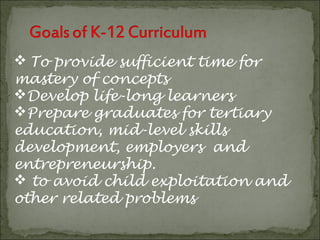
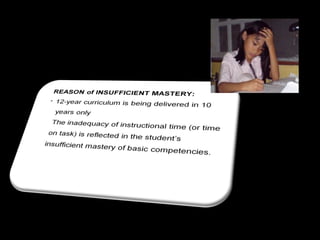
 To provide sufficient time for
mastery of concepts
Develop life-long learners
Prepare graduates for tertiary
education, mid-level skills
development, employers and
entrepreneurship.
 to avoid child exploitation and
other related problems
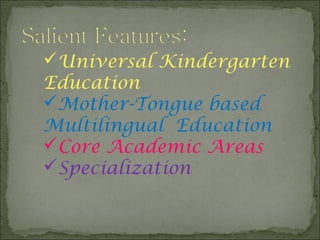
Universal Kindergarten
Education
Mother-Tongue based
Multilingual Education
Core Academic Areas
Specialization
K-12 Basic Education ProgramK-12 Basic Education Program
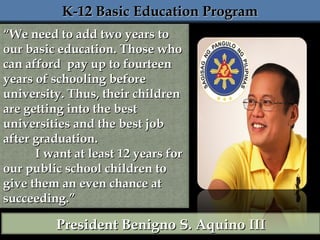
““We need to add two years toWe need to add two years to
our basic education. Those whoour basic education. Those who
can afford pay up to fourteencan afford pay up to fourteen
years of schooling beforeyears of schooling before
university. Thus, their childrenuniversity. Thus, their children
are getting into the bestare getting into the best
universities and the best jobuniversities and the best job
after graduation.after graduation.
I want at least 12 years forI want at least 12 years for
our public school children toour public school children to
give them an even chance atgive them an even chance at
succeeding.”succeeding.”
President Benigno S. Aquino IIIPresident Benigno S. Aquino III
Monroe Survey ( 1925 ) Secondary
Education did not prepare for life and
recommended training in agriculture,
commerce and industry
K-12K-12
Basic EducationBasic Education
ProgramProgram
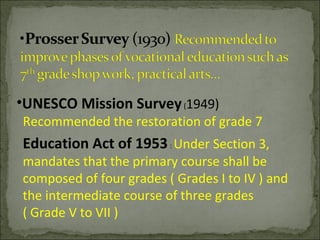
•UNESCO Mission Survey(1949)
Recommended the restoration of grade 7
Education Act of 1953: Under Section 3,
mandates that the primary course shall be
composed of four grades ( Grades I to IV ) and
the intermediate course of three grades
( Grade V to VII )
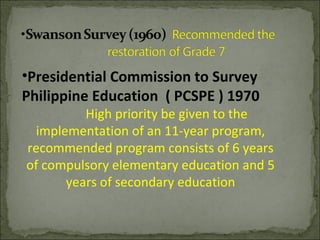
•Presidential Commission to Survey
Philippine Education ( PCSPE ) 1970
High priority be given to the
implementation of an 11-year program,
recommended program consists of 6 years
of compulsory elementary education and 5
years of secondary education
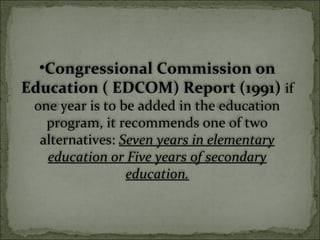
•Congressional Commission on
Education ( EDCOM) Report (1991) if
one year is to be added in the education
program, it recommends one of two
alternatives: Seven years in elementary
education or Five years of secondary
education.
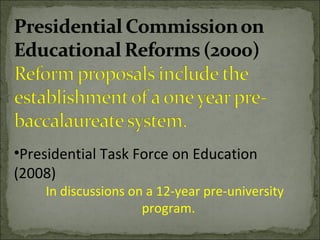
•Presidential Task Force on Education
(2008)
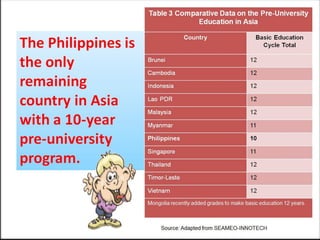
In discussions on a 12-year pre-university
program.
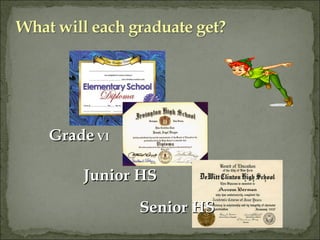
GradeGrade VIVI
Junior HSJunior HS
Senior HSSenior HS
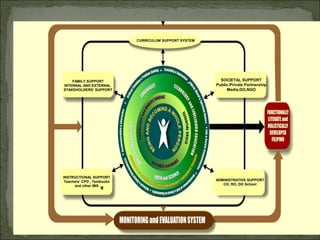
FAMILY SUPPORT
INTERNAL AND EXTERNAL
STAKEHOLDERS’ SUPPORT
CURRICULUM SUPPORT SYSTEM
INSTRUCTIONAL SUPPORT
Teachers’ CPD , Textbooks
and other IMS
SOCIETAL SUPPORT
Public-Private Partnership
Media,GO,NGO
ADMINISTRATIVE SUPPORT
CO, RO, DO School
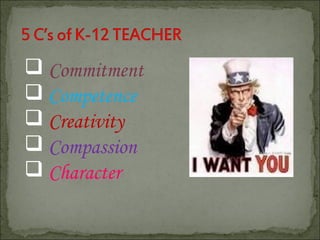
 Commitment
 Competence
 Creativity
 Compassion
 Character
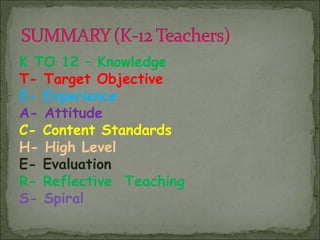
K TO 12 – Knowledge
T- Target Objective
E- Experience
A- Attitude
C- Content Standards
H- High Level
E- Evaluation
R- Reflective Teaching
S- Spiral
If education could be
the only best option to
secure the future of our
youth, all of us are here
to support this option.
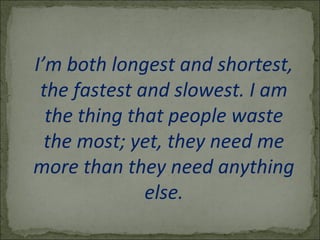
I’m both longest and shortest,
the fastest and slowest. I am
the thing that people waste
the most; yet, they need me
more than they need anything
else.
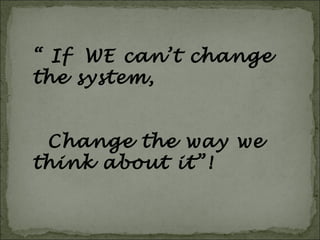
“ If WE can’t change
the system,
Change the way we
think about it”!
K 12 features

K 12 features

  • 2.
    How many sidesdoes a circle have?
  • 4.
     To providesufficient time for mastery of concepts Develop life-long learners Prepare graduates for tertiary education, mid-level skills development, employers and entrepreneurship.  to avoid child exploitation and other related problems
  • 5.
    Universal Kindergarten Education Mother-Tongue based MultilingualEducation Core Academic Areas Specialization
  • 18.
    K-12 Basic EducationProgramK-12 Basic Education Program ““We need to add two years toWe need to add two years to our basic education. Those whoour basic education. Those who can afford pay up to fourteencan afford pay up to fourteen years of schooling beforeyears of schooling before university. Thus, their childrenuniversity. Thus, their children are getting into the bestare getting into the best universities and the best jobuniversities and the best job after graduation.after graduation. I want at least 12 years forI want at least 12 years for our public school children toour public school children to give them an even chance atgive them an even chance at succeeding.”succeeding.” President Benigno S. Aquino IIIPresident Benigno S. Aquino III
  • 20.
    Monroe Survey (1925 ) Secondary Education did not prepare for life and recommended training in agriculture, commerce and industry K-12K-12 Basic EducationBasic Education ProgramProgram
  • 21.
    •UNESCO Mission Survey(1949) Recommendedthe restoration of grade 7 Education Act of 1953: Under Section 3, mandates that the primary course shall be composed of four grades ( Grades I to IV ) and the intermediate course of three grades ( Grade V to VII )
  • 22.
    •Presidential Commission toSurvey Philippine Education ( PCSPE ) 1970 High priority be given to the implementation of an 11-year program, recommended program consists of 6 years of compulsory elementary education and 5 years of secondary education
  • 23.
    •Congressional Commission on Education( EDCOM) Report (1991) if one year is to be added in the education program, it recommends one of two alternatives: Seven years in elementary education or Five years of secondary education.
  • 24.
    •Presidential Task Forceon Education (2008) In discussions on a 12-year pre-university program.
  • 27.
    GradeGrade VIVI Junior HSJuniorHS Senior HSSenior HS
  • 29.
    FAMILY SUPPORT INTERNAL ANDEXTERNAL STAKEHOLDERS’ SUPPORT CURRICULUM SUPPORT SYSTEM INSTRUCTIONAL SUPPORT Teachers’ CPD , Textbooks and other IMS SOCIETAL SUPPORT Public-Private Partnership Media,GO,NGO ADMINISTRATIVE SUPPORT CO, RO, DO School
  • 30.
     Commitment  Competence Creativity  Compassion  Character
  • 31.
    K TO 12– Knowledge T- Target Objective E- Experience A- Attitude C- Content Standards H- High Level E- Evaluation R- Reflective Teaching S- Spiral
  • 32.
    If education couldbe the only best option to secure the future of our youth, all of us are here to support this option.
  • 34.
    I’m both longestand shortest, the fastest and slowest. I am the thing that people waste the most; yet, they need me more than they need anything else.
  • 35.
    “ If WEcan’t change the system, Change the way we think about it”!