ACHIEVING UNIVERSAL
PRIMARY EDUCATION
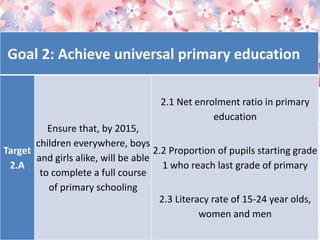
Goal 2: Achieve universal primary education
Target
2.A
Ensure that, by 2015,
children everywhere, boys
and girls alike, will be able
to complete a full course
of primary schooling
2.1 Net enrolment ratio in primary
education
2.2 Proportion of pupils starting grade
1 who reach last grade of primary
2.3 Literacy rate of 15-24 year olds,
women and men
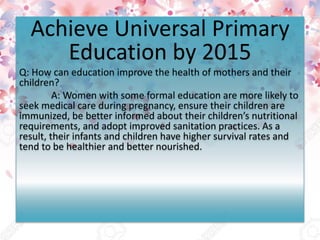
Achieve Universal Primary
Education by 2015
Q: How can education improve the health of mothers and their
children?
A: Women with some formal education are more likely to
seek medical care during pregnancy, ensure their children are
immunized, be better informed about their children’s nutritional
requirements, and adopt improved sanitation practices. As a
result, their infants and children have higher survival rates and
tend to be healthier and better nourished.
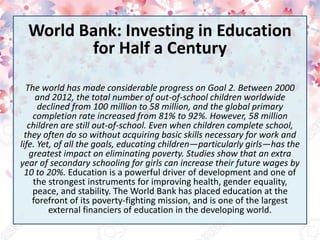
World Bank: Investing in Education
for Half a Century
The world has made considerable progress on Goal 2. Between 2000
and 2012, the total number of out-of-school children worldwide
declined from 100 million to 58 million, and the global primary
completion rate increased from 81% to 92%. However, 58 million
children are still out-of-school. Even when children complete school,
they often do so without acquiring basic skills necessary for work and
life. Yet, of all the goals, educating children—particularly girls—has the
greatest impact on eliminating poverty. Studies show that an extra
year of secondary schooling for girls can increase their future wages by
10 to 20%. Education is a powerful driver of development and one of
the strongest instruments for improving health, gender equality,
peace, and stability. The World Bank has placed education at the
forefront of its poverty-fighting mission, and is one of the largest
external financiers of education in the developing world.
Making Strides in Education
The World Bank supports education through an
average of $2.8 billion a year in new financing for
the poorest countries as well as for middle-income
countries. Support for primary education has been
a priority over the past decade for the International
Development Association (IDA), the Bank’s fund for
the poorest countries. IDA integrates education into
national economic strategies, and creates education
systems that empower children to become
productive citizens.
Our Education Strategy
• Measure education outcomes, especially for
poor people and disadvantaged communities
• Offer innovative incentives, like cash for
attendance, to keep kids in school
• Ensure that education leads to learning skills,
and that it is relevant and of good quality
• Establish standards for teachers and schools
• Train teachers, especially those who serve
disadvantaged communities
Some of Our MDG 2 Results
With IDA’s help, countries recruited or trained more than 3.5
million additional teachers from 2002-2012, and built or
renovated more than 2 million classrooms for 105 million
children, and purchased or distributed about 300 million
textbooks from 2000-2010.
• Afghanistan: 2.7 million girls were enrolled in school in
2012, up from 191,000 in 2002; nearly 140,000 teachers
have been trained, of which 39,000 are women.
• Bangladesh: Between 2004 and the end of 2012, “second
chance” primary education was provided for more than
790,000 out of school children (more than half of them
girls) from the 90 poorest sub-districts of the country.
• Chad: Between 2003 and 2012, 2.6 million books were
distributed to schools, 400 classrooms were built and
equipped, 20,000 people were taught to read and write,
and 11,700 community teachers were trained.
WHY DID THE
GOVERNMENT
GIVE EMPHASIS ON
THE UNIVERSAL
PRIMARY
EDUCATION?
During their primary education, students are
taught to think critically, to strive to attain high
standards, to meet the challenges posed by
technological advancements and to develop
citizenship and basic values.
 Educating children helps reduce poverty and
promote gender equality. It helps lower child
mortality rates and promote concern for the
environment.
 It is inextricably linked to Goal 3 – gender
parity – as universal primary education by
definition requires
gender parity.
Further, education – specifically free
primary school for all children – is a
fundamental right to which governments
committed themselves under the
1989 Convention of the Rights of the
Child.
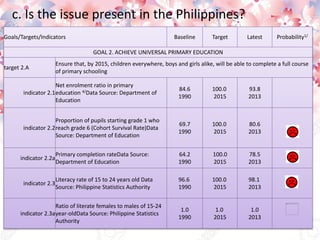
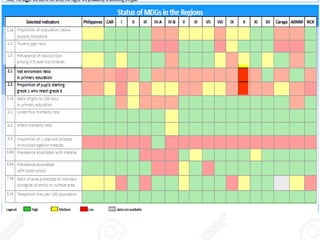
c. Is the issue present in the Philippines?
Goals/Targets/Indicators Baseline Target Latest Probability1/
GOAL 2. ACHIEVE UNIVERSAL PRIMARY EDUCATION
target 2.A
Ensure that, by 2015, children everywhere, boys and girls alike, will be able to complete a full course
of primary schooling
indicator 2.1
Net enrolment ratio in primary
education 4/Data Source: Department of
Education
84.6
1990
100.0
2015
93.8
2013
indicator 2.2
Proportion of pupils starting grade 1 who
reach grade 6 (Cohort Survival Rate)Data
Source: Department of Education
69.7
1990
100.0
2015
80.6
2013
indicator 2.2a
Primary completion rateData Source:
Department of Education
64.2
1990
100.0
2015
78.5
2013
indicator 2.3
Literacy rate of 15 to 24 years old Data
Source: Philippine Statistics Authority
96.6
1990
100.0
2015
98.1
2013
indicator 2.3a
Ratio of literate females to males of 15-24
year-oldData Source: Philippine Statistics
Authority
1.0
1990
1.0
2015
1.0
2013
WAYS TO SOLVE THE
PROBLEM
METHOD 1: Supporting Programs
That Advance Universal Primary
Education
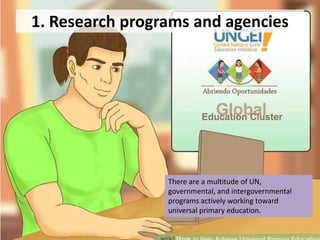
1. Research programs and agencies
There are a multitude of UN,
governmental, and intergovernmental
programs actively working toward
universal primary education.
2. Donate
If you’ve found some private
agencies that share your vision,
the most straightforward way to
help them is by giving a
donation. Your donation can be
monetary or in-kind.
3. Vote to increase non - military
foreign aid.
While you can’t pick exactly where
foreign aid will go, most non -
military foreign aid will at least
help advance educational goals
indirectly. For example,
malnutrition, poverty, and disease
are big reasons why any particular
child isn’t attending elementary
school.
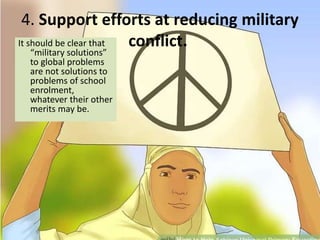
4. Support efforts at reducing military
conflict.It should be clear that
“military solutions”
to global problems
are not solutions to
problems of school
enrolment,
whatever their other
merits may be.
Method2
Becoming an Effective
Advocate
1. Spread the word
amongst friends and
associates.
Explain to the people in your
circle the importance of
primary education and just
how close the international
community is to solving the
problem.
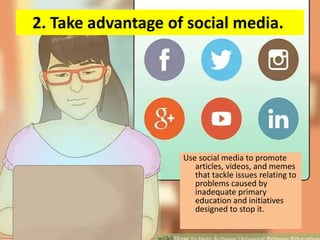
2. Take advantage of social media.
Use social media to promote
articles, videos, and memes
that tackle issues relating to
problems caused by
inadequate primary
education and initiatives
designed to stop it.
3. Transform your opinions into
media.
You can take your advocacy
one step further by
creating content
centered around
achieving universal
primary education.
“Content creation” just
means creating any type
of media—like hosting or
contributing to podcasts,
blogs, and vlogs.
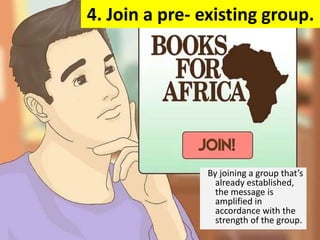
4. Join a pre- existing group.
By joining a group that’s
already established,
the message is
amplified in
accordance with the
strength of the group.
5. Reach out to people in power.
• Take your message to
people who have the
power to make the
changes you want to
make. With an
international effort to
address primary
education, there are
many different decision
makers and many ways
to communicate with
them.
METHOD 3
WORKING IN A FIELD
1. Be a voluntourist.
“Voluntourism” means
planning a tourist experience
around volunteer activity,
and it is a growing sector of
international travel. Instead
of your vacation revolving
around pleasure activities, it
centers on service activities.
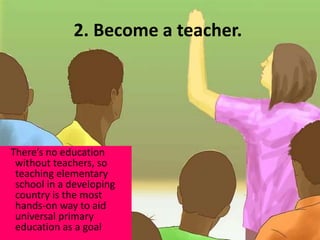
2. Become a teacher.
There’s no education
without teachers, so
teaching elementary
school in a developing
country is the most
hands-on way to aid
universal primary
education as a goal
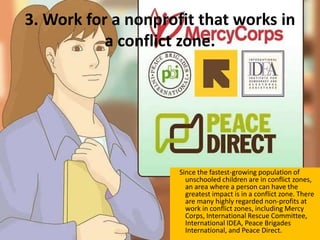
3. Work for a nonprofit that works in
a conflict zone.
Since the fastest-growing population of
unschooled children are in conflict zones,
an area where a person can have the
greatest impact is in a conflict zone. There
are many highly regarded non-profits at
work in conflict zones, including Mercy
Corps, International Rescue Committee,
International IDEA, Peace Brigades
International, and Peace Direct.

MDG 2: Achieving Universal Primary Education

  • 1.
  • 2.
    Goal 2: Achieveuniversal primary education Target 2.A Ensure that, by 2015, children everywhere, boys and girls alike, will be able to complete a full course of primary schooling 2.1 Net enrolment ratio in primary education 2.2 Proportion of pupils starting grade 1 who reach last grade of primary 2.3 Literacy rate of 15-24 year olds, women and men
  • 3.
    Achieve Universal Primary Educationby 2015 Q: How can education improve the health of mothers and their children? A: Women with some formal education are more likely to seek medical care during pregnancy, ensure their children are immunized, be better informed about their children’s nutritional requirements, and adopt improved sanitation practices. As a result, their infants and children have higher survival rates and tend to be healthier and better nourished.
  • 4.
    World Bank: Investingin Education for Half a Century The world has made considerable progress on Goal 2. Between 2000 and 2012, the total number of out-of-school children worldwide declined from 100 million to 58 million, and the global primary completion rate increased from 81% to 92%. However, 58 million children are still out-of-school. Even when children complete school, they often do so without acquiring basic skills necessary for work and life. Yet, of all the goals, educating children—particularly girls—has the greatest impact on eliminating poverty. Studies show that an extra year of secondary schooling for girls can increase their future wages by 10 to 20%. Education is a powerful driver of development and one of the strongest instruments for improving health, gender equality, peace, and stability. The World Bank has placed education at the forefront of its poverty-fighting mission, and is one of the largest external financiers of education in the developing world.
  • 5.
    Making Strides inEducation The World Bank supports education through an average of $2.8 billion a year in new financing for the poorest countries as well as for middle-income countries. Support for primary education has been a priority over the past decade for the International Development Association (IDA), the Bank’s fund for the poorest countries. IDA integrates education into national economic strategies, and creates education systems that empower children to become productive citizens.
  • 6.
    Our Education Strategy •Measure education outcomes, especially for poor people and disadvantaged communities • Offer innovative incentives, like cash for attendance, to keep kids in school • Ensure that education leads to learning skills, and that it is relevant and of good quality • Establish standards for teachers and schools • Train teachers, especially those who serve disadvantaged communities
  • 7.
    Some of OurMDG 2 Results With IDA’s help, countries recruited or trained more than 3.5 million additional teachers from 2002-2012, and built or renovated more than 2 million classrooms for 105 million children, and purchased or distributed about 300 million textbooks from 2000-2010. • Afghanistan: 2.7 million girls were enrolled in school in 2012, up from 191,000 in 2002; nearly 140,000 teachers have been trained, of which 39,000 are women. • Bangladesh: Between 2004 and the end of 2012, “second chance” primary education was provided for more than 790,000 out of school children (more than half of them girls) from the 90 poorest sub-districts of the country. • Chad: Between 2003 and 2012, 2.6 million books were distributed to schools, 400 classrooms were built and equipped, 20,000 people were taught to read and write, and 11,700 community teachers were trained.
  • 8.
    WHY DID THE GOVERNMENT GIVEEMPHASIS ON THE UNIVERSAL PRIMARY EDUCATION?
  • 9.
    During their primaryeducation, students are taught to think critically, to strive to attain high standards, to meet the challenges posed by technological advancements and to develop citizenship and basic values.
  • 10.
     Educating childrenhelps reduce poverty and promote gender equality. It helps lower child mortality rates and promote concern for the environment.  It is inextricably linked to Goal 3 – gender parity – as universal primary education by definition requires gender parity.
  • 11.
    Further, education –specifically free primary school for all children – is a fundamental right to which governments committed themselves under the 1989 Convention of the Rights of the Child.
  • 12.
    c. Is theissue present in the Philippines? Goals/Targets/Indicators Baseline Target Latest Probability1/ GOAL 2. ACHIEVE UNIVERSAL PRIMARY EDUCATION target 2.A Ensure that, by 2015, children everywhere, boys and girls alike, will be able to complete a full course of primary schooling indicator 2.1 Net enrolment ratio in primary education 4/Data Source: Department of Education 84.6 1990 100.0 2015 93.8 2013 indicator 2.2 Proportion of pupils starting grade 1 who reach grade 6 (Cohort Survival Rate)Data Source: Department of Education 69.7 1990 100.0 2015 80.6 2013 indicator 2.2a Primary completion rateData Source: Department of Education 64.2 1990 100.0 2015 78.5 2013 indicator 2.3 Literacy rate of 15 to 24 years old Data Source: Philippine Statistics Authority 96.6 1990 100.0 2015 98.1 2013 indicator 2.3a Ratio of literate females to males of 15-24 year-oldData Source: Philippine Statistics Authority 1.0 1990 1.0 2015 1.0 2013
  • 14.
    WAYS TO SOLVETHE PROBLEM
  • 15.
    METHOD 1: SupportingPrograms That Advance Universal Primary Education
  • 16.
    1. Research programsand agencies There are a multitude of UN, governmental, and intergovernmental programs actively working toward universal primary education.
  • 17.
    2. Donate If you’vefound some private agencies that share your vision, the most straightforward way to help them is by giving a donation. Your donation can be monetary or in-kind.
  • 18.
    3. Vote toincrease non - military foreign aid. While you can’t pick exactly where foreign aid will go, most non - military foreign aid will at least help advance educational goals indirectly. For example, malnutrition, poverty, and disease are big reasons why any particular child isn’t attending elementary school.
  • 19.
    4. Support effortsat reducing military conflict.It should be clear that “military solutions” to global problems are not solutions to problems of school enrolment, whatever their other merits may be.
  • 20.
  • 21.
    1. Spread theword amongst friends and associates. Explain to the people in your circle the importance of primary education and just how close the international community is to solving the problem.
  • 22.
    2. Take advantageof social media. Use social media to promote articles, videos, and memes that tackle issues relating to problems caused by inadequate primary education and initiatives designed to stop it.
  • 23.
    3. Transform youropinions into media. You can take your advocacy one step further by creating content centered around achieving universal primary education. “Content creation” just means creating any type of media—like hosting or contributing to podcasts, blogs, and vlogs.
  • 24.
    4. Join apre- existing group. By joining a group that’s already established, the message is amplified in accordance with the strength of the group.
  • 25.
    5. Reach outto people in power. • Take your message to people who have the power to make the changes you want to make. With an international effort to address primary education, there are many different decision makers and many ways to communicate with them.
  • 26.
  • 27.
    1. Be avoluntourist. “Voluntourism” means planning a tourist experience around volunteer activity, and it is a growing sector of international travel. Instead of your vacation revolving around pleasure activities, it centers on service activities.
  • 28.
    2. Become ateacher. There’s no education without teachers, so teaching elementary school in a developing country is the most hands-on way to aid universal primary education as a goal
  • 29.
    3. Work fora nonprofit that works in a conflict zone. Since the fastest-growing population of unschooled children are in conflict zones, an area where a person can have the greatest impact is in a conflict zone. There are many highly regarded non-profits at work in conflict zones, including Mercy Corps, International Rescue Committee, International IDEA, Peace Brigades International, and Peace Direct.