Education For All Goals
BS(Bachelor of studies) Education
Instructor: Miss Tanzela Bashir
Education For All Goals
• Six internationally agreed education goals aim to meet the learning needs of
all children, youth and adults by 2015.
• Goal 1: Expand early childhood care and education
• Goal 2: Provide free and compulsory primary education for all
• Goal 3: Promote learning and life skills for young people and
adults
• Goal 4: Increase adult literacy by 50 percent
• Goal 5: Achieve gender parity by 2005, gender equality by 2015
• Goal 6: Improve the quality of education
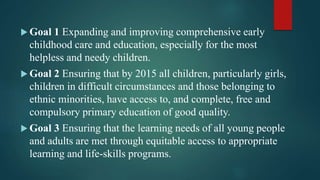
 Goal 1 Expanding and improving comprehensive early
childhood care and education, especially for the most
helpless and needy children.
 Goal 2 Ensuring that by 2015 all children, particularly girls,
children in difficult circumstances and those belonging to
ethnic minorities, have access to, and complete, free and
compulsory primary education of good quality.
 Goal 3 Ensuring that the learning needs of all young people
and adults are met through equitable access to appropriate
learning and life-skills programs.
 Goal 4 Achieving a 50 per cent improvement in levels of adult literacy
by 2015, especially for women, and equitable access to basic and
continuing education for all adults.
 Goal 5 Eliminating gender disparities in primary and secondary
education by 2005, and achieving gender equality in education by 2015,
with a focus on ensuring girls’ full and equal access to and achievement
in basic education of good quality.
 Goal 6 Improving all aspects of the quality of education and ensuring
excellence of all so that recognized and measurable learning outcomes
are achieved by all, especially in literacy, numeracy and essential life
skills.
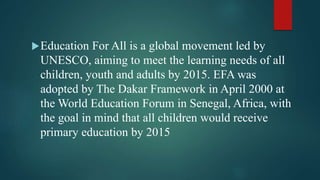
Education For All is a global movement led by
UNESCO, aiming to meet the learning needs of all
children, youth and adults by 2015. EFA was
adopted by The Dakar Framework in April 2000 at
the World Education Forum in Senegal, Africa, with
the goal in mind that all children would receive
primary education by 2015
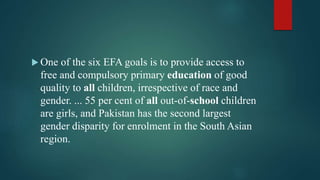
 One of the six EFA goals is to provide access to
free and compulsory primary education of good
quality to all children, irrespective of race and
gender. ... 55 per cent of all out-of-school children
are girls, and Pakistan has the second largest
gender disparity for enrolment in the South Asian
region.
Report reveals the following findings:
 Goal 1. Expand early childhood care and education:
Forty seven percent of countries reached the goal and
another eight percent were close. Twenty percent were
very far from the goal. Yet, in 2012, nearly two-thirds
more children were enrolled in early childhood education
than in 1999.
 Goal 2. Achieve universal primary education: Fifty-two percent of
countries achieved this goal; ten percent are close and the remaining
thirty-eight percent are far or very far from achieving it. This leaves
almost 100 million children not completing primary education in 2015.
A lack of focus on the marginalized has left the poorest five times less
likely to complete a full cycle of primary education than the richest and
over a third of out of school children living in conflict affected zones.
 There have been important successes: Around 50 million more children
are enrolled in school now than were in 1999. Education is still not free
in many places, but cash transfer and school feeding programmes have
had a positive impact on school enrolment for the poor.
 Goal 3. Ensure equal access to learning and life skills
for youth and adults: Forty-six percent of countries
reached universal lower secondary enrolment. Globally,
numbers in lower secondary education increased by 27%
and more than doubled in Africa, one third of youths in
low income countries will not complete lower secondary
school in 2015.
 Goal 4. Achieving a 50 per cent reduction in levels of
adult illiteracy: Only 25% of countries reached this goal;
32% remain very far from it. While globally the percentage
of illiterate adults fell from 18% in 2000 to 14% in 2015,
this progress is almost completely attributed to more
educated young people reaching adulthood. Women
continue to make up almost two-thirds of the illiterate adult
population. African women do not have basic literacy
skills.
 Goal 5. Achieve gender parity and equality
Gender parity will be achieved at the primary level
in 69% of countries by 2015. At secondary level,
only 48% of countries will reach the goal. Child
marriage and early pregnancy continue to hinder
girls’ progress in education as does the need for
teacher training in gender sensitive approaches and
curriculum reform.
 Goal 6. Improve the quality of education and ensure
measurable learning outcomes for all: The numbers of pupils
per teacher decreased in 121 of 146 countries between 1990 and
2012 at the primary level, but 4 million more teachers are still
needed to get all children into school.
 Trained teachers remain in short supply in one third of countries;
in several African countries, less than 50 percent are trained.
However, education quality has received increased attention since
2000; the number of countries carrying out national learning
assessments has doubled.
THE END

EFA Goals.pptx

  • 1.
    Education For AllGoals BS(Bachelor of studies) Education Instructor: Miss Tanzela Bashir
  • 2.
    Education For AllGoals • Six internationally agreed education goals aim to meet the learning needs of all children, youth and adults by 2015. • Goal 1: Expand early childhood care and education • Goal 2: Provide free and compulsory primary education for all • Goal 3: Promote learning and life skills for young people and adults • Goal 4: Increase adult literacy by 50 percent • Goal 5: Achieve gender parity by 2005, gender equality by 2015 • Goal 6: Improve the quality of education
  • 3.
     Goal 1Expanding and improving comprehensive early childhood care and education, especially for the most helpless and needy children.  Goal 2 Ensuring that by 2015 all children, particularly girls, children in difficult circumstances and those belonging to ethnic minorities, have access to, and complete, free and compulsory primary education of good quality.  Goal 3 Ensuring that the learning needs of all young people and adults are met through equitable access to appropriate learning and life-skills programs.
  • 4.
     Goal 4Achieving a 50 per cent improvement in levels of adult literacy by 2015, especially for women, and equitable access to basic and continuing education for all adults.  Goal 5 Eliminating gender disparities in primary and secondary education by 2005, and achieving gender equality in education by 2015, with a focus on ensuring girls’ full and equal access to and achievement in basic education of good quality.  Goal 6 Improving all aspects of the quality of education and ensuring excellence of all so that recognized and measurable learning outcomes are achieved by all, especially in literacy, numeracy and essential life skills.
  • 5.
    Education For Allis a global movement led by UNESCO, aiming to meet the learning needs of all children, youth and adults by 2015. EFA was adopted by The Dakar Framework in April 2000 at the World Education Forum in Senegal, Africa, with the goal in mind that all children would receive primary education by 2015
  • 6.
     One ofthe six EFA goals is to provide access to free and compulsory primary education of good quality to all children, irrespective of race and gender. ... 55 per cent of all out-of-school children are girls, and Pakistan has the second largest gender disparity for enrolment in the South Asian region.
  • 7.
    Report reveals thefollowing findings:  Goal 1. Expand early childhood care and education: Forty seven percent of countries reached the goal and another eight percent were close. Twenty percent were very far from the goal. Yet, in 2012, nearly two-thirds more children were enrolled in early childhood education than in 1999.
  • 8.
     Goal 2.Achieve universal primary education: Fifty-two percent of countries achieved this goal; ten percent are close and the remaining thirty-eight percent are far or very far from achieving it. This leaves almost 100 million children not completing primary education in 2015. A lack of focus on the marginalized has left the poorest five times less likely to complete a full cycle of primary education than the richest and over a third of out of school children living in conflict affected zones.  There have been important successes: Around 50 million more children are enrolled in school now than were in 1999. Education is still not free in many places, but cash transfer and school feeding programmes have had a positive impact on school enrolment for the poor.
  • 9.
     Goal 3.Ensure equal access to learning and life skills for youth and adults: Forty-six percent of countries reached universal lower secondary enrolment. Globally, numbers in lower secondary education increased by 27% and more than doubled in Africa, one third of youths in low income countries will not complete lower secondary school in 2015.
  • 10.
     Goal 4.Achieving a 50 per cent reduction in levels of adult illiteracy: Only 25% of countries reached this goal; 32% remain very far from it. While globally the percentage of illiterate adults fell from 18% in 2000 to 14% in 2015, this progress is almost completely attributed to more educated young people reaching adulthood. Women continue to make up almost two-thirds of the illiterate adult population. African women do not have basic literacy skills.
  • 11.
     Goal 5.Achieve gender parity and equality Gender parity will be achieved at the primary level in 69% of countries by 2015. At secondary level, only 48% of countries will reach the goal. Child marriage and early pregnancy continue to hinder girls’ progress in education as does the need for teacher training in gender sensitive approaches and curriculum reform.
  • 12.
     Goal 6.Improve the quality of education and ensure measurable learning outcomes for all: The numbers of pupils per teacher decreased in 121 of 146 countries between 1990 and 2012 at the primary level, but 4 million more teachers are still needed to get all children into school.  Trained teachers remain in short supply in one third of countries; in several African countries, less than 50 percent are trained. However, education quality has received increased attention since 2000; the number of countries carrying out national learning assessments has doubled.
  • 13.