Education For All (EFA)
Ma. Giselle Agustin
Alexandra Mae Pagkalinawan
What is EFA?
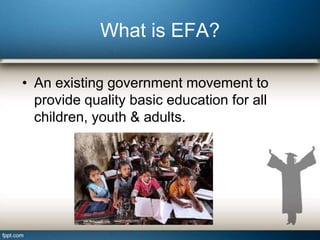
• An existing government movement to
provide quality basic education for all
children, youth & adults.
History of EFA
• Launched at World Conference on
Education for All in 1990
• UNESCO, UNDP, UNFPA, UNCEF and
World bank
The Six EFA Goals
1. Expanding and improving comprehensive
early childhood care and education,
especially for the most vulnerable and
disadvantaged children.
The Six EFA Goals
• Ensuring that by 2015 all children,
particularly girls, children in difficult
circumstances and those belonging to
ethnic minorities, have access to, and
complete, free and compulsory primary
education of good quality.
The Six EFA Goals
• Ensuring that the learning needs of all
young people and adults are met through
equitable access to appropriate learning
and life-skills programs.
The Six EFA Goals
• Achieving a 50% improvement in levels of
adult literacy by 2015, especially for
women, and equitable access to basic and
continuing education for all adults.
The Six EFA Goals
• Eliminating gender disparities in primary
and secondary education by 2005, and
achieving gender equality in education by
2015, with a focus on ensuring girls’ full
and equal access to and achievement in
basic education of good quality.
The Six EFA Goals
• Improving all aspects of the quality of
education and ensuring excellence of all
so that recognized and measurable
learning outcomes are achieved by
all, especially in literacy, numeracy and
essential life skills.
Philippine Education For All
• A vision and a holistic program of reforms
that aims at improving the quality of basic
education for every Filipino by 2015.
Overall Goals & Objectives of
Philippine EFA 2015
1. Universal coverage of Out of School Youth
(OSY) and adults in the provision of basic
learning needs;
2. Universal school participation and
elimination of drop outs and repetition in
first three grades;
Overall Goals & Objectives of
Philippine EFA 2015
3. Universal completion of full cycle of basic
education schooling with satisfactory
achievement levels by all at every grade or
year;
4. Total community commitment to
attainment of basic education
competencies for all.
Four component outcomes to
achieve EFA Goals
1. Universal coverage of out-of-school
youths and adults in the provision of basic
learning needs. All persons who failed to
acquire the essential competence to be
functionally literate in their native tongue,
in Filipino, and in English.
Four component outcomes to
achieve EFA Goals
2. Universal school participation and
elimination of drop-outs and repetition in
first three grades. All children aged six
should enter school ready to learn and
prepared to achieve the required
competencies for Grades 1 to 3.
Four component outcomes to
achieve EFA Goals
3. Universal completion of the full cycle of
basic education schooling with satisfactory
achievement levels by all at every grade or
year.
Four component outcomes to
achieve EFA Goals
4. Total community commitment to attainment
of basic education competencies for all:
Every community should mobilize all its
social, political, cultural and economic
resources and capabilities to support the
universal attainment of basic education
competencies in Filipino and English.
Nine Urgent and Critical Tasks
1. Make every school continuously improve
its performance.
2. Expand early childhood care and
development coverage to yield more EFA
benefits.
3. Transform existing non-formal and
informal learning options into a truly viable
alternative learning system yielding more
EFA benefits;
Nine Urgent and Critical Tasks
4. Get all teachers to continuously improve
their teaching practices.
5. Increase the cycle of schooling to reach
12 years of formal basic education.
6. Continue enrichment of curriculum
development in the context of pillars of
new functional literacy;
Nine Urgent and Critical Tasks
7. Provide adequate and stable public
funding for country-wide attainment of EFA
goals;
8. Create network of community- based
groups for local attainment of EFA goals;
9. Monitor progress in effort towards
attainment of EFA goals.
LARGER STAKES TO THE
NATION
1. Language
2. National Identity
3. Social capital
4. Cultural practices
5. Individual freedom

Education for All Globally & in the Philippines

  • 1.
    Education For All(EFA) Ma. Giselle Agustin Alexandra Mae Pagkalinawan
  • 2.
    What is EFA? •An existing government movement to provide quality basic education for all children, youth & adults.
  • 3.
    History of EFA •Launched at World Conference on Education for All in 1990 • UNESCO, UNDP, UNFPA, UNCEF and World bank
  • 4.
    The Six EFAGoals 1. Expanding and improving comprehensive early childhood care and education, especially for the most vulnerable and disadvantaged children.
  • 5.
    The Six EFAGoals • Ensuring that by 2015 all children, particularly girls, children in difficult circumstances and those belonging to ethnic minorities, have access to, and complete, free and compulsory primary education of good quality.
  • 6.
    The Six EFAGoals • Ensuring that the learning needs of all young people and adults are met through equitable access to appropriate learning and life-skills programs.
  • 7.
    The Six EFAGoals • Achieving a 50% improvement in levels of adult literacy by 2015, especially for women, and equitable access to basic and continuing education for all adults.
  • 8.
    The Six EFAGoals • Eliminating gender disparities in primary and secondary education by 2005, and achieving gender equality in education by 2015, with a focus on ensuring girls’ full and equal access to and achievement in basic education of good quality.
  • 9.
    The Six EFAGoals • Improving all aspects of the quality of education and ensuring excellence of all so that recognized and measurable learning outcomes are achieved by all, especially in literacy, numeracy and essential life skills.
  • 10.
    Philippine Education ForAll • A vision and a holistic program of reforms that aims at improving the quality of basic education for every Filipino by 2015.
  • 11.
    Overall Goals &Objectives of Philippine EFA 2015 1. Universal coverage of Out of School Youth (OSY) and adults in the provision of basic learning needs; 2. Universal school participation and elimination of drop outs and repetition in first three grades;
  • 12.
    Overall Goals &Objectives of Philippine EFA 2015 3. Universal completion of full cycle of basic education schooling with satisfactory achievement levels by all at every grade or year; 4. Total community commitment to attainment of basic education competencies for all.
  • 13.
    Four component outcomesto achieve EFA Goals 1. Universal coverage of out-of-school youths and adults in the provision of basic learning needs. All persons who failed to acquire the essential competence to be functionally literate in their native tongue, in Filipino, and in English.
  • 14.
    Four component outcomesto achieve EFA Goals 2. Universal school participation and elimination of drop-outs and repetition in first three grades. All children aged six should enter school ready to learn and prepared to achieve the required competencies for Grades 1 to 3.
  • 15.
    Four component outcomesto achieve EFA Goals 3. Universal completion of the full cycle of basic education schooling with satisfactory achievement levels by all at every grade or year.
  • 16.
    Four component outcomesto achieve EFA Goals 4. Total community commitment to attainment of basic education competencies for all: Every community should mobilize all its social, political, cultural and economic resources and capabilities to support the universal attainment of basic education competencies in Filipino and English.
  • 17.
    Nine Urgent andCritical Tasks 1. Make every school continuously improve its performance. 2. Expand early childhood care and development coverage to yield more EFA benefits. 3. Transform existing non-formal and informal learning options into a truly viable alternative learning system yielding more EFA benefits;
  • 18.
    Nine Urgent andCritical Tasks 4. Get all teachers to continuously improve their teaching practices. 5. Increase the cycle of schooling to reach 12 years of formal basic education. 6. Continue enrichment of curriculum development in the context of pillars of new functional literacy;
  • 19.
    Nine Urgent andCritical Tasks 7. Provide adequate and stable public funding for country-wide attainment of EFA goals; 8. Create network of community- based groups for local attainment of EFA goals; 9. Monitor progress in effort towards attainment of EFA goals.
  • 20.
    LARGER STAKES TOTHE NATION 1. Language 2. National Identity 3. Social capital 4. Cultural practices 5. Individual freedom