EDUC638/EME6613 Openness in Education 
September 30, 2014 
Mathieu Plourdebit.ly/educ638-open14
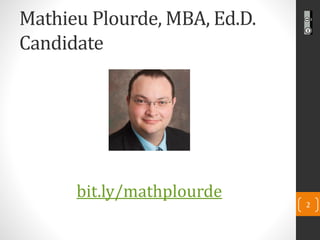
Mathieu Plourde, MBA, Ed.D. Candidate 
bit.ly/mathplourde 
2
BEFORE WE START… 3
What is open? 
•Let’s gather definitions of the word “open” 
•http://bit.ly/def-open14 
4
What is free? 
•Let’s gather definitions of the word “free” 
•http://bit.ly/def-free14 
5
HISTORY LESSON 
A little 
6
Traditional software model 
Credit: somethingstartedcrazyand Rob on Flickr. 
7
Open source software 
USERS 
DEVELOPERS 
8
Open encyclopedia 
9
Source: Apple Just Ended the Era of Paid Operating Systems (Wired) 
10
Gratis 
Libre 
& 
(free of charge) 
(freedom of use) 
11
Open education 
"...is the simple and powerful idea that the world’s knowledge is a public good and that technology in general and the Worldwide Web in particular provide an extraordinary opportunity for everyone to share, use, and reuse knowledge." 
—The William and Flora Hewlett Foundation 12
Open education 
13
Evolution towards MOOCs 
Gerard L. Hanley, http://jolt.merlot.org/vol9no2/hanley_message_0613.htm
WHY OPEN MATTERS 15
Increase in textbook prices and college tuition (GAO) 
16
Demand for degrees 
17 
McCoy, D., Schiller, S. R., Frank, E., & Schiller, S. (2011, April 4). Textbook Affordability: Emerging Solutions in Ohio. Webinar, . Retrieved from http://www.educause.edu/Resources/TextbookAffordabilityEmergingS/226560
Low-cost pathways 
18
Typical textbook cycle 
19
Adopting an open textbook 
•Andrea Everard, Associate Professor 
•Accounting & MIS 
•MISY427 Information Technology Applications in Management -Fall 2011 
•Link to blog post and video testimonial
Costs associated with potential textbooks for MISY427
State of Washington 
The Open Course Library has saved students $5.5 million in textbook coststo date, including $2.9 million during the 2012-2013 academic year alone.”
Tidewater Community College 
“For students who pursue the new “textbook-free” degree, the total cost for required textbooks will be zero. Instead, the program will use high quality open textbooks and other open educational resources, known as OER, which are freely accessible, openly licensed materials useful for teaching, learning, assessment and research. It is estimated that a TCC student who completes the degree through the textbook-free initiative might save one-third on the cost of college.” 
http://www.tcc.edu/news/press/2013/TextbookFreeDegree.htm
Open textbooks in K12 
•State of Utah pilot provides a printed copy for $5 per student. 
•Replaces a 7 year cycle. 
•Fresh content every year, students keep the book. 
•Open textbook calculator: 
•http://openedgroup.org/calculator/ 
David Wiley, http://www.slideshare.net/opencontent/the-5-texbook
OER Repositories/Referatories 
•http://sites.udel.edu/open/finding/
WHAT MAKES SOMETHING OPEN? 
26
Copyright licensing 
•Open educational resources (OER) are powered by Creative Commons. The author sets the acceptable uses from the get-go. 
http://creativecommons.org/licenses/
BEWARE: OPENWASHING 
“What's getting lost here is the power of "free" to benefit not only institutions, but students as well.” 
-Anya Kamenetz
The OER spectrum 
Textbook 
Learning object
The OER spectrum 
Textbook 
Learning object 
Whole 
Traditional 
Fixed 
Peer-reviewed 
"Nugget" 
Innovative 
Evolving 
"Wisdom of the crowd"
What makes a resource open? 
•David Wiley's 4Rs: 
•Reuse: the right to reuse the content in its unaltered/verbatim form (e.g., make a backup copy of the content) 
•Revise: the right to adapt, adjust, modify, or alter the content itself (e.g., translate the content into another language) 
•Remix: the right to combine the original or revised content with other content to create something new (e.g., incorporate the content into a mashup) 
•Redistribute: the right to share copies of the original content, the revisions, or the remixes with others (e.g., give a copy of the content to a friend)
THE BIG BAD MOOC 32
Are you afraid MOOCs might take away your job? 
•Yes 
•No 
33 
Credit: Daniel Lobo on Flickr.com
What is a MOOC anyway? 
34
35 
Casey Green at #digedcon, April 2013
36
UD’s first MOOC 
37 
www.canvas.net/courses/phoneography-the-basics-of-cell-phone-photography
ConnectivistMOOCs 
38
Explore a MOOC catalog 
39 
www.class-central.com
Found something interesting? 
•How would you incorporate a MOOC in your everyday life? 
•Personally (as a hobby) 
•Educationally (to support your coursework as a student) 
•Professionally (to support your lifelong learning as a professional) 
•For teaching (to support your students) 
40
The value of MOOCs 
•San Jose State U. Puts MOOC Project on Hold 
•Prior learning assessment: 
•Western Governors University 
•SUNY REAL 
•Wrapping 
•Mozilla open badges 
41
BARRIERS TO OPEN 42
Perception of quality 
•Outside resources: 
•“Not mine” 
•“Not peer-reviewed” 
•“Not someone I know” 
•Personal resources: 
•Copyright confusion 
•“Not perfect enough to share” 
43
Startup cost and time 
•Finding 
•Vetting 
•Sequencing 
•Remixing 
•Filling up gaps 
•Assembling in a web format 
•Missing ancillaries and homework-as-a-service 
44
CONCLUSION 45
Learning resources ecosystem 
46
Curriculum design 
1.Commercial textbook selection 
2.Build from scratch 
1.Learning objectives 
2.Course outline 
3.Explore OER 
4.Identify gaps 
5.Explore commercial options 
6.Remix, repurpose 
7.Build, share, improve 
47
WE NEED YOU!
Mathieu Plourde, MBA, Ed.D. Candidate 
bit.ly/mathplourde 
Slides: bit.ly/educ638-open14 
50 
sites.udel.edu/open
OTHER OPENNESSES 51
Open access research 
http://www.youtube.com/watch?v=L5rVH1KGBCY
Open educational practices 
•http://openteaching.ud- css.net/2013/03/openeducationwk-udsnf12/
Personal learning networks 
Attribution: Alec Couros(courosa) on Flickr.com

2014-09-30 Openness in Education

  • 1.
    EDUC638/EME6613 Openness inEducation September 30, 2014 Mathieu Plourdebit.ly/educ638-open14
  • 2.
    Mathieu Plourde, MBA,Ed.D. Candidate bit.ly/mathplourde 2
  • 3.
  • 4.
    What is open? •Let’s gather definitions of the word “open” •http://bit.ly/def-open14 4
  • 5.
    What is free? •Let’s gather definitions of the word “free” •http://bit.ly/def-free14 5
  • 6.
  • 7.
    Traditional software model Credit: somethingstartedcrazyand Rob on Flickr. 7
  • 8.
    Open source software USERS DEVELOPERS 8
  • 9.
  • 10.
    Source: Apple JustEnded the Era of Paid Operating Systems (Wired) 10
  • 11.
    Gratis Libre & (free of charge) (freedom of use) 11
  • 12.
    Open education "...isthe simple and powerful idea that the world’s knowledge is a public good and that technology in general and the Worldwide Web in particular provide an extraordinary opportunity for everyone to share, use, and reuse knowledge." —The William and Flora Hewlett Foundation 12
  • 13.
  • 14.
    Evolution towards MOOCs Gerard L. Hanley, http://jolt.merlot.org/vol9no2/hanley_message_0613.htm
  • 15.
  • 16.
    Increase in textbookprices and college tuition (GAO) 16
  • 17.
    Demand for degrees 17 McCoy, D., Schiller, S. R., Frank, E., & Schiller, S. (2011, April 4). Textbook Affordability: Emerging Solutions in Ohio. Webinar, . Retrieved from http://www.educause.edu/Resources/TextbookAffordabilityEmergingS/226560
  • 18.
  • 19.
  • 20.
    Adopting an opentextbook •Andrea Everard, Associate Professor •Accounting & MIS •MISY427 Information Technology Applications in Management -Fall 2011 •Link to blog post and video testimonial
  • 21.
    Costs associated withpotential textbooks for MISY427
  • 22.
    State of Washington The Open Course Library has saved students $5.5 million in textbook coststo date, including $2.9 million during the 2012-2013 academic year alone.”
  • 23.
    Tidewater Community College “For students who pursue the new “textbook-free” degree, the total cost for required textbooks will be zero. Instead, the program will use high quality open textbooks and other open educational resources, known as OER, which are freely accessible, openly licensed materials useful for teaching, learning, assessment and research. It is estimated that a TCC student who completes the degree through the textbook-free initiative might save one-third on the cost of college.” http://www.tcc.edu/news/press/2013/TextbookFreeDegree.htm
  • 24.
    Open textbooks inK12 •State of Utah pilot provides a printed copy for $5 per student. •Replaces a 7 year cycle. •Fresh content every year, students keep the book. •Open textbook calculator: •http://openedgroup.org/calculator/ David Wiley, http://www.slideshare.net/opencontent/the-5-texbook
  • 25.
  • 26.
  • 27.
    Copyright licensing •Openeducational resources (OER) are powered by Creative Commons. The author sets the acceptable uses from the get-go. http://creativecommons.org/licenses/
  • 28.
    BEWARE: OPENWASHING “What'sgetting lost here is the power of "free" to benefit not only institutions, but students as well.” -Anya Kamenetz
  • 29.
    The OER spectrum Textbook Learning object
  • 30.
    The OER spectrum Textbook Learning object Whole Traditional Fixed Peer-reviewed "Nugget" Innovative Evolving "Wisdom of the crowd"
  • 31.
    What makes aresource open? •David Wiley's 4Rs: •Reuse: the right to reuse the content in its unaltered/verbatim form (e.g., make a backup copy of the content) •Revise: the right to adapt, adjust, modify, or alter the content itself (e.g., translate the content into another language) •Remix: the right to combine the original or revised content with other content to create something new (e.g., incorporate the content into a mashup) •Redistribute: the right to share copies of the original content, the revisions, or the remixes with others (e.g., give a copy of the content to a friend)
  • 32.
    THE BIG BADMOOC 32
  • 33.
    Are you afraidMOOCs might take away your job? •Yes •No 33 Credit: Daniel Lobo on Flickr.com
  • 34.
    What is aMOOC anyway? 34
  • 35.
    35 Casey Greenat #digedcon, April 2013
  • 36.
  • 37.
    UD’s first MOOC 37 www.canvas.net/courses/phoneography-the-basics-of-cell-phone-photography
  • 38.
  • 39.
    Explore a MOOCcatalog 39 www.class-central.com
  • 40.
    Found something interesting? •How would you incorporate a MOOC in your everyday life? •Personally (as a hobby) •Educationally (to support your coursework as a student) •Professionally (to support your lifelong learning as a professional) •For teaching (to support your students) 40
  • 41.
    The value ofMOOCs •San Jose State U. Puts MOOC Project on Hold •Prior learning assessment: •Western Governors University •SUNY REAL •Wrapping •Mozilla open badges 41
  • 42.
  • 43.
    Perception of quality •Outside resources: •“Not mine” •“Not peer-reviewed” •“Not someone I know” •Personal resources: •Copyright confusion •“Not perfect enough to share” 43
  • 44.
    Startup cost andtime •Finding •Vetting •Sequencing •Remixing •Filling up gaps •Assembling in a web format •Missing ancillaries and homework-as-a-service 44
  • 45.
  • 46.
  • 47.
    Curriculum design 1.Commercialtextbook selection 2.Build from scratch 1.Learning objectives 2.Course outline 3.Explore OER 4.Identify gaps 5.Explore commercial options 6.Remix, repurpose 7.Build, share, improve 47
  • 49.
  • 50.
    Mathieu Plourde, MBA,Ed.D. Candidate bit.ly/mathplourde Slides: bit.ly/educ638-open14 50 sites.udel.edu/open
  • 51.
  • 52.
    Open access research http://www.youtube.com/watch?v=L5rVH1KGBCY
  • 53.
    Open educational practices •http://openteaching.ud- css.net/2013/03/openeducationwk-udsnf12/
  • 54.
    Personal learning networks Attribution: Alec Couros(courosa) on Flickr.com