EDU555 CURRICULUM AND INSTRUCTION
WEEK 3
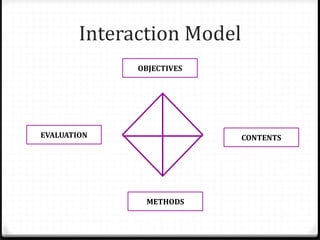
OBJECTIVES
METHODS
EVALUATION CONTENTS
Interaction Model
Interaction / Dynamic Model
0 To overcome the weaknesses of the Tyler’s Model, Taba
(1962) and Cohen proposed a more dynamic process of
curriculum development
0 It is a modification of the Tyler’s Model
0 In this model, curriculum development is seen as a dynamic
process
0 It may begin with any of the four curriculum element i.e.
objectives, contents, methods, evaluation and these
elements can be followed in any sequence
Interaction Model
0 Curriculum development may begin with any of the
curriculum element i.e. need not follow the order
or sequence as in Tyler’s Model.
0 The four elements are regarded as interactive and
modifiable i.e. changes can be made at any time.
0 A change made to one element will similarly cause
changes to the other elements.
0 As such, the curriculum development process
becomes flexible and dynamic.
Interaction Model
Strengths:
0 Practical
Represent a true picture of curriculum
development
0 Flexible
Allows the curriculum developer to:
0 Change the order of planning, and thus, not restricted by
a fixed procedure.
0 React to learning situations in determining the sequence
to follow according to the curriculum element.
Interaction Model
Weaknesses:
0 No fixed objectives:
By not stating objectives first, the objectives may be
accommodated to suit the contents.
As a result, the objectives are not in line with the initial
objectives.
0 No fixed direction
Continuous changing of direction during the process of
curriculum development will result in a disorganised
curriculum.
Interaction Model
0 The Interaction Model is practical and flexible and can
be appropriately used to design the curriculum.
Taba’s Model
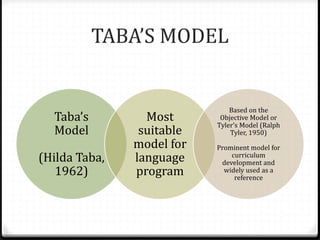
TABA’S MODEL
Taba’s
Model
(Hilda Taba,
1962)
Most
suitable
model for
language
program
Based on the
Objective Model or
Tyler’s Model (Ralph
Tyler, 1950)
Prominent model for
curriculum
development and
widely used as a
reference
Taba’s Model
0 Also known as “Grass-roots approach’.
0 Based on the rationale that those who teach the curriculum
i.e. the teacher, should participate in developing the
curriculum.
0 Teacher should have major input in curriculum
development.
0 Agreed with Tyler that there should be a definite
order in developing the curriculum to facilitate
attaining a more thoughtful and dynamically
conceived curriculum.
Taba’s Model
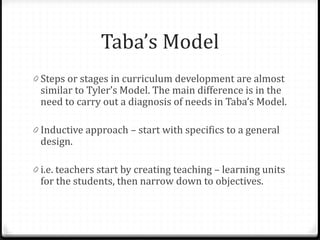
0 Steps or stages in curriculum development are almost
similar to Tyler’s Model. The main difference is in the
need to carry out a diagnosis of needs in Taba’s Model.
0 Inductive approach – start with specifics to a general
design.
0 i.e. teachers start by creating teaching – learning units
for the students, then narrow down to objectives.
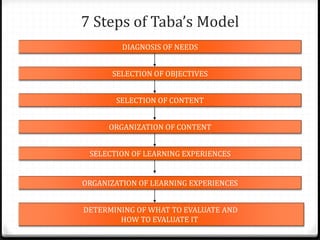
7 Steps of Taba’s Model
DIAGNOSIS OF NEEDS
SELECTION OF OBJECTIVES
SELECTION OF CONTENT
ORGANIZATION OF CONTENT
SELECTION OF LEARNING EXPERIENCES
ORGANIZATION OF LEARNING EXPERIENCES
DETERMINING OF WHAT TO EVALUATE AND
HOW TO EVALUATE IT
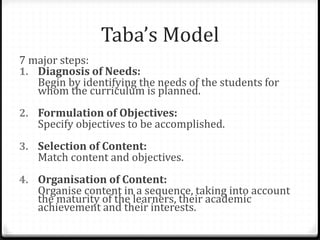
Taba’s Model
7 major steps:
1. Diagnosis of Needs:
Begin by identifying the needs of the students for
whom the curriculum is planned.
2. Formulation of Objectives:
Specify objectives to be accomplished.
3. Selection of Content:
Match content and objectives.
4. Organisation of Content:
Organise content in a sequence, taking into account
the maturity of the learners, their academic
achievement and their interests.
Taba’s Model
5. Selection of Learning Experiences:
Teacher selects learning experiences and methods
that will involve the students with the content.
6. Organisation of Learning Experiences:
Sequence and organise learning activities.
7. Evaluation and Means of Evaluation:
Determine how objectives are to be accomplished
and what have been accomplished.
CONTEMPORARY MODEL
OR
FRAMEWORK OF CURRICULUM
DEVELOPMENT
Curriculum Development
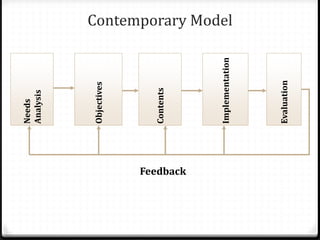
0 Based on 3 models of curriculum development, the
contemporary model or framework of curriculum
development involves 5 steps:
1) Needs analysis
2) Formulating Objectives
3) Selecting and organizing content
4) Implementing the curriculum
5) Evaluating the curriculum
Contemporary ModelNeeds
Analysis
Objectives
Implementation
Contents
Evaluation
Feedback
Curriculum Development
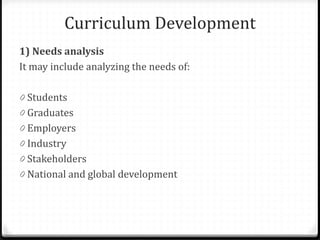
1) Needs analysis
It may include analyzing the needs of:
0 Students
0 Graduates
0 Employers
0 Industry
0 Stakeholders
0 National and global development
Curriculum Development
2) Formulation of objectives
Curriculum Development
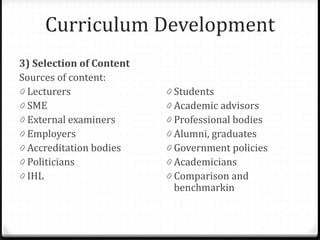
3) Selection of Content
Sources of content:
0 Lecturers
0 SME
0 External examiners
0 Employers
0 Accreditation bodies
0 Politicians
0 IHL
0 Students
0 Academic advisors
0 Professional bodies
0 Alumni, graduates
0 Government policies
0 Academicians
0 Comparison and
benchmarkin
Curriculum Development
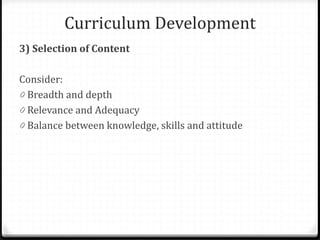
3) Selection of Content
Consider:
0 Breadth and depth
0 Relevance and Adequacy
0 Balance between knowledge, skills and attitude
Curriculum Development
4) Implementation
0 Teaching and learning process
Curriculum Development
5) Evaluation
0 Determine the method to measure whether the curriculum
is achieving the desired objectives or results
0 It involves an appraisal of the students’ actual behaviour
0 It should be carried out at several different times to secure
evidence of the permanence of the learning achieved
Curriculum Development
5) Evaluation
0 Using a variety of methods e.g. tests, work samples,
questionnaires, records, etc.
0 Results should be used to:
0 indicate strengths and weaknesses of the program
0 to plan for revision
THANK YOU

Edu555 cni week 3

  • 1.
    EDU555 CURRICULUM ANDINSTRUCTION WEEK 3
  • 2.
  • 3.
    Interaction / DynamicModel 0 To overcome the weaknesses of the Tyler’s Model, Taba (1962) and Cohen proposed a more dynamic process of curriculum development 0 It is a modification of the Tyler’s Model 0 In this model, curriculum development is seen as a dynamic process 0 It may begin with any of the four curriculum element i.e. objectives, contents, methods, evaluation and these elements can be followed in any sequence
  • 4.
    Interaction Model 0 Curriculumdevelopment may begin with any of the curriculum element i.e. need not follow the order or sequence as in Tyler’s Model. 0 The four elements are regarded as interactive and modifiable i.e. changes can be made at any time. 0 A change made to one element will similarly cause changes to the other elements. 0 As such, the curriculum development process becomes flexible and dynamic.
  • 5.
    Interaction Model Strengths: 0 Practical Representa true picture of curriculum development 0 Flexible Allows the curriculum developer to: 0 Change the order of planning, and thus, not restricted by a fixed procedure. 0 React to learning situations in determining the sequence to follow according to the curriculum element.
  • 6.
    Interaction Model Weaknesses: 0 Nofixed objectives: By not stating objectives first, the objectives may be accommodated to suit the contents. As a result, the objectives are not in line with the initial objectives. 0 No fixed direction Continuous changing of direction during the process of curriculum development will result in a disorganised curriculum.
  • 7.
    Interaction Model 0 TheInteraction Model is practical and flexible and can be appropriately used to design the curriculum.
  • 8.
  • 9.
    TABA’S MODEL Taba’s Model (Hilda Taba, 1962) Most suitable modelfor language program Based on the Objective Model or Tyler’s Model (Ralph Tyler, 1950) Prominent model for curriculum development and widely used as a reference
  • 10.
    Taba’s Model 0 Alsoknown as “Grass-roots approach’. 0 Based on the rationale that those who teach the curriculum i.e. the teacher, should participate in developing the curriculum. 0 Teacher should have major input in curriculum development. 0 Agreed with Tyler that there should be a definite order in developing the curriculum to facilitate attaining a more thoughtful and dynamically conceived curriculum.
  • 11.
    Taba’s Model 0 Stepsor stages in curriculum development are almost similar to Tyler’s Model. The main difference is in the need to carry out a diagnosis of needs in Taba’s Model. 0 Inductive approach – start with specifics to a general design. 0 i.e. teachers start by creating teaching – learning units for the students, then narrow down to objectives.
  • 12.
    7 Steps ofTaba’s Model DIAGNOSIS OF NEEDS SELECTION OF OBJECTIVES SELECTION OF CONTENT ORGANIZATION OF CONTENT SELECTION OF LEARNING EXPERIENCES ORGANIZATION OF LEARNING EXPERIENCES DETERMINING OF WHAT TO EVALUATE AND HOW TO EVALUATE IT
  • 13.
    Taba’s Model 7 majorsteps: 1. Diagnosis of Needs: Begin by identifying the needs of the students for whom the curriculum is planned. 2. Formulation of Objectives: Specify objectives to be accomplished. 3. Selection of Content: Match content and objectives. 4. Organisation of Content: Organise content in a sequence, taking into account the maturity of the learners, their academic achievement and their interests.
  • 14.
    Taba’s Model 5. Selectionof Learning Experiences: Teacher selects learning experiences and methods that will involve the students with the content. 6. Organisation of Learning Experiences: Sequence and organise learning activities. 7. Evaluation and Means of Evaluation: Determine how objectives are to be accomplished and what have been accomplished.
  • 15.
    CONTEMPORARY MODEL OR FRAMEWORK OFCURRICULUM DEVELOPMENT
  • 16.
    Curriculum Development 0 Basedon 3 models of curriculum development, the contemporary model or framework of curriculum development involves 5 steps: 1) Needs analysis 2) Formulating Objectives 3) Selecting and organizing content 4) Implementing the curriculum 5) Evaluating the curriculum
  • 17.
  • 18.
    Curriculum Development 1) Needsanalysis It may include analyzing the needs of: 0 Students 0 Graduates 0 Employers 0 Industry 0 Stakeholders 0 National and global development
  • 19.
  • 20.
    Curriculum Development 3) Selectionof Content Sources of content: 0 Lecturers 0 SME 0 External examiners 0 Employers 0 Accreditation bodies 0 Politicians 0 IHL 0 Students 0 Academic advisors 0 Professional bodies 0 Alumni, graduates 0 Government policies 0 Academicians 0 Comparison and benchmarkin
  • 21.
    Curriculum Development 3) Selectionof Content Consider: 0 Breadth and depth 0 Relevance and Adequacy 0 Balance between knowledge, skills and attitude
  • 22.
    Curriculum Development 4) Implementation 0Teaching and learning process
  • 23.
    Curriculum Development 5) Evaluation 0Determine the method to measure whether the curriculum is achieving the desired objectives or results 0 It involves an appraisal of the students’ actual behaviour 0 It should be carried out at several different times to secure evidence of the permanence of the learning achieved
  • 24.
    Curriculum Development 5) Evaluation 0Using a variety of methods e.g. tests, work samples, questionnaires, records, etc. 0 Results should be used to: 0 indicate strengths and weaknesses of the program 0 to plan for revision
  • 25.