Morgan P.Appel
Assistant Dean
Education and Community Outreach
This presentation and a host of related
materials and resources may be accessed
directly using Slide Share
(https://www.slideshare.net/).
Just search my name and you will be there
in a flash (although when you’ve hit French
recipes, you’ve gone too far).
A Dream of
Distance Learning:
1950s – 1960s
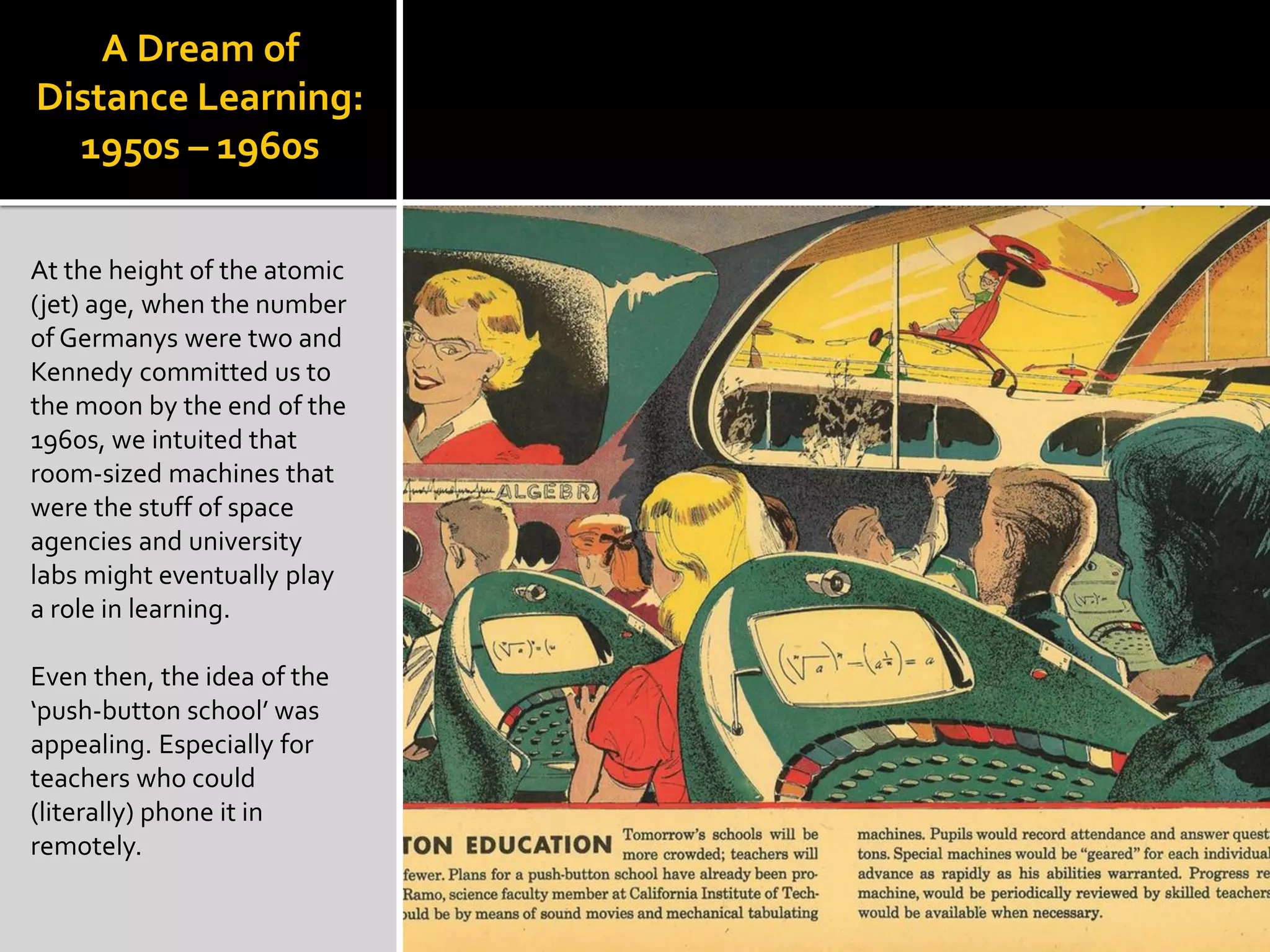
At the height of the atomic
(jet) age, when the number
of Germanys were two and
Kennedy committed us to
the moon by the end of the
1960s, we intuited that
room-sized machines that
were the stuff of space
agencies and university
labs might eventually play
a role in learning.
Even then, the idea of the
‘push-button school’ was
appealing. Especially for
teachers who could
(literally) phone it in
remotely.
Educational
Technology:
1970s – 1980s
As we moved out of the 1960s
and into the ‘me’ decade,
computers became somewhat
smaller (although not
necessarily friendlier).Though
limited in capability by today’s
standards, computers
revolutionized the learning
environment.
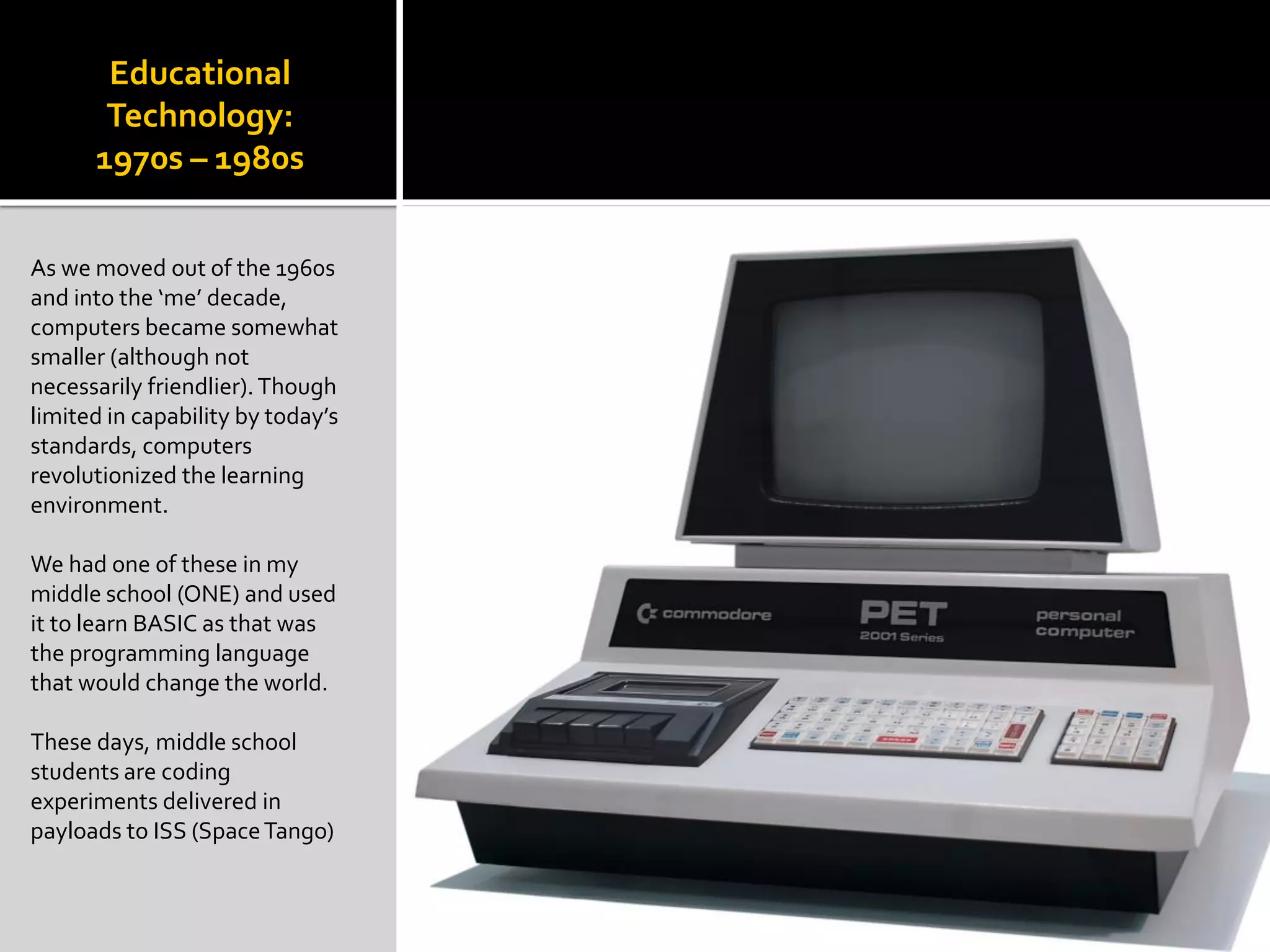
We had one of these in my
middle school (ONE) and used
it to learn BASIC as that was
the programming language
that would change the world.
These days, middle school
students are coding
experiments delivered in
payloads to ISS (SpaceTango)
Present Day:
2019 and Beyond
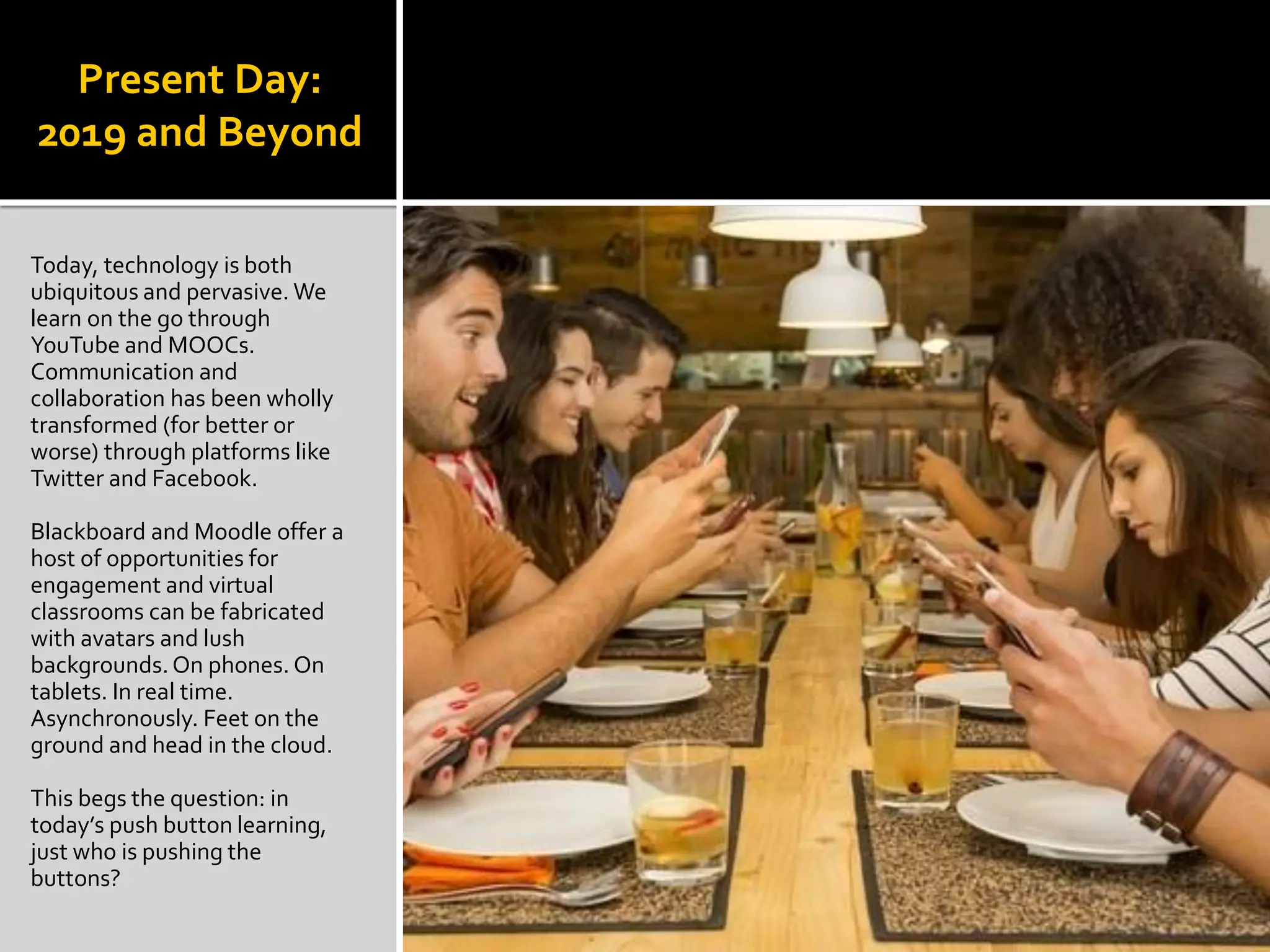
Today, technology is both
ubiquitous and pervasive. We
learn on the go through
YouTube and MOOCs.
Communication and
collaboration has been wholly
transformed (for better or
worse) through platforms like
Twitter and Facebook.
Blackboard and Moodle offer a
host of opportunities for
engagement and virtual
classrooms can be fabricated
with avatars and lush
backgrounds.On phones. On
tablets. In real time.
Asynchronously. Feet on the
ground and head in the cloud.
This begs the question: in
today’s push button learning,
just who is pushing the
buttons?
 UC San Diego, 2006: Facebook was just off and running.
Twitter hadn’t really left the starting gate. All about SMS and
Instant Messenger (if one could sort it out)
 Distance learning = CDs (!) delivered to students to watch
lessons and respond by email (!)
 Technology was an add-on, not an approach to teaching and
learning. A bit of fun and/or a means for students to turn in
work whilst on vacation or traveling.
 Face-to-Face = 95 percent (< 1,000 students per year: from San
Diego primarily).Today, online = 99.8 percent, 15,000 students
across the globe (including DoDEA personnel)
 Increasing demand (nationally and globally) and a subsequent
buyer’s market for educational services
 Obligation as a public university with a service mission
(attending to under resourced constituencies)
 Infusing online coursework into our own portfolios (and a
manifest need to train our own instructors)
 Changing learning technologies and platforms: accessible and
affordable
 Adoption of distance learning by institutions outside of the
University of California (and outside of traditional education)
 Need to undertake a leadership role (versus ‘fly-by-night’
operators)
2006
 Format: boutique, on
campus and in person sole
option (oddly)
 Audience: K-12 teachers
seeking to convert face-to-
face classes online
 Education occurs in schools
and sometimes other
places
2019
 Format: blended, hybrid
and online. Asynchronous
and synchronous. Glocal
focus.
 Audiences: manifold and
diverse (educators,
trainers, nonprofits,
government, ad. nauseum)
 Education is everywhere
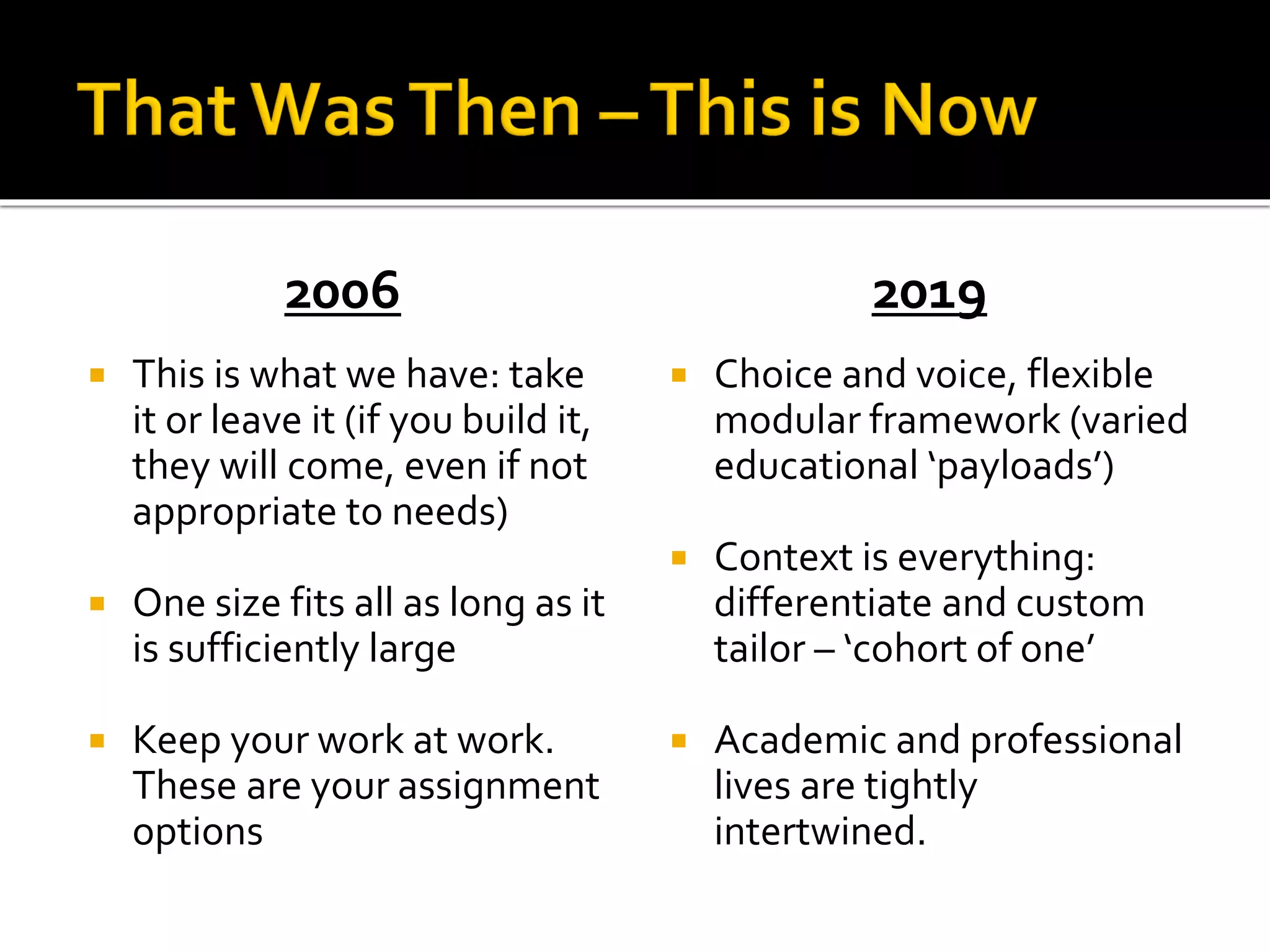
2006
 This is what we have: take
it or leave it (if you build it,
they will come, even if not
appropriate to needs)
 One size fits all as long as it
is sufficiently large
 Keep your work at work.
These are your assignment
options
2019
 Choice and voice, flexible
modular framework (varied
educational ‘payloads’)
 Context is everything:
differentiate and custom
tailor – ‘cohort of one’
 Academic and professional
lives are tightly
intertwined.
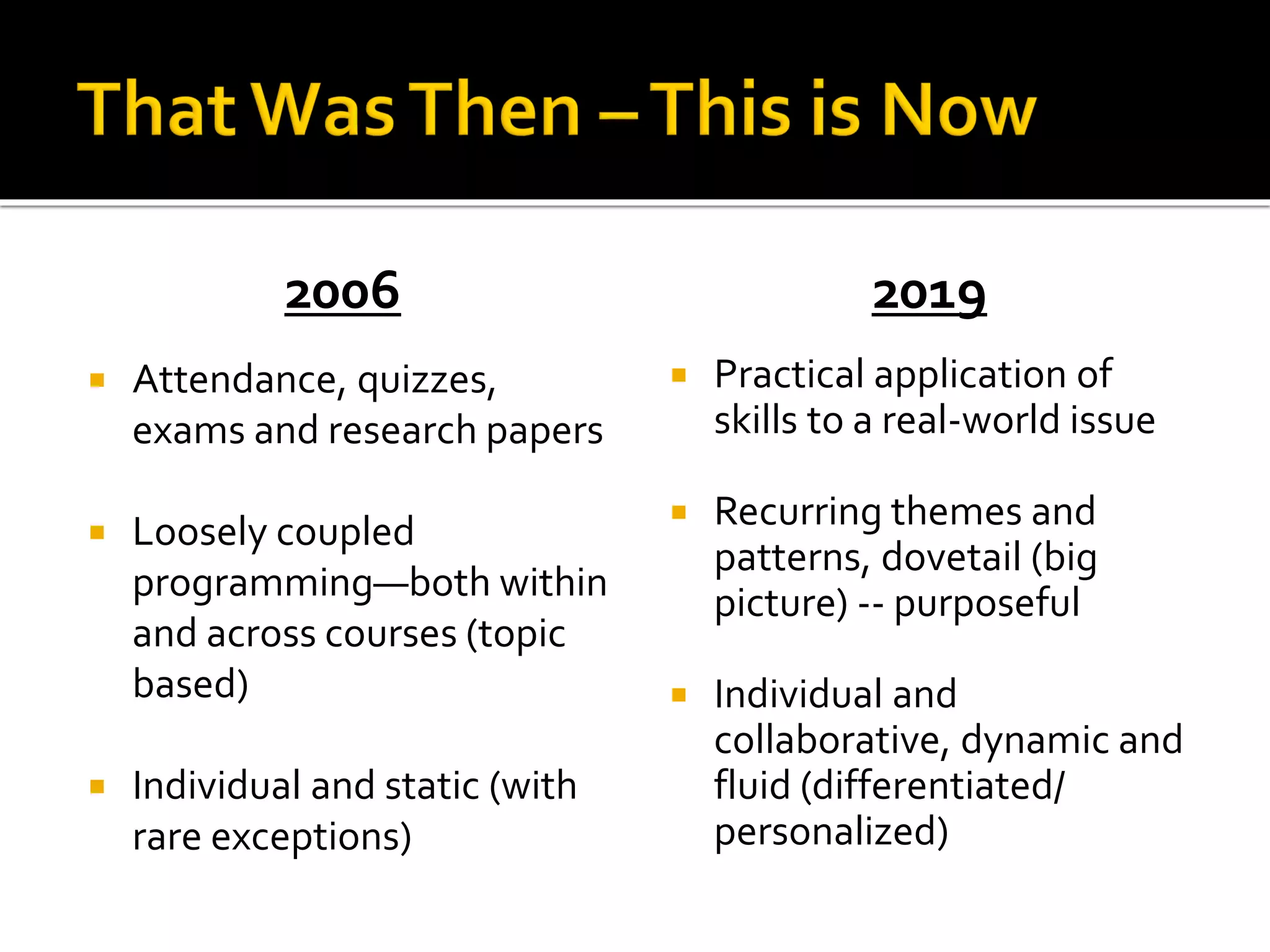
2006
 Attendance, quizzes,
exams and research papers
 Loosely coupled
programming—both within
and across courses (topic
based)
 Individual and static (with
rare exceptions)
2019
 Practical application of
skills to a real-world issue
 Recurring themes and
patterns, dovetail (big
picture) -- purposeful
 Individual and
collaborative, dynamic and
fluid (differentiated/
personalized)
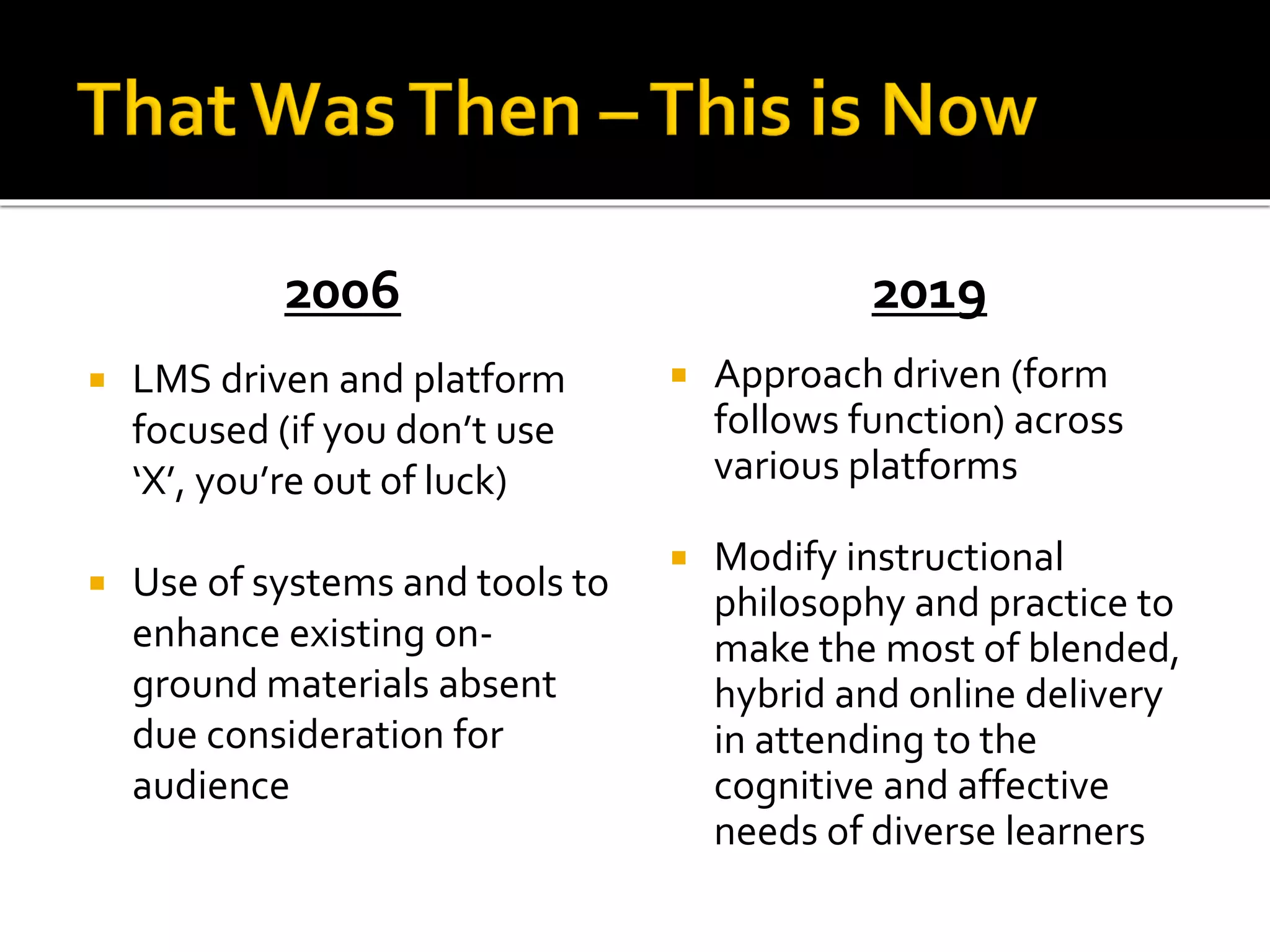
2006
 LMS driven and platform
focused (if you don’t use
‘X’, you’re out of luck)
 Use of systems and tools to
enhance existing on-
ground materials absent
due consideration for
audience
2019
 Approach driven (form
follows function) across
various platforms
 Modify instructional
philosophy and practice to
make the most of blended,
hybrid and online delivery
in attending to the
cognitive and affective
needs of diverse learners
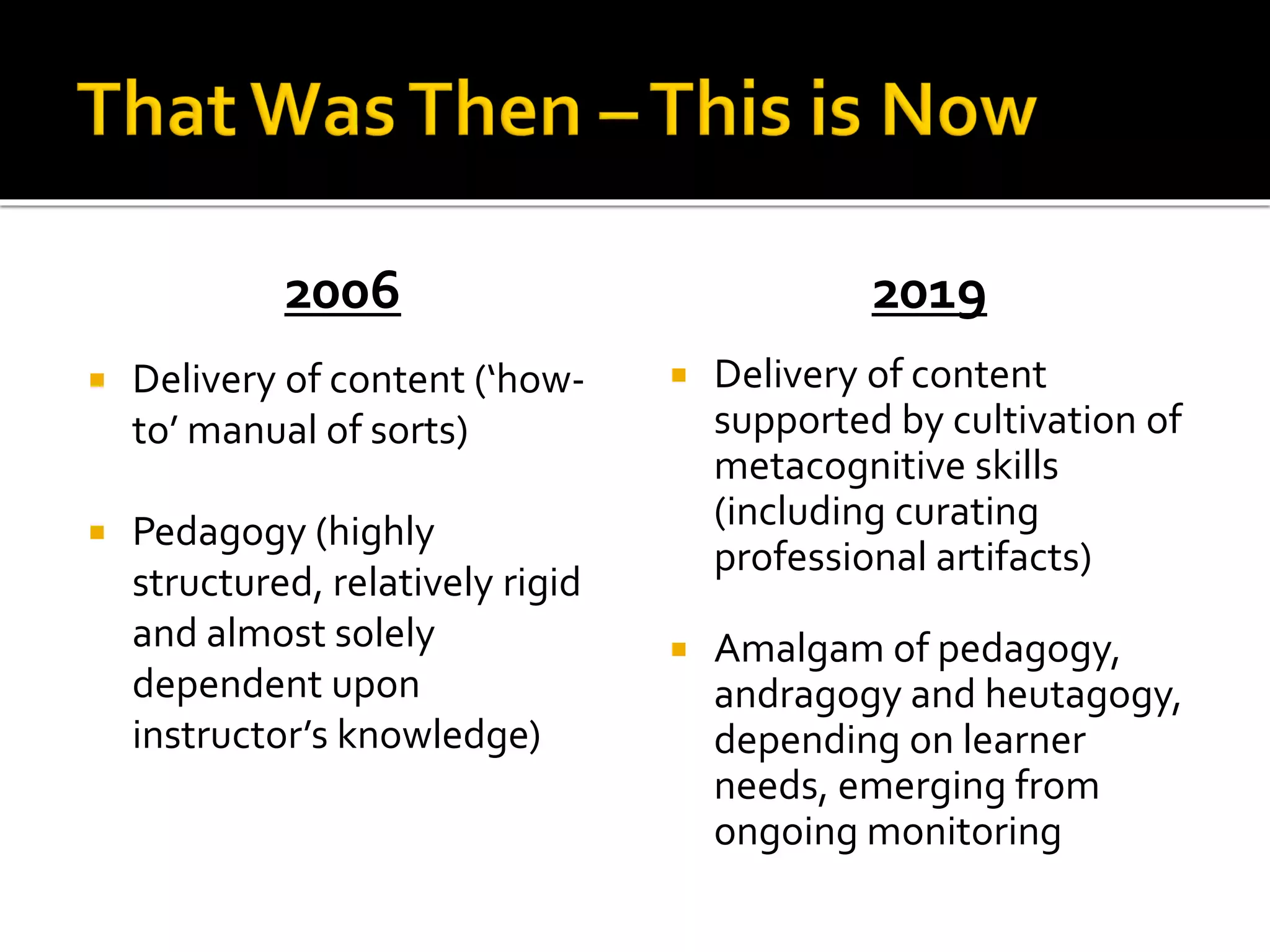
2006
 Delivery of content (‘how-
to’ manual of sorts)
 Pedagogy (highly
structured, relatively rigid
and almost solely
dependent upon
instructor’s knowledge)
2019
 Delivery of content
supported by cultivation of
metacognitive skills
(including curating
professional artifacts)
 Amalgam of pedagogy,
andragogy and heutagogy,
depending on learner
needs, emerging from
ongoing monitoring
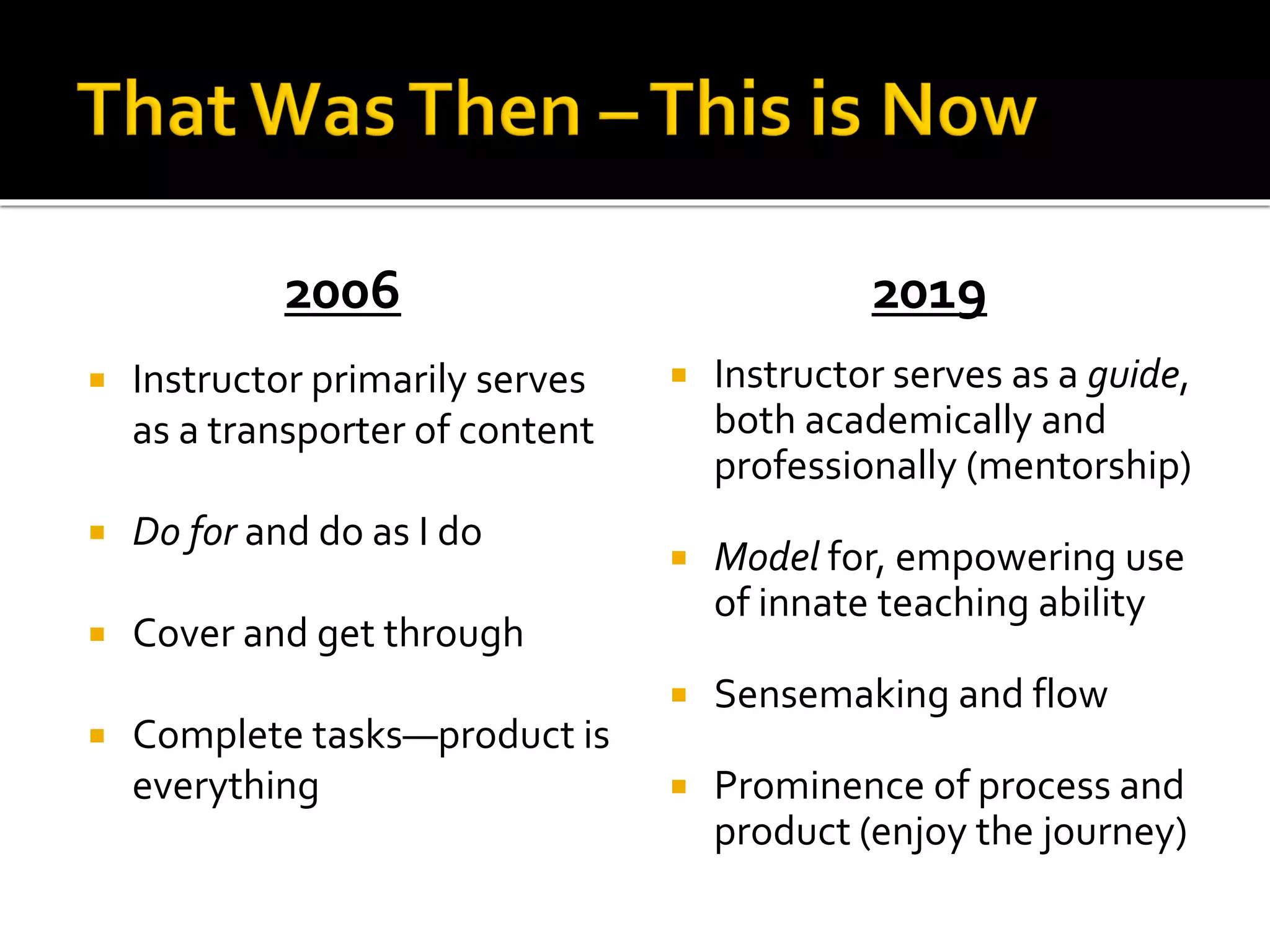
2006
 Instructor primarily serves
as a transporter of content
 Do for and do as I do
 Cover and get through
 Complete tasks—product is
everything
2019
 Instructor serves as a guide,
both academically and
professionally (mentorship)
 Model for, empowering use
of innate teaching ability
 Sensemaking and flow
 Prominence of process and
product (enjoy the journey)
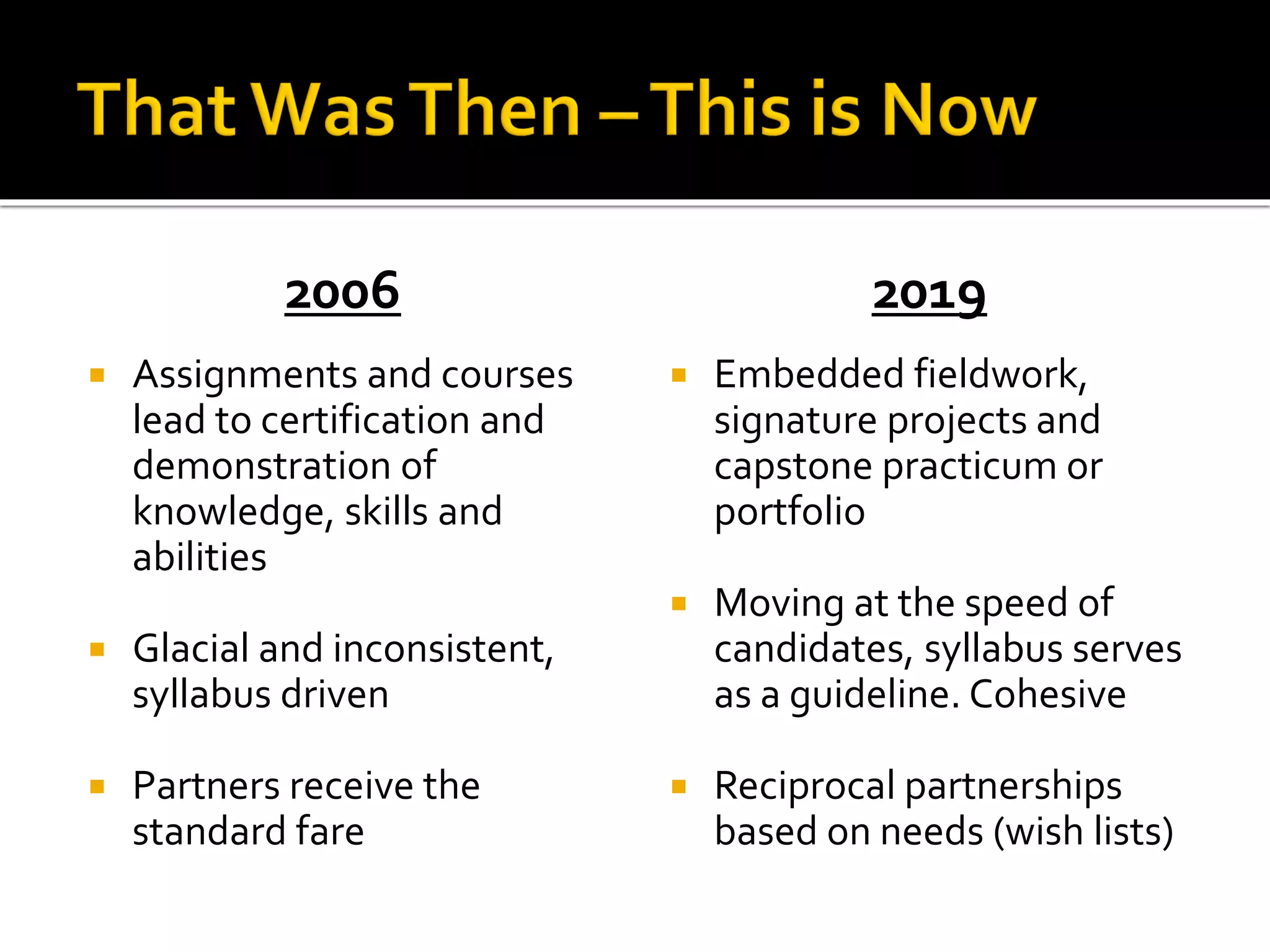
2006
 Assignments and courses
lead to certification and
demonstration of
knowledge, skills and
abilities
 Glacial and inconsistent,
syllabus driven
 Partners receive the
standard fare
2019
 Embedded fieldwork,
signature projects and
capstone practicum or
portfolio
 Moving at the speed of
candidates, syllabus serves
as a guideline. Cohesive
 Reciprocal partnerships
based on needs (wish lists)
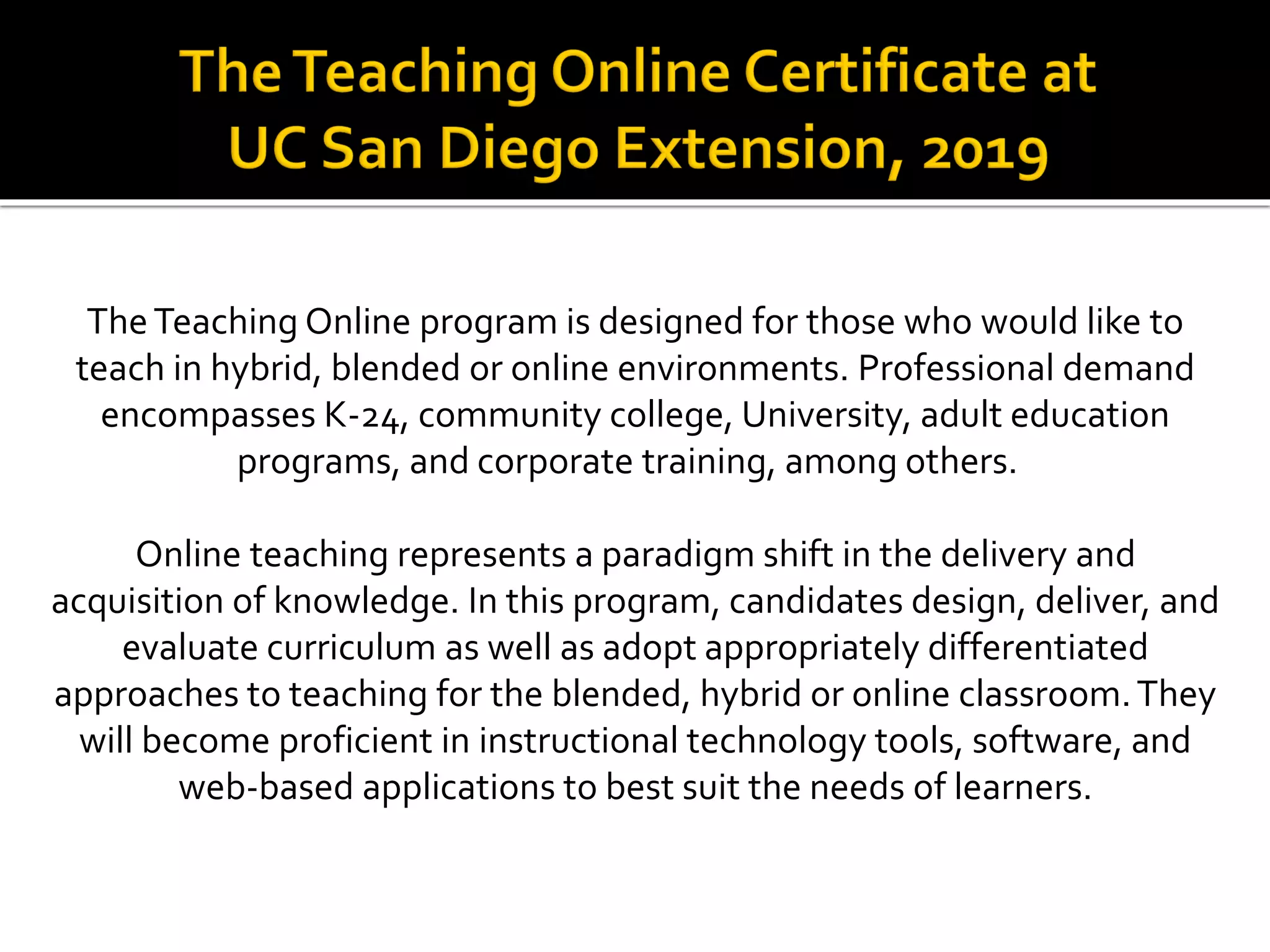
TheTeaching Online program is designed for those who would like to
teach in hybrid, blended or online environments. Professional demand
encompasses K-24, community college, University, adult education
programs, and corporate training, among others.
Online teaching represents a paradigm shift in the delivery and
acquisition of knowledge. In this program, candidates design, deliver, and
evaluate curriculum as well as adopt appropriately differentiated
approaches to teaching for the blended, hybrid or online classroom.They
will become proficient in instructional technology tools, software, and
web-based applications to best suit the needs of learners.
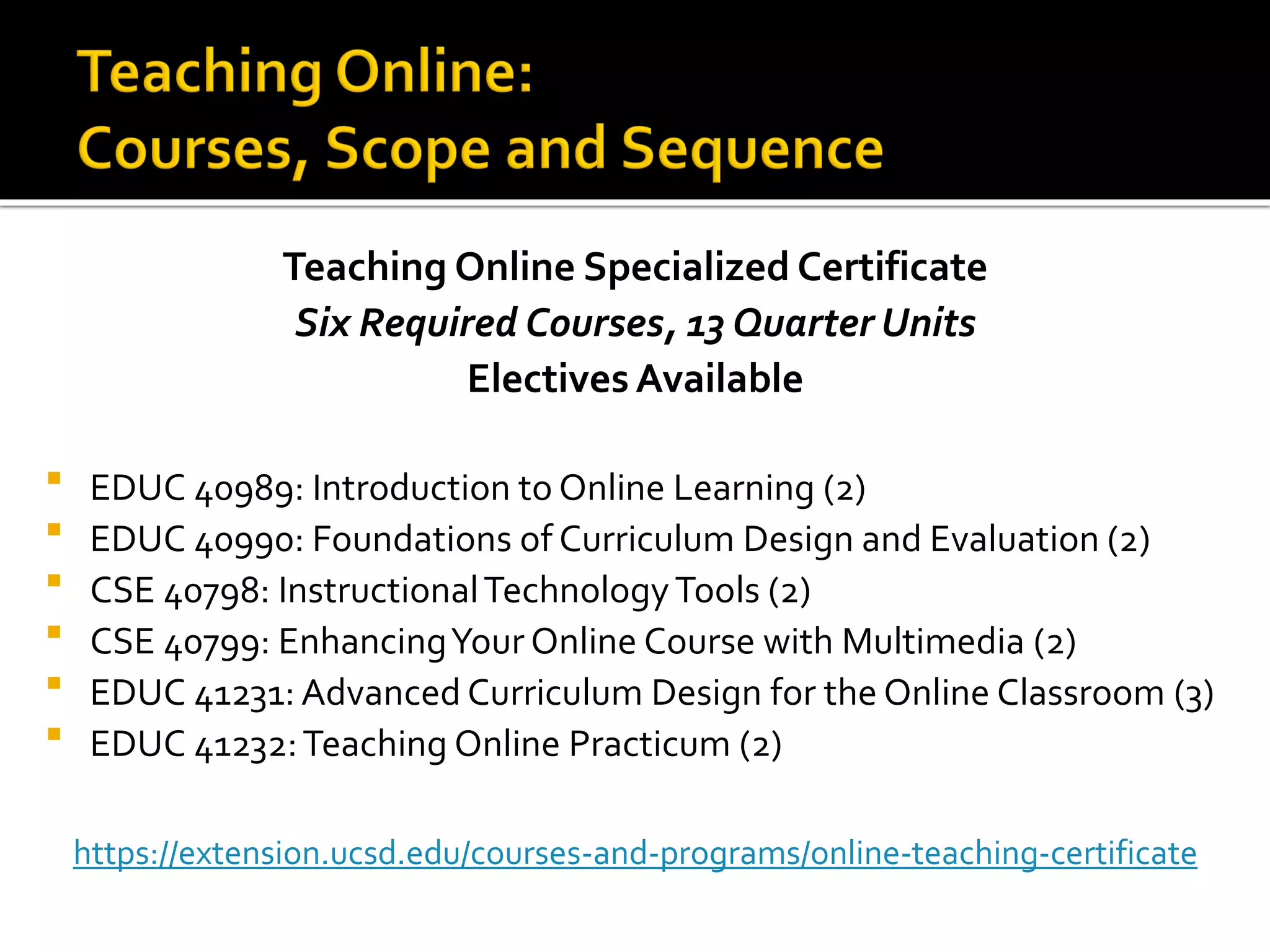
Teaching Online Specialized Certificate
Six Required Courses, 13 Quarter Units
Electives Available
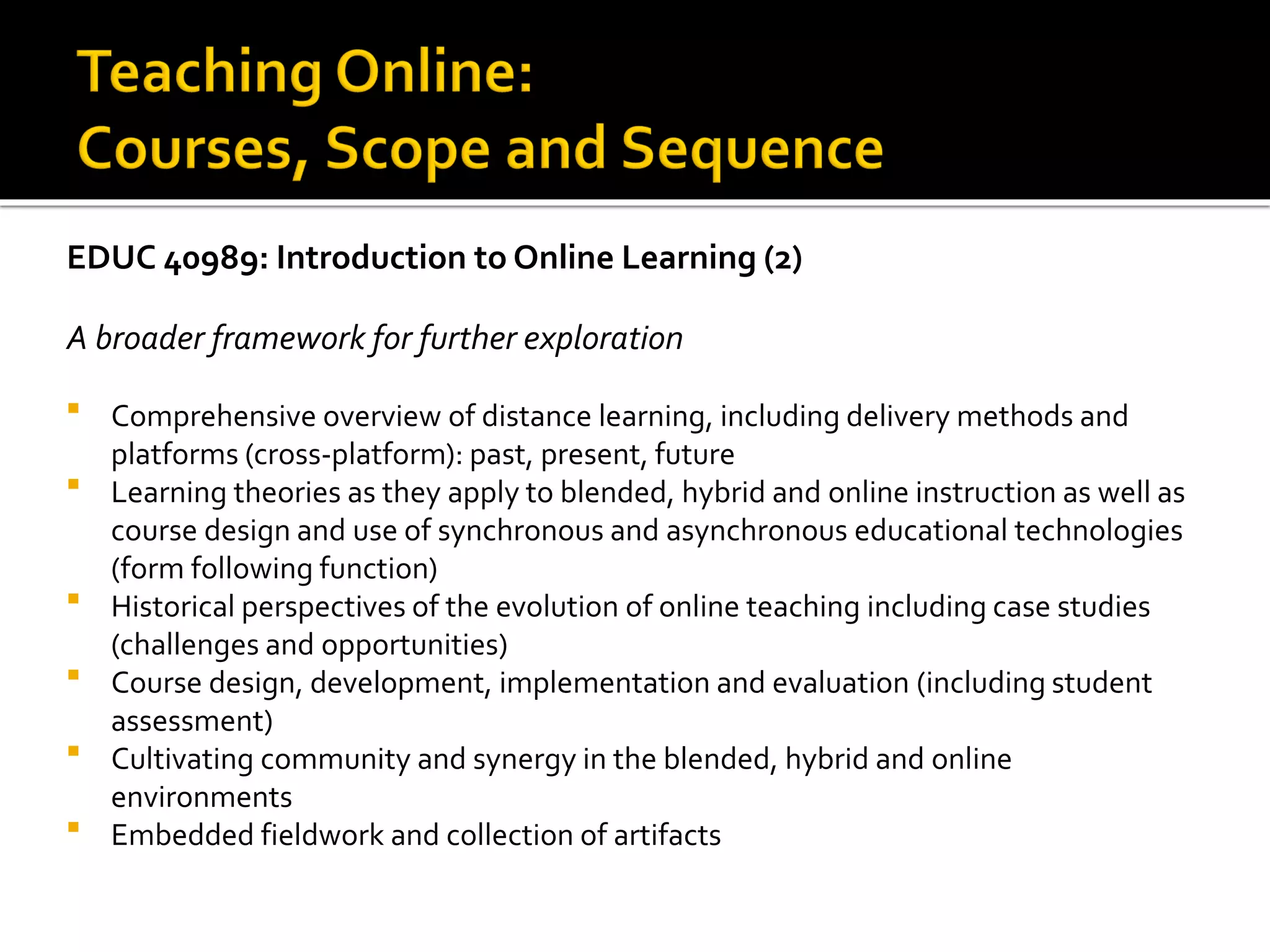
 EDUC 40989: Introduction to Online Learning (2)
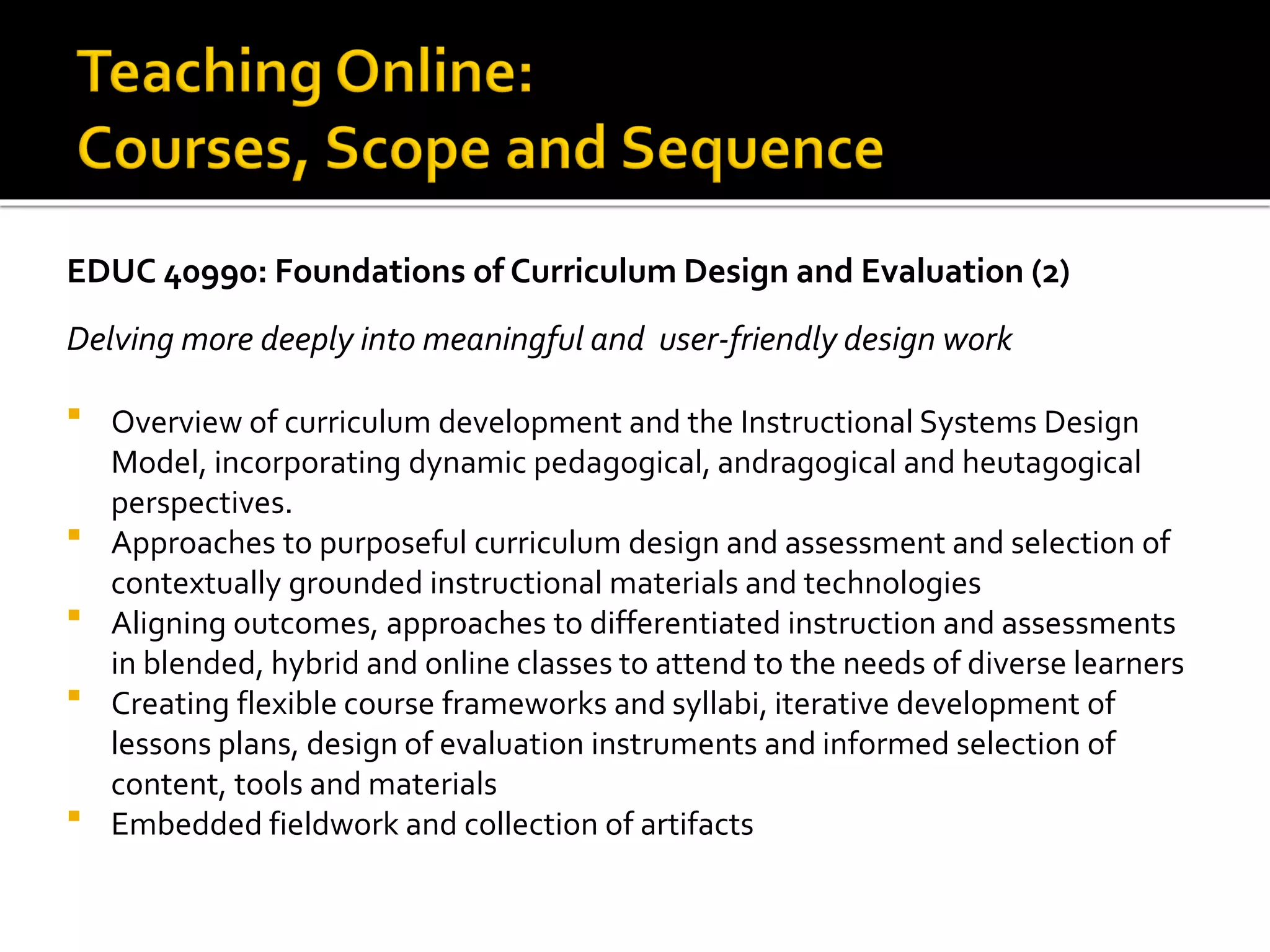
 EDUC 40990: Foundations of Curriculum Design and Evaluation (2)
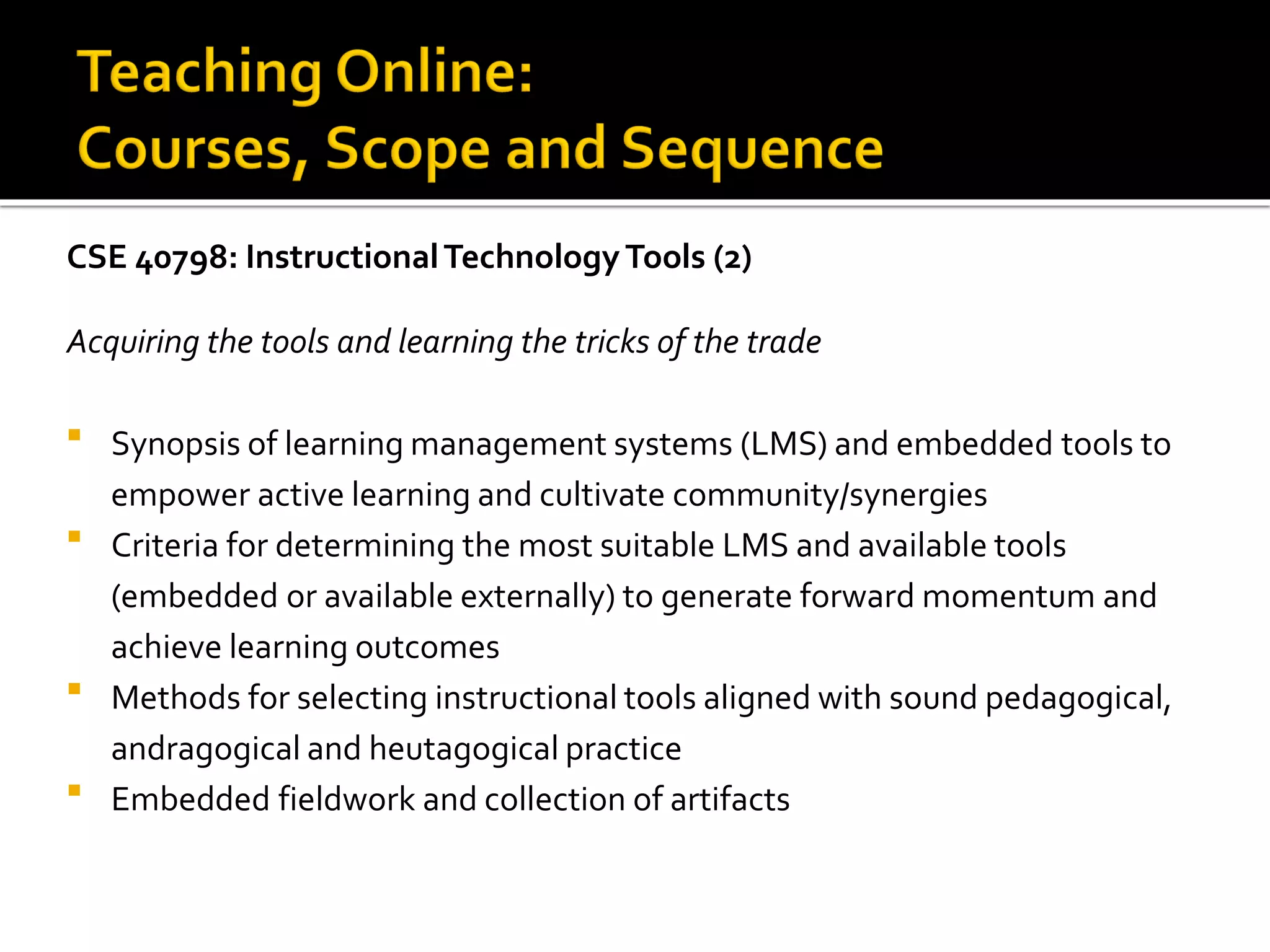
 CSE 40798: InstructionalTechnologyTools (2)
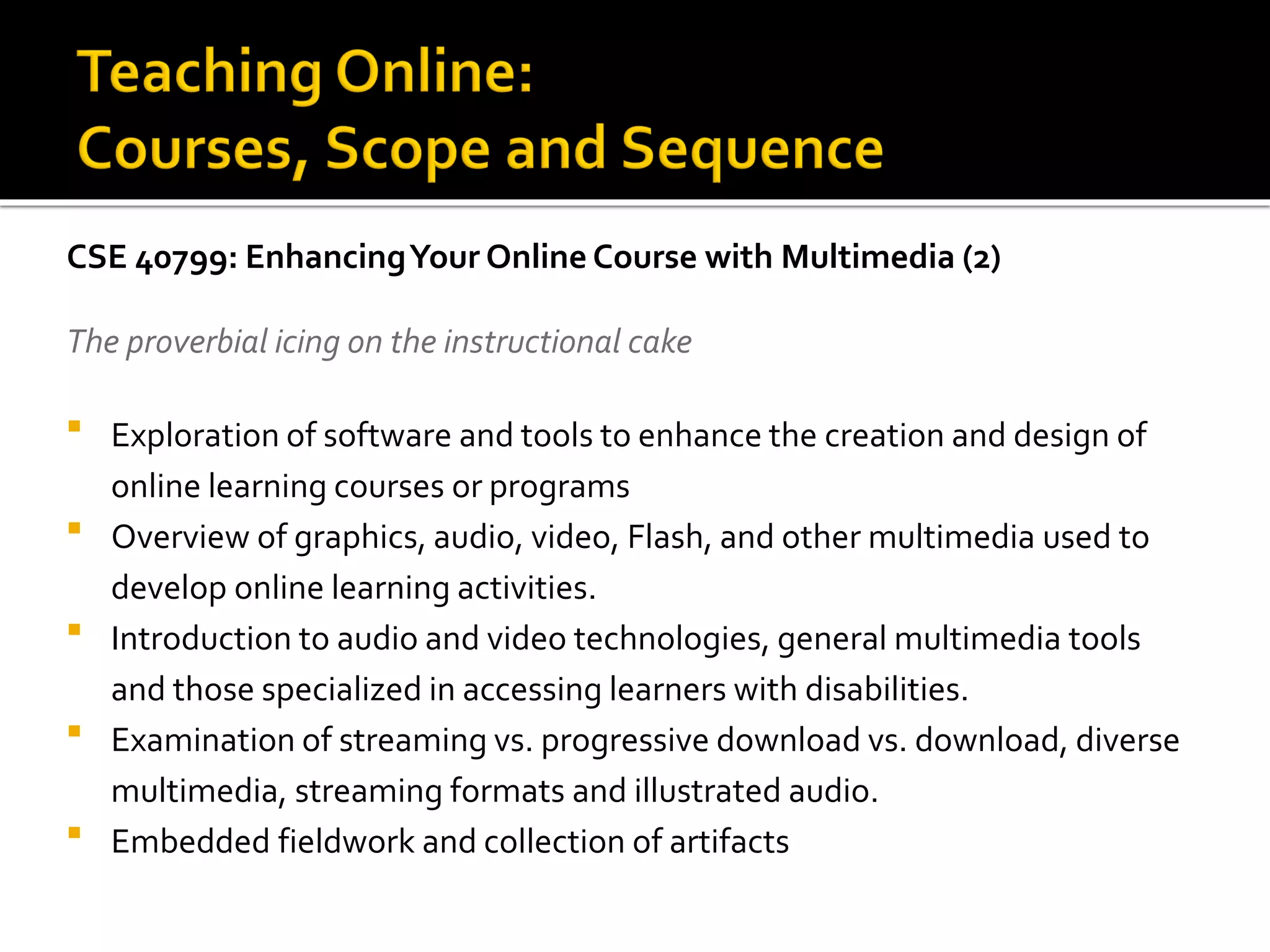
 CSE 40799: EnhancingYour Online Course with Multimedia (2)
 EDUC 41231: Advanced Curriculum Design for the Online Classroom (3)
 EDUC 41232:Teaching Online Practicum (2)
https://extension.ucsd.edu/courses-and-programs/online-teaching-certificate
EDUC 40989: Introduction to Online Learning (2)
A broader framework for further exploration
 Comprehensive overview of distance learning, including delivery methods and
platforms (cross-platform): past, present, future
 Learning theories as they apply to blended, hybrid and online instruction as well as
course design and use of synchronous and asynchronous educational technologies
(form following function)
 Historical perspectives of the evolution of online teaching including case studies
(challenges and opportunities)
 Course design, development, implementation and evaluation (including student
assessment)
 Cultivating community and synergy in the blended, hybrid and online
environments
 Embedded fieldwork and collection of artifacts
EDUC 40990: Foundations of Curriculum Design and Evaluation (2)
Delving more deeply into meaningful and user-friendly design work
 Overview of curriculum development and the Instructional Systems Design
Model, incorporating dynamic pedagogical, andragogical and heutagogical
perspectives.
 Approaches to purposeful curriculum design and assessment and selection of
contextually grounded instructional materials and technologies
 Aligning outcomes, approaches to differentiated instruction and assessments
in blended, hybrid and online classes to attend to the needs of diverse learners
 Creating flexible course frameworks and syllabi, iterative development of
lessons plans, design of evaluation instruments and informed selection of
content, tools and materials
 Embedded fieldwork and collection of artifacts
CSE 40798: InstructionalTechnologyTools (2)
Acquiring the tools and learning the tricks of the trade
 Synopsis of learning management systems (LMS) and embedded tools to
empower active learning and cultivate community/synergies
 Criteria for determining the most suitable LMS and available tools
(embedded or available externally) to generate forward momentum and
achieve learning outcomes
 Methods for selecting instructional tools aligned with sound pedagogical,
andragogical and heutagogical practice
 Embedded fieldwork and collection of artifacts
CSE 40799: EnhancingYour Online Course with Multimedia (2)
The proverbial icing on the instructional cake
 Exploration of software and tools to enhance the creation and design of
online learning courses or programs
 Overview of graphics, audio, video, Flash, and other multimedia used to
develop online learning activities.
 Introduction to audio and video technologies, general multimedia tools
and those specialized in accessing learners with disabilities.
 Examination of streaming vs. progressive download vs. download, diverse
multimedia, streaming formats and illustrated audio.
 Embedded fieldwork and collection of artifacts
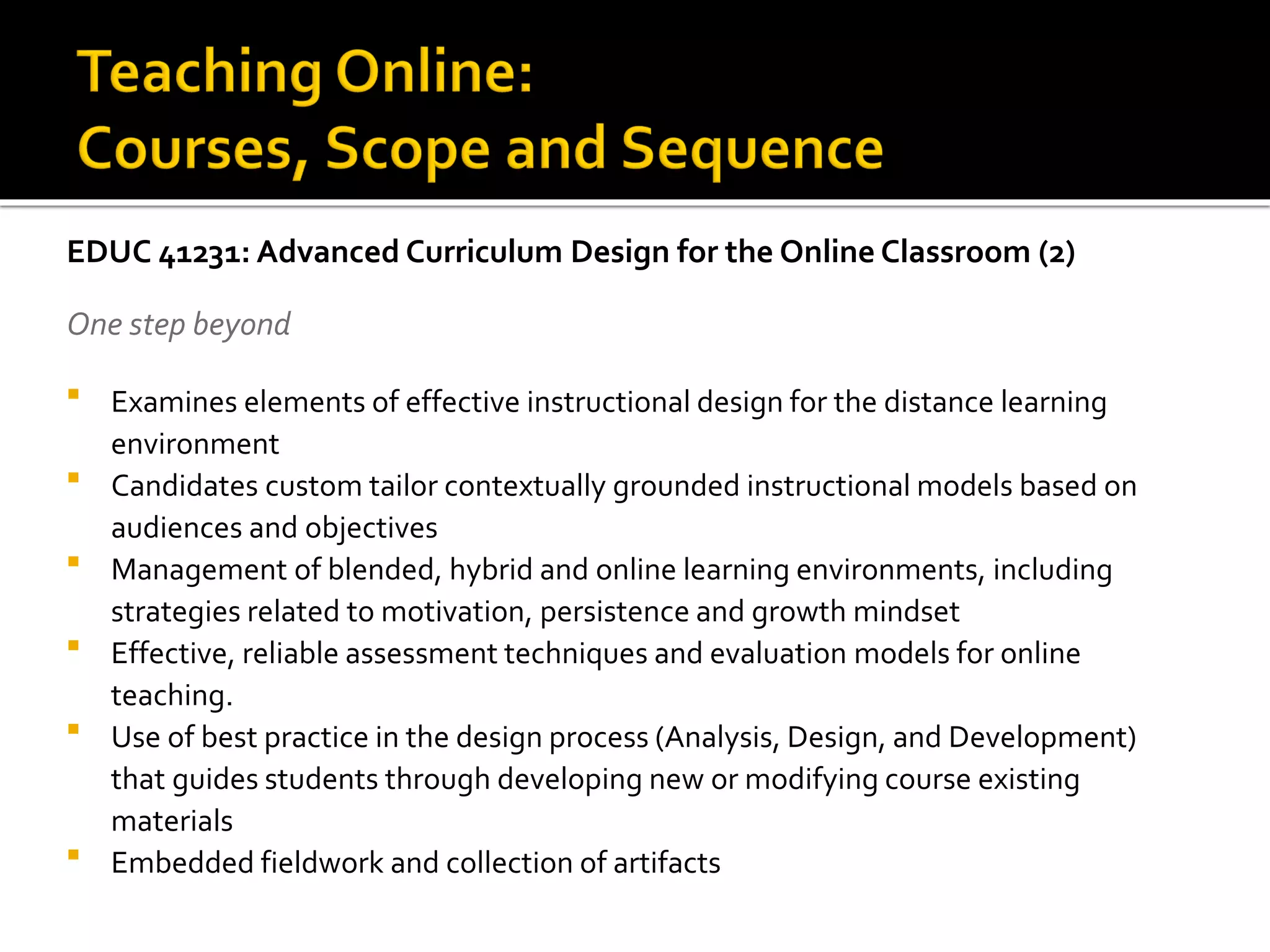
EDUC 41231: Advanced Curriculum Design for the Online Classroom (2)
One step beyond
 Examines elements of effective instructional design for the distance learning
environment
 Candidates custom tailor contextually grounded instructional models based on
audiences and objectives
 Management of blended, hybrid and online learning environments, including
strategies related to motivation, persistence and growth mindset
 Effective, reliable assessment techniques and evaluation models for online
teaching.
 Use of best practice in the design process (Analysis, Design, and Development)
that guides students through developing new or modifying course existing
materials
 Embedded fieldwork and collection of artifacts
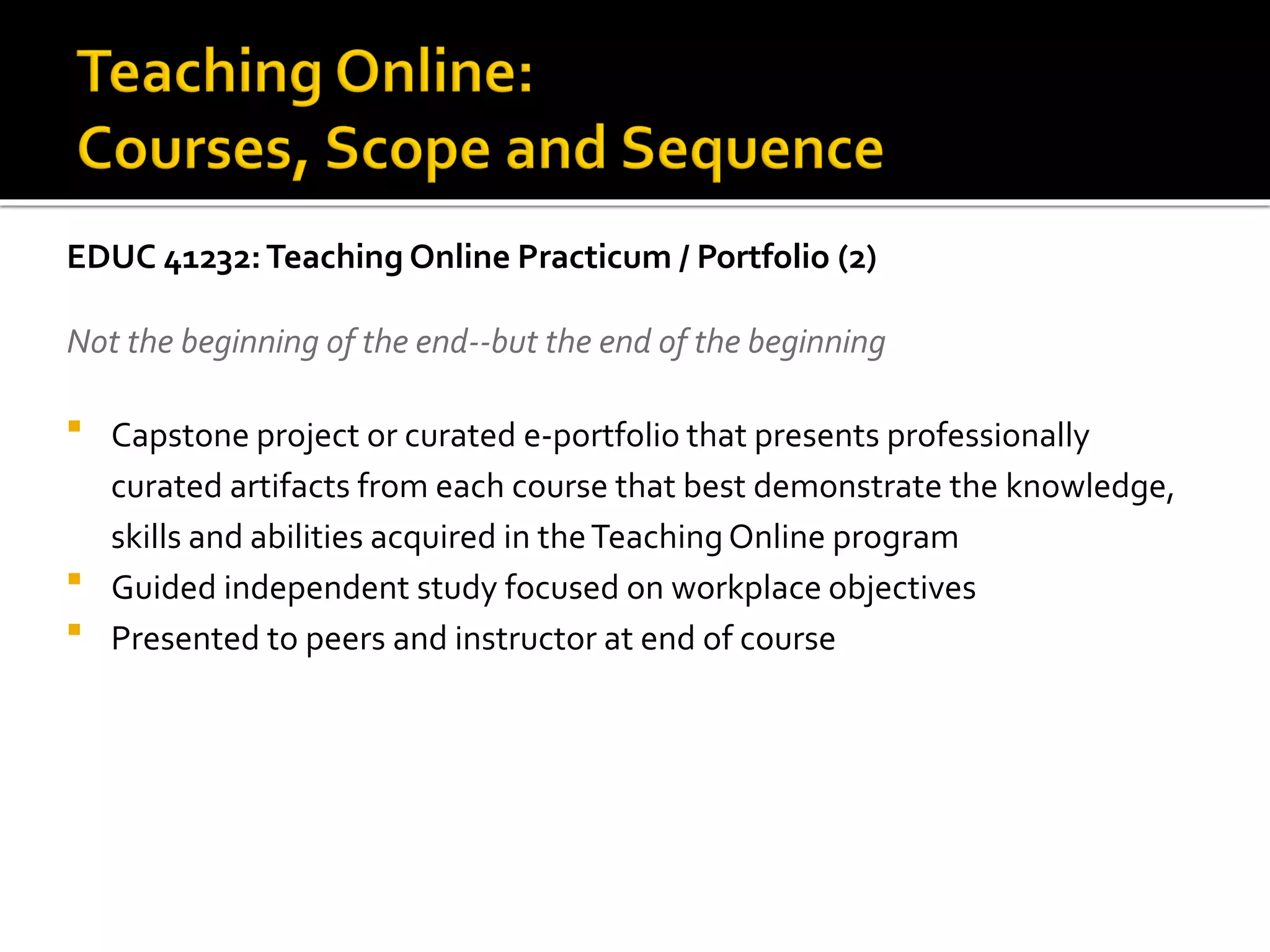
EDUC 41232:Teaching Online Practicum / Portfolio (2)
Not the beginning of the end--but the end of the beginning
 Capstone project or curated e-portfolio that presents professionally
curated artifacts from each course that best demonstrate the knowledge,
skills and abilities acquired in theTeachingOnline program
 Guided independent study focused on workplace objectives
 Presented to peers and instructor at end of course
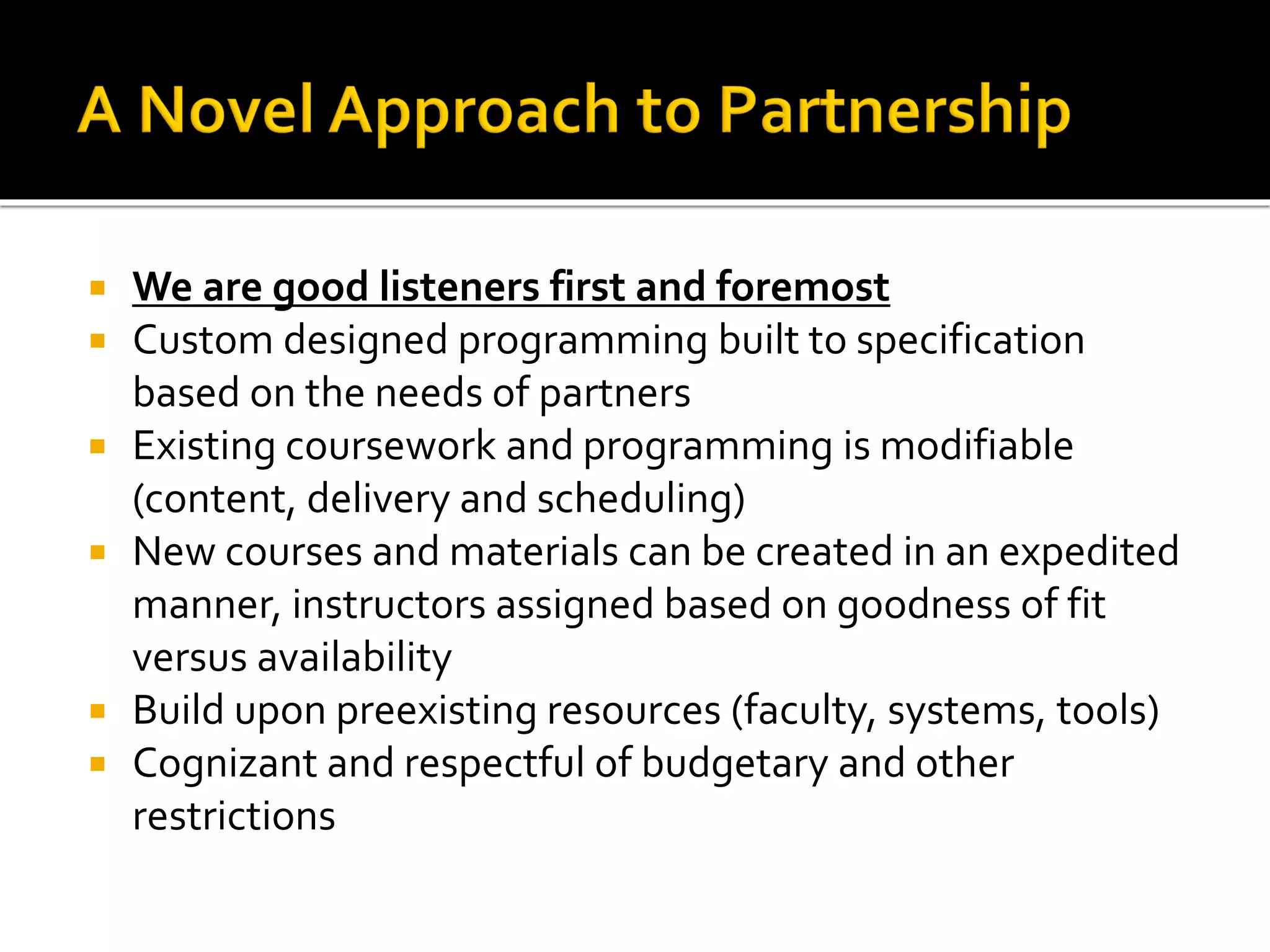
 We are good listeners first and foremost
 Custom designed programming built to specification
based on the needs of partners
 Existing coursework and programming is modifiable
(content, delivery and scheduling)
 New courses and materials can be created in an expedited
manner, instructors assigned based on goodness of fit
versus availability
 Build upon preexisting resources (faculty, systems, tools)
 Cognizant and respectful of budgetary and other
restrictions
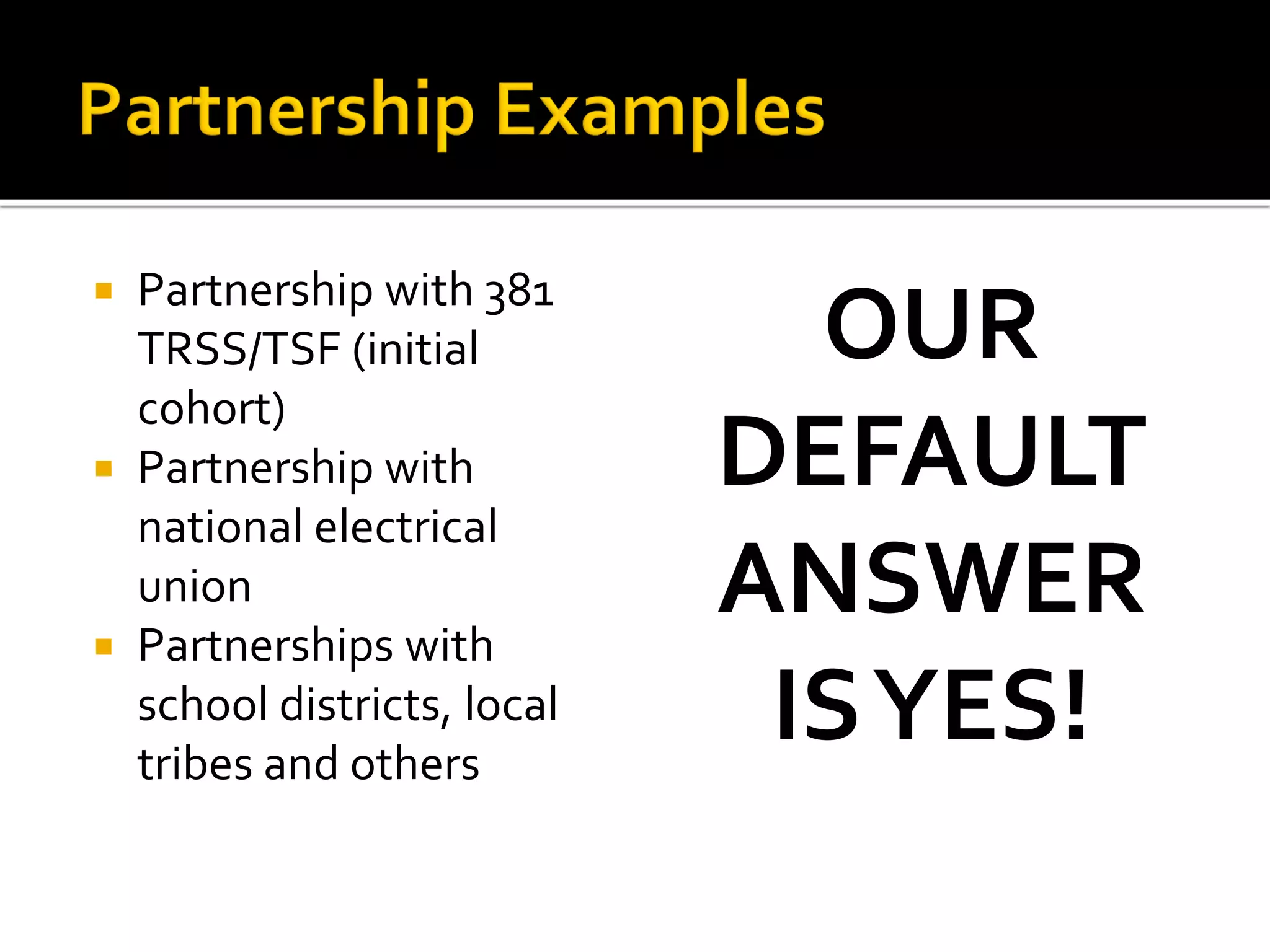
 Partnership with 381
TRSS/TSF (initial
cohort)
 Partnership with
national electrical
union
 Partnerships with
school districts, local
tribes and others
OUR
DEFAULT
ANSWER
ISYES!
Morgan Appel
Assistant Dean
Education and Community Outreach
UC San Diego Extension
9500 Gilman Drive, MC 0170-N
La Jolla, California 92093-0170
mappel@ucsd.edu
858-534-9273
extension.ucsd.edu/education

Head in the Cloud and Feet on the Ground: Context-Based Professional Development and Certification in Teaching Online

  • 1.
  • 2.
    This presentation anda host of related materials and resources may be accessed directly using Slide Share (https://www.slideshare.net/). Just search my name and you will be there in a flash (although when you’ve hit French recipes, you’ve gone too far).
  • 3.
    A Dream of DistanceLearning: 1950s – 1960s At the height of the atomic (jet) age, when the number of Germanys were two and Kennedy committed us to the moon by the end of the 1960s, we intuited that room-sized machines that were the stuff of space agencies and university labs might eventually play a role in learning. Even then, the idea of the ‘push-button school’ was appealing. Especially for teachers who could (literally) phone it in remotely.
  • 4.
    Educational Technology: 1970s – 1980s Aswe moved out of the 1960s and into the ‘me’ decade, computers became somewhat smaller (although not necessarily friendlier).Though limited in capability by today’s standards, computers revolutionized the learning environment. We had one of these in my middle school (ONE) and used it to learn BASIC as that was the programming language that would change the world. These days, middle school students are coding experiments delivered in payloads to ISS (SpaceTango)
  • 5.
    Present Day: 2019 andBeyond Today, technology is both ubiquitous and pervasive. We learn on the go through YouTube and MOOCs. Communication and collaboration has been wholly transformed (for better or worse) through platforms like Twitter and Facebook. Blackboard and Moodle offer a host of opportunities for engagement and virtual classrooms can be fabricated with avatars and lush backgrounds.On phones. On tablets. In real time. Asynchronously. Feet on the ground and head in the cloud. This begs the question: in today’s push button learning, just who is pushing the buttons?
  • 6.
     UC SanDiego, 2006: Facebook was just off and running. Twitter hadn’t really left the starting gate. All about SMS and Instant Messenger (if one could sort it out)  Distance learning = CDs (!) delivered to students to watch lessons and respond by email (!)  Technology was an add-on, not an approach to teaching and learning. A bit of fun and/or a means for students to turn in work whilst on vacation or traveling.  Face-to-Face = 95 percent (< 1,000 students per year: from San Diego primarily).Today, online = 99.8 percent, 15,000 students across the globe (including DoDEA personnel)
  • 7.
     Increasing demand(nationally and globally) and a subsequent buyer’s market for educational services  Obligation as a public university with a service mission (attending to under resourced constituencies)  Infusing online coursework into our own portfolios (and a manifest need to train our own instructors)  Changing learning technologies and platforms: accessible and affordable  Adoption of distance learning by institutions outside of the University of California (and outside of traditional education)  Need to undertake a leadership role (versus ‘fly-by-night’ operators)
  • 8.
    2006  Format: boutique,on campus and in person sole option (oddly)  Audience: K-12 teachers seeking to convert face-to- face classes online  Education occurs in schools and sometimes other places 2019  Format: blended, hybrid and online. Asynchronous and synchronous. Glocal focus.  Audiences: manifold and diverse (educators, trainers, nonprofits, government, ad. nauseum)  Education is everywhere
  • 9.
    2006  This iswhat we have: take it or leave it (if you build it, they will come, even if not appropriate to needs)  One size fits all as long as it is sufficiently large  Keep your work at work. These are your assignment options 2019  Choice and voice, flexible modular framework (varied educational ‘payloads’)  Context is everything: differentiate and custom tailor – ‘cohort of one’  Academic and professional lives are tightly intertwined.
  • 10.
    2006  Attendance, quizzes, examsand research papers  Loosely coupled programming—both within and across courses (topic based)  Individual and static (with rare exceptions) 2019  Practical application of skills to a real-world issue  Recurring themes and patterns, dovetail (big picture) -- purposeful  Individual and collaborative, dynamic and fluid (differentiated/ personalized)
  • 11.
    2006  LMS drivenand platform focused (if you don’t use ‘X’, you’re out of luck)  Use of systems and tools to enhance existing on- ground materials absent due consideration for audience 2019  Approach driven (form follows function) across various platforms  Modify instructional philosophy and practice to make the most of blended, hybrid and online delivery in attending to the cognitive and affective needs of diverse learners
  • 12.
    2006  Delivery ofcontent (‘how- to’ manual of sorts)  Pedagogy (highly structured, relatively rigid and almost solely dependent upon instructor’s knowledge) 2019  Delivery of content supported by cultivation of metacognitive skills (including curating professional artifacts)  Amalgam of pedagogy, andragogy and heutagogy, depending on learner needs, emerging from ongoing monitoring
  • 13.
    2006  Instructor primarilyserves as a transporter of content  Do for and do as I do  Cover and get through  Complete tasks—product is everything 2019  Instructor serves as a guide, both academically and professionally (mentorship)  Model for, empowering use of innate teaching ability  Sensemaking and flow  Prominence of process and product (enjoy the journey)
  • 14.
    2006  Assignments andcourses lead to certification and demonstration of knowledge, skills and abilities  Glacial and inconsistent, syllabus driven  Partners receive the standard fare 2019  Embedded fieldwork, signature projects and capstone practicum or portfolio  Moving at the speed of candidates, syllabus serves as a guideline. Cohesive  Reciprocal partnerships based on needs (wish lists)
  • 15.
    TheTeaching Online programis designed for those who would like to teach in hybrid, blended or online environments. Professional demand encompasses K-24, community college, University, adult education programs, and corporate training, among others. Online teaching represents a paradigm shift in the delivery and acquisition of knowledge. In this program, candidates design, deliver, and evaluate curriculum as well as adopt appropriately differentiated approaches to teaching for the blended, hybrid or online classroom.They will become proficient in instructional technology tools, software, and web-based applications to best suit the needs of learners.
  • 16.
    Teaching Online SpecializedCertificate Six Required Courses, 13 Quarter Units Electives Available  EDUC 40989: Introduction to Online Learning (2)  EDUC 40990: Foundations of Curriculum Design and Evaluation (2)  CSE 40798: InstructionalTechnologyTools (2)  CSE 40799: EnhancingYour Online Course with Multimedia (2)  EDUC 41231: Advanced Curriculum Design for the Online Classroom (3)  EDUC 41232:Teaching Online Practicum (2) https://extension.ucsd.edu/courses-and-programs/online-teaching-certificate
  • 17.
    EDUC 40989: Introductionto Online Learning (2) A broader framework for further exploration  Comprehensive overview of distance learning, including delivery methods and platforms (cross-platform): past, present, future  Learning theories as they apply to blended, hybrid and online instruction as well as course design and use of synchronous and asynchronous educational technologies (form following function)  Historical perspectives of the evolution of online teaching including case studies (challenges and opportunities)  Course design, development, implementation and evaluation (including student assessment)  Cultivating community and synergy in the blended, hybrid and online environments  Embedded fieldwork and collection of artifacts
  • 18.
    EDUC 40990: Foundationsof Curriculum Design and Evaluation (2) Delving more deeply into meaningful and user-friendly design work  Overview of curriculum development and the Instructional Systems Design Model, incorporating dynamic pedagogical, andragogical and heutagogical perspectives.  Approaches to purposeful curriculum design and assessment and selection of contextually grounded instructional materials and technologies  Aligning outcomes, approaches to differentiated instruction and assessments in blended, hybrid and online classes to attend to the needs of diverse learners  Creating flexible course frameworks and syllabi, iterative development of lessons plans, design of evaluation instruments and informed selection of content, tools and materials  Embedded fieldwork and collection of artifacts
  • 19.
    CSE 40798: InstructionalTechnologyTools(2) Acquiring the tools and learning the tricks of the trade  Synopsis of learning management systems (LMS) and embedded tools to empower active learning and cultivate community/synergies  Criteria for determining the most suitable LMS and available tools (embedded or available externally) to generate forward momentum and achieve learning outcomes  Methods for selecting instructional tools aligned with sound pedagogical, andragogical and heutagogical practice  Embedded fieldwork and collection of artifacts
  • 20.
    CSE 40799: EnhancingYourOnline Course with Multimedia (2) The proverbial icing on the instructional cake  Exploration of software and tools to enhance the creation and design of online learning courses or programs  Overview of graphics, audio, video, Flash, and other multimedia used to develop online learning activities.  Introduction to audio and video technologies, general multimedia tools and those specialized in accessing learners with disabilities.  Examination of streaming vs. progressive download vs. download, diverse multimedia, streaming formats and illustrated audio.  Embedded fieldwork and collection of artifacts
  • 21.
    EDUC 41231: AdvancedCurriculum Design for the Online Classroom (2) One step beyond  Examines elements of effective instructional design for the distance learning environment  Candidates custom tailor contextually grounded instructional models based on audiences and objectives  Management of blended, hybrid and online learning environments, including strategies related to motivation, persistence and growth mindset  Effective, reliable assessment techniques and evaluation models for online teaching.  Use of best practice in the design process (Analysis, Design, and Development) that guides students through developing new or modifying course existing materials  Embedded fieldwork and collection of artifacts
  • 22.
    EDUC 41232:Teaching OnlinePracticum / Portfolio (2) Not the beginning of the end--but the end of the beginning  Capstone project or curated e-portfolio that presents professionally curated artifacts from each course that best demonstrate the knowledge, skills and abilities acquired in theTeachingOnline program  Guided independent study focused on workplace objectives  Presented to peers and instructor at end of course
  • 23.
     We aregood listeners first and foremost  Custom designed programming built to specification based on the needs of partners  Existing coursework and programming is modifiable (content, delivery and scheduling)  New courses and materials can be created in an expedited manner, instructors assigned based on goodness of fit versus availability  Build upon preexisting resources (faculty, systems, tools)  Cognizant and respectful of budgetary and other restrictions
  • 24.
     Partnership with381 TRSS/TSF (initial cohort)  Partnership with national electrical union  Partnerships with school districts, local tribes and others OUR DEFAULT ANSWER ISYES!
  • 26.
    Morgan Appel Assistant Dean Educationand Community Outreach UC San Diego Extension 9500 Gilman Drive, MC 0170-N La Jolla, California 92093-0170 mappel@ucsd.edu 858-534-9273 extension.ucsd.edu/education