What to talk about throughout the
Lesson?
A. Characteristics of Motion information and
media
Formats
Sources
Advantages and Limitations
Values
What to talk about throughout the
Lesson?
B. Selection Criteria
C. Design Principle and Elements
What is Motion?
- is the action or process of moving
or being moved.
- a form of media that has the appearance of a
moving text and graphics on a display.
- Its purpose is to communicate information in
multiple way.
~Roblyer, 2006
- an integrated sight-and-sound
kinetic media
~Shelton, 2004
- media based on moving images with audio and
interaction function.
Ex:
 Film and Cinema
 Electronic Billboards
 Television shows
 Online videos
 Phone gaming
Characteristics of Motion
Information and Media
It communicates message to
large, heterogeneous, and anonymous
audiences.
Characteristics of Motion
Information and Media
It communicates message to mass
audiences simultaneously, sometimes in
public, other times in private.
Characteristics of Motion
Information and Media
It embodies messages that are
usually impersonal and transitory.
Characteristics of Motion
Information and Media
It is multi-sensory such that the audience's
sight and hearing stimulated in concert. Such
combination of sensory stimuli forms a complex
synergism that can significantly enhance
communication.
Characteristics of Motion
Information and Media
It is a formal, authorative channel of
communication. Accordingly, its power
informing and entertaining lies in the
communicators ability control visual and aural
stimuli.
Characteristics of Motion
Information and Media
It is instrumental in behavior and attitude
modification- that is, attitude formation, change,
conversation, and canalzation (directing a
performed attitude to a new direction).
Characteristics of Motion
Information and Media
It confers status issues,
persons, organizations, or social
movements.
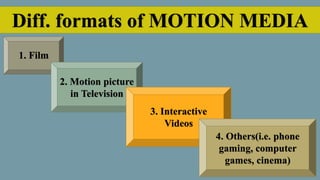
Diff. formats of MOTION MEDIA
1. Film
2. Motion picture
in Television
3. Interactive
Videos
4. Others(i.e. phone
gaming, computer
games, cinema)
1. Film
- also called a movie picture, is a series of still
or moving images.
- film; movie; theatrical film; photoplay
- recorded on celluloid film and projected on a
screen in cinema theaters
Mise-En-Scene
- Is the arrangement of everything that
appears on the framing.
Types of Film
- a scene from the animated film.
- a trailer of a short film, ninety
seconds about a surveillance expert taking on an
assignment that might be his downfall.
- telling where commercialized
and fast food comes from.
Types of Film
- Indie film
- Movies produced outside of the big studio system
- Produced and distributed by independent
entertainment agencies.
Types of Film
- Films that are widely released in cinemas
2. Motion Picture in Television
- television is a telecommunication medium for
transmitting and receiving moving images that can
be monochrome (black and white) or colored,with
or without accompanying sounds.
Types of Motion Picture in Television
a. Commercial advertisement on TV
b. Philippine melodrama
c. Reality show
d. Game show
e. Talk show
f. Television news
3. Interactive Video
- usually refers to a technique used to blend
interaction and linear film or video.
Types of Interactive Video
a.) "Customizable" Online Interactive Videos
- customizable videos allow the user to adjust
some variables and then play a videos customized
to the users particular references.how ever the user
does not actually interact with the video while it is
playing.
Types of Interactive Video
b.) "Conversational" Online Interactive Videos
- conversational videos allows the user to
interact with a video in a turn-based manner,
almost as though the user was having a simple
conversation with the characters in the video.
Types of Interactive Video
c.)"Exploratory" Online Interactive Videos
- exploratory videos allow the user to move
through.
4. Others (i.e phone gaming, computer
games, cinema)
Livestream
- is a love streaming video platform that allow
users to view and broadcast video content using a
camera and a computer through the internet it offers a
free and supported service and multi-tiered premium
services.
4. Others(i.e phone gaming,computer
games,cinema)
Youtube
- is a video sharing website, created by three
former Paypal employees in February 2005, on which
users can upload, view, share videos. Unregistered
users can watch videos, while registered users can
upload unlimited number of videos.
Sources of Motion Media
Internet
Studios
Broadcast
Channels
Video Channels
Libraries
Advantages and Limitations of
Motion Media
Advantages of Motion Media
MOLLON: Better mastery of procedures, as opposed
to stagnant images.
PROCESSES: Operations where sequental movement
is needed can be shown.
SAFE OBSERVATION: Observing phenomena that
might be dangerous to view directly.
Advantages of Motion Media
SKILL LEARNING: Videos can be viewed over and over,so
repeated observation of skills is possible.
DRAMATIZATION: Recreations of history and
personalities;observing and analyzing human relations
problem.
AFFECTIVE LEARNING: Films for shaping personal and
social attitudes; documentaries and propaganda films to affect
attitudes.
Advantages of Motion Media
PROBLEM SOLVING: Open ended dramatizations
can leave viewers to solve problems themselves.
CULTURAL UNDERSTANDING: Appreciation for
other cultures by seeing video depiction of them.
ESTABLISHING COMMONALITY: People with
different backgrounds can discuss topics after watching
a video.
Limitations of Motion Media
FIXED PACE
- cannot be interrupted still
PHENOMENA
- Motion media is sometimes unsuitable to
other topics such as those involving a map,a wiring
diagram,etc.
Limitations of Motion Media
MISINTERPRETATION
- In documentaries and dramatizations
especially,intended messages are quite deep and
complex.because of that,young viewers who lack
maturity tend to misinterpret the message.
COST
- Equipment and materials for motion media are
expensive (e.g.DVD player,TV,etc.
Values, Selection Criteria and Design
Principle and Elements
Values
1. It increases pupil interest.
2. It increases factual learning.
3. It can retain learning.
4. It can increase reading interest.
Selection Criteria
1. TaskFactors
- the type of objectives, and hence
the type of learning activities which
should be providedfor the learner.
Selection Criteria
2. Learner Factors
- some learners may learn better
from certain media than from others.
Design Principle and Elements
1. Timing
- it may determine the way the
frames will need to be set up. It helps
to express the emotion of a scene.
Design Principle and Elements
2. Ease in/out
- works by adjusting frames in
order to give the impression of
something moving slowly then rapidly.
Design Principle and Elements
3. Anticipation
- prepares the viewer for
something to happen. This gives the
scene more energy as it begins to
develop and move.
Design Principle and Elements
4. Staging
- process of arranging all elements
in a sne so that the eye of the vieweris
directed towards focal point.
Design Principle and Elements
5. Arcs
- can help make the transition look
smoother. In moving objects, arcs can
make motion more realistic.
Design Principle and Elements
6. Action and Reaction
- can be approached in a
realisticway or not.
“Movies are not necessarily
mirrors of reality. They just
depict a certain reality that may
be relatable to audiences”
“Movies recreate some of life's truth in
a way that capture your imagination,
which is why they potentially have a
greater impact than other forms of
media”
Thank You!
by: Christian Jay C. Gonzales
Credits to Prezi.com for the
informations, thank you so much!

429443259-Lesson-15-Motion-Information-and-Media.pptx

  • 2.
    What to talkabout throughout the Lesson? A. Characteristics of Motion information and media Formats Sources Advantages and Limitations Values
  • 3.
    What to talkabout throughout the Lesson? B. Selection Criteria C. Design Principle and Elements
  • 4.
    What is Motion? -is the action or process of moving or being moved.
  • 5.
    - a formof media that has the appearance of a moving text and graphics on a display. - Its purpose is to communicate information in multiple way. ~Roblyer, 2006
  • 6.
    - an integratedsight-and-sound kinetic media ~Shelton, 2004
  • 7.
    - media basedon moving images with audio and interaction function. Ex:  Film and Cinema  Electronic Billboards  Television shows  Online videos  Phone gaming
  • 8.
    Characteristics of Motion Informationand Media It communicates message to large, heterogeneous, and anonymous audiences.
  • 9.
    Characteristics of Motion Informationand Media It communicates message to mass audiences simultaneously, sometimes in public, other times in private.
  • 10.
    Characteristics of Motion Informationand Media It embodies messages that are usually impersonal and transitory.
  • 11.
    Characteristics of Motion Informationand Media It is multi-sensory such that the audience's sight and hearing stimulated in concert. Such combination of sensory stimuli forms a complex synergism that can significantly enhance communication.
  • 12.
    Characteristics of Motion Informationand Media It is a formal, authorative channel of communication. Accordingly, its power informing and entertaining lies in the communicators ability control visual and aural stimuli.
  • 13.
    Characteristics of Motion Informationand Media It is instrumental in behavior and attitude modification- that is, attitude formation, change, conversation, and canalzation (directing a performed attitude to a new direction).
  • 14.
    Characteristics of Motion Informationand Media It confers status issues, persons, organizations, or social movements.
  • 15.
    Diff. formats ofMOTION MEDIA 1. Film 2. Motion picture in Television 3. Interactive Videos 4. Others(i.e. phone gaming, computer games, cinema)
  • 16.
    1. Film - alsocalled a movie picture, is a series of still or moving images. - film; movie; theatrical film; photoplay - recorded on celluloid film and projected on a screen in cinema theaters
  • 17.
    Mise-En-Scene - Is thearrangement of everything that appears on the framing.
  • 18.
    Types of Film -a scene from the animated film. - a trailer of a short film, ninety seconds about a surveillance expert taking on an assignment that might be his downfall. - telling where commercialized and fast food comes from.
  • 19.
    Types of Film -Indie film - Movies produced outside of the big studio system - Produced and distributed by independent entertainment agencies.
  • 20.
    Types of Film -Films that are widely released in cinemas
  • 21.
    2. Motion Picturein Television - television is a telecommunication medium for transmitting and receiving moving images that can be monochrome (black and white) or colored,with or without accompanying sounds.
  • 22.
    Types of MotionPicture in Television a. Commercial advertisement on TV b. Philippine melodrama c. Reality show d. Game show e. Talk show f. Television news
  • 23.
    3. Interactive Video -usually refers to a technique used to blend interaction and linear film or video.
  • 24.
    Types of InteractiveVideo a.) "Customizable" Online Interactive Videos - customizable videos allow the user to adjust some variables and then play a videos customized to the users particular references.how ever the user does not actually interact with the video while it is playing.
  • 25.
    Types of InteractiveVideo b.) "Conversational" Online Interactive Videos - conversational videos allows the user to interact with a video in a turn-based manner, almost as though the user was having a simple conversation with the characters in the video.
  • 26.
    Types of InteractiveVideo c.)"Exploratory" Online Interactive Videos - exploratory videos allow the user to move through.
  • 27.
    4. Others (i.ephone gaming, computer games, cinema) Livestream - is a love streaming video platform that allow users to view and broadcast video content using a camera and a computer through the internet it offers a free and supported service and multi-tiered premium services.
  • 28.
    4. Others(i.e phonegaming,computer games,cinema) Youtube - is a video sharing website, created by three former Paypal employees in February 2005, on which users can upload, view, share videos. Unregistered users can watch videos, while registered users can upload unlimited number of videos.
  • 29.
    Sources of MotionMedia Internet Studios Broadcast Channels Video Channels Libraries
  • 30.
  • 31.
    Advantages of MotionMedia MOLLON: Better mastery of procedures, as opposed to stagnant images. PROCESSES: Operations where sequental movement is needed can be shown. SAFE OBSERVATION: Observing phenomena that might be dangerous to view directly.
  • 32.
    Advantages of MotionMedia SKILL LEARNING: Videos can be viewed over and over,so repeated observation of skills is possible. DRAMATIZATION: Recreations of history and personalities;observing and analyzing human relations problem. AFFECTIVE LEARNING: Films for shaping personal and social attitudes; documentaries and propaganda films to affect attitudes.
  • 33.
    Advantages of MotionMedia PROBLEM SOLVING: Open ended dramatizations can leave viewers to solve problems themselves. CULTURAL UNDERSTANDING: Appreciation for other cultures by seeing video depiction of them. ESTABLISHING COMMONALITY: People with different backgrounds can discuss topics after watching a video.
  • 34.
    Limitations of MotionMedia FIXED PACE - cannot be interrupted still PHENOMENA - Motion media is sometimes unsuitable to other topics such as those involving a map,a wiring diagram,etc.
  • 35.
    Limitations of MotionMedia MISINTERPRETATION - In documentaries and dramatizations especially,intended messages are quite deep and complex.because of that,young viewers who lack maturity tend to misinterpret the message. COST - Equipment and materials for motion media are expensive (e.g.DVD player,TV,etc.
  • 36.
    Values, Selection Criteriaand Design Principle and Elements
  • 37.
    Values 1. It increasespupil interest. 2. It increases factual learning. 3. It can retain learning. 4. It can increase reading interest.
  • 38.
    Selection Criteria 1. TaskFactors -the type of objectives, and hence the type of learning activities which should be providedfor the learner.
  • 39.
    Selection Criteria 2. LearnerFactors - some learners may learn better from certain media than from others.
  • 40.
    Design Principle andElements 1. Timing - it may determine the way the frames will need to be set up. It helps to express the emotion of a scene.
  • 41.
    Design Principle andElements 2. Ease in/out - works by adjusting frames in order to give the impression of something moving slowly then rapidly.
  • 42.
    Design Principle andElements 3. Anticipation - prepares the viewer for something to happen. This gives the scene more energy as it begins to develop and move.
  • 43.
    Design Principle andElements 4. Staging - process of arranging all elements in a sne so that the eye of the vieweris directed towards focal point.
  • 44.
    Design Principle andElements 5. Arcs - can help make the transition look smoother. In moving objects, arcs can make motion more realistic.
  • 45.
    Design Principle andElements 6. Action and Reaction - can be approached in a realisticway or not.
  • 46.
    “Movies are notnecessarily mirrors of reality. They just depict a certain reality that may be relatable to audiences”
  • 47.
    “Movies recreate someof life's truth in a way that capture your imagination, which is why they potentially have a greater impact than other forms of media”
  • 48.
    Thank You! by: ChristianJay C. Gonzales Credits to Prezi.com for the informations, thank you so much!