Graphic Narrative
Evaluation
Does your final product reflect your
original intentions?
My final product does mostly follow my original intentions
however some pages do not reflect exactly. For example, page 2
of my book shows the view from the garden onto the back of the
houses. It includes the mum looking out of the window onto
some flowers in the witch’s garden next door. This on my flat
plan was originally meant to be a close up of the flowers where
you can see the mum in the background, but this was difficult to
create and so came out differently than planned. The aspect of
the close up instead got transferred onto page 4 when the witch
finds the dad stealing from her. I feel like this has worked better
as captures more emotion and makes it overall easier for the
child to follow the story. Apart from this, I feel as if my final
product clearly and closely follows my flat plan and original
intentions.
How well have you constructed your
images?
I believe the construction of my images overall went well. I used a
few patterns to create texture overlays and involved them
throughout the whole of the book. As well as this, consistency has
been taken into consideration when thinking about colour schemes
and making sure they’re repeated within the different settings and
scenes. When thinking about my characters, they’ve all been
constructed to look similar and have the same style. I think I have
created them well as they all represent clearly who they’re meant
to be and give an idea on perspective when telling the story. In
contrast to this though, I feel like I should’ve constructed a few
more variations of each character to be more suited to each
particular scene so that it becomes more interesting and they’re
not stood in the same position all the time.
In addition to this, I could have come up with a few more
variations of each page. This is because some pages are very
similar to others but just shown from different angles and
depths of the images. By doing this, it would make the story
more interesting and there would be more new things to look
at on each page to keep the child’s attention.
How well have you used text to anchor
your images
I have effectively used text to explain what is going on in each of
the pages. However, some text gives more detail than what is
shown in a particular image.
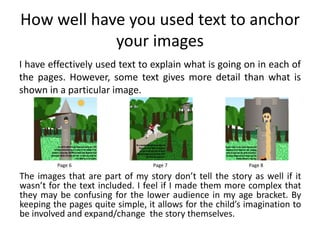
Page 6 Page 7 Page 8
The images that are part of my story don’t tell the story as well if it
wasn’t for the text included. I feel if I made them more complex that
they may be confusing for the lower audience in my age bracket. By
keeping the pages quite simple, it allows for the child’s imagination to
be involved and expand/change the story themselves.
For example, on page 6, if the child can read and follow the story
on their own, then they’ll understand why the photo shows
Rapunzel in the tower on her own. However, if a child can’t read
or is having the book read to them, the photo may not explain
100% what is going on clearly.
The text I feel is effective because it tells the story straight to the
point which is good in order to keep the child interested and
attracted to the images at the same time. It is also good because
it involves detail but not too much so doesn't take attention
away from the images I have created.
Is your product suitable for your
audience?
My book was originally aimed at 4-8 year olds but I have decided
to change it to be aimed at 3-6 year olds due to how the graphics
of it have turned out. In my proposal, I stated that my story
would be more detailed, which it has turned out to be, but the
images aren’t as detailed as I had imagined. I have lowered the
age due to the bright colours/textures and how the images
explain what’s going on without being too informational,
therefore it still leaving some ideas to the imagination if the child
can’t read by themselves. I think it’s suitable also because of the
classic fairy tale theme to it which exists widely on the market
today and is very popular within a similar age range to the one I
have chosen.
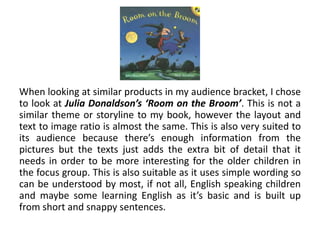
When looking at similar products in my audience bracket, I chose
to look at Julia Donaldson’s ‘Room on the Broom’. This is not a
similar theme or storyline to my book, however the layout and
text to image ratio is almost the same. This is also very suited to
its audience because there’s enough information from the
pictures but the texts just adds the extra bit of detail that it
needs in order to be more interesting for the older children in
the focus group. This is also suitable as it uses simple wording so
can be understood by most, if not all, English speaking children
and maybe some learning English as it’s basic and is built up
from short and snappy sentences.
What do you like/dislike about the
techniques you have used?
Before production of the book, we look at and practised
different techniques for creating characters/animals/locations.
This included things such as rotoscoping, using shapes to create
characters and narrative environments, comic book effects and
illustrations. Within my work, the technique I have liked the most
is using shapes to create characters and narrow environment. I
think this method is quick and you can create almost exactly
what you want by distorting, warping and changing the
perspective of something simple. A downfall to this method
though is that I didn’t like it when originally trying to create
trees. I found that it wasn’t very effective and they didn’t look
great once I had finished them. I decided to use the brush tool
instead as it gave a more realistic look and fit in better with the
rest of the images and backgrounds.
For the more difficult things I wanted to create, I used
rotoscoping. I liked this because I could find something that was
similar to what I was constructing and then crop around it and
edit it to be exactly how I wanted it to be. To give more depth to
the images, I decided to use images as a clipping mask on the
grass and the houses as this again gave a more realistic look and
also adds small details. However, apart from the objects I used it
on, I didn’t like this technique as I feel it made the images look
almost too busy and not all the patterns worked well together.
What do you like/dislike about how
your final product looks?
I think my final product looks good but I feel like I should’ve
made it more 3D in order to make it look more professional. I like
how each page has linked together with colours and objects as
well as how I’ve used the space. I used the empty areas on each
page to either add text or emphasise the main focus of the
image which I feel worked effectively.
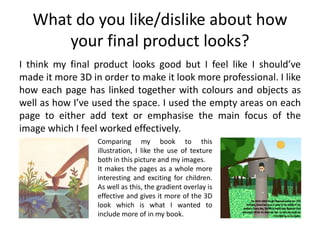
Comparing my book to this
illustration, I like the use of texture
both in this picture and my images.
It makes the pages as a whole more
interesting and exciting for children.
As well as this, the gradient overlay is
effective and gives it more of the 3D
look which is what I wanted to
include more of in my book.
Something I dislike about my final product include my lack of
variations for the characters. I think the amount of characters is
good for the story to not become too over crowded. However if I
was to do it again with more time, then I would create each
character from different angles and view points to really
emphasise the position they’re in or the movement they’re
doing.
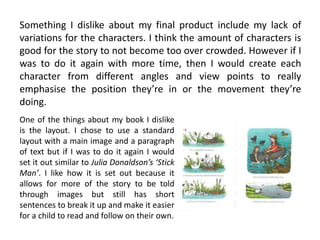
One of the things about my book I dislike
is the layout. I chose to use a standard
layout with a main image and a paragraph
of text but if I was to do it again I would
set it out similar to Julia Donaldson’s ‘Stick
Man’. I like how it is set out because it
allows for more of the story to be told
through images but still has short
sentences to break it up and make it easier
for a child to read and follow on their own.
Why did you include the content you
used?
The story is aimed at young children so I have used particular
fonts that are easier to be read and are more eye catching.
Children get excited and are more likely to be curious/willing to
get interested in the book if things such as the following are
included. Young children are still learning to read and if there is
too much text they will be bored or get tired. Images help break
up the text and gives the child a moment to relax and even helps
them create a picture of the story in their head helped by the
image. Pictures that have a gradient overlay effect will help the
child even more in picturing the characters or the story because
it gives the picture a realistic and 3D effect. These thing help the
child stay interested and makes the child want to read on and
find out what happens next.
Bright colours attract children’s attention so if an image has
these it’ll make the child want to see it. If a bright image is
included on the front of children’s book it will attract more
children than a dull image.
What signs, symbols or codes have
your used in your work?
Choices of colour in my work all flow and link together
throughout the whole story. I have chosen brighter colours like
greens/purples with the addition of some darker colours as well,
which symbolise and represent the feelings that are trying to be
created. For example, the grey colour of the tower. This is
because the concept of the tower is bad compared to everything
around it which is bright and happy. Character design is mixed as
some are created very similarly to the traditional English fairy
tale characters and others stray from that as well. Normally in
fairy tales, the prince/lead male character saves a girl from
something and this I have carried on with my book as it proves to
be a very popular theme for children’s stories. This links to
British culture.
Another symbol used is the prince. This is nearly always used
and thought of in a traditional folk/fairy tale story and clearly
represents wealth. This generally contrasts with the rest of the
characters in the story and the royalty plays a lead character
most of the time.
What representations can be found in
your work?
Men and women are mostly all shown to be equal in
my book; the only exception being the witch and the
prince which may be portrayed as bad or superior
characters. Despite this, the negative representation
which may be shown through the witch is balanced out
with the mum and Rapunzel, with them being female
characters which are good.
I chose to not include characters from different ethnic
backgrounds or different religions when creating my
characters as particular representations can be viewed
as discrimination if not balanced out or at least have a
good fate.
What style have you employed in your
products?
My books visual style is very unique. I chose to create very
cartoon like characters and emphasise the features that
they have. This way it’s not an exact representation of what
people are actually like, making it less controversial and
more light hearted. This particular style will also be more
excited for the children as it’s something a bit different that
they’re going to be attracted by. Part of my style includes
slight addition of texture throughout, giving it a more
realistic or interesting look. Style shows and gives ideas of
light and shadows within the images, again giving it a more
3D effect.
What were the strengths and weaknesses
of the pre-production and planning
Overall, my time management wasn’t brilliant. I feel as though I
gave myself too much to do in each session when creating each
page and because of that, some pages look a bit rushed or un
finished. Despite this problem, I feel as if my planning booklet
did help when making considerations about content of my book
as well what materials I have to use and how I will use them. It
also helped in knowing what orders to do things so that I was
sure to finish on time. Regarding the research I did, I found it
very effective and decided it is one of the most important parts
of the process. Through this it helped me to decide exactly what
I wanted to create and what style it would be in. I was then able
to fill in a proposal about all the details of my own book.
With this proposal, I stated the dimensions of my book which
was helpful when deciding where to put everything in order for
it not to become too over crowded. The peer feedback also was
important as it helped me to make my book even stronger and
my ideas improve widely.
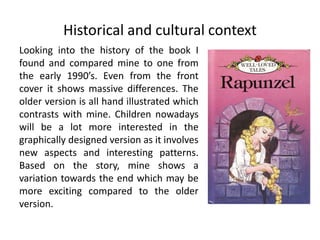
Historical and cultural context
Looking into the history of the book I
found and compared mine to one from
the early 1990’s. Even from the front
cover it shows massive differences. The
older version is all hand illustrated which
contrasts with mine. Children nowadays
will be a lot more interested in the
graphically designed version as it involves
new aspects and interesting patterns.
Based on the story, mine shows a
variation towards the end which may be
more exciting compared to the older
version.

Digital graphics evaluation pro forma

  • 1.
  • 2.
    Does your finalproduct reflect your original intentions? My final product does mostly follow my original intentions however some pages do not reflect exactly. For example, page 2 of my book shows the view from the garden onto the back of the houses. It includes the mum looking out of the window onto some flowers in the witch’s garden next door. This on my flat plan was originally meant to be a close up of the flowers where you can see the mum in the background, but this was difficult to create and so came out differently than planned. The aspect of the close up instead got transferred onto page 4 when the witch finds the dad stealing from her. I feel like this has worked better as captures more emotion and makes it overall easier for the child to follow the story. Apart from this, I feel as if my final product clearly and closely follows my flat plan and original intentions.
  • 3.
    How well haveyou constructed your images? I believe the construction of my images overall went well. I used a few patterns to create texture overlays and involved them throughout the whole of the book. As well as this, consistency has been taken into consideration when thinking about colour schemes and making sure they’re repeated within the different settings and scenes. When thinking about my characters, they’ve all been constructed to look similar and have the same style. I think I have created them well as they all represent clearly who they’re meant to be and give an idea on perspective when telling the story. In contrast to this though, I feel like I should’ve constructed a few more variations of each character to be more suited to each particular scene so that it becomes more interesting and they’re not stood in the same position all the time.
  • 4.
    In addition tothis, I could have come up with a few more variations of each page. This is because some pages are very similar to others but just shown from different angles and depths of the images. By doing this, it would make the story more interesting and there would be more new things to look at on each page to keep the child’s attention.
  • 5.
    How well haveyou used text to anchor your images I have effectively used text to explain what is going on in each of the pages. However, some text gives more detail than what is shown in a particular image. Page 6 Page 7 Page 8 The images that are part of my story don’t tell the story as well if it wasn’t for the text included. I feel if I made them more complex that they may be confusing for the lower audience in my age bracket. By keeping the pages quite simple, it allows for the child’s imagination to be involved and expand/change the story themselves.
  • 6.
    For example, onpage 6, if the child can read and follow the story on their own, then they’ll understand why the photo shows Rapunzel in the tower on her own. However, if a child can’t read or is having the book read to them, the photo may not explain 100% what is going on clearly. The text I feel is effective because it tells the story straight to the point which is good in order to keep the child interested and attracted to the images at the same time. It is also good because it involves detail but not too much so doesn't take attention away from the images I have created.
  • 7.
    Is your productsuitable for your audience? My book was originally aimed at 4-8 year olds but I have decided to change it to be aimed at 3-6 year olds due to how the graphics of it have turned out. In my proposal, I stated that my story would be more detailed, which it has turned out to be, but the images aren’t as detailed as I had imagined. I have lowered the age due to the bright colours/textures and how the images explain what’s going on without being too informational, therefore it still leaving some ideas to the imagination if the child can’t read by themselves. I think it’s suitable also because of the classic fairy tale theme to it which exists widely on the market today and is very popular within a similar age range to the one I have chosen.
  • 8.
    When looking atsimilar products in my audience bracket, I chose to look at Julia Donaldson’s ‘Room on the Broom’. This is not a similar theme or storyline to my book, however the layout and text to image ratio is almost the same. This is also very suited to its audience because there’s enough information from the pictures but the texts just adds the extra bit of detail that it needs in order to be more interesting for the older children in the focus group. This is also suitable as it uses simple wording so can be understood by most, if not all, English speaking children and maybe some learning English as it’s basic and is built up from short and snappy sentences.
  • 9.
    What do youlike/dislike about the techniques you have used? Before production of the book, we look at and practised different techniques for creating characters/animals/locations. This included things such as rotoscoping, using shapes to create characters and narrative environments, comic book effects and illustrations. Within my work, the technique I have liked the most is using shapes to create characters and narrow environment. I think this method is quick and you can create almost exactly what you want by distorting, warping and changing the perspective of something simple. A downfall to this method though is that I didn’t like it when originally trying to create trees. I found that it wasn’t very effective and they didn’t look great once I had finished them. I decided to use the brush tool instead as it gave a more realistic look and fit in better with the rest of the images and backgrounds.
  • 10.
    For the moredifficult things I wanted to create, I used rotoscoping. I liked this because I could find something that was similar to what I was constructing and then crop around it and edit it to be exactly how I wanted it to be. To give more depth to the images, I decided to use images as a clipping mask on the grass and the houses as this again gave a more realistic look and also adds small details. However, apart from the objects I used it on, I didn’t like this technique as I feel it made the images look almost too busy and not all the patterns worked well together.
  • 11.
    What do youlike/dislike about how your final product looks? I think my final product looks good but I feel like I should’ve made it more 3D in order to make it look more professional. I like how each page has linked together with colours and objects as well as how I’ve used the space. I used the empty areas on each page to either add text or emphasise the main focus of the image which I feel worked effectively. Comparing my book to this illustration, I like the use of texture both in this picture and my images. It makes the pages as a whole more interesting and exciting for children. As well as this, the gradient overlay is effective and gives it more of the 3D look which is what I wanted to include more of in my book.
  • 12.
    Something I dislikeabout my final product include my lack of variations for the characters. I think the amount of characters is good for the story to not become too over crowded. However if I was to do it again with more time, then I would create each character from different angles and view points to really emphasise the position they’re in or the movement they’re doing. One of the things about my book I dislike is the layout. I chose to use a standard layout with a main image and a paragraph of text but if I was to do it again I would set it out similar to Julia Donaldson’s ‘Stick Man’. I like how it is set out because it allows for more of the story to be told through images but still has short sentences to break it up and make it easier for a child to read and follow on their own.
  • 13.
    Why did youinclude the content you used? The story is aimed at young children so I have used particular fonts that are easier to be read and are more eye catching. Children get excited and are more likely to be curious/willing to get interested in the book if things such as the following are included. Young children are still learning to read and if there is too much text they will be bored or get tired. Images help break up the text and gives the child a moment to relax and even helps them create a picture of the story in their head helped by the image. Pictures that have a gradient overlay effect will help the child even more in picturing the characters or the story because it gives the picture a realistic and 3D effect. These thing help the child stay interested and makes the child want to read on and find out what happens next.
  • 14.
    Bright colours attractchildren’s attention so if an image has these it’ll make the child want to see it. If a bright image is included on the front of children’s book it will attract more children than a dull image.
  • 15.
    What signs, symbolsor codes have your used in your work? Choices of colour in my work all flow and link together throughout the whole story. I have chosen brighter colours like greens/purples with the addition of some darker colours as well, which symbolise and represent the feelings that are trying to be created. For example, the grey colour of the tower. This is because the concept of the tower is bad compared to everything around it which is bright and happy. Character design is mixed as some are created very similarly to the traditional English fairy tale characters and others stray from that as well. Normally in fairy tales, the prince/lead male character saves a girl from something and this I have carried on with my book as it proves to be a very popular theme for children’s stories. This links to British culture.
  • 16.
    Another symbol usedis the prince. This is nearly always used and thought of in a traditional folk/fairy tale story and clearly represents wealth. This generally contrasts with the rest of the characters in the story and the royalty plays a lead character most of the time.
  • 17.
    What representations canbe found in your work? Men and women are mostly all shown to be equal in my book; the only exception being the witch and the prince which may be portrayed as bad or superior characters. Despite this, the negative representation which may be shown through the witch is balanced out with the mum and Rapunzel, with them being female characters which are good. I chose to not include characters from different ethnic backgrounds or different religions when creating my characters as particular representations can be viewed as discrimination if not balanced out or at least have a good fate.
  • 18.
    What style haveyou employed in your products? My books visual style is very unique. I chose to create very cartoon like characters and emphasise the features that they have. This way it’s not an exact representation of what people are actually like, making it less controversial and more light hearted. This particular style will also be more excited for the children as it’s something a bit different that they’re going to be attracted by. Part of my style includes slight addition of texture throughout, giving it a more realistic or interesting look. Style shows and gives ideas of light and shadows within the images, again giving it a more 3D effect.
  • 19.
    What were thestrengths and weaknesses of the pre-production and planning Overall, my time management wasn’t brilliant. I feel as though I gave myself too much to do in each session when creating each page and because of that, some pages look a bit rushed or un finished. Despite this problem, I feel as if my planning booklet did help when making considerations about content of my book as well what materials I have to use and how I will use them. It also helped in knowing what orders to do things so that I was sure to finish on time. Regarding the research I did, I found it very effective and decided it is one of the most important parts of the process. Through this it helped me to decide exactly what I wanted to create and what style it would be in. I was then able to fill in a proposal about all the details of my own book.
  • 20.
    With this proposal,I stated the dimensions of my book which was helpful when deciding where to put everything in order for it not to become too over crowded. The peer feedback also was important as it helped me to make my book even stronger and my ideas improve widely.
  • 21.
    Historical and culturalcontext Looking into the history of the book I found and compared mine to one from the early 1990’s. Even from the front cover it shows massive differences. The older version is all hand illustrated which contrasts with mine. Children nowadays will be a lot more interested in the graphically designed version as it involves new aspects and interesting patterns. Based on the story, mine shows a variation towards the end which may be more exciting compared to the older version.