+
Film and Video Editing
Techniques
YOUR NAME
+ Provide a simple definition of what film editing is
 Film editing is where you change elements of the films shot in
post production
+ Can you list some examples of early film editing? Think
about the different ways that film makers could combine
shots using the technology of the time. Include
weblinks/images where necessary
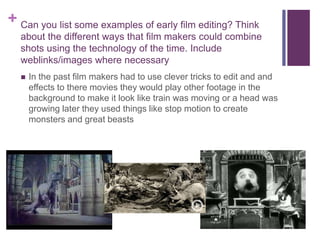
 In the past film makers had to use clever tricks to edit and and
effects to there movies they would play other footage in the
background to make it look like train was moving or a head was
growing later they used things like stop motion to create
monsters and great beasts
+ Describe the concept of ‘montage’ and juxtaposition
[remember Eisenstein and Kuleshov] and give an
example
 In the story the main or a main character needs to get ready
that’s when to put them selves to test and shows a passage of
time your gona need a montage and from anyting you want
them to go from just a beginner to a pro your going to need a
montage even rocky had a montage
+ List the types of cut/edit you can use and provide an
example of each on in use
 Cuts: instant transition
 Fade-outs: screen goes dark
 Fade-ins: screen becomes lighter
 Dissolves: end of shot A is briefly superimposed over the
beginning of shot B
 Wipes: a moving boundary line crosses the screen. Shot B
‘pushes’ shot A off the screen [George Lucas and Star Wars]
+ Below, list the four relationships between shots
1. Editing and Graphic Relationships [PICTURE]
2. Editing and Rhythmic Relationships [RHYTHM]
3. Editing and Temporal Relationships [TIME]
4. Editing and Spatial Relationships [SPACE]
+ For GRAPHIC relationships provide a description and examples of it’s
usage [with a weblink to a sequence on YouTube and still frames where
necessary – you may add more slides if you need to]
 It is when you cut to something that has a visual similarity in it
but at the same time everything around the aspect has
changed for example in the film gravity when Matt Kowalski
there's a graphical and colour similarity in the shots. Another
example of smooth editing is also in Gravity in the start when
the Space debris hits Explorer its one long contuses shot that
very smooth
 https://www.youtube.com/watch?v=DYDaIyfitn8
 https://www.youtube.com/watch?v=vKW-Gd_S_xc
+ For GRAPHIC relationships provide a description and examples of it’s
usage [with a weblink to a sequence on YouTube and still frames where
necessary – you may add more slides if you need to]
 A contrast to gravity is a scene from slumdog millionaire where
is on the game show and it cuts from the game show to the
action that is happening to give a sense of suspense with its
quick cuts in contrast with gravity's smother cuts
+ For RYTHMIC relationships provide a description and examples of it’s
usage [with a weblink to a sequence on YouTube and still frames where
necessary – you may add more slides if you need to]
 A good exsample of rythhmic relations if films is in inseption at
the end where the shots fit the rythem of the movie and music
in the background and it makes use not notes the cuts unsles
we are looking for it and this get use lost in the film and we
think he is back in reality but at the end of the film the spinner
makes use qwestion everything and ask at what point was the
main charicter in reality and it makes look back at scenes like
this and try to spot everything out to find the answer
+ For RYTHMIC relationships provide a description and examples of it’s
usage [with a weblink to a sequence on YouTube and still frames where
necessary – you may add more slides if you need to]
 the only logic connecting the shots is that provided by Bow
Wow Wow’s song, “I want candy”, and a few graphic
matches. The sequence is a hallmark of Coppola’s style –
interweaving period decadence and frivolity with a
contemporary youthful exuberance – which is also distinctively
feminine.
+ For TEMPORAL relationships provide a description and examples of it’s
usage [with a weblink to a sequence on YouTube and still frames where
necessary – you may add more slides if you need to]
 Peter Jackson uses matches on action to give the chase a
sense of dynamism. The viewer can never assume what is
going to happen next, as the scene is constantly shifting. He
uses a very complex version of match on action, jumping from
close ups to far away helicopter shots and back without a
pause. It is almost dizzying, yet thrilling at the same time. Be
sure to keep your eye on the white horse; this is the character
we are following and although hard to see at times it is present
in every part of the clip.
+ Define the ‘Hollywood method’ of continuity editing and why it
became so prevalent…
 This is concerned with ensuring the smooth flow of shot to shot
and establishing a firm sense of space and spatial relations.
We can look at this in three ways:
1. The 180 Degree Line
2. POV and Identification
3. Cross Cutting
It became prvelent in films so that I would make it easlyer to
make the story flow from scene to scene it makes the events of
the movie easy to follow
+ Provide a description of a scene where the 180 degree line has
been used, how does it provide spatial continuity/discontinuity?
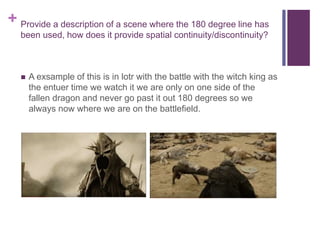
 A exsample of this is in lotr with the battle with the witch king as
the entuer time we watch it we are only on one side of the
fallen dragon and never go past it out 180 degrees so we
always now where we are on the battlefield.
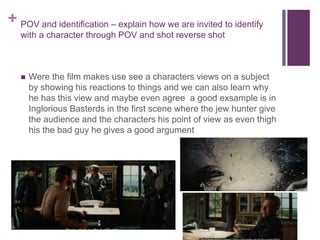
+ POV and identification – explain how we are invited to identify
with a character through POV and shot reverse shot
 Were the film makes use see a characters views on a subject
by showing his reactions to things and we can also learn why
he has this view and maybe even agree a good exsample is in
Inglorious Basterds in the first scene where the jew hunter give
the audience and the characters his point of view as even thigh
his the bad guy he gives a good argument
+ Provide a definition of cross-cutting/parallel editing, what is so
effective about this technique? Where might a director use it?
 Cross cutting is when you cut back and forth from two or more
action scenes that are happening at the same time in the story
a great exsample is inseption in the case scene at the midel
part of the move cuting from the van to joseph gordon levitt in
the hotel its realy effective as it shows how one world impacts
the other world well and it makes a much better more
interesting scene that keeps the viewer thinking of it for hours
+ What is Ellipsis? Select an example and explain how it
works…
 From the film glossary: the shortening of the plot duration of a
film achieved by deliberately omitting intervals or sections of
the narrative story or action; an ellipsis is marked by an editing
transition (a fade,dissolve, wipe, jump cut, or change of scene)
to omit a period or gap of time from the film's narrative
+ What is meant by the term ‘intensified continuity’? Why do you
think continuity editing has developed in this way?
 David Bordwell claims that intensified continuity is the
general idea that, over the history of film, the average amount
of shots has increased, the framing of the shots are closer,
more drastic focal lengths are used and an increase in camera
movement rather than just stationary shots
+
Your Case Study
+
Free choice case study
 Your individual case study should describe the development of
editing in film and aim to highlight the different aspects of
editing discussed in the lecture [with examples]
 You should select at least 2 different examples/clips to discuss
– you should include links to these and use still images to
support your arguments
 Use the questions listed on the next slide to start your
investigations
+
Questions to ask
 When any two shots are joined, you can ask several questions:
1. How are the shots graphically continuous or discontinuous?
2. What rhythmic relations are created?
3. Are the shots spatially continuous? If not, what creates the
spatial discontinuity? [Cross-cutting? Ambiguous cues?] If the
shots are continuous, how does the 180-degree system
create the continuity?
4. Are the shots temporally continuous? If so, what creates the
continuity? [e.g. matches on action?] If not, what creates the
discontinuity?
+
1st clip
+
1st clip
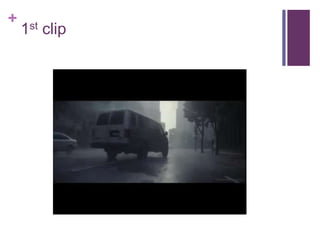
 This clip is one of the most clever example of cross cutting I
have seen in film as it uses cross cutting to show how one
world has a effect on the other. It parallels what is happening to
the truck to the dream worlds gravity and rules. This creates a
sense of suspense and is in my opinion to keep a flowing
narrative and action scene. This scene is in many ways
continuous as its graphically and spacially. It might not be in
same place or have same characters but it keeps the same
physics from scene to scene. So, if the van fall to its right the
characters in the other world will do the same. This is spacially
continuous because it acts like the other world ie the corridor is
like the van tipping over. See clip 01:19:00-02:31:00.
+
1st clip
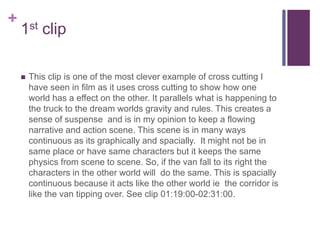
 This film and clip does have intensified continuity but most are
long. It it doesn't get boring to watch and when it cuts it’s at
important times to cut and when something interesting is going
on it doesn't cut and uses a long shot of the events.
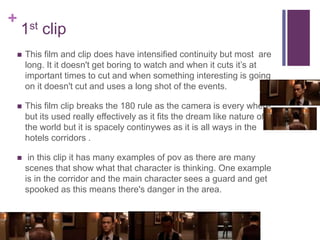
 This film clip breaks the 180 rule as the camera is every where
but its used really effectively as it fits the dream like nature of
the world but it is spacely continywes as it is all ways in the
hotels corridors .
 in this clip it has many examples of pov as there are many
scenes that show what that character is thinking. One example
is in the corridor and the main character sees a guard and get
spooked as this means there's danger in the area.
+
2nd clip
+
2nd clip
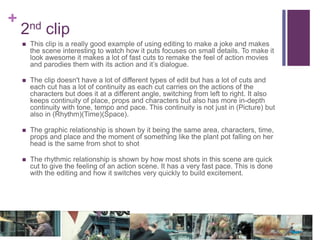
 This clip is a really good example of using editing to make a joke and makes
the scene interesting to watch how it puts focuses on small details. To make it
look awesome it makes a lot of fast cuts to remake the feel of action movies
and parodies them with its action and it’s dialogue.
 The clip doesn't have a lot of different types of edit but has a lot of cuts and
each cut has a lot of continuity as each cut carries on the actions of the
characters but does it at a different angle, switching from left to right. It also
keeps continuity of place, props and characters but also has more in-depth
continuity with tone, tempo and pace. This continuity is not just in (Picture) but
also in (Rhythm)(Time)(Space).
 The graphic relationship is shown by it being the same area, characters, time,
props and place and the moment of something like the plant pot falling on her
head is the same from shot to shot
 The rhythmic relationship is shown by how most shots in this scene are quick
cut to give the feeling of an action scene. It has a very fast pace. This is done
with the editing and how it switches very quickly to build excitement.
+
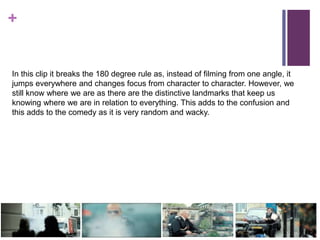
In this clip it breaks the 180 degree rule as, instead of filming from one angle, it
jumps everywhere and changes focus from character to character. However, we
still know where we are as there are the distinctive landmarks that keep us
knowing where we are in relation to everything. This adds to the confusion and
this adds to the comedy as it is very random and wacky.
+
3nd clip
+
3nd clip
 This clip from the film atoment is very good as a example of
one shot but using all the

Case study editing

  • 1.
    + Film and VideoEditing Techniques YOUR NAME
  • 2.
    + Provide asimple definition of what film editing is  Film editing is where you change elements of the films shot in post production
  • 3.
    + Can youlist some examples of early film editing? Think about the different ways that film makers could combine shots using the technology of the time. Include weblinks/images where necessary  In the past film makers had to use clever tricks to edit and and effects to there movies they would play other footage in the background to make it look like train was moving or a head was growing later they used things like stop motion to create monsters and great beasts
  • 4.
    + Describe theconcept of ‘montage’ and juxtaposition [remember Eisenstein and Kuleshov] and give an example  In the story the main or a main character needs to get ready that’s when to put them selves to test and shows a passage of time your gona need a montage and from anyting you want them to go from just a beginner to a pro your going to need a montage even rocky had a montage
  • 5.
    + List thetypes of cut/edit you can use and provide an example of each on in use  Cuts: instant transition  Fade-outs: screen goes dark  Fade-ins: screen becomes lighter  Dissolves: end of shot A is briefly superimposed over the beginning of shot B  Wipes: a moving boundary line crosses the screen. Shot B ‘pushes’ shot A off the screen [George Lucas and Star Wars]
  • 6.
    + Below, listthe four relationships between shots 1. Editing and Graphic Relationships [PICTURE] 2. Editing and Rhythmic Relationships [RHYTHM] 3. Editing and Temporal Relationships [TIME] 4. Editing and Spatial Relationships [SPACE]
  • 7.
    + For GRAPHICrelationships provide a description and examples of it’s usage [with a weblink to a sequence on YouTube and still frames where necessary – you may add more slides if you need to]  It is when you cut to something that has a visual similarity in it but at the same time everything around the aspect has changed for example in the film gravity when Matt Kowalski there's a graphical and colour similarity in the shots. Another example of smooth editing is also in Gravity in the start when the Space debris hits Explorer its one long contuses shot that very smooth  https://www.youtube.com/watch?v=DYDaIyfitn8  https://www.youtube.com/watch?v=vKW-Gd_S_xc
  • 8.
    + For GRAPHICrelationships provide a description and examples of it’s usage [with a weblink to a sequence on YouTube and still frames where necessary – you may add more slides if you need to]  A contrast to gravity is a scene from slumdog millionaire where is on the game show and it cuts from the game show to the action that is happening to give a sense of suspense with its quick cuts in contrast with gravity's smother cuts
  • 9.
    + For RYTHMICrelationships provide a description and examples of it’s usage [with a weblink to a sequence on YouTube and still frames where necessary – you may add more slides if you need to]  A good exsample of rythhmic relations if films is in inseption at the end where the shots fit the rythem of the movie and music in the background and it makes use not notes the cuts unsles we are looking for it and this get use lost in the film and we think he is back in reality but at the end of the film the spinner makes use qwestion everything and ask at what point was the main charicter in reality and it makes look back at scenes like this and try to spot everything out to find the answer
  • 10.
    + For RYTHMICrelationships provide a description and examples of it’s usage [with a weblink to a sequence on YouTube and still frames where necessary – you may add more slides if you need to]  the only logic connecting the shots is that provided by Bow Wow Wow’s song, “I want candy”, and a few graphic matches. The sequence is a hallmark of Coppola’s style – interweaving period decadence and frivolity with a contemporary youthful exuberance – which is also distinctively feminine.
  • 11.
    + For TEMPORALrelationships provide a description and examples of it’s usage [with a weblink to a sequence on YouTube and still frames where necessary – you may add more slides if you need to]  Peter Jackson uses matches on action to give the chase a sense of dynamism. The viewer can never assume what is going to happen next, as the scene is constantly shifting. He uses a very complex version of match on action, jumping from close ups to far away helicopter shots and back without a pause. It is almost dizzying, yet thrilling at the same time. Be sure to keep your eye on the white horse; this is the character we are following and although hard to see at times it is present in every part of the clip.
  • 12.
    + Define the‘Hollywood method’ of continuity editing and why it became so prevalent…  This is concerned with ensuring the smooth flow of shot to shot and establishing a firm sense of space and spatial relations. We can look at this in three ways: 1. The 180 Degree Line 2. POV and Identification 3. Cross Cutting It became prvelent in films so that I would make it easlyer to make the story flow from scene to scene it makes the events of the movie easy to follow
  • 13.
    + Provide adescription of a scene where the 180 degree line has been used, how does it provide spatial continuity/discontinuity?  A exsample of this is in lotr with the battle with the witch king as the entuer time we watch it we are only on one side of the fallen dragon and never go past it out 180 degrees so we always now where we are on the battlefield.
  • 14.
    + POV andidentification – explain how we are invited to identify with a character through POV and shot reverse shot  Were the film makes use see a characters views on a subject by showing his reactions to things and we can also learn why he has this view and maybe even agree a good exsample is in Inglorious Basterds in the first scene where the jew hunter give the audience and the characters his point of view as even thigh his the bad guy he gives a good argument
  • 15.
    + Provide adefinition of cross-cutting/parallel editing, what is so effective about this technique? Where might a director use it?  Cross cutting is when you cut back and forth from two or more action scenes that are happening at the same time in the story a great exsample is inseption in the case scene at the midel part of the move cuting from the van to joseph gordon levitt in the hotel its realy effective as it shows how one world impacts the other world well and it makes a much better more interesting scene that keeps the viewer thinking of it for hours
  • 16.
    + What isEllipsis? Select an example and explain how it works…  From the film glossary: the shortening of the plot duration of a film achieved by deliberately omitting intervals or sections of the narrative story or action; an ellipsis is marked by an editing transition (a fade,dissolve, wipe, jump cut, or change of scene) to omit a period or gap of time from the film's narrative
  • 17.
    + What ismeant by the term ‘intensified continuity’? Why do you think continuity editing has developed in this way?  David Bordwell claims that intensified continuity is the general idea that, over the history of film, the average amount of shots has increased, the framing of the shots are closer, more drastic focal lengths are used and an increase in camera movement rather than just stationary shots
  • 18.
  • 19.
    + Free choice casestudy  Your individual case study should describe the development of editing in film and aim to highlight the different aspects of editing discussed in the lecture [with examples]  You should select at least 2 different examples/clips to discuss – you should include links to these and use still images to support your arguments  Use the questions listed on the next slide to start your investigations
  • 20.
    + Questions to ask When any two shots are joined, you can ask several questions: 1. How are the shots graphically continuous or discontinuous? 2. What rhythmic relations are created? 3. Are the shots spatially continuous? If not, what creates the spatial discontinuity? [Cross-cutting? Ambiguous cues?] If the shots are continuous, how does the 180-degree system create the continuity? 4. Are the shots temporally continuous? If so, what creates the continuity? [e.g. matches on action?] If not, what creates the discontinuity?
  • 21.
  • 22.
    + 1st clip  Thisclip is one of the most clever example of cross cutting I have seen in film as it uses cross cutting to show how one world has a effect on the other. It parallels what is happening to the truck to the dream worlds gravity and rules. This creates a sense of suspense and is in my opinion to keep a flowing narrative and action scene. This scene is in many ways continuous as its graphically and spacially. It might not be in same place or have same characters but it keeps the same physics from scene to scene. So, if the van fall to its right the characters in the other world will do the same. This is spacially continuous because it acts like the other world ie the corridor is like the van tipping over. See clip 01:19:00-02:31:00.
  • 23.
    + 1st clip  Thisfilm and clip does have intensified continuity but most are long. It it doesn't get boring to watch and when it cuts it’s at important times to cut and when something interesting is going on it doesn't cut and uses a long shot of the events.  This film clip breaks the 180 rule as the camera is every where but its used really effectively as it fits the dream like nature of the world but it is spacely continywes as it is all ways in the hotels corridors .  in this clip it has many examples of pov as there are many scenes that show what that character is thinking. One example is in the corridor and the main character sees a guard and get spooked as this means there's danger in the area.
  • 24.
  • 25.
    + 2nd clip  Thisclip is a really good example of using editing to make a joke and makes the scene interesting to watch how it puts focuses on small details. To make it look awesome it makes a lot of fast cuts to remake the feel of action movies and parodies them with its action and it’s dialogue.  The clip doesn't have a lot of different types of edit but has a lot of cuts and each cut has a lot of continuity as each cut carries on the actions of the characters but does it at a different angle, switching from left to right. It also keeps continuity of place, props and characters but also has more in-depth continuity with tone, tempo and pace. This continuity is not just in (Picture) but also in (Rhythm)(Time)(Space).  The graphic relationship is shown by it being the same area, characters, time, props and place and the moment of something like the plant pot falling on her head is the same from shot to shot  The rhythmic relationship is shown by how most shots in this scene are quick cut to give the feeling of an action scene. It has a very fast pace. This is done with the editing and how it switches very quickly to build excitement.
  • 26.
    + In this clipit breaks the 180 degree rule as, instead of filming from one angle, it jumps everywhere and changes focus from character to character. However, we still know where we are as there are the distinctive landmarks that keep us knowing where we are in relation to everything. This adds to the confusion and this adds to the comedy as it is very random and wacky.
  • 27.
  • 28.
    + 3nd clip  Thisclip from the film atoment is very good as a example of one shot but using all the