FILM LANGUAGE
Editing
Editing
 Sequences the shots into something that
makes sense for the audience, in terms of
time and space.
 Most common editing technique in use today
is called ‘Continuity Editing’
Continuity Editing
 Makes sense of the spatial (space)
relationships
 Progresses events
 Shows reactions to previous actions
 Allows the film to shift through time
 Gives the film rhythm
 Calls the audience’s attention to significant
objects / characters / events in the narrative
Making Sense of Space
Continuity Editing
Spatial Relationships
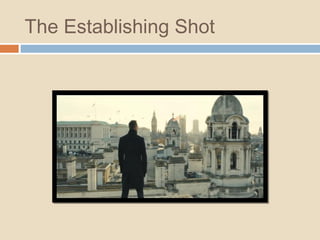
 The Establishing Shot
 All edits should be motivated
 Action / Reaction
 Eye-Line Match
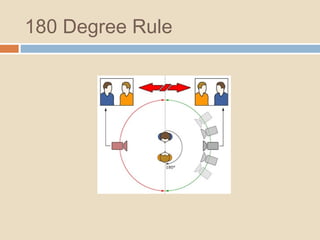
 180 degree rule
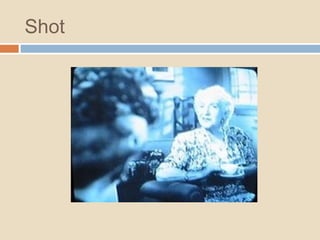
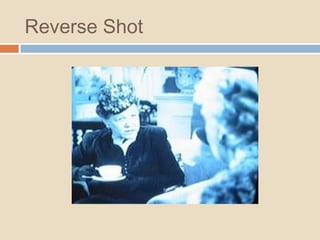
 Shot Reverse Shot
 Match on Action
 Diegetic Sound
The Establishing Shot
The Eyeline Match
180 Degree Rule
Shot
Reverse Shot
Match on Action
Making Sense of Time
Continuity Editing
Time Relationships
 Fade In / Out
 Ellipsis
 Slow Motion
 Parallel Editing
 Flash Back
Parallel Editing
Silence of the Lambs
Fooling the Audience
Bullet Time (Slow Motion)
Cutting Speed
EDITING CHALLENGE.
Count the number of cuts in the following
sequence:
‘PSYCHO’
In this sequence, note where and when the
editing changes pace and to what effect.
Style
Editing Styles
 Straight cut
 Fade out
 Dissolve
 Wipe
 Jump cut
Transition Style
The Star Wars Wipe
Spud’s Interview
ANOTHER STYLE OF
EDITING IS CALLED…
Used to show a passing of long periods of
time and progression of a character or
relationship.
Montage Editing
Montage Sequence
“...montage is an idea that arises from the
collision of independent shots“ Eisenstein
Soviet Montage
Battleship Potemkin (1925)
Eisenstein
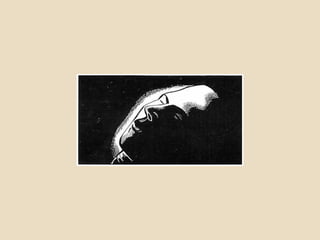
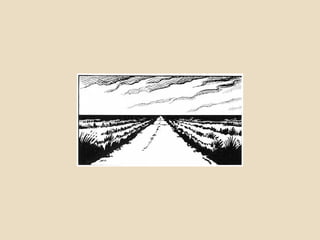
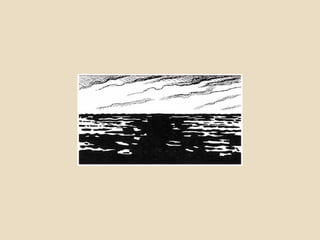
GRAPHIC MATCH
Example 1
Example 2
Graphic Match
Editing Controls Text
Progression:
• Picture relationships
• Rhythmic relationships
• Time relationships
• Space Relationships

Editing

Editor's Notes

  • #15 Could use Argo
  • #27 The Jump Cut
  • #29 Team America World Police – Montage Song
  • #30 Thinking Film DVD Editing - Hot Fuzz Sequence
  • #40 Minority Report