 Sarita Chander
 The Editor works closely with the director and they ensure that the story given to them is
decent and flows well with a beginning, middle and end. They chose the shots carefully
and edit them into a series of scenes which then turn into a assembled piece and
becomes a finished. The editor works very closely with the directors and select scenes
and edit them together to create a good flow of story. Editors also generally work in a
supervisory roles such as in music, sound and track laying.
 Overall editors work with the directors to craft the finished film in a editing suite for a long
hours and they run a team of assistants occasionally for big productions as there is a lot
of work to be done due to the fact that the role is busy and very important.
Parallel Editing:
Parallel editing basically means cross cutting and the technique is of alternating
two or more scenes that often happen simultaneously but in different locations. If
the scenes are simultaneous, they occasionally culminate in a single place.
Sequence shot:
A long take that extends for an entire scene or sequence. It is composed of only one shot with
no editing.
Shot reverse shot cutting
Usually used for conversation scenes, this technique alternates between over-the-shoulder shots showing
each character speaking.
Montage:
Scenes whose emotional impact and visual design are achieved through the editing
together of many brief shots. The shower scene from Psycho is an example of montage
editing.
Continuity editing:
Editing that creates action that flows smoothly across shots and scenes without jarring visual
inconsistencies. Establishes a sense of story for the viewer.
Editors firstly prepare all the shots by analyzing which ones they need and want, they then cut on the
action or cut across on the frame movement.
they cut on empty frames to let the subject come in, they also cut to the secondary action by tilting
to the main subject or cutting the empathic part of the dialogue.
 Narration – This is a traditional style of storytelling using a narrator who is off-camera and
never seen. This generic “voice” is an objective storyteller.
an example of narration occurs in the movie called Touching the Void and its shown in the
start when he's explaining how he feels.
 Host – This is a style of storytelling where you learn the story through a guide or a host.
You see this person on camera and they take you through the story in their own words.
The host could be you, it could be a celebrity or a professional host or just a person who
has some connection to the story.
an example of a movie which used this is the film called Maniac and this is a great example
people of we as an since feel like a host.
 No Narration – is in documentaries where there is no narration. The story is pieced
together using only clips of interviews, raw footage, on-screen text and graphics.
an example where no narration Is used is in some BBC documentaries like Panorama where
they show in interview clips of the happening events.
 Recreations/Drama – This storytelling technique is often used in historical documentaries
where important events have already taken place and there is no existing footage.
an example of this is period dramas and films such as The Reign.
 Follow One Character – This is a style of storytelling where you choose one person to
follow for your story.
an example of this is from the movie Wrecked as its main focus is one person and we see
their story.
Mainly before sound came in silent movies used to cut the subtitles. The first
motion picture synchronized dialogue sequence and the film was based on
day of atonement which was a play written by Sam Raphnelson.
location mixing is the editing of all sound.
ADR is automatic dialogue replacement or looping. ADR is recording of
replacement dialogue in sync with the picture.
Dialogue editing: the dialogue editor will take the cut and break out all
individual mic tracks. they'll also make sure all the directors cues are
removed and they will then often odd room tone and ambience to
smooth out the recording.
Sound effects editing, sound design : sounds which are identifiable with
the character for example if a villain is walking in you may hear sounds
of creaks, screams and squeaking.
Foley: is the live sounds effects recording.
Music: in a film scenario, a composer will create the music for the film
laugh tracks: usually is par of a sitcom TV production and not a feature
film. when laugh tracks are added the laughs are usually placed by
sound effects
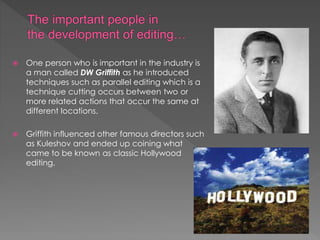
 One person who is important in the industry is
a man called DW Griffith as he introduced
techniques such as parallel editing which is a
technique cutting occurs between two or
more related actions that occur the same at
different locations.
 Griffith influenced other famous directors such
as Kuleshov and ended up coining what
came to be known as classic Hollywood
editing.
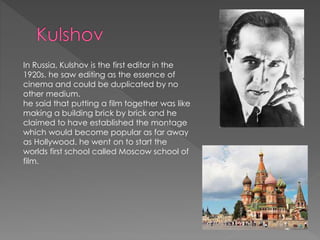
In Russia, Kulshov is the first editor in the
1920s. he saw editing as the essence of
cinema and could be duplicated by no
other medium.
he said that putting a film together was like
making a building brick by brick and he
claimed to have established the montage
which would become popular as far away
as Hollywood. he went on to start the
worlds first school called Moscow school of
film.
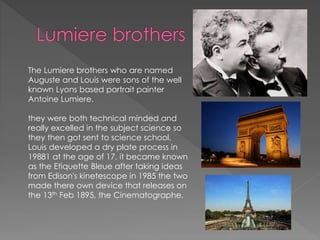
The Lumiere brothers who are named
Auguste and Louis were sons of the well
known Lyons based portrait painter
Antoine Lumiere.
they were both technical minded and
really excelled in the subject science so
they then got sent to science school.
Louis developed a dry plate process in
19881 at the age of 17, it became known
as the Etiquette Bleue after taking ideas
from Edison's kinetescope in 1985 the two
made there own device that releases on
the 13th Feb 1895, the Cinematographe.
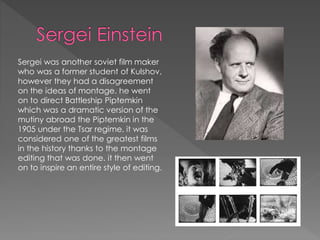
Sergei was another soviet film maker
who was a former student of Kulshov,
however they had a disagreement
on the ideas of montage. he went
on to direct Battleship Piptemkin
which was a dramatic version of the
mutiny abroad the Piptemkin in the
1905 under the Tsar regime, it was
considered one of the greatest films
in the history thanks to the montage
editing that was done. it then went
on to inspire an entire style of editing.

Role of the editor

  • 1.
  • 2.
     The Editorworks closely with the director and they ensure that the story given to them is decent and flows well with a beginning, middle and end. They chose the shots carefully and edit them into a series of scenes which then turn into a assembled piece and becomes a finished. The editor works very closely with the directors and select scenes and edit them together to create a good flow of story. Editors also generally work in a supervisory roles such as in music, sound and track laying.  Overall editors work with the directors to craft the finished film in a editing suite for a long hours and they run a team of assistants occasionally for big productions as there is a lot of work to be done due to the fact that the role is busy and very important.
  • 3.
    Parallel Editing: Parallel editingbasically means cross cutting and the technique is of alternating two or more scenes that often happen simultaneously but in different locations. If the scenes are simultaneous, they occasionally culminate in a single place. Sequence shot: A long take that extends for an entire scene or sequence. It is composed of only one shot with no editing. Shot reverse shot cutting Usually used for conversation scenes, this technique alternates between over-the-shoulder shots showing each character speaking. Montage: Scenes whose emotional impact and visual design are achieved through the editing together of many brief shots. The shower scene from Psycho is an example of montage editing. Continuity editing: Editing that creates action that flows smoothly across shots and scenes without jarring visual inconsistencies. Establishes a sense of story for the viewer. Editors firstly prepare all the shots by analyzing which ones they need and want, they then cut on the action or cut across on the frame movement. they cut on empty frames to let the subject come in, they also cut to the secondary action by tilting to the main subject or cutting the empathic part of the dialogue.
  • 4.
     Narration –This is a traditional style of storytelling using a narrator who is off-camera and never seen. This generic “voice” is an objective storyteller. an example of narration occurs in the movie called Touching the Void and its shown in the start when he's explaining how he feels.  Host – This is a style of storytelling where you learn the story through a guide or a host. You see this person on camera and they take you through the story in their own words. The host could be you, it could be a celebrity or a professional host or just a person who has some connection to the story. an example of a movie which used this is the film called Maniac and this is a great example people of we as an since feel like a host.  No Narration – is in documentaries where there is no narration. The story is pieced together using only clips of interviews, raw footage, on-screen text and graphics. an example where no narration Is used is in some BBC documentaries like Panorama where they show in interview clips of the happening events.  Recreations/Drama – This storytelling technique is often used in historical documentaries where important events have already taken place and there is no existing footage. an example of this is period dramas and films such as The Reign.  Follow One Character – This is a style of storytelling where you choose one person to follow for your story. an example of this is from the movie Wrecked as its main focus is one person and we see their story. Mainly before sound came in silent movies used to cut the subtitles. The first motion picture synchronized dialogue sequence and the film was based on day of atonement which was a play written by Sam Raphnelson.
  • 5.
    location mixing isthe editing of all sound. ADR is automatic dialogue replacement or looping. ADR is recording of replacement dialogue in sync with the picture. Dialogue editing: the dialogue editor will take the cut and break out all individual mic tracks. they'll also make sure all the directors cues are removed and they will then often odd room tone and ambience to smooth out the recording. Sound effects editing, sound design : sounds which are identifiable with the character for example if a villain is walking in you may hear sounds of creaks, screams and squeaking. Foley: is the live sounds effects recording. Music: in a film scenario, a composer will create the music for the film laugh tracks: usually is par of a sitcom TV production and not a feature film. when laugh tracks are added the laughs are usually placed by sound effects
  • 6.
     One personwho is important in the industry is a man called DW Griffith as he introduced techniques such as parallel editing which is a technique cutting occurs between two or more related actions that occur the same at different locations.  Griffith influenced other famous directors such as Kuleshov and ended up coining what came to be known as classic Hollywood editing.
  • 7.
    In Russia, Kulshovis the first editor in the 1920s. he saw editing as the essence of cinema and could be duplicated by no other medium. he said that putting a film together was like making a building brick by brick and he claimed to have established the montage which would become popular as far away as Hollywood. he went on to start the worlds first school called Moscow school of film.
  • 8.
    The Lumiere brotherswho are named Auguste and Louis were sons of the well known Lyons based portrait painter Antoine Lumiere. they were both technical minded and really excelled in the subject science so they then got sent to science school. Louis developed a dry plate process in 19881 at the age of 17, it became known as the Etiquette Bleue after taking ideas from Edison's kinetescope in 1985 the two made there own device that releases on the 13th Feb 1895, the Cinematographe.
  • 9.
    Sergei was anothersoviet film maker who was a former student of Kulshov, however they had a disagreement on the ideas of montage. he went on to direct Battleship Piptemkin which was a dramatic version of the mutiny abroad the Piptemkin in the 1905 under the Tsar regime, it was considered one of the greatest films in the history thanks to the montage editing that was done. it then went on to inspire an entire style of editing.