CanGrassrootsParentEducationalProgramsCompetewithNationally
ProminentProgramstoPreventChildAbuse?
Margaret Coombes, PhD
University of the Fraser Valley, BC, Canada
Can grassroots parent educational programs
compete with nationally prominent programs to
prevent child abuse?
• Prevalence Child Protection Services (CPS) Investigations
• Families, abuse &poverty
• Community Based Research
• Preliminary Findings: Phase 1 – Focus Group
• Conclusion & Phase 2
Canadian Child Maltreatment
• 235,842 maltreatment Child
Protection Services (CPS)
investigations in Canada
(2008)
• Estimated that 75% were
children under the age of 12
years
• 26% of families investigated
remained open for on-going
services(Public, H. A. O. C., 2010).
• 8% placed out of the home in
foster care or in formal or informal
kinship arrangements (Public, H. A. O. C.,
2010).
• Disproportional representation of
First Nations, Aboriginal children
investigated & in care in Canada
(Sinha, Trocmé, Fallon, & MacLaurin, 2013)
Families, Abuse and Poverty
• Poverty compounds many issues related to child abuse
(English, Graham, Litrownik, Everson, & Bangdiwala, 2005)
• British Columbia - rich province, most unequal distribution
of wealth between rich & poor (Broadbent Report ,2014)
• In 2013, BC has the highest rate of child poverty in
Canada (First Call: BC Child and Youth Advocacy Coalition, 2014).
• 49.8% of children living with single-mothers are living in
poverty children (First Call: BC Child and Youth Advocacy Coalition, 2014).
• Child Care in Greater Vancouver ($1200.00 - $1800.oo
CA) £ 644.64 to £ 966.95 (Coalition of Child Care Advocates of BC, 2014)
Parent Education & Child Abuse
• Debate to focus on parenting or related problems,
such as parental substance abuse, parental mental
illness, domestic violence, and child conduct
problems and/or issues of poverty (Barth, 2009; English,
Graham, Litrownik, Everson, & Bangdiwala, 2005)
• Parent educational programs are more likely to have
better outcomes if the service includes some of the
following factors: a focus on early childhood
interventions, peer support groups for parents, and
clear strategies to engage families, among others(Barth,
R. P., 2009).
Community Research
Collaborative of a University, a non-profit agency &
Child Welfare
• Long-term mixed study
• Objective to evaluate the effectiveness of the program
to engage parents, improve participants’ parenting
skills, improve parent & child interactions (decrease
abuse & neglect), or increase parents’ competencies
in problem-solving.
Community Research
• Non-profit agency (ACS) interactive parent educational
programs
• Large agency, 70 programs, serve 38,000, Triple P., seeking
evidence based
• 70% of the participants referred by Child Welfare
• Participants primarily mothers & receiving social assistance
• Initial Phase: Focus Groups and Process Analysis
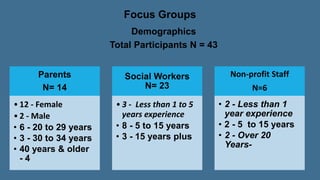
Focus Groups
Demographics
Total Participants N = 43
Parents
N= 14
• 12 - Female
• 2 - Male
• 6 - 20 to 29 years
• 3 - 30 to 34 years
• 40 years & older
- 4
Social Workers
N= 23
• 3 - Less than 1 to 5
years experience
• 8 - 5 to 15 years
• 3 - 15 years plus
Non-profit Staff
N=6
• 2 - Less than 1
year experience
• 2 - 5 to 15 years
• 2 - Over 20
Years-
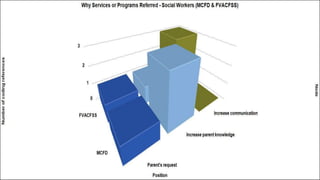
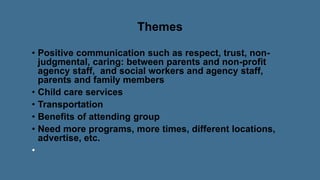
Themes
• Positive communication such as respect, trust, non-
judgmental, caring: between parents and non-profit
agency staff, and social workers and agency staff,
parents and family members
• Child care services
• Transportation
• Benefits of attending group
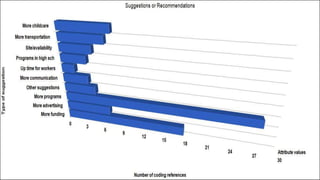
• Need more programs, more times, different locations,
advertise, etc.
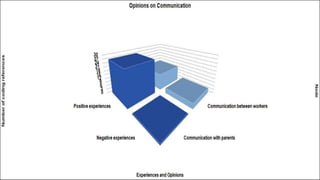
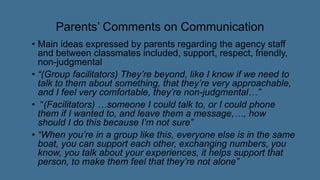
Parents’ Comments on Communication
• Main ideas expressed by parents regarding the agency staff
and between classmates included, support, respect, friendly,
non-judgmental
• “(Group facilitators) They’re beyond, like I know if we need to
talk to them about something, that they’re very approachable,
and I feel very comfortable, they’re non-judgmental…”
• “(Facilitators) …someone I could talk to, or I could phone
them if I wanted to, and leave them a message,…, how
should I do this because I’m not sure”
• “When you’re in a group like this, everyone else is in the same
boat, you can support each other, exchanging numbers, you
know, you talk about your experiences, it helps support that
person, to make them feel that they’re not alone”
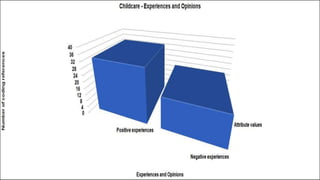
Comments on Childcare
• “I wouldn’t have been able to come today because my mom
has gone away on a trip, cause I have to be with my kids”
• “…it’s great for the kids to socialize and hang out with other
kids”
• “the child care providers are wonderful with the kids. They’re
great. And you know, the snack they provide are always
healthy snacks, they’re great”
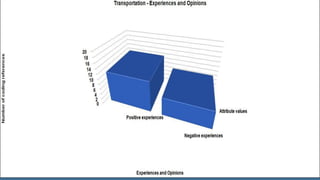
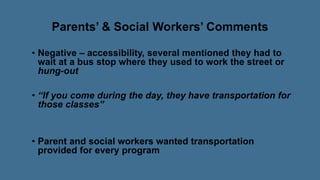
Parents’ & Social Workers’ Comments
• Negative – accessibility, several mentioned they had to
wait at a bus stop where they used to work the street or
hung-out
• “If you come during the day, they have transportation for
those classes”
• Parent and social workers wanted transportation
provided for every program
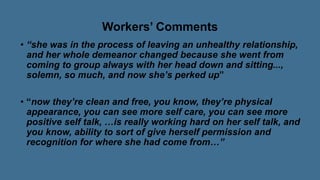
Workers’ Comments
• “she was in the process of leaving an unhealthy relationship,
and her whole demeanor changed because she went from
coming to group always with her head down and sitting...,
solemn, so much, and now she’s perked up”
• “now they’re clean and free, you know, they’re physical
appearance, you can see more self care, you can see more
positive self talk, …is really working hard on her self talk, and
you know, ability to sort of give herself permission and
recognition for where she had come from…”
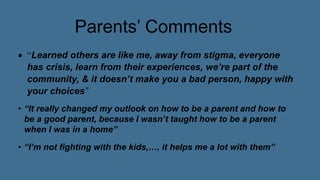
Parents’ Comments
 “Learned others are like me, away from stigma, everyone
has crisis, learn from their experiences, we’re part of the
community, & it doesn’t make you a bad person, happy with
your choices”
• “It really changed my outlook on how to be a parent and how to
be a good parent, because I wasn’t taught how to be a parent
when I was in a home”
• “I’m not fighting with the kids,…, it helps me a lot with them”
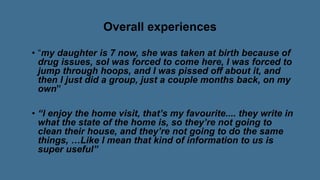
Overall experiences
• “my daughter is 7 now, she was taken at birth because of
drug issues, soI was forced to come here, I was forced to
jump through hoops, and I was pissed off about it, and
then I just did a group, just a couple months back, on my
own”
• “I enjoy the home visit, that’s my favourite.... they write in
what the state of the home is, so they’re not going to
clean their house, and they’re not going to do the same
things, …Like I mean that kind of information to us is
super useful”
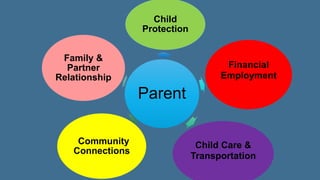
Parent
Child
Protection
Financial
Employment
Child Care &
Transportation
Community
Connections
Family &
Partner
Relationship
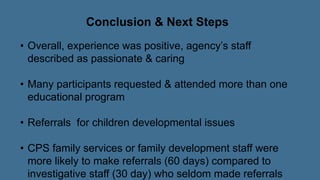
Conclusion & Next Steps
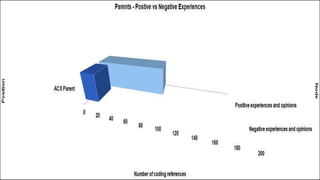
• Overall, experience was positive, agency’s staff
described as passionate & caring
• Many participants requested & attended more than one
educational program
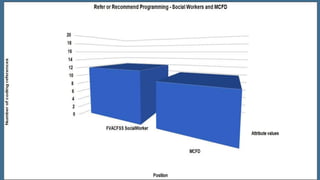
• Referrals for children developmental issues
• CPS family services or family development staff were
more likely to make referrals (60 days) compared to
investigative staff (30 day) who seldom made referrals
Conclusion & Next Steps
,
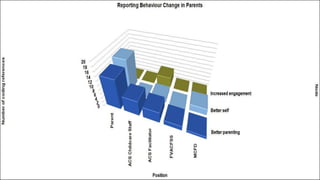
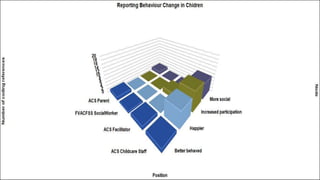
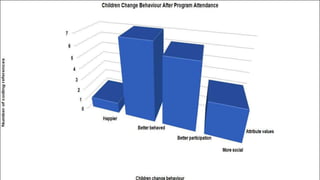
• Although children were reported to have behavioural
changes, parents’ behavioural changes were the most
frequently mentioned in the groups
• Agency staff reported observed behaviours & gave direct
feedback to parents
• Compared to other parenting programs, lower costs to
sustain own program
• Phase 2 one year, re-reports to CPS, (100 families)pre &
post behavioural scales/instruments, anonymous self-reports
Barth, R. P. (2009). Preventing Child Abuse and Neglect with Parent Training: Evidence and Opportunities. Future Of Children, 19(2), 95-118.
Public, H. A. O. C. (2010). Canadian
Berger, L. M., & Waldfogel, J. (2011). Economic determinants and consequences of child maltreatment. OECD Social, Employment and
Migration Working Papers: 111, OECD Publishing
Blackstock,C, The Canadian human rights tribunal on First Nations child welfare: Why if Canada wins, equality and justice lose. Children
and Youth Services Review, 33: 187–194 http://dx.doi.org.proxy.ufv.ca:2048/10.1016/j.childyouth.2010.09.002
Broadbent Institute (2014). Haves and Have Nots. https://www. broadbentinstitute. ca/sites/default/files/documents/have-havenots.pdf
Coalition of Child Care Advocates of BC, 2014 (2014). http://www.cccabc.bc.ca/resources/publications/publications-2013/
English, D. J., Bangdiwala, S. I., & Runyan, D. K. (2005). The dimensions of maltreatment: introduction. Child Abuse & Neglect,
29(Longitudinal Studies of Child Abuse and Neglect (LONGSCAN) Special Issue), 441-460. doi:10.1016/j.chiabu.2003.09.023
English, D. J., Upadhyaya, M. P., Litrownik, A. J., Marshall, J. M., Runyan, D. K., Graham, J. C., & Dubowitz, H. (2005). Maltreatment's wake:
The relationship of maltreatment dimensions to child outcomes. Child Abuse & Neglect, 29(Longitudinal Studies of Child Abuse and Neglect
(LONGSCAN) Special Issue), 597-619. doi:10.1016/j.chiabu.2004.12.008
First Call: BC Child and Youth Advocacy Coalition(2014). First Call Coalition's, 2014 BC Child Poverty Report Card.. www.still1in5.ca
Incidence Study of Reported Child Abuse and Neglect, 2008: Major Findings. Ottawa, ON, CAN: National Clearinghouse on Family Violence,
Public Health Agency of Canada. Retrieved from http://www.ebrary.com
Public, H. A. O. C. (2010). Canadian Incidence Study of Reported Child Abuse and Neglect, 2008: Major Findings. Ottawa, ON, CAN: National
Clearinghouse on Family Violence, Public Health Agency of Canada. Retrieved from http://www.ebrary.com
Sinha, V., Trocmé, N., Fallon, B., & MacLaurin, B. (2013). Understanding the investigation-stage overrepresentation of First Nations children
in the child welfare system: An analysis of the First Nations component of the Canadian Incidence Study of Reported Child Abuse and
Neglect 2008. Child Abuse & Neglect, 37(10), 821-831. doi:10.1016/j.chiabu.2012.11.010
1. Could you please share with everyone your first name and what Family Education group(s) you have attended or have
completed at Abbotsford Community Services (ACS)? (Have flip chart or piece of paper with list of groups for participants
to refer to)
2. Could you describe what your experience was coming to the Abbotsford Community Services Family Education Program for
the first time?
3. Was the program(s) what you expected? Please explain.
4. Who do you think benefits from attending these groups?
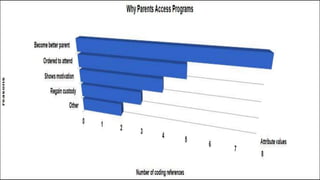
5. In your experience, what are some of the reasons a parent would attend a Family Education group?
6. Did the Family Education group change the way you think about anything? Please explain
Can Grassroots Parent Educational Programs Compete with Nationally Prominent Programs to Prevent Child Abuse

Can Grassroots Parent Educational Programs Compete with Nationally Prominent Programs to Prevent Child Abuse

  • 1.
  • 2.
    Can grassroots parenteducational programs compete with nationally prominent programs to prevent child abuse? • Prevalence Child Protection Services (CPS) Investigations • Families, abuse &poverty • Community Based Research • Preliminary Findings: Phase 1 – Focus Group • Conclusion & Phase 2
  • 3.
    Canadian Child Maltreatment •235,842 maltreatment Child Protection Services (CPS) investigations in Canada (2008) • Estimated that 75% were children under the age of 12 years • 26% of families investigated remained open for on-going services(Public, H. A. O. C., 2010). • 8% placed out of the home in foster care or in formal or informal kinship arrangements (Public, H. A. O. C., 2010). • Disproportional representation of First Nations, Aboriginal children investigated & in care in Canada (Sinha, Trocmé, Fallon, & MacLaurin, 2013)
  • 4.
    Families, Abuse andPoverty • Poverty compounds many issues related to child abuse (English, Graham, Litrownik, Everson, & Bangdiwala, 2005) • British Columbia - rich province, most unequal distribution of wealth between rich & poor (Broadbent Report ,2014) • In 2013, BC has the highest rate of child poverty in Canada (First Call: BC Child and Youth Advocacy Coalition, 2014). • 49.8% of children living with single-mothers are living in poverty children (First Call: BC Child and Youth Advocacy Coalition, 2014). • Child Care in Greater Vancouver ($1200.00 - $1800.oo CA) £ 644.64 to £ 966.95 (Coalition of Child Care Advocates of BC, 2014)
  • 5.
    Parent Education &Child Abuse • Debate to focus on parenting or related problems, such as parental substance abuse, parental mental illness, domestic violence, and child conduct problems and/or issues of poverty (Barth, 2009; English, Graham, Litrownik, Everson, & Bangdiwala, 2005) • Parent educational programs are more likely to have better outcomes if the service includes some of the following factors: a focus on early childhood interventions, peer support groups for parents, and clear strategies to engage families, among others(Barth, R. P., 2009).
  • 6.
    Community Research Collaborative ofa University, a non-profit agency & Child Welfare • Long-term mixed study • Objective to evaluate the effectiveness of the program to engage parents, improve participants’ parenting skills, improve parent & child interactions (decrease abuse & neglect), or increase parents’ competencies in problem-solving.
  • 7.
    Community Research • Non-profitagency (ACS) interactive parent educational programs • Large agency, 70 programs, serve 38,000, Triple P., seeking evidence based • 70% of the participants referred by Child Welfare • Participants primarily mothers & receiving social assistance • Initial Phase: Focus Groups and Process Analysis
  • 8.
    Focus Groups Demographics Total ParticipantsN = 43 Parents N= 14 • 12 - Female • 2 - Male • 6 - 20 to 29 years • 3 - 30 to 34 years • 40 years & older - 4 Social Workers N= 23 • 3 - Less than 1 to 5 years experience • 8 - 5 to 15 years • 3 - 15 years plus Non-profit Staff N=6 • 2 - Less than 1 year experience • 2 - 5 to 15 years • 2 - Over 20 Years-
  • 11.
    Themes • Positive communicationsuch as respect, trust, non- judgmental, caring: between parents and non-profit agency staff, and social workers and agency staff, parents and family members • Child care services • Transportation • Benefits of attending group • Need more programs, more times, different locations, advertise, etc.
  • 13.
    Parents’ Comments onCommunication • Main ideas expressed by parents regarding the agency staff and between classmates included, support, respect, friendly, non-judgmental • “(Group facilitators) They’re beyond, like I know if we need to talk to them about something, that they’re very approachable, and I feel very comfortable, they’re non-judgmental…” • “(Facilitators) …someone I could talk to, or I could phone them if I wanted to, and leave them a message,…, how should I do this because I’m not sure” • “When you’re in a group like this, everyone else is in the same boat, you can support each other, exchanging numbers, you know, you talk about your experiences, it helps support that person, to make them feel that they’re not alone”
  • 15.
    Comments on Childcare •“I wouldn’t have been able to come today because my mom has gone away on a trip, cause I have to be with my kids” • “…it’s great for the kids to socialize and hang out with other kids” • “the child care providers are wonderful with the kids. They’re great. And you know, the snack they provide are always healthy snacks, they’re great”
  • 17.
    Parents’ & SocialWorkers’ Comments • Negative – accessibility, several mentioned they had to wait at a bus stop where they used to work the street or hung-out • “If you come during the day, they have transportation for those classes” • Parent and social workers wanted transportation provided for every program
  • 19.
    Workers’ Comments • “shewas in the process of leaving an unhealthy relationship, and her whole demeanor changed because she went from coming to group always with her head down and sitting..., solemn, so much, and now she’s perked up” • “now they’re clean and free, you know, they’re physical appearance, you can see more self care, you can see more positive self talk, …is really working hard on her self talk, and you know, ability to sort of give herself permission and recognition for where she had come from…”
  • 20.
    Parents’ Comments  “Learnedothers are like me, away from stigma, everyone has crisis, learn from their experiences, we’re part of the community, & it doesn’t make you a bad person, happy with your choices” • “It really changed my outlook on how to be a parent and how to be a good parent, because I wasn’t taught how to be a parent when I was in a home” • “I’m not fighting with the kids,…, it helps me a lot with them”
  • 22.
    Overall experiences • “mydaughter is 7 now, she was taken at birth because of drug issues, soI was forced to come here, I was forced to jump through hoops, and I was pissed off about it, and then I just did a group, just a couple months back, on my own” • “I enjoy the home visit, that’s my favourite.... they write in what the state of the home is, so they’re not going to clean their house, and they’re not going to do the same things, …Like I mean that kind of information to us is super useful”
  • 24.
  • 25.
    Conclusion & NextSteps • Overall, experience was positive, agency’s staff described as passionate & caring • Many participants requested & attended more than one educational program • Referrals for children developmental issues • CPS family services or family development staff were more likely to make referrals (60 days) compared to investigative staff (30 day) who seldom made referrals
  • 26.
    Conclusion & NextSteps , • Although children were reported to have behavioural changes, parents’ behavioural changes were the most frequently mentioned in the groups • Agency staff reported observed behaviours & gave direct feedback to parents • Compared to other parenting programs, lower costs to sustain own program • Phase 2 one year, re-reports to CPS, (100 families)pre & post behavioural scales/instruments, anonymous self-reports
  • 28.
    Barth, R. P.(2009). Preventing Child Abuse and Neglect with Parent Training: Evidence and Opportunities. Future Of Children, 19(2), 95-118. Public, H. A. O. C. (2010). Canadian Berger, L. M., & Waldfogel, J. (2011). Economic determinants and consequences of child maltreatment. OECD Social, Employment and Migration Working Papers: 111, OECD Publishing Blackstock,C, The Canadian human rights tribunal on First Nations child welfare: Why if Canada wins, equality and justice lose. Children and Youth Services Review, 33: 187–194 http://dx.doi.org.proxy.ufv.ca:2048/10.1016/j.childyouth.2010.09.002 Broadbent Institute (2014). Haves and Have Nots. https://www. broadbentinstitute. ca/sites/default/files/documents/have-havenots.pdf Coalition of Child Care Advocates of BC, 2014 (2014). http://www.cccabc.bc.ca/resources/publications/publications-2013/ English, D. J., Bangdiwala, S. I., & Runyan, D. K. (2005). The dimensions of maltreatment: introduction. Child Abuse & Neglect, 29(Longitudinal Studies of Child Abuse and Neglect (LONGSCAN) Special Issue), 441-460. doi:10.1016/j.chiabu.2003.09.023 English, D. J., Upadhyaya, M. P., Litrownik, A. J., Marshall, J. M., Runyan, D. K., Graham, J. C., & Dubowitz, H. (2005). Maltreatment's wake: The relationship of maltreatment dimensions to child outcomes. Child Abuse & Neglect, 29(Longitudinal Studies of Child Abuse and Neglect (LONGSCAN) Special Issue), 597-619. doi:10.1016/j.chiabu.2004.12.008 First Call: BC Child and Youth Advocacy Coalition(2014). First Call Coalition's, 2014 BC Child Poverty Report Card.. www.still1in5.ca Incidence Study of Reported Child Abuse and Neglect, 2008: Major Findings. Ottawa, ON, CAN: National Clearinghouse on Family Violence, Public Health Agency of Canada. Retrieved from http://www.ebrary.com Public, H. A. O. C. (2010). Canadian Incidence Study of Reported Child Abuse and Neglect, 2008: Major Findings. Ottawa, ON, CAN: National Clearinghouse on Family Violence, Public Health Agency of Canada. Retrieved from http://www.ebrary.com Sinha, V., Trocmé, N., Fallon, B., & MacLaurin, B. (2013). Understanding the investigation-stage overrepresentation of First Nations children in the child welfare system: An analysis of the First Nations component of the Canadian Incidence Study of Reported Child Abuse and Neglect 2008. Child Abuse & Neglect, 37(10), 821-831. doi:10.1016/j.chiabu.2012.11.010
  • 29.
    1. Could youplease share with everyone your first name and what Family Education group(s) you have attended or have completed at Abbotsford Community Services (ACS)? (Have flip chart or piece of paper with list of groups for participants to refer to) 2. Could you describe what your experience was coming to the Abbotsford Community Services Family Education Program for the first time? 3. Was the program(s) what you expected? Please explain. 4. Who do you think benefits from attending these groups? 5. In your experience, what are some of the reasons a parent would attend a Family Education group? 6. Did the Family Education group change the way you think about anything? Please explain

Editor's Notes

  • #8 6-7 planning, Questionnaires parent & staff
  • #13 Negative experiences – initially being forced to attend, child care & parent,
  • #15 Negative experiences included not having access when attending certain groups
  • #17 Accessibility to the aagency where it was located, not receiving transportation