Promoting a Trauma Informed Lens when Assessing
the Well-Being of Children in the Child Welfare System
Racquel Ellis
Mental Health Counseling Intern
Long Island University, Brooklyn Campus
Manhattan/Staten Island Division of Child
Protection
May 1, 2015
DEFINITION OF TRAUMA
 A traumatic event with a
set of characteristic
symptoms
 Event that is life
threatening, can lead to
serious injury or rape
 Vicarious experience of
trauma (witness reactions
or learning of an event)
 Client need not “feel”
traumatized at event
 Chronic trauma refers to
repeated assaults on the
child’s body and mind e.g.,
chronic sexual or physical
abuse, exposure to ongoing
domestic violence,
emotional or physical
neglect(Cook et al.,2005).
American Psychiatric Association,2013
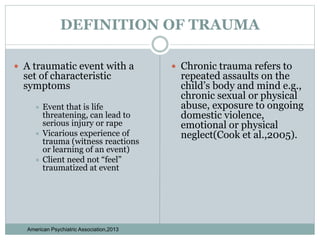
RELEVANCE
 There is an increasing body of
literature affirming that
trauma, including neglect, has a
significant impact on brain
development, particularly
during the sensitive periods,
such as infancy or
adolescence(Child Welfare
Information Gateway, 2011).
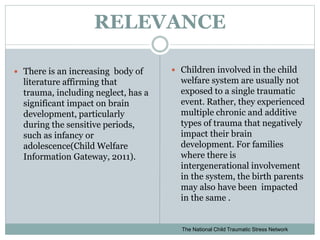
 Children involved in the child
welfare system are usually not
exposed to a single traumatic
event. Rather, they experienced
multiple chronic and additive
types of trauma that negatively
impact their brain
development. For families
where there is
intergenerational involvement
in the system, the birth parents
may also have been impacted
in the same .
The National Child Traumatic Stress Network
RELEVANCE
 Mismanagement of trauma reduces the likelihood of
reunification (Rubin, O’Reilly, Luan & Localio, 2007),
increases placement instability (Hartnett, Leathers, Falconnier &
Testa, 1999), results in the application of increasingly more
restrictive placements (Pecora et al., 2005), increases the
likelihood of administration of strong psychotropic medicines
(Raghavan et al., 2005), and increases the likelihood that the
child will carry on an intergenerational cycle of abuse or neglect
upon becoming a parent (Fang & Corso, 2007).
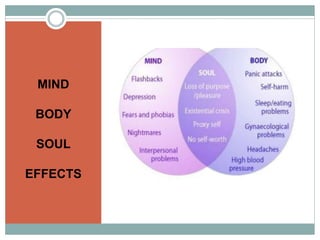
MIND
BODY
SOUL
EFFECTS
How Do Children Experience Trauma ?
 Children are at increase
vulnerability when compared to
adults for developing negative
outcomes after trauma.
 Separation and loss are not life
threatening but maybe
perceived as so to children
especially very young children.
 Child traumatic stress may
manifest in destructive and
maladaptive ways that can
impair their ability to self
regulate.
 Self regulation maybe
underdeveloped as a result the
child may have difficulty
controlling his/her emotions and
behaviors.
 A child is also affected by his/her
proximity to the event and the
event’s personal significance for
him/her.
 A child response to trauma are
shaped by the extent to which
his/her support system is
disrupted during or after the
trauma, which can often affect the
child’s reaction.
National Child Abuse and Neglect Database(NCANDS)
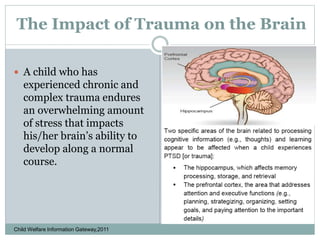
The Impact of Trauma on the Brain
 A child who has
experienced chronic and
complex trauma endures
an overwhelming amount
of stress that impacts
his/her brain’s ability to
develop along a normal
course.
Child Welfare Information Gateway,2011
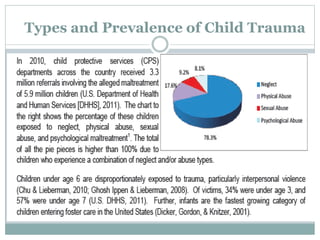
Types and Prevalence of Child Trauma
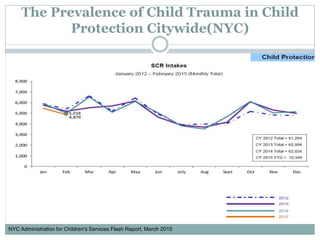
The Prevalence of Child Trauma in Child
Protection Citywide(NYC)
NYC Administration for Children's Services Flash Report, March 2015
Trauma and the Child Welfare System
 Children involved in the child welfare systems are particularly
vulnerable to traumatic events.
 Separation from a caregiver maybe considered a traumatic event for
younger children.
 For many individuals contact with the child welfare system may serve
as a trigger a traumatic event and bring back memories of prior
personal family experiences.
 Trauma also often results in ruptured relationships. Within child
welfare systems there are likely to be both ruptures and conflicts among
family members who are seeking to care for a child.
Child Welfare Information Gateway,2011
Theoretical Framework
 Adults play an important role in
children’s emotional development
and emotional regulation. One key
is the development of a trusting
relationship and secure attachment
(Frost,Wortham, & Reifel, 2008).
 Intergenerational transmission
theory postulates that being a
victim of physical abuse or
witnessing the abuse of the other
family members, teaches boys to
become violent. With continued
exposure to violence, learning
occurs through both observational
learning and positive
reinforcement in the form of
approval for violent behavior (Craig
& Sprang, 2007).
 Attachment is the most complex
and crucial emotional bond that
develops between the child and
caring adults during the early
years of life. Children take their
behavioral cues from caring
adults’ complementary and
responsive demeanors. These
strong, affectionate bonds then
become a secure base—an
emotional scheme or set of
expectations—that will
ultimately create the blueprint for
future relationships and social
competency (Tanyel,2009).
Theoretical Framework
 It is commonly believed that a
parent with history of
childhood maltreatment is at
risk of abusing and or
neglecting their own child
(ren). Consistent evidence has
been found for the
intergenerational transmission
of physical punishment based
on social learning models, even
after controlling for alternative
explanatory models
(Lunkenheimer, Kittler, Olson,
& Kleinberg, 2006).
 The first evidence for the
intergenerational transmission
of child abuse comes from case
histories of families in which
abuse has occurred in many
generations (Ertem, Leventhal, &
Dobbs, 2000). Traumatic
experiences are cumulative and
if one generation does not heal,
problems are transmitted to
subsequent generations.
 Enhance Family Well-
Being and Resilience
 Enhance the Well-Being
and Resilience of those
Working in the System
 Partner with Youth and
Families
Recommendations
 Maximize Physical and
Psychological Safety for
Children and Families
 Identify Trauma-Related
Needs of Children and
Families
 Enhance Child Well-Being
and Resilience
 Partner with Agencies and
Systems that Interact with
Children and Families
Proposal for the Department of Child Protection
 Continued encouragement of child protective staff to incorporate
trauma assessments when working with families(which is done when
we assess for well-being).
 Advocate for trauma informed services which may help with the
decrease of repeated maltreated cases.
 Learn about the service providers in the community that offer trauma
informed services and partner with them to help the families we service.
 Continued training of child protective team on trauma and how it affect
the children and families we work with.
References
 American Psychiatrist Association(APA).
(2013). Diagnostic and Statistical
manual of mental disorder.
Washington, DC.
 Cook, A., Spinazzola, J., Ford, J.,
Lanktree, C., Blaustein, M., Cloitre,
M., et al. (2005). Complex trauma in
children and adolescents.
Psychiatric Annals, 35(5), 390-398.
 Craig, C. D., & Sprang, G. (2007).
Trauma exposure and child abuse
potential: Investigating the Cycle
of Violence. American Journal of
Orthopsychiatry, 296-305.
 Ertem, I. O., Leventhal, J. M., & Dobbs,
S. (2000). Intergenerational
continuity of child physical abuse:
How good is the evidence? The
Lancet, 814-819.
 Fang, X., & Corso, P. S. (2007). Child
maltreatment, youth violence,
and intimate partner violence:
Developmental relationships.
American Journal of Preventive
Medicine, 33(4), 281-290.
 Frost, J. L., Wortham, S. C., & Reifel, S.
(2008). Play and child
development. Upper Saddle
River, NJ: Merrill Prentice Hall.
References
 Child Welfare Information Gateway.
(2011). Brain/cognitive
development. Retrieved from
http://www.childwelfare.gov/can/impact/develop
ment/brain.cfm
 Hartnett, M. A., Leathers, S., Falconnier,
L., & Testa, M. (1999). Placement
stability study. Urbana, IL: Children
and Family Research Center.
.
 Lunkenheimer, E. S., Kittler, J. E., Olson,
S. L., & Kleinberg, F. (2006).
The Intergenerational Transmission
of Physical Punishment: Differing
Mechanisms in Mothers' and
Fathers' Endorsement? Journal of
Family Violence, 509-519.
 NYC Administration for Children’s
Services. Flash Report , March
2015
 National Child Traumatic Stress
Network, Child Welfare
Committee(2011). Birth parents
with trauma histories and child
welfare system: A guide for child
welfare staff. Los Angeles and
Durham: National Center for Child
Traumatic Stress.
References
 Pecora , P. J., Kessler, R. C., Williams, J.,
O'Brien, K., Downs, A. C.,
English, D., et al. (2005).
Improving family foster care :
Findings from the
Northwest Foster Care Alumni
Study. Seattle: Casey Family
Programs.
 Raghavan, R., Zima, B. T., Anderson, R.
M., Leibowitz, A. A., Schuster, M.
A., & Landsverk, J. (2005).
Psychotropic medication use in a
national probability sample of
children in the child welfare system.
Journal of Child and Adolescent
Psychopharmacology, 15(1), 97-106.
 Rubin, D. M., O'Reilly, A. L., Luan, X.,
Localio, A. R. (2007). The impact
of placement stability on behavioral
well-being for children in foster
care. Pediatrics , 119(2), 336-344.
 Tanyel, N. E. (2009). Emotional
Regulation: Developing Toddlers'
Social Competence. Dimensions of
Early Childhood, 10-15.

Promoting a trauma informed lens

  • 1.
    Promoting a TraumaInformed Lens when Assessing the Well-Being of Children in the Child Welfare System Racquel Ellis Mental Health Counseling Intern Long Island University, Brooklyn Campus Manhattan/Staten Island Division of Child Protection May 1, 2015
  • 2.
    DEFINITION OF TRAUMA A traumatic event with a set of characteristic symptoms  Event that is life threatening, can lead to serious injury or rape  Vicarious experience of trauma (witness reactions or learning of an event)  Client need not “feel” traumatized at event  Chronic trauma refers to repeated assaults on the child’s body and mind e.g., chronic sexual or physical abuse, exposure to ongoing domestic violence, emotional or physical neglect(Cook et al.,2005). American Psychiatric Association,2013
  • 3.
    RELEVANCE  There isan increasing body of literature affirming that trauma, including neglect, has a significant impact on brain development, particularly during the sensitive periods, such as infancy or adolescence(Child Welfare Information Gateway, 2011).  Children involved in the child welfare system are usually not exposed to a single traumatic event. Rather, they experienced multiple chronic and additive types of trauma that negatively impact their brain development. For families where there is intergenerational involvement in the system, the birth parents may also have been impacted in the same . The National Child Traumatic Stress Network
  • 4.
    RELEVANCE  Mismanagement oftrauma reduces the likelihood of reunification (Rubin, O’Reilly, Luan & Localio, 2007), increases placement instability (Hartnett, Leathers, Falconnier & Testa, 1999), results in the application of increasingly more restrictive placements (Pecora et al., 2005), increases the likelihood of administration of strong psychotropic medicines (Raghavan et al., 2005), and increases the likelihood that the child will carry on an intergenerational cycle of abuse or neglect upon becoming a parent (Fang & Corso, 2007).
  • 5.
  • 6.
    How Do ChildrenExperience Trauma ?  Children are at increase vulnerability when compared to adults for developing negative outcomes after trauma.  Separation and loss are not life threatening but maybe perceived as so to children especially very young children.  Child traumatic stress may manifest in destructive and maladaptive ways that can impair their ability to self regulate.  Self regulation maybe underdeveloped as a result the child may have difficulty controlling his/her emotions and behaviors.  A child is also affected by his/her proximity to the event and the event’s personal significance for him/her.  A child response to trauma are shaped by the extent to which his/her support system is disrupted during or after the trauma, which can often affect the child’s reaction. National Child Abuse and Neglect Database(NCANDS)
  • 7.
    The Impact ofTrauma on the Brain  A child who has experienced chronic and complex trauma endures an overwhelming amount of stress that impacts his/her brain’s ability to develop along a normal course. Child Welfare Information Gateway,2011
  • 8.
    Types and Prevalenceof Child Trauma
  • 9.
    The Prevalence ofChild Trauma in Child Protection Citywide(NYC) NYC Administration for Children's Services Flash Report, March 2015
  • 10.
    Trauma and theChild Welfare System  Children involved in the child welfare systems are particularly vulnerable to traumatic events.  Separation from a caregiver maybe considered a traumatic event for younger children.  For many individuals contact with the child welfare system may serve as a trigger a traumatic event and bring back memories of prior personal family experiences.  Trauma also often results in ruptured relationships. Within child welfare systems there are likely to be both ruptures and conflicts among family members who are seeking to care for a child. Child Welfare Information Gateway,2011
  • 11.
    Theoretical Framework  Adultsplay an important role in children’s emotional development and emotional regulation. One key is the development of a trusting relationship and secure attachment (Frost,Wortham, & Reifel, 2008).  Intergenerational transmission theory postulates that being a victim of physical abuse or witnessing the abuse of the other family members, teaches boys to become violent. With continued exposure to violence, learning occurs through both observational learning and positive reinforcement in the form of approval for violent behavior (Craig & Sprang, 2007).  Attachment is the most complex and crucial emotional bond that develops between the child and caring adults during the early years of life. Children take their behavioral cues from caring adults’ complementary and responsive demeanors. These strong, affectionate bonds then become a secure base—an emotional scheme or set of expectations—that will ultimately create the blueprint for future relationships and social competency (Tanyel,2009).
  • 12.
    Theoretical Framework  Itis commonly believed that a parent with history of childhood maltreatment is at risk of abusing and or neglecting their own child (ren). Consistent evidence has been found for the intergenerational transmission of physical punishment based on social learning models, even after controlling for alternative explanatory models (Lunkenheimer, Kittler, Olson, & Kleinberg, 2006).  The first evidence for the intergenerational transmission of child abuse comes from case histories of families in which abuse has occurred in many generations (Ertem, Leventhal, & Dobbs, 2000). Traumatic experiences are cumulative and if one generation does not heal, problems are transmitted to subsequent generations.
  • 13.
     Enhance FamilyWell- Being and Resilience  Enhance the Well-Being and Resilience of those Working in the System  Partner with Youth and Families Recommendations  Maximize Physical and Psychological Safety for Children and Families  Identify Trauma-Related Needs of Children and Families  Enhance Child Well-Being and Resilience  Partner with Agencies and Systems that Interact with Children and Families
  • 14.
    Proposal for theDepartment of Child Protection  Continued encouragement of child protective staff to incorporate trauma assessments when working with families(which is done when we assess for well-being).  Advocate for trauma informed services which may help with the decrease of repeated maltreated cases.  Learn about the service providers in the community that offer trauma informed services and partner with them to help the families we service.  Continued training of child protective team on trauma and how it affect the children and families we work with.
  • 15.
    References  American PsychiatristAssociation(APA). (2013). Diagnostic and Statistical manual of mental disorder. Washington, DC.  Cook, A., Spinazzola, J., Ford, J., Lanktree, C., Blaustein, M., Cloitre, M., et al. (2005). Complex trauma in children and adolescents. Psychiatric Annals, 35(5), 390-398.  Craig, C. D., & Sprang, G. (2007). Trauma exposure and child abuse potential: Investigating the Cycle of Violence. American Journal of Orthopsychiatry, 296-305.  Ertem, I. O., Leventhal, J. M., & Dobbs, S. (2000). Intergenerational continuity of child physical abuse: How good is the evidence? The Lancet, 814-819.  Fang, X., & Corso, P. S. (2007). Child maltreatment, youth violence, and intimate partner violence: Developmental relationships. American Journal of Preventive Medicine, 33(4), 281-290.  Frost, J. L., Wortham, S. C., & Reifel, S. (2008). Play and child development. Upper Saddle River, NJ: Merrill Prentice Hall.
  • 16.
    References  Child WelfareInformation Gateway. (2011). Brain/cognitive development. Retrieved from http://www.childwelfare.gov/can/impact/develop ment/brain.cfm  Hartnett, M. A., Leathers, S., Falconnier, L., & Testa, M. (1999). Placement stability study. Urbana, IL: Children and Family Research Center. .  Lunkenheimer, E. S., Kittler, J. E., Olson, S. L., & Kleinberg, F. (2006). The Intergenerational Transmission of Physical Punishment: Differing Mechanisms in Mothers' and Fathers' Endorsement? Journal of Family Violence, 509-519.  NYC Administration for Children’s Services. Flash Report , March 2015  National Child Traumatic Stress Network, Child Welfare Committee(2011). Birth parents with trauma histories and child welfare system: A guide for child welfare staff. Los Angeles and Durham: National Center for Child Traumatic Stress.
  • 17.
    References  Pecora ,P. J., Kessler, R. C., Williams, J., O'Brien, K., Downs, A. C., English, D., et al. (2005). Improving family foster care : Findings from the Northwest Foster Care Alumni Study. Seattle: Casey Family Programs.  Raghavan, R., Zima, B. T., Anderson, R. M., Leibowitz, A. A., Schuster, M. A., & Landsverk, J. (2005). Psychotropic medication use in a national probability sample of children in the child welfare system. Journal of Child and Adolescent Psychopharmacology, 15(1), 97-106.  Rubin, D. M., O'Reilly, A. L., Luan, X., Localio, A. R. (2007). The impact of placement stability on behavioral well-being for children in foster care. Pediatrics , 119(2), 336-344.  Tanyel, N. E. (2009). Emotional Regulation: Developing Toddlers' Social Competence. Dimensions of Early Childhood, 10-15.