Trauma: Triage,
Resuscitation and
Monitoring
Dr. P. M. Mshelbwala,
Department of Surgery,
College of Health Sciences,
University of Abuja
Trauma
• One of the leading cause of disability & death
– 3rd most common cause of death worldwide
– More than 5 million deaths annually
– 12% of world burden of disease
– Considered a major public health issue
• The study of medical problems associated
with physical injury i.e. adverse effect of
physical force
Dr. P. M. Mshelbwala 2
Trauma
• Has a very wide spectrum
– from minor injuries to life & limb threatening
injuries
• Severity of injury and time of intervention are
key in determining outcome
• A systematic method of assessment and
intervention is necessary
Dr. P. M. Mshelbwala 3
Trimodal Death Distribution
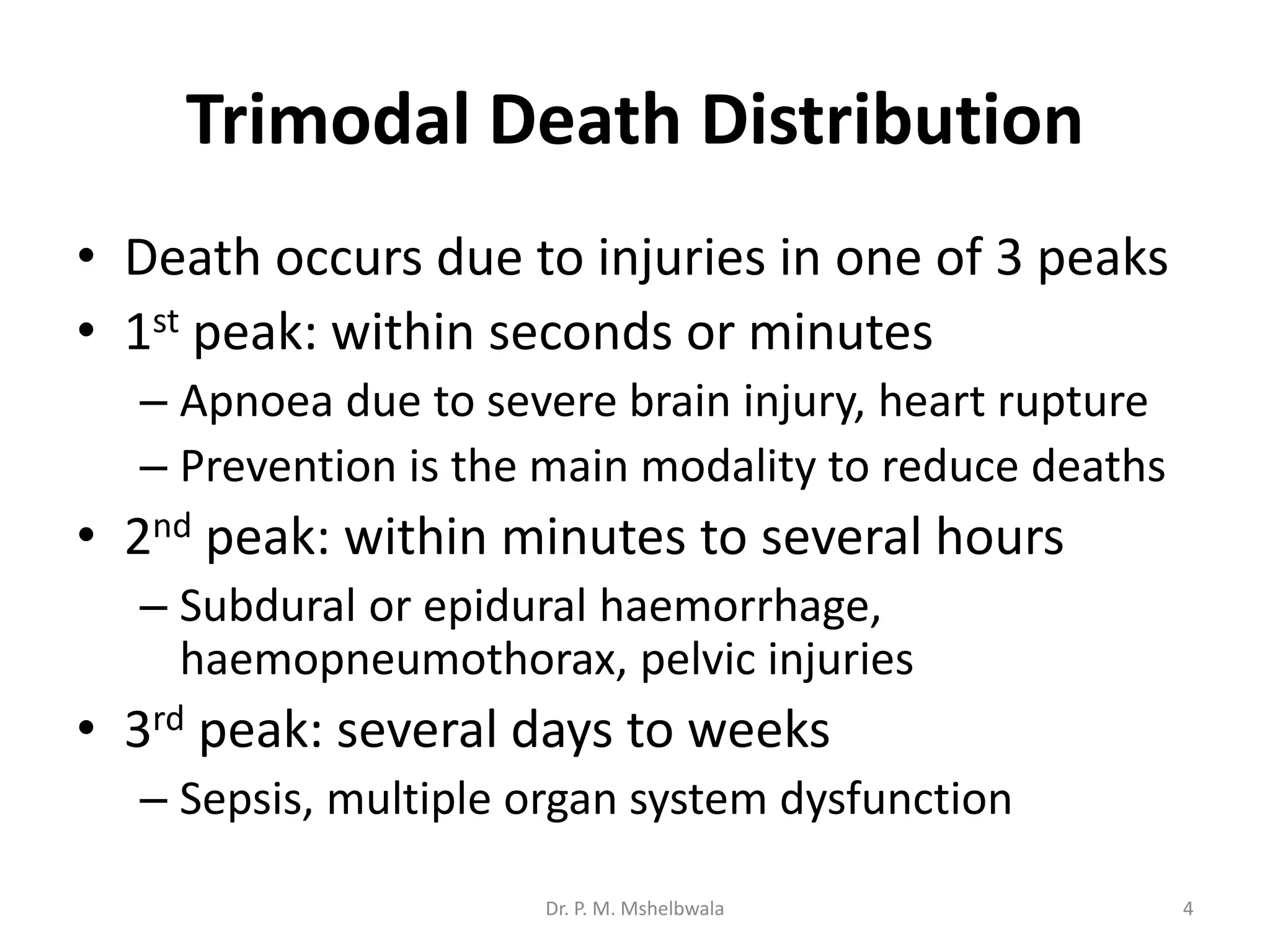
• Death occurs due to injuries in one of 3 peaks
• 1st peak: within seconds or minutes
– Apnoea due to severe brain injury, heart rupture
– Prevention is the main modality to reduce deaths
• 2nd peak: within minutes to several hours
– Subdural or epidural haemorrhage,
haemopneumothorax, pelvic injuries
• 3rd peak: several days to weeks
– Sepsis, multiple organ system dysfunction
Dr. P. M. Mshelbwala 4
Triage
• French word ‘triager’ – to sort
• Objective method of assessing patients
• Applied at site of injury field
– i.e. pre-hospital care
– Stay & play or scoop & run
• Applied in hospital
– On arrival at A&E
– In radiology department
– Operating theatre
Dr. P. M. Mshelbwala 5
Triage
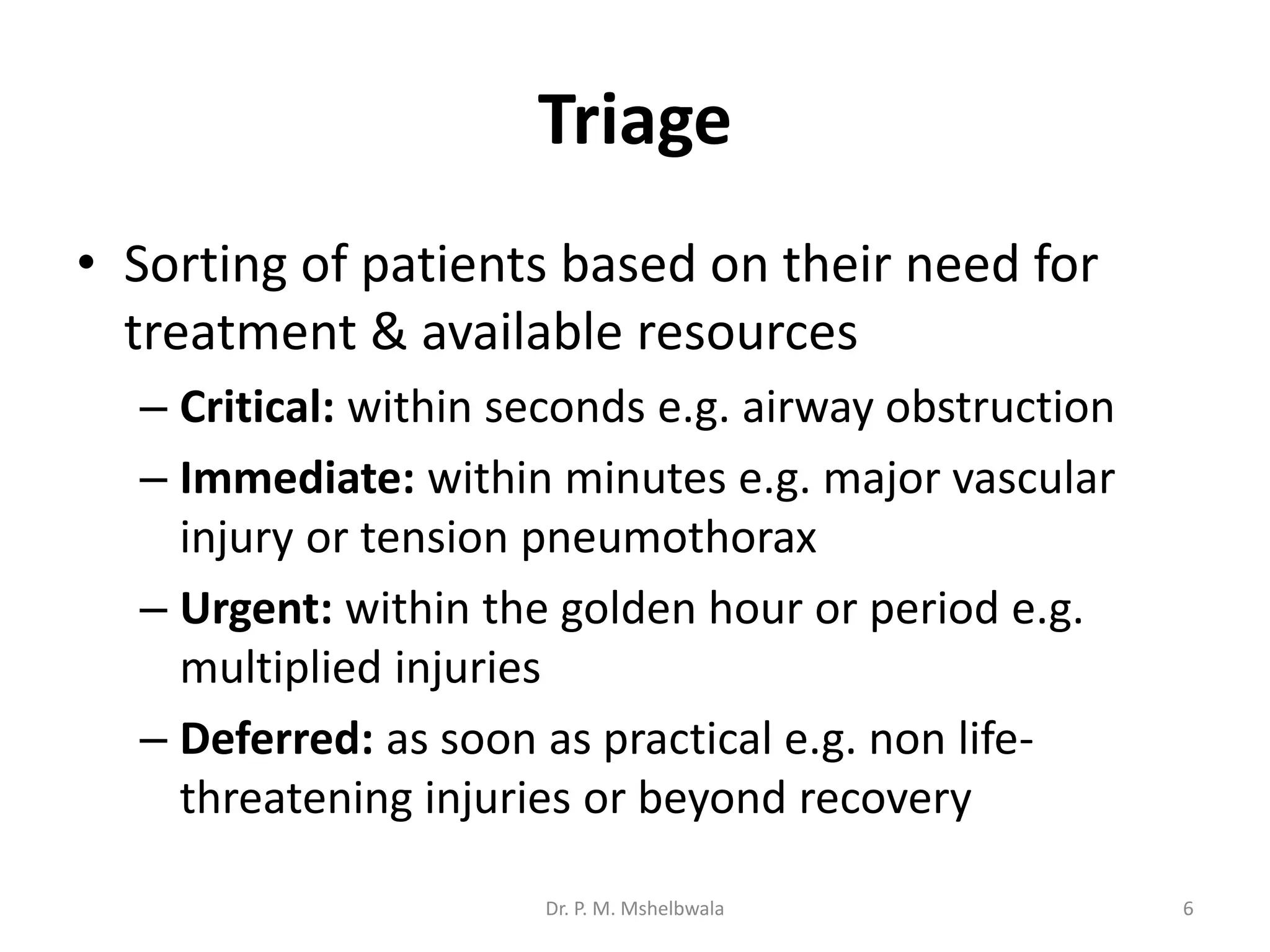
• Sorting of patients based on their need for
treatment & available resources
– Critical: within seconds e.g. airway obstruction
– Immediate: within minutes e.g. major vascular
injury or tension pneumothorax
– Urgent: within the golden hour or period e.g.
multiplied injuries
– Deferred: as soon as practical e.g. non life-
threatening injuries or beyond recovery
Dr. P. M. Mshelbwala 6
Assessment of the Trauma Patient
Primary Survey
A, B, C, D, E
Dr. P. M. Mshelbwala 7
Assessment of the Trauma Patient
• A: airway with cervical spine protection
• B: breathing & ventilation
• C: circulation & haemorrhage control
• D: disability (neurologic evaluation)
• E: exposure/environmental control
– Based upon the Advanced Trauma Life Support
(ATLS) system developed in the USA
Dr. P. M. Mshelbwala 8
Airway Maintenance with Cervical
Spine Protection
• Assess airway for patency
– Look for foreign bodies, facial & mandibular
fractures, dentures etc
– If patient can communicate verbally, the airway is
likely to be patent
– Do chin-lift or jaw thrust maneuver, don’t
hyperextend, rotate nor hyperflex neck
• Use cervical collar until cervical injury is
excluded
Dr. P. M. Mshelbwala 9
Breathing & Ventilation
• If airway is patent, ensure breathing or assist
ventilation for adequate gas exchange
– Ambu bag
– ? Mouth to mouth resuscitation
• Expose chest to assess chest wall excursion
• Look out for tension pneumothorax
Dr. P. M. Mshelbwala 10
Circulation with Control of
Haemorrhage
• Consider
– Blood volume
– Cardiac output
– Bleeding
• Assess
– Level of consciousness
– Skin colour
– Pulse
– External haemorrhage
Dr. P. M. Mshelbwala 11
Disability (Neurologic Evaluation)
• Perform at the end of primary survey
• Assess
– Level of consciousness
• Use Glasgow Coma Scale (GCS)
– Pupillary size & reaction
– Lateralizing signs
– Spinal cord injury level
Dr. P. M. Mshelbwala 12
Exposure/Environmental Control
• Adequately undress the patient
– Cutting off garments & clothes may be best
• Ensure warmth
– Cover patient with blankets
– Use external warming devices
– Warm all fluids to be infused
Dr. P. M. Mshelbwala 13
Resuscitation
• Airway
– Protect at all times with chin-lift or jaw-thrust
– Intubate if necessary
• Breathing
– Provide oxygen by mask-reservoir device to maintain
oxygenation
• Circulation
– Ensure 2 wide bore IV lines, infuse fluids in bolus,
obtain blood for transfusion
– Avoid hypothermia
Dr. P. M. Mshelbwala 14
Monitoring
• Electrocardiographic monitoring
• Urinary catheters
• Nasogastric tubes
• Arterial blood gases levels
• Pulse oximetry
• X-ray, ultrasound scan other diagnostic studies
Dr. P. M. Mshelbwala 15
Secondary Survey
• Performed after primary survey (ABCDE) is
completed and resuscitation is underway
• Complete History – iSAMPLE
Dr. P. M. Mshelbwala 16
iSAMPLE
• i – Immunization or Tetanus Status
• S – Social History. Available social support
• A- Allergies
• M- Medications patient is currently on
• P – Past medical illness
• L – Last meal
• E – Events related to the injury
Dr. P. M. Mshelbwala 17
Secondary Survey
• Head-to-toe evaluation of the trauma patient
• Physical examination
• Look out for missed injuries
• Reassessment of all vital signs
• Continue monitoring
Dr. P. M. Mshelbwala 18
Adjuncts to Secondary Survey
• Reevaluate the patient
• Decide definitive care
• Keep records for medico-legal purposes
• Prevention of trauma is the best ‘treatment’
Dr. P. M. Mshelbwala 19
Conclusion
• Trauma is a leading cause of death
• It is a global health issue
• Timely & systematic intervention improves
outcome
• Preventive measures are the best ‘treatment’
Dr. P. M. Mshelbwala 20
References
• Bailey & Love’s Short Practice of Surgery. 25th
edition
• WHO Guidelines for Essential trauma care
• Advanced Trauma Life Support for Doctors. 8th
edition
Dr. P. M. Mshelbwala 21

TRIAGE: Trauma: Triage ,Resuscitation and Monitoring

  • 1.
    Trauma: Triage, Resuscitation and Monitoring Dr.P. M. Mshelbwala, Department of Surgery, College of Health Sciences, University of Abuja
  • 2.
    Trauma • One ofthe leading cause of disability & death – 3rd most common cause of death worldwide – More than 5 million deaths annually – 12% of world burden of disease – Considered a major public health issue • The study of medical problems associated with physical injury i.e. adverse effect of physical force Dr. P. M. Mshelbwala 2
  • 3.
    Trauma • Has avery wide spectrum – from minor injuries to life & limb threatening injuries • Severity of injury and time of intervention are key in determining outcome • A systematic method of assessment and intervention is necessary Dr. P. M. Mshelbwala 3
  • 4.
    Trimodal Death Distribution •Death occurs due to injuries in one of 3 peaks • 1st peak: within seconds or minutes – Apnoea due to severe brain injury, heart rupture – Prevention is the main modality to reduce deaths • 2nd peak: within minutes to several hours – Subdural or epidural haemorrhage, haemopneumothorax, pelvic injuries • 3rd peak: several days to weeks – Sepsis, multiple organ system dysfunction Dr. P. M. Mshelbwala 4
  • 5.
    Triage • French word‘triager’ – to sort • Objective method of assessing patients • Applied at site of injury field – i.e. pre-hospital care – Stay & play or scoop & run • Applied in hospital – On arrival at A&E – In radiology department – Operating theatre Dr. P. M. Mshelbwala 5
  • 6.
    Triage • Sorting ofpatients based on their need for treatment & available resources – Critical: within seconds e.g. airway obstruction – Immediate: within minutes e.g. major vascular injury or tension pneumothorax – Urgent: within the golden hour or period e.g. multiplied injuries – Deferred: as soon as practical e.g. non life- threatening injuries or beyond recovery Dr. P. M. Mshelbwala 6
  • 7.
    Assessment of theTrauma Patient Primary Survey A, B, C, D, E Dr. P. M. Mshelbwala 7
  • 8.
    Assessment of theTrauma Patient • A: airway with cervical spine protection • B: breathing & ventilation • C: circulation & haemorrhage control • D: disability (neurologic evaluation) • E: exposure/environmental control – Based upon the Advanced Trauma Life Support (ATLS) system developed in the USA Dr. P. M. Mshelbwala 8
  • 9.
    Airway Maintenance withCervical Spine Protection • Assess airway for patency – Look for foreign bodies, facial & mandibular fractures, dentures etc – If patient can communicate verbally, the airway is likely to be patent – Do chin-lift or jaw thrust maneuver, don’t hyperextend, rotate nor hyperflex neck • Use cervical collar until cervical injury is excluded Dr. P. M. Mshelbwala 9
  • 10.
    Breathing & Ventilation •If airway is patent, ensure breathing or assist ventilation for adequate gas exchange – Ambu bag – ? Mouth to mouth resuscitation • Expose chest to assess chest wall excursion • Look out for tension pneumothorax Dr. P. M. Mshelbwala 10
  • 11.
    Circulation with Controlof Haemorrhage • Consider – Blood volume – Cardiac output – Bleeding • Assess – Level of consciousness – Skin colour – Pulse – External haemorrhage Dr. P. M. Mshelbwala 11
  • 12.
    Disability (Neurologic Evaluation) •Perform at the end of primary survey • Assess – Level of consciousness • Use Glasgow Coma Scale (GCS) – Pupillary size & reaction – Lateralizing signs – Spinal cord injury level Dr. P. M. Mshelbwala 12
  • 13.
    Exposure/Environmental Control • Adequatelyundress the patient – Cutting off garments & clothes may be best • Ensure warmth – Cover patient with blankets – Use external warming devices – Warm all fluids to be infused Dr. P. M. Mshelbwala 13
  • 14.
    Resuscitation • Airway – Protectat all times with chin-lift or jaw-thrust – Intubate if necessary • Breathing – Provide oxygen by mask-reservoir device to maintain oxygenation • Circulation – Ensure 2 wide bore IV lines, infuse fluids in bolus, obtain blood for transfusion – Avoid hypothermia Dr. P. M. Mshelbwala 14
  • 15.
    Monitoring • Electrocardiographic monitoring •Urinary catheters • Nasogastric tubes • Arterial blood gases levels • Pulse oximetry • X-ray, ultrasound scan other diagnostic studies Dr. P. M. Mshelbwala 15
  • 16.
    Secondary Survey • Performedafter primary survey (ABCDE) is completed and resuscitation is underway • Complete History – iSAMPLE Dr. P. M. Mshelbwala 16
  • 17.
    iSAMPLE • i –Immunization or Tetanus Status • S – Social History. Available social support • A- Allergies • M- Medications patient is currently on • P – Past medical illness • L – Last meal • E – Events related to the injury Dr. P. M. Mshelbwala 17
  • 18.
    Secondary Survey • Head-to-toeevaluation of the trauma patient • Physical examination • Look out for missed injuries • Reassessment of all vital signs • Continue monitoring Dr. P. M. Mshelbwala 18
  • 19.
    Adjuncts to SecondarySurvey • Reevaluate the patient • Decide definitive care • Keep records for medico-legal purposes • Prevention of trauma is the best ‘treatment’ Dr. P. M. Mshelbwala 19
  • 20.
    Conclusion • Trauma isa leading cause of death • It is a global health issue • Timely & systematic intervention improves outcome • Preventive measures are the best ‘treatment’ Dr. P. M. Mshelbwala 20
  • 21.
    References • Bailey &Love’s Short Practice of Surgery. 25th edition • WHO Guidelines for Essential trauma care • Advanced Trauma Life Support for Doctors. 8th edition Dr. P. M. Mshelbwala 21