Problem domain models
Design for the unexpected
How to implement it in practice – 1
Paul Valckenaers
Objective
• Introduce problem domain models as
a source of stability and invariance,
especially when the unexpected happens
• Prepare the audience for the next presentation:
Problem domain models as a source of coherence
and consistency
Problem domain stability
It takes time, effort, resources, … (¿miracles?) to change reality
Hence, when designing/implementing ICT infrastructure/systems,
the problem domain is unlikely to change often, profoundly or fast.
• E.g. in the human resource management (HRM) domain
• Personnel will be hired
• Personnel will be promoted
• Personnel will retire, resign or be fired
• …
Today, tomorrow, next year, in the next decade…
User requirements’ instability
• User requirements are uncertain and prone to change:
• When customers start to use a system, they immediately
see what should be different, what can be improved, …
• When the fulfilling of user requirements affects competitiveness,
these requirements become a moving target.
• The (wo)man-invented world around us changes all the time (e.g. regulations).
• For instance:
• The human resources department (HR) may change its
reporting requirements every week, based on what
matter needs to be addressed (urgently).
• When the organization will be audited, tries to qualify for
some certification, needs to comply with new requirements
from a major customer, … the IT systems need adjustments.
Problem domain models
The inherent stability of the problem domain can be exploited by
the use of a problem domain model within the overall IT system.
To inherit the stability, the problem domain model must not include
properties, features, functionalities, limitations, etc. that are absent
in the corresponding reality. This can be tricky/subtle.
The use of a problem domain model as a separate and explicit part
of the overall IT system is feasible and economical almost everywhere.
Exceptions are niches (e.g. space, high-speed telecom) that need to
pre-process/compile/… domain-related information for computational
efficiency reasons (i.e. extremely high speed or low energy consumption).
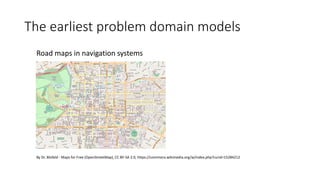
The earliest problem domain models
Road maps in navigation systems
By Dr. Blofeld - Maps for Free (OpenStreetMap), CC BY-SA 2.0, https://commons.wikimedia.org/w/index.php?curid=15284212
With problem domain models
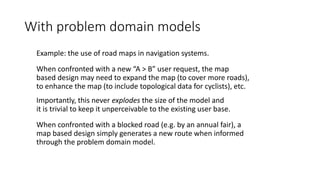
Example: the use of road maps in navigation systems.
When confronted with a new “A > B” user request, the map
based design may need to expand the map (to cover more roads),
to enhance the map (to include topological data for cyclists), etc.
Importantly, this never explodes the size of the model and
it is trivial to keep it unperceivable to the existing user base.
When confronted with a blocked road (e.g. by an annual fair), a
map based design simply generates a new route when informed
through the problem domain model.
Without problem domain models
Alternative design without an explicit problem domain model:
a route descriptions database replaces the road maps.
When confronted with a new A > B user request, it needs to be
added to the database (will explode!). When generating routes by
combining existing routes, inefficiencies are likely (unless primitive
route descriptions become so small, the database becomes a map).
When a road is closed indefinitely, blocked temporarily, or becomes
one-way, route descriptions become invalid (they break).
When an application wants to look for parking space, … the
database is ill-suited to contribute, etc.
Without problem domain models
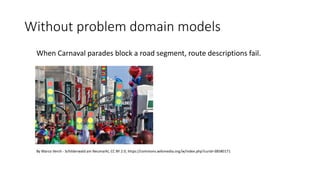
When Carnaval parades block a road segment, route descriptions fail.
By Marco Verch - Schilderwald am Neumarkt, CC BY 2.0, https://commons.wikimedia.org/w/index.php?curid=38580171
Discussion
Why is the potential of explicit problem domain models
so unknown and underutilized except for road maps, … ?
• It is not easy to withstand the pressure from the user
to deliver the required functionality ASAP.
• It is easy to introduce limitations in the problem domain
model that annihilate its benefits.
• …
The forthcoming presentations will cover this extensively,
shedding light on what it takes to design problem domain
models that preserve its stability benefit and (much) more.

D4U presentation 1 - problem domain models

  • 1.
    Problem domain models Designfor the unexpected How to implement it in practice – 1 Paul Valckenaers
  • 2.
    Objective • Introduce problemdomain models as a source of stability and invariance, especially when the unexpected happens • Prepare the audience for the next presentation: Problem domain models as a source of coherence and consistency
  • 3.
    Problem domain stability Ittakes time, effort, resources, … (¿miracles?) to change reality Hence, when designing/implementing ICT infrastructure/systems, the problem domain is unlikely to change often, profoundly or fast. • E.g. in the human resource management (HRM) domain • Personnel will be hired • Personnel will be promoted • Personnel will retire, resign or be fired • … Today, tomorrow, next year, in the next decade…
  • 4.
    User requirements’ instability •User requirements are uncertain and prone to change: • When customers start to use a system, they immediately see what should be different, what can be improved, … • When the fulfilling of user requirements affects competitiveness, these requirements become a moving target. • The (wo)man-invented world around us changes all the time (e.g. regulations). • For instance: • The human resources department (HR) may change its reporting requirements every week, based on what matter needs to be addressed (urgently). • When the organization will be audited, tries to qualify for some certification, needs to comply with new requirements from a major customer, … the IT systems need adjustments.
  • 5.
    Problem domain models Theinherent stability of the problem domain can be exploited by the use of a problem domain model within the overall IT system. To inherit the stability, the problem domain model must not include properties, features, functionalities, limitations, etc. that are absent in the corresponding reality. This can be tricky/subtle. The use of a problem domain model as a separate and explicit part of the overall IT system is feasible and economical almost everywhere. Exceptions are niches (e.g. space, high-speed telecom) that need to pre-process/compile/… domain-related information for computational efficiency reasons (i.e. extremely high speed or low energy consumption).
  • 6.
    The earliest problemdomain models Road maps in navigation systems By Dr. Blofeld - Maps for Free (OpenStreetMap), CC BY-SA 2.0, https://commons.wikimedia.org/w/index.php?curid=15284212
  • 7.
    With problem domainmodels Example: the use of road maps in navigation systems. When confronted with a new “A > B” user request, the map based design may need to expand the map (to cover more roads), to enhance the map (to include topological data for cyclists), etc. Importantly, this never explodes the size of the model and it is trivial to keep it unperceivable to the existing user base. When confronted with a blocked road (e.g. by an annual fair), a map based design simply generates a new route when informed through the problem domain model.
  • 8.
    Without problem domainmodels Alternative design without an explicit problem domain model: a route descriptions database replaces the road maps. When confronted with a new A > B user request, it needs to be added to the database (will explode!). When generating routes by combining existing routes, inefficiencies are likely (unless primitive route descriptions become so small, the database becomes a map). When a road is closed indefinitely, blocked temporarily, or becomes one-way, route descriptions become invalid (they break). When an application wants to look for parking space, … the database is ill-suited to contribute, etc.
  • 9.
    Without problem domainmodels When Carnaval parades block a road segment, route descriptions fail. By Marco Verch - Schilderwald am Neumarkt, CC BY 2.0, https://commons.wikimedia.org/w/index.php?curid=38580171
  • 10.
    Discussion Why is thepotential of explicit problem domain models so unknown and underutilized except for road maps, … ? • It is not easy to withstand the pressure from the user to deliver the required functionality ASAP. • It is easy to introduce limitations in the problem domain model that annihilate its benefits. • … The forthcoming presentations will cover this extensively, shedding light on what it takes to design problem domain models that preserve its stability benefit and (much) more.