jserra@microsoft.com
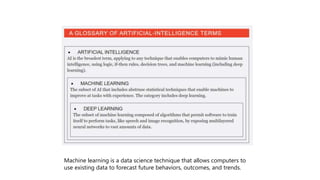
Machine learning is a data science technique that allows computers to
use existing data to forecast future behaviors, outcomes, and trends.
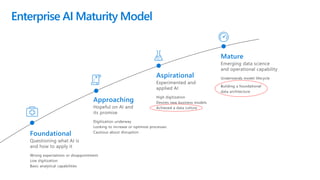
Enterprise AI Maturity Model
Foundational
Wrong expectations or disappointment
Low digitization
Basic analytical capabilities
Questioning what AI is
and how to apply it
Approaching
Digitization underway
Looking to increase or optimize processes
Cautious about disruption
Hopeful on AI and
its promise
Aspirational
High digitization
Desires new business models
Achieved a data culture
Experimented and
applied AI
Mature
Understands model lifecycle
Building a foundational
data architecture
Emerging data science
and operational capability
© Microsoft Corporation
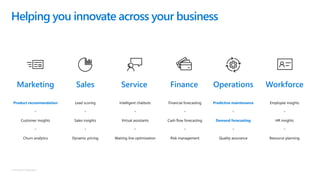
Helping you innovate across your business
Customer insights Sales insights Virtual assistants Cash flow forecasting HR insights
Churn analytics Dynamic pricing Waiting line optimization Risk management Quality assurance Resource planning
Lead scoring Intelligent chatbots Financial forecasting Employee insights
Marketing Sales Service Finance Operations Workforce
Product recommendationProduct recommendation Predictive maintenancePredictive maintenance
Demand forecastingDemand forecasting
© Microsoft Corporation
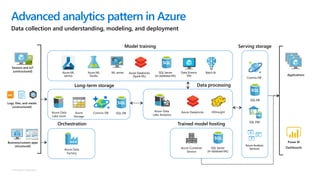
Advanced analytics pattern in Azure
Azure Data
Lake store
Azure
Storage
HDInsightAzure Databricks
Azure ML
service
ML server
Model training
Long-term storage Data processing
Azure Data
Lake Analytics
Azure ML
Studio
SQL Server
(in-database ML)
Azure Databricks
(Spark ML)
Data Science
VM
Cosmos DB
Serving storage
SQL DB
SQL DW
Azure Analysis
Services
Cosmos DB
Batch AI
SQL DB
Azure Data
Factory
Orchestration
Azure Container
Service
Trained model hosting
SQL Server
(in-database ML)
Data collection and understanding, modeling, and deployment
Sensors and IoT
(unstructured)
Logs, files, and media
(unstructured)
Business/custom apps
(structured)
Applications
Dashboards
Power BI
Azure Machine Learning Studio
© Microsoft Corporation
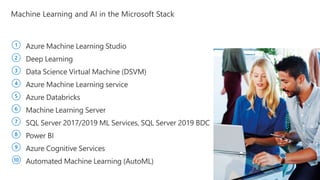
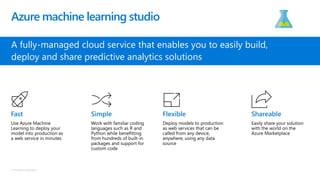
Azure machine learning studio
Use Azure Machine
Learning to deploy your
model into production as
a web service in minutes
Work with familiar coding
languages such as R and
Python while benefitting
from hundreds of built-in
packages and support for
custom code
Deploy models to production
as web services that can be
called from any device,
anywhere, using any data
source
Easily share your solution
with the world on the
Azure Marketplace
A fully-managed cloud service that enables you to easily build,
deploy and share predictive analytics solutions
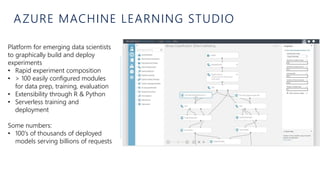
AZURE MACHINE LEARNING STUDIO
Platform for emerging data scientists
to graphically build and deploy
experiments
• Rapid experiment composition
• > 100 easily configured modules
for data prep, training, evaluation
• Extensibility through R & Python
• Serverless training and
deployment
Some numbers:
• 100’s of thousands of deployed
models serving billions of requests
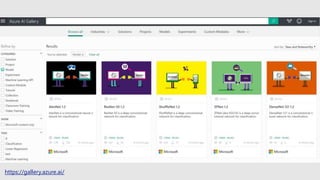
https://gallery.azure.ai/
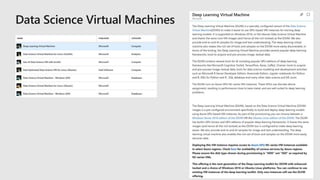
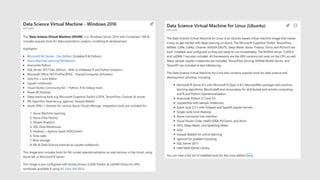
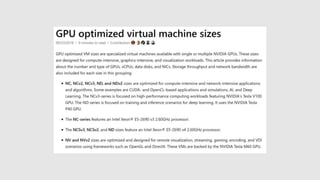
Data Science Virtual Machines (DSVM)
Data Science Virtual Machines
Azure Machine Learning service
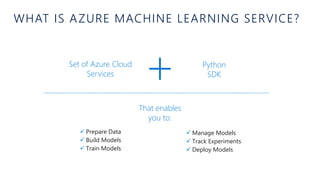
WHAT IS AZURE MACHINE LEARNING SERVICE?
Set of Azure Cloud
Services
Python
SDK
 Prepare Data
 Build Models
 Train Models
 Manage Models
 Track Experiments
 Deploy Models
That enables
you to:
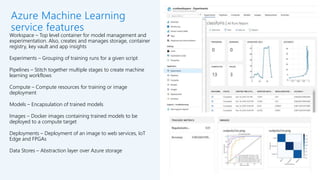
Workspace – Top level container for model management and
experimentation. Also, creates and manages storage, container
registry, key vault and app insights
Experiments – Grouping of training runs for a given script
Pipelines – Stitch together multiple stages to create machine
learning workflows
Compute – Compute resources for training or image
deployment
Models – Encapsulation of trained models
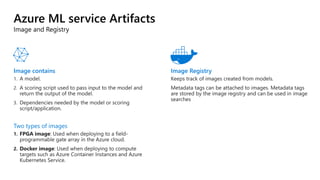
Images – Docker images containing trained models to be
deployed to a compute target
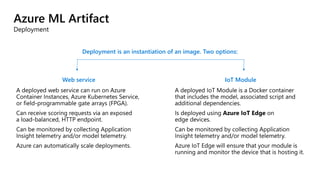
Deployments – Deployment of an image to web services, IoT
Edge and FPGAs
Data Stores – Abstraction layer over Azure storage
Azure Machine Learning
service features
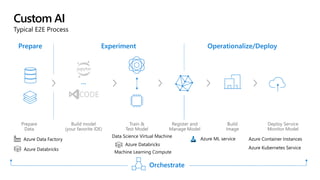
Custom AI
Typical E2E Process
…
Prepare Experiment Operationalize/Deploy
Orchestrate
Azure Databricks
Machine Learning Compute
Data Science Virtual Machine
Azure ML service Azure Container Instances
Azure Kubernetes ServiceAzure Databricks
Azure Data Factory
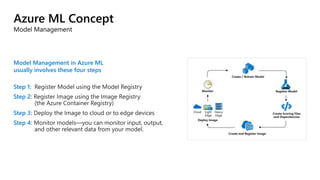
Azure ML Concept
Model Management
Model Management in Azure ML
usually involves these four steps
Step 1:
Step 2:
Step 3:
Step 4:
Azure ML Artifact
Compute Target
Compute Target Training Deployment
Local Computer ✓
A Linux VM in Azure (such as the Data
Science Virtual Machine)
✓
Azure ML Compute ✓
Azure Databricks ✓
Azure Data Lake Analytics ✓
Apache Spark for HDInsight ✓
Azure Container Instance ✓
Azure Kubernetes Service ✓
Azure IoT Edge ✓
Field-programmable gate array (FPGA) ✓
Currently supported compute targets
Azure ML service Artifacts
Image and Registry
Image contains
Two types of images
Image Registry
Azure ML Artifact
Deployment
Deployment is an instantiation of an image. Two options:
Web service IoT Module
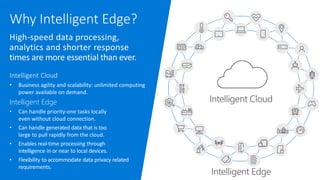
Why Intelligent Edge?
High-speed data processing,
analytics and shorter response
times are more essential than ever.
Intelligent Cloud
• Business agility and scalability: unlimited computing
power available on demand.
Intelligent Edge
• Can handle priority-one tasks locally
even without cloud connection.
• Can handle generated data that is too
large to pull rapidly from the cloud.
• Enables real-time processing through
intelligence in or near to local devices.
• Flexibility to accommodate data privacy related
requirements.
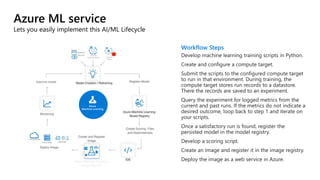
Azure ML service
Lets you easily implement this AI/ML Lifecycle
Azure
Machine Learning
Workflow Steps
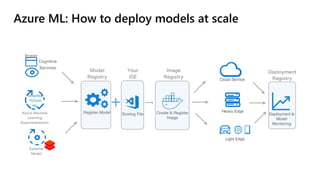
Azure ML: How to deploy models at scale
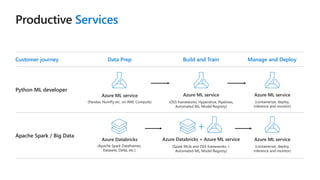
Services
+
Customer journey Data Prep Build and Train Manage and Deploy
Apache Spark / Big Data
Python ML developer
Azure ML service
(Pandas, NumPy etc. on AML Compute)
Azure ML service
(OSS frameworks, Hyperdrive, Pipelines,
Automated ML, Model Registry)
Azure ML service
(containerize, deploy,
inference and monitor)
Azure ML service
(containerize, deploy,
inference and monitor)
Azure Databricks
(Apache Spark Dataframes,
Datasets, Delta, etc.)
Azure Databricks + Azure ML service
(Spark MLib and OSS frameworks +
Automated ML, Model Registry)
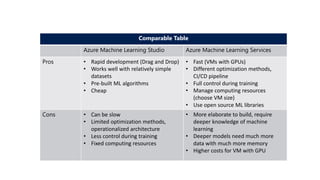
Comparable Table
Azure Machine Learning Studio Azure Machine Learning Services
Pros • Rapid development (Drag and Drop)
• Works well with relatively simple
datasets
• Pre-built ML algorithms
• Cheap
• Fast (VMs with GPUs)
• Different optimization methods,
CI/CD pipeline
• Full control during training
• Manage computing resources
(choose VM size)
• Use open source ML libraries
Cons • Can be slow
• Limited optimization methods,
operationalized architecture
• Less control during training
• Fixed computing resources
• More elaborate to build, require
deeper knowledge of machine
learning
• Deeper models need much more
data with much more memory
• Higher costs for VM with GPU
Azure Databricks
Databricks Spark as a managed service on Azure
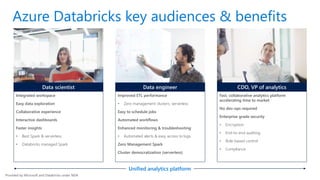
Azure Databricks key audiences & benefits
Unified analytics platform
Integrated workspace
Easy data exploration
Collaborative experience
Interactive dashboards
Faster insights
• Best Spark & serverless
• Databricks managed Spark
Improved ETL performance
• Zero management clusters, serverless
Easy to schedule jobs
Automated workflows
Enhanced monitoring & troubleshooting
• Automated alerts & easy access to logs
Zero Management Spark
Cluster democratization (serverless)
Fast, collaborative analytics platform
accelerating time to market
No dev-ops required
Enterprise grade security
• Encryption
• End-to-end auditing
• Role-based control
• Compliance
Data scientist Data engineer CDO, VP of analytics
Provided by Microsoft and Databricks under NDA
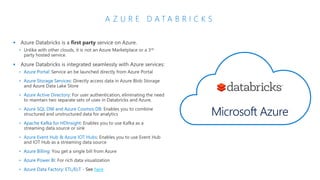
A Z U R E D A T A B R I C K S
Microsoft Azure
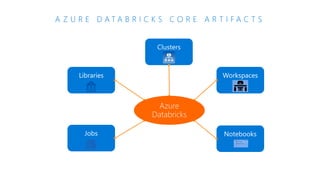
A Z U R E D A T A B R I C K S C O R E A R T I F A C T S
Azure
Databricks
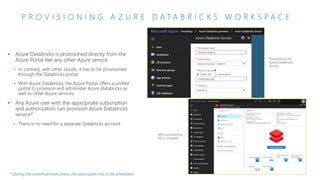
P R O V I S I O N I N G A Z U R E D A T A B R I C K S W O R K S P A C E
© Microsoft Corporation
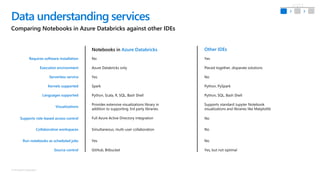
Comparing Notebooks in Azure Databricks against other IDEs
Data understanding services
Notebooks in Azure Databricks Other IDEs
No
Azure Databricks only
Yes
Spark
Python, Scala, R, SQL, Bash Shell
Provides extensive visualizations library in
addition to supporting 3rd party libraries.
Full Azure Active Directory integration
Simultaneous, multi-user collaboration
Yes
GitHub, Bitbucket
Requires software installation Yes
Pieced together, disparate solutions
No
Python, PySpark
Python, SQL, Bash Shell
Supports standard Jupyter Notebook
visualizations and libraries like Matplotlib
No
No
No
Yes, but not optimal
Execution environment
Serverless service
Kernels supported
Languages supported
Visualizations
Supports role-based access control
Collaborative workspaces
Run notebooks as scheduled jobs
Source control
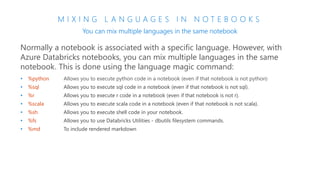
M I X I N G L A N G U A G E S I N N O T E B O O K S
You can mix multiple languages in the same notebook
Normally a notebook is associated with a specific language. However, with
Azure Databricks notebooks, you can mix multiple languages in the same
notebook. This is done using the language magic command:
• %python Allows you to execute python code in a notebook (even if that notebook is not python)
• %sql Allows you to execute sql code in a notebook (even if that notebook is not sql).
• %r Allows you to execute r code in a notebook (even if that notebook is not r).
• %scala Allows you to execute scala code in a notebook (even if that notebook is not scala).
• %sh Allows you to execute shell code in your notebook.
• %fs Allows you to use Databricks Utilities - dbutils filesystem commands.
• %md To include rendered markdown
© Microsoft Corporation
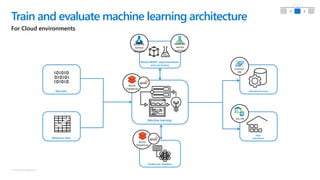
For Cloud environments
Train and evaluate machine learning architecture
Raw data
Reference data
• 0
1
Machine learning
Azure
Databricks
Scale out clusters
Azure
Databricks
Operational stores
Data
warehouse
SQL DW
Cosmos
DB
Model MGMT, experimentation,
and run history
Azure ML
Service
(preview)
Azure ML
service
(preview)
© Microsoft Corporation
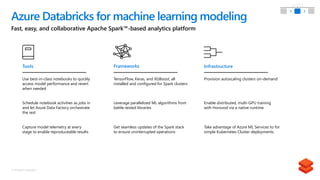
Fast, easy, and collaborative Apache Spark™-based analytics platform
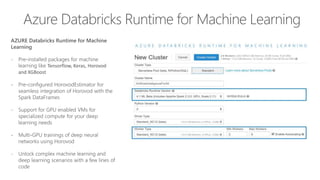
Azure Databricks for machine learning modeling
Tools InfrastructureFrameworks
Provision autoscaling clusters on-demandUse best-in-class notebooks to quickly
access model performance and revert
when needed
TensorFlow, Keras, and XGBoost, all
installed and configured for Spark clusters
Enable distributed, multi-GPU training
with Horovod via a native runtime
Get seamless updates of the Spark stack
to ensure uninterrupted operations
Capture model telemetry at every
stage to enable reproduceable results
Schedule notebook activities as jobs in
and let Azure Data Factory orchestrate
the rest
Take advantage of Azure ML Services to for
simple Kubernetes Cluster deployments
Leverage parallelized ML algorithms from
battle-tested libraries
© Microsoft Corporation
Build in your environment of choice
Custom IDEs
Visual studio tools for AINotebooksR studio PyCharm
S P A R K M A C H I N E L E A R N I N G ( M L ) O V E R V I E W
 Offers a set of parallelized machine learning algorithms (see next
slide)
 Supports Model Selection (hyperparameter tuning) using Cross
Validation and Train-Validation Split.
 Supports Java, Scala or Python apps using DataFrame-based API (as
of Spark 2.0). Benefits include:
• An uniform API across ML algorithms and across multiple languages
• Facilitates ML pipelines (enables combining multiple algorithms into a
single pipeline).
• Optimizations through Tungsten and Catalyst
• Spark MLlib comes pre-installed on Azure Databricks
• 3rd Party libraries supported include: H20 Sparkling Water, SciKit-
learn and XGBoost
Enables Parallel, Distributed ML for large datasets on Spark Clusters
M M L S P A R K
Microsoft Machine Learning Library for Apache Spark (MMLSpark) lets
you easily create scalable machine learning models for large datasets.
It includes integration of SparkML pipelines with the Microsoft
Cognitive Toolkit and OpenCV, enabling you to:
 Ingress and pre-process image data
 Featurize images and text using pre-trained deep learning models
 Train and score classification and regression models using implicit
featurization
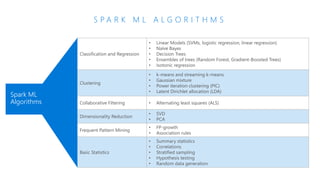
S P A R K M L A L G O R I T H M S
Spark ML
Algorithms
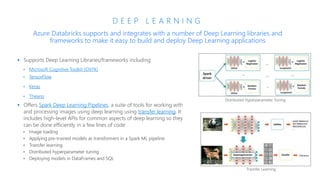
D E E P L E A R N I N G
 Supports Deep Learning Libraries/frameworks including:
• Microsoft Cognitive Toolkit (CNTK)
• TensorFlow
• Keras
• Theano
 Offers Spark Deep Learning Pipelines, a suite of tools for working with
and processing images using deep learning using transfer learning. It
includes high-level APIs for common aspects of deep learning so they
can be done efficiently in a few lines of code:
Azure Databricks supports and integrates with a number of Deep Learning libraries and
frameworks to make it easy to build and deploy Deep Learning applications
Distributed Hyperparameter Tuning
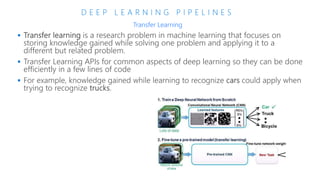
Transfer Learning
D E E P L E A R N I N G P I P E L I N E S

 Transfer Learning APIs for common aspects of deep learning so they can be done
efficiently in a few lines of code

Transfer Learning
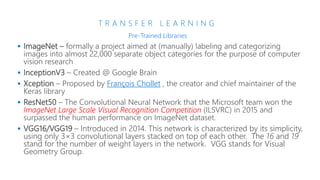
T R A N S F E R L E A R N I N G
 ImageNet –
 InceptionV3 – Created @ Google Brain
 Xception – François Chollet
 ResNet50 –
ImageNet Large Scale Visual Recognition Competition
 VGG16/VGG19 – Introduced in 2014. This network is characterized by its simplicity,
using only 3×3 convolutional layers stacked on top of each other. The 16 and 19
stand for the number of weight layers in the network. VGG stands for Visual
Geometry Group.
Pre-Trained Libraries
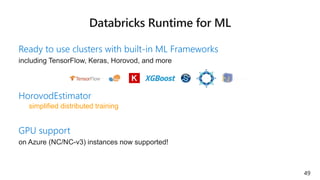
Ready to use clusters with built-in ML Frameworks
HorovodEstimator
for simplified distributed training on TensorFlow with Apache Spark
GPU support
49
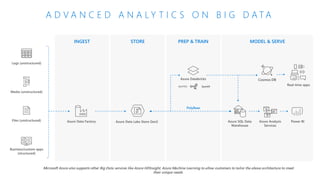
A D V A N C E D A N A L Y T I C S O N B I G D A T A
INGEST STORE PREP & TRAIN MODEL & SERVE
Cosmos DB
Business/custom apps
(structured)
Files (unstructured)
Media (unstructured)
Logs (unstructured)
Azure Data Lake Store Gen2Azure Data Factory Azure SQL Data
Warehouse
Azure Analysis
Services
Power BI
PolyBase
SparkR
Azure Databricks
Microsoft Azure also supports other Big Data services like Azure HDInsight, Azure Machine Learning to allow customers to tailor the above architecture to meet
their unique needs.
Real-time apps
© Microsoft Corporation
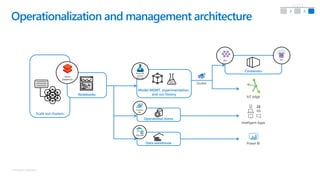
Operationalization and management architecture
Scale out clusters
Notebooks
Azure
Databricks
Containers
AKS ACI
IoT edge
Intelligent Apps
Power BI
Docker
Model MGMT, experimentation,
and run history
Azure ML
service
(Preview)
Data warehouse
SQL DW
Operational stores
Cosmos
DB
C L I C K T O E D I T M A S T E R T I T L E S T Y L E
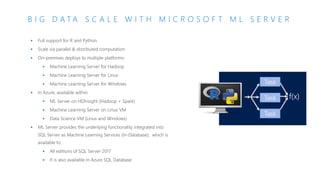
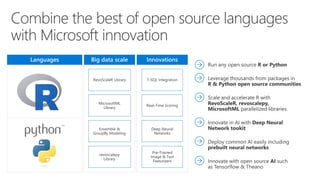
B I G D A T A S C A L E W I T H M I C R O S O F T M L S E R V E R
f(x)
Task
Task
Task
 Full support for R and Python
 Scale via parallel & distributed computation
 On-premises deploys to multiple platforms:
 Machine Learning Server for Hadoop
 Machine Learning Server for Linux
 Machine Learning Server for Windows
 In Azure, available within:
 ML Server on HDInsight (Hadoop + Spark)
 Machine Learning Server on Linux VM
 Data Science VM (Linux and Windows)
 ML Server provides the underlying functionality integrated into
SQL Server as Machine Learning Services (In-Database), which is
available to:
 All editions of SQL Server 2017
 It is also available in Azure SQL Database
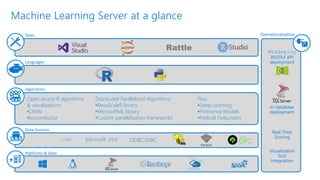
Machine Learning Server at a glance
Platforms & Data
Tools
Languages
Algorithms
Data Sources
Rattle Mrsdeploy
RESTful API
deployment
Real-Time
Scoring
Visualization
Tool
Integration
.csv Microsoft .XDF
In-database
deployment
Operationalization
Distributed Parallelized Algorithms:
•RevoScaleR library
•MicrosoftML library
•Custom parallelization frameworks
Open source R algorithms
& visualizations:
•CRAN
•bioconductor
Plus:
•Deep Learning
•Pretrained Models
•Prebuilt Featurizers
ODBC/JDBC
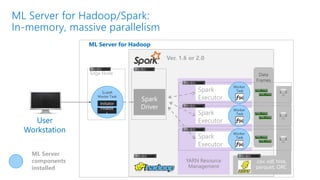
ML Server for Hadoop/Spark:
In-memory, massive parallelism
User
Workstation
ML Server for Hadoop
Data
Frames
YARN Resource
Management
Spark
Executor
Worker
Task
Spark
Executor
Worker
Task
Spark
Executor
Worker
Task
.csv, xdf, hive,
parquet, ORC
ScaleR
Master Task
Finalize
r
Initiator
Edge Node
Spark
Driver
Ver. 1.6 or 2.0
ML Server
components
installed
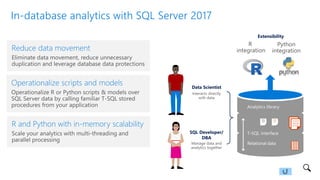
In-database analytics with SQL Server 2017
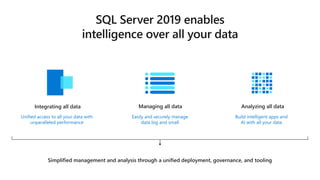
Build intelligent apps and
AI with all your data
Analyzing all data
Easily and securely manage
data big and small
Managing all data
Simplified management and analysis through a unified deployment, governance, and tooling
Unified access to all your data with
unparalleled performance
Integrating all data
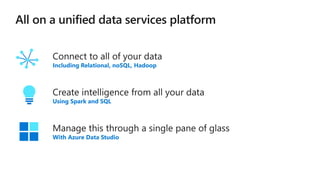
Including Relational, noSQL, Hadoop
Using Spark and SQL
With Azure Data Studio
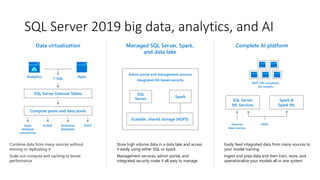
SQL Server 2019 big data, analytics, and AI
Managed SQL Server, Spark,
and data lake
Store high volume data in a data lake and access
it easily using either SQL or Spark
Management services, admin portal, and
integrated security make it all easy to manage
SQL
Server
Data virtualization
Combine data from many sources without
moving or replicating it
Scale out compute and caching to boost
performance
T-SQL
Analytics Apps
Open
database
connectivity
NoSQL Relational
databases
HDFS
Complete AI platform
Easily feed integrated data from many sources to
your model training
Ingest and prep data and then train, store, and
operationalize your models all in one system
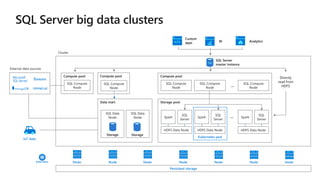
SQL Server External Tables
Compute pools and data pools
Spark
Scalable, shared storage (HDFS)
External
data sources
Admin portal and management services
Integrated AD-based security
SQL Server
ML Services
Spark &
Spark ML
HDFS
REST API containers
for models
Compute pool
SQL Compute
Node
SQL Compute
Node
SQL Compute
Node
…
Compute pool
SQL Compute
Node
IoT data
Directly
read from
HDFS
Persistent storage
…
Storage pool
SQL
Server
Spark
HDFS Data Node
SQL
Server
Spark
HDFS Data Node
SQL
Server
Spark
HDFS Data Node
Kubernetes pod
Analytics
Custom
apps BI
SQL Server
master instance
Node Node Node Node Node Node Node
SQL
Data mart
SQL Data
Node
SQL Data
Node
Compute pool
SQL Compute
Node
Storage Storage
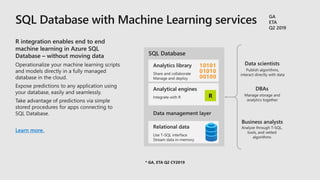
Learn more.
R
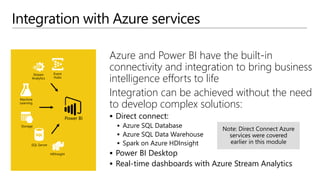
Integration with Azure services
Azure and Power BI have the built-in
connectivity and integration to bring business
intelligence efforts to life
Integration can be achieved without the need
to develop complex solutions:
 Direct connect:
 Azure SQL Database
 Azure SQL Data Warehouse
 Spark on Azure HDInsight
 Power BI Desktop
 Real-time dashboards with Azure Stream Analytics
HDInsight
Storage
Event
Hubs
Machine
Learning
SQL Server
Stream
Analytics
Power BI
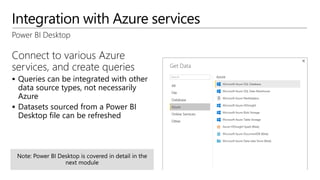
Integration with Azure services
Power BI Desktop
Connect to various Azure
services, and create queries
 Queries can be integrated with other
data source types, not necessarily
Azure
 Datasets sourced from a Power BI
Desktop file can be refreshed
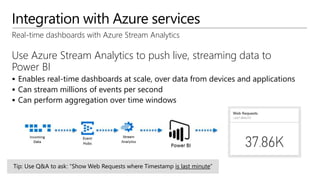
Integration with Azure services
Real-time dashboards with Azure Stream Analytics
Use Azure Stream Analytics to push live, streaming data to
Power BI
 Enables real-time dashboards at scale, over data from devices and applications
 Can stream millions of events per second
 Can perform aggregation over time windows
Integration with Azure services
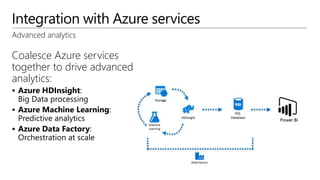
Advanced analytics
Coalesce Azure services
together to drive advanced
analytics:
 Azure HDInsight:
Big Data processing
 Azure Machine Learning:
Predictive analytics
 Azure Data Factory:
Orchestration at scale
Describing additional capabilities
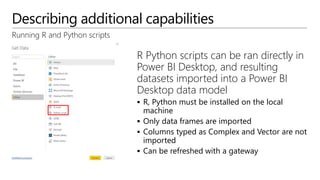
Running R and Python scripts
R Python scripts can be ran directly in
Power BI Desktop, and resulting
datasets imported into a Power BI
Desktop data model
 R, Python must be installed on the local
machine
 Only data frames are imported
 Columns typed as Complex and Vector are not
imported
 Can be refreshed with a gateway
Describing additional capabilities
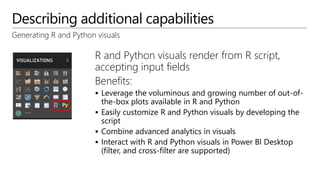
Generating R and Python visuals
R and Python visuals render from R script,
accepting input fields
Benefits:
 Leverage the voluminous and growing number of out-of-
the-box plots available in R and Python
 Easily customize R and Python visuals by developing the
script
 Combine advanced analytics in visuals
 Interact with R and Python visuals in Power BI Desktop
(filter, and cross-filter are supported)
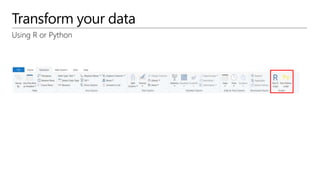
Transform your data
Using R or Python
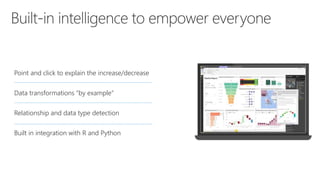
Point and click to explain the increase/decrease
Data transformations “by example”
Relationship and data type detection
Built in integration with R and Python
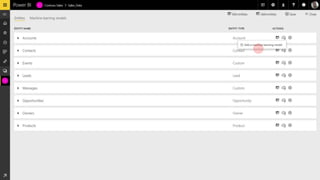
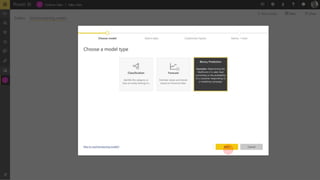
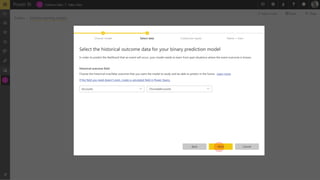
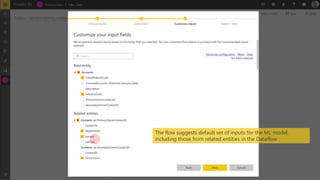
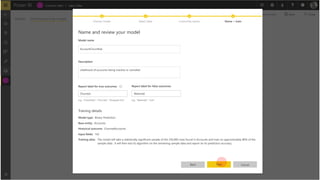
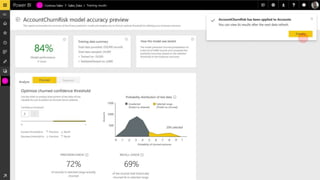
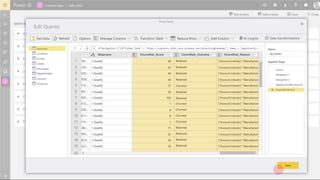
Power BI AutoML
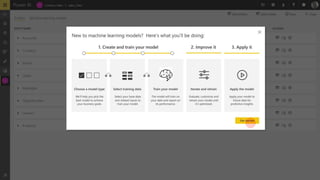
The flow suggests default set of inputs for the ML model,
including those from related entities in the Dataflow.
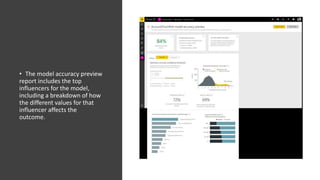
• The model accuracy preview
report includes the top
influencers for the model,
including a breakdown of how
the different values for that
influencer affects the
outcome.
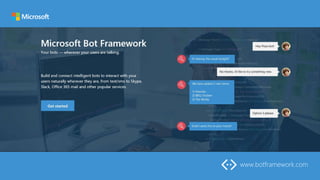
www.botframework.com
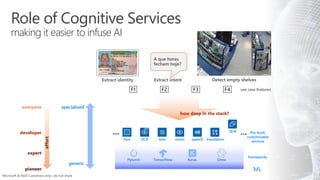
Role of Cognitive Services
making it easier to infuse AI
frameworks
TensorFlow KerasPytorch Onnx
ML
Extract intent Detect empty shelvesExtract identity
generic
specialized
effort
pioneer
expert
developer
everyone
Pre-built,
customizable
services
face OCR text vision speech translation
QnA
......
use case featuresF1 F2 F3 F4
how deep in the stack?
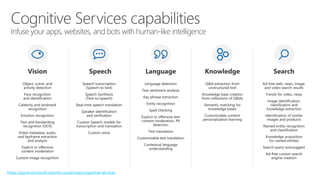
Cognitive Services capabilities
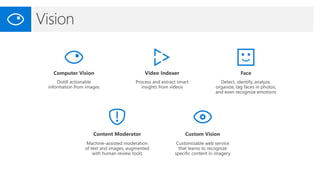
Infuse your apps, websites, and bots with human-like intelligence
https://azure.microsoft.com/en-us/services/cognitive-services
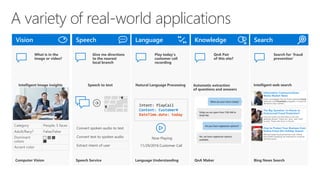
A variety of real-world applications
Vision Speech
Intent: PlayCall
Language Knowledge Search
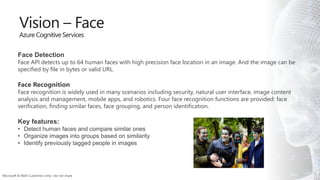
Face Detection
Face API detects up to 64 human faces with high precision face location in an image. And the image can be
specified by file in bytes or valid URL.
Face Recognition
Face recognition is widely used in many scenarios including security, natural user interface, image content
analysis and management, mobile apps, and robotics. Four face recognition functions are provided: face
verification, finding similar faces, face grouping, and person identification.
Key features:
• Detect human faces and compare similar ones
• Organize images into groups based on similarity
• Identify previously tagged people in images
Vision – Face
Azure Cognitive Services
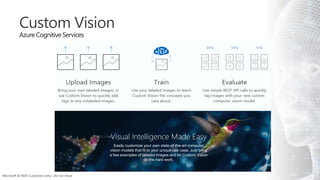
Visual Intelligence Made Easy
Easily customize your own state-of-the-art computer
vision models that fit to your unique use case. Just bring
a few examples of labeled images and let Custom Vision
do the hard work.
Custom Vision
Azure Cognitive Services
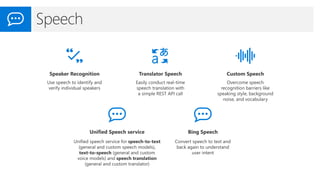
Speech
Azure Cognitive Services
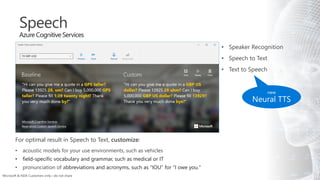
For optimal result in Speech to Text, customize:
• acoustic models for your use environments, such as vehicles
• field-specific vocabulary and grammar, such as medical or IT
• pronunciation of abbreviations and acronyms, such as "IOU" for "I owe you."
• Speaker Recognition
• Speech to Text
• Text to Speech
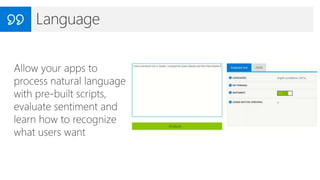
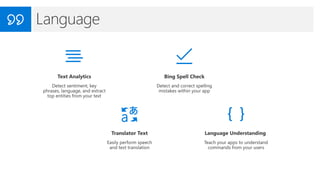
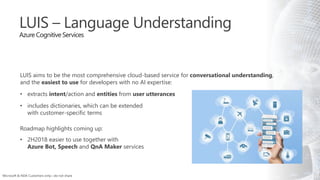
LUIS – Language Understanding
Azure Cognitive Services
LUIS aims to be the most comprehensive cloud-based service for conversational understanding,
and the easiest to use for developers with no AI expertise:
• extracts intent/action and entities from user utterances
• includes dictionaries, which can be extended
with customer-specific terms
Roadmap highlights coming up:
• 2H2018 easier to use together with
Azure Bot, Speech and QnA Maker services