Submitted by :- SHASHANK
1228
AJAY
Industrial & market structure
Ajay
WHAT IS INDUSTRIAL
STRUCTURE ??
ACCORDING TO J.S.BAIN :“ A group of sellers or
of close substitute output who supply to a
common group of buyers ”
In similar term a group of firms producing close
substitute for the common group of buyer. It is not
necessary that the substitute good comes from
the same industry.
For example Wooden blanket and electric room
heaters are used for removal of cold but they
cannot be cannot as output of one industry . The
nature of these product is different. They are
based on different technologies. So, one easily
conceive them as output of different industries.
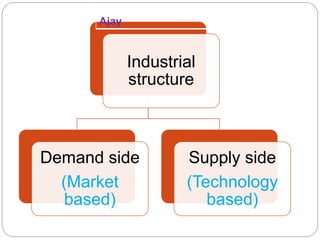
Industrial
structure
Demand side
(Market
based)
Supply side
(Technology
based)
Ajay
Ajay
Demand side ( market based ) criteria
We would come to know how consumer
distinguish between particular products
although the technology involved are similar.
Example – DELL AND HP
Ajay
2 . Supply side ( technology based )
criteria
Grouping those product that have similar
technological expertise
Example- manufactures of rolls Royce
producing a smaller car that would compete
with the mini.
MARKET
STRUCTURE
MARKET STRUCTURE
 By the structure of any complex body we mean
the pattern or form or manner in which the
constituent part of the body are arranged
together. Taking the market as complex body, we
have to examine how its different constituent i.e.
seller and buyer linked together
Features of market
structure
Degree of Seller
Concentration
Degree of buyer
concentration
Degree of product
Differentiation
Condition of entry to
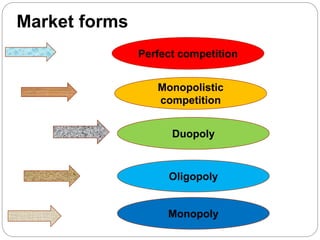
Market forms
Perfect competition
Monopolistic
competition
Duopoly
Oligopoly
Monopoly
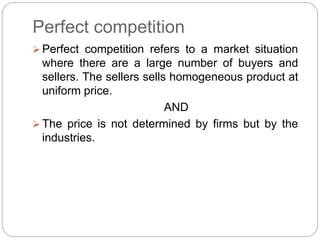
Perfect competition
 Perfect competition refers to a market situation
where there are a large number of buyers and
sellers. The sellers sells homogeneous product at
uniform price.
AND
 The price is not determined by firms but by the
industries.
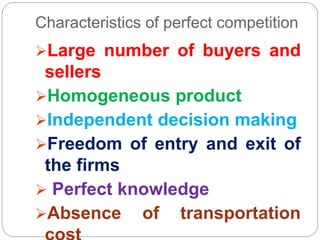
Characteristics of perfect competition
Large number of buyers and
sellers
Homogeneous product
Independent decision making
Freedom of entry and exit of
the firms
 Perfect knowledge
Absence of transportation
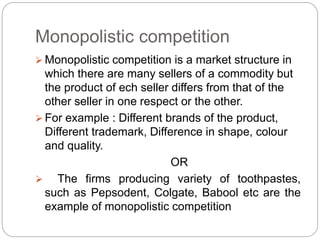
Monopolistic competition
 Monopolistic competition is a market structure in
which there are many sellers of a commodity but
the product of ech seller differs from that of the
other seller in one respect or the other.
 For example : Different brands of the product,
Different trademark, Difference in shape, colour
and quality.
OR
 The firms producing variety of toothpastes,
such as Pepsodent, Colgate, Babool etc are the
example of monopolistic competition
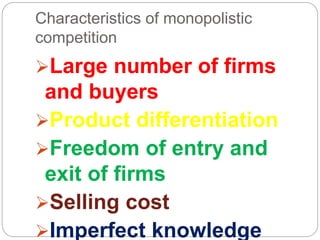
Characteristics of monopolistic
competition
Large number of firms
and buyers
Product differentiation
Freedom of entry and
exit of firms
Selling cost
Imperfect knowledge
Ajay
Monopoly
 Monopoly is the market form which has always
attracted the attention of the economists. This
word has come from Greek words, monos
(single), polein (selling), which means alone to
sell, it implies a market structure , where there is
a single seller. In economics theory , monopoly is
characterised by sole producer selling a distinct
product for which there are no close substitute
and there are strong barriers to entry. This sole
producer controls entire supply of the market.
Ajay
Characteristics of monopoly
One seller and large numbers
of buyers
Monopoly is also an industry
Restriction on the entry of
new firms
No close substitute
Price maker
Price discrimination
Oligopoly
 It is the form of market in which there is a
competition among a few firm . A small number of
firms are producing a commodity and competing
in the market
 Example: coke ,Pepsi and a few other competing
in the global market of soft drink
Characteristics of Oligopoly
Few sellers and many
buyers
Homogeneous or
differentiated products
Advertisement
Some barriers to entry
Kinked demand curve
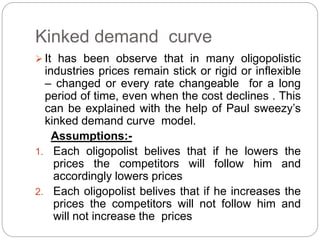
 It has been observe that in many oligopolistic
industries prices remain stick or rigid or inflexible
– changed or every rate changeable for a long
period of time, even when the cost declines . This
can be explained with the help of Paul sweezy’s
kinked demand curve model.
Assumptions:-
1. Each oligopolist belives that if he lowers the
prices the competitors will follow him and
accordingly lowers prices
2. Each oligopolist belives that if he increases the
prices the competitors will not follow him and
will not increase the prices
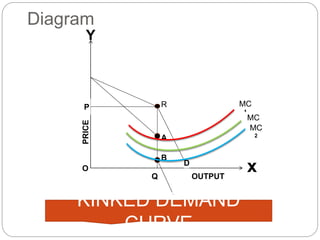
Diagram
x
Y
PRICE
OUTPUT
O
R
A
B
D
P
Q
MC
1
MC
MC
2
KINKED DEMAND
CURVE
Thank
you

Economics

  • 1.
    Submitted by :-SHASHANK 1228 AJAY Industrial & market structure
  • 2.
    Ajay WHAT IS INDUSTRIAL STRUCTURE?? ACCORDING TO J.S.BAIN :“ A group of sellers or of close substitute output who supply to a common group of buyers ” In similar term a group of firms producing close substitute for the common group of buyer. It is not necessary that the substitute good comes from the same industry. For example Wooden blanket and electric room heaters are used for removal of cold but they cannot be cannot as output of one industry . The nature of these product is different. They are based on different technologies. So, one easily conceive them as output of different industries.
  • 3.
  • 4.
    Ajay Demand side (market based ) criteria We would come to know how consumer distinguish between particular products although the technology involved are similar. Example – DELL AND HP
  • 5.
    Ajay 2 . Supplyside ( technology based ) criteria Grouping those product that have similar technological expertise Example- manufactures of rolls Royce producing a smaller car that would compete with the mini.
  • 6.
  • 7.
    MARKET STRUCTURE  Bythe structure of any complex body we mean the pattern or form or manner in which the constituent part of the body are arranged together. Taking the market as complex body, we have to examine how its different constituent i.e. seller and buyer linked together
  • 8.
    Features of market structure Degreeof Seller Concentration Degree of buyer concentration Degree of product Differentiation Condition of entry to
  • 9.
  • 10.
    Perfect competition  Perfectcompetition refers to a market situation where there are a large number of buyers and sellers. The sellers sells homogeneous product at uniform price. AND  The price is not determined by firms but by the industries.
  • 11.
    Characteristics of perfectcompetition Large number of buyers and sellers Homogeneous product Independent decision making Freedom of entry and exit of the firms  Perfect knowledge Absence of transportation
  • 12.
    Monopolistic competition  Monopolisticcompetition is a market structure in which there are many sellers of a commodity but the product of ech seller differs from that of the other seller in one respect or the other.  For example : Different brands of the product, Different trademark, Difference in shape, colour and quality. OR  The firms producing variety of toothpastes, such as Pepsodent, Colgate, Babool etc are the example of monopolistic competition
  • 13.
    Characteristics of monopolistic competition Largenumber of firms and buyers Product differentiation Freedom of entry and exit of firms Selling cost Imperfect knowledge
  • 14.
    Ajay Monopoly  Monopoly isthe market form which has always attracted the attention of the economists. This word has come from Greek words, monos (single), polein (selling), which means alone to sell, it implies a market structure , where there is a single seller. In economics theory , monopoly is characterised by sole producer selling a distinct product for which there are no close substitute and there are strong barriers to entry. This sole producer controls entire supply of the market.
  • 15.
    Ajay Characteristics of monopoly Oneseller and large numbers of buyers Monopoly is also an industry Restriction on the entry of new firms No close substitute Price maker Price discrimination
  • 16.
    Oligopoly  It isthe form of market in which there is a competition among a few firm . A small number of firms are producing a commodity and competing in the market  Example: coke ,Pepsi and a few other competing in the global market of soft drink
  • 17.
    Characteristics of Oligopoly Fewsellers and many buyers Homogeneous or differentiated products Advertisement Some barriers to entry
  • 18.
    Kinked demand curve It has been observe that in many oligopolistic industries prices remain stick or rigid or inflexible – changed or every rate changeable for a long period of time, even when the cost declines . This can be explained with the help of Paul sweezy’s kinked demand curve model. Assumptions:- 1. Each oligopolist belives that if he lowers the prices the competitors will follow him and accordingly lowers prices 2. Each oligopolist belives that if he increases the prices the competitors will not follow him and will not increase the prices
  • 19.
  • 20.