1
Chapter One: Introduction
1.1. Introduction to the subject matter
 Natural resource and environmental economics is the
application of the principles of economics to the study
of how natural and environmental resources are
developed and managed.
 As its name indicates the subject has two parts:
 Natural resource economics
 Environmental economics
2
 Although they are a very close concepts, narrowly
defined they are distinct disciplines. The difference
between these two sub-fields is primarily a matter of
focus.
Natural resource economics is the study of how
society allocates scarce natural resources such as
stocks of fish, stands of trees, fresh water, oil, and
other naturally occurring resources.
3
 It is concerned with optimal allocation of natural resources in
the present as well as in the future, i.e. inter-temporal
resource allocation.
 Environmental economics studies alternative environmental
policies to deal with environmental problems (air pollution,
water pollution, toxic substances, solid waste, global
warming, land degradation, etc.).
 It is concerned with the conservation of natural environments
and biodiversity, the way wastes are disposed of to bring
about quality of air, water, and soil.
4
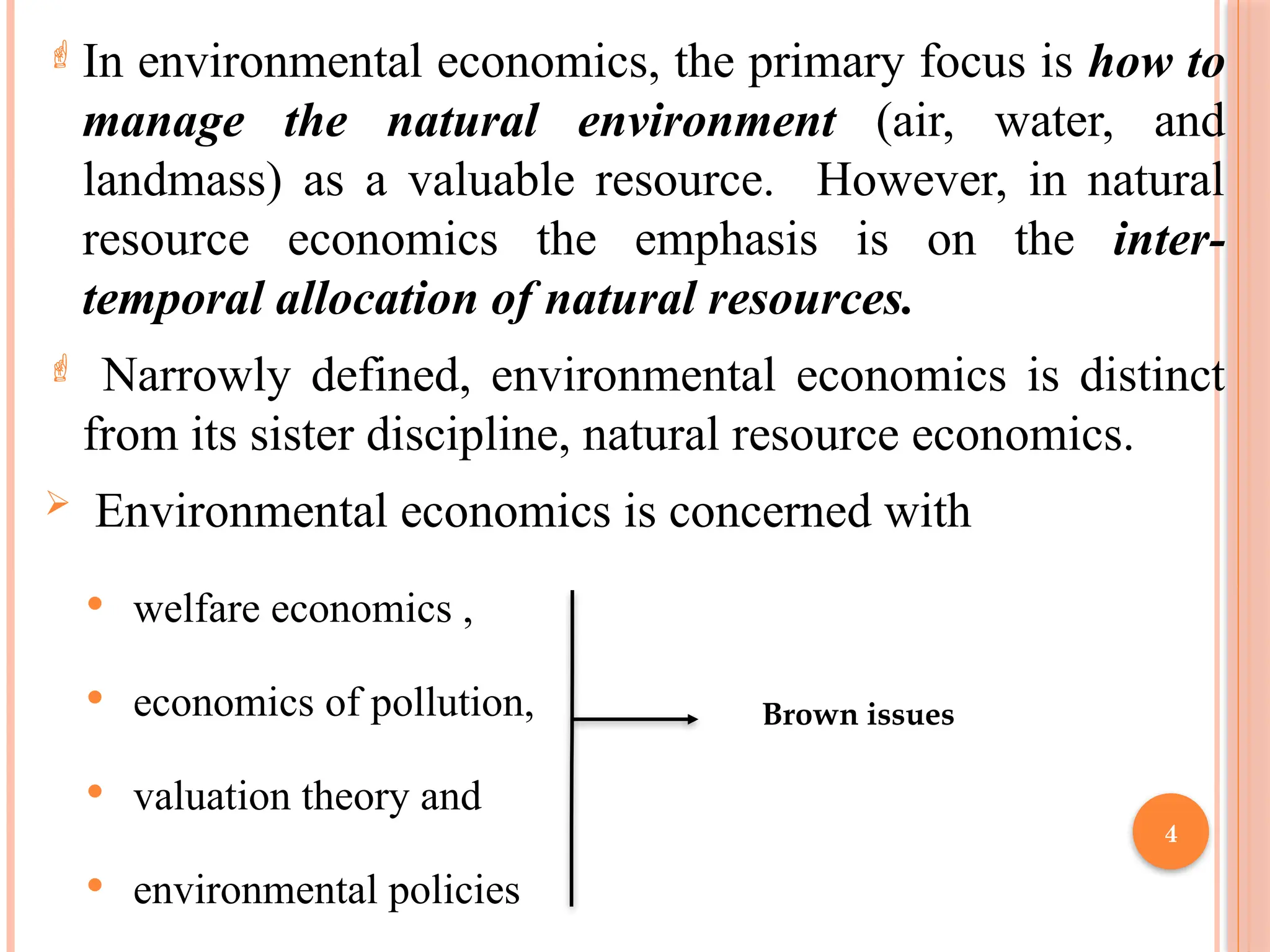
 In environmental economics, the primary focus is how to
manage the natural environment (air, water, and
landmass) as a valuable resource. However, in natural
resource economics the emphasis is on the inter-
temporal allocation of natural resources.
 Narrowly defined, environmental economics is distinct
from its sister discipline, natural resource economics.
 Environmental economics is concerned with
 welfare economics ,
 economics of pollution,
 valuation theory and
 environmental policies
Brown issues
5
 Natural resource economics is concerned with the
optimal utilization of natural resource – green issues
 Brown agenda focuses on improving human well-being
by reducing direct threats to human health, particularly
by improving water, sanitation and housing.
 Green agenda focuses on ecosystem protection for
sustainable development, by preventing resource
degradation and the loss or deterioration of natural life-
support systems.
6
 Broadly defined, environmental economics is concerned
with both green and brown issues.
 Hence, in the broad sense, environmental economics is not
distinct from its sister discipline, natural resource
economics.
What are natural and environmental resources?
Natural resources- resources provided by nature that can be
divided into increasingly smaller units and allocated at the
margin.
- They can be living or non-living things endowed by earth.
7
- They serve as inputs to the economic system.
- They are currently being exploited or potentially can be
exploited by human beings as a source of food, raw
materials, energy, etc.
Environmental resources – resources provided by nature
that are indivisible.
- Environmental resources are affected by the economic
system (e.g. pollution).
8
 Natural resources are generally grouped into two major
categories: renewable and non-renewable natural
resources.
 Renewable resources are those resources that are
capable of regenerating themselves within a relatively
short period, provided the environment in which they
are nurtured is not unduly disturbed.
- Examples include plants, fish, forests, soil, solar
radiation, wind, tides, etc.
9
 Non-renewable resources are resources that are formed
by geological processes over millions of years and exist
as fixed stocks which, which once extracted, cannot be
renewed.
- Their re-generative capacity can be assumed to be zero
for all practical human purposes.
- Examples of these resources include metallic minerals
(iron, aluminum, copper, and uranium; and non-metallic
minerals (fossil fuels, clay, sand, salt, and phosphates).
10
 Environment:
- is the Earth and its atmosphere.
- refers to the living (organisms) and non-living (such as
temperature, rainfall, day length, wind, and ocean)
components of the natural world, and to the interactions
between them, that support life on earth.
 Ecosystem – are organisms living in a particular
environment, such as a forest or a coral reef, and the
physical parts of the environment that affect them.
11
Why Study Natural Resource and Environmental
Economics?
 Market failures. Markets, and thus prices, often do not
exist for natural and environmental resources. Thus,
government intervention may be appropriate.
 Dynamics. The decision to use natural resources today does affect
what will be available tomorrow.
 Irreversibility. Damage to natural resources has long-term effects.
12
 Linkages between the economy and ecosystem
1.2. Inter-linkage between the environment and the economy
 Economic activity takes place within, and is part of, the
environment.
 There is a two-way relationships between the economy
and the environment.
- In economics, the environment is viewed as a composite
asset that provides a variety of services.
13
 The environment provides the following functions or
services for the economy.
(1) Source of energy and raw materials. It provides the
economy with raw materials, which are transformed into
consumer products by the production process, and
energy, which fuels this transformation.
(2) Sink of wastes (residuals). It absorbs waste products
from the economy or serves as sink of wastes/ residuals
of production and consumption.
14
- The raw materials and energy used in the production process
return to the environment as waste products.
(3) Serves as a life support to sustain human life. The
environment also provides services directly to consumers.
- The air we breathe, the nourishment we receive from food and
drink, and the protection we derive from shelter and clothing
are all benefits we receive, either directly or indirectly, from
the environment.
 It is a very special asset because it provides the life-support
systems that sustain our existence.
15
(4) It provides aesthetic values.
- The environment provides us with varieties of amenities (recreational
services) for which no substitute exists.
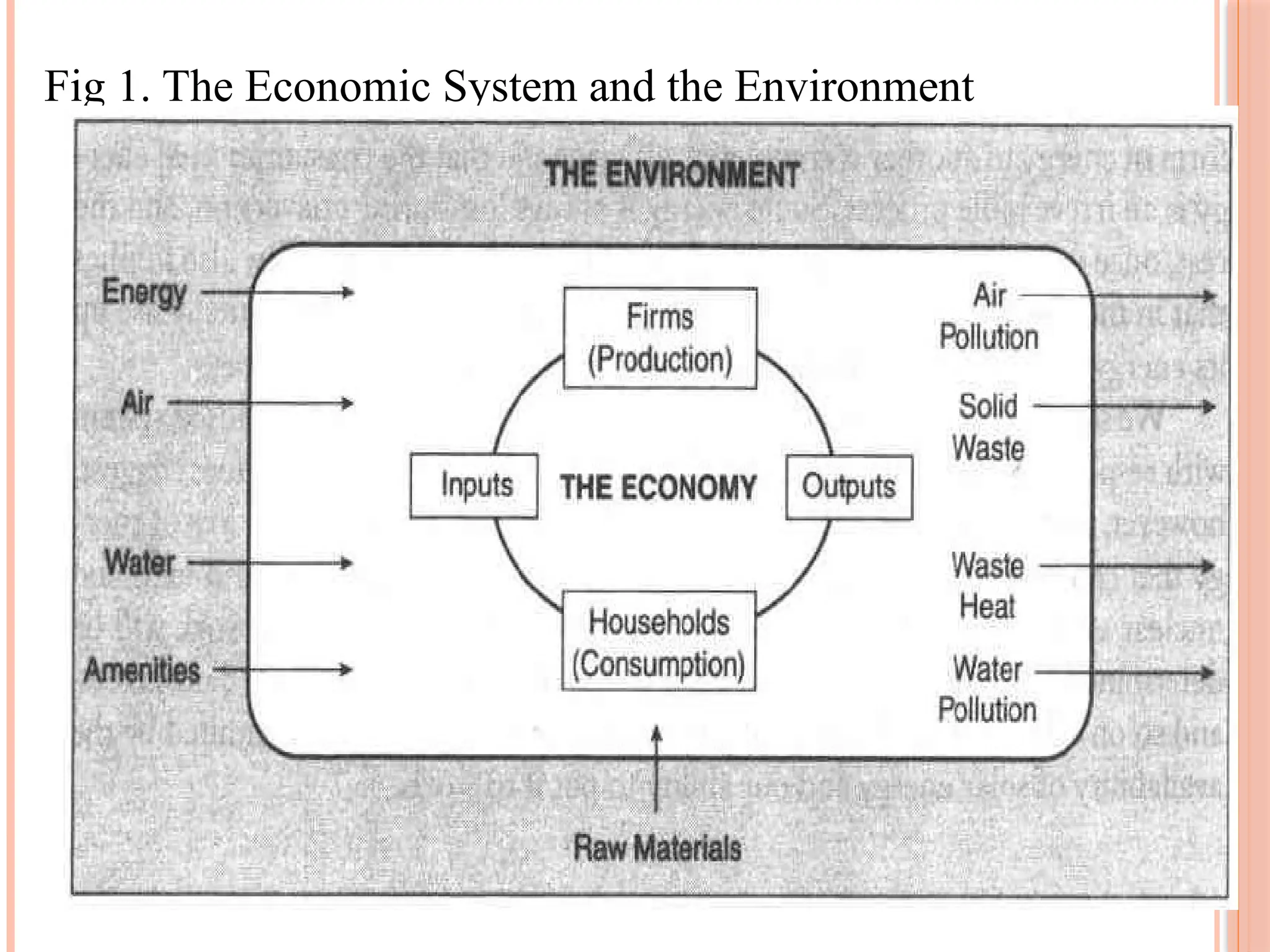
 If the environment is defined broadly enough, the relationship
between the environment and the economic system can be
considered as a closed system.
 A closed system is one in which no inputs (energy or matter) are
received from outside the system and no outputs are transferred
outside the system.
 An open system, by contrast, is one in which the system imports
or exports matter or energy.
16
Fig 1. The Economic System and the Environment
17
 The knowledge of the relationship between the environment
and the economy help us to design an appropriate policy that
prevents undue depreciation of the environment, so that it may
continue to provide its services.
 Modern ecologists, “the environment possesses a unique
‘carrying capacity’ to support humans, and once that capacity
is exceeded widespread ecological destruction occurs with
disastrous consequence for humanity.” Thus, the focus is no
longer on individual societies but on the survival of the planet.
18
1.3. The prospect of economic growth: two views
 Will economic growth continue in the future? Does the
environment impose constraints on economic growth in the future?
 There are two views:
1. pessimist view
2. optimist view
The Pessimist View
The pessimists believe in;
√ Natural and environmental resources are finite.
√ The waste assimilation capacity of the environment is limited.
19
 Economic growth is ultimately unsustainable, i.e., there are limits
to economic growth.

The limits to economic growth can arise from
i) The depletion of non-renewable natural resources
- Economic growth process uses successive large amount of natural
resources until they are gone.
- Finally, the society will run out of non-renewable resources on
which the industrial base depends.
- When the resources have been depleted, the economic system
will collapse resulting in;
20
 Massive unemployment
 Decreased food production
 Decline in population as death rate soars.
 Thus, economic growth is ultimately limited by resource
constraints.
ii) Excess waste (pollution) generated by continued
economic growth (industrialization)
- Continued economic growth (industrialization) generates
more waste and hence raises the level of global pollution.
21
- Given its limited waste assimilation capacity, the
environment will eventually be unable to absorb any more
waste (pollution) resulting from continued economic
growth (industrialization).
 This ultimately leads to ever increasing environmental
degradation -- reduction in the quantities and qualities of
environmental services , and hence increased difficulty of
the environment in sustaining economic growth.
22
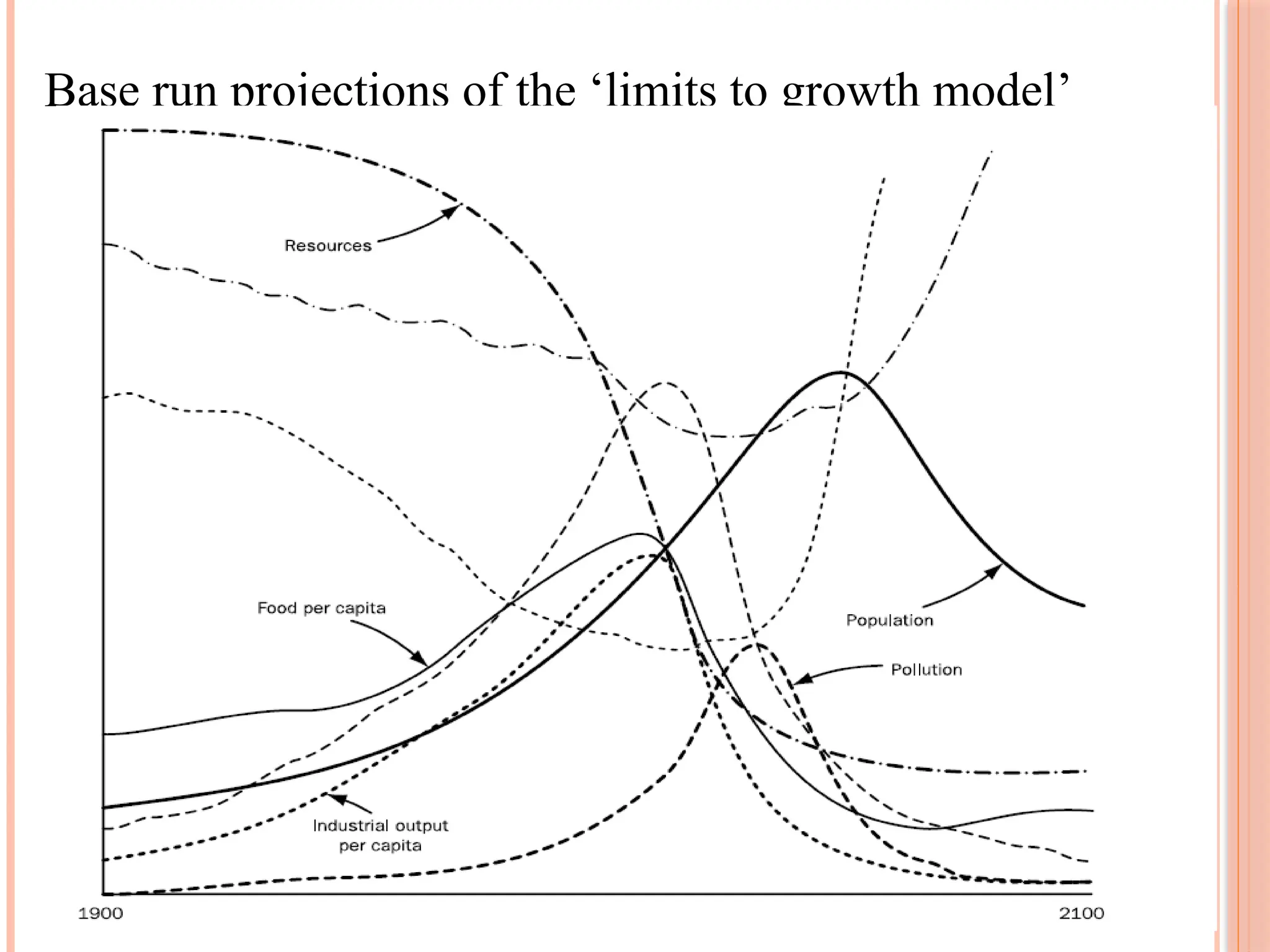
The main conclusions of the pessimistic models are;
(1) If the present growth trends in world population,
industrialization, pollution, food production and resource
depletion continue unchanged, the limits to growth on
this planet will be reached within the next 100 years and
the world society will collapse.
 The most probable result will be a sudden and
uncontrollable decline in both population and industrial
capacity.
23
(2) A piecemeal approach to solving the individual
problems will not be successful.
- If the depletion of non-renewable natural resources and
pollution problems were somehow jointly solved,
population would grow and the availability of food would
become the binding constraint.
 The removal of one limit merely causes the system to
bump into another one.
24
(3) Overshoot and collapse can be avoided only by an immediate
limit on population & pollution, and cessation of economic
growth.
The pessimist scenario shows only two possible outcomes:
 the termination of growth by self restraint and conscious
policy -- an approach that avoids the collapse, or
 the termination of growth by collision with the natural limits,
resulting in societal collapse.
 Thus, according pessimistic view, one way or the other growth
will cease.
25
Base run projections of the ‘limits to growth model’
26
The Optimist View
 Like pessimists , the optimists believe in the existence of
√ Limited natural resources or resource scarcity
√ Limited assimilative capacity of the environment.
 However, the optimists believe that , with the existence of
these constraints, it is possible to attain infinite or
sustainable economic growth. This is because;
i) Market system
- The market system can keep the scarce resources from
depletion or exhaustion by increasing their prices.
27
 When prices of the resources increase, people will decrease
their consumption by substituting them with human made raw
materials.
ii) Technological advancement
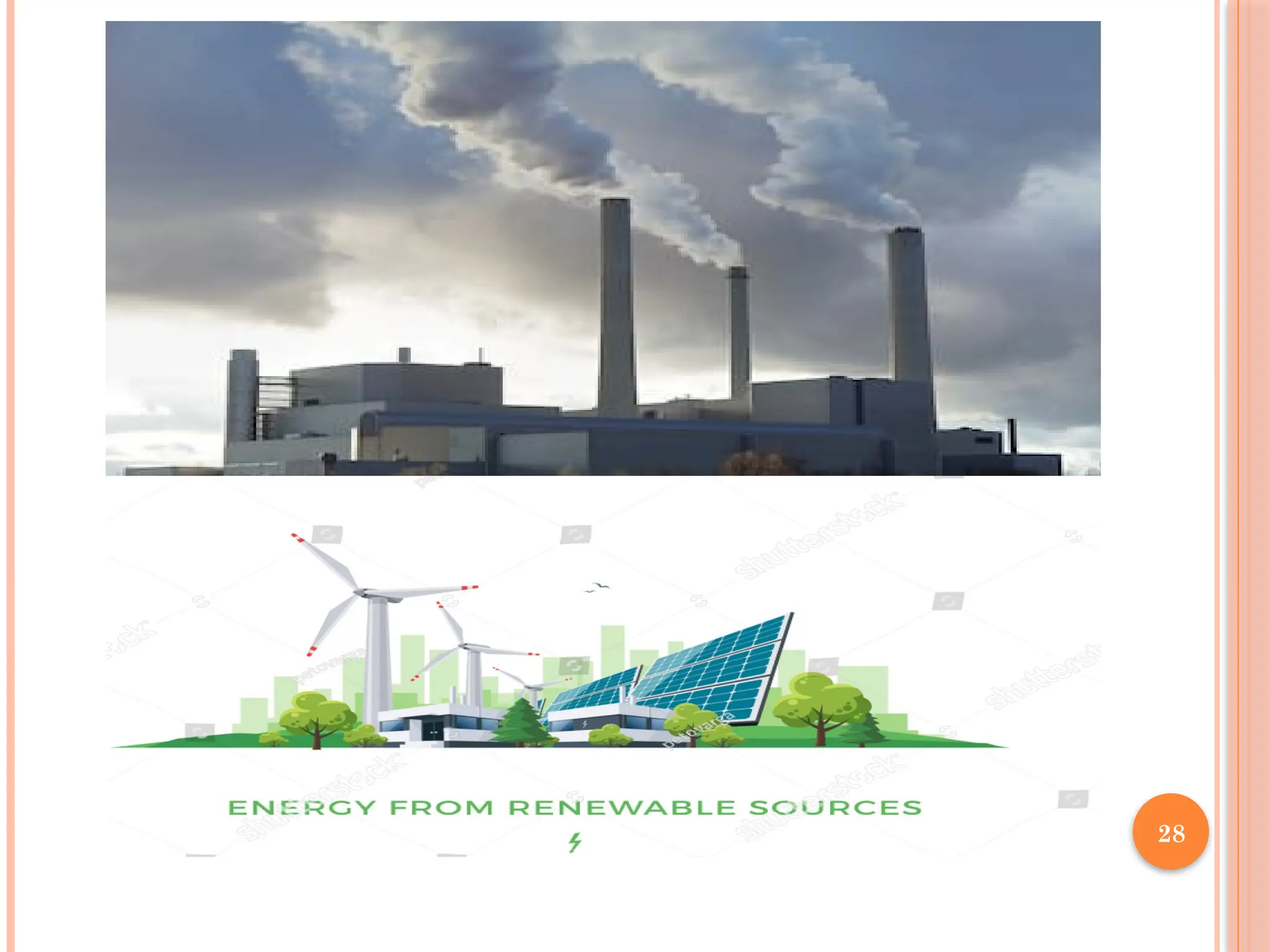
- Technology can help the environment in assimilating the
wastes.
- Technology also helps us to reuse the byproducts so that the
assimilative capacity of the environment can be improved.
 Therefore, the optimists believe that indefinite economic
growth is possible.
28
29
Chapter Two
Some Issues on the Environment and Development
2.1. The environment and emerging development issues
 For a long period of time, the issue of the environment is
ignored in the development process.
 This is partially because of the special consideration
given for environmental good.
 Because of the problem of market failure, natural and
environmental resources were not considered as economic
good.
30
 For a good to be considered as economic good,
- it must be marketable (tradable)
- it must provide utility
- it must be relatively scarce
 Even in the 1950's and 1960's natural and environmental
resources were considered as free goods.
 Because of this, a number of problems have been
happened to the environment, and have resulted in
environmental degradation.
31
 Environmental degradation is the deterioration of the environment in
quality, quantity or diversity/composition.

The forms of environmental degradation include:
- rapid deforestation
- land degradation
- excessive soil erosion
- watershed degradation
- fuel-wood and water shortages
- over-grazing
- over-fishing
- loss of bio-diversity
- pollution
- urban congestion, etc.
32
 In the late 1960's and 1970's, the concern of
environmental degradation began in the industrialized
countries and was extended to less developed countries by
the 1980's.
 Thus, it is only after 1980s that environmental issues
were treated as development issue and people observe that
development is related to the environment.
 The various forms of environmental degradation, if left
unchecked, will undermine the economic development.
33
 The protection of the environment was considered as an
essential part of development without which development
will be undermined.
 Who is the victim of environmental problems?
 Both developed and developing countries.
 However, the most pressing issues in LDCs are not
necessarily the same as in the developed countries.
34
 The most immediate environmental problems facing
developing countries include;
- unsafe water
- deforestation
- Soil depletion
- indoor smoke (from use of biomass fuel such as wood,
straw, dung)
- Outdoor smoke (from coal burning).
35
 But for developed countries, the main concerns are issues;
- global warming– an increase in the world’s
temperature caused by increased concentrations of
greenhouse gases (carbon dioxide, methane, nitrous
oxide &hydro fluorocarbons) in the upper
atmosphere.
 Accumulation of greenhouse gases in the upper atmosphere traps
the heat reflected from the earth's surface, which increases surface
temperatures.
36
- depletion of ozone layer – is caused by chlorofluorocarbons which erode
the protective ozone layer and allow more solar radiation to penetrate the
atmosphere.
- acid rain and
- hazardous waste materials.
 However, the environmental problems of less and more
developed countries are not completely independent of
each other.
37
 Carbon dioxide emissions that come primarily from rich
countries causes greenhouse effect everywhere; less
developed countries are also affected by the global
warming.
 Loss of biodiversity due to destruction of tropical
rainforests in less developed country is a problem for
more developed countries as well.
Poverty and the environment
 poverty leads to environmental degradation and
environmental degradation worsen poverty.
38
2.2. Population growth and the environment
Population growth leads to environmental degradation in two ways:
1. Population growth increase the demand for goods and services this
cause environmental degradation
2. It produces more waste and creates additional stress on the
assimilative capacity of the environment.
 Assimilation is the natural capacity of the environment to decompose
residuals/wastes to the environment either chemically or biologically.
 Thus, population growth intensifies environmental problems.
  Population Human Activity Production &
Consumption Resource ConsumptionDepletion of Resources
& Waste Accumulation.
39
 Hence, there should be policies for reducing population growth
rate. Some of the policies used to reduce population growth
include;
 Family planning: Access to family planning should be
increased.
 Education: Educate the people to the benefit of having small
family.
 Economic incentives and disincentives
 Marriage age law: Legislating and implementing legal law that
specifies the minimum age for marriage.
 Using force
40
2.3. Economic growth and the environment
 As stated earlier, environmental problems differ
substantially between less and more developed countries.
 This is because most environmental problems tend to vary
with economic growth.
 Does this mean that economic growth lead to
environmental degradation?
 Generally there are three patterns of relationship between
economic growth and environmental degradation.
41
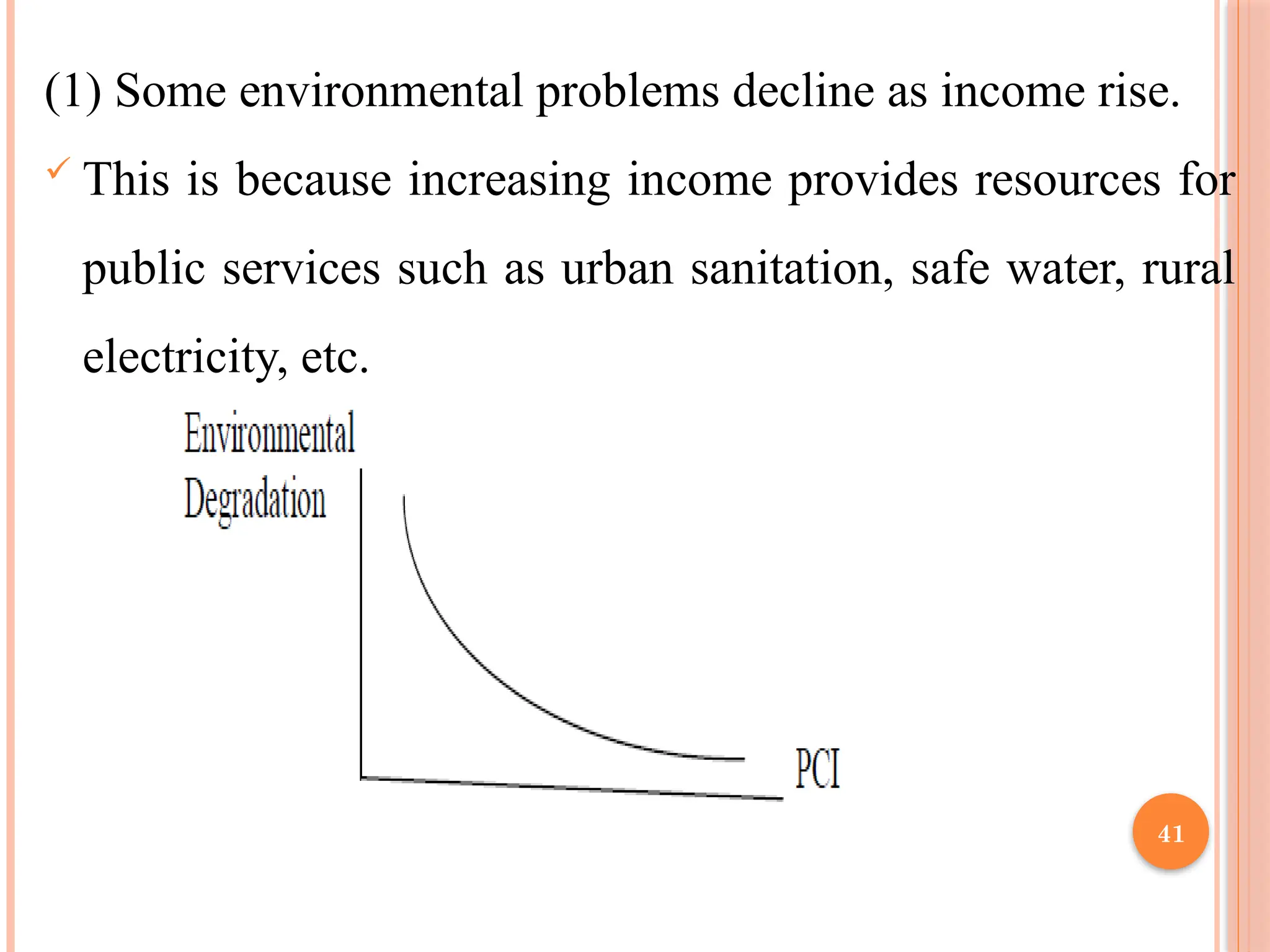
(1) Some environmental problems decline as income rise.
 This is because increasing income provides resources for
public services such as urban sanitation, safe water, rural
electricity, etc.
42
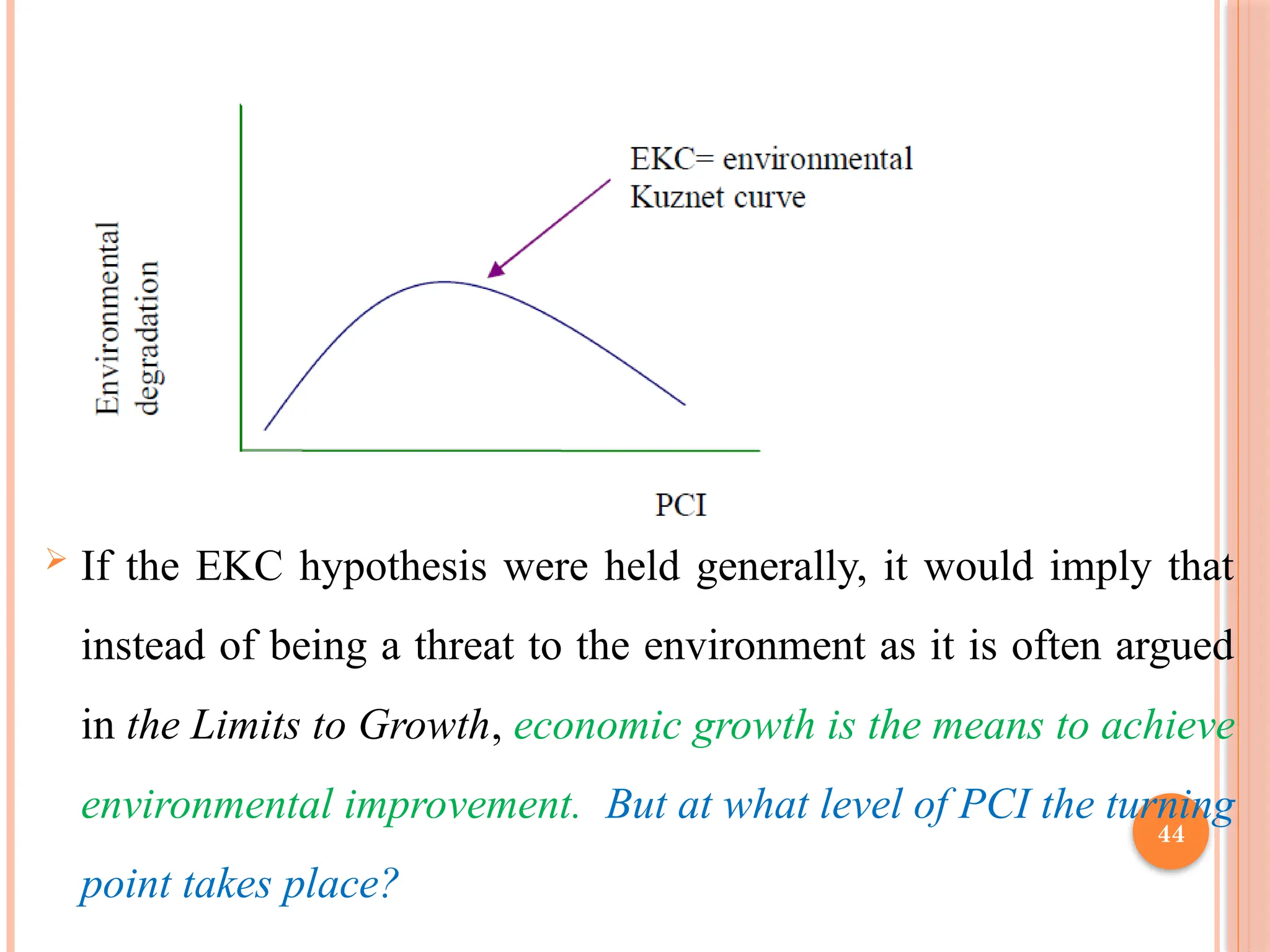
(2) Some environmental problems initially worsen but then
improve as income rise.
Example: air and water pollution
 At early stage of economic growth, people don't worry about
the environmental problems; they worry about increase in
their income.
 However, as their income rises, people attach high value to the
environmental quality; they need clean air, water, etc. As a
result, they start to take measures to reduce pollution, so
environmental degradation declines.
43
 The inverted-U shape relationship between
environmental degradation and per capita income is
usually referred to as the “environmental Kuznets
curve” (EKC), named after Kuznets.
 Kuznets (1955) hypothesized that pollution and other
environmental degradation first rises and then falls with
increases in income per capita, implying that economic
growth will eventually reduce environmental damages of
the early stages of it.
44
 If the EKC hypothesis were held generally, it would imply that
instead of being a threat to the environment as it is often argued
in the Limits to Growth, economic growth is the means to achieve
environmental improvement. But at what level of PCI the turning
point takes place?
45
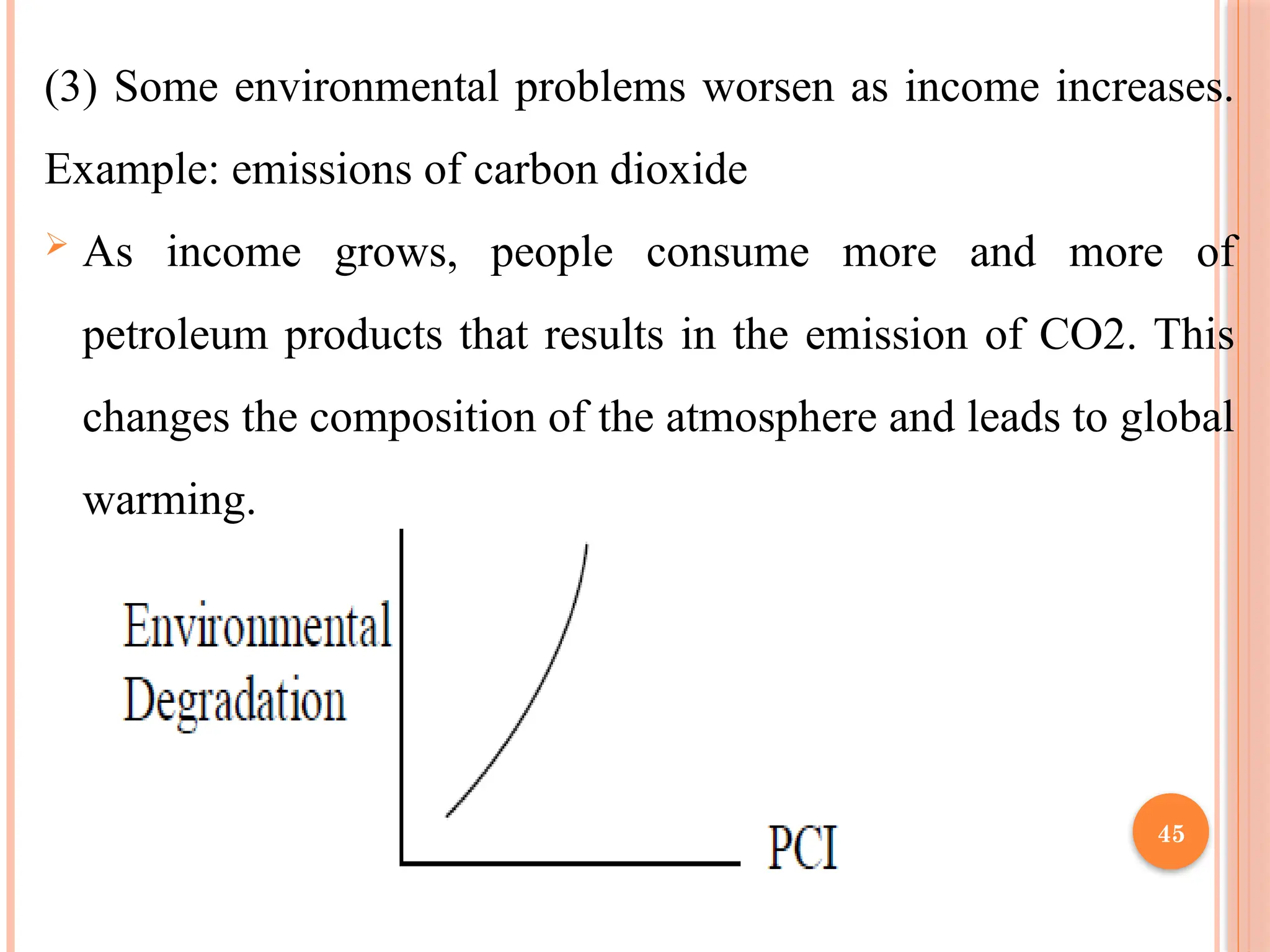
(3) Some environmental problems worsen as income increases.
Example: emissions of carbon dioxide
 As income grows, people consume more and more of
petroleum products that results in the emission of CO2. This
changes the composition of the atmosphere and leads to global
warming.
46
2.4. Sustainable development and economic policies
Sustainable Development
 The term sustainable development was first used in 1987
by the World Commission on Environment and
Development.
 In 1987 the World Commission on Environment and
Development (WCED) published the book entitled Our
Common Future, also known as the Brundtland
Commission, after the coordinator of the commission, Gro
Brundtland.
47
 The Brundtland Commission concluded that our
common future depends on sustainable development.
 The World Commission on Environment and
Development (the Brundtland Commission, 1987) defined
sustainable as :
Sustainable development is development that meets the
needs of the present generation without compromising the
ability of future generations to meet their own needs.
 The key concepts associated with the definition of
sustainable development are;
48
1) Needs: Sustainable development puts priority in meeting the
needs, in particular the essential needs of the world’s poor.
2) Limits on the ability of the environment to meet present and
future needs.
3) Equity. The goal of sustainable development is principally
equity rather than efficiency issues though it doesn’t mean that
efficiency is irrelevant to sustainable development.
 Thus, achieving sustainable development involves achieving
equity both within generations (intra-generation equity) and
across generations (inter-generational equity).
49
4) Fundamental ethical principle: the responsibility of
present generations to future generations
 According to sustainable development definition, those
who are enjoying the fruits of economic development
today must not make the future generations worse off by
excessively degrading the environment.
 The needs of the present should not be satisfied at the
expense of future needs (well-being).
 The concept of sustainable development is a broader
concept than economic growth.
50
 Economic growth: is an increase in the capacity of an
economy to produce goods and services, compared from
one period of time to another.
 In economics, economic growth is expressed in terms of
economic growth rate.
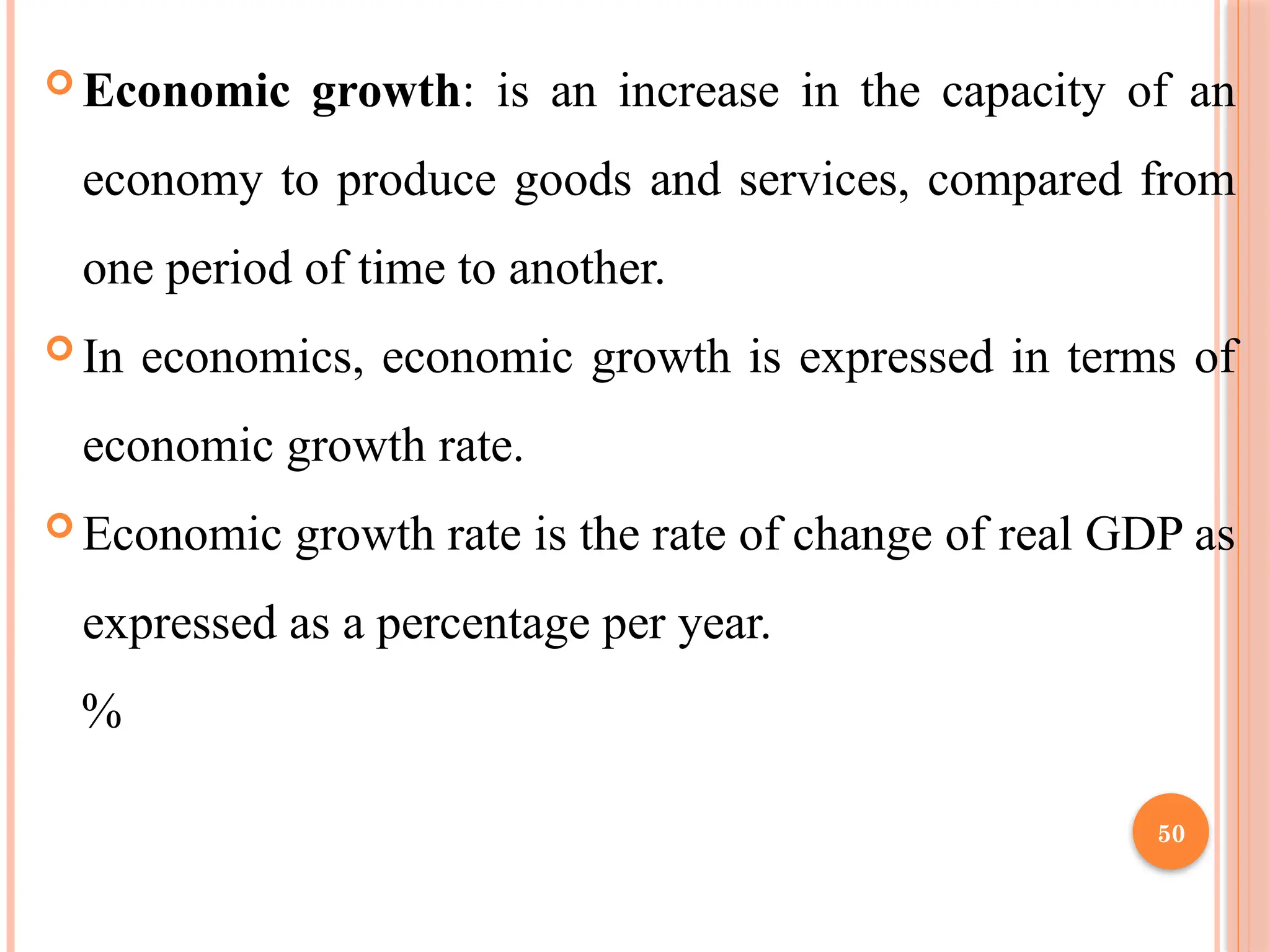
 Economic growth rate is the rate of change of real GDP as
expressed as a percentage per year.
%
51
 Sustainable development has three pillars:
 Economic Development –poverty reduction
 Social Development – active participation of women ,
education, good governance
 Environmental Development – prevent environmental
degradation and patterns of unsustainable development
 Sustainable development is environmentally conscious.
Objectives of sustainable development
The three pillars of sustainable development are its three
objectives:
52
1) Economic objectives
- It includes promoting economic growth , economic
stability and efficiency.
2) Social objectives
- It includes fulfilling people’s cultural, material, spiritual
needs in equitable manner.
3) Environmental objectives
- It includes maintaining and improving the long-term
validity of the ecosystem.
53
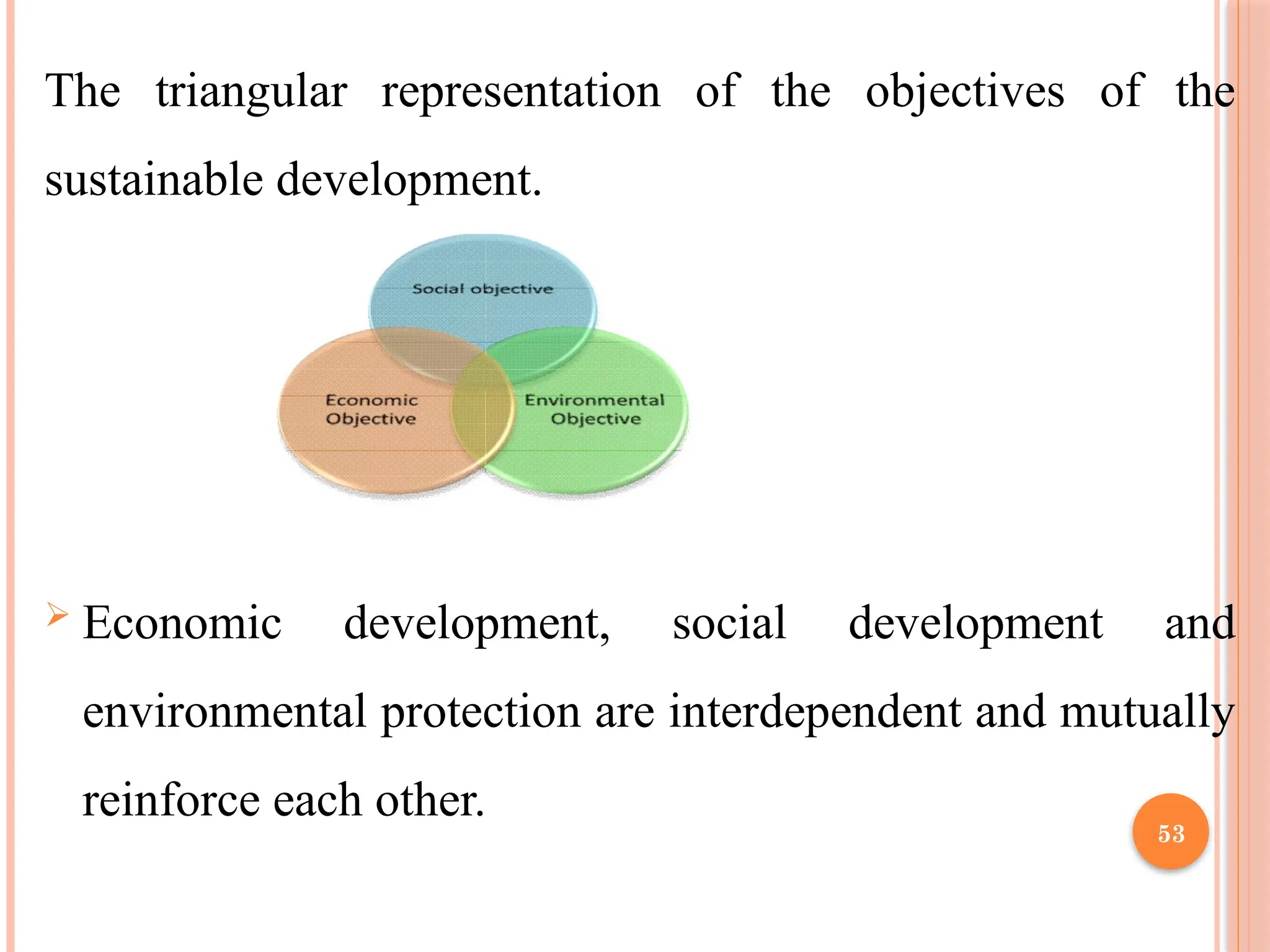
The triangular representation of the objectives of the
sustainable development.
 Economic development, social development and
environmental protection are interdependent and mutually
reinforce each other.
54
From the above discussions we can concluded that
sustainable development involves balancing between the
followings:
a) balancing between human needs & ability of the
environment to meet these needs .
b) balancing between the needs of the present & future
generations
c) balancing between the poor & the rich.
55
Targets of Sustainable Development
The two important targets of sustainable development are;
1. Respect for people -- improving the quality of human
life for a long time; and these qualities include:
- long and healthy life
- access to education
- decent standard of living
- political freedom
- guarantee on human rights, etc.
56
2. Respect for the ecosystem -- conserving the environment (or
protecting the world’s natural system). Development must
protect the structure, functions & diversity of the world’s
natural system. It includes:
- the need to conserve the life support system
- the need to conserve the biological diversity (all species of
animal & plants)
- ensure that all uses of renewable resource are sustainable
- minimize the depletion of non-renewable resources via
recycling, efficiency and switching to renewable substitutes
57
Signs of unsustainable Development
Are we achieving sustainable development?
 The experiences are of course discouraging.
 There are some signs of unsustainable development.
1) Poverty
 More than a billion people live in absolute poverty.
 One fifth of them can not get enough food.
 Every year million of children die from malnutrition &
preventable diseases.
58
2) Increasing population and consumption of resources
 Since industrial revolution, the population has increased 8
folds.
 Water withdrawal has grown from100 – 4000 km 3/year.
3) Resource Depletion
 In less than 200 years, the planet has lost 6 million km2 of
forests.
 Every year 700,000 km2 of agricultural land has been
made unproductive.
59
4) Pollution
 It is becoming a major problem in industrialized counters.
 It affects the health of the people; e.g. cancer.
5) Global climate change
 Because of global warming, the world temperature has
been increasing, and rain fall has been decreasing.
6) Debt problems
 The cumulative debt of low income countries is more
ƒ
than 1 trillion and the interest payment has reached 60
million dollar per year.
60
Weak Vs. Strong Sustainability
I. Weak sustainability (Hartwick-Solow sustainability)
- Weak sustainability theory has been developed from
economic models of growth and technological change in
the context of limited resources.
- A central idea of weak sustainability theory is the
assumption that man-made capital and natural capital are
substitutes.
61
 Thus, according to this view, sustainability simply requires
maintaining total capital stock ( Km + Kn) constant.
 Composition of capital stock is not relevant.
 Thus, natural capital may not be considered as an absolute
necessity or natural capital is a non-binding constraint to
sustainability.
 If man-made and natural capitals are substitutes, depletion
of exhaustible resources and large-scale degradation of
environmental quality need not be a major concern.
62
 If decrease of natural capital is compensated by the
increase in the man-made capital, there is sustainable
development.
 Weak sustainability criterion does not consider natural
capital as an absolute must for continued economic
growth.
II. Strong sustainability (Ecological economics )
 According to this perspective, human-made capital
cannot effectively substitute for natural capital.
63
 Rather, the two components of capital are complements.
 A combination of both types of capital assets is needed in
the production process.
 Thus, sustainability requires maintaining natural capital
(Kn) non-declining /constant.
 An economy cannot continue to function without natural
capital.
 Furthermore, it is expected that natural capital will be the
limiting factor in the future.
64
Sustainability according to Viederman (1996)
 Sustainability is a community’s control and prudent use of
all forms of capital to ensure that present and future
generations can attain a high degree of economic security
and achieve democracy while maintaining the integrity of
the ecological systems upon which all life and production
depends.
 Viederman identified five forms of capital for sustainable
development that shape, and are shaped by, human
society.
65
1) natural capital
2) human capital
3) human-created capital
4) social capital and
5) cultural capital
 Natural capital – is the value of the existing stock of
natural resources (forests, fisheries, water, mineral
deposits, etc. ) and the environment in general.
66
- Natural capital generates the flow of natural resources
(e.g., harvest of fish from fisheries, harvest of trees from a
forest, grazing of livestock on rangeland) and ecosystem
services (e.g., oxygen from forests, freshwater filtration
from watersheds, nutrient cycling in wetlands) upon
which human society depends.
- Natural capital is vulnerable to resource degradation
from the over-harvesting/over-extraction of natural
resources and pollution that results from the exhaustion
of environmental sinks.
67
 Human capital is a term used for human knowledge,
skills, and capabilities that create a larger and more
valuable flow of labor and volunteer services.
- Human capital is created by investments in education and
health.
 Human-created capital is comprised of technologies,
production facilities (e.g., factories, offices, laboratories,
roads and other infrastructures), and inventory of products
that economists traditionally think of as “capital stock.”
68
- Investment increases the stock of created capital, which in
turn provides a larger flow of goods and services.
 Social capital refers to the stock of “civic virtues” and
networks of civic engagement, involvement, mutual
norms, and trust essential to build democratic
communities.
 Cultural capital refers to the body of knowledge, stories,
visions, myths, and languages shared by people and
providing the framework for how people view the world
and their proper role in it.
69
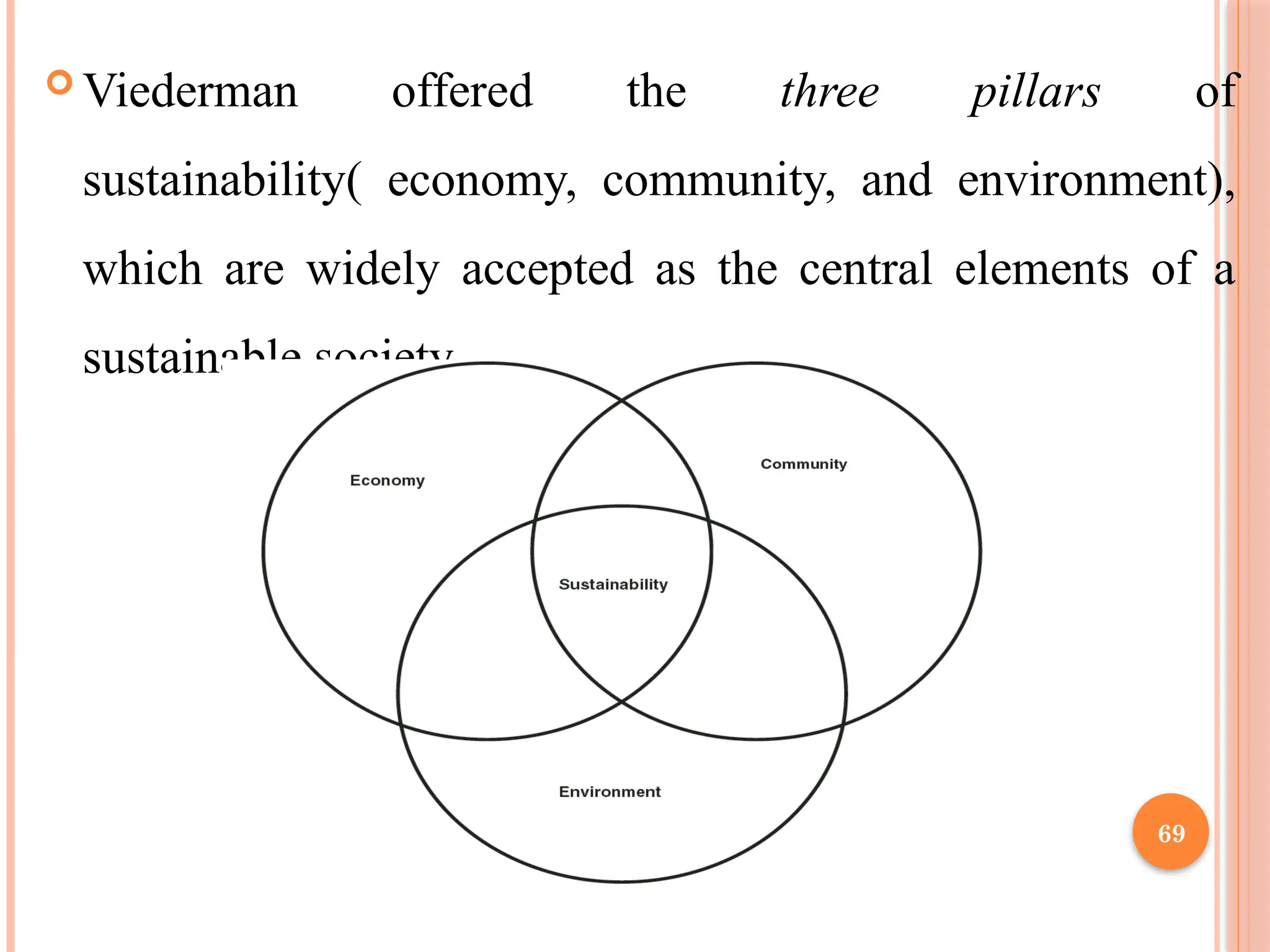
 Viederman offered the three pillars of
sustainability( economy, community, and environment),
which are widely accepted as the central elements of a
sustainable society.
70
National Income and Green Accounting
 Sustainable development analysis differs from the
standard analysis of economic growth and development .
 Traditional national income accounting measures (GDP ,
GNP, per capita income, etc., ) are commonly used to
measure a country’s level of economic activity and
progress in development, with GDP being the most
frequently used measure.
71
 Macroeconomic analyses and international comparisons
are based on these measures, and they are widely
recognized as important standards of economic progress.
 However, many analysts have pointed out that these
measures give a highly misleading impression of
economic and human development.
 Can we say that a country with a higher per capita income
is necessarily better off than a similar country with a
lower per capita national income?
72
 The overall well-being of a country is dependent on many
factors other than income levels, including health,
education levels, social cohesion, and political
participation.
 From the point of view of environmental analysis, a
country’s well-being is also a function of natural capital
levels and environmental quality.
 Thus, GDP is never used as an accurate measure of a
country’s well-being.
73
 But politicians and economists often place
disproportionate importance on GDP and they consider
maximizing it as the primary objective of public policy.
 But maximizing GDP can conflict with other goals such
as promoting social equity or protecting the environment.
 In our study of environmental issues, the traditional
national income accounting measures fail to account for
√ Environmental assets and their functions
√ Environmental degradation and resource depletion as a social cost of
economic activity.
74
 Contemporarily, there are attempts to adjust or replace
traditional accounting measures to include the
environment in national accounting – green accounting/
environmental accounting.
 Green accounting is a general term applied to efforts to
incorporate natural resources and environmental quality
into national accounting techniques.
 Green accounts provide data on the contribution of
natural resources to economic well-being and the costs
imposed by pollution and resource degradation.
75
 The most basic approach to green accounting is to start
with traditional measures and make adjustments that
reflect environmental concerns .
 The following approaches to environmental accounting
adjust traditional national accounting measures to account
for natural capital depreciation and environmental
damage.
 Environmentally adjusted net domestic product
 Adjusted Net Savings/Genuine Savings
76
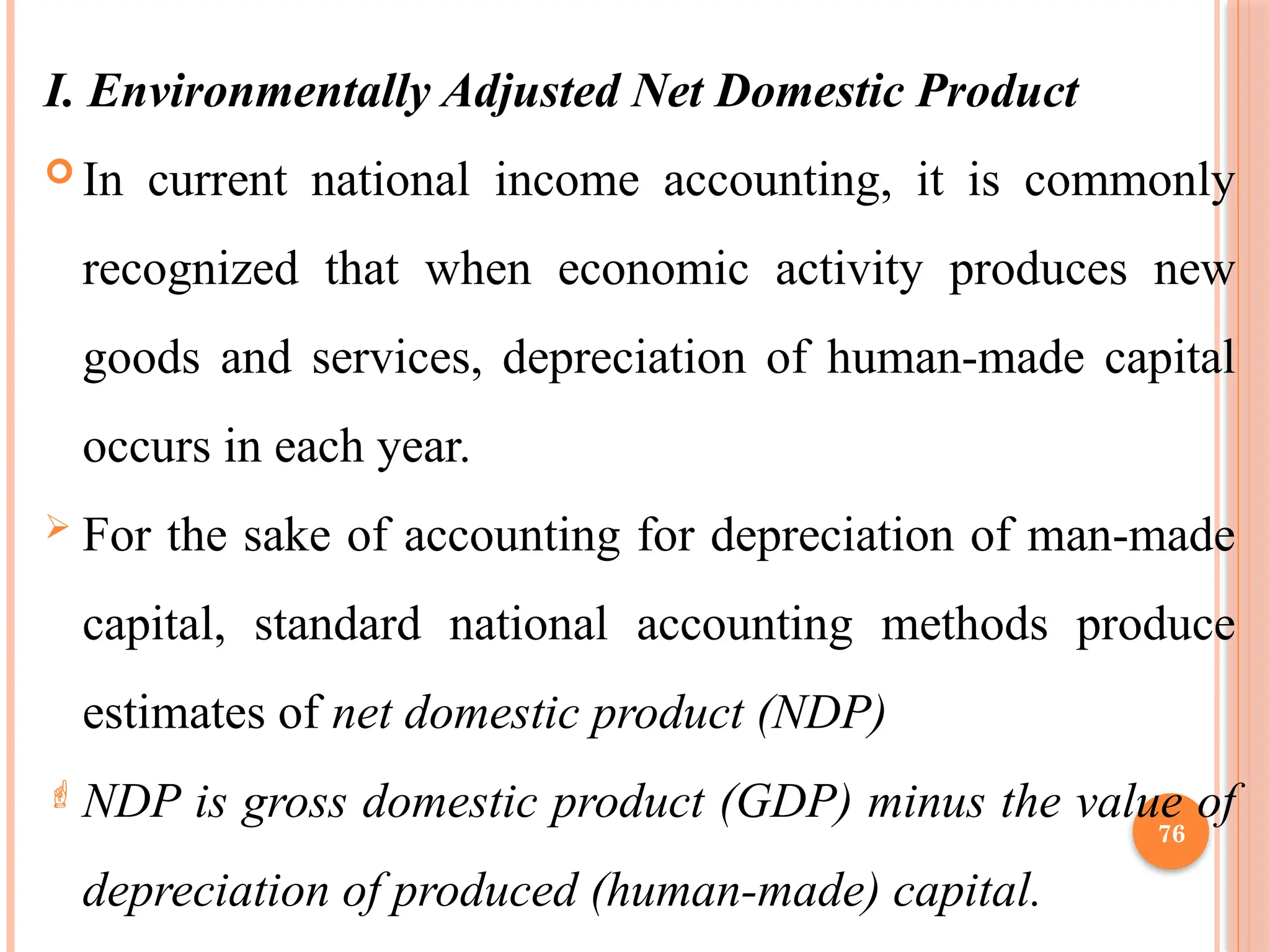
I. Environmentally Adjusted Net Domestic Product
 In current national income accounting, it is commonly
recognized that when economic activity produces new
goods and services, depreciation of human-made capital
occurs in each year.
 For the sake of accounting for depreciation of man-made
capital, standard national accounting methods produce
estimates of net domestic product (NDP)
 NDP is gross domestic product (GDP) minus the value of
depreciation of produced (human-made) capital.
77
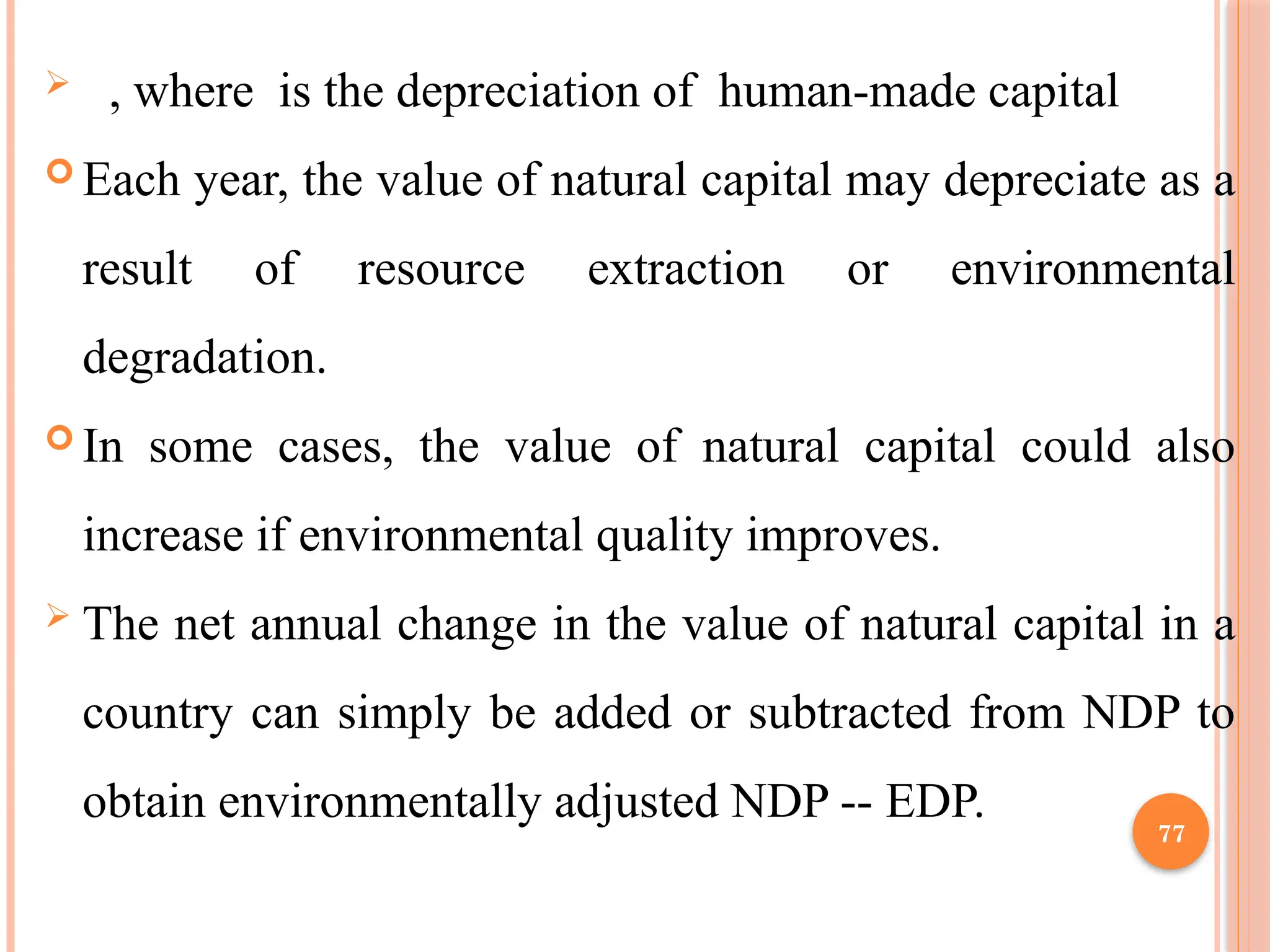
 , where is the depreciation of human-made capital
 Each year, the value of natural capital may depreciate as a
result of resource extraction or environmental
degradation.
 In some cases, the value of natural capital could also
increase if environmental quality improves.
 The net annual change in the value of natural capital in a
country can simply be added or subtracted from NDP to
obtain environmentally adjusted NDP -- EDP.
78
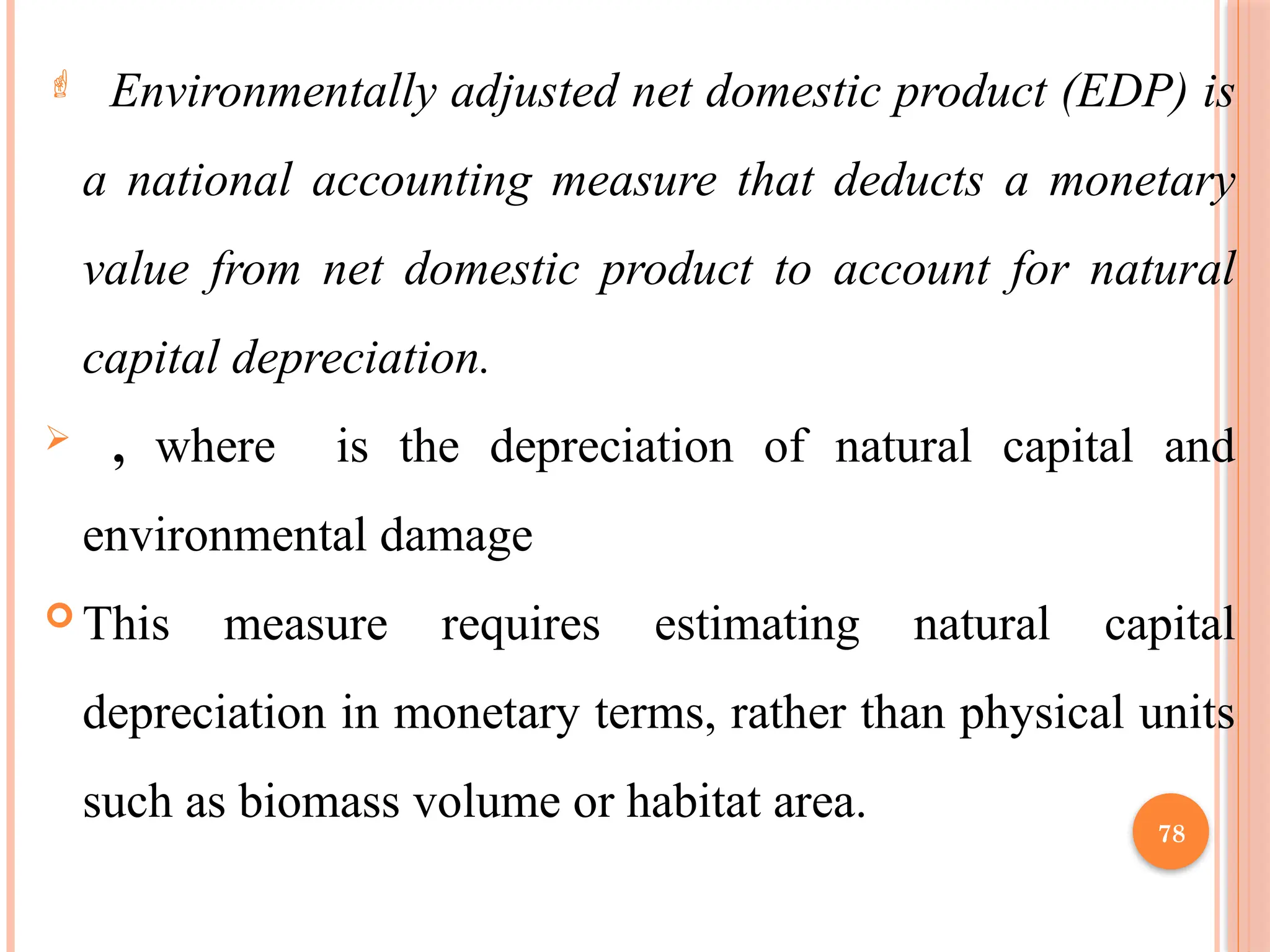
 Environmentally adjusted net domestic product (EDP) is
a national accounting measure that deducts a monetary
value from net domestic product to account for natural
capital depreciation.
 , where is the depreciation of natural capital and
environmental damage
 This measure requires estimating natural capital
depreciation in monetary terms, rather than physical units
such as biomass volume or habitat area.
79
 Natural capital depreciation is a reduction in national accounting
for loss of natural capital, such as a reduction in the supply of
timber, wildlife habitat, or mineral resources.
Important points:
1) Natural capital depreciation amounts a significant
portion of GDP.
 E.g. EDP is normally about 20 percent lower than GDP
in Indonesia during 1971-1984.
80
2) Measuring the growth of GDP to illustrate changes in
social welfare may not produce accurate results.
 For instance, in Indonesia, GDP grew at an annual rate of
7.1%. However, EDP only grew at an annual rate of 4%
during 1971–1984.
 This shows that much of the apparent growth was at the
expense of the environment.
3) Monetization of natural capital needs to be approached
carefully.
81
 If we measure the value of natural capital at market
prices, we can lose important information regarding the
actual physical stock of those resources.
 For instance, in Indonesia, there was a noticeable spike in
EDP in 1974. Does this indicate an appreciation of natural
capital and an environmental improvement?
 Not necessarily. In 1973-1974, there was a dramatic
increase in world oil prices, rather than a change in oil
reserves in the country.
82
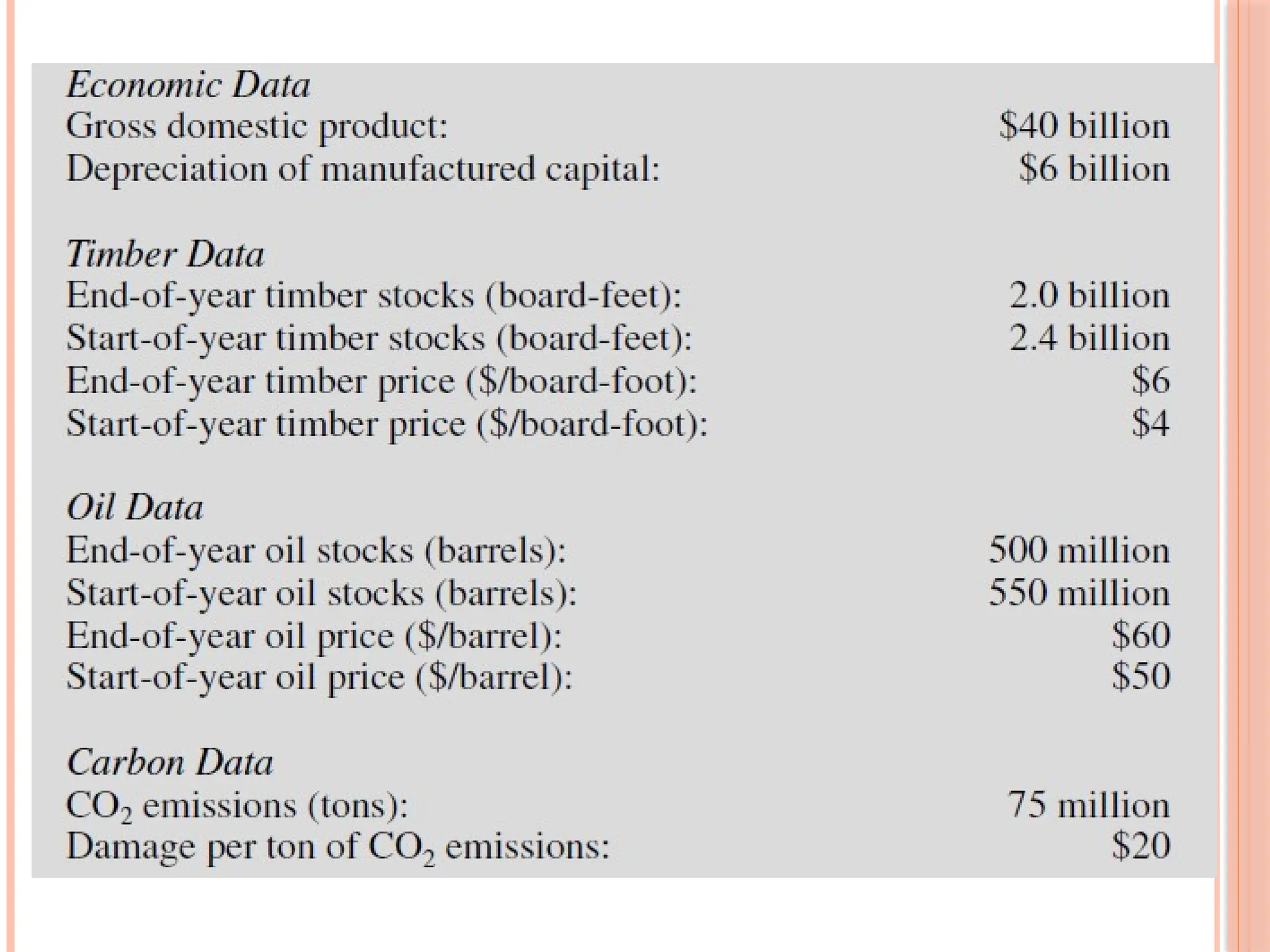
 Example: Suppose you have been hired by the developing
country of Equatoria to calculate its environmentally
adjusted net domestic product (EDP). Assume for
simplicity that only three adjustments need to be made to
account for natural capital depreciation and pollution
damages: timber capital, oil capital, and carbon dioxide
damages.
You have been given the following data:
What is the EDP for Equatoria?
83
84
 Solution: For timber and oil, you will need to calculate
the value of depreciation, or appreciation, as the change in
the total market value of the resource during the year,
where total market value is the physical quantity times the
resource price.
 NDP =GDP- Dm=$34 billion
EDP=NDP- Dn= $34 billion- $6.4 billion= $ 27. 6 billion
But, Dn= Change in total market value of timber and oil
+ total CO2 emissions damage = $ 2.4 billion + $ 2.5
billion + $ 1.5 billion= $ 6.4 billion
85
II. Adjusted Net Savings/Genuine Savings
 Traditional national accounting methods also estimate
saving and investment rates.
 These accounts provide some insight into how much a
country is saving for its future.
 Gross domestic savings: includes savings by
governments, businesses, and individuals
 Net domestic savings (NDS): is a national accounting
measure equal to gross domestic savings less
manufactured capital depreciation.
86
 Net domestic saving can be positive or negative.
 We can adjust net domestic savings to incorporate how a
country manages its natural resources and environmental
quality.
 This provides information about whether the country is
saving for the future or causing depletion that may make
future generations worse off.
87
 Adjusted net savings (ANS): is a national accounting
measure developed by the World Bank which aims to
measure how much a country is actually saving for it its
future generations.

 ANS is also called genuine Savings.
 Genuine savings are savings adjusted not for depreciation
of the man made capital stock but also for depletion of
natural resource and degradation of the environment.
88
 The concept of genuine savings is implied from the
definition of weak sustainability.
 If genuine saving is persistently negative, then it
indicates the total capital stock available to future
generations has been eroding--a clear indication of
unsustainability.
 Note that high dependency of natural resource results in
lower genuine savings.
 Countries which highly depend on natural resources have
lower genuine savings, and vice versa.
89
Environmental asset accounts/natural resource accounts
 Any index that monetizes various environmental factors
and combines the results with traditional monetary
aggregates (GDP) implicitly assumes a degree of
substitutability among natural capital and human-made
capital.
 Thus, measures like EDP and ANS address weak
sustainability but not stronger forms of sustainability.
90
 If we are interested in achieving strong sustainability, we
need to concern ourselves with the preservation of natural
capital.
 A further distinction exists between strong sustainability
and very strong sustainability.
 Strong sustainability- seeks to maintain the overall level
of natural capital but allows the substitutability of
different types of natural capital, at least for noncritical
resources.
91
 Very strong sustainability- seeks to maintain the levels of
various types of natural capital, allowing for substitutability
only within each category of natural capital.
 An alternative approach is to maintain national accounts
that measure the levels of different types of natural capital
and environmental impacts in either physical or monetary
units---- environmental accounts / natural resource
accounts.
 These accounts are based on defining various natural capital
categories, such as:
92
- timber resources
- mineral resources
- agricultural land, and
- Groundwater
 The accounts may have different degrees of aggregation.
 The accounts can be expressed in physical and monetary
units.
 The two main strengths of environmental asset accounts
in physical units are:
93
(1)They provide a detailed picture of a country’s natural
capital levels and trends over time.
(2) They provide a means for assessing very strong
sustainability.
 Since each category of natural capital is quantified in a
separate account, policy makers can determine whether
the levels of each are being maintained.
 Environmental asset accounts can also be expressed in
monetary units.
94
 This simply involves multiplying a physical unit estimate
by the market price per unit.
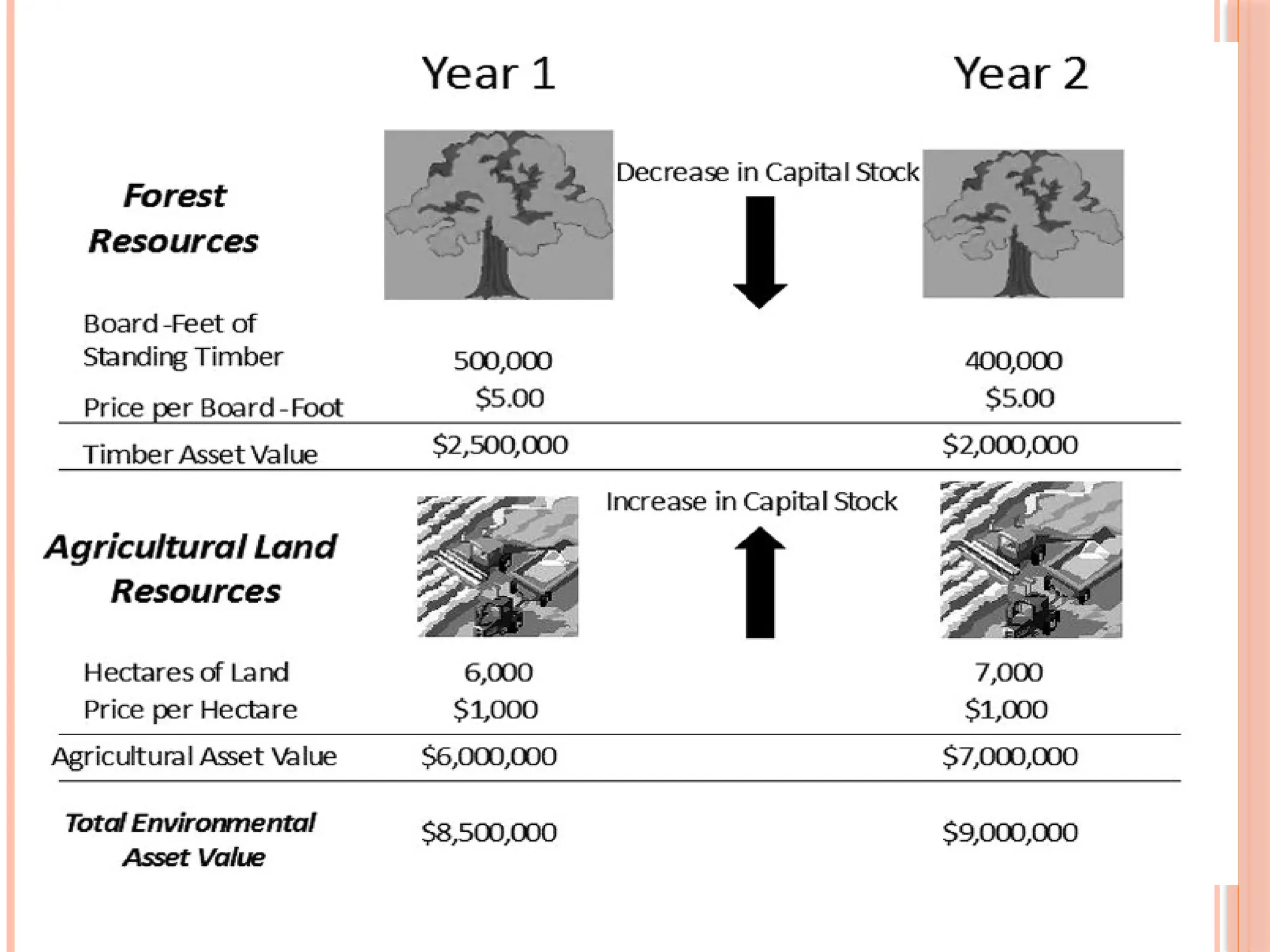
 Example: if a society has a standing timber stock of
500,000 board-feet and the market price is $5.00 per
board-foot, then the asset value of their timber is $2.5
million.
 Comparing different assets in monetary units has both
advantages and disadvantages.
95
Advantages:
i. Environmental asset accounts in monetary terms offer
the benefit of comparability, among different types of
natural capital and to GDP.
ii. Environmental asset accounts in monetary units can be
used to give an overall measure of sustainability
because gains and losses in different categories can be
compared.
 Example: assume there are only two natural resource
assets in a society: timber and agricultural land
96
.
97
Does overall level of natural capital of the society increase?
 If we kept asset accounts only in physical units, we would
not be able to assess the society’s overall level of natural
capital.
 But , the value of its natural assets has actually increased
by $0.5 million.
Disadvantages:
i. Changing in prices may give misleading information on
society’s stock of natural assets.
98
 Suppose that the price of timber increased in Year 2 to $7.00
per board-foot. Even though the stock of timber was reduced
by 100,000 board-feet, the value of the stock in Year 2 would
be $2.8 million.
ii. Monetary value estimates do not consider non-market values,
such as ecosystem services.
 In general, incorrect accounting leads to incorrect policies. If
economists accept conventional estimates, such as GDP), then
their policy recommendations are likely to be wrong in the
case of natural resource dependent economies.
99
Policies for Development and the Environment
 If policies for development and environmental quality are
properly designed and implemented, they can
complement or substitute each other.
 To overcome the causes of environmental damages, two
category of policies are required (available):
1. Win-win Policies
2. Forgotten environmental policies
100
Win-win Policies
 These are policies that aim to improve both economic
efficiency and the environment. These policies include:
a. Correcting (preventing) policy failures.
 Policy failure: occurs when inappropriate government
policies, or an absence of required policy, result in market
distortions for natural resource use, aggravated market
failures, and natural resource degradation.
101
 Policy failures lead to both ecological and economic
damages.
Examples:
- Eliminating subsidy for the use of fossil fuels
- Eliminating subsidy on chemical fertilizers etc.
b. Improving access to resource and technology.
Examples:
- Defining property right (improves over grazing, over
fishing)
- Use of better technology (↓environmental degradation).
102
c. Promoting equitable income and growth.
 The poor people are the main agents and victims of
environmental degradation.
 Thus, poverty reduction is not only attacking poverty as a
moral imperative, but it is also essential for improving
environmental quality.
 Win – win policies may also include
 Investing in human resource/human capital investment (education, health,
nutrition, family planning, etc.)
 Investing in a better sanitation & safe water, and
103
 Improved research & extension services can improve the environment
and raise incomes.
Forgotten Environmental Policies
 The win-win policies are not enough to ensure
environmental quality.
 Before the past two decades, the world relied more on
markets and less on government to promote development.
 However, environmental protection is one area in which
government must maintain a central role.
104
Example: Dumping of wastes in public waters, or the over
use of land whose ownership is unclear, etc.
 Markets provide little or no incentive for curbing these
damages.
 Strong public institutions and policies for environmental
protection are essential.
 The forgotten environmental policies aim at changing the
behavior of polluters . These policies include:
a. Policies based on incentives
105
E.g. Taxation-government charges polluters according to the amount
they pollute.
b. Policies based on quantitative restrictions (command and control
policies).
E.g. Setting emission standards- a legal limit on how much pollutant a
firm emits.

NR_chapter_one_and_two_-2024[1].pptx eco

  • 1.
    1 Chapter One: Introduction 1.1.Introduction to the subject matter  Natural resource and environmental economics is the application of the principles of economics to the study of how natural and environmental resources are developed and managed.  As its name indicates the subject has two parts:  Natural resource economics  Environmental economics
  • 2.
    2  Although theyare a very close concepts, narrowly defined they are distinct disciplines. The difference between these two sub-fields is primarily a matter of focus. Natural resource economics is the study of how society allocates scarce natural resources such as stocks of fish, stands of trees, fresh water, oil, and other naturally occurring resources.
  • 3.
    3  It isconcerned with optimal allocation of natural resources in the present as well as in the future, i.e. inter-temporal resource allocation.  Environmental economics studies alternative environmental policies to deal with environmental problems (air pollution, water pollution, toxic substances, solid waste, global warming, land degradation, etc.).  It is concerned with the conservation of natural environments and biodiversity, the way wastes are disposed of to bring about quality of air, water, and soil.
  • 4.
    4  In environmentaleconomics, the primary focus is how to manage the natural environment (air, water, and landmass) as a valuable resource. However, in natural resource economics the emphasis is on the inter- temporal allocation of natural resources.  Narrowly defined, environmental economics is distinct from its sister discipline, natural resource economics.  Environmental economics is concerned with  welfare economics ,  economics of pollution,  valuation theory and  environmental policies Brown issues
  • 5.
    5  Natural resourceeconomics is concerned with the optimal utilization of natural resource – green issues  Brown agenda focuses on improving human well-being by reducing direct threats to human health, particularly by improving water, sanitation and housing.  Green agenda focuses on ecosystem protection for sustainable development, by preventing resource degradation and the loss or deterioration of natural life- support systems.
  • 6.
    6  Broadly defined,environmental economics is concerned with both green and brown issues.  Hence, in the broad sense, environmental economics is not distinct from its sister discipline, natural resource economics. What are natural and environmental resources? Natural resources- resources provided by nature that can be divided into increasingly smaller units and allocated at the margin. - They can be living or non-living things endowed by earth.
  • 7.
    7 - They serveas inputs to the economic system. - They are currently being exploited or potentially can be exploited by human beings as a source of food, raw materials, energy, etc. Environmental resources – resources provided by nature that are indivisible. - Environmental resources are affected by the economic system (e.g. pollution).
  • 8.
    8  Natural resourcesare generally grouped into two major categories: renewable and non-renewable natural resources.  Renewable resources are those resources that are capable of regenerating themselves within a relatively short period, provided the environment in which they are nurtured is not unduly disturbed. - Examples include plants, fish, forests, soil, solar radiation, wind, tides, etc.
  • 9.
    9  Non-renewable resourcesare resources that are formed by geological processes over millions of years and exist as fixed stocks which, which once extracted, cannot be renewed. - Their re-generative capacity can be assumed to be zero for all practical human purposes. - Examples of these resources include metallic minerals (iron, aluminum, copper, and uranium; and non-metallic minerals (fossil fuels, clay, sand, salt, and phosphates).
  • 10.
    10  Environment: - isthe Earth and its atmosphere. - refers to the living (organisms) and non-living (such as temperature, rainfall, day length, wind, and ocean) components of the natural world, and to the interactions between them, that support life on earth.  Ecosystem – are organisms living in a particular environment, such as a forest or a coral reef, and the physical parts of the environment that affect them.
  • 11.
    11 Why Study NaturalResource and Environmental Economics?  Market failures. Markets, and thus prices, often do not exist for natural and environmental resources. Thus, government intervention may be appropriate.  Dynamics. The decision to use natural resources today does affect what will be available tomorrow.  Irreversibility. Damage to natural resources has long-term effects.
  • 12.
    12  Linkages betweenthe economy and ecosystem 1.2. Inter-linkage between the environment and the economy  Economic activity takes place within, and is part of, the environment.  There is a two-way relationships between the economy and the environment. - In economics, the environment is viewed as a composite asset that provides a variety of services.
  • 13.
    13  The environmentprovides the following functions or services for the economy. (1) Source of energy and raw materials. It provides the economy with raw materials, which are transformed into consumer products by the production process, and energy, which fuels this transformation. (2) Sink of wastes (residuals). It absorbs waste products from the economy or serves as sink of wastes/ residuals of production and consumption.
  • 14.
    14 - The rawmaterials and energy used in the production process return to the environment as waste products. (3) Serves as a life support to sustain human life. The environment also provides services directly to consumers. - The air we breathe, the nourishment we receive from food and drink, and the protection we derive from shelter and clothing are all benefits we receive, either directly or indirectly, from the environment.  It is a very special asset because it provides the life-support systems that sustain our existence.
  • 15.
    15 (4) It providesaesthetic values. - The environment provides us with varieties of amenities (recreational services) for which no substitute exists.  If the environment is defined broadly enough, the relationship between the environment and the economic system can be considered as a closed system.  A closed system is one in which no inputs (energy or matter) are received from outside the system and no outputs are transferred outside the system.  An open system, by contrast, is one in which the system imports or exports matter or energy.
  • 16.
    16 Fig 1. TheEconomic System and the Environment
  • 17.
    17  The knowledgeof the relationship between the environment and the economy help us to design an appropriate policy that prevents undue depreciation of the environment, so that it may continue to provide its services.  Modern ecologists, “the environment possesses a unique ‘carrying capacity’ to support humans, and once that capacity is exceeded widespread ecological destruction occurs with disastrous consequence for humanity.” Thus, the focus is no longer on individual societies but on the survival of the planet.
  • 18.
    18 1.3. The prospectof economic growth: two views  Will economic growth continue in the future? Does the environment impose constraints on economic growth in the future?  There are two views: 1. pessimist view 2. optimist view The Pessimist View The pessimists believe in; √ Natural and environmental resources are finite. √ The waste assimilation capacity of the environment is limited.
  • 19.
    19  Economic growthis ultimately unsustainable, i.e., there are limits to economic growth.  The limits to economic growth can arise from i) The depletion of non-renewable natural resources - Economic growth process uses successive large amount of natural resources until they are gone. - Finally, the society will run out of non-renewable resources on which the industrial base depends. - When the resources have been depleted, the economic system will collapse resulting in;
  • 20.
    20  Massive unemployment Decreased food production  Decline in population as death rate soars.  Thus, economic growth is ultimately limited by resource constraints. ii) Excess waste (pollution) generated by continued economic growth (industrialization) - Continued economic growth (industrialization) generates more waste and hence raises the level of global pollution.
  • 21.
    21 - Given itslimited waste assimilation capacity, the environment will eventually be unable to absorb any more waste (pollution) resulting from continued economic growth (industrialization).  This ultimately leads to ever increasing environmental degradation -- reduction in the quantities and qualities of environmental services , and hence increased difficulty of the environment in sustaining economic growth.
  • 22.
    22 The main conclusionsof the pessimistic models are; (1) If the present growth trends in world population, industrialization, pollution, food production and resource depletion continue unchanged, the limits to growth on this planet will be reached within the next 100 years and the world society will collapse.  The most probable result will be a sudden and uncontrollable decline in both population and industrial capacity.
  • 23.
    23 (2) A piecemealapproach to solving the individual problems will not be successful. - If the depletion of non-renewable natural resources and pollution problems were somehow jointly solved, population would grow and the availability of food would become the binding constraint.  The removal of one limit merely causes the system to bump into another one.
  • 24.
    24 (3) Overshoot andcollapse can be avoided only by an immediate limit on population & pollution, and cessation of economic growth. The pessimist scenario shows only two possible outcomes:  the termination of growth by self restraint and conscious policy -- an approach that avoids the collapse, or  the termination of growth by collision with the natural limits, resulting in societal collapse.  Thus, according pessimistic view, one way or the other growth will cease.
  • 25.
    25 Base run projectionsof the ‘limits to growth model’
  • 26.
    26 The Optimist View Like pessimists , the optimists believe in the existence of √ Limited natural resources or resource scarcity √ Limited assimilative capacity of the environment.  However, the optimists believe that , with the existence of these constraints, it is possible to attain infinite or sustainable economic growth. This is because; i) Market system - The market system can keep the scarce resources from depletion or exhaustion by increasing their prices.
  • 27.
    27  When pricesof the resources increase, people will decrease their consumption by substituting them with human made raw materials. ii) Technological advancement - Technology can help the environment in assimilating the wastes. - Technology also helps us to reuse the byproducts so that the assimilative capacity of the environment can be improved.  Therefore, the optimists believe that indefinite economic growth is possible.
  • 28.
  • 29.
    29 Chapter Two Some Issueson the Environment and Development 2.1. The environment and emerging development issues  For a long period of time, the issue of the environment is ignored in the development process.  This is partially because of the special consideration given for environmental good.  Because of the problem of market failure, natural and environmental resources were not considered as economic good.
  • 30.
    30  For agood to be considered as economic good, - it must be marketable (tradable) - it must provide utility - it must be relatively scarce  Even in the 1950's and 1960's natural and environmental resources were considered as free goods.  Because of this, a number of problems have been happened to the environment, and have resulted in environmental degradation.
  • 31.
    31  Environmental degradationis the deterioration of the environment in quality, quantity or diversity/composition.  The forms of environmental degradation include: - rapid deforestation - land degradation - excessive soil erosion - watershed degradation - fuel-wood and water shortages - over-grazing - over-fishing - loss of bio-diversity - pollution - urban congestion, etc.
  • 32.
    32  In thelate 1960's and 1970's, the concern of environmental degradation began in the industrialized countries and was extended to less developed countries by the 1980's.  Thus, it is only after 1980s that environmental issues were treated as development issue and people observe that development is related to the environment.  The various forms of environmental degradation, if left unchecked, will undermine the economic development.
  • 33.
    33  The protectionof the environment was considered as an essential part of development without which development will be undermined.  Who is the victim of environmental problems?  Both developed and developing countries.  However, the most pressing issues in LDCs are not necessarily the same as in the developed countries.
  • 34.
    34  The mostimmediate environmental problems facing developing countries include; - unsafe water - deforestation - Soil depletion - indoor smoke (from use of biomass fuel such as wood, straw, dung) - Outdoor smoke (from coal burning).
  • 35.
    35  But fordeveloped countries, the main concerns are issues; - global warming– an increase in the world’s temperature caused by increased concentrations of greenhouse gases (carbon dioxide, methane, nitrous oxide &hydro fluorocarbons) in the upper atmosphere.  Accumulation of greenhouse gases in the upper atmosphere traps the heat reflected from the earth's surface, which increases surface temperatures.
  • 36.
    36 - depletion ofozone layer – is caused by chlorofluorocarbons which erode the protective ozone layer and allow more solar radiation to penetrate the atmosphere. - acid rain and - hazardous waste materials.  However, the environmental problems of less and more developed countries are not completely independent of each other.
  • 37.
    37  Carbon dioxideemissions that come primarily from rich countries causes greenhouse effect everywhere; less developed countries are also affected by the global warming.  Loss of biodiversity due to destruction of tropical rainforests in less developed country is a problem for more developed countries as well. Poverty and the environment  poverty leads to environmental degradation and environmental degradation worsen poverty.
  • 38.
    38 2.2. Population growthand the environment Population growth leads to environmental degradation in two ways: 1. Population growth increase the demand for goods and services this cause environmental degradation 2. It produces more waste and creates additional stress on the assimilative capacity of the environment.  Assimilation is the natural capacity of the environment to decompose residuals/wastes to the environment either chemically or biologically.  Thus, population growth intensifies environmental problems.   Population Human Activity Production & Consumption Resource ConsumptionDepletion of Resources & Waste Accumulation.
  • 39.
    39  Hence, thereshould be policies for reducing population growth rate. Some of the policies used to reduce population growth include;  Family planning: Access to family planning should be increased.  Education: Educate the people to the benefit of having small family.  Economic incentives and disincentives  Marriage age law: Legislating and implementing legal law that specifies the minimum age for marriage.  Using force
  • 40.
    40 2.3. Economic growthand the environment  As stated earlier, environmental problems differ substantially between less and more developed countries.  This is because most environmental problems tend to vary with economic growth.  Does this mean that economic growth lead to environmental degradation?  Generally there are three patterns of relationship between economic growth and environmental degradation.
  • 41.
    41 (1) Some environmentalproblems decline as income rise.  This is because increasing income provides resources for public services such as urban sanitation, safe water, rural electricity, etc.
  • 42.
    42 (2) Some environmentalproblems initially worsen but then improve as income rise. Example: air and water pollution  At early stage of economic growth, people don't worry about the environmental problems; they worry about increase in their income.  However, as their income rises, people attach high value to the environmental quality; they need clean air, water, etc. As a result, they start to take measures to reduce pollution, so environmental degradation declines.
  • 43.
    43  The inverted-Ushape relationship between environmental degradation and per capita income is usually referred to as the “environmental Kuznets curve” (EKC), named after Kuznets.  Kuznets (1955) hypothesized that pollution and other environmental degradation first rises and then falls with increases in income per capita, implying that economic growth will eventually reduce environmental damages of the early stages of it.
  • 44.
    44  If theEKC hypothesis were held generally, it would imply that instead of being a threat to the environment as it is often argued in the Limits to Growth, economic growth is the means to achieve environmental improvement. But at what level of PCI the turning point takes place?
  • 45.
    45 (3) Some environmentalproblems worsen as income increases. Example: emissions of carbon dioxide  As income grows, people consume more and more of petroleum products that results in the emission of CO2. This changes the composition of the atmosphere and leads to global warming.
  • 46.
    46 2.4. Sustainable developmentand economic policies Sustainable Development  The term sustainable development was first used in 1987 by the World Commission on Environment and Development.  In 1987 the World Commission on Environment and Development (WCED) published the book entitled Our Common Future, also known as the Brundtland Commission, after the coordinator of the commission, Gro Brundtland.
  • 47.
    47  The BrundtlandCommission concluded that our common future depends on sustainable development.  The World Commission on Environment and Development (the Brundtland Commission, 1987) defined sustainable as : Sustainable development is development that meets the needs of the present generation without compromising the ability of future generations to meet their own needs.  The key concepts associated with the definition of sustainable development are;
  • 48.
    48 1) Needs: Sustainabledevelopment puts priority in meeting the needs, in particular the essential needs of the world’s poor. 2) Limits on the ability of the environment to meet present and future needs. 3) Equity. The goal of sustainable development is principally equity rather than efficiency issues though it doesn’t mean that efficiency is irrelevant to sustainable development.  Thus, achieving sustainable development involves achieving equity both within generations (intra-generation equity) and across generations (inter-generational equity).
  • 49.
    49 4) Fundamental ethicalprinciple: the responsibility of present generations to future generations  According to sustainable development definition, those who are enjoying the fruits of economic development today must not make the future generations worse off by excessively degrading the environment.  The needs of the present should not be satisfied at the expense of future needs (well-being).  The concept of sustainable development is a broader concept than economic growth.
  • 50.
    50  Economic growth:is an increase in the capacity of an economy to produce goods and services, compared from one period of time to another.  In economics, economic growth is expressed in terms of economic growth rate.  Economic growth rate is the rate of change of real GDP as expressed as a percentage per year. %
  • 51.
    51  Sustainable developmenthas three pillars:  Economic Development –poverty reduction  Social Development – active participation of women , education, good governance  Environmental Development – prevent environmental degradation and patterns of unsustainable development  Sustainable development is environmentally conscious. Objectives of sustainable development The three pillars of sustainable development are its three objectives:
  • 52.
    52 1) Economic objectives -It includes promoting economic growth , economic stability and efficiency. 2) Social objectives - It includes fulfilling people’s cultural, material, spiritual needs in equitable manner. 3) Environmental objectives - It includes maintaining and improving the long-term validity of the ecosystem.
  • 53.
    53 The triangular representationof the objectives of the sustainable development.  Economic development, social development and environmental protection are interdependent and mutually reinforce each other.
  • 54.
    54 From the abovediscussions we can concluded that sustainable development involves balancing between the followings: a) balancing between human needs & ability of the environment to meet these needs . b) balancing between the needs of the present & future generations c) balancing between the poor & the rich.
  • 55.
    55 Targets of SustainableDevelopment The two important targets of sustainable development are; 1. Respect for people -- improving the quality of human life for a long time; and these qualities include: - long and healthy life - access to education - decent standard of living - political freedom - guarantee on human rights, etc.
  • 56.
    56 2. Respect forthe ecosystem -- conserving the environment (or protecting the world’s natural system). Development must protect the structure, functions & diversity of the world’s natural system. It includes: - the need to conserve the life support system - the need to conserve the biological diversity (all species of animal & plants) - ensure that all uses of renewable resource are sustainable - minimize the depletion of non-renewable resources via recycling, efficiency and switching to renewable substitutes
  • 57.
    57 Signs of unsustainableDevelopment Are we achieving sustainable development?  The experiences are of course discouraging.  There are some signs of unsustainable development. 1) Poverty  More than a billion people live in absolute poverty.  One fifth of them can not get enough food.  Every year million of children die from malnutrition & preventable diseases.
  • 58.
    58 2) Increasing populationand consumption of resources  Since industrial revolution, the population has increased 8 folds.  Water withdrawal has grown from100 – 4000 km 3/year. 3) Resource Depletion  In less than 200 years, the planet has lost 6 million km2 of forests.  Every year 700,000 km2 of agricultural land has been made unproductive.
  • 59.
    59 4) Pollution  Itis becoming a major problem in industrialized counters.  It affects the health of the people; e.g. cancer. 5) Global climate change  Because of global warming, the world temperature has been increasing, and rain fall has been decreasing. 6) Debt problems  The cumulative debt of low income countries is more ƒ than 1 trillion and the interest payment has reached 60 million dollar per year.
  • 60.
    60 Weak Vs. StrongSustainability I. Weak sustainability (Hartwick-Solow sustainability) - Weak sustainability theory has been developed from economic models of growth and technological change in the context of limited resources. - A central idea of weak sustainability theory is the assumption that man-made capital and natural capital are substitutes.
  • 61.
    61  Thus, accordingto this view, sustainability simply requires maintaining total capital stock ( Km + Kn) constant.  Composition of capital stock is not relevant.  Thus, natural capital may not be considered as an absolute necessity or natural capital is a non-binding constraint to sustainability.  If man-made and natural capitals are substitutes, depletion of exhaustible resources and large-scale degradation of environmental quality need not be a major concern.
  • 62.
    62  If decreaseof natural capital is compensated by the increase in the man-made capital, there is sustainable development.  Weak sustainability criterion does not consider natural capital as an absolute must for continued economic growth. II. Strong sustainability (Ecological economics )  According to this perspective, human-made capital cannot effectively substitute for natural capital.
  • 63.
    63  Rather, thetwo components of capital are complements.  A combination of both types of capital assets is needed in the production process.  Thus, sustainability requires maintaining natural capital (Kn) non-declining /constant.  An economy cannot continue to function without natural capital.  Furthermore, it is expected that natural capital will be the limiting factor in the future.
  • 64.
    64 Sustainability according toViederman (1996)  Sustainability is a community’s control and prudent use of all forms of capital to ensure that present and future generations can attain a high degree of economic security and achieve democracy while maintaining the integrity of the ecological systems upon which all life and production depends.  Viederman identified five forms of capital for sustainable development that shape, and are shaped by, human society.
  • 65.
    65 1) natural capital 2)human capital 3) human-created capital 4) social capital and 5) cultural capital  Natural capital – is the value of the existing stock of natural resources (forests, fisheries, water, mineral deposits, etc. ) and the environment in general.
  • 66.
    66 - Natural capitalgenerates the flow of natural resources (e.g., harvest of fish from fisheries, harvest of trees from a forest, grazing of livestock on rangeland) and ecosystem services (e.g., oxygen from forests, freshwater filtration from watersheds, nutrient cycling in wetlands) upon which human society depends. - Natural capital is vulnerable to resource degradation from the over-harvesting/over-extraction of natural resources and pollution that results from the exhaustion of environmental sinks.
  • 67.
    67  Human capitalis a term used for human knowledge, skills, and capabilities that create a larger and more valuable flow of labor and volunteer services. - Human capital is created by investments in education and health.  Human-created capital is comprised of technologies, production facilities (e.g., factories, offices, laboratories, roads and other infrastructures), and inventory of products that economists traditionally think of as “capital stock.”
  • 68.
    68 - Investment increasesthe stock of created capital, which in turn provides a larger flow of goods and services.  Social capital refers to the stock of “civic virtues” and networks of civic engagement, involvement, mutual norms, and trust essential to build democratic communities.  Cultural capital refers to the body of knowledge, stories, visions, myths, and languages shared by people and providing the framework for how people view the world and their proper role in it.
  • 69.
    69  Viederman offeredthe three pillars of sustainability( economy, community, and environment), which are widely accepted as the central elements of a sustainable society.
  • 70.
    70 National Income andGreen Accounting  Sustainable development analysis differs from the standard analysis of economic growth and development .  Traditional national income accounting measures (GDP , GNP, per capita income, etc., ) are commonly used to measure a country’s level of economic activity and progress in development, with GDP being the most frequently used measure.
  • 71.
    71  Macroeconomic analysesand international comparisons are based on these measures, and they are widely recognized as important standards of economic progress.  However, many analysts have pointed out that these measures give a highly misleading impression of economic and human development.  Can we say that a country with a higher per capita income is necessarily better off than a similar country with a lower per capita national income?
  • 72.
    72  The overallwell-being of a country is dependent on many factors other than income levels, including health, education levels, social cohesion, and political participation.  From the point of view of environmental analysis, a country’s well-being is also a function of natural capital levels and environmental quality.  Thus, GDP is never used as an accurate measure of a country’s well-being.
  • 73.
    73  But politiciansand economists often place disproportionate importance on GDP and they consider maximizing it as the primary objective of public policy.  But maximizing GDP can conflict with other goals such as promoting social equity or protecting the environment.  In our study of environmental issues, the traditional national income accounting measures fail to account for √ Environmental assets and their functions √ Environmental degradation and resource depletion as a social cost of economic activity.
  • 74.
    74  Contemporarily, thereare attempts to adjust or replace traditional accounting measures to include the environment in national accounting – green accounting/ environmental accounting.  Green accounting is a general term applied to efforts to incorporate natural resources and environmental quality into national accounting techniques.  Green accounts provide data on the contribution of natural resources to economic well-being and the costs imposed by pollution and resource degradation.
  • 75.
    75  The mostbasic approach to green accounting is to start with traditional measures and make adjustments that reflect environmental concerns .  The following approaches to environmental accounting adjust traditional national accounting measures to account for natural capital depreciation and environmental damage.  Environmentally adjusted net domestic product  Adjusted Net Savings/Genuine Savings
  • 76.
    76 I. Environmentally AdjustedNet Domestic Product  In current national income accounting, it is commonly recognized that when economic activity produces new goods and services, depreciation of human-made capital occurs in each year.  For the sake of accounting for depreciation of man-made capital, standard national accounting methods produce estimates of net domestic product (NDP)  NDP is gross domestic product (GDP) minus the value of depreciation of produced (human-made) capital.
  • 77.
    77  , whereis the depreciation of human-made capital  Each year, the value of natural capital may depreciate as a result of resource extraction or environmental degradation.  In some cases, the value of natural capital could also increase if environmental quality improves.  The net annual change in the value of natural capital in a country can simply be added or subtracted from NDP to obtain environmentally adjusted NDP -- EDP.
  • 78.
    78  Environmentally adjustednet domestic product (EDP) is a national accounting measure that deducts a monetary value from net domestic product to account for natural capital depreciation.  , where is the depreciation of natural capital and environmental damage  This measure requires estimating natural capital depreciation in monetary terms, rather than physical units such as biomass volume or habitat area.
  • 79.
    79  Natural capitaldepreciation is a reduction in national accounting for loss of natural capital, such as a reduction in the supply of timber, wildlife habitat, or mineral resources. Important points: 1) Natural capital depreciation amounts a significant portion of GDP.  E.g. EDP is normally about 20 percent lower than GDP in Indonesia during 1971-1984.
  • 80.
    80 2) Measuring thegrowth of GDP to illustrate changes in social welfare may not produce accurate results.  For instance, in Indonesia, GDP grew at an annual rate of 7.1%. However, EDP only grew at an annual rate of 4% during 1971–1984.  This shows that much of the apparent growth was at the expense of the environment. 3) Monetization of natural capital needs to be approached carefully.
  • 81.
    81  If wemeasure the value of natural capital at market prices, we can lose important information regarding the actual physical stock of those resources.  For instance, in Indonesia, there was a noticeable spike in EDP in 1974. Does this indicate an appreciation of natural capital and an environmental improvement?  Not necessarily. In 1973-1974, there was a dramatic increase in world oil prices, rather than a change in oil reserves in the country.
  • 82.
    82  Example: Supposeyou have been hired by the developing country of Equatoria to calculate its environmentally adjusted net domestic product (EDP). Assume for simplicity that only three adjustments need to be made to account for natural capital depreciation and pollution damages: timber capital, oil capital, and carbon dioxide damages. You have been given the following data: What is the EDP for Equatoria?
  • 83.
  • 84.
    84  Solution: Fortimber and oil, you will need to calculate the value of depreciation, or appreciation, as the change in the total market value of the resource during the year, where total market value is the physical quantity times the resource price.  NDP =GDP- Dm=$34 billion EDP=NDP- Dn= $34 billion- $6.4 billion= $ 27. 6 billion But, Dn= Change in total market value of timber and oil + total CO2 emissions damage = $ 2.4 billion + $ 2.5 billion + $ 1.5 billion= $ 6.4 billion
  • 85.
    85 II. Adjusted NetSavings/Genuine Savings  Traditional national accounting methods also estimate saving and investment rates.  These accounts provide some insight into how much a country is saving for its future.  Gross domestic savings: includes savings by governments, businesses, and individuals  Net domestic savings (NDS): is a national accounting measure equal to gross domestic savings less manufactured capital depreciation.
  • 86.
    86  Net domesticsaving can be positive or negative.  We can adjust net domestic savings to incorporate how a country manages its natural resources and environmental quality.  This provides information about whether the country is saving for the future or causing depletion that may make future generations worse off.
  • 87.
    87  Adjusted netsavings (ANS): is a national accounting measure developed by the World Bank which aims to measure how much a country is actually saving for it its future generations.   ANS is also called genuine Savings.  Genuine savings are savings adjusted not for depreciation of the man made capital stock but also for depletion of natural resource and degradation of the environment.
  • 88.
    88  The conceptof genuine savings is implied from the definition of weak sustainability.  If genuine saving is persistently negative, then it indicates the total capital stock available to future generations has been eroding--a clear indication of unsustainability.  Note that high dependency of natural resource results in lower genuine savings.  Countries which highly depend on natural resources have lower genuine savings, and vice versa.
  • 89.
    89 Environmental asset accounts/naturalresource accounts  Any index that monetizes various environmental factors and combines the results with traditional monetary aggregates (GDP) implicitly assumes a degree of substitutability among natural capital and human-made capital.  Thus, measures like EDP and ANS address weak sustainability but not stronger forms of sustainability.
  • 90.
    90  If weare interested in achieving strong sustainability, we need to concern ourselves with the preservation of natural capital.  A further distinction exists between strong sustainability and very strong sustainability.  Strong sustainability- seeks to maintain the overall level of natural capital but allows the substitutability of different types of natural capital, at least for noncritical resources.
  • 91.
    91  Very strongsustainability- seeks to maintain the levels of various types of natural capital, allowing for substitutability only within each category of natural capital.  An alternative approach is to maintain national accounts that measure the levels of different types of natural capital and environmental impacts in either physical or monetary units---- environmental accounts / natural resource accounts.  These accounts are based on defining various natural capital categories, such as:
  • 92.
    92 - timber resources -mineral resources - agricultural land, and - Groundwater  The accounts may have different degrees of aggregation.  The accounts can be expressed in physical and monetary units.  The two main strengths of environmental asset accounts in physical units are:
  • 93.
    93 (1)They provide adetailed picture of a country’s natural capital levels and trends over time. (2) They provide a means for assessing very strong sustainability.  Since each category of natural capital is quantified in a separate account, policy makers can determine whether the levels of each are being maintained.  Environmental asset accounts can also be expressed in monetary units.
  • 94.
    94  This simplyinvolves multiplying a physical unit estimate by the market price per unit.  Example: if a society has a standing timber stock of 500,000 board-feet and the market price is $5.00 per board-foot, then the asset value of their timber is $2.5 million.  Comparing different assets in monetary units has both advantages and disadvantages.
  • 95.
    95 Advantages: i. Environmental assetaccounts in monetary terms offer the benefit of comparability, among different types of natural capital and to GDP. ii. Environmental asset accounts in monetary units can be used to give an overall measure of sustainability because gains and losses in different categories can be compared.  Example: assume there are only two natural resource assets in a society: timber and agricultural land
  • 96.
  • 97.
    97 Does overall levelof natural capital of the society increase?  If we kept asset accounts only in physical units, we would not be able to assess the society’s overall level of natural capital.  But , the value of its natural assets has actually increased by $0.5 million. Disadvantages: i. Changing in prices may give misleading information on society’s stock of natural assets.
  • 98.
    98  Suppose thatthe price of timber increased in Year 2 to $7.00 per board-foot. Even though the stock of timber was reduced by 100,000 board-feet, the value of the stock in Year 2 would be $2.8 million. ii. Monetary value estimates do not consider non-market values, such as ecosystem services.  In general, incorrect accounting leads to incorrect policies. If economists accept conventional estimates, such as GDP), then their policy recommendations are likely to be wrong in the case of natural resource dependent economies.
  • 99.
    99 Policies for Developmentand the Environment  If policies for development and environmental quality are properly designed and implemented, they can complement or substitute each other.  To overcome the causes of environmental damages, two category of policies are required (available): 1. Win-win Policies 2. Forgotten environmental policies
  • 100.
    100 Win-win Policies  Theseare policies that aim to improve both economic efficiency and the environment. These policies include: a. Correcting (preventing) policy failures.  Policy failure: occurs when inappropriate government policies, or an absence of required policy, result in market distortions for natural resource use, aggravated market failures, and natural resource degradation.
  • 101.
    101  Policy failureslead to both ecological and economic damages. Examples: - Eliminating subsidy for the use of fossil fuels - Eliminating subsidy on chemical fertilizers etc. b. Improving access to resource and technology. Examples: - Defining property right (improves over grazing, over fishing) - Use of better technology (↓environmental degradation).
  • 102.
    102 c. Promoting equitableincome and growth.  The poor people are the main agents and victims of environmental degradation.  Thus, poverty reduction is not only attacking poverty as a moral imperative, but it is also essential for improving environmental quality.  Win – win policies may also include  Investing in human resource/human capital investment (education, health, nutrition, family planning, etc.)  Investing in a better sanitation & safe water, and
  • 103.
    103  Improved research& extension services can improve the environment and raise incomes. Forgotten Environmental Policies  The win-win policies are not enough to ensure environmental quality.  Before the past two decades, the world relied more on markets and less on government to promote development.  However, environmental protection is one area in which government must maintain a central role.
  • 104.
    104 Example: Dumping ofwastes in public waters, or the over use of land whose ownership is unclear, etc.  Markets provide little or no incentive for curbing these damages.  Strong public institutions and policies for environmental protection are essential.  The forgotten environmental policies aim at changing the behavior of polluters . These policies include: a. Policies based on incentives
  • 105.
    105 E.g. Taxation-government chargespolluters according to the amount they pollute. b. Policies based on quantitative restrictions (command and control policies). E.g. Setting emission standards- a legal limit on how much pollutant a firm emits.