INTERNATIONAL ISLAMIC UNIVERSITY MALAYSIA
                                                COURSE OUTLINE

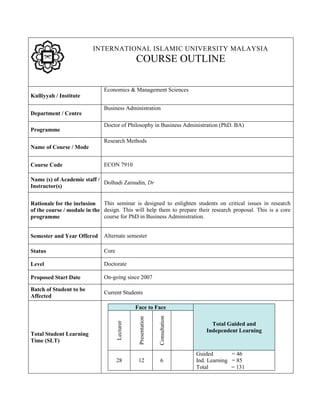
                              Economics & Management Sciences
Kulliyyah / Institute

                              Business Administration
Department / Centre

                              Doctor of Philosophy in Business Administration (PhD. BA)
Programme
                              Research Methods
Name of Course / Mode


Course Code                   ECON 7910

Name (s) of Academic staff /
                             Dolhadi Zainudin, Dr
Instructor(s)


Rationale for the inclusion This seminar is designed to enlighten students on critical issues in research
of the course / module in the design. This will help them to prepare their research proposal. This is a core
programme                     course for PhD in Business Administration.


Semester and Year Offered     Alternate semester

Status                        Core

Level                         Doctorate

Proposed Start Date           On-going since 2007

Batch of Student to be
                              Current Students
Affected
                                                Face to Face
                                                                Consultation
                                                 Presentation
                                     Lecturer


                                                                                     Total Guided and
                                                                                   Independent Learning
Total Student Learning
Time (SLT)

                                                                               Guided        = 46
                                     28          12             6              Ind. Learning = 85
                                                                               Total         = 131
Credit Value (hours)      3

Pre-requisites (if any)   None

Co-requisites (if any)    None

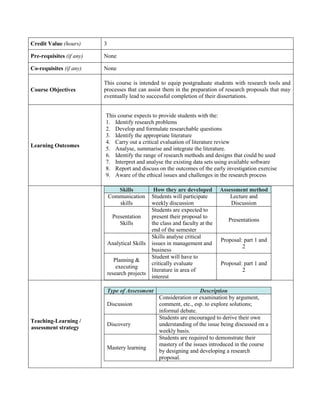
                          This course is intended to equip postgraduate students with research tools and
Course Objectives         processes that can assist them in the preparation of research proposals that may
                          eventually lead to successful completion of their dissertations.


                          This course expects to provide students with the:
                          1. Identify research problems
                          2. Develop and formulate researchable questions
                          3. Identify the appropriate literature
                          4. Carry out a critical evaluation of literature review
Learning Outcomes
                          5. Analyse, summarise and integrate the literature.
                          6. Identify the range of research methods and designs that could be used
                          7. Interpret and analyse the existing data sets using available software
                          8. Report and discuss on the outcomes of the early investigation exercise
                          9. Aware of the ethical issues and challenges in the research process

                                 Skills          How they are developed        Assessment method
                              Communication     Students will participate          Lecture and
                                 skills         weekly discussion                  Discussion
                                                Students are expected to
                                Presentation    present their proposal to
                                                                                  Presentations
                                    Skills      the class and faculty at the
                                                end of the semester
                                                Skills analyse critical
                                                                               Proposal: part 1 and
                              Analytical Skills issues in management and
                                                                                        2
                                                business
                                                Student will have to
                                 Planning &
                                                critically evaluate            Proposal: part 1 and
                                  executing
                                                literature in area of                   2
                              research projects
                                                interest

                              Type of Assessment                      Description
                                                    Consideration or examination by argument,
                              Discussion            comment, etc., esp. to explore solutions;
                                                    informal debate.
                                                    Students are encouraged to derive their own
Teaching-Learning /
                              Discovery             understanding of the issue being discussed on a
assessment strategy
                                                    weekly basis.
                                                    Students are required to demonstrate their
                                                    mastery of the issues introduced in the course
                              Mastery learning
                                                    by designing and developing a research
                                                    proposal.
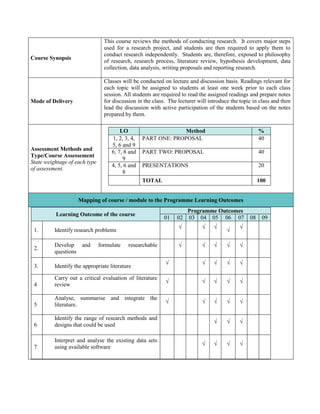
This course reviews the methods of conducting research. It covers major steps
                                 used for a research project, and students are then required to apply them to
                                 conduct research independently. Students are, therefore, exposed to philosophy
Course Synopsis
                                 of research, research process, literature review, hypothesis development, data
                                 collection, data analysis, writing proposals and reporting research.

                                 Classes will be conducted on lecture and discussion basis. Readings relevant for
                                 each topic will be assigned to students at least one week prior to each class
                                 session. All students are required to read the assigned readings and prepare notes
Mode of Delivery                 for discussion in the class. The lecturer will introduce the topic in class and then
                                 lead the discussion with active participation of the students based on the notes
                                 prepared by them.

                                        LO                     Method                                  %
                                    1, 2, 3, 4,   PART ONE: PROPOSAL                                   40
                                    5, 6 and 9
Assessment Methods and              6, 7, 8 and   PART TWO: PROPOSAL                                   40
Type/Course Assessement
                                         9
State weightage of each type
                                    4, 5, 6 and   PRESENTATIONS                                        20
of assessment.
                                         8
                                                  TOTAL                                                100


                    Mapping of course / module to the Programme Learning Outcomes
                                                                      Programme Outcomes
          Learning Outcome of the course
                                                            01   02   03 04 05 06 07              08    09
                                                                  √          √    √           √
 1.       Identify research problems                                                    √

          Develop and          formulate    researchable          √          √    √     √     √
 2.
          questions
                                                            √                √    √     √     √
 3.       Identify the appropriate literature

          Carry out a critical evaluation of literature
                                                            √                √    √     √     √
 4        review

          Analyse, summarise and integrate the
                                                            √                √    √     √     √
 5        literature.

          Identify the range of research methods and
                                                                                  √     √     √
 6        designs that could be used

          Interpret and analyse the existing data sets
                                                                             √    √     √     √
 7        using available software
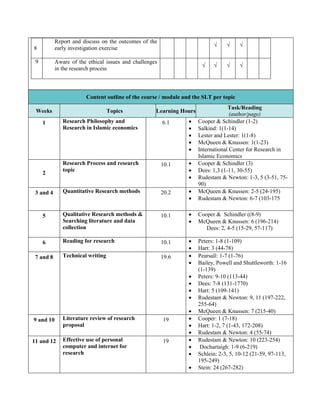
Report and discuss on the outcomes of the
                                                                           √     √    √
8          early investigation exercise

 9         Aware of the ethical issues and challenges
                                                                      √    √     √    √
           in the research process


                       Content outline of the course / module and the SLT per topic
                                                                                  Task/Reading
 Weeks                            Topics            Learning Hours
                                                                                   (author/page)
     1        Research Philosophy and                   6.1         Cooper & Schindler (1-2)
              Research in Islamic economics                         Salkind: 1(1-14)
                                                                    Lester and Lester: 1(1-8)
                                                                    McQueen & Knussen: 1(1-23)
                                                                    International Center for Research in
                                                                     Islamic Economics
              Research Process and research             10.1        Cooper & Schindler (3)
     2
              topic                                                 Dees: 1,3 (1-11, 30-55)
                                                                    Rudestam & Newton: 1-3, 5 (3-51, 75-
                                                                     90)
 3 and 4      Quantitative Research methods             20.2        McQueen & Knussen: 2-5 (24-195)
                                                                    Rudestam & Newton: 6-7 (103-175


     5        Qualitative Research methods &            10.1        Cooper & Schindler ((8-9)
              Searching literature and data                         McQueen & Knussen: 6 (196-214)
              collection                                                Dees: 2, 4-5 (15-29, 57-117)

     6        Reading for research                      10.1        Peters: 1-8 (1-109)
                                                                    Hart: 3 (44-78)
 7 and 8      Technical writing                         19.6        Pearsall: 1-7 (1-76)
                                                                    Bailey, Powell and Shuttleworth: 1-16
                                                                     (1-139)
                                                                    Peters: 9-10 (113-44)
                                                                    Dees: 7-8 (131-1770)
                                                                    Hart: 5 (109-141)
                                                                    Rudestam & Newton: 9, 11 (197-222,
                                                                     255-64)
                                                                    McQueen & Knussen: 7 (215-40)
9 and 10      Literature review of research             19          Cooper: 1 (7-18)
              proposal                                              Hart: 1-2, 7 (1-43, 172-208)
                                                                    Rudestam & Newton: 4 (55-74)
11 and 12     Effective use of personal                 19          Rudestam & Newton: 10 (223-254)
              computer and internet for                              Dochartaigh: 1-9 (6-219)
              research                                              Schlein: 2-3, 5, 10-12 (21-59, 97-113,
                                                                     195-249)
                                                                    Stein: 24 (267-282)
13 and 14     Presentation (Projects)                     17

              TOTAL                                       131

                                  Required references supporting the course
Cooper, Donald R. And Pamela S. Schindler (20011). Business Research Methods. 11th Edition.
McGraw-Hill International Edition.


                               Recommended references supporting the course

Cooper, H. M. (1989). Integrating research: a guide for literature reviews. Newbury Park: Sage Publications

McQueen, R. A. & Christina, K. (2002). Research Methods for Social Science: A Practical Introduction.
Harlow (England): Prentice-Hall

Dees, R. (1997). Writing the modern research paper (2nd ed.). Boston: Allyn and Bacon.

Hart, C. (1998). Doing a Literature Review: Releasing the Social Science Imagination. London: Sage
Publications

International Center for Research in Islamic Economics. (1985). Guidelines for Key Issues in Islamic
Economics, Jeddah: King Abdul Aziz University.

Lester, J. D. & James, L. Jr. (2002) Writing research papers: a complete guide (10th ed.). New York: Longman.

Pearsall, T. E. (2001). Elements of Technical Writing (2nd ed.). Boston: Allyn and Bacon.

Peeters, J. (1991). Elements of Critical Reading. New York: Macmillan Publishing Company

 Rudestam, K. E., & Rae, R. N. (2001). Surviving Your dissertation: A Comprehensive Guide to Content and
 Process (2nd ed.). Thousand Oaks: Sage Publications.
Salkind, N. J. (2000). Exploring Research (4th ed.). New Jersey: Prentice-Hall.

Schlein, A. (2000). Find It Online: A complete Guide to Online Research (2nd ed.). Tempe: Facts on Demand.

Stein, S. (1999). Learning, teaching and researching on the internet: a practical guide for social scientists. New
York: Longman

Econ 7910 research methods_seminar for ph_d's students

  • 1.
    INTERNATIONAL ISLAMIC UNIVERSITYMALAYSIA COURSE OUTLINE Economics & Management Sciences Kulliyyah / Institute Business Administration Department / Centre Doctor of Philosophy in Business Administration (PhD. BA) Programme Research Methods Name of Course / Mode Course Code ECON 7910 Name (s) of Academic staff / Dolhadi Zainudin, Dr Instructor(s) Rationale for the inclusion This seminar is designed to enlighten students on critical issues in research of the course / module in the design. This will help them to prepare their research proposal. This is a core programme course for PhD in Business Administration. Semester and Year Offered Alternate semester Status Core Level Doctorate Proposed Start Date On-going since 2007 Batch of Student to be Current Students Affected Face to Face Consultation Presentation Lecturer Total Guided and Independent Learning Total Student Learning Time (SLT) Guided = 46 28 12 6 Ind. Learning = 85 Total = 131
  • 2.
    Credit Value (hours) 3 Pre-requisites (if any) None Co-requisites (if any) None This course is intended to equip postgraduate students with research tools and Course Objectives processes that can assist them in the preparation of research proposals that may eventually lead to successful completion of their dissertations. This course expects to provide students with the: 1. Identify research problems 2. Develop and formulate researchable questions 3. Identify the appropriate literature 4. Carry out a critical evaluation of literature review Learning Outcomes 5. Analyse, summarise and integrate the literature. 6. Identify the range of research methods and designs that could be used 7. Interpret and analyse the existing data sets using available software 8. Report and discuss on the outcomes of the early investigation exercise 9. Aware of the ethical issues and challenges in the research process Skills How they are developed Assessment method Communication Students will participate Lecture and skills weekly discussion Discussion Students are expected to Presentation present their proposal to Presentations Skills the class and faculty at the end of the semester Skills analyse critical Proposal: part 1 and Analytical Skills issues in management and 2 business Student will have to Planning & critically evaluate Proposal: part 1 and executing literature in area of 2 research projects interest Type of Assessment Description Consideration or examination by argument, Discussion comment, etc., esp. to explore solutions; informal debate. Students are encouraged to derive their own Teaching-Learning / Discovery understanding of the issue being discussed on a assessment strategy weekly basis. Students are required to demonstrate their mastery of the issues introduced in the course Mastery learning by designing and developing a research proposal.
  • 3.
    This course reviewsthe methods of conducting research. It covers major steps used for a research project, and students are then required to apply them to conduct research independently. Students are, therefore, exposed to philosophy Course Synopsis of research, research process, literature review, hypothesis development, data collection, data analysis, writing proposals and reporting research. Classes will be conducted on lecture and discussion basis. Readings relevant for each topic will be assigned to students at least one week prior to each class session. All students are required to read the assigned readings and prepare notes Mode of Delivery for discussion in the class. The lecturer will introduce the topic in class and then lead the discussion with active participation of the students based on the notes prepared by them. LO Method % 1, 2, 3, 4, PART ONE: PROPOSAL 40 5, 6 and 9 Assessment Methods and 6, 7, 8 and PART TWO: PROPOSAL 40 Type/Course Assessement 9 State weightage of each type 4, 5, 6 and PRESENTATIONS 20 of assessment. 8 TOTAL 100 Mapping of course / module to the Programme Learning Outcomes Programme Outcomes Learning Outcome of the course 01 02 03 04 05 06 07 08 09 √ √ √ √ 1. Identify research problems √ Develop and formulate researchable √ √ √ √ √ 2. questions √ √ √ √ √ 3. Identify the appropriate literature Carry out a critical evaluation of literature √ √ √ √ √ 4 review Analyse, summarise and integrate the √ √ √ √ √ 5 literature. Identify the range of research methods and √ √ √ 6 designs that could be used Interpret and analyse the existing data sets √ √ √ √ 7 using available software
  • 4.
    Report and discusson the outcomes of the √ √ √ 8 early investigation exercise 9 Aware of the ethical issues and challenges √ √ √ √ in the research process Content outline of the course / module and the SLT per topic Task/Reading Weeks Topics Learning Hours (author/page) 1 Research Philosophy and 6.1  Cooper & Schindler (1-2) Research in Islamic economics  Salkind: 1(1-14)  Lester and Lester: 1(1-8)  McQueen & Knussen: 1(1-23)  International Center for Research in Islamic Economics Research Process and research 10.1  Cooper & Schindler (3) 2 topic  Dees: 1,3 (1-11, 30-55)  Rudestam & Newton: 1-3, 5 (3-51, 75- 90) 3 and 4 Quantitative Research methods 20.2  McQueen & Knussen: 2-5 (24-195)  Rudestam & Newton: 6-7 (103-175 5 Qualitative Research methods & 10.1  Cooper & Schindler ((8-9) Searching literature and data  McQueen & Knussen: 6 (196-214) collection Dees: 2, 4-5 (15-29, 57-117) 6 Reading for research 10.1  Peters: 1-8 (1-109)  Hart: 3 (44-78) 7 and 8 Technical writing 19.6  Pearsall: 1-7 (1-76)  Bailey, Powell and Shuttleworth: 1-16 (1-139)  Peters: 9-10 (113-44)  Dees: 7-8 (131-1770)  Hart: 5 (109-141)  Rudestam & Newton: 9, 11 (197-222, 255-64)  McQueen & Knussen: 7 (215-40) 9 and 10 Literature review of research 19  Cooper: 1 (7-18) proposal  Hart: 1-2, 7 (1-43, 172-208)  Rudestam & Newton: 4 (55-74) 11 and 12 Effective use of personal 19  Rudestam & Newton: 10 (223-254) computer and internet for  Dochartaigh: 1-9 (6-219) research  Schlein: 2-3, 5, 10-12 (21-59, 97-113, 195-249)  Stein: 24 (267-282)
  • 5.
    13 and 14 Presentation (Projects) 17 TOTAL 131 Required references supporting the course Cooper, Donald R. And Pamela S. Schindler (20011). Business Research Methods. 11th Edition. McGraw-Hill International Edition. Recommended references supporting the course Cooper, H. M. (1989). Integrating research: a guide for literature reviews. Newbury Park: Sage Publications McQueen, R. A. & Christina, K. (2002). Research Methods for Social Science: A Practical Introduction. Harlow (England): Prentice-Hall Dees, R. (1997). Writing the modern research paper (2nd ed.). Boston: Allyn and Bacon. Hart, C. (1998). Doing a Literature Review: Releasing the Social Science Imagination. London: Sage Publications International Center for Research in Islamic Economics. (1985). Guidelines for Key Issues in Islamic Economics, Jeddah: King Abdul Aziz University. Lester, J. D. & James, L. Jr. (2002) Writing research papers: a complete guide (10th ed.). New York: Longman. Pearsall, T. E. (2001). Elements of Technical Writing (2nd ed.). Boston: Allyn and Bacon. Peeters, J. (1991). Elements of Critical Reading. New York: Macmillan Publishing Company Rudestam, K. E., & Rae, R. N. (2001). Surviving Your dissertation: A Comprehensive Guide to Content and Process (2nd ed.). Thousand Oaks: Sage Publications. Salkind, N. J. (2000). Exploring Research (4th ed.). New Jersey: Prentice-Hall. Schlein, A. (2000). Find It Online: A complete Guide to Online Research (2nd ed.). Tempe: Facts on Demand. Stein, S. (1999). Learning, teaching and researching on the internet: a practical guide for social scientists. New York: Longman