ENVIRONMENTAL
PROBLEMS
• Creation Story (Faith)
  • Day 1 – Light and darkness
  • Day 2 – Sky
  • Day 3 – Sea and earth’s vegetation
  • Day 4 – Moon and stars
  • Day 5 – Animals creatures
  • Day 6 – Man

• Scientific Explanation
  • Molten earth, shallow seas, bacteria
Man cultivated the earth and used only
the things he needed to survive…


But later, he learned
that he can get more
than what he
needs….
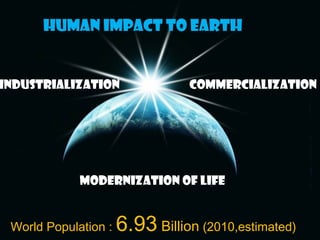
Human Impact to Earth


Industrialization                Commercialization


             Modernization of Life


 World Population :   6.93 Billion (2010,estimated)
Environmental pollution
  The addition to the natural
   environment of any substance
   or energy form at a rate that
   results in higher than natural
   concentration of that substance.
pollution
  The undesirable change in the
   physical, chemical or biological
   characteristics of an ecosystem that
   injures or kills living organisms and
   makes the environment unfit.
pollutANT
  Are substances that cause pollution.
   They may cause primary damage with
   direct identifiable impacts or secondary
   damage in the form of minor
   disturbance to nature balance.
AIR
pollution
      water
      pollution
land
pollution
AIR pollution
 The physical and chemical alteration
  of the properties of air which is harmful
  to human health, vegetation and
  animals.
 Outdoor Pollution – pollution derived from
    the mixture or collection of additional loads
    of chemical produced by natural events and
    human activities.

Fossil fuel combustion, photochemical smog,
volcanic eruptions, forest fire, radioactivity
 Indoor Pollution – pollution derived from
   the accumulation or build up of chemicals,
   suspended particulate matter and volatile
   organic compounds inside infrastructures
   that are harmful to health.

Aerosol spray, chlorine treated water, air
freshener crystals, tobacco and cigarettes,
carpets and plastic products, floor tiles
and pipe insulation, paint and thinners,
unvented gas and kerosene stoves, dry
cleaning fluids
WATER pollution
 The physical or chemical
  change in the surface
  water or ground water
  that can adversely affect
  living organisms.
WATER pollution
POINT SOURCE : A Source that discharges
pollutants or any discharge such as waste water
through pipes, ditches and sewers into bodies of
water at specific location.


NON - POINT SOURCE : One of many widely
scattered sources that discharge pollutants over
a large area such as run-offs into surface water,
construction area, parking lots, roadways.
Common types of water
pollutants
 Disease causing organisms
 Oxygen demanding wastes
 Water-soluble inorganic chemicals
 Organic Chemicals
 Radioactive substances
 Sediments of suspended water
Water related pROBLEMS
 EUTROPHICATION
 THERMAL POLLUTION
 OIL SPILL
 GARBAGE DISPOSAL
 RED TIDE
land pollution
 The presence in land of any
  solid waste in such quantity
  would be injurious to human
  health or welfare or plant,
  animal, human life and
  property.
TYPES OF SOLID WASTE
Municipal Solid Waste: Includes garbage,
rubbish ashes, bulky discarded items, animal
carcass, demolition wastes.

Agricultural Solid Waste: Includes livestock, post
harvest crop residues, plant trimmings,
damaged grains as animal feeds

Litter: Wrappers, beer cans, waste paper, plastic
bags and cups, bottles, Styrofoam, diapers, tin
cans.
ENVIRONMENTAL
JURISPRUDENCE
The Millennium Development Goals

A goal set by the United Nations
that will address the leading
problems affecting a large portion
of the world today.
The Millennium Development Goals
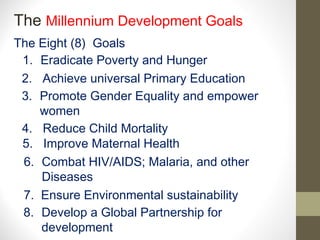
The Eight (8) Goals
 1. Eradicate Poverty and Hunger
 2. Achieve universal Primary Education
 3. Promote Gender Equality and empower
    women
 4. Reduce Child Mortality
 5. Improve Maternal Health
 6. Combat HIV/AIDS; Malaria, and other
    Diseases
 7. Ensure Environmental sustainability
 8. Develop a Global Partnership for
    development
The Millennium Development Goals


GOAL 7: ENSURE
ENVIRONMENTAL SUSTAINABILITY
Target A– Integrate the principles of
sustainable development into country
policies and programs and reverse the loss
of environmental resources.
The Millennium Development Goals

Target B – Halve, by 2015, the
proportion of people without sustainable
access to drinking water


Target C – By 2020, to have achieved
a significant improvement in the lives of at
least 100 million slum dwellers.
Laws that Govern Environmental
Protection in the Philippines.

Presidential Decree 1151
Known as Philippine
Environmental Policy that is known
to create, develop and improve
conditions promoting productive
harmony between man and nature;
fulfill social and economical
requirements for Filipinos; ensure
attainment of environmental
Republic Act No. 3571
An Act prohibiting the
cutting, destroying or
injuring or planted or
growing trees or of flowering
plants and shrubs or plants
of scenic value along public
roads, plazas, school
premises or in any public
ground.
Presidential Decree No. 221
Series of 87
Prescribing the interim
procedures in the processing
and approval of applications
for the exploitation,
development and utilization
of minerals.
Presidential Decree No. 1198
Requiring all individuals,
partnership or corporation
engaged in exploration,
development and exploitation
of all natural resources in
the construction of
infrastructure or projects to
restore or rehabilitate to
their original condition.
Presidential Decree No. 1152
Chapter 3 Section 45
Solid wastes disposal shall
be by sanitary landfill,
incineration, composting and
other methods as may be
approved by competent
government authority.
Presidential Decree No. 1152
Chapter 5 Section 49
The dumping, disposal of
solid wastes into the sea and
any body of water in the
Philippines, including
shorelines and riverbanks
where these wastes are likely
to be washed, is prohibited.
Presidential Decree No. 1152
Chapter 4 Section 34
The control of soil erosion
on the banks or rivers,
shores, lakes and the control
of flooding in and from
rivers and lakes.
Presidential Decree No. 1219
Providing for the
exploration, exploitation,
utilization and conservation
of coral resources.
Republic Act No. 6969
Toxic Substances and
Hazardous and Nuclear
Waste Control of 1990.
WORLD ENVIRONMENT REPORT
(Guardian.uk.com / United Nations Assessment
        / National Geographic News
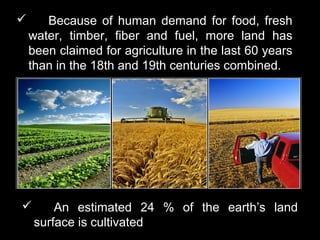
      Because of human demand for food, fresh
    water, timber, fiber and fuel, more land has
    been claimed for agriculture in the last 60 years
    than in the 18th and 19th centuries combined.


       An estimated 24 % of the earth’s land
    surface is cultivated
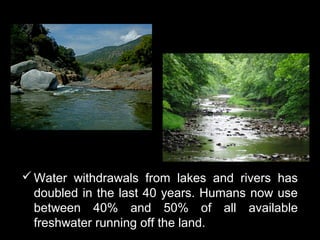
 Water withdrawals from lakes and rivers has
  doubled in the last 40 years. Humans now use
  between 40% and 50% of all available
  freshwater running off the land.
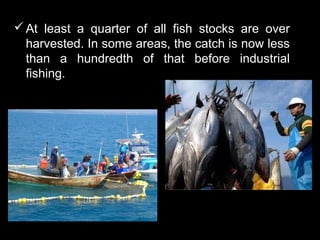
 At least a quarter of all fish stocks are over
  harvested. In some areas, the catch is now less
  than a hundredth of that before industrial
  fishing.
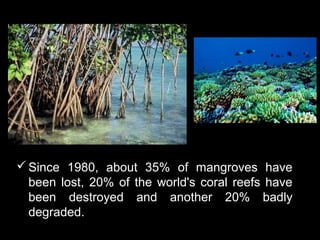
 Since 1980, about 35% of mangroves have
  been lost, 20% of the world's coral reefs have
  been destroyed and another 20% badly
  degraded.
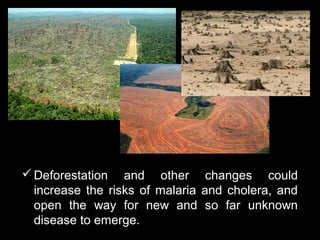
 Deforestation and other changes could
  increase the risks of malaria and cholera, and
  open the way for new and so far unknown
  disease to emerge.
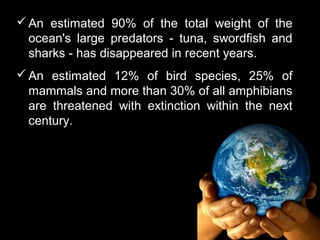
 An estimated 90% of the total weight of the
  ocean's large predators - tuna, swordfish and
  sharks - has disappeared in recent years.
 An estimated 12% of bird species, 25% of
  mammals and more than 30% of all amphibians
  are threatened with extinction within the next
  century.
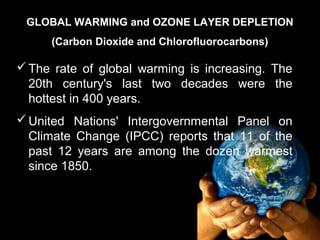
GLOBAL WARMING and OZONE LAYER DEPLETION
     (Carbon Dioxide and Chlorofluorocarbons)

 The rate of global warming is increasing. The
  20th century's last two decades were the
  hottest in 400 years.
 United Nations' Intergovernmental Panel on
  Climate Change (IPCC) reports that 11 of the
  past 12 years are among the dozen warmest
  since 1850.
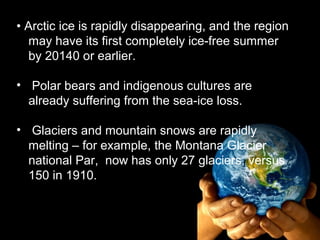
• Arctic ice is rapidly disappearing, and the region
   may have its first completely ice-free summer
   by 20140 or earlier.

• Polar bears and indigenous cultures are
  already suffering from the sea-ice loss.

• Glaciers and mountain snows are rapidly
  melting – for example, the Montana Glacier
  national Par, now has only 27 glaciers, versus
  150 in 1910.
The scientists warn. "In many cases, it is literally
  a matter of living on borrowed time. By using up
  supplies of our resources we are depleting
  assets at the expense of our children."


If all these worsen… what will
our future be? How will the
future generations survive?
Is it really possible for the humanity to
be one in achieving the goal of
reviving mother earth?


“You may say I’m a dreamer.. But I’m
not the only one…I hope someday you
will join us and the world will live as
one…Imagine all the people… living
life in peace…sharing all the world…”
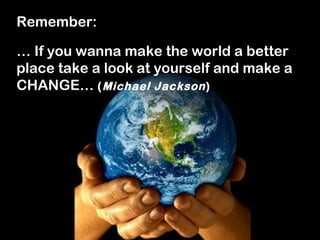
Remember:

… If you wanna make the world a better
place take a look at yourself and make a
CHANGE… ( Michael Jackson )

Ecology - Environmental Problems

  • 1.
  • 3.
    • Creation Story(Faith) • Day 1 – Light and darkness • Day 2 – Sky • Day 3 – Sea and earth’s vegetation • Day 4 – Moon and stars • Day 5 – Animals creatures • Day 6 – Man • Scientific Explanation • Molten earth, shallow seas, bacteria
  • 4.
    Man cultivated theearth and used only the things he needed to survive… But later, he learned that he can get more than what he needs….
  • 5.
    Human Impact toEarth Industrialization Commercialization Modernization of Life World Population : 6.93 Billion (2010,estimated)
  • 6.
    Environmental pollution The addition to the natural environment of any substance or energy form at a rate that results in higher than natural concentration of that substance.
  • 7.
    pollution  Theundesirable change in the physical, chemical or biological characteristics of an ecosystem that injures or kills living organisms and makes the environment unfit. pollutANT  Are substances that cause pollution. They may cause primary damage with direct identifiable impacts or secondary damage in the form of minor disturbance to nature balance.
  • 8.
    AIR pollution water pollution land pollution
  • 9.
    AIR pollution  Thephysical and chemical alteration of the properties of air which is harmful to human health, vegetation and animals.  Outdoor Pollution – pollution derived from the mixture or collection of additional loads of chemical produced by natural events and human activities. Fossil fuel combustion, photochemical smog, volcanic eruptions, forest fire, radioactivity
  • 10.
     Indoor Pollution– pollution derived from the accumulation or build up of chemicals, suspended particulate matter and volatile organic compounds inside infrastructures that are harmful to health. Aerosol spray, chlorine treated water, air freshener crystals, tobacco and cigarettes, carpets and plastic products, floor tiles and pipe insulation, paint and thinners, unvented gas and kerosene stoves, dry cleaning fluids
  • 11.
    WATER pollution  Thephysical or chemical change in the surface water or ground water that can adversely affect living organisms.
  • 12.
    WATER pollution POINT SOURCE: A Source that discharges pollutants or any discharge such as waste water through pipes, ditches and sewers into bodies of water at specific location. NON - POINT SOURCE : One of many widely scattered sources that discharge pollutants over a large area such as run-offs into surface water, construction area, parking lots, roadways.
  • 13.
    Common types ofwater pollutants  Disease causing organisms  Oxygen demanding wastes  Water-soluble inorganic chemicals  Organic Chemicals  Radioactive substances  Sediments of suspended water
  • 14.
    Water related pROBLEMS EUTROPHICATION  THERMAL POLLUTION  OIL SPILL  GARBAGE DISPOSAL  RED TIDE
  • 15.
    land pollution  Thepresence in land of any solid waste in such quantity would be injurious to human health or welfare or plant, animal, human life and property.
  • 16.
    TYPES OF SOLIDWASTE Municipal Solid Waste: Includes garbage, rubbish ashes, bulky discarded items, animal carcass, demolition wastes. Agricultural Solid Waste: Includes livestock, post harvest crop residues, plant trimmings, damaged grains as animal feeds Litter: Wrappers, beer cans, waste paper, plastic bags and cups, bottles, Styrofoam, diapers, tin cans.
  • 17.
  • 18.
    The Millennium DevelopmentGoals A goal set by the United Nations that will address the leading problems affecting a large portion of the world today.
  • 19.
    The Millennium DevelopmentGoals The Eight (8) Goals 1. Eradicate Poverty and Hunger 2. Achieve universal Primary Education 3. Promote Gender Equality and empower women 4. Reduce Child Mortality 5. Improve Maternal Health 6. Combat HIV/AIDS; Malaria, and other Diseases 7. Ensure Environmental sustainability 8. Develop a Global Partnership for development
  • 20.
    The Millennium DevelopmentGoals GOAL 7: ENSURE ENVIRONMENTAL SUSTAINABILITY Target A– Integrate the principles of sustainable development into country policies and programs and reverse the loss of environmental resources.
  • 21.
    The Millennium DevelopmentGoals Target B – Halve, by 2015, the proportion of people without sustainable access to drinking water Target C – By 2020, to have achieved a significant improvement in the lives of at least 100 million slum dwellers.
  • 22.
    Laws that GovernEnvironmental Protection in the Philippines. Presidential Decree 1151 Known as Philippine Environmental Policy that is known to create, develop and improve conditions promoting productive harmony between man and nature; fulfill social and economical requirements for Filipinos; ensure attainment of environmental
  • 23.
    Republic Act No.3571 An Act prohibiting the cutting, destroying or injuring or planted or growing trees or of flowering plants and shrubs or plants of scenic value along public roads, plazas, school premises or in any public ground.
  • 24.
    Presidential Decree No.221 Series of 87 Prescribing the interim procedures in the processing and approval of applications for the exploitation, development and utilization of minerals.
  • 25.
    Presidential Decree No.1198 Requiring all individuals, partnership or corporation engaged in exploration, development and exploitation of all natural resources in the construction of infrastructure or projects to restore or rehabilitate to their original condition.
  • 26.
    Presidential Decree No.1152 Chapter 3 Section 45 Solid wastes disposal shall be by sanitary landfill, incineration, composting and other methods as may be approved by competent government authority.
  • 27.
    Presidential Decree No.1152 Chapter 5 Section 49 The dumping, disposal of solid wastes into the sea and any body of water in the Philippines, including shorelines and riverbanks where these wastes are likely to be washed, is prohibited.
  • 28.
    Presidential Decree No.1152 Chapter 4 Section 34 The control of soil erosion on the banks or rivers, shores, lakes and the control of flooding in and from rivers and lakes.
  • 29.
    Presidential Decree No.1219 Providing for the exploration, exploitation, utilization and conservation of coral resources. Republic Act No. 6969 Toxic Substances and Hazardous and Nuclear Waste Control of 1990.
  • 30.
    WORLD ENVIRONMENT REPORT (Guardian.uk.com/ United Nations Assessment / National Geographic News
  • 31.
    Because of human demand for food, fresh water, timber, fiber and fuel, more land has been claimed for agriculture in the last 60 years than in the 18th and 19th centuries combined.  An estimated 24 % of the earth’s land surface is cultivated
  • 32.
     Water withdrawalsfrom lakes and rivers has doubled in the last 40 years. Humans now use between 40% and 50% of all available freshwater running off the land.
  • 33.
     At leasta quarter of all fish stocks are over harvested. In some areas, the catch is now less than a hundredth of that before industrial fishing.
  • 34.
     Since 1980,about 35% of mangroves have been lost, 20% of the world's coral reefs have been destroyed and another 20% badly degraded.
  • 35.
     Deforestation andother changes could increase the risks of malaria and cholera, and open the way for new and so far unknown disease to emerge.
  • 36.
     An estimated90% of the total weight of the ocean's large predators - tuna, swordfish and sharks - has disappeared in recent years.  An estimated 12% of bird species, 25% of mammals and more than 30% of all amphibians are threatened with extinction within the next century.
  • 37.
    GLOBAL WARMING andOZONE LAYER DEPLETION (Carbon Dioxide and Chlorofluorocarbons)  The rate of global warming is increasing. The 20th century's last two decades were the hottest in 400 years.  United Nations' Intergovernmental Panel on Climate Change (IPCC) reports that 11 of the past 12 years are among the dozen warmest since 1850.
  • 38.
    • Arctic iceis rapidly disappearing, and the region may have its first completely ice-free summer by 20140 or earlier. • Polar bears and indigenous cultures are already suffering from the sea-ice loss. • Glaciers and mountain snows are rapidly melting – for example, the Montana Glacier national Par, now has only 27 glaciers, versus 150 in 1910.
  • 39.
    The scientists warn."In many cases, it is literally a matter of living on borrowed time. By using up supplies of our resources we are depleting assets at the expense of our children." If all these worsen… what will our future be? How will the future generations survive?
  • 40.
    Is it reallypossible for the humanity to be one in achieving the goal of reviving mother earth? “You may say I’m a dreamer.. But I’m not the only one…I hope someday you will join us and the world will live as one…Imagine all the people… living life in peace…sharing all the world…”
  • 41.
    Remember: … If youwanna make the world a better place take a look at yourself and make a CHANGE… ( Michael Jackson )