www.studymafia.org
Submitted To: Submitted By:
www.studymafia.org www.studymafia.org
Seminar
On
TRANSISTORS
Content
 What is a Transistor?
 Evolution of transistor
 Importance of transistor
 Definition & transistor types
 Transistor symbol & operation
 Advantages of transistor
 Latest in transistor technology
 References
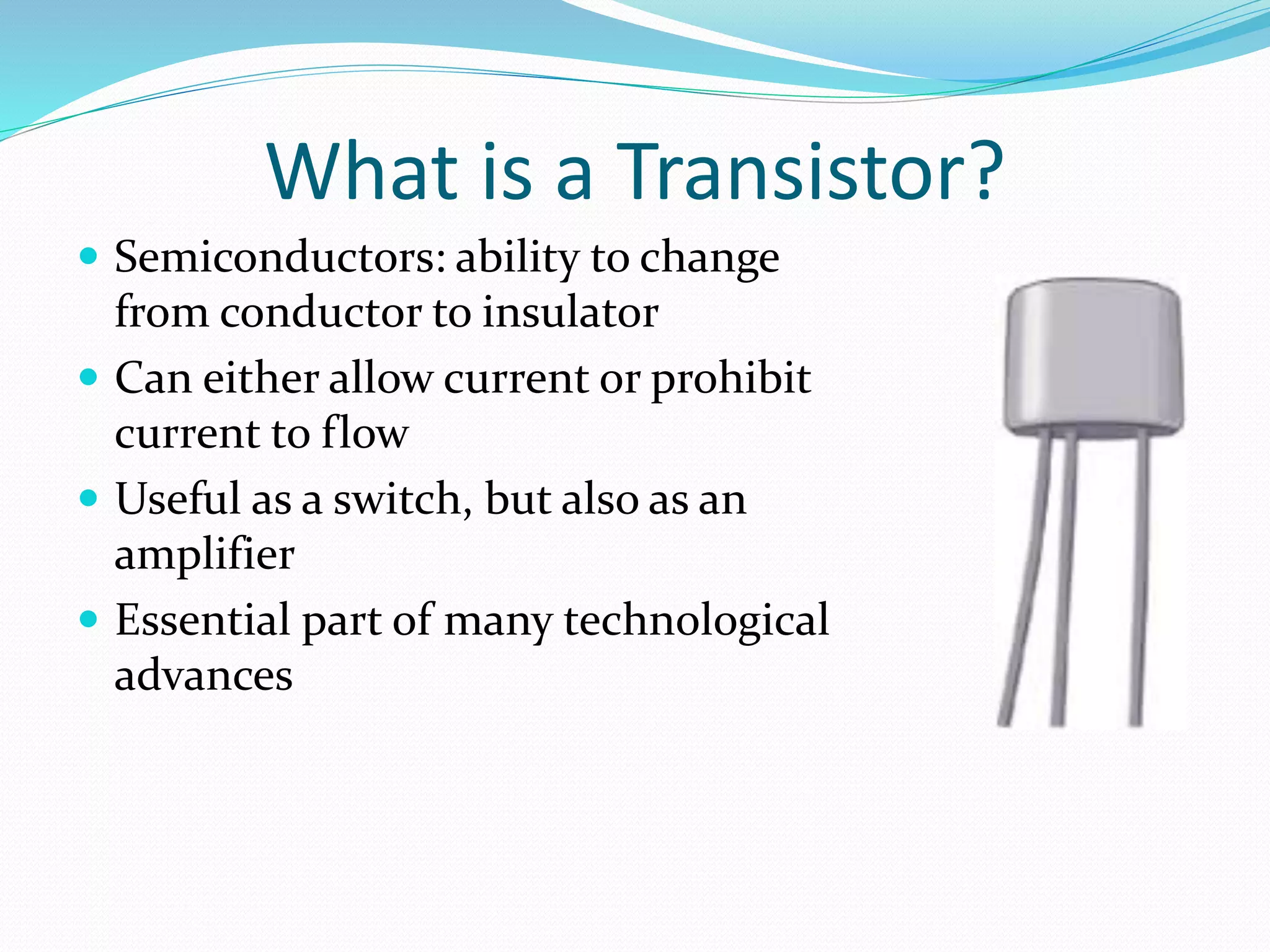
What is a Transistor?
 Semiconductors: ability to change
from conductor to insulator
 Can either allow current or prohibit
current to flow
 Useful as a switch, but also as an
amplifier
 Essential part of many technological
advances
History of transistors
In 1906, an American inventor and physicist,
Lee De Forest, made the vacuum tube triode
or audion as he called it.
 Used in radios
 Used in early computers
The first transistor
In 1947, John
Bardeen and
Walter Brattain
deviced - the first
"point contact"
transistor.
Moore’s Law
It’s an observation made by Gordon E. Moore, in
which he predicted that the number of transistors,
inside an Integrated Circuit, could
be doubled every 24 months.
At the density that also
minimized the cost of a transistor.
Transistor Definition
Transistor is an electronic device made
of three layers of semiconductor
material that can act as an insulator
and a conductor.
The three layered transistor is also
known as the bipolar junction
transistor.
Bipolar Junction Transistors (BJT’s)
 The term bipolar refers to the use of both
holes and electrons as charge carriers in the
transistor structure
 There are two types of BJTs, the NPN and
PNP
Basic construction
Regions of a transistor
 A transistor has three regions namely,
 Emitter- heavily doped
 Base- lightly doped
 Collector- moderately doped
Transistor symbols Transistor
symbols
Transistor operation
force – voltage/current
water flow – current
- amplification
Transistor biasing
 The base-emitter (BE) junction is forward biased
 The base-collector (BC) junction is reverse biased.
IE=IB+IC
Operating regions of BJT
Cut off region
Linear region
Saturation region
Types of transistor
 BJT - Bipolar Junction Transistor
 UJT- Unipolar Junction Transistor
 FET - Field Effect Transistor
 MOS - Metal Oxide Semiconductor
Transistor applications
Transistor as a switch
When used as an electronic switch, the transistor is
normally operated alternately in cut-off and saturation
regions.
Transistor as amplifier
 Due to the small changes in
base current the collector
current will mimic the input
with greater amplitude
Future of Transistors
 Molecular electronics
 Carbon nanotube transistors
 Nano inspiration wire transistors
 Quantum computing
 CMOS devices will add functionality to CMOS non-
volatile memory, opto-electronics, sensing….
 CMOS technology will address new markets
macroelectronics, bio-medical devices, …
 Biology may provide for new technologies bottom-up
assembly, human intelligence
What’s new in transistor
technology?
3D Transistor made using
Tri-Gate transistors on its 22nm logic
technology.
Advantage of Tri-Gate Transistors
·More than 50% power reduction at
constant performance.
·37% performance increase at low voltage
·Improved performance and efficiency.
References
 www.google.com
 www.wikipedia.com
 www.studymafia.org
 www.pptplanet.com
Thanks

ECE Transistor PPT.pptx

  • 1.
    www.studymafia.org Submitted To: SubmittedBy: www.studymafia.org www.studymafia.org Seminar On TRANSISTORS
  • 2.
    Content  What isa Transistor?  Evolution of transistor  Importance of transistor  Definition & transistor types  Transistor symbol & operation  Advantages of transistor  Latest in transistor technology  References
  • 3.
    What is aTransistor?  Semiconductors: ability to change from conductor to insulator  Can either allow current or prohibit current to flow  Useful as a switch, but also as an amplifier  Essential part of many technological advances
  • 4.
    History of transistors In1906, an American inventor and physicist, Lee De Forest, made the vacuum tube triode or audion as he called it.  Used in radios  Used in early computers
  • 5.
    The first transistor In1947, John Bardeen and Walter Brattain deviced - the first "point contact" transistor.
  • 6.
    Moore’s Law It’s anobservation made by Gordon E. Moore, in which he predicted that the number of transistors, inside an Integrated Circuit, could be doubled every 24 months. At the density that also minimized the cost of a transistor.
  • 7.
    Transistor Definition Transistor isan electronic device made of three layers of semiconductor material that can act as an insulator and a conductor. The three layered transistor is also known as the bipolar junction transistor.
  • 8.
    Bipolar Junction Transistors(BJT’s)  The term bipolar refers to the use of both holes and electrons as charge carriers in the transistor structure  There are two types of BJTs, the NPN and PNP
  • 9.
  • 10.
    Regions of atransistor  A transistor has three regions namely,  Emitter- heavily doped  Base- lightly doped  Collector- moderately doped
  • 11.
  • 12.
    Transistor operation force –voltage/current water flow – current - amplification
  • 13.
    Transistor biasing  Thebase-emitter (BE) junction is forward biased  The base-collector (BC) junction is reverse biased. IE=IB+IC
  • 14.
    Operating regions ofBJT Cut off region Linear region Saturation region
  • 15.
    Types of transistor BJT - Bipolar Junction Transistor  UJT- Unipolar Junction Transistor  FET - Field Effect Transistor  MOS - Metal Oxide Semiconductor
  • 16.
    Transistor applications Transistor asa switch When used as an electronic switch, the transistor is normally operated alternately in cut-off and saturation regions.
  • 17.
    Transistor as amplifier Due to the small changes in base current the collector current will mimic the input with greater amplitude
  • 18.
    Future of Transistors Molecular electronics  Carbon nanotube transistors  Nano inspiration wire transistors  Quantum computing  CMOS devices will add functionality to CMOS non- volatile memory, opto-electronics, sensing….  CMOS technology will address new markets macroelectronics, bio-medical devices, …  Biology may provide for new technologies bottom-up assembly, human intelligence
  • 19.
    What’s new intransistor technology? 3D Transistor made using Tri-Gate transistors on its 22nm logic technology. Advantage of Tri-Gate Transistors ·More than 50% power reduction at constant performance. ·37% performance increase at low voltage ·Improved performance and efficiency.
  • 20.
    References  www.google.com  www.wikipedia.com www.studymafia.org  www.pptplanet.com
  • 21.

Editor's Notes