Extracting MUCs in a Black-box Constraint 
© 2014 IBM Corporation 
An Optimal Iterative Algorithm for 
Network 
Philippe Laborie 
IBM, Software Group 
Aug. 22, 2014 
21st European Conference on Artificial Intelligence
Objective 
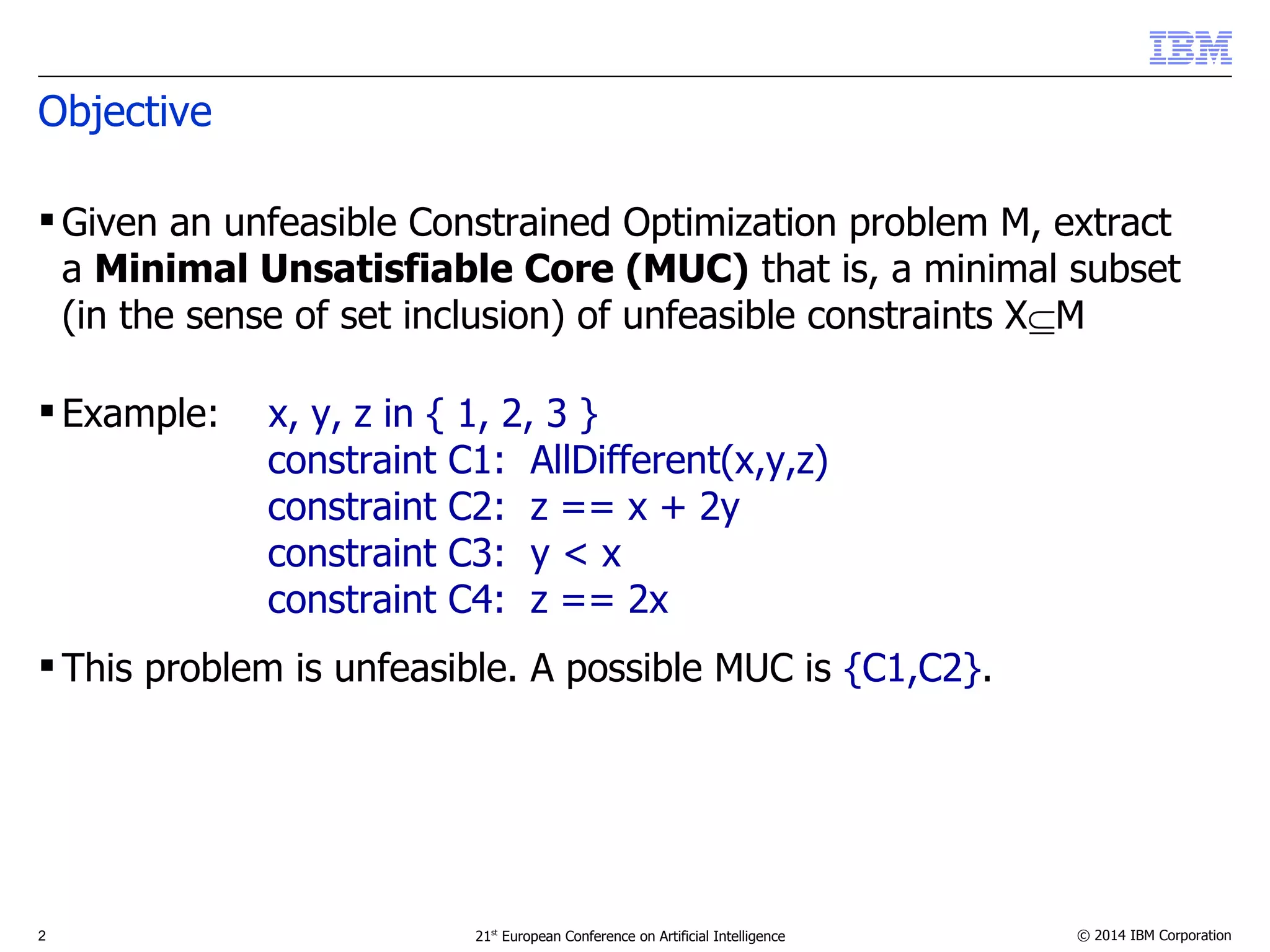
Given an unfeasible Constrained Optimization problem M, extract 
a Minimal Unsatisfiable Core (MUC) that is, a minimal subset 
(in the sense of set inclusion) of unfeasible constraints XM 
 Example: x, y, z in { 1, 2, 3 } 
constraint C1: AllDifferent(x,y,z) 
constraint C2: z == x + 2y 
constraint C3: y < x 
constraint C4: z == 2x 
 This problem is unfeasible. A possible MUC is {C1,C2}. 
2 21st European Conference on Artificial Intelligence © 2014 IBM Corporation
Objective 
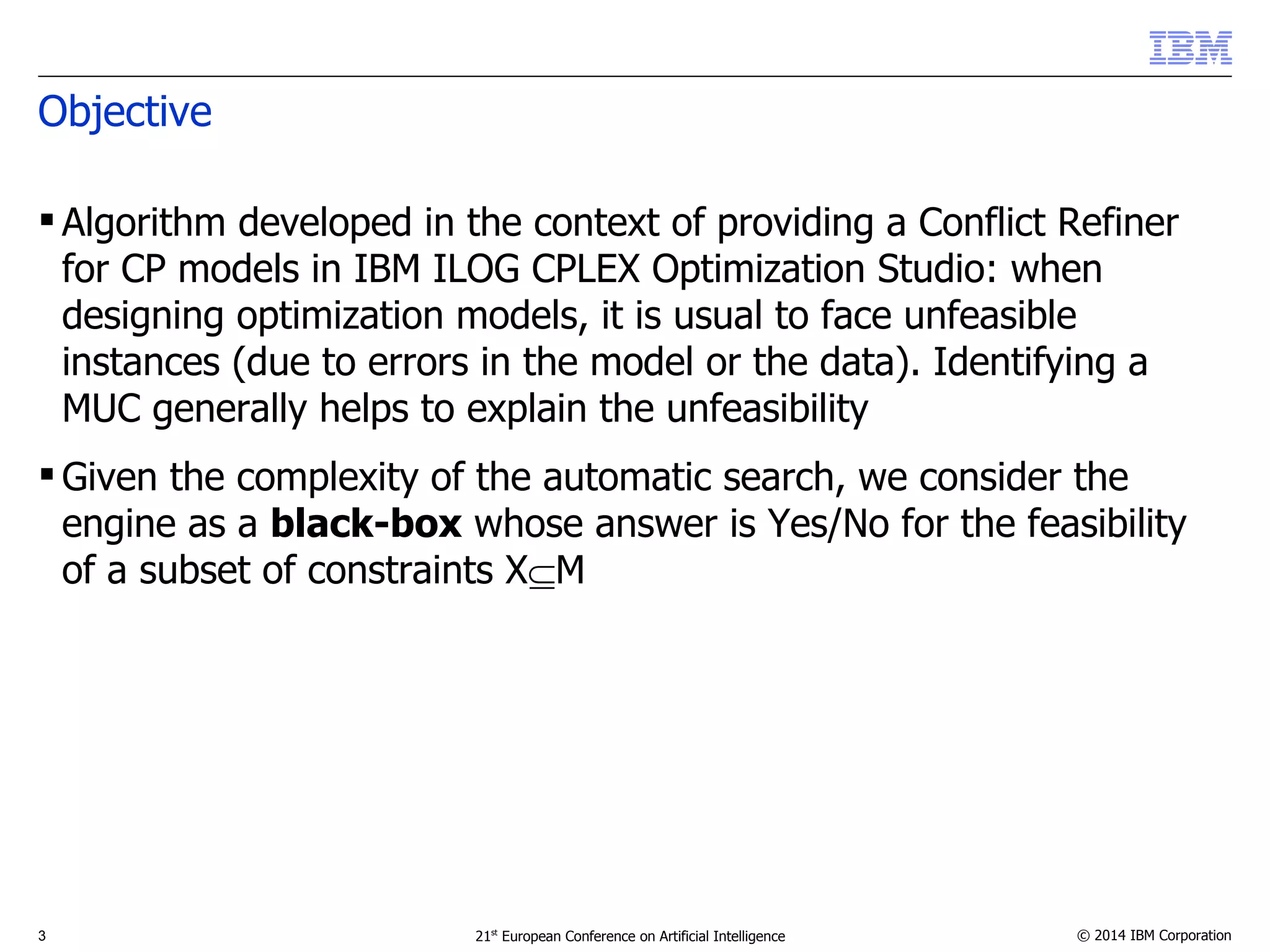
 Algorithm developed in the context of providing a Conflict Refiner 
for CP models in IBM ILOG CPLEX Optimization Studio: when 
designing optimization models, it is usual to face unfeasible 
instances (due to errors in the model or the data). Identifying a 
MUC generally helps to explain the unfeasibility 
Given the complexity of the automatic search, we consider the 
engine as a black-box whose answer is Yes/No for the feasibility 
of a subset of constraints XM 
3 21st European Conference on Artificial Intelligence © 2014 IBM Corporation
Abstracted problem 
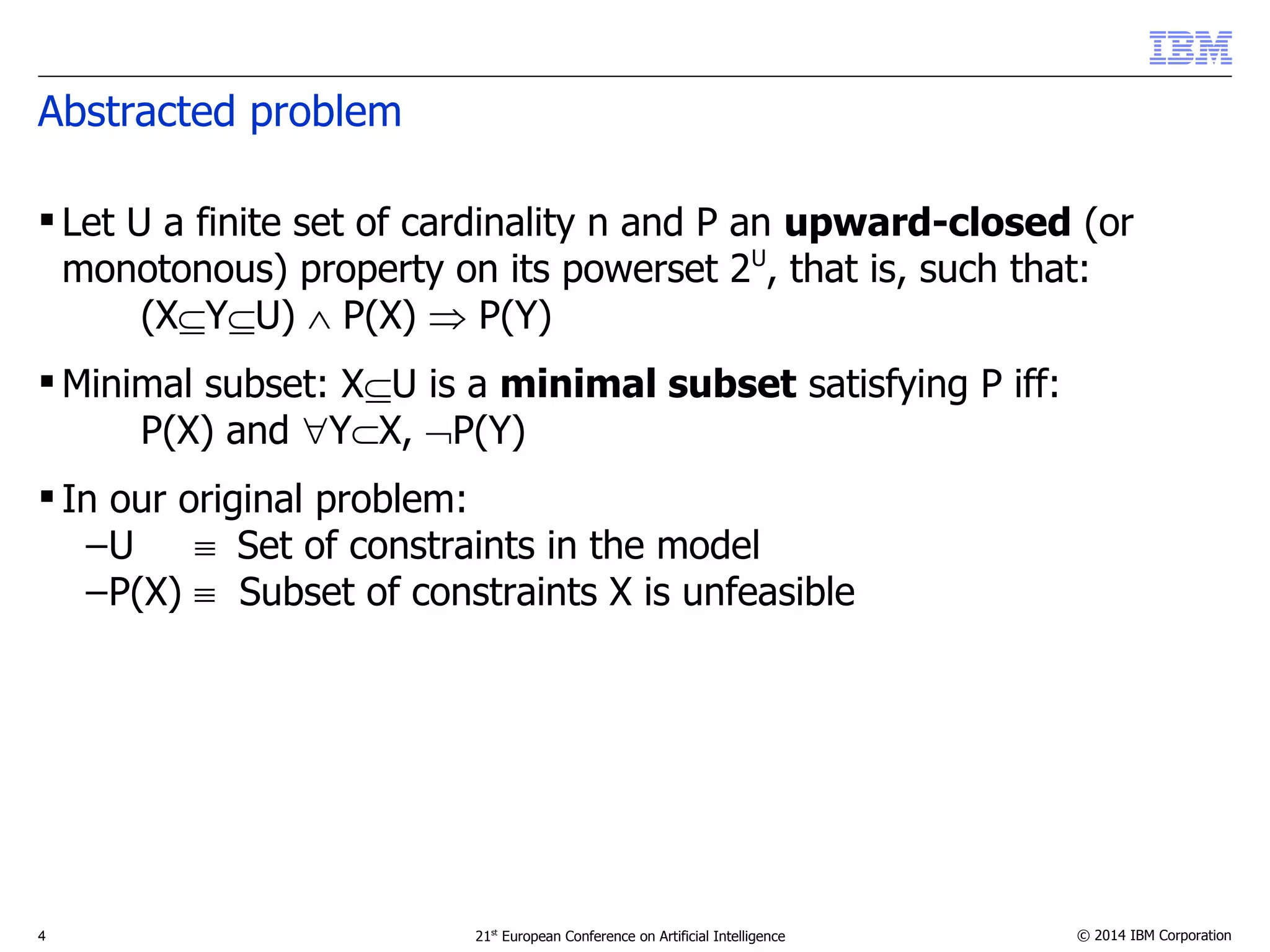
 Let U a finite set of cardinality n and P an upward-closed (or 
monotonous) property on its powerset 2U, that is, such that: 
(XYU)  P(X)  P(Y) 
Minimal subset: XU is a minimal subset satisfying P iff: 
P(X) and YX, P(Y) 
 In our original problem: 
–U  Set of constraints in the model 
–P(X)  Subset of constraints X is unfeasible 
4 21st European Conference on Artificial Intelligence © 2014 IBM Corporation
Abstracted problem 
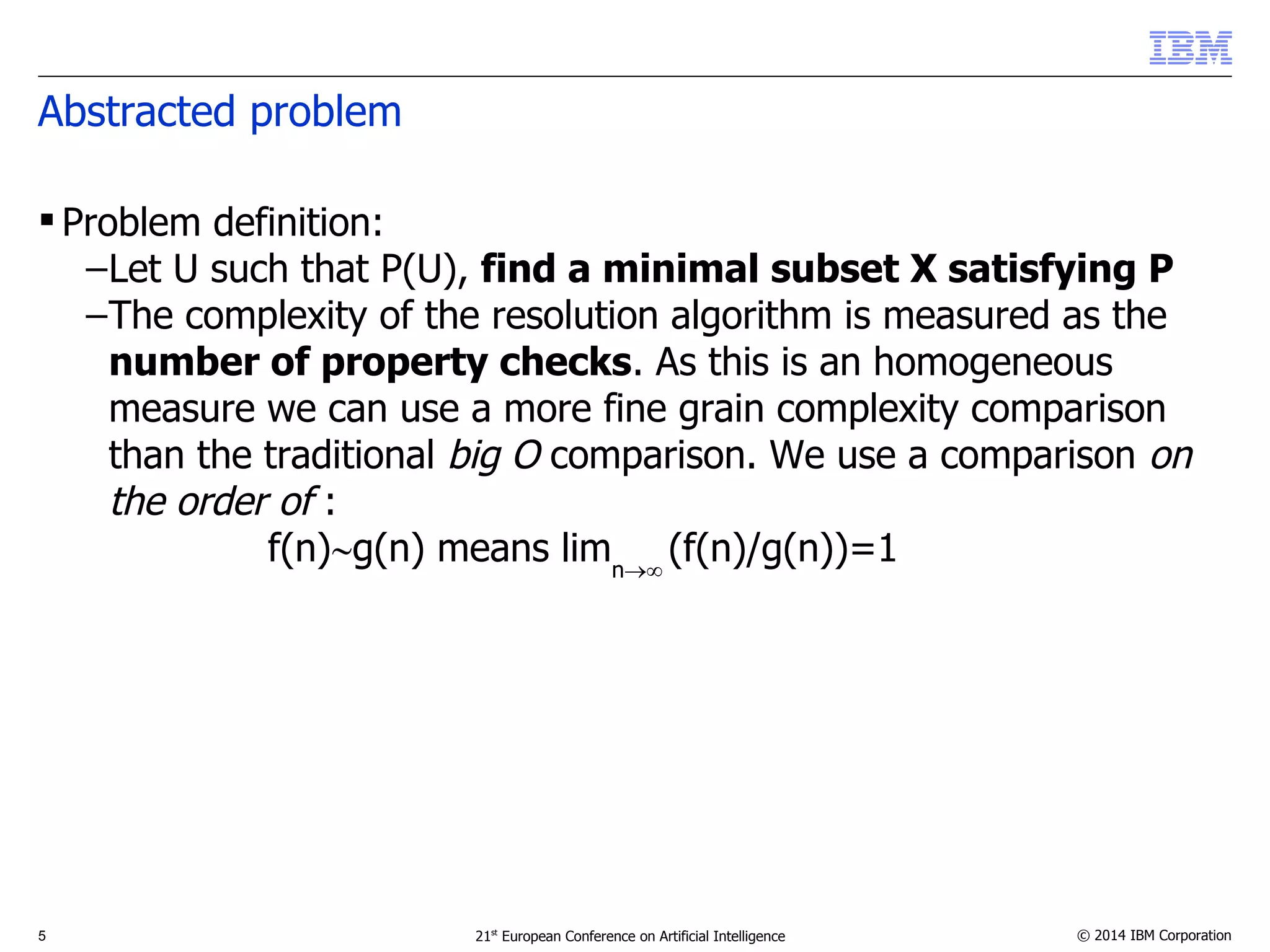
 Problem definition: 
–Let U such that P(U), find a minimal subset X satisfying P 
–The complexity of the resolution algorithm is measured as the 
number of property checks. As this is an homogeneous 
measure we can use a more fine grain complexity comparison 
than the traditional big O comparison. We use a comparison on 
the order of : 
f(n)g(n) means limn (f(n)/g(n))=1 
5 21st European Conference on Artificial Intelligence © 2014 IBM Corporation
A family of iterative algorithms 
 Elements of U are stored in an array of size n 
 Array is shuffled so as to rule out any particular structure 
 Algorithm will select the “rightmost” minimal set in the array 
 Scan elements from left to right 
Grows a current subset X 
X U[i] 
Ui 
6 21st European Conference on Artificial Intelligence © 2014 IBM Corporation
A family of iterative algorithms 
Next element U[i] to be added to current subset X is the one with 
the smallest index i such that P(X U Ui) 
When a new element U[i] is added, property P can be checked on 
current subset X (if P(X), algorithm can be stopped) 
 Algorithms in this family differs according to the way to find the 
next element U[i] 
7 21st European Conference on Artificial Intelligence © 2014 IBM Corporation
Position of consecutive elements 
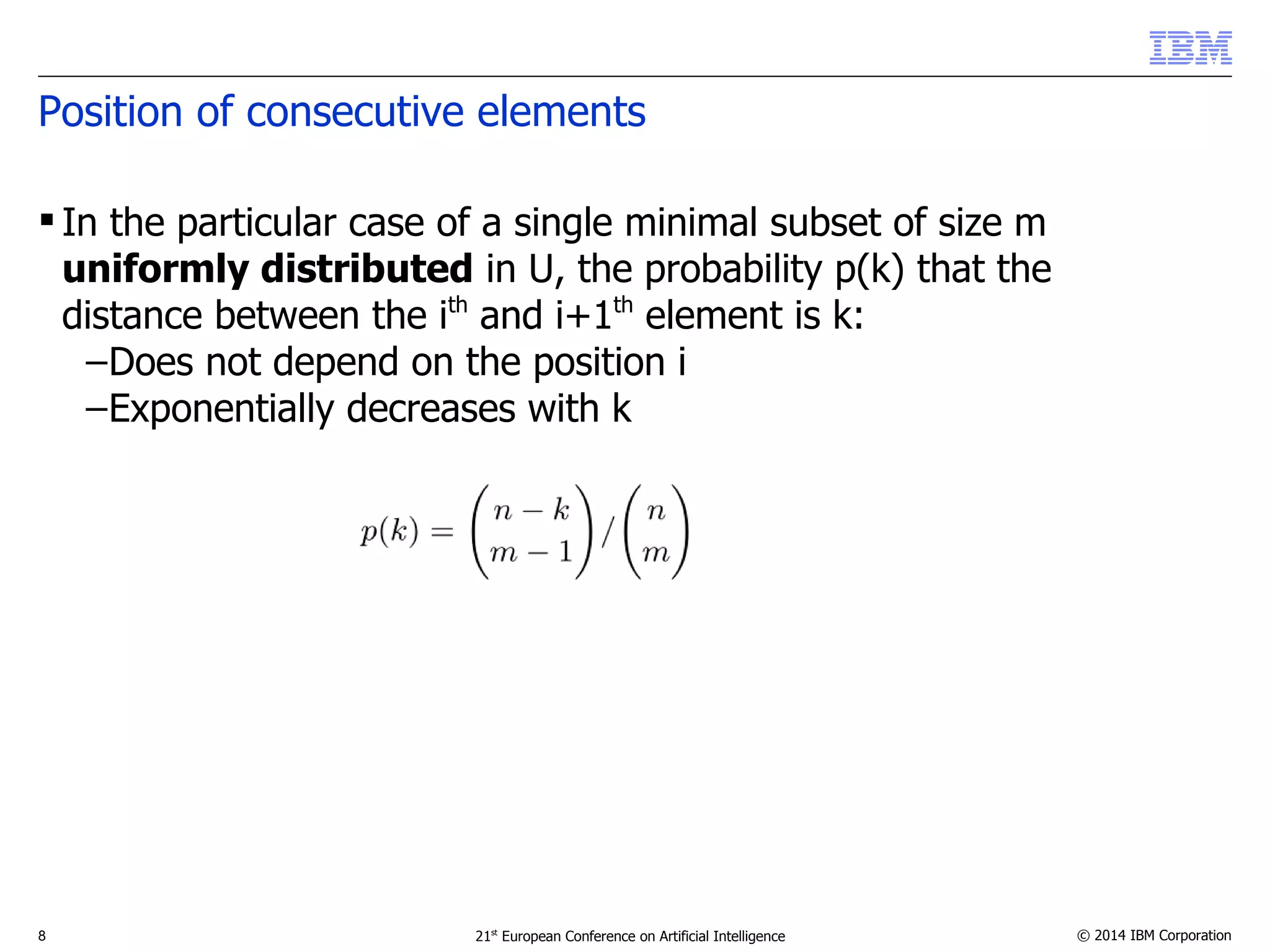
 In the particular case of a single minimal subset of size m 
uniformly distributed in U, the probability p(k) that the 
distance between the ith and i+1th element is k: 
–Does not depend on the position i 
–Exponentially decreases with k 
8 21st European Conference on Artificial Intelligence © 2014 IBM Corporation
Position of consecutive elements 
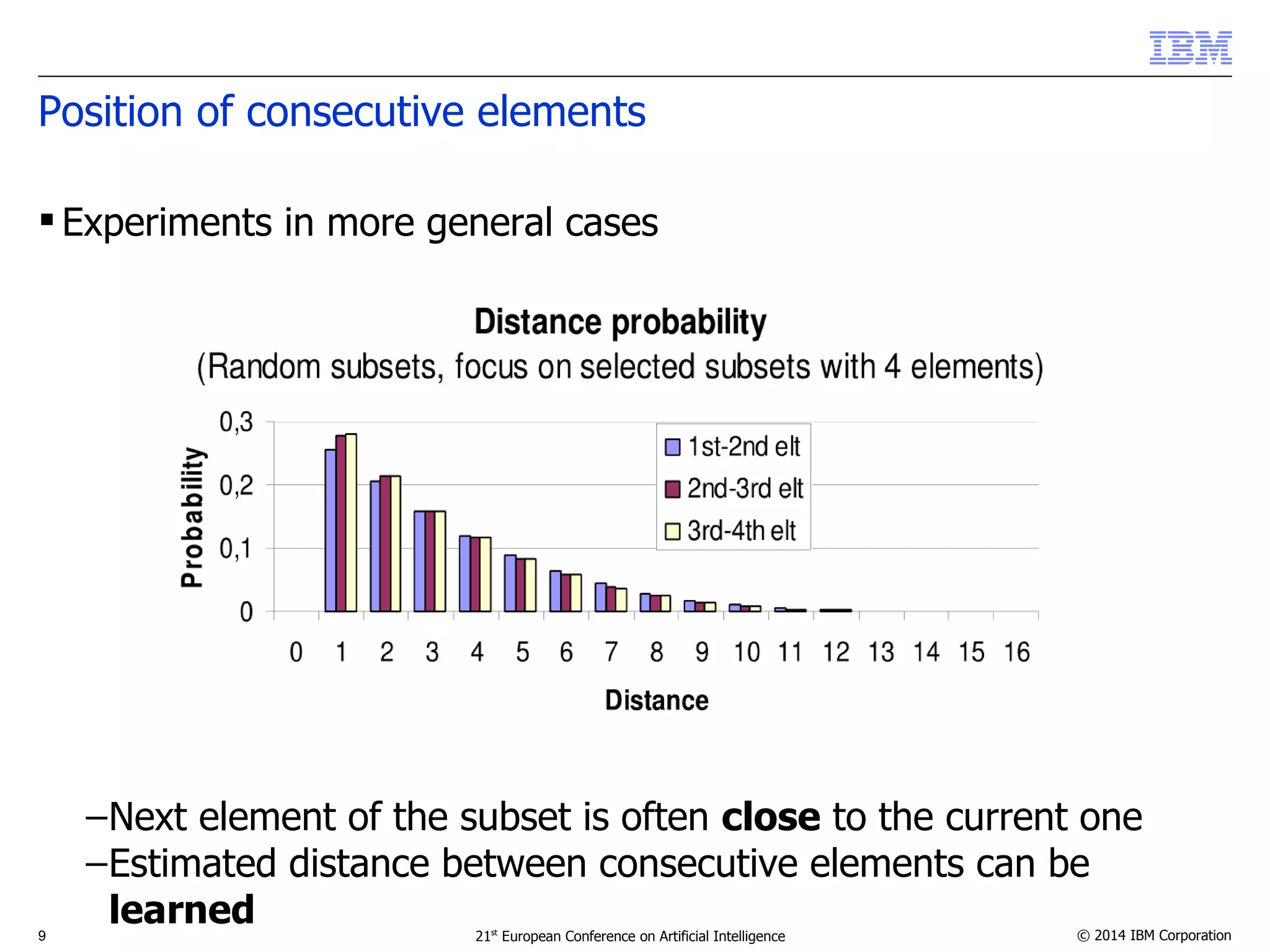
 Experiments in more general cases 
–Next element of the subset is often close to the current one 
–Estimated distance between consecutive elements can be 
learned 
9 21st European Conference on Artificial Intelligence © 2014 IBM Corporation
Dichotomy 
 A dichotomy algorithm DC has been proposed in [Hemery&al-06]. 
It performs a dichotomic search in order to find next element 
U[i]. 
P 
P 
PP 
10 21st European Conference on Artificial Intelligence © 2014 IBM Corporation
Dichotomy 
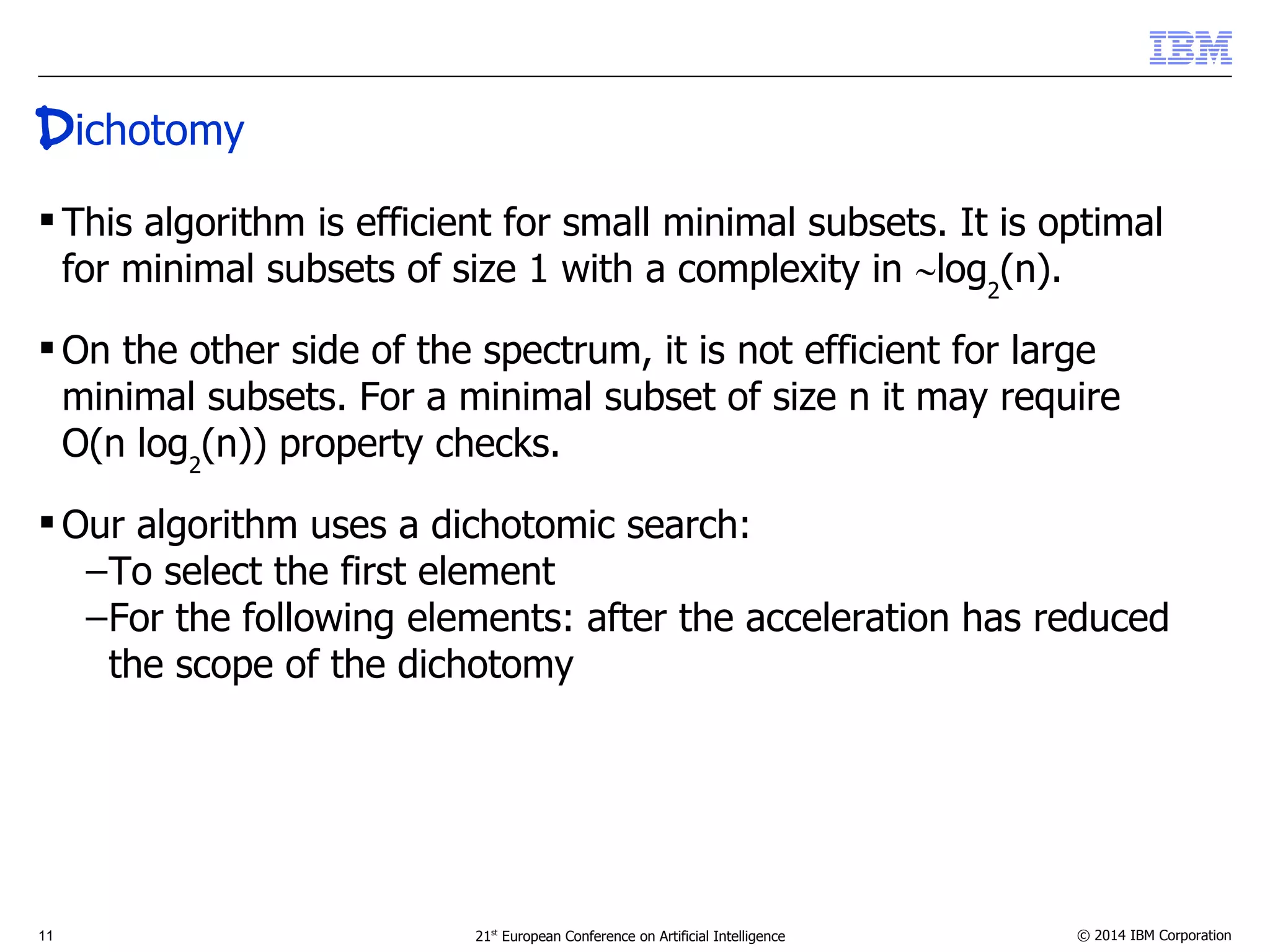
 This algorithm is efficient for small minimal subsets. It is optimal 
for minimal subsets of size 1 with a complexity in log2(n). 
On the other side of the spectrum, it is not efficient for large 
minimal subsets. For a minimal subset of size n it may require 
O(n log2(n)) property checks. 
Our algorithm uses a dichotomic search: 
–To select the first element 
–For the following elements: after the acceleration has reduced 
the scope of the dichotomy 
11 21st European Conference on Artificial Intelligence © 2014 IBM Corporation
Acceleration / Progression 
 The probabilistic study of the distance between consecutive 
elements suggests that it may pay off to look for the next 
element close to the current one 
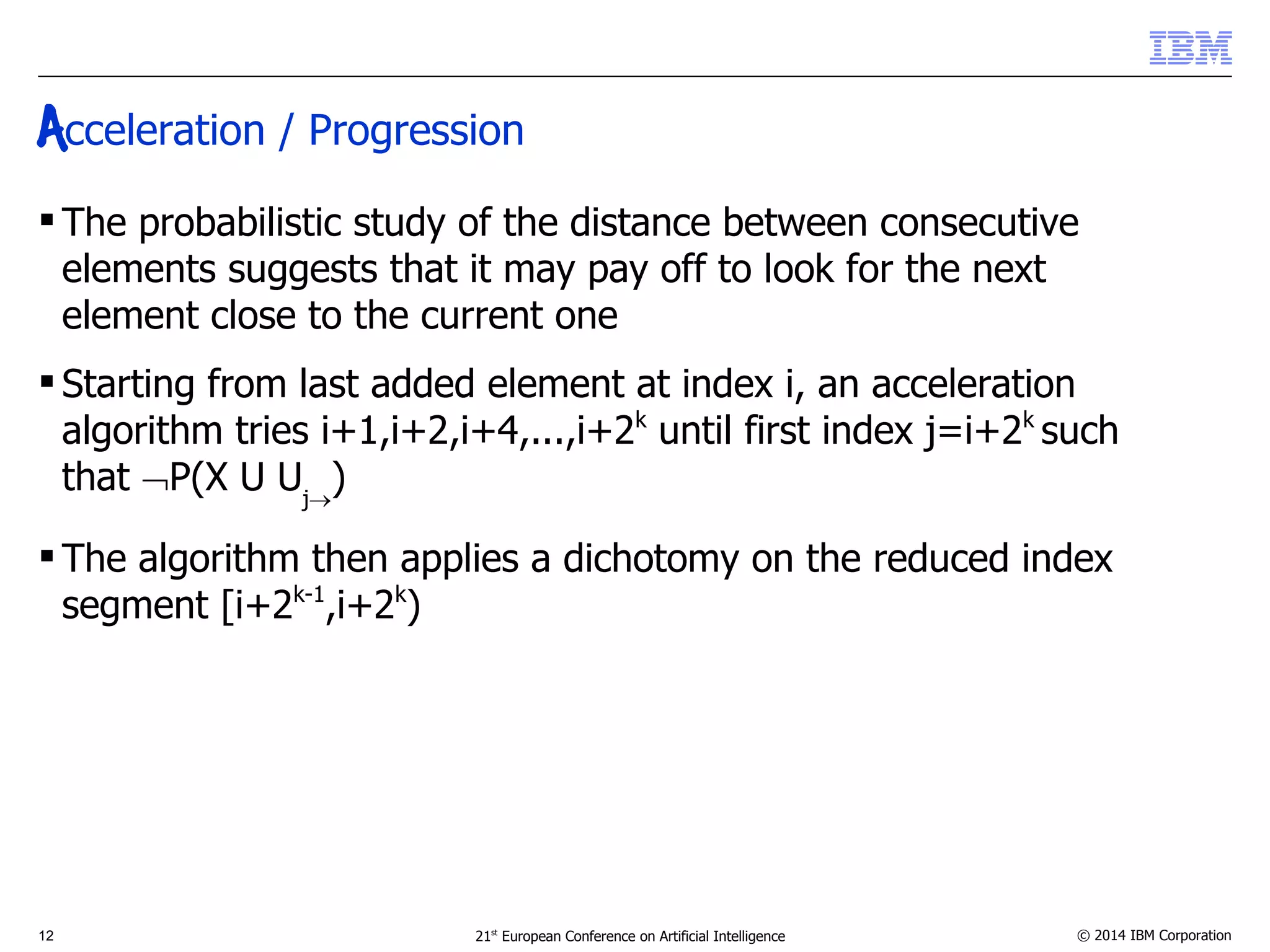
 Starting from last added element at index i, an acceleration 
algorithm tries i+1,i+2,i+4,...,i+2k until first index j=i+2k such 
that P(X U Uj) 
 The algorithm then applies a dichotomy on the reduced index 
segment [i+2k-1,i+2k) 
12 21st European Conference on Artificial Intelligence © 2014 IBM Corporation
Acceleration / Progression 
 A similar approach is used in [Marques-Silva&al-13] 
Main differences of our algorithm: 
–The first iteration uses dichotomy, not acceleration 
–The initial step in the acceleration is learned (see below), it is 
not necessarily 1 
–Up to a certain size, property is checked on current subset X 
each time a new element is added 
 These differences allow showing optimality of the proposed 
algorithm for small minimal subsets 
13 21st European Conference on Artificial Intelligence © 2014 IBM Corporation
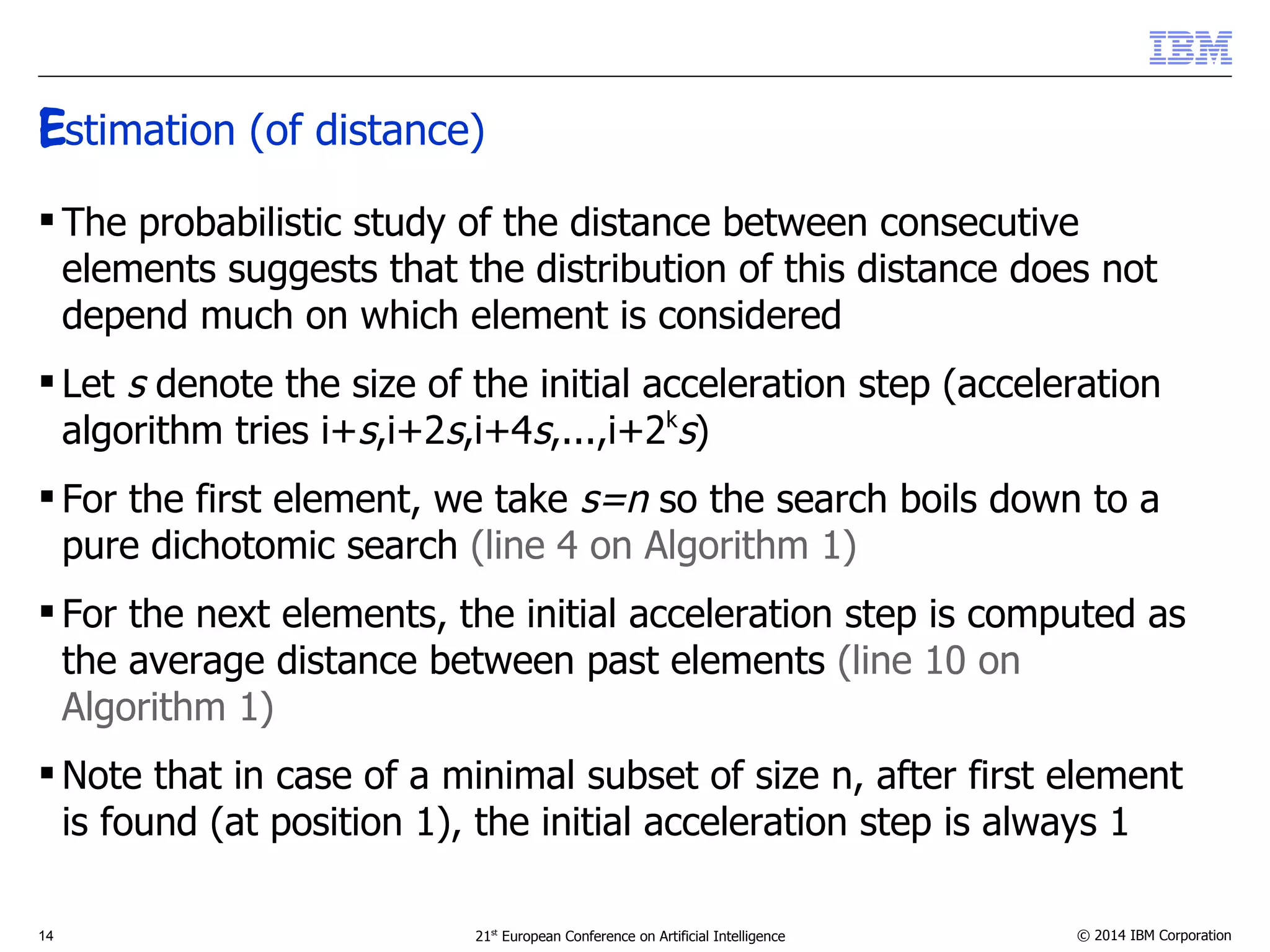
Estimation (of distance) 
 The probabilistic study of the distance between consecutive 
elements suggests that the distribution of this distance does not 
depend much on which element is considered 
 Let s denote the size of the initial acceleration step (acceleration 
algorithm tries i+s,i+2s,i+4s,...,i+2ks) 
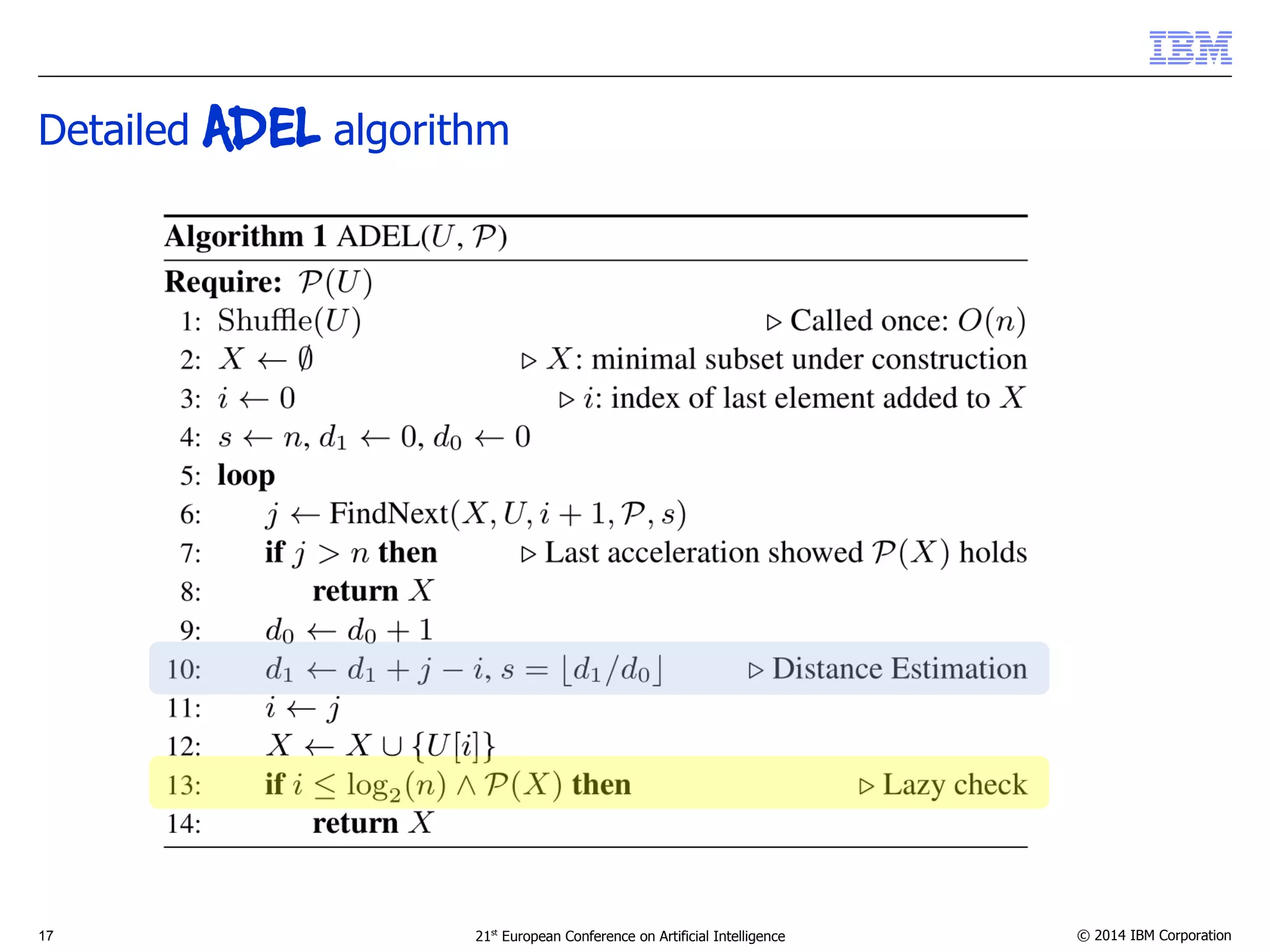
 For the first element, we take s=n so the search boils down to a 
pure dichotomic search (line 4 on Algorithm 1) 
 For the next elements, the initial acceleration step is computed as 
the average distance between past elements (line 10 on 
Algorithm 1) 
Note that in case of a minimal subset of size n, after first element 
is found (at position 1), the initial acceleration step is always 1 
14 21st European Conference on Artificial Intelligence © 2014 IBM Corporation
Lazy checks 
 Property P(X) may be checked when a new element is added to 
X, this allows stopping the search as soon as X satisfies P 
 This is efficient for small minimal subsets. Typically, for a minimal 
subset of size 1, once the initial dichotomy has selected an (the) 
element, search will be stopped immediately 
 This is inefficient for large subsets. Typically, for a minimal subset 
of size n, n-1 useless checks P(X) will be performed 
15 21st European Conference on Artificial Intelligence © 2014 IBM Corporation
Lazy checks 
When the last element of the minimal subset is added to X, if we 
do not check P(X), it will take the acceleration about O(log2(n)) 
additional checks to show that X satisfies P(X) 
 The idea is to check P(X) only for the first log2(n) elements. For 
larger subsets, the O(log2(n)) price to pay for letting the 
acceleration show the property will not exceed the O(log2(n)) we 
already payed to check the first log2(n) elements so the algorithm 
can stop checking P(X) (line 13 of Algorithm 1) 
16 21st European Conference on Artificial Intelligence © 2014 IBM Corporation
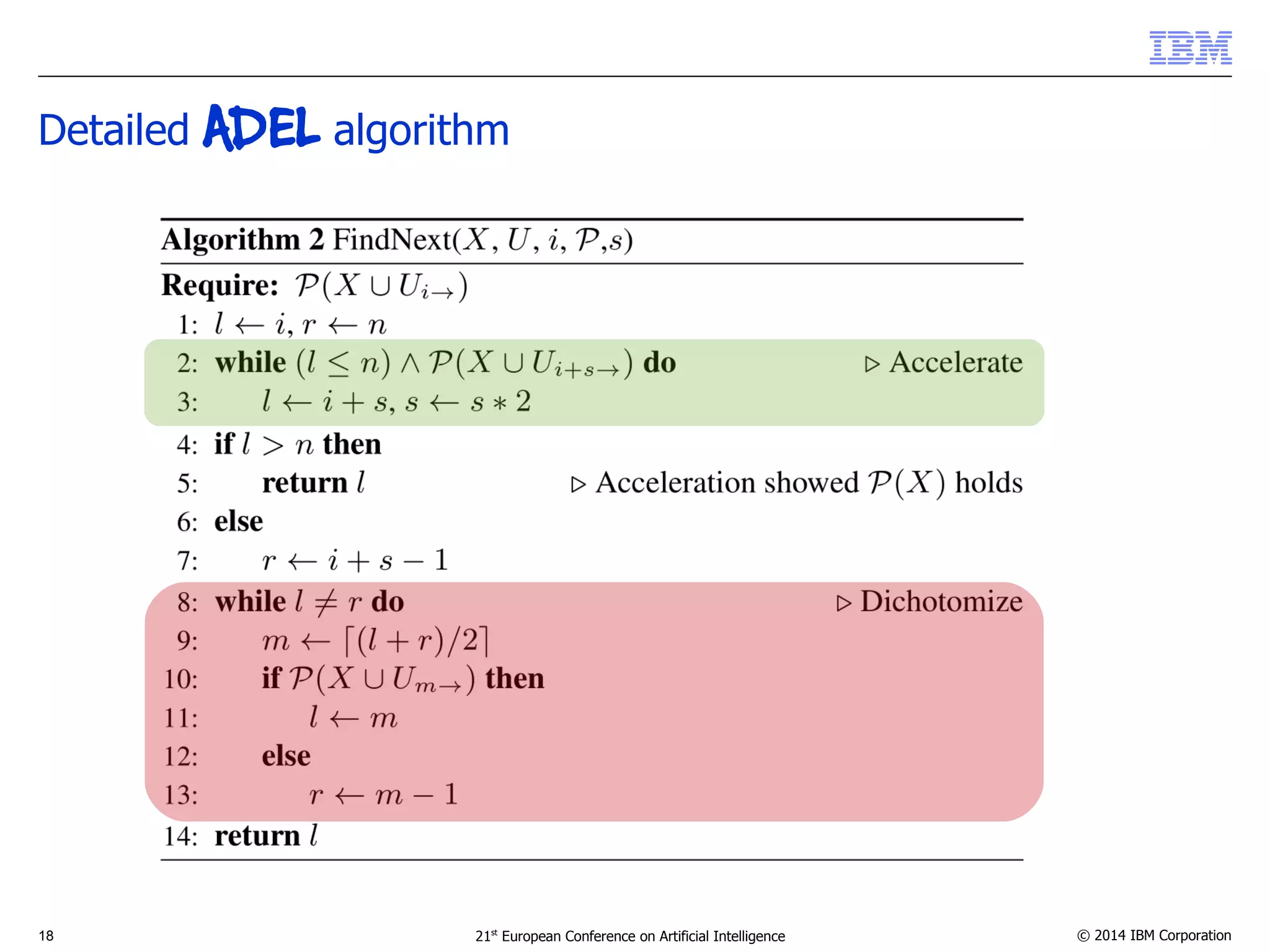
Detailed ADEL algorithm 
17 21st European Conference on Artificial Intelligence © 2014 IBM Corporation
Detailed ADEL algorithm 
18 21st European Conference on Artificial Intelligence © 2014 IBM Corporation
Results 
19 21st European Conference on Artificial Intelligence © 2014 IBM Corporation
Results 
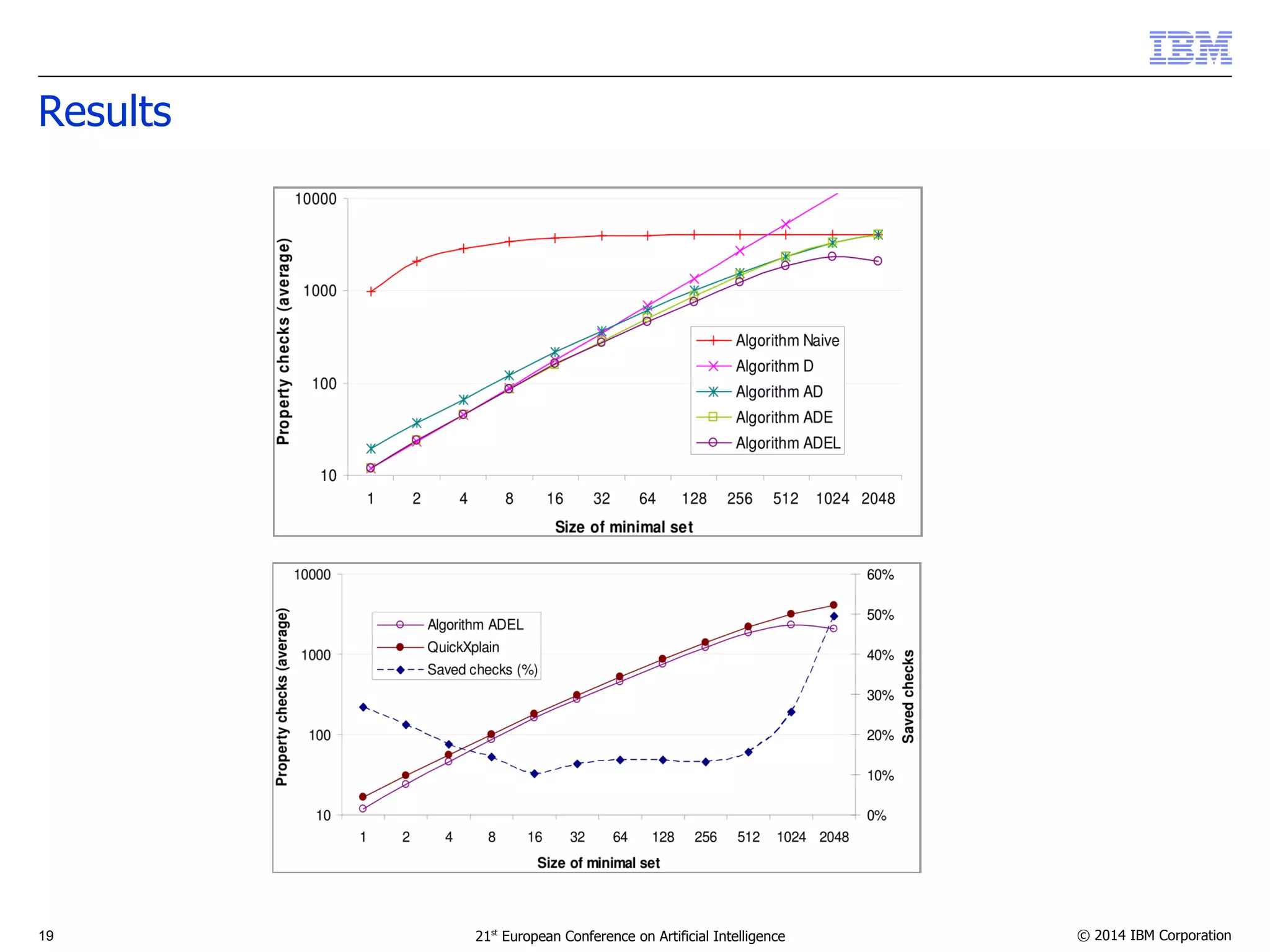
 Algorithm ADEL is optimal in both extreme cases: 
–For small subsets: log2(n) for minimal subset of size 1 
–For large subsets: n for minimal subset of size n 
 Compared to QuickXplain [Junker-04]: 
–For small subsets, it performs 1.5 times less checks 
–For large subsets, it performs twice less checks 
 It behaves continuously in between these extreme cases and 
outperforms all variants as well as QuickXplain 
 ADEL algorithm is used as the implementation of the Conflict 
Refiner functionality for CP models in IBM ILOG CPLEX 
Optimization Studio since version 12.5 
20 21st European Conference on Artificial Intelligence © 2014 IBM Corporation
References 
[Junker-04] U. Junker. QuickXplain: Preferred explanations and 
relaxations for over-constrained problems. In Proc. AAAI-04. 2004. 
[Hemery&al-06] F. Hemery, C. Lecoutre, L. Sais and F. 
Boussemart. Extracting MUCs from constraint networks. In Proc. 
ECAI-06. 2006. 
[Marques-Silva&al-13] J. Marques-Silva, M. Janota and A. Belov. 
Minimal Sets over Monotone Predicates in Boolean Formulae. In 
Proc. CAV-13. 2013. 
21 21st European Conference on Artificial Intelligence © 2014 IBM Corporation

An Optimal Iterative Algorithm for Extracting MUCs in a Black-box Constraint Network

  • 1.
    Extracting MUCs ina Black-box Constraint © 2014 IBM Corporation An Optimal Iterative Algorithm for Network Philippe Laborie IBM, Software Group Aug. 22, 2014 21st European Conference on Artificial Intelligence
  • 2.
    Objective Given anunfeasible Constrained Optimization problem M, extract a Minimal Unsatisfiable Core (MUC) that is, a minimal subset (in the sense of set inclusion) of unfeasible constraints XM  Example: x, y, z in { 1, 2, 3 } constraint C1: AllDifferent(x,y,z) constraint C2: z == x + 2y constraint C3: y < x constraint C4: z == 2x  This problem is unfeasible. A possible MUC is {C1,C2}. 2 21st European Conference on Artificial Intelligence © 2014 IBM Corporation
  • 3.
    Objective  Algorithmdeveloped in the context of providing a Conflict Refiner for CP models in IBM ILOG CPLEX Optimization Studio: when designing optimization models, it is usual to face unfeasible instances (due to errors in the model or the data). Identifying a MUC generally helps to explain the unfeasibility Given the complexity of the automatic search, we consider the engine as a black-box whose answer is Yes/No for the feasibility of a subset of constraints XM 3 21st European Conference on Artificial Intelligence © 2014 IBM Corporation
  • 4.
    Abstracted problem Let U a finite set of cardinality n and P an upward-closed (or monotonous) property on its powerset 2U, that is, such that: (XYU)  P(X)  P(Y) Minimal subset: XU is a minimal subset satisfying P iff: P(X) and YX, P(Y)  In our original problem: –U  Set of constraints in the model –P(X)  Subset of constraints X is unfeasible 4 21st European Conference on Artificial Intelligence © 2014 IBM Corporation
  • 5.
    Abstracted problem Problem definition: –Let U such that P(U), find a minimal subset X satisfying P –The complexity of the resolution algorithm is measured as the number of property checks. As this is an homogeneous measure we can use a more fine grain complexity comparison than the traditional big O comparison. We use a comparison on the order of : f(n)g(n) means limn (f(n)/g(n))=1 5 21st European Conference on Artificial Intelligence © 2014 IBM Corporation
  • 6.
    A family ofiterative algorithms  Elements of U are stored in an array of size n  Array is shuffled so as to rule out any particular structure  Algorithm will select the “rightmost” minimal set in the array  Scan elements from left to right Grows a current subset X X U[i] Ui 6 21st European Conference on Artificial Intelligence © 2014 IBM Corporation
  • 7.
    A family ofiterative algorithms Next element U[i] to be added to current subset X is the one with the smallest index i such that P(X U Ui) When a new element U[i] is added, property P can be checked on current subset X (if P(X), algorithm can be stopped)  Algorithms in this family differs according to the way to find the next element U[i] 7 21st European Conference on Artificial Intelligence © 2014 IBM Corporation
  • 8.
    Position of consecutiveelements  In the particular case of a single minimal subset of size m uniformly distributed in U, the probability p(k) that the distance between the ith and i+1th element is k: –Does not depend on the position i –Exponentially decreases with k 8 21st European Conference on Artificial Intelligence © 2014 IBM Corporation
  • 9.
    Position of consecutiveelements  Experiments in more general cases –Next element of the subset is often close to the current one –Estimated distance between consecutive elements can be learned 9 21st European Conference on Artificial Intelligence © 2014 IBM Corporation
  • 10.
    Dichotomy  Adichotomy algorithm DC has been proposed in [Hemery&al-06]. It performs a dichotomic search in order to find next element U[i]. P P PP 10 21st European Conference on Artificial Intelligence © 2014 IBM Corporation
  • 11.
    Dichotomy  Thisalgorithm is efficient for small minimal subsets. It is optimal for minimal subsets of size 1 with a complexity in log2(n). On the other side of the spectrum, it is not efficient for large minimal subsets. For a minimal subset of size n it may require O(n log2(n)) property checks. Our algorithm uses a dichotomic search: –To select the first element –For the following elements: after the acceleration has reduced the scope of the dichotomy 11 21st European Conference on Artificial Intelligence © 2014 IBM Corporation
  • 12.
    Acceleration / Progression  The probabilistic study of the distance between consecutive elements suggests that it may pay off to look for the next element close to the current one  Starting from last added element at index i, an acceleration algorithm tries i+1,i+2,i+4,...,i+2k until first index j=i+2k such that P(X U Uj)  The algorithm then applies a dichotomy on the reduced index segment [i+2k-1,i+2k) 12 21st European Conference on Artificial Intelligence © 2014 IBM Corporation
  • 13.
    Acceleration / Progression  A similar approach is used in [Marques-Silva&al-13] Main differences of our algorithm: –The first iteration uses dichotomy, not acceleration –The initial step in the acceleration is learned (see below), it is not necessarily 1 –Up to a certain size, property is checked on current subset X each time a new element is added  These differences allow showing optimality of the proposed algorithm for small minimal subsets 13 21st European Conference on Artificial Intelligence © 2014 IBM Corporation
  • 14.
    Estimation (of distance)  The probabilistic study of the distance between consecutive elements suggests that the distribution of this distance does not depend much on which element is considered  Let s denote the size of the initial acceleration step (acceleration algorithm tries i+s,i+2s,i+4s,...,i+2ks)  For the first element, we take s=n so the search boils down to a pure dichotomic search (line 4 on Algorithm 1)  For the next elements, the initial acceleration step is computed as the average distance between past elements (line 10 on Algorithm 1) Note that in case of a minimal subset of size n, after first element is found (at position 1), the initial acceleration step is always 1 14 21st European Conference on Artificial Intelligence © 2014 IBM Corporation
  • 15.
    Lazy checks Property P(X) may be checked when a new element is added to X, this allows stopping the search as soon as X satisfies P  This is efficient for small minimal subsets. Typically, for a minimal subset of size 1, once the initial dichotomy has selected an (the) element, search will be stopped immediately  This is inefficient for large subsets. Typically, for a minimal subset of size n, n-1 useless checks P(X) will be performed 15 21st European Conference on Artificial Intelligence © 2014 IBM Corporation
  • 16.
    Lazy checks Whenthe last element of the minimal subset is added to X, if we do not check P(X), it will take the acceleration about O(log2(n)) additional checks to show that X satisfies P(X)  The idea is to check P(X) only for the first log2(n) elements. For larger subsets, the O(log2(n)) price to pay for letting the acceleration show the property will not exceed the O(log2(n)) we already payed to check the first log2(n) elements so the algorithm can stop checking P(X) (line 13 of Algorithm 1) 16 21st European Conference on Artificial Intelligence © 2014 IBM Corporation
  • 17.
    Detailed ADEL algorithm 17 21st European Conference on Artificial Intelligence © 2014 IBM Corporation
  • 18.
    Detailed ADEL algorithm 18 21st European Conference on Artificial Intelligence © 2014 IBM Corporation
  • 19.
    Results 19 21stEuropean Conference on Artificial Intelligence © 2014 IBM Corporation
  • 20.
    Results  AlgorithmADEL is optimal in both extreme cases: –For small subsets: log2(n) for minimal subset of size 1 –For large subsets: n for minimal subset of size n  Compared to QuickXplain [Junker-04]: –For small subsets, it performs 1.5 times less checks –For large subsets, it performs twice less checks  It behaves continuously in between these extreme cases and outperforms all variants as well as QuickXplain  ADEL algorithm is used as the implementation of the Conflict Refiner functionality for CP models in IBM ILOG CPLEX Optimization Studio since version 12.5 20 21st European Conference on Artificial Intelligence © 2014 IBM Corporation
  • 21.
    References [Junker-04] U.Junker. QuickXplain: Preferred explanations and relaxations for over-constrained problems. In Proc. AAAI-04. 2004. [Hemery&al-06] F. Hemery, C. Lecoutre, L. Sais and F. Boussemart. Extracting MUCs from constraint networks. In Proc. ECAI-06. 2006. [Marques-Silva&al-13] J. Marques-Silva, M. Janota and A. Belov. Minimal Sets over Monotone Predicates in Boolean Formulae. In Proc. CAV-13. 2013. 21 21st European Conference on Artificial Intelligence © 2014 IBM Corporation