June 26-29, 2018
June 26-29, 2018
CPAIOR 2018
CPAIOR 2018
© 2018 IBM Corporation
Objective Landscapes for
Constraint Programming
Philippe Laborie, IBM
laborie@fr.ibm.com
2 / 12 CPAIOR 2018 © 2018 IBM Corporation
Goal
Improve performance of a Black-Box CP Solver (in our
case IBM ILOG CP Optimizer) by exploiting some
information on the relation between decision variables and
objective value
This idea is not new !
Impact-Based Search [Refalo-2014]
Activity-Based Search [Michel&Van Hentenryck-2012]
Linear Relaxations [Beck&Refalo-2003, Laborie&Rogerie-2016]
…, …, ...
But we had specific requirements:
It should work for variables with huge domains, typically with
continuous semantics (start/end times of activities)
It should scale to large problems with several 1000s of
variables
3 / 12 CPAIOR 2018 © 2018 IBM Corporation
Goal
Typical examples of objective functions in the real-world:
Scheduling in semiconductor manufacturing:
xi
: Boolean variables (allocations of tasks to machines)
ej
: End time of task j, Fj
: Earliness/Tardiness cost function
dk
: Delay variable between some particular tasks
Resource Constrained Project Scheduling with Net Present
Value:
ep
: End times of activities producing cash
ec
: End times of activities consuming cash
4 / 12 CPAIOR 2018 © 2018 IBM Corporation
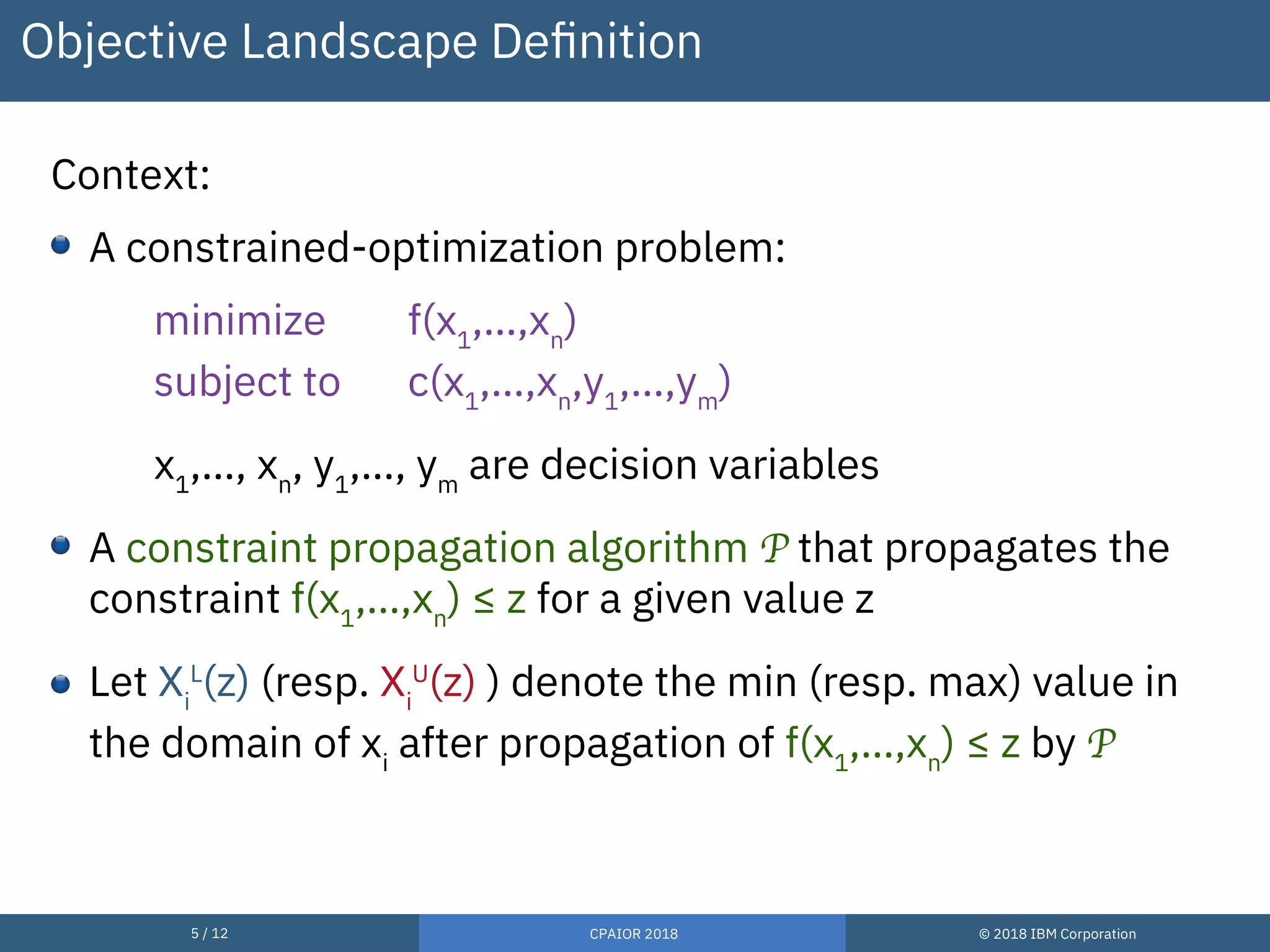
The Philosophy of Objective Landscapes
“Lazy Programmers for Lazy Machines.”
The new technique should (almost) not add any
computational cost to the existing search algorithms
The new technique should reuse existing algorithms as
much as possible
→ Use existing algorithms in a different way !
5 / 12 CPAIOR 2018 © 2018 IBM Corporation
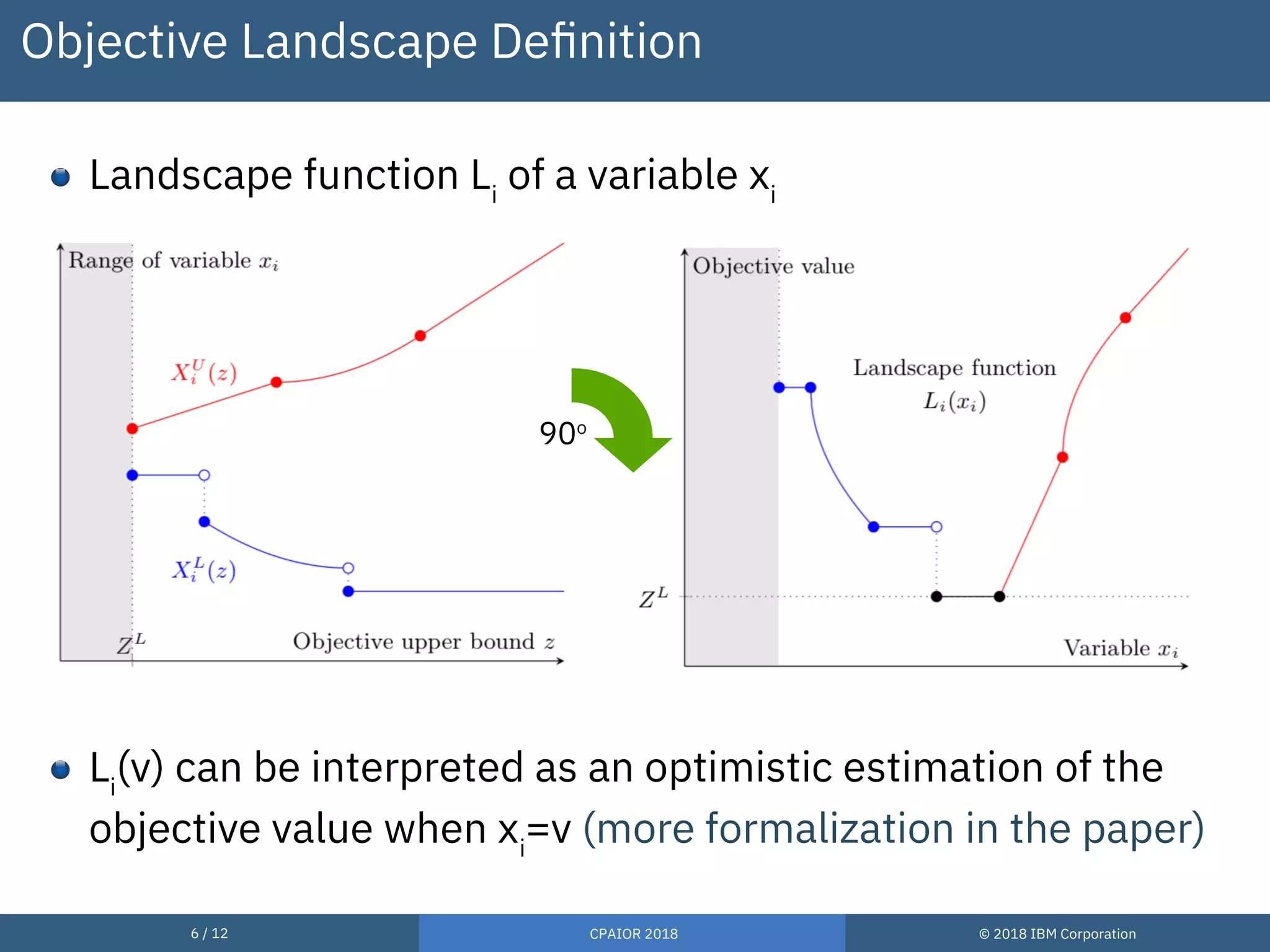
Objective Landscape Definition
Context:
A constrained-optimization problem:
minimize f(x1
,…,xn
)
subject to c(x1
,…,xn
,y1
,…,ym
)
x1
,…, xn
, y1
,…, ym
are decision variables
A constraint propagation algorithm P that propagates the
constraint f(x1
,…,xn
) ≤ z for a given value z
Let Xi
L
(z) (resp. Xi
U
(z) ) denote the min (resp. max) value in
the domain of xi
after propagation of f(x1
,…,xn
) ≤ z by P
6 / 12 CPAIOR 2018 © 2018 IBM Corporation
Objective Landscape Definition
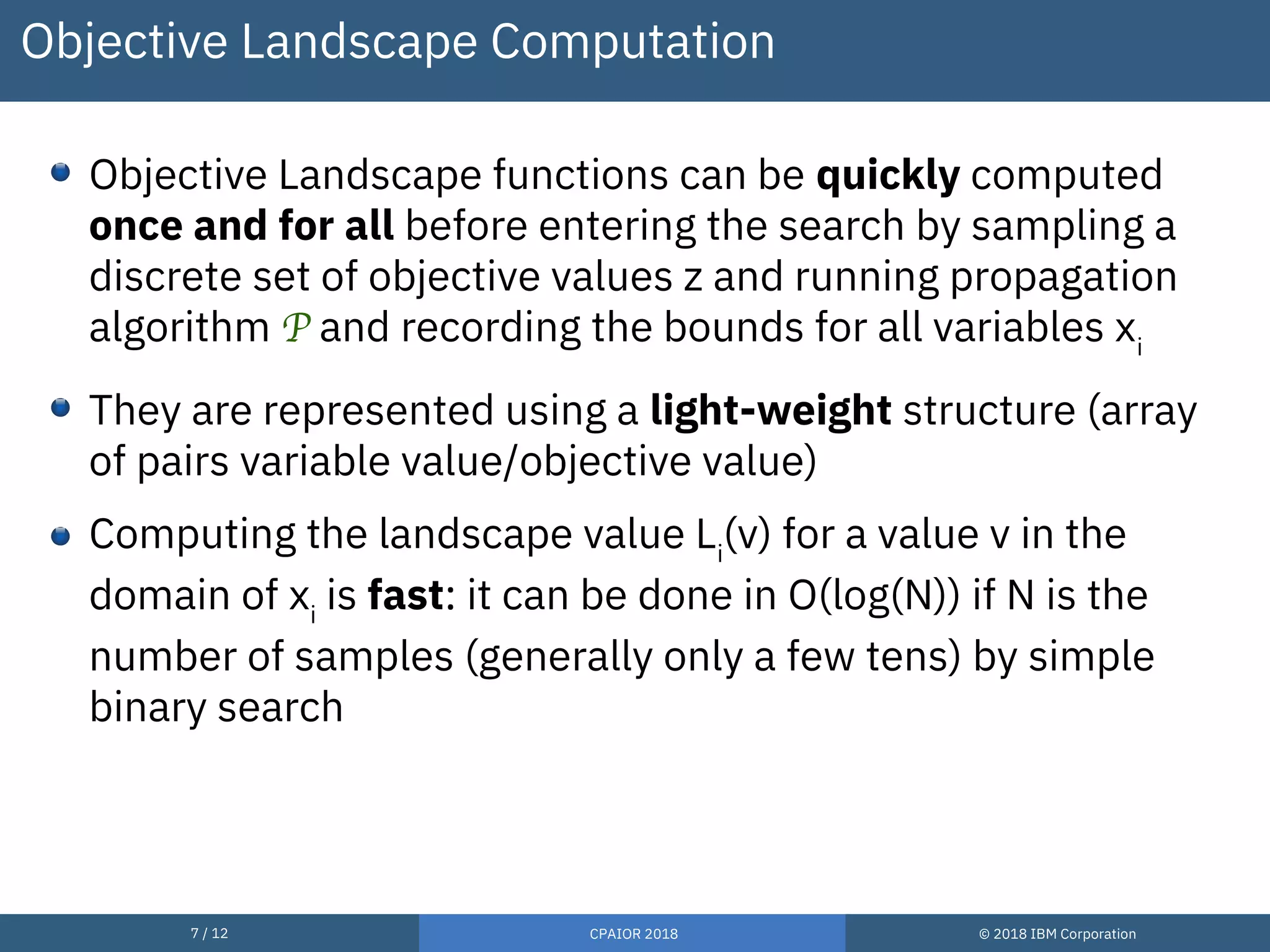
Landscape function Li
of a variable xi
Li
(v) can be interpreted as an optimistic estimation of the
objective value when xi
=v (more formalization in the paper)
90o
7 / 12 CPAIOR 2018 © 2018 IBM Corporation
Objective Landscape Computation
Objective Landscape functions can be quickly computed
once and for all before entering the search by sampling a
discrete set of objective values z and running propagation
algorithm P and recording the bounds for all variables xi
They are represented using a light-weight structure (array
of pairs variable value/objective value)
Computing the landscape value Li
(v) for a value v in the
domain of xi
is fast: it can be done in O(log(N)) if N is the
number of samples (generally only a few tens) by simple
binary search
8 / 12 CPAIOR 2018 © 2018 IBM Corporation
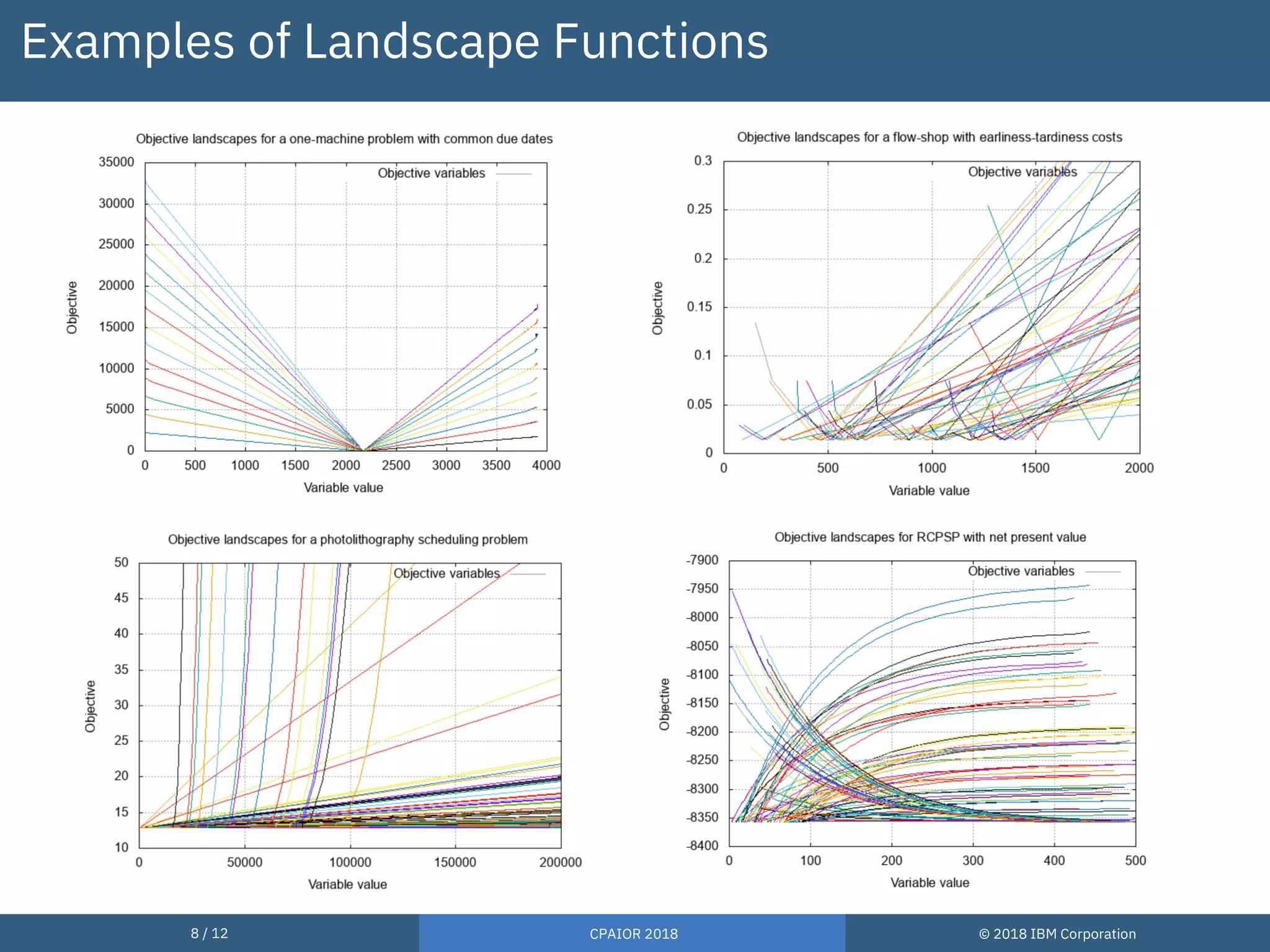
Examples of Landscape Functions
9 / 12 CPAIOR 2018 © 2018 IBM Corporation
Objective Landscape Exploitation
In CP, landscape functions can be used in many ways
during the search:
Selection of variables
Selection of values
In a Large Neighborhood Search (LNS) context:
Selection of LNS fragment
Prevent cost degradation for some variables in LNS moves
Selection of variables and values in LNS completion
We still did not fully explore all these ideas
10 / 12 CPAIOR 2018 © 2018 IBM Corporation
Objective Landscape Exploitation
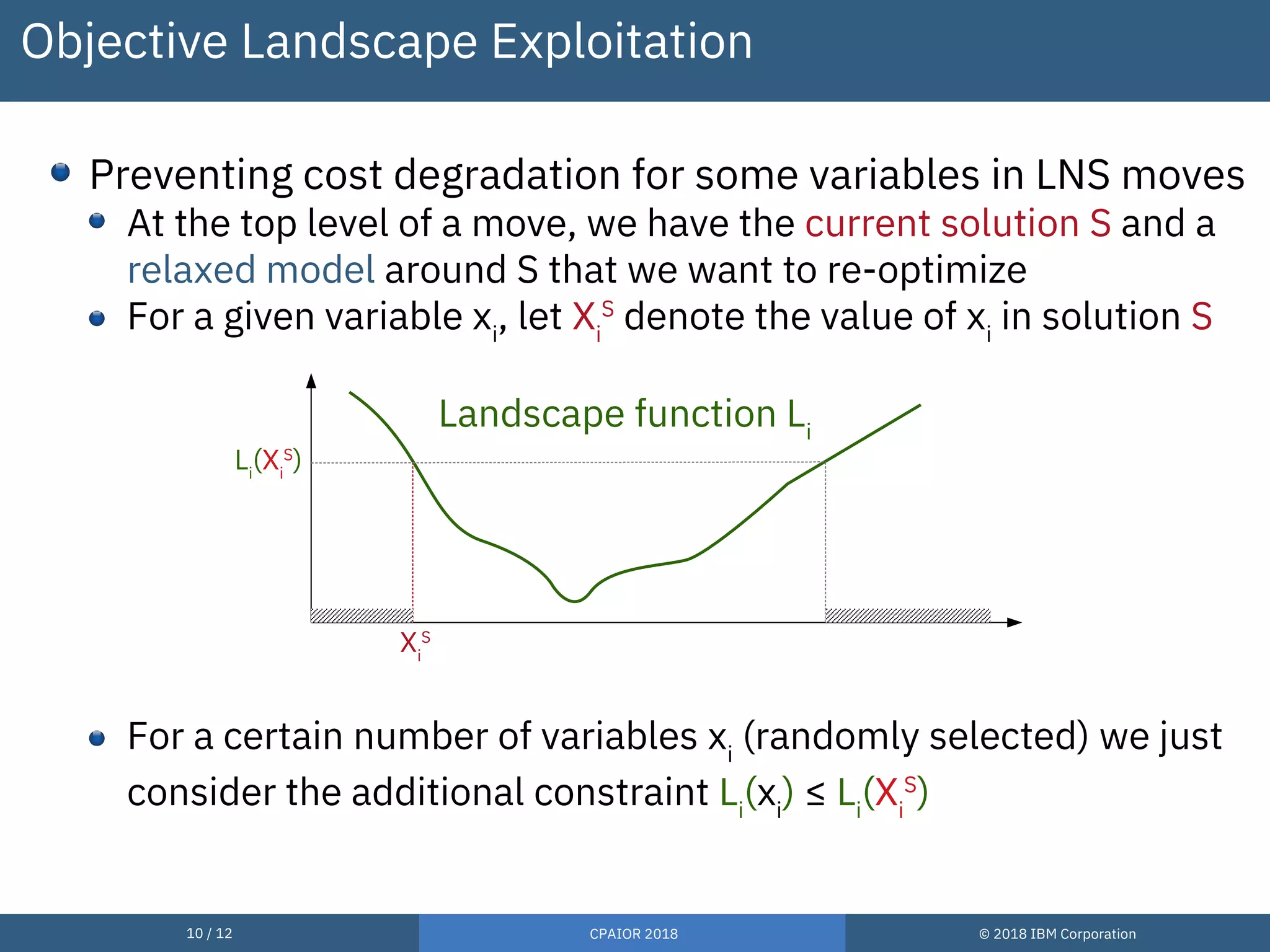
Preventing cost degradation for some variables in LNS moves
At the top level of a move, we have the current solution S and a
relaxed model around S that we want to re-optimize
For a given variable xi
, let Xi
S
denote the value of xi
in solution S
For a certain number of variables xi
(randomly selected) we just
consider the additional constraint Li
(xi
) ≤ Li
(Xi
S
)
Xi
S
Landscape function Li
Li
(Xi
S
)
11 / 12 CPAIOR 2018 © 2018 IBM Corporation
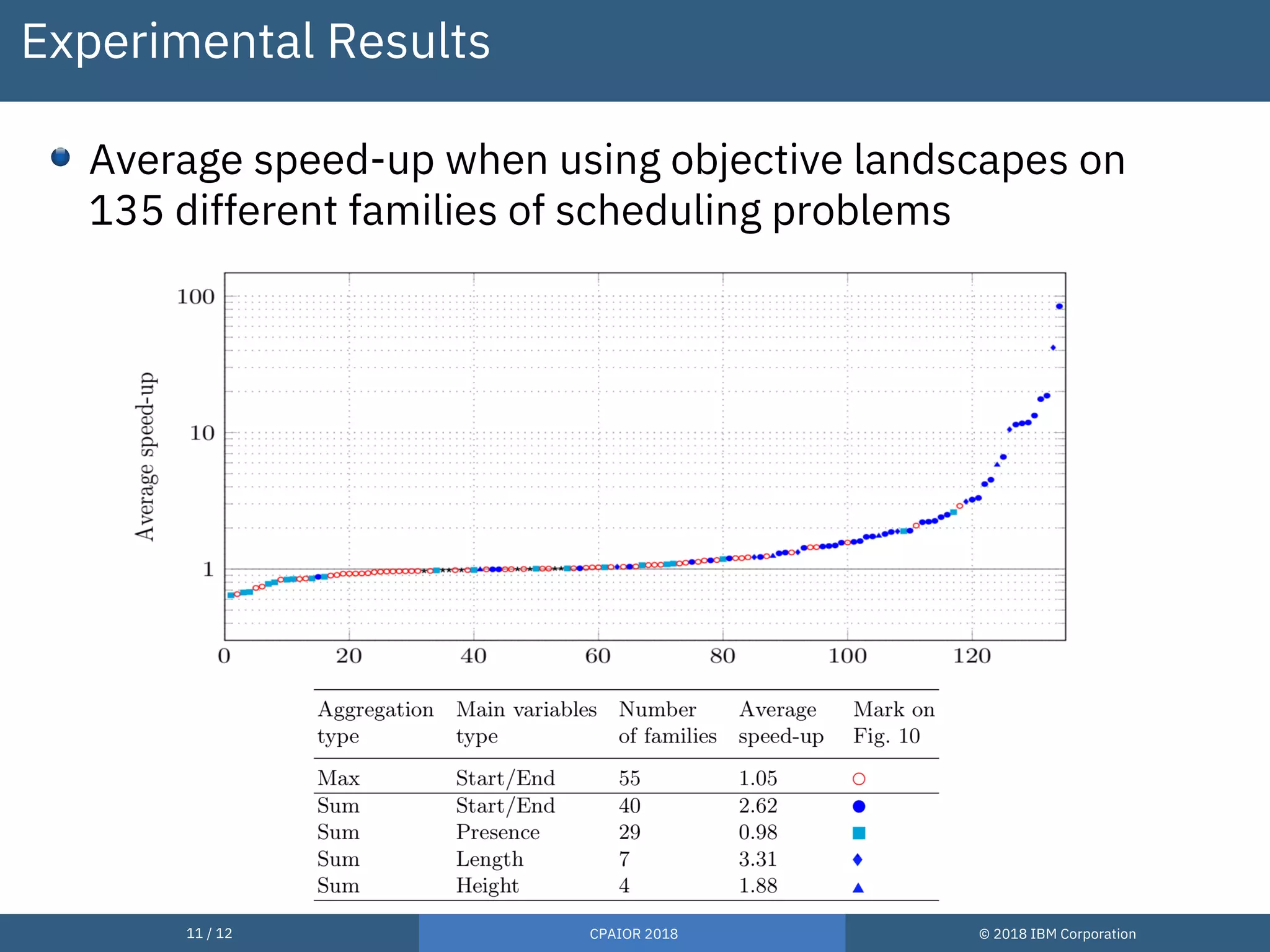
Experimental Results
Average speed-up when using objective landscapes on
135 different families of scheduling problems
12 / 12 CPAIOR 2018 © 2018 IBM Corporation
Conclusion and Future Work
Implemented in automated search of IBM ILOG CP
Optimizer V12.7.1/12.8
Average speed-up x1.5 between 12.7 and 12.8
Up to two orders of magnitude speed-up for some problems
with objective expressed as a weighted sum of variables
with continuous semantics (very common in real problems)
Future work:
Investigate other forms of landscape exploitation in the search
Objective landscapes can be generalized to store holes in the
domains
Constraints of the problem could be exploited too

Objective Landscapes for Constraint Programming

  • 1.
    June 26-29, 2018 June26-29, 2018 CPAIOR 2018 CPAIOR 2018 © 2018 IBM Corporation © 2018 IBM Corporation Objective Landscapes for Constraint Programming Philippe Laborie, IBM laborie@fr.ibm.com
  • 2.
    2 / 12CPAIOR 2018 © 2018 IBM Corporation Goal Improve performance of a Black-Box CP Solver (in our case IBM ILOG CP Optimizer) by exploiting some information on the relation between decision variables and objective value This idea is not new ! Impact-Based Search [Refalo-2014] Activity-Based Search [Michel&Van Hentenryck-2012] Linear Relaxations [Beck&Refalo-2003, Laborie&Rogerie-2016] …, …, ... But we had specific requirements: It should work for variables with huge domains, typically with continuous semantics (start/end times of activities) It should scale to large problems with several 1000s of variables
  • 3.
    3 / 12CPAIOR 2018 © 2018 IBM Corporation Goal Typical examples of objective functions in the real-world: Scheduling in semiconductor manufacturing: xi : Boolean variables (allocations of tasks to machines) ej : End time of task j, Fj : Earliness/Tardiness cost function dk : Delay variable between some particular tasks Resource Constrained Project Scheduling with Net Present Value: ep : End times of activities producing cash ec : End times of activities consuming cash
  • 4.
    4 / 12CPAIOR 2018 © 2018 IBM Corporation The Philosophy of Objective Landscapes “Lazy Programmers for Lazy Machines.” The new technique should (almost) not add any computational cost to the existing search algorithms The new technique should reuse existing algorithms as much as possible → Use existing algorithms in a different way !
  • 5.
    5 / 12CPAIOR 2018 © 2018 IBM Corporation Objective Landscape Definition Context: A constrained-optimization problem: minimize f(x1 ,…,xn ) subject to c(x1 ,…,xn ,y1 ,…,ym ) x1 ,…, xn , y1 ,…, ym are decision variables A constraint propagation algorithm P that propagates the constraint f(x1 ,…,xn ) ≤ z for a given value z Let Xi L (z) (resp. Xi U (z) ) denote the min (resp. max) value in the domain of xi after propagation of f(x1 ,…,xn ) ≤ z by P
  • 6.
    6 / 12CPAIOR 2018 © 2018 IBM Corporation Objective Landscape Definition Landscape function Li of a variable xi Li (v) can be interpreted as an optimistic estimation of the objective value when xi =v (more formalization in the paper) 90o
  • 7.
    7 / 12CPAIOR 2018 © 2018 IBM Corporation Objective Landscape Computation Objective Landscape functions can be quickly computed once and for all before entering the search by sampling a discrete set of objective values z and running propagation algorithm P and recording the bounds for all variables xi They are represented using a light-weight structure (array of pairs variable value/objective value) Computing the landscape value Li (v) for a value v in the domain of xi is fast: it can be done in O(log(N)) if N is the number of samples (generally only a few tens) by simple binary search
  • 8.
    8 / 12CPAIOR 2018 © 2018 IBM Corporation Examples of Landscape Functions
  • 9.
    9 / 12CPAIOR 2018 © 2018 IBM Corporation Objective Landscape Exploitation In CP, landscape functions can be used in many ways during the search: Selection of variables Selection of values In a Large Neighborhood Search (LNS) context: Selection of LNS fragment Prevent cost degradation for some variables in LNS moves Selection of variables and values in LNS completion We still did not fully explore all these ideas
  • 10.
    10 / 12CPAIOR 2018 © 2018 IBM Corporation Objective Landscape Exploitation Preventing cost degradation for some variables in LNS moves At the top level of a move, we have the current solution S and a relaxed model around S that we want to re-optimize For a given variable xi , let Xi S denote the value of xi in solution S For a certain number of variables xi (randomly selected) we just consider the additional constraint Li (xi ) ≤ Li (Xi S ) Xi S Landscape function Li Li (Xi S )
  • 11.
    11 / 12CPAIOR 2018 © 2018 IBM Corporation Experimental Results Average speed-up when using objective landscapes on 135 different families of scheduling problems
  • 12.
    12 / 12CPAIOR 2018 © 2018 IBM Corporation Conclusion and Future Work Implemented in automated search of IBM ILOG CP Optimizer V12.7.1/12.8 Average speed-up x1.5 between 12.7 and 12.8 Up to two orders of magnitude speed-up for some problems with objective expressed as a weighted sum of variables with continuous semantics (very common in real problems) Future work: Investigate other forms of landscape exploitation in the search Objective landscapes can be generalized to store holes in the domains Constraints of the problem could be exploited too