Oct. 10, 2019
Oct. 10, 2019
PDIA 2019
PDIA 2019
© 2019 IBM Corporation
CP Optimizer
pour la planification
et l’ordonnancement
Philippe Laborie
IBM, IBM Data & AI
laborie@fr.ibm.com
2 / 28 PDIA 2019 © 2019 IBM Corporation
What is scheduling ?
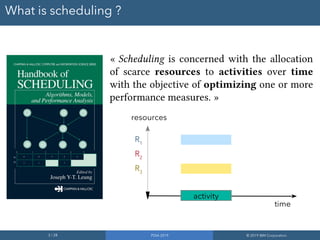
« Scheduling is concerned with the allocation
of scarce resources to activities over time
with the objective of optimizing one or more
performance measures. »
3 / 28 PDIA 2019 © 2019 IBM Corporation
What is scheduling ?
« Scheduling is concerned with the allocation
of scarce resources to activities over time
with the objective of optimizing one or more
performance measures. »
activity
R2
time
resources
R3
R1
4 / 28 PDIA 2019 © 2019 IBM Corporation
Examples of scheduling problems
Resource-Constrained Project Scheduling (RCPSP)
Notorious NP-Hard problem in combinatorial optimization
(>5000 references on Google Scholar)
N tasks with precedence constraints
M resources of limited capacity
Minimize project makespan
1
1
2
2
4
4
3
3
5
5
6
6
0 7
R1
R2
1
2
3
4
5
6
p1
=2
(1,2)
C1
=2
C2
=3
time
5 / 28 PDIA 2019 © 2019 IBM Corporation
Examples of scheduling problems
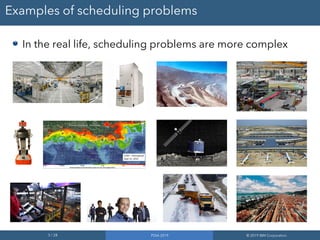
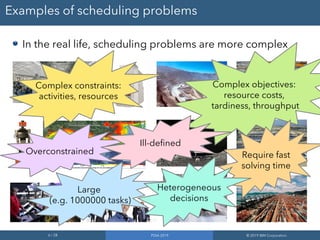
In the real life, scheduling problems are more complex
6 / 28 PDIA 2019 © 2019 IBM Corporation
Examples of scheduling problems
Complex objectives:
resource costs,
tardiness, throughput
Complex constraints:
activities, resources
Overconstrained
Ill-defined
Large
(e.g. 1000000 tasks)
Require fast
solving time
In the real life, scheduling problems are more complex
Heterogeneous
decisions
7 / 28 PDIA 2019 © 2019 IBM Corporation
What is CP Optimizer ?
Historically developed since 2007 by ILOG, now IBM
Our team has 20+ years of experience in designing
combinatorial optimization tools for real-life industrial
problems, and particularly scheduling problems
#1 objective of CP Optimizer : lower the barrier to entry
for efficiently solving industrial scheduling problems
Targeted audience goes beyond CP experts:
OR experts
Data scientists
Software engineers
8 / 28 PDIA 2019 © 2019 IBM Corporation
What is CP Optimizer ?
Model & run approach:
User focuses on a declarative mathematical model of
the problem using the classical ingredients of
combinatorial optimization: variables, constraints,
expressions, objective function
Resolution is performed by an automated search
algorithm with the following properties: complete,
deterministic, anytime, efficient, robust, continuously
improving ...
9 / 28 PDIA 2019 © 2019 IBM Corporation
What is CP Optimizer ?
Model & run approach: wait … this already exists: it looks
like Mixed Integer Linear Programming (MILP) !
Right: we borrowed a lot from the MILP paradigm when
designing CP optimizer
Wrong: MILP is usually not good for scheduling problems
Difficult to model them
Many modeling tricks exist but they are brittle
Large models (typically in n2
or n3
with problem size)
Poor performance, especially on large problems
Often it takes long even to get a feasible solution (not
anytime)
10 / 28 PDIA 2019 © 2019 IBM Corporation
What’s wrong with MILP (and classical CP) for scheduling ?
It’s missing the essential ingredient of scheduling: time
Interestingly, time is a very relevant topic in AI
Temporal reasoning
Reasoning on action and change
11 / 28 PDIA 2019 © 2019 IBM Corporation
Time in AI: examples
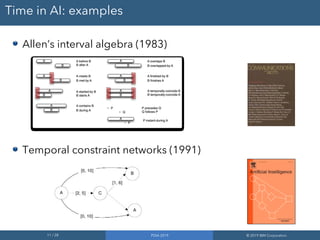
Allen’s interval algebra (1983)
Temporal constraint networks (1991)
12 / 28 PDIA 2019 © 2019 IBM Corporation
Time in AI: examples
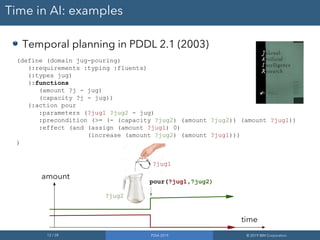
Temporal planning in PDDL 2.1 (2003)
(define (domain jug-pouring)
(:requirements :typing :fluents)
(:types jug)
(:functions
(amount ?j - jug)
(capacity ?j - jug))
(:action pour
:parameters (?jug1 ?jug2 - jug)
:precondition (>= (- (capacity ?jug2) (amount ?jug2)) (amount ?jug1))
:effect (and (assign (amount ?jug1) 0)
(increase (amount ?jug2) (amount ?jug1)))
)
?jug1
?jug2
time
amount
pour(?jug1,?jug2)
13 / 28 PDIA 2019 © 2019 IBM Corporation
Time in AI: examples
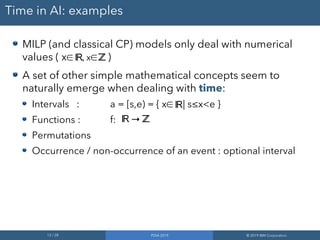
MILP (and classical CP) models only deal with numerical
values ( x∈ , x∈ )
A set of other simple mathematical concepts seem to
naturally emerge when dealing with time:
Intervals : a = [s,e) = { x∈ | s≤x<e }
Functions : f: →
Permutations
Occurrence / non-occurrence of an event : optional interval
ℝ
ℝ
ℝ ℤ
ℤ
14 / 28 PDIA 2019 © 2019 IBM Corporation
What is CP Optimizer ?
What if we integrate these mathematical concepts in the
model …
And keep all the good ideas of MILP:
Model & run
Exact algorithm
Input/output file format
Language versatility (C++, Python, Java, C#, OPL)
Modeling assistance (warnings, …)
Conflict refiner
Warm-start
…
That’s exactly what CP Optimizer is about !
15 / 28 PDIA 2019 © 2019 IBM Corporation
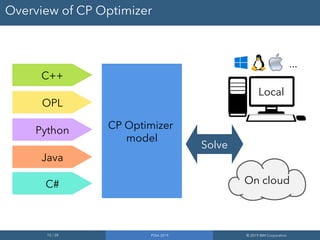
Overview of CP Optimizer
CP Optimizer
model
C++
OPL
Python
Java
C# On cloud
Local
...
Solve
16 / 28 PDIA 2019 © 2019 IBM Corporation
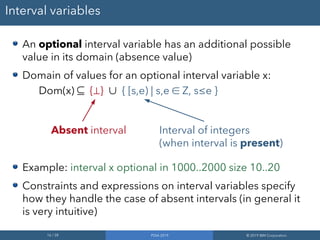
Interval variables
An optional interval variable has an additional possible
value in its domain (absence value)
Domain of values for an optional interval variable x:
Dom(x) ⊆ {⊥} ∪ { [s,e) | s,e ∈ Z, s≤e }
Example: interval x optional in 1000..2000 size 10..20
Constraints and expressions on interval variables specify
how they handle the case of absent intervals (in general it
is very intuitive)
Absent interval Interval of integers
(when interval is present)
17 / 28 PDIA 2019 © 2019 IBM Corporation
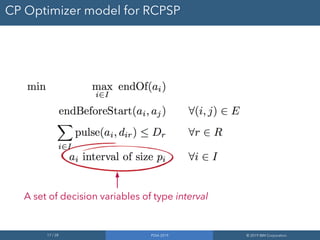
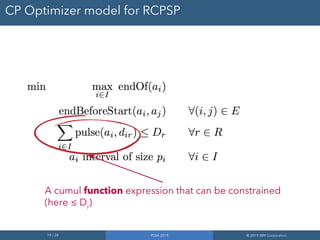
CP Optimizer model for RCPSP
A set of decision variables of type interval
18 / 28 PDIA 2019 © 2019 IBM Corporation
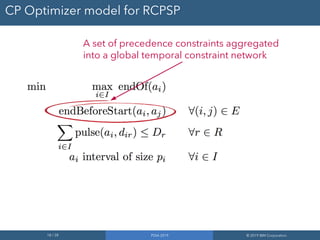
CP Optimizer model for RCPSP
A set of precedence constraints aggregated
into a global temporal constraint network
19 / 28 PDIA 2019 © 2019 IBM Corporation
CP Optimizer model for RCPSP
A cumul function expression that can be constrained
(here ≤ Dr
)
20 / 28 PDIA 2019 © 2019 IBM Corporation
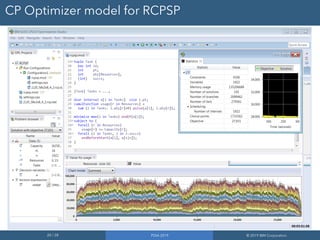
CP Optimizer model for RCPSP
21 / 28 PDIA 2019 © 2019 IBM Corporation
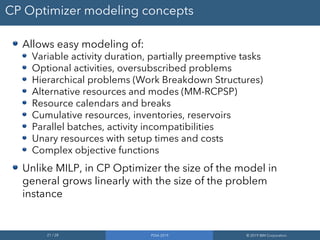
CP Optimizer modeling concepts
Allows easy modeling of:
Variable activity duration, partially preemptive tasks
Optional activities, oversubscribed problems
Hierarchical problems (Work Breakdown Structures)
Alternative resources and modes (MM-RCPSP)
Resource calendars and breaks
Cumulative resources, inventories, reservoirs
Parallel batches, activity incompatibilities
Unary resources with setup times and costs
Complex objective functions
Unlike MILP, in CP Optimizer the size of the model in
general grows linearly with the size of the problem
instance
22 / 28 PDIA 2019 © 2019 IBM Corporation
CP Optimizer model for Work-Breakdown Structures
task
dec
OR
OR
Note the similarities with Hierarchical Task Network (HTN) in A.I. Planning
23 / 28 PDIA 2019 © 2019 IBM Corporation
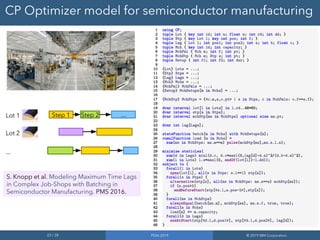
CP Optimizer model for semiconductor manufacturing
Step 1 Step 2 ...Lot 1
Lot 2
...
S. Knopp et al. Modeling Maximum Time Lags
in Complex Job-Shops with Batching in
Semiconductor Manufacturing. PMS 2016.
24 / 28 PDIA 2019 © 2019 IBM Corporation
CP Optimizer automatic search - Performance
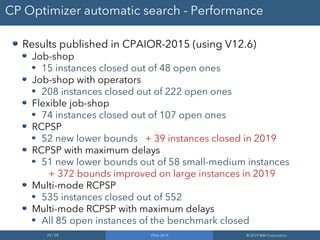
Results published in CPAIOR-2015 (using V12.6)
Job-shop
15 instances closed out of 48 open ones
Job-shop with operators
208 instances closed out of 222 open ones
Flexible job-shop
74 instances closed out of 107 open ones
RCPSP
52 new lower bounds + 39 instances closed in 2019
RCPSP with maximum delays
51 new lower bounds out of 58 small-medium instances
+ 372 bounds improved on large instances in 2019
Multi-mode RCPSP
535 instances closed out of 552
Multi-mode RCPSP with maximum delays
All 85 open instances of the benchmark closed
25 / 28 PDIA 2019 © 2019 IBM Corporation
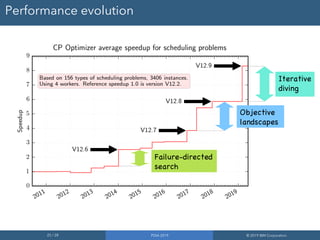
Performance evolution
Objective
landscapes
Failure-directed
search
Iterative
diving
26 / 28 PDIA 2019 © 2019 IBM Corporation
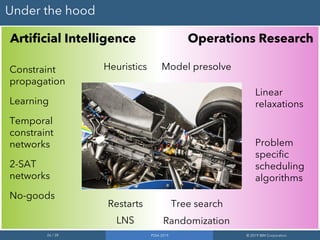
Under the hood
Artificial Intelligence Operations Research
Constraint
propagation
Learning
Temporal
constraint
networks
2-SAT
networks
No-goods
Linear
relaxations
Problem
specific
scheduling
algorithms
Tree searchRestarts
LNS Randomization
Model presolveHeuristics
27 / 28 PDIA 2019 © 2019 IBM Corporation
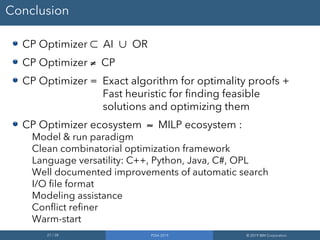
Conclusion
CP Optimizer ⊂ AI ∪ OR
CP Optimizer ≠ CP
CP Optimizer = Exact algorithm for optimality proofs +
Fast heuristic for finding feasible
solutions and optimizing them
CP Optimizer ecosystem ≈ MILP ecosystem :
Model & run paradigm
Clean combinatorial optimization framework
Language versatility: C++, Python, Java, C#, OPL
Well documented improvements of automatic search
I/O file format
Modeling assistance
Conflict refiner
Warm-start
28 / 28 PDIA 2019 © 2019 IBM Corporation
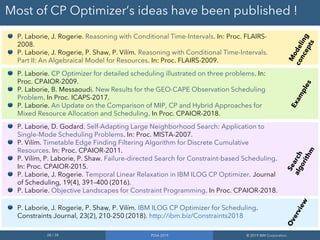
Most of CP Optimizer’s ideas have been published !
P. Laborie, J. Rogerie. Reasoning with Conditional Time-Intervals. In: Proc. FLAIRS-
2008.
P. Laborie, J. Rogerie, P. Shaw, P. Vilím. Reasoning with Conditional Time-Intervals.
Part II: An Algebraical Model for Resources. In: Proc. FLAIRS-2009.
P. Laborie. CP Optimizer for detailed scheduling illustrated on three problems. In:
Proc. CPAIOR-2009.
P. Laborie, B. Messaoudi. New Results for the GEO-CAPE Observation Scheduling
Problem. In Proc. ICAPS-2017.
P. Laborie. An Update on the Comparison of MIP, CP and Hybrid Approaches for
Mixed Resource Allocation and Scheduling. In Proc. CPAIOR-2018.
P. Laborie, D. Godard. Self-Adapting Large Neighborhood Search: Application to
Single-Mode Scheduling Problems. In: Proc. MISTA-2007.
P. Vilím. Timetable Edge Finding Filtering Algorithm for Discrete Cumulative
Resources. In: Proc. CPAIOR-2011.
P. Vilím, P. Laborie, P. Shaw. Failure-directed Search for Constraint-based Scheduling.
In: Proc. CPAIOR-2015.
P. Laborie, J. Rogerie. Temporal Linear Relaxation in IBM ILOG CP Optimizer. Journal
of Scheduling, 19(4), 391–400 (2016).
P. Laborie. Objective Landscapes for Constraint Programming. In Proc. CPAIOR-2018.
P. Laborie, J. Rogerie, P. Shaw, P. Vilím. IBM ILOG CP Optimizer for Scheduling.
Constraints Journal, 23(2), 210-250 (2018). http://ibm.biz/Constraints2018
Examples
Searchalgorithm
Overview
Modeling
concepts

CP Optimizer pour la planification et l'ordonnancement

  • 1.
    Oct. 10, 2019 Oct.10, 2019 PDIA 2019 PDIA 2019 © 2019 IBM Corporation © 2019 IBM Corporation CP Optimizer pour la planification et l’ordonnancement Philippe Laborie IBM, IBM Data & AI laborie@fr.ibm.com
  • 2.
    2 / 28PDIA 2019 © 2019 IBM Corporation What is scheduling ? « Scheduling is concerned with the allocation of scarce resources to activities over time with the objective of optimizing one or more performance measures. »
  • 3.
    3 / 28PDIA 2019 © 2019 IBM Corporation What is scheduling ? « Scheduling is concerned with the allocation of scarce resources to activities over time with the objective of optimizing one or more performance measures. » activity R2 time resources R3 R1
  • 4.
    4 / 28PDIA 2019 © 2019 IBM Corporation Examples of scheduling problems Resource-Constrained Project Scheduling (RCPSP) Notorious NP-Hard problem in combinatorial optimization (>5000 references on Google Scholar) N tasks with precedence constraints M resources of limited capacity Minimize project makespan 1 1 2 2 4 4 3 3 5 5 6 6 0 7 R1 R2 1 2 3 4 5 6 p1 =2 (1,2) C1 =2 C2 =3 time
  • 5.
    5 / 28PDIA 2019 © 2019 IBM Corporation Examples of scheduling problems In the real life, scheduling problems are more complex
  • 6.
    6 / 28PDIA 2019 © 2019 IBM Corporation Examples of scheduling problems Complex objectives: resource costs, tardiness, throughput Complex constraints: activities, resources Overconstrained Ill-defined Large (e.g. 1000000 tasks) Require fast solving time In the real life, scheduling problems are more complex Heterogeneous decisions
  • 7.
    7 / 28PDIA 2019 © 2019 IBM Corporation What is CP Optimizer ? Historically developed since 2007 by ILOG, now IBM Our team has 20+ years of experience in designing combinatorial optimization tools for real-life industrial problems, and particularly scheduling problems #1 objective of CP Optimizer : lower the barrier to entry for efficiently solving industrial scheduling problems Targeted audience goes beyond CP experts: OR experts Data scientists Software engineers
  • 8.
    8 / 28PDIA 2019 © 2019 IBM Corporation What is CP Optimizer ? Model & run approach: User focuses on a declarative mathematical model of the problem using the classical ingredients of combinatorial optimization: variables, constraints, expressions, objective function Resolution is performed by an automated search algorithm with the following properties: complete, deterministic, anytime, efficient, robust, continuously improving ...
  • 9.
    9 / 28PDIA 2019 © 2019 IBM Corporation What is CP Optimizer ? Model & run approach: wait … this already exists: it looks like Mixed Integer Linear Programming (MILP) ! Right: we borrowed a lot from the MILP paradigm when designing CP optimizer Wrong: MILP is usually not good for scheduling problems Difficult to model them Many modeling tricks exist but they are brittle Large models (typically in n2 or n3 with problem size) Poor performance, especially on large problems Often it takes long even to get a feasible solution (not anytime)
  • 10.
    10 / 28PDIA 2019 © 2019 IBM Corporation What’s wrong with MILP (and classical CP) for scheduling ? It’s missing the essential ingredient of scheduling: time Interestingly, time is a very relevant topic in AI Temporal reasoning Reasoning on action and change
  • 11.
    11 / 28PDIA 2019 © 2019 IBM Corporation Time in AI: examples Allen’s interval algebra (1983) Temporal constraint networks (1991)
  • 12.
    12 / 28PDIA 2019 © 2019 IBM Corporation Time in AI: examples Temporal planning in PDDL 2.1 (2003) (define (domain jug-pouring) (:requirements :typing :fluents) (:types jug) (:functions (amount ?j - jug) (capacity ?j - jug)) (:action pour :parameters (?jug1 ?jug2 - jug) :precondition (>= (- (capacity ?jug2) (amount ?jug2)) (amount ?jug1)) :effect (and (assign (amount ?jug1) 0) (increase (amount ?jug2) (amount ?jug1))) ) ?jug1 ?jug2 time amount pour(?jug1,?jug2)
  • 13.
    13 / 28PDIA 2019 © 2019 IBM Corporation Time in AI: examples MILP (and classical CP) models only deal with numerical values ( x∈ , x∈ ) A set of other simple mathematical concepts seem to naturally emerge when dealing with time: Intervals : a = [s,e) = { x∈ | s≤x<e } Functions : f: → Permutations Occurrence / non-occurrence of an event : optional interval ℝ ℝ ℝ ℤ ℤ
  • 14.
    14 / 28PDIA 2019 © 2019 IBM Corporation What is CP Optimizer ? What if we integrate these mathematical concepts in the model … And keep all the good ideas of MILP: Model & run Exact algorithm Input/output file format Language versatility (C++, Python, Java, C#, OPL) Modeling assistance (warnings, …) Conflict refiner Warm-start … That’s exactly what CP Optimizer is about !
  • 15.
    15 / 28PDIA 2019 © 2019 IBM Corporation Overview of CP Optimizer CP Optimizer model C++ OPL Python Java C# On cloud Local ... Solve
  • 16.
    16 / 28PDIA 2019 © 2019 IBM Corporation Interval variables An optional interval variable has an additional possible value in its domain (absence value) Domain of values for an optional interval variable x: Dom(x) ⊆ {⊥} ∪ { [s,e) | s,e ∈ Z, s≤e } Example: interval x optional in 1000..2000 size 10..20 Constraints and expressions on interval variables specify how they handle the case of absent intervals (in general it is very intuitive) Absent interval Interval of integers (when interval is present)
  • 17.
    17 / 28PDIA 2019 © 2019 IBM Corporation CP Optimizer model for RCPSP A set of decision variables of type interval
  • 18.
    18 / 28PDIA 2019 © 2019 IBM Corporation CP Optimizer model for RCPSP A set of precedence constraints aggregated into a global temporal constraint network
  • 19.
    19 / 28PDIA 2019 © 2019 IBM Corporation CP Optimizer model for RCPSP A cumul function expression that can be constrained (here ≤ Dr )
  • 20.
    20 / 28PDIA 2019 © 2019 IBM Corporation CP Optimizer model for RCPSP
  • 21.
    21 / 28PDIA 2019 © 2019 IBM Corporation CP Optimizer modeling concepts Allows easy modeling of: Variable activity duration, partially preemptive tasks Optional activities, oversubscribed problems Hierarchical problems (Work Breakdown Structures) Alternative resources and modes (MM-RCPSP) Resource calendars and breaks Cumulative resources, inventories, reservoirs Parallel batches, activity incompatibilities Unary resources with setup times and costs Complex objective functions Unlike MILP, in CP Optimizer the size of the model in general grows linearly with the size of the problem instance
  • 22.
    22 / 28PDIA 2019 © 2019 IBM Corporation CP Optimizer model for Work-Breakdown Structures task dec OR OR Note the similarities with Hierarchical Task Network (HTN) in A.I. Planning
  • 23.
    23 / 28PDIA 2019 © 2019 IBM Corporation CP Optimizer model for semiconductor manufacturing Step 1 Step 2 ...Lot 1 Lot 2 ... S. Knopp et al. Modeling Maximum Time Lags in Complex Job-Shops with Batching in Semiconductor Manufacturing. PMS 2016.
  • 24.
    24 / 28PDIA 2019 © 2019 IBM Corporation CP Optimizer automatic search - Performance Results published in CPAIOR-2015 (using V12.6) Job-shop 15 instances closed out of 48 open ones Job-shop with operators 208 instances closed out of 222 open ones Flexible job-shop 74 instances closed out of 107 open ones RCPSP 52 new lower bounds + 39 instances closed in 2019 RCPSP with maximum delays 51 new lower bounds out of 58 small-medium instances + 372 bounds improved on large instances in 2019 Multi-mode RCPSP 535 instances closed out of 552 Multi-mode RCPSP with maximum delays All 85 open instances of the benchmark closed
  • 25.
    25 / 28PDIA 2019 © 2019 IBM Corporation Performance evolution Objective landscapes Failure-directed search Iterative diving
  • 26.
    26 / 28PDIA 2019 © 2019 IBM Corporation Under the hood Artificial Intelligence Operations Research Constraint propagation Learning Temporal constraint networks 2-SAT networks No-goods Linear relaxations Problem specific scheduling algorithms Tree searchRestarts LNS Randomization Model presolveHeuristics
  • 27.
    27 / 28PDIA 2019 © 2019 IBM Corporation Conclusion CP Optimizer ⊂ AI ∪ OR CP Optimizer ≠ CP CP Optimizer = Exact algorithm for optimality proofs + Fast heuristic for finding feasible solutions and optimizing them CP Optimizer ecosystem ≈ MILP ecosystem : Model & run paradigm Clean combinatorial optimization framework Language versatility: C++, Python, Java, C#, OPL Well documented improvements of automatic search I/O file format Modeling assistance Conflict refiner Warm-start
  • 28.
    28 / 28PDIA 2019 © 2019 IBM Corporation Most of CP Optimizer’s ideas have been published ! P. Laborie, J. Rogerie. Reasoning with Conditional Time-Intervals. In: Proc. FLAIRS- 2008. P. Laborie, J. Rogerie, P. Shaw, P. Vilím. Reasoning with Conditional Time-Intervals. Part II: An Algebraical Model for Resources. In: Proc. FLAIRS-2009. P. Laborie. CP Optimizer for detailed scheduling illustrated on three problems. In: Proc. CPAIOR-2009. P. Laborie, B. Messaoudi. New Results for the GEO-CAPE Observation Scheduling Problem. In Proc. ICAPS-2017. P. Laborie. An Update on the Comparison of MIP, CP and Hybrid Approaches for Mixed Resource Allocation and Scheduling. In Proc. CPAIOR-2018. P. Laborie, D. Godard. Self-Adapting Large Neighborhood Search: Application to Single-Mode Scheduling Problems. In: Proc. MISTA-2007. P. Vilím. Timetable Edge Finding Filtering Algorithm for Discrete Cumulative Resources. In: Proc. CPAIOR-2011. P. Vilím, P. Laborie, P. Shaw. Failure-directed Search for Constraint-based Scheduling. In: Proc. CPAIOR-2015. P. Laborie, J. Rogerie. Temporal Linear Relaxation in IBM ILOG CP Optimizer. Journal of Scheduling, 19(4), 391–400 (2016). P. Laborie. Objective Landscapes for Constraint Programming. In Proc. CPAIOR-2018. P. Laborie, J. Rogerie, P. Shaw, P. Vilím. IBM ILOG CP Optimizer for Scheduling. Constraints Journal, 23(2), 210-250 (2018). http://ibm.biz/Constraints2018 Examples Searchalgorithm Overview Modeling concepts