© 2009 IBM Corporation
®
Modeling and Solving
Resource-Constrained Project Scheduling Problems
with IBM ILOG CP Optimizer
Philippe Laborie
ILOG Principal Scientist
IBM Software Group
laborie@fr.ibm.com
2
IBM Software Group
© 2009 IBM Corporation
What is IBM ILOG CP Optimizer?
 A Constraint Programming engine for combinatorial
problems (including scheduling problems)
 Implements a Model & Run paradigm
– Model: Concise and Expressive modeling language
– Run: Powerful automatic search procedure
 Available through the following interfaces:
– OPL (Optimization Programming Language)
– C++ (native interface)
– Java, .NET (wrapping of the C++ engine)
3
IBM Software Group
© 2009 IBM Corporation
Modeling
Language
[1,2]
IBM ILOG CP Optimizer for Detailed Scheduling
[1] Reasoning with Conditional Time-intervals. FLAIRS-08.
[2] Reasoning with Conditional Time-intervals, Part II: an Algebraical Model for Resources. FLAIRS-09.
• Extension of classical CSP with a new type of decision variable:
optional interval variable :
Domain(a)  {}  { [s,e) | s,e, s≤e }
• Introduction of mathematical notions such as sequences and functions to
capture temporal aspects of scheduling problems
Absent interval Interval of integers
4
IBM Software Group
© 2009 IBM Corporation
Automatic
Search
[3,4]
IBM ILOG CP Optimizer for Detailed Scheduling
[3] Randomized Large Neighborhood Search for Cumulative Scheduling. ICAPS-05.
[4] Self-Adapting Large Neighborhood Search: Application to Single-mode Scheduling Problems. MISTA-07.
POS generation
Fragment
Selection
- Problem structure
- Randomization
Tree search
- LP relaxation
- Propagation
- Dominance rules
Continue
search ?
Problem
Machine
Learning
Techniques
[1] Reasoning with Conditional Time-intervals. FLAIRS-08.
[2] Reasoning with Conditional Time-intervals, Part II: an Algebraical Model for Resources. FLAIRS-09.
Self-Adapting
Large Neighborhood
Search
5
IBM Software Group
© 2009 IBM Corporation
IBM ILOG CP Optimizer for Detailed Scheduling
Modeling
Language
[1,2]
Automatic
Search
[3,4]
Efficient
search
Easy
modeling
[3] Randomized Large Neighborhood Search for Cumulative Scheduling. ICAPS-05.
[4] Self-Adapting Large Neighborhood Search: Application to Single-mode Scheduling Problems. MISTA-07.
[1] Reasoning with Conditional Time-intervals. FLAIRS-08.
[2] Reasoning with Conditional Time-intervals, Part II: an Algebraical Model for Resources. FLAIRS-09.
6
IBM Software Group
© 2009 IBM Corporation
IBM ILOG CP Optimizer for Detailed Scheduling
Modeling
Language
[1,2]
Automatic
Search
[3,4]
Efficient
search
Easy
modeling
Detailed Scheduling
Problems
[3] Randomized Large Neighborhood Search for Cumulative Scheduling. ICAPS-05.
[4] Self-Adapting Large Neighborhood Search: Application to Single-mode Scheduling Problems. MISTA-07.
[1] Reasoning with Conditional Time-intervals. FLAIRS-08.
[2] Reasoning with Conditional Time-intervals, Part II: an Algebraical Model for Resources. FLAIRS-09.
7
IBM Software Group
© 2009 IBM Corporation
IBM ILOG CP Optimizer for Detailed Scheduling
Modeling
Language
[1,2]
Automatic
Search
[3,4]
Efficient
search
Easy
modeling
[3] Randomized Large Neighborhood Search for Cumulative Scheduling. ICAPS-05.
[4] Self-Adapting Large Neighborhood Search: Application to Single-mode Scheduling Problems. MISTA-07.
[1] Reasoning with Conditional Time-intervals. FLAIRS-08.
[2] Reasoning with Conditional Time-intervals, Part II: an Algebraical Model for Resources. FLAIRS-09.
Resource-Constrained
Project Scheduling
Problems
8
IBM Software Group
© 2009 IBM Corporation
Resource
Types
Multi-
Modes
Max-
Delays
Resource
Calendars
Optional
Tasks
Work
Breakdown
Structure
Objective
Function
Makespan
Earliness/
Tardiness
Task
Durations
Allocation
Costs
Unperformed
Tasks
No
Yes
Renewable
Non-
Renewable
No
Yes
No
Yes
No
YesYes
Inventories
No
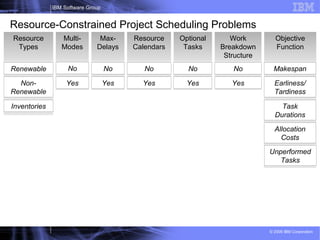
Resource-Constrained Project Scheduling Problems
9
IBM Software Group
© 2009 IBM Corporation
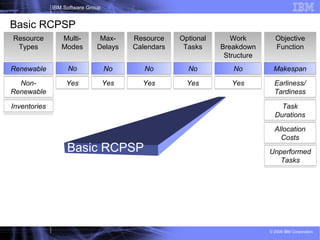
Basic RCPSP
Resource
Types
Multi-
Modes
Max-
Delays
Resource
Calendars
Optional
Tasks
Work
Breakdown
Structure
Objective
Function
Makespan
Earliness/
Tardiness
Task
Durations
Allocation
Costs
No
Yes
Renewable
Non-
Renewable
No
Yes
No
Yes
No
YesYes
Inventories
No
Unperformed
Tasks
Basic RCPSP
10
IBM Software Group
© 2009 IBM Corporation
Basic RCPSP
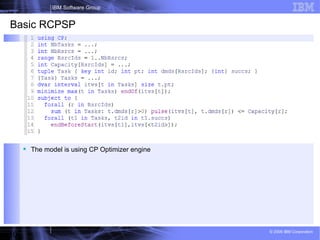
 The model is using CP Optimizer engine
11
IBM Software Group
© 2009 IBM Corporation
Basic RCPSP
Data
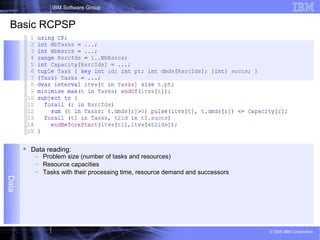
 Data reading:
– Problem size (number of tasks and resources)
– Resource capacities
– Tasks with their processing time, resource demand and successors
12
IBM Software Group
© 2009 IBM Corporation
Basic RCPSP
Decisions
 Decision variables:
– Tasks: array of interval variables
itvs[t]
t.pt
13
IBM Software Group
© 2009 IBM Corporation
Basic RCPSP
Objective
 Objective:
– Minimize project makespan
itvs[t1]
itvs[t2]
itvs[tn]
max(t in Tasks) endOf(itvs[t])
14
IBM Software Group
© 2009 IBM Corporation
Basic RCPSP
Constraints
 Constraints:
– Resource capacity constraints (using cumul functions)
itvs[t]
t.dmds[r] pulse
itvs[t1]itvs[t2]
itvs[tn]
 pulse
Capacity[r]
15
IBM Software Group
© 2009 IBM Corporation
Basic RCPSP
Constraints
 Constraints:
– Precedence constraints between tasks
itvs[t1]
itvs[t2]
itvs[tn]
16
IBM Software Group
© 2009 IBM Corporation
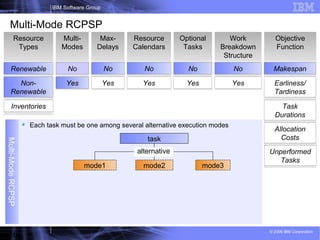
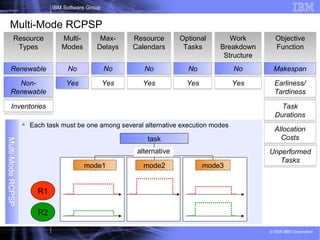
Multi-ModeRCPSP
 Each task must be one among several alternative execution modes
Resource
Types
Multi-
Modes
Max-
Delays
Resource
Calendars
Optional
Tasks
Work
Breakdown
Structure
Objective
Function
Makespan
Earliness/
Tardiness
Task
Durations
Allocation
Costs
No
Yes
Renewable
Non-
Renewable
No
Yes
No
Yes
No
Yes
No
Yes
Inventories
Unperformed
Tasks
Multi-Mode RCPSP
task
alternative
mode1 mode2 mode3
17
IBM Software Group
© 2009 IBM Corporation
Multi-ModeRCPSP
 Each task must be one among several alternative execution modes
Resource
Types
Multi-
Modes
Max-
Delays
Resource
Calendars
Optional
Tasks
Work
Breakdown
Structure
Objective
Function
Makespan
Earliness/
Tardiness
Task
Durations
Allocation
Costs
No
Yes
Renewable
Non-
Renewable
No
Yes
No
Yes
No
Yes
No
Yes
Inventories
Unperformed
Tasks
Multi-Mode RCPSP
mode1 mode2 mode3
R1
R2
task
alternative
18
IBM Software Group
© 2009 IBM Corporation
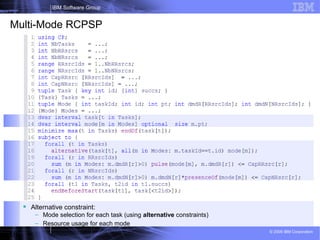
Multi-Mode RCPSP
 Alternative constraint:
– Mode selection for each task (using alternative constraints)
– Resource usage for each mode
19
IBM Software Group
© 2009 IBM Corporation
Inventories
 Cumul functions with stepAtStart/stepAtEnd
Resource
Types
Multi-
Modes
Max-
Delays
Resource
Calendars
Optional
Tasks
Work
Breakdown
Structure
Objective
Function
Makespan
Earliness/
Tardiness
Task
Durations
Allocation
Costs
No
Yes
Renewable
Non-
Renewable
No
Yes
No
Yes
NoNo
Yes
Unperformed
Tasks
Inventories
producer[p]
QProd[p]stepAtEnd
consumer[c]
QCons[c] stepAtStart
p c
Yes
Modeling Inventories
20
IBM Software Group
© 2009 IBM Corporation
Max.Delays
 Precedence constraints with delays
Modeling Maximum Delays
Resource
Types
Multi-
Modes
Max-
Delays
Resource
Calendars
Optional
Tasks
Work
Breakdown
Structure
Objective
Function
Makespan
Earliness/
Tardiness
Task
Durations
Allocation
Costs
No
Yes
Renewable
Non-
Renewable
No
Yes
No
Yes
NoNo
Yes
Unperformed
Tasks
Inventories
Yes
task[1] task[2]
[dmin,dmax]
21
IBM Software Group
© 2009 IBM Corporation
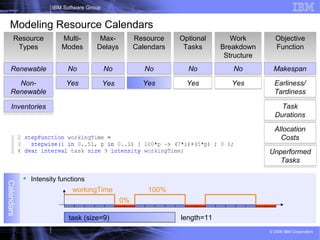
Calendars
 Intensity functions
Modeling Resource Calendars
Resource
Types
Multi-
Modes
Max-
Delays
Resource
Calendars
Optional
Tasks
Work
Breakdown
Structure
Objective
Function
Makespan
Earliness/
Tardiness
Task
Durations
Allocation
Costs
No
Yes
Renewable
Non-
Renewable
No
Yes
No
Yes
NoNo
Yes
Unperformed
Tasks
Inventories
Yes
task (size=9)
workingTime
length=11
100%
0%
22
IBM Software Group
© 2009 IBM Corporation
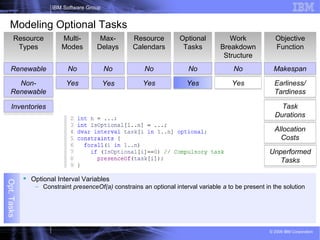
Opt.Tasks
 Optional Interval Variables
– Constraint presenceOf(a) constrains an optional interval variable a to be present in the solution
Modeling Optional Tasks
Resource
Types
Multi-
Modes
Max-
Delays
Resource
Calendars
Optional
Tasks
Work
Breakdown
Structure
Objective
Function
Makespan
Earliness/
Tardiness
Task
Durations
Allocation
Costs
No
Yes
Renewable
Non-
Renewable
No
Yes
No
Yes
NoNo
Yes
Unperformed
Tasks
Inventories
Yes
23
IBM Software Group
© 2009 IBM Corporation
WBS
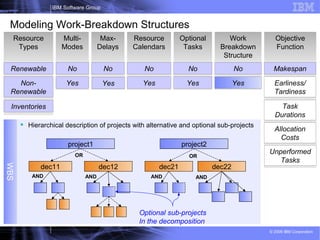
 Hierarchical description of projects with alternative and optional sub-projects
Modeling Work-Breakdown Structures
Resource
Types
Multi-
Modes
Max-
Delays
Resource
Calendars
Optional
Tasks
Work
Breakdown
Structure
Objective
Function
Makespan
Earliness/
Tardiness
Task
Durations
Allocation
Costs
No
Yes
Renewable
Non-
Renewable
No
Yes
No
Yes
NoNo
Yes
Unperformed
Tasks
Inventories
Yes
project1 project2
dec11 dec12 dec21 dec22
OR OR
AND AND AND AND
Optional sub-projects
In the decomposition
24
IBM Software Group
© 2009 IBM Corporation
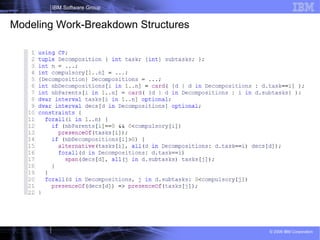
Modeling Work-Breakdown Structures
25
IBM Software Group
© 2009 IBM Corporation
Objective
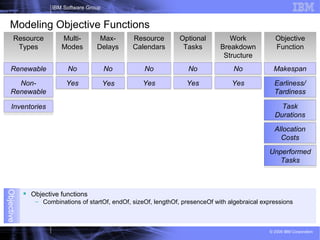
 Objective functions
– Combinations of startOf, endOf, sizeOf, lengthOf, presenceOf with algebraical expressions
Modeling Objective Functions
Resource
Types
Multi-
Modes
Max-
Delays
Resource
Calendars
Optional
Tasks
Work
Breakdown
Structure
Objective
Function
Makespan
Earliness/
Tardiness
Task
Durations
Allocation
Costs
No
Yes
Renewable
Non-
Renewable
No
Yes
No
Yes
NoNo
Yes
Unperformed
Tasks
Inventories
Yes
26
IBM Software Group
© 2009 IBM Corporation
Objective
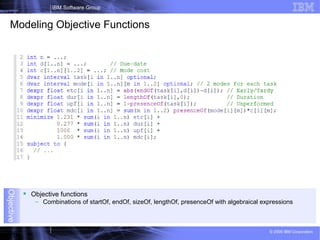
 Objective functions
– Combinations of startOf, endOf, sizeOf, lengthOf, presenceOf with algebraical expressions
Modeling Objective Functions
27
IBM Software Group
© 2009 IBM Corporation
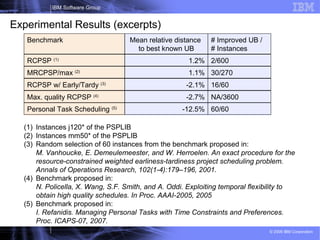
Experimental Results (excerpts)
(1) Instances j120* of the PSPLIB
(2) Instances mm50* of the PSPLIB
(3) Random selection of 60 instances from the benchmark proposed in:
M. Vanhoucke, E. Demeulemeester, and W. Herroelen. An exact procedure for the
resource-constrained weighted earliness-tardiness project scheduling problem.
Annals of Operations Research, 102(1-4):179–196, 2001.
(4) Benchmark proposed in:
N. Policella, X. Wang, S.F. Smith, and A. Oddi. Exploiting temporal flexibility to
obtain high quality schedules. In Proc. AAAI-2005, 2005
(5) Benchmark proposed in:
I. Refanidis. Managing Personal Tasks with Time Constraints and Preferences.
Proc. ICAPS-07, 2007.
Benchmark Mean relative distance
to best known UB
# Improved UB /
# Instances
RCPSP (1)
1.2% 2/600
MRCPSP/max (2)
1.1% 30/270
RCPSP w/ Early/Tardy (3)
-2.1% 16/60
Max. quality RCPSP (4)
-2.7% NA/3600
Personal Task Scheduling (5)
-12.5% 60/60
28
IBM Software Group
© 2009 IBM Corporation
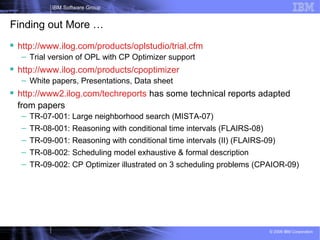
Finding out More …
 http://www.ilog.com/products/oplstudio/trial.cfm
– Trial version of OPL with CP Optimizer support
 http://www.ilog.com/products/cpoptimizer
– White papers, Presentations, Data sheet
 http://www2.ilog.com/techreports has some technical reports adapted
from papers
– TR-07-001: Large neighborhood search (MISTA-07)
– TR-08-001: Reasoning with conditional time intervals (FLAIRS-08)
– TR-09-001: Reasoning with conditional time intervals (II) (FLAIRS-09)
– TR-08-002: Scheduling model exhaustive & formal description
– TR-09-002: CP Optimizer illustrated on 3 scheduling problems (CPAIOR-09)

Modeling and Solving Resource-Constrained Project Scheduling Problems with IBM ILOG CP Optimizer

  • 1.
    © 2009 IBMCorporation ® Modeling and Solving Resource-Constrained Project Scheduling Problems with IBM ILOG CP Optimizer Philippe Laborie ILOG Principal Scientist IBM Software Group laborie@fr.ibm.com
  • 2.
    2 IBM Software Group ©2009 IBM Corporation What is IBM ILOG CP Optimizer?  A Constraint Programming engine for combinatorial problems (including scheduling problems)  Implements a Model & Run paradigm – Model: Concise and Expressive modeling language – Run: Powerful automatic search procedure  Available through the following interfaces: – OPL (Optimization Programming Language) – C++ (native interface) – Java, .NET (wrapping of the C++ engine)
  • 3.
    3 IBM Software Group ©2009 IBM Corporation Modeling Language [1,2] IBM ILOG CP Optimizer for Detailed Scheduling [1] Reasoning with Conditional Time-intervals. FLAIRS-08. [2] Reasoning with Conditional Time-intervals, Part II: an Algebraical Model for Resources. FLAIRS-09. • Extension of classical CSP with a new type of decision variable: optional interval variable : Domain(a)  {}  { [s,e) | s,e, s≤e } • Introduction of mathematical notions such as sequences and functions to capture temporal aspects of scheduling problems Absent interval Interval of integers
  • 4.
    4 IBM Software Group ©2009 IBM Corporation Automatic Search [3,4] IBM ILOG CP Optimizer for Detailed Scheduling [3] Randomized Large Neighborhood Search for Cumulative Scheduling. ICAPS-05. [4] Self-Adapting Large Neighborhood Search: Application to Single-mode Scheduling Problems. MISTA-07. POS generation Fragment Selection - Problem structure - Randomization Tree search - LP relaxation - Propagation - Dominance rules Continue search ? Problem Machine Learning Techniques [1] Reasoning with Conditional Time-intervals. FLAIRS-08. [2] Reasoning with Conditional Time-intervals, Part II: an Algebraical Model for Resources. FLAIRS-09. Self-Adapting Large Neighborhood Search
  • 5.
    5 IBM Software Group ©2009 IBM Corporation IBM ILOG CP Optimizer for Detailed Scheduling Modeling Language [1,2] Automatic Search [3,4] Efficient search Easy modeling [3] Randomized Large Neighborhood Search for Cumulative Scheduling. ICAPS-05. [4] Self-Adapting Large Neighborhood Search: Application to Single-mode Scheduling Problems. MISTA-07. [1] Reasoning with Conditional Time-intervals. FLAIRS-08. [2] Reasoning with Conditional Time-intervals, Part II: an Algebraical Model for Resources. FLAIRS-09.
  • 6.
    6 IBM Software Group ©2009 IBM Corporation IBM ILOG CP Optimizer for Detailed Scheduling Modeling Language [1,2] Automatic Search [3,4] Efficient search Easy modeling Detailed Scheduling Problems [3] Randomized Large Neighborhood Search for Cumulative Scheduling. ICAPS-05. [4] Self-Adapting Large Neighborhood Search: Application to Single-mode Scheduling Problems. MISTA-07. [1] Reasoning with Conditional Time-intervals. FLAIRS-08. [2] Reasoning with Conditional Time-intervals, Part II: an Algebraical Model for Resources. FLAIRS-09.
  • 7.
    7 IBM Software Group ©2009 IBM Corporation IBM ILOG CP Optimizer for Detailed Scheduling Modeling Language [1,2] Automatic Search [3,4] Efficient search Easy modeling [3] Randomized Large Neighborhood Search for Cumulative Scheduling. ICAPS-05. [4] Self-Adapting Large Neighborhood Search: Application to Single-mode Scheduling Problems. MISTA-07. [1] Reasoning with Conditional Time-intervals. FLAIRS-08. [2] Reasoning with Conditional Time-intervals, Part II: an Algebraical Model for Resources. FLAIRS-09. Resource-Constrained Project Scheduling Problems
  • 8.
    8 IBM Software Group ©2009 IBM Corporation Resource Types Multi- Modes Max- Delays Resource Calendars Optional Tasks Work Breakdown Structure Objective Function Makespan Earliness/ Tardiness Task Durations Allocation Costs Unperformed Tasks No Yes Renewable Non- Renewable No Yes No Yes No YesYes Inventories No Resource-Constrained Project Scheduling Problems
  • 9.
    9 IBM Software Group ©2009 IBM Corporation Basic RCPSP Resource Types Multi- Modes Max- Delays Resource Calendars Optional Tasks Work Breakdown Structure Objective Function Makespan Earliness/ Tardiness Task Durations Allocation Costs No Yes Renewable Non- Renewable No Yes No Yes No YesYes Inventories No Unperformed Tasks Basic RCPSP
  • 10.
    10 IBM Software Group ©2009 IBM Corporation Basic RCPSP  The model is using CP Optimizer engine
  • 11.
    11 IBM Software Group ©2009 IBM Corporation Basic RCPSP Data  Data reading: – Problem size (number of tasks and resources) – Resource capacities – Tasks with their processing time, resource demand and successors
  • 12.
    12 IBM Software Group ©2009 IBM Corporation Basic RCPSP Decisions  Decision variables: – Tasks: array of interval variables itvs[t] t.pt
  • 13.
    13 IBM Software Group ©2009 IBM Corporation Basic RCPSP Objective  Objective: – Minimize project makespan itvs[t1] itvs[t2] itvs[tn] max(t in Tasks) endOf(itvs[t])
  • 14.
    14 IBM Software Group ©2009 IBM Corporation Basic RCPSP Constraints  Constraints: – Resource capacity constraints (using cumul functions) itvs[t] t.dmds[r] pulse itvs[t1]itvs[t2] itvs[tn]  pulse Capacity[r]
  • 15.
    15 IBM Software Group ©2009 IBM Corporation Basic RCPSP Constraints  Constraints: – Precedence constraints between tasks itvs[t1] itvs[t2] itvs[tn]
  • 16.
    16 IBM Software Group ©2009 IBM Corporation Multi-ModeRCPSP  Each task must be one among several alternative execution modes Resource Types Multi- Modes Max- Delays Resource Calendars Optional Tasks Work Breakdown Structure Objective Function Makespan Earliness/ Tardiness Task Durations Allocation Costs No Yes Renewable Non- Renewable No Yes No Yes No Yes No Yes Inventories Unperformed Tasks Multi-Mode RCPSP task alternative mode1 mode2 mode3
  • 17.
    17 IBM Software Group ©2009 IBM Corporation Multi-ModeRCPSP  Each task must be one among several alternative execution modes Resource Types Multi- Modes Max- Delays Resource Calendars Optional Tasks Work Breakdown Structure Objective Function Makespan Earliness/ Tardiness Task Durations Allocation Costs No Yes Renewable Non- Renewable No Yes No Yes No Yes No Yes Inventories Unperformed Tasks Multi-Mode RCPSP mode1 mode2 mode3 R1 R2 task alternative
  • 18.
    18 IBM Software Group ©2009 IBM Corporation Multi-Mode RCPSP  Alternative constraint: – Mode selection for each task (using alternative constraints) – Resource usage for each mode
  • 19.
    19 IBM Software Group ©2009 IBM Corporation Inventories  Cumul functions with stepAtStart/stepAtEnd Resource Types Multi- Modes Max- Delays Resource Calendars Optional Tasks Work Breakdown Structure Objective Function Makespan Earliness/ Tardiness Task Durations Allocation Costs No Yes Renewable Non- Renewable No Yes No Yes NoNo Yes Unperformed Tasks Inventories producer[p] QProd[p]stepAtEnd consumer[c] QCons[c] stepAtStart p c Yes Modeling Inventories
  • 20.
    20 IBM Software Group ©2009 IBM Corporation Max.Delays  Precedence constraints with delays Modeling Maximum Delays Resource Types Multi- Modes Max- Delays Resource Calendars Optional Tasks Work Breakdown Structure Objective Function Makespan Earliness/ Tardiness Task Durations Allocation Costs No Yes Renewable Non- Renewable No Yes No Yes NoNo Yes Unperformed Tasks Inventories Yes task[1] task[2] [dmin,dmax]
  • 21.
    21 IBM Software Group ©2009 IBM Corporation Calendars  Intensity functions Modeling Resource Calendars Resource Types Multi- Modes Max- Delays Resource Calendars Optional Tasks Work Breakdown Structure Objective Function Makespan Earliness/ Tardiness Task Durations Allocation Costs No Yes Renewable Non- Renewable No Yes No Yes NoNo Yes Unperformed Tasks Inventories Yes task (size=9) workingTime length=11 100% 0%
  • 22.
    22 IBM Software Group ©2009 IBM Corporation Opt.Tasks  Optional Interval Variables – Constraint presenceOf(a) constrains an optional interval variable a to be present in the solution Modeling Optional Tasks Resource Types Multi- Modes Max- Delays Resource Calendars Optional Tasks Work Breakdown Structure Objective Function Makespan Earliness/ Tardiness Task Durations Allocation Costs No Yes Renewable Non- Renewable No Yes No Yes NoNo Yes Unperformed Tasks Inventories Yes
  • 23.
    23 IBM Software Group ©2009 IBM Corporation WBS  Hierarchical description of projects with alternative and optional sub-projects Modeling Work-Breakdown Structures Resource Types Multi- Modes Max- Delays Resource Calendars Optional Tasks Work Breakdown Structure Objective Function Makespan Earliness/ Tardiness Task Durations Allocation Costs No Yes Renewable Non- Renewable No Yes No Yes NoNo Yes Unperformed Tasks Inventories Yes project1 project2 dec11 dec12 dec21 dec22 OR OR AND AND AND AND Optional sub-projects In the decomposition
  • 24.
    24 IBM Software Group ©2009 IBM Corporation Modeling Work-Breakdown Structures
  • 25.
    25 IBM Software Group ©2009 IBM Corporation Objective  Objective functions – Combinations of startOf, endOf, sizeOf, lengthOf, presenceOf with algebraical expressions Modeling Objective Functions Resource Types Multi- Modes Max- Delays Resource Calendars Optional Tasks Work Breakdown Structure Objective Function Makespan Earliness/ Tardiness Task Durations Allocation Costs No Yes Renewable Non- Renewable No Yes No Yes NoNo Yes Unperformed Tasks Inventories Yes
  • 26.
    26 IBM Software Group ©2009 IBM Corporation Objective  Objective functions – Combinations of startOf, endOf, sizeOf, lengthOf, presenceOf with algebraical expressions Modeling Objective Functions
  • 27.
    27 IBM Software Group ©2009 IBM Corporation Experimental Results (excerpts) (1) Instances j120* of the PSPLIB (2) Instances mm50* of the PSPLIB (3) Random selection of 60 instances from the benchmark proposed in: M. Vanhoucke, E. Demeulemeester, and W. Herroelen. An exact procedure for the resource-constrained weighted earliness-tardiness project scheduling problem. Annals of Operations Research, 102(1-4):179–196, 2001. (4) Benchmark proposed in: N. Policella, X. Wang, S.F. Smith, and A. Oddi. Exploiting temporal flexibility to obtain high quality schedules. In Proc. AAAI-2005, 2005 (5) Benchmark proposed in: I. Refanidis. Managing Personal Tasks with Time Constraints and Preferences. Proc. ICAPS-07, 2007. Benchmark Mean relative distance to best known UB # Improved UB / # Instances RCPSP (1) 1.2% 2/600 MRCPSP/max (2) 1.1% 30/270 RCPSP w/ Early/Tardy (3) -2.1% 16/60 Max. quality RCPSP (4) -2.7% NA/3600 Personal Task Scheduling (5) -12.5% 60/60
  • 28.
    28 IBM Software Group ©2009 IBM Corporation Finding out More …  http://www.ilog.com/products/oplstudio/trial.cfm – Trial version of OPL with CP Optimizer support  http://www.ilog.com/products/cpoptimizer – White papers, Presentations, Data sheet  http://www2.ilog.com/techreports has some technical reports adapted from papers – TR-07-001: Large neighborhood search (MISTA-07) – TR-08-001: Reasoning with conditional time intervals (FLAIRS-08) – TR-09-001: Reasoning with conditional time intervals (II) (FLAIRS-09) – TR-08-002: Scheduling model exhaustive & formal description – TR-09-002: CP Optimizer illustrated on 3 scheduling problems (CPAIOR-09)