Feb. 20, 2019
Feb. 20, 2019
ROADEF-2019
ROADEF-2019
© 2019 IBM Corporation
Recent advances on
large scheduling problems
in CP Optimizer
Philippe Laborie, IBM
laborie@fr.ibm.com
2 / 17 ROADEF 2019 © 2019 IBM Corporation
In this presentation
1. Recap about IBM CP Optimizer
By the way: if you have CPLEX, you also have
CP Optimizer!
2. Performance improvements on scheduling problems
in coming release V12.9
3 / 17 ROADEF 2019 © 2019 IBM Corporation
CP Optimizer for scheduling in two sentences
A mathematical modeling language for combinatorial
optimization problems that extends ILP (and classical CP)
with some algebra on intervals and functions allowing
compact and maintainable formulations for complex
scheduling problems
A continuously improving automatic search algorithm
that is complete, anytime, efficient (e.g. competitive with
problem-specific algorithms on classical problems) and
scalable
Recent review of CP Optimizer (modeling concepts,
applications, examples, tools, performance,…) :
IBM ILOG CP Optimizer for scheduling. Constraints (2018)
23:210–250. http://ibm.biz/Constraints2018
4 / 17 ROADEF 2019 © 2019 IBM Corporation
Typical scheduling problems for CP Optimizer
5 / 17 ROADEF 2019 © 2019 IBM Corporation
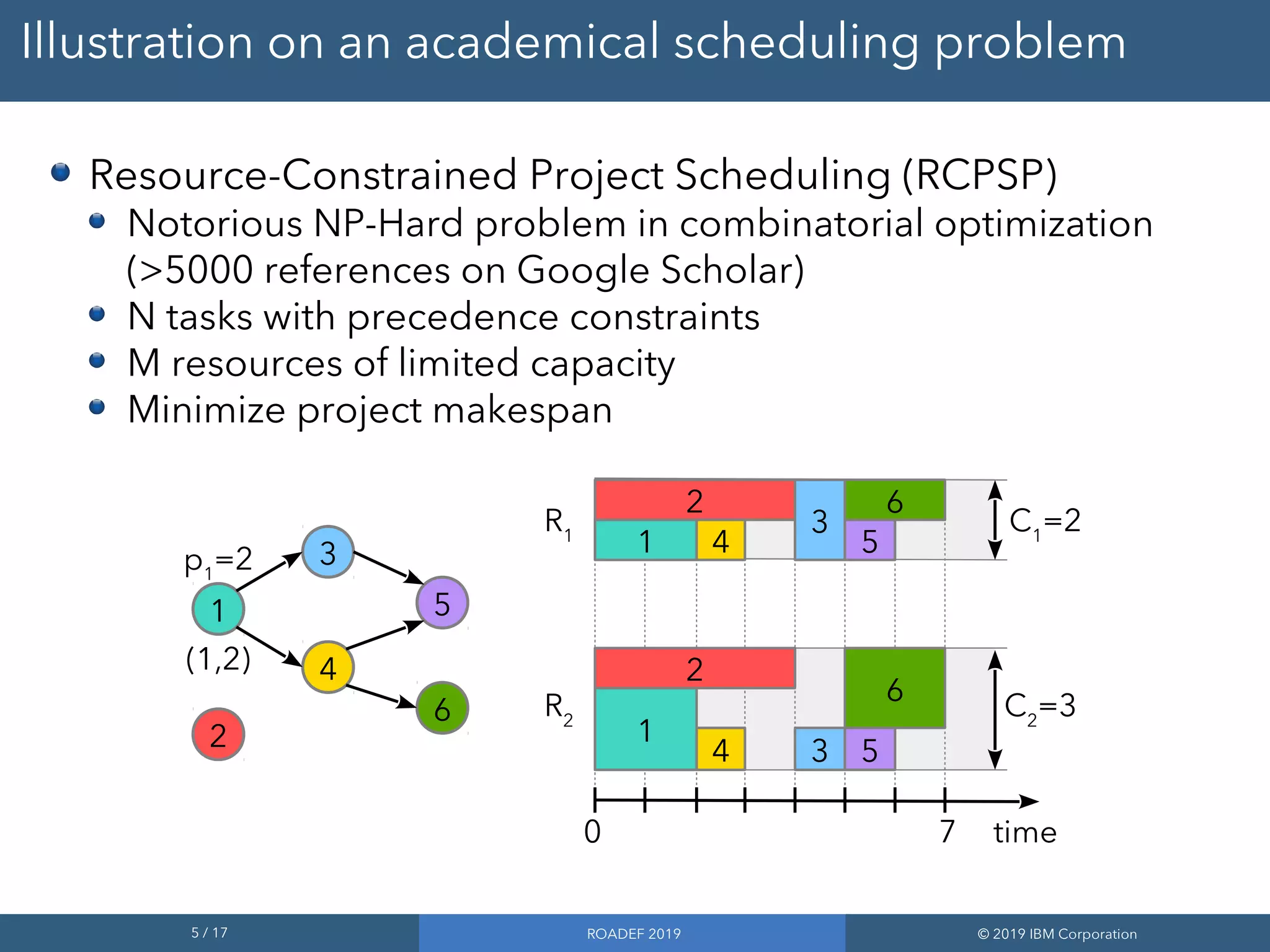
Illustration on an academical scheduling problem
Resource-Constrained Project Scheduling (RCPSP)
Notorious NP-Hard problem in combinatorial optimization
(>5000 references on Google Scholar)
N tasks with precedence constraints
M resources of limited capacity
Minimize project makespan
1
1
2
2
4
4
3
3
5
5
6
6
0 7
R1
R2
1
2
3
4
5
6
p1
=2
(1,2)
C1
=2
C2
=3
time
6 / 17 ROADEF 2019 © 2019 IBM Corporation
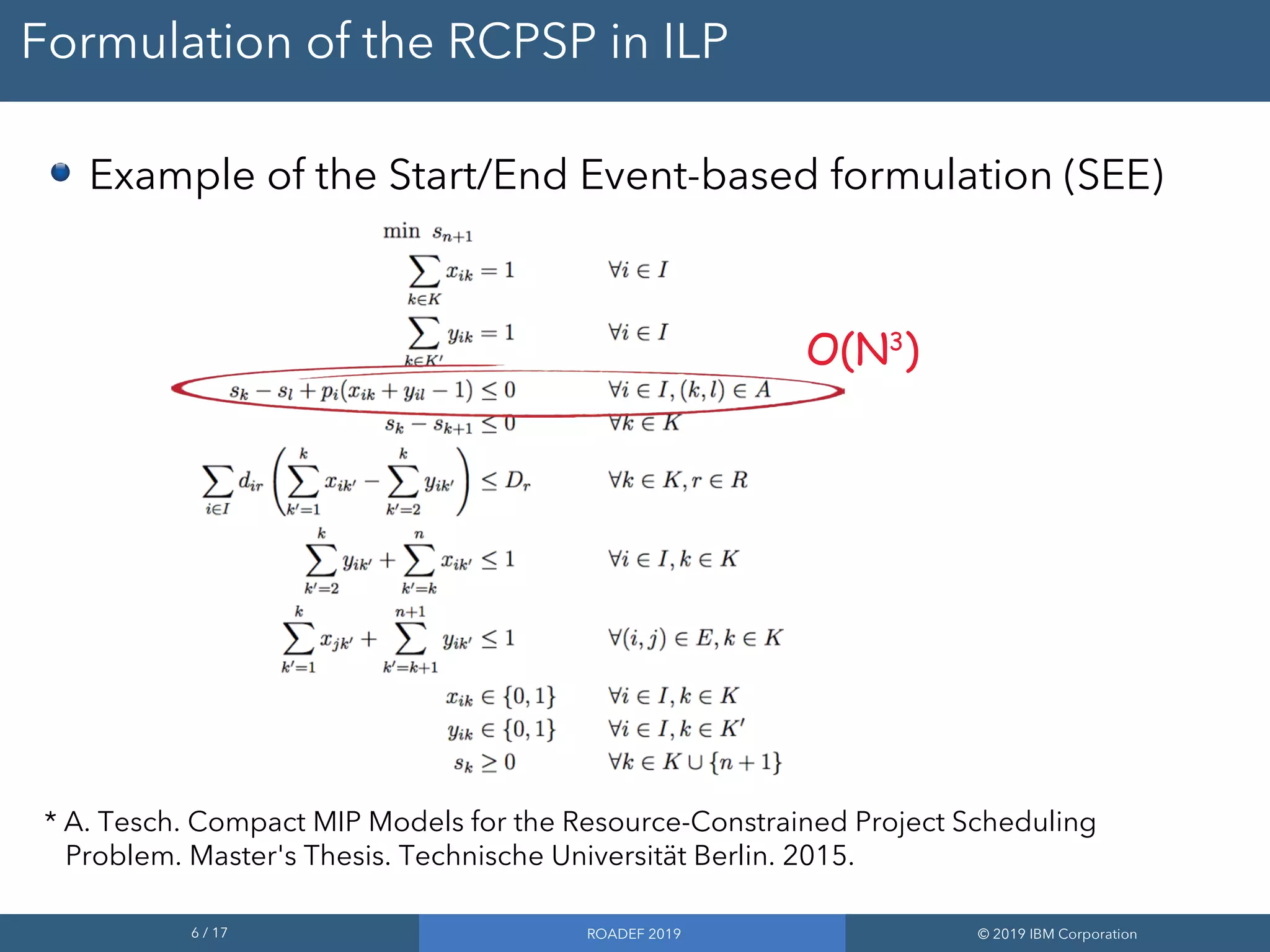
Formulation of the RCPSP in ILP
Example of the Start/End Event-based formulation (SEE)
O(N3
)
* A. Tesch. Compact MIP Models for the Resource-Constrained Project Scheduling
Problem. Master's Thesis. Technische Universität Berlin. 2015.
7 / 17 ROADEF 2019 © 2019 IBM Corporation
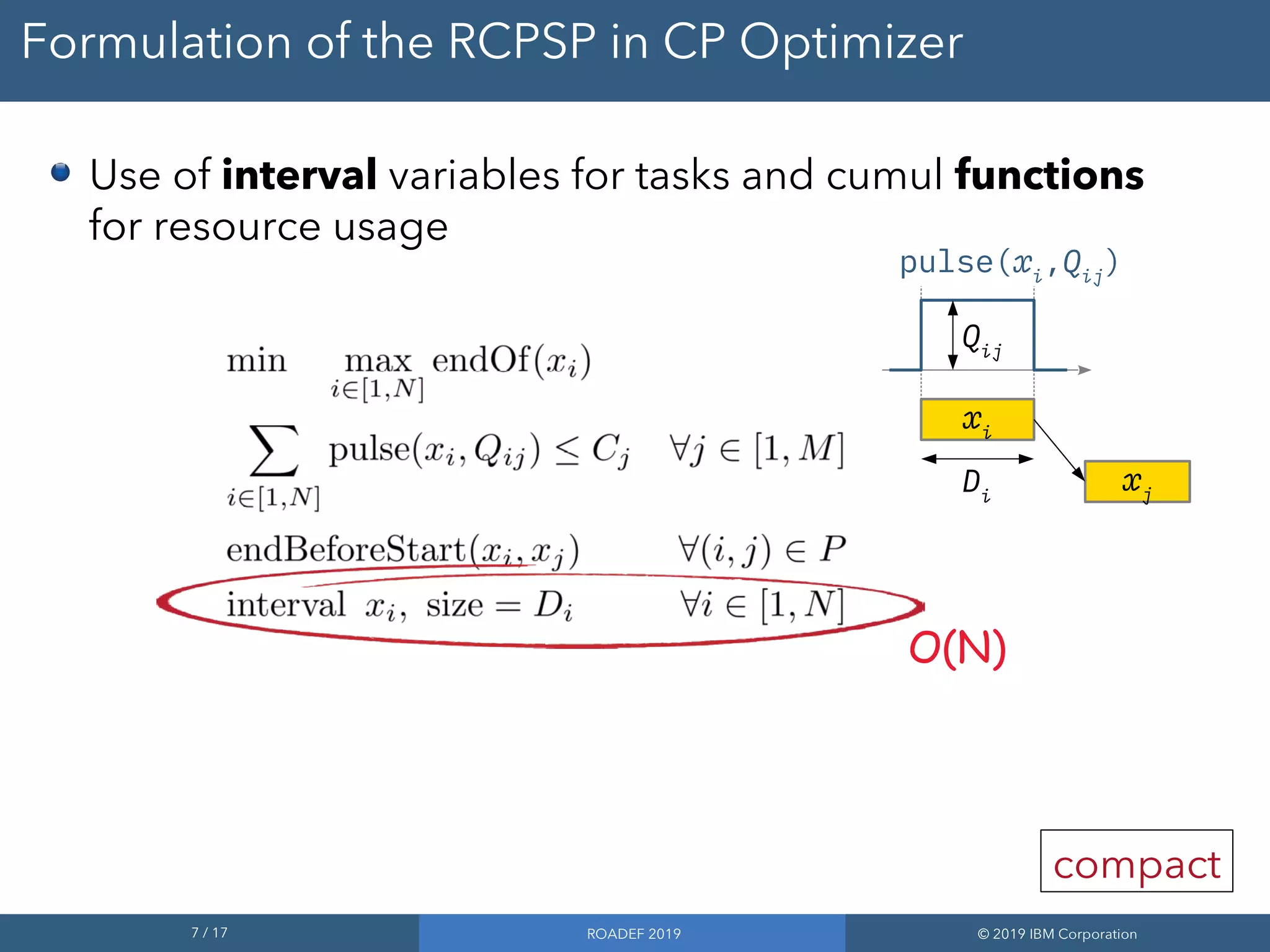
Formulation of the RCPSP in CP Optimizer
Use of interval variables for tasks and cumul functions
for resource usage
O(N)
xi
xj
Qij
Di
pulse(xi
,Qij
)
compact
8 / 17 ROADEF 2019 © 2019 IBM Corporation
Formulation of the RCPSP in CP Optimizer
Use of interval variables for tasks and cumul functions
for resource usage
from docplex.cp.model import *
model = CpoModel()
# Decision variables: tasks x
x = [interval_var(size=D[i]) for i in N]
# Objective: minimize project makespan
model.add(minimize(max(end_of(x[i]) for i in N)))
# Constraints: resource capacities
for j in M: model.add(sum(pulse(x[i],q) for [i,q] in R[j]) <= C[j])
# Constraints: precedence between tasks
for [i,j] in P: model.add(end_before_start(x[i],x[j]))
# Solve the model
sol = model.solve(TimeLimit=300)
compact
xi
xj
Qij
Di
pulse(xi
,Qij
)
9 / 17 ROADEF 2019 © 2019 IBM Corporation
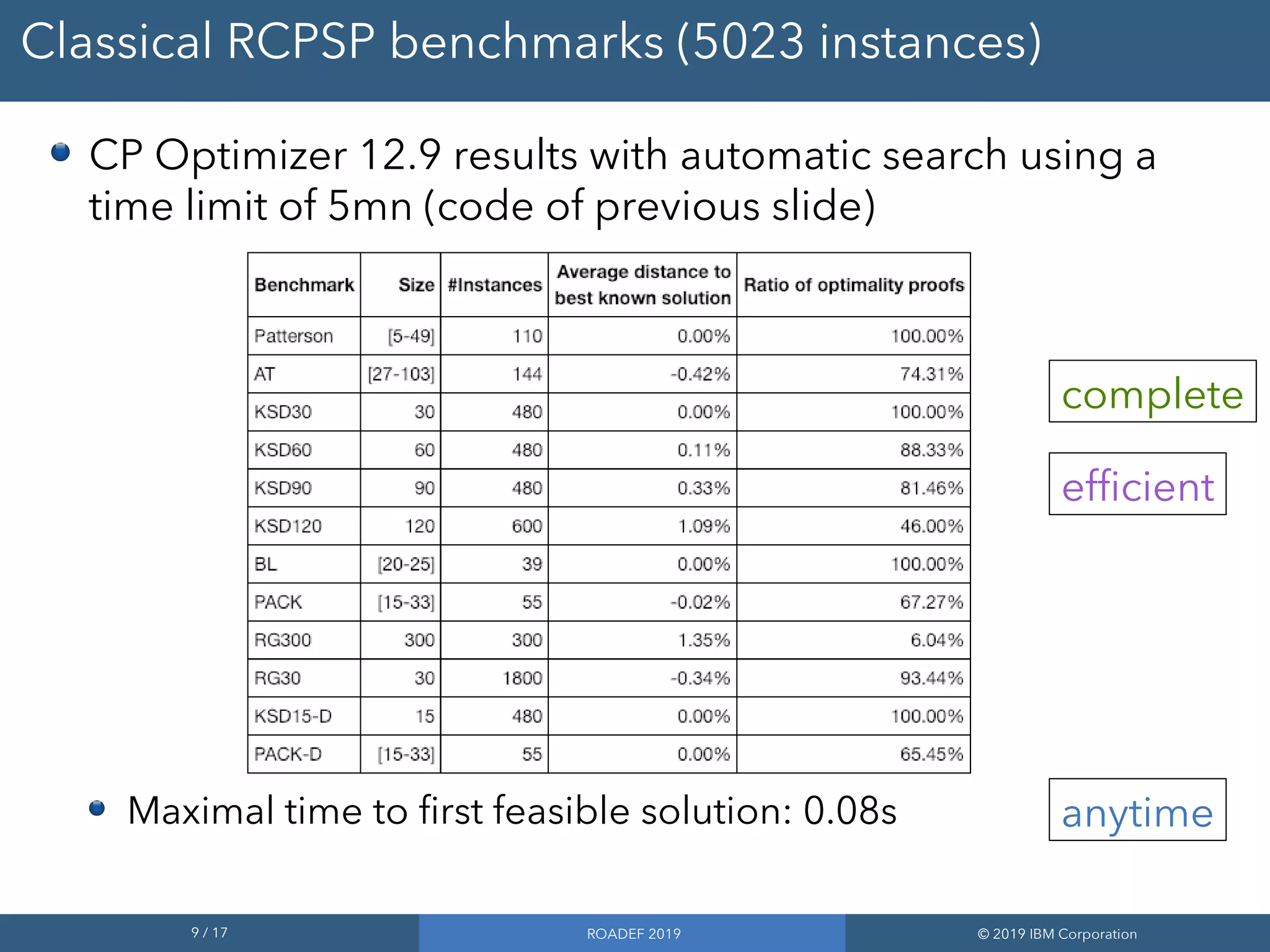
Classical RCPSP benchmarks (5023 instances)
CP Optimizer 12.9 results with automatic search using a
time limit of 5mn (code of previous slide)
Maximal time to first feasible solution: 0.08s anytime
complete
efficient
10 / 17 ROADEF 2019 © 2019 IBM Corporation
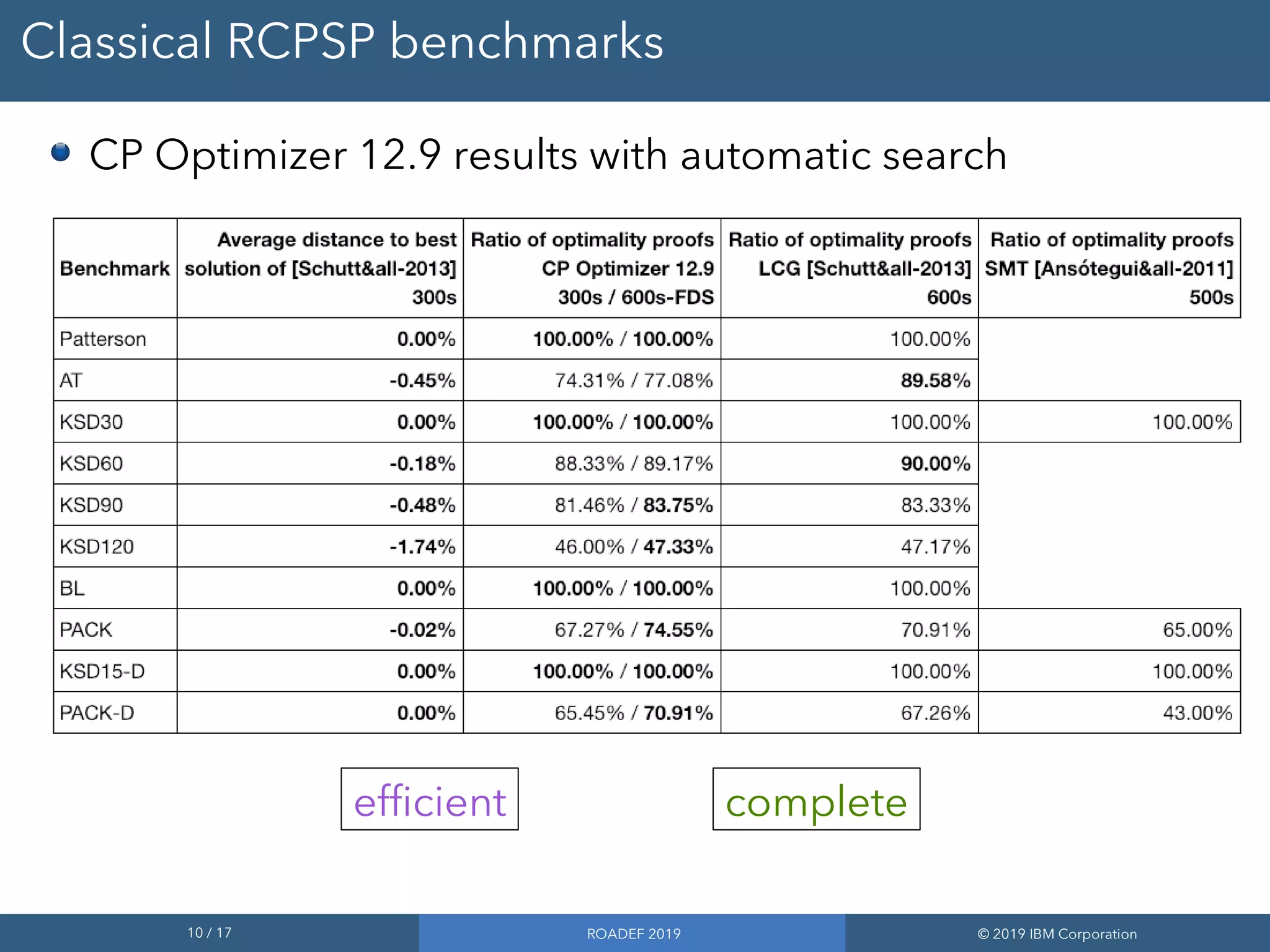
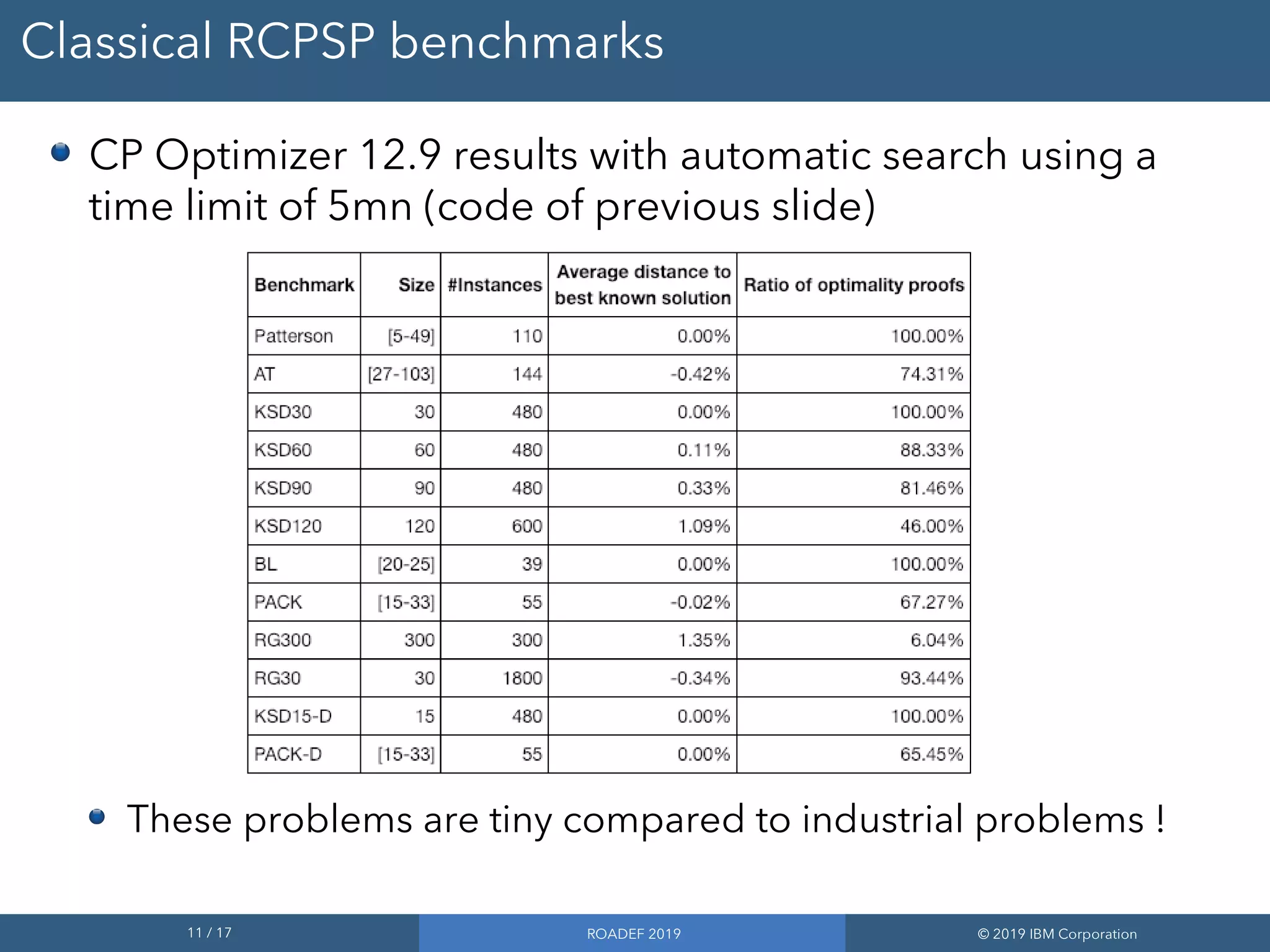
Classical RCPSP benchmarks
CP Optimizer 12.9 results with automatic search
completeefficient
11 / 17 ROADEF 2019 © 2019 IBM Corporation
Classical RCPSP benchmarks
CP Optimizer 12.9 results with automatic search using a
time limit of 5mn (code of previous slide)
These problems are tiny compared to industrial problems !
12 / 17 ROADEF 2019 © 2019 IBM Corporation
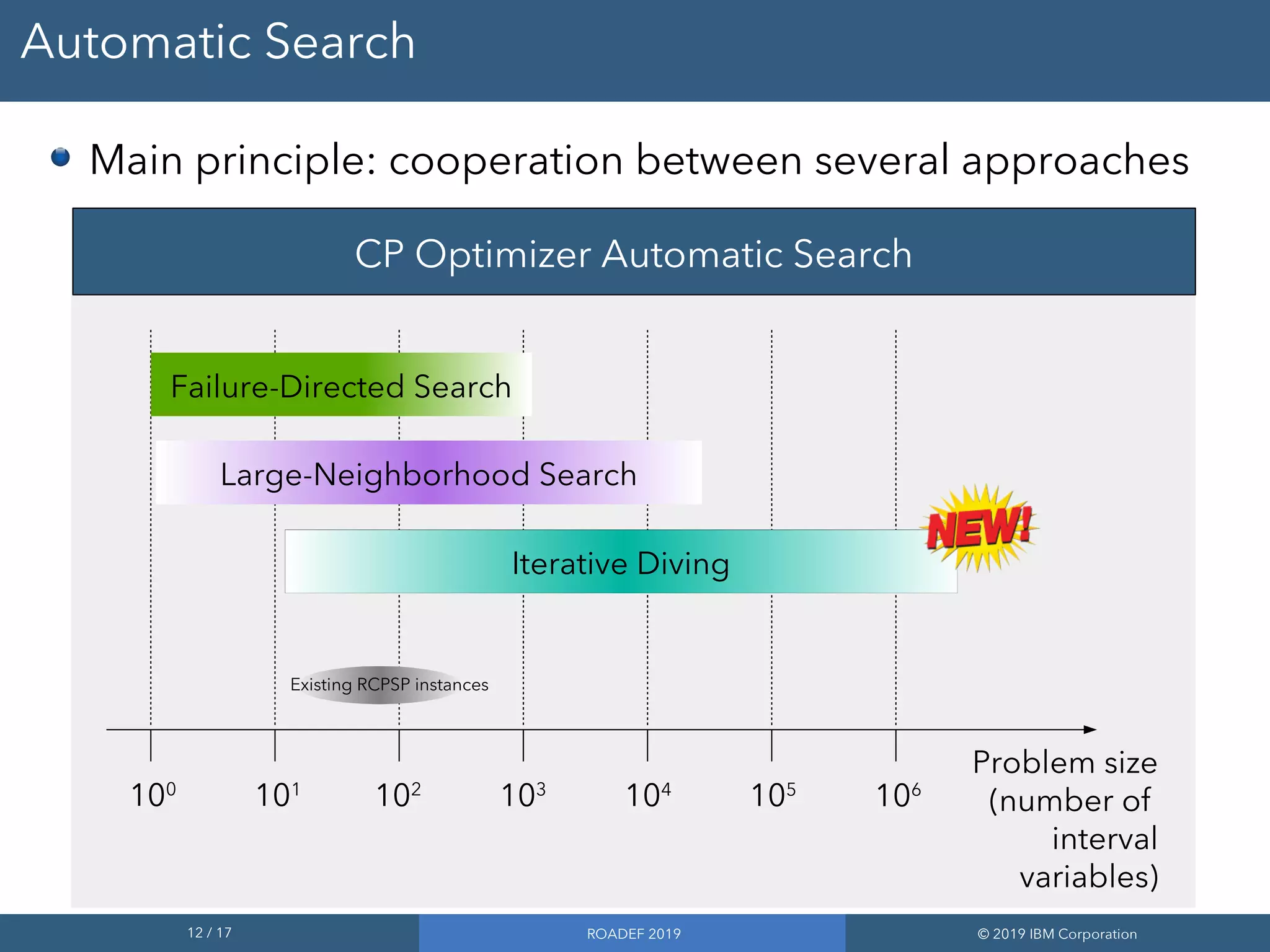
Automatic Search
Main principle: cooperation between several approaches
100
101
102
103
104
105
106
CP Optimizer Automatic Search
Failure-Directed Search
Large-Neighborhood Search
Iterative Diving
Problem size
(number of
interval
variables)
Existing RCPSP instances
13 / 17 ROADEF 2019 © 2019 IBM Corporation
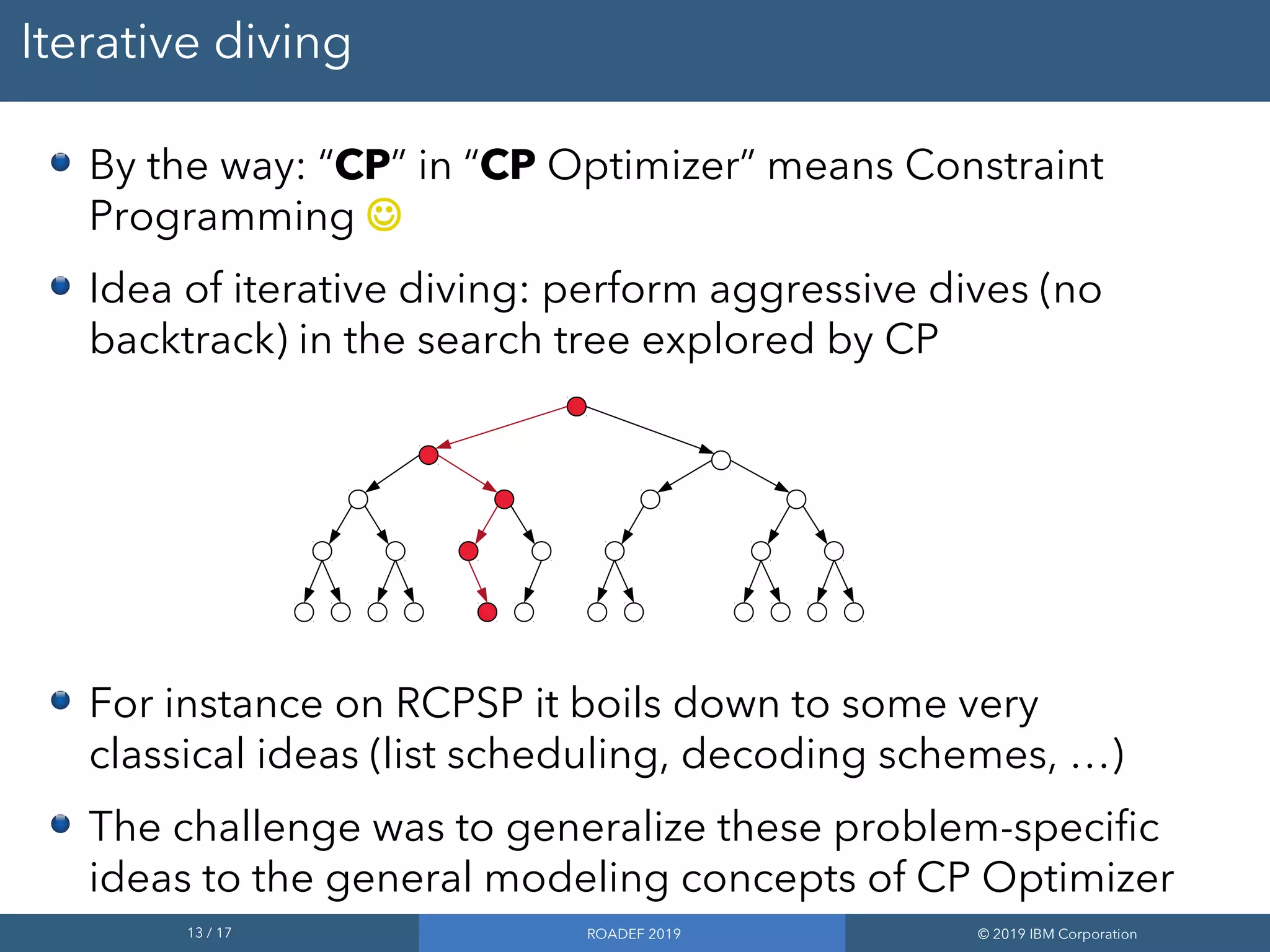
Iterative diving
By the way: “CP” in “CP Optimizer” means Constraint
Programming 
Idea of iterative diving: perform aggressive dives (no
backtrack) in the search tree explored by CP
For instance on RCPSP it boils down to some very
classical ideas (list scheduling, decoding schemes, …)
The challenge was to generalize these problem-specific
ideas to the general modeling concepts of CP Optimizer
14 / 17 ROADEF 2019 © 2019 IBM Corporation
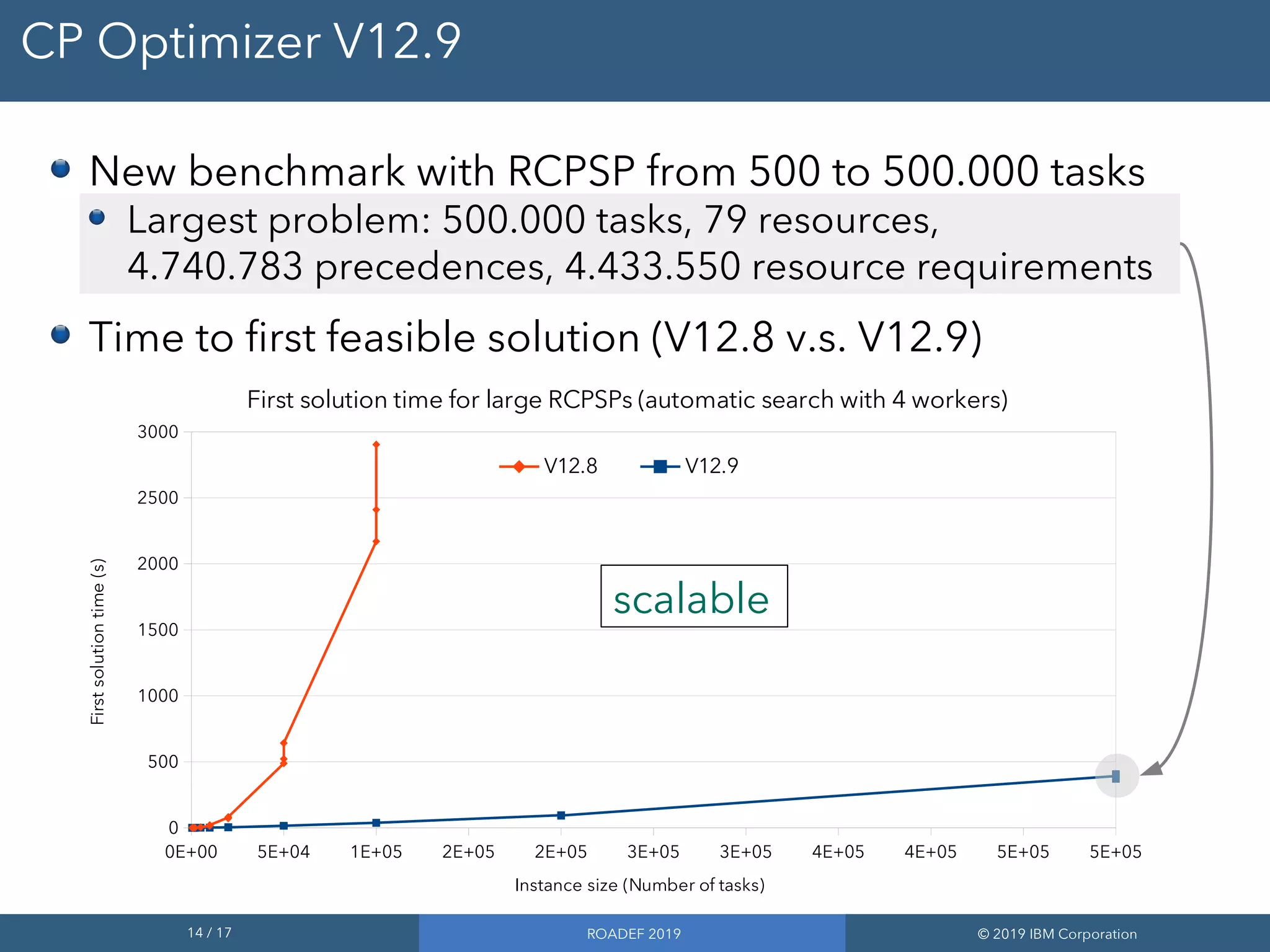
CP Optimizer V12.9
New benchmark with RCPSP from 500 to 500.000 tasks
Largest problem: 500.000 tasks, 79 resources,
4.740.783 precedences, 4.433.550 resource requirements
Time to first feasible solution (V12.8 v.s. V12.9)
0E+00 5E+04 1E+05 2E+05 2E+05 3E+05 3E+05 4E+05 4E+05 5E+05 5E+05
0
500
1000
1500
2000
2500
3000
First solution time for large RCPSPs (automatic search with 4 workers)
V12.8 V12.9
Instance size (Number of tasks)
Firstsolutiontime(s)
scalable
15 / 17 ROADEF 2019 © 2019 IBM Corporation
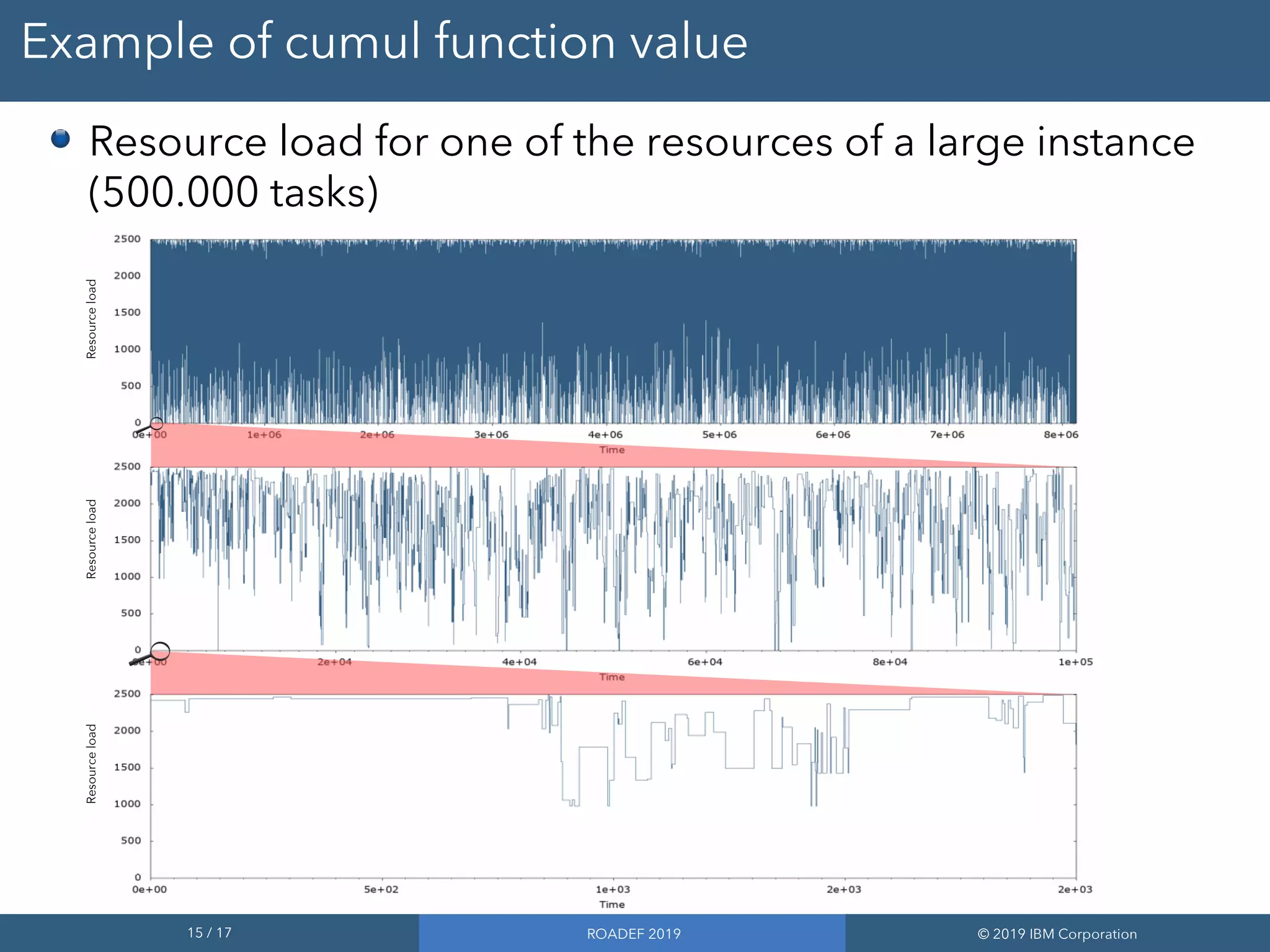
Example of cumul function value
ResourceloadResourceloadResourceload
Resource load for one of the resources of a large instance
(500.000 tasks)
16 / 17 ROADEF 2019 © 2019 IBM Corporation
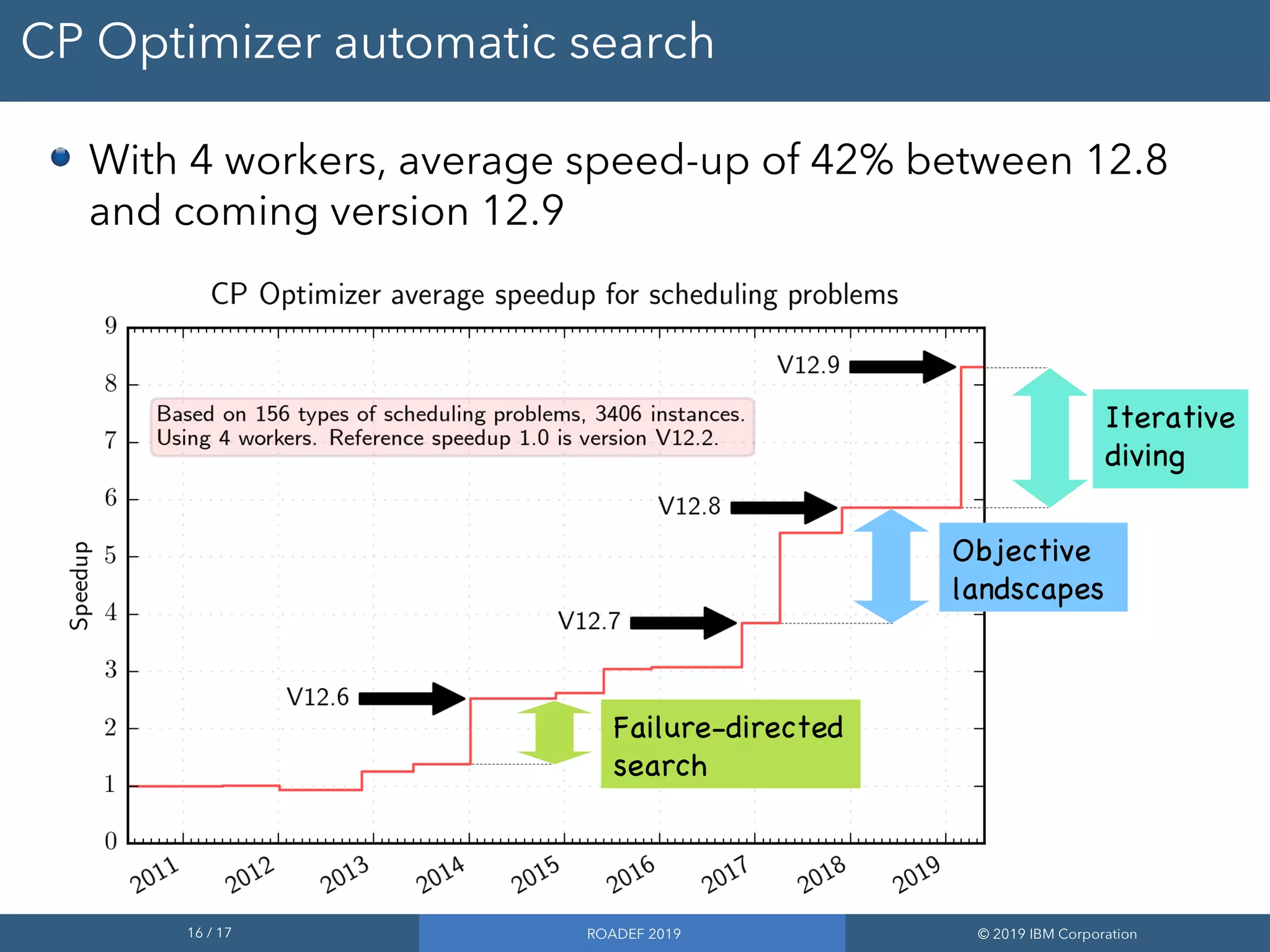
CP Optimizer automatic search
Objective
landscapes
Failure-directed
search
Iterative
diving
With 4 workers, average speed-up of 42% between 12.8
and coming version 12.9
17 / 17 ROADEF 2019 © 2019 IBM Corporation
Conclusion
A mathematical modeling language for combinatorial
optimization problems that extends ILP (and classical CP)
with some algebra on intervals and functions allowing
compact and maintainable formulations for complex
scheduling problems
A continuously improving automatic search algorithm
that is complete, anytime, efficient (e.g. competitive with
problem-specific algorithms on classical problems) and
scalable
Recent review of CP Optimizer (modeling concepts,
applications, examples, tools, performance,…) :
IBM ILOG CP Optimizer for scheduling. Constraints (2018)
23:210–250. http://ibm.biz/Constraints2018

Recent advances on large scheduling problems in CP Optimizer

  • 1.
    Feb. 20, 2019 Feb.20, 2019 ROADEF-2019 ROADEF-2019 © 2019 IBM Corporation © 2019 IBM Corporation Recent advances on large scheduling problems in CP Optimizer Philippe Laborie, IBM laborie@fr.ibm.com
  • 2.
    2 / 17ROADEF 2019 © 2019 IBM Corporation In this presentation 1. Recap about IBM CP Optimizer By the way: if you have CPLEX, you also have CP Optimizer! 2. Performance improvements on scheduling problems in coming release V12.9
  • 3.
    3 / 17ROADEF 2019 © 2019 IBM Corporation CP Optimizer for scheduling in two sentences A mathematical modeling language for combinatorial optimization problems that extends ILP (and classical CP) with some algebra on intervals and functions allowing compact and maintainable formulations for complex scheduling problems A continuously improving automatic search algorithm that is complete, anytime, efficient (e.g. competitive with problem-specific algorithms on classical problems) and scalable Recent review of CP Optimizer (modeling concepts, applications, examples, tools, performance,…) : IBM ILOG CP Optimizer for scheduling. Constraints (2018) 23:210–250. http://ibm.biz/Constraints2018
  • 4.
    4 / 17ROADEF 2019 © 2019 IBM Corporation Typical scheduling problems for CP Optimizer
  • 5.
    5 / 17ROADEF 2019 © 2019 IBM Corporation Illustration on an academical scheduling problem Resource-Constrained Project Scheduling (RCPSP) Notorious NP-Hard problem in combinatorial optimization (>5000 references on Google Scholar) N tasks with precedence constraints M resources of limited capacity Minimize project makespan 1 1 2 2 4 4 3 3 5 5 6 6 0 7 R1 R2 1 2 3 4 5 6 p1 =2 (1,2) C1 =2 C2 =3 time
  • 6.
    6 / 17ROADEF 2019 © 2019 IBM Corporation Formulation of the RCPSP in ILP Example of the Start/End Event-based formulation (SEE) O(N3 ) * A. Tesch. Compact MIP Models for the Resource-Constrained Project Scheduling Problem. Master's Thesis. Technische Universität Berlin. 2015.
  • 7.
    7 / 17ROADEF 2019 © 2019 IBM Corporation Formulation of the RCPSP in CP Optimizer Use of interval variables for tasks and cumul functions for resource usage O(N) xi xj Qij Di pulse(xi ,Qij ) compact
  • 8.
    8 / 17ROADEF 2019 © 2019 IBM Corporation Formulation of the RCPSP in CP Optimizer Use of interval variables for tasks and cumul functions for resource usage from docplex.cp.model import * model = CpoModel() # Decision variables: tasks x x = [interval_var(size=D[i]) for i in N] # Objective: minimize project makespan model.add(minimize(max(end_of(x[i]) for i in N))) # Constraints: resource capacities for j in M: model.add(sum(pulse(x[i],q) for [i,q] in R[j]) <= C[j]) # Constraints: precedence between tasks for [i,j] in P: model.add(end_before_start(x[i],x[j])) # Solve the model sol = model.solve(TimeLimit=300) compact xi xj Qij Di pulse(xi ,Qij )
  • 9.
    9 / 17ROADEF 2019 © 2019 IBM Corporation Classical RCPSP benchmarks (5023 instances) CP Optimizer 12.9 results with automatic search using a time limit of 5mn (code of previous slide) Maximal time to first feasible solution: 0.08s anytime complete efficient
  • 10.
    10 / 17ROADEF 2019 © 2019 IBM Corporation Classical RCPSP benchmarks CP Optimizer 12.9 results with automatic search completeefficient
  • 11.
    11 / 17ROADEF 2019 © 2019 IBM Corporation Classical RCPSP benchmarks CP Optimizer 12.9 results with automatic search using a time limit of 5mn (code of previous slide) These problems are tiny compared to industrial problems !
  • 12.
    12 / 17ROADEF 2019 © 2019 IBM Corporation Automatic Search Main principle: cooperation between several approaches 100 101 102 103 104 105 106 CP Optimizer Automatic Search Failure-Directed Search Large-Neighborhood Search Iterative Diving Problem size (number of interval variables) Existing RCPSP instances
  • 13.
    13 / 17ROADEF 2019 © 2019 IBM Corporation Iterative diving By the way: “CP” in “CP Optimizer” means Constraint Programming  Idea of iterative diving: perform aggressive dives (no backtrack) in the search tree explored by CP For instance on RCPSP it boils down to some very classical ideas (list scheduling, decoding schemes, …) The challenge was to generalize these problem-specific ideas to the general modeling concepts of CP Optimizer
  • 14.
    14 / 17ROADEF 2019 © 2019 IBM Corporation CP Optimizer V12.9 New benchmark with RCPSP from 500 to 500.000 tasks Largest problem: 500.000 tasks, 79 resources, 4.740.783 precedences, 4.433.550 resource requirements Time to first feasible solution (V12.8 v.s. V12.9) 0E+00 5E+04 1E+05 2E+05 2E+05 3E+05 3E+05 4E+05 4E+05 5E+05 5E+05 0 500 1000 1500 2000 2500 3000 First solution time for large RCPSPs (automatic search with 4 workers) V12.8 V12.9 Instance size (Number of tasks) Firstsolutiontime(s) scalable
  • 15.
    15 / 17ROADEF 2019 © 2019 IBM Corporation Example of cumul function value ResourceloadResourceloadResourceload Resource load for one of the resources of a large instance (500.000 tasks)
  • 16.
    16 / 17ROADEF 2019 © 2019 IBM Corporation CP Optimizer automatic search Objective landscapes Failure-directed search Iterative diving With 4 workers, average speed-up of 42% between 12.8 and coming version 12.9
  • 17.
    17 / 17ROADEF 2019 © 2019 IBM Corporation Conclusion A mathematical modeling language for combinatorial optimization problems that extends ILP (and classical CP) with some algebra on intervals and functions allowing compact and maintainable formulations for complex scheduling problems A continuously improving automatic search algorithm that is complete, anytime, efficient (e.g. competitive with problem-specific algorithms on classical problems) and scalable Recent review of CP Optimizer (modeling concepts, applications, examples, tools, performance,…) : IBM ILOG CP Optimizer for scheduling. Constraints (2018) 23:210–250. http://ibm.biz/Constraints2018