Math Team – ECA Reflections
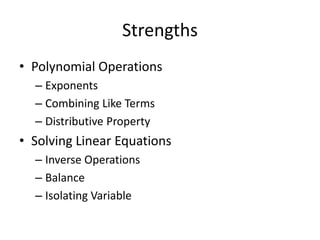
Strengths
• Polynomial Operations
  – Exponents
  – Combining Like Terms
  – Distributive Property
• Solving Linear Equations
  – Inverse Operations
  – Balance
  – Isolating Variable
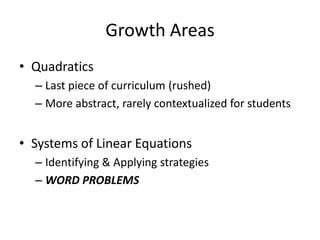
Growth Areas
• Quadratics
  – Last piece of curriculum (rushed)
  – More abstract, rarely contextualized for students


• Systems of Linear Equations
  – Identifying & Applying strategies
  – WORD PROBLEMS
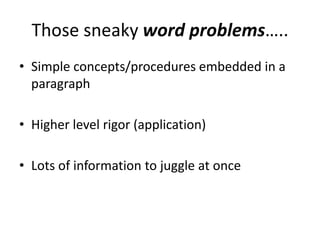
Those sneaky word problems…..
• Simple concepts/procedures embedded in a
  paragraph

• Higher level rigor (application)

• Lots of information to juggle at once
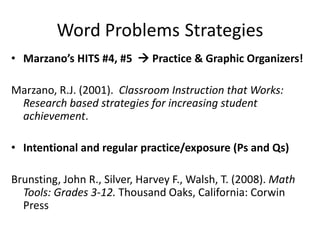
Word Problems Strategies
• Marzano’s HITS #4, #5  Practice & Graphic Organizers!

Marzano, R.J. (2001). Classroom Instruction that Works:
 Research based strategies for increasing student
 achievement.

• Intentional and regular practice/exposure (Ps and Qs)

Brunsting, John R., Silver, Harvey F., Walsh, T. (2008). Math
  Tools: Grades 3-12. Thousand Oaks, California: Corwin
  Press
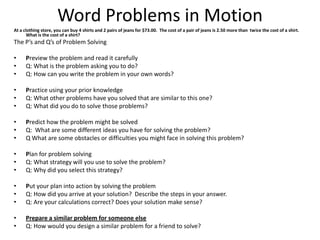
Word Problems in Motion
At a clothing store, you can buy 4 shirts and 2 pairs of jeans for $73.00. The cost of a pair of jeans is 2.50 more than twice the cost of a shirt.
       What is the cost of a shirt?
The P’s and Q’s of Problem Solving

•     Preview the problem and read it carefully
•     Q: What is the problem asking you to do?
•     Q: How can you write the problem in your own words?

•     Practice using your prior knowledge
•     Q: What other problems have you solved that are similar to this one?
•     Q: What did you do to solve those problems?

•     Predict how the problem might be solved
•     Q: What are some different ideas you have for solving the problem?
•     Q What are some obstacles or difficulties you might face in solving this problem?

•     Plan for problem solving
•     Q: What strategy will you use to solve the problem?
•     Q: Why did you select this strategy?

•     Put your plan into action by solving the problem
•     Q: How did you arrive at your solution? Describe the steps in your answer.
•     Q: Are your calculations correct? Does your solution make sense?

•     Prepare a similar problem for someone else
•     Q: How would you design a similar problem for a friend to solve?

ECA reflections

  • 1.
    Math Team –ECA Reflections
  • 2.
    Strengths • Polynomial Operations – Exponents – Combining Like Terms – Distributive Property • Solving Linear Equations – Inverse Operations – Balance – Isolating Variable
  • 3.
    Growth Areas • Quadratics – Last piece of curriculum (rushed) – More abstract, rarely contextualized for students • Systems of Linear Equations – Identifying & Applying strategies – WORD PROBLEMS
  • 4.
    Those sneaky wordproblems….. • Simple concepts/procedures embedded in a paragraph • Higher level rigor (application) • Lots of information to juggle at once
  • 5.
    Word Problems Strategies •Marzano’s HITS #4, #5  Practice & Graphic Organizers! Marzano, R.J. (2001). Classroom Instruction that Works: Research based strategies for increasing student achievement. • Intentional and regular practice/exposure (Ps and Qs) Brunsting, John R., Silver, Harvey F., Walsh, T. (2008). Math Tools: Grades 3-12. Thousand Oaks, California: Corwin Press
  • 6.
    Word Problems inMotion At a clothing store, you can buy 4 shirts and 2 pairs of jeans for $73.00. The cost of a pair of jeans is 2.50 more than twice the cost of a shirt. What is the cost of a shirt? The P’s and Q’s of Problem Solving • Preview the problem and read it carefully • Q: What is the problem asking you to do? • Q: How can you write the problem in your own words? • Practice using your prior knowledge • Q: What other problems have you solved that are similar to this one? • Q: What did you do to solve those problems? • Predict how the problem might be solved • Q: What are some different ideas you have for solving the problem? • Q What are some obstacles or difficulties you might face in solving this problem? • Plan for problem solving • Q: What strategy will you use to solve the problem? • Q: Why did you select this strategy? • Put your plan into action by solving the problem • Q: How did you arrive at your solution? Describe the steps in your answer. • Q: Are your calculations correct? Does your solution make sense? • Prepare a similar problem for someone else • Q: How would you design a similar problem for a friend to solve?