Digging into Mathematics Discourse:
Selecting and Sequencing Student Solutions
Gladis Kersaint, Ph.D.
Dean, Neag School of Education
April 17, 2017
#ReadyMath
Goals
To consider ways to engage students in meaningful and productive
mathematics discussions
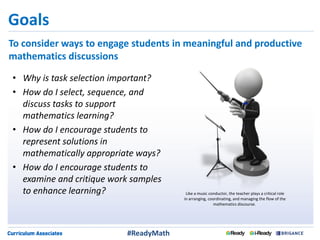
Like a music conductor, the teacher plays a critical role
in arranging, coordinating, and managing the flow of the
mathematics discourse.
• Why is task selection important?
• How do I select, sequence, and
discuss tasks to support
mathematics learning?
• How do I encourage students to
represent solutions in
mathematically appropriate ways?
• How do I encourage students to
examine and critique work samples
to enhance learning?
#ReadyMath
Teachers gain insights not only about what students know
but also about the approaches they use,
how well they understand the ideas and
the ways they present their knowledge.”
“Mathematical discourse serves as a forum in which to
exchange and record mathematics ideas,
document evidence of learning, and
monitor growth in knowledge development.
#ReadyMath
Task Selection
Task 1:
Find the mean, median, and mode of the
following set of numbers: 6, 5, 5, 5, 7, 9, 11
Task 2:
Create a data set with at least 7 values so that
the mean is 20, the median is 12, and the mode
is 23.
#ReadyMath
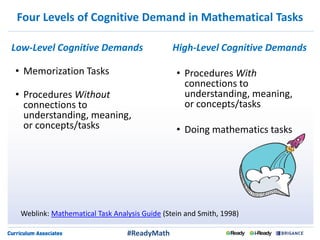
Four Levels of Cognitive Demand in Mathematical Tasks
Low-Level Cognitive Demands
• Memorization Tasks
• Procedures Without
connections to
understanding, meaning,
or concepts/tasks
High-Level Cognitive Demands
• Procedures With
connections to
understanding, meaning,
or concepts/tasks
• Doing mathematics tasks
Weblink: Mathematical Task Analysis Guide (Stein and Smith, 1998)
#ReadyMath
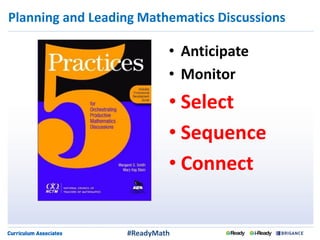
Planning and Leading Mathematics Discussions
• Anticipate
• Monitor
• Select
• Sequence
• Connect
#ReadyMath
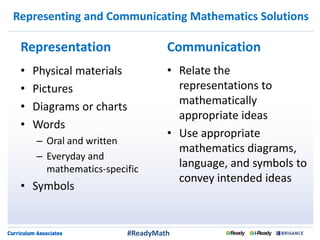
Representing and Communicating Mathematics Solutions
Representation
• Physical materials
• Pictures
• Diagrams or charts
• Words
– Oral and written
– Everyday and
mathematics-specific
• Symbols
Communication
• Relate the
representations to
mathematically
appropriate ideas
• Use appropriate
mathematics diagrams,
language, and symbols to
convey intended ideas
#ReadyMath
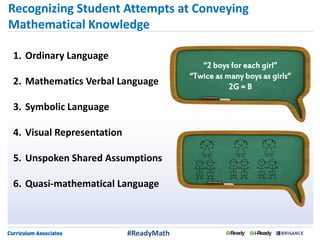
Recognizing Student Attempts at Conveying
Mathematical Knowledge
1. Ordinary Language
2. Mathematics Verbal Language
3. Symbolic Language
4. Visual Representation
5. Unspoken Shared Assumptions
6. Quasi-mathematical Language
“2 boys for each girl”
“Twice as many boys as girls”
2G = B
#ReadyMath
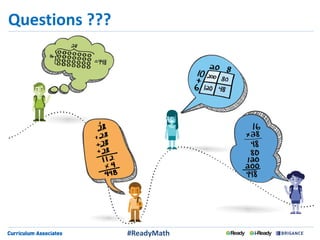
Questions ???
#ReadyMath
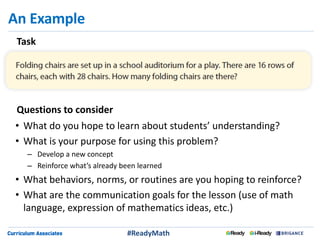
An Example
Questions to consider
• What do you hope to learn about students’ understanding?
• What is your purpose for using this problem?
– Develop a new concept
– Reinforce what’s already been learned
• What behaviors, norms, or routines are you hoping to reinforce?
• What are the communication goals for the lesson (use of math
language, expression of mathematics ideas, etc.)
Task
#ReadyMath
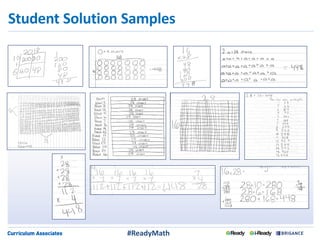
Student Solution Samples
#ReadyMath
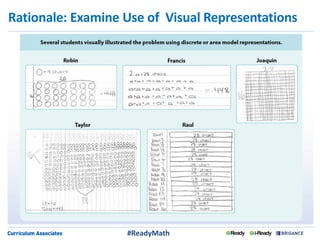
Rationale: Examine Use of Visual Representations
Robin
#ReadyMath
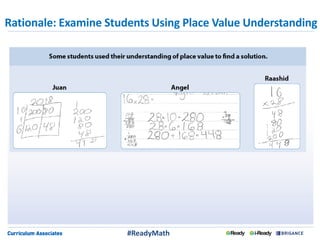
Rationale: Examine Students Using Place Value Understanding
#ReadyMath
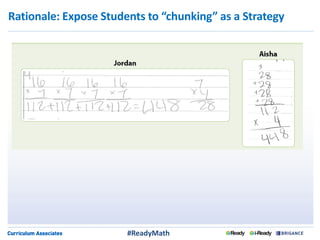
Rationale: Expose Students to “chunking” as a Strategy
#ReadyMath
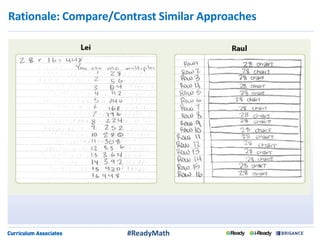
Rationale: Compare/Contrast Similar Approaches
#ReadyMath
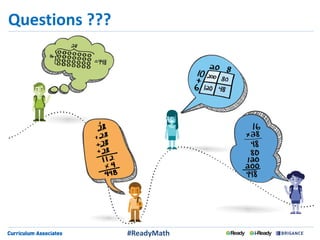
Questions ???
#ReadyMath
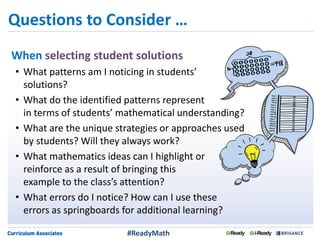
Questions to Consider …
When selecting student solutions
• What patterns am I noticing in students’
solutions?
• What do the identified patterns represent
in terms of students’ mathematical understanding?
• What are the unique strategies or approaches used
by students? Will they always work?
• What mathematics ideas can I highlight or
reinforce as a result of bringing this
example to the class’s attention?
• What errors do I notice? How can I use these
errors as springboards for additional learning?
#ReadyMath
Questions to Consider …
When selecting which students to call on
• How do I ensure that every student has a voice in my
classroom?
• What supports do I need to provide to prepare
students to experience success in sharing their ideas?
• How do I structure the learning environment so that
students are willing to expose their mistakes and, as a
result, learn from them?
• How do I make math conversations a regular part of
classroom interactions?
#ReadyMath
Questions to Consider …
When sequencing student solutions
• What are the advantages/disadvantages of sequencing the
discussion in this order?
• How do I build students’
understanding as we transition
from one set of solution strategies
to the next?
• What questions do I ask to encourage
students to critique ideas that are
presented?
• How do the questions support students in making
connections between and among the work to be shared?
#ReadyMath
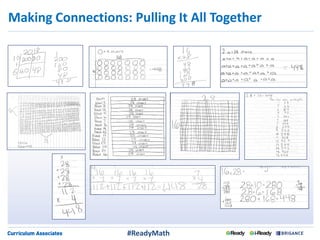
Making Connections: Pulling It All Together
#ReadyMath
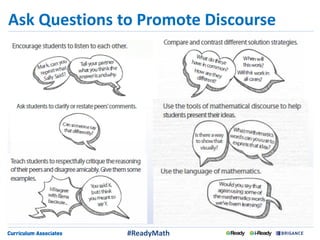
Ask Questions to Promote Discourse
#ReadyMath
Questions ???
#ReadyMath
Contact Information
Gladis Kersaint
Dean, Neag School of Education
Professor of Mathematics Education, University of Connecticut
Board Member, National Council of Teachers
of Mathematics 2012–2015
Kersaint@uconn.edu
#ReadyMath

CREATIVE MATHS TRAINING

  • 2.
    Digging into MathematicsDiscourse: Selecting and Sequencing Student Solutions Gladis Kersaint, Ph.D. Dean, Neag School of Education April 17, 2017 #ReadyMath
  • 3.
    Goals To consider waysto engage students in meaningful and productive mathematics discussions Like a music conductor, the teacher plays a critical role in arranging, coordinating, and managing the flow of the mathematics discourse. • Why is task selection important? • How do I select, sequence, and discuss tasks to support mathematics learning? • How do I encourage students to represent solutions in mathematically appropriate ways? • How do I encourage students to examine and critique work samples to enhance learning? #ReadyMath
  • 4.
    Teachers gain insightsnot only about what students know but also about the approaches they use, how well they understand the ideas and the ways they present their knowledge.” “Mathematical discourse serves as a forum in which to exchange and record mathematics ideas, document evidence of learning, and monitor growth in knowledge development. #ReadyMath
  • 5.
    Task Selection Task 1: Findthe mean, median, and mode of the following set of numbers: 6, 5, 5, 5, 7, 9, 11 Task 2: Create a data set with at least 7 values so that the mean is 20, the median is 12, and the mode is 23. #ReadyMath
  • 6.
    Four Levels ofCognitive Demand in Mathematical Tasks Low-Level Cognitive Demands • Memorization Tasks • Procedures Without connections to understanding, meaning, or concepts/tasks High-Level Cognitive Demands • Procedures With connections to understanding, meaning, or concepts/tasks • Doing mathematics tasks Weblink: Mathematical Task Analysis Guide (Stein and Smith, 1998) #ReadyMath
  • 7.
    Planning and LeadingMathematics Discussions • Anticipate • Monitor • Select • Sequence • Connect #ReadyMath
  • 8.
    Representing and CommunicatingMathematics Solutions Representation • Physical materials • Pictures • Diagrams or charts • Words – Oral and written – Everyday and mathematics-specific • Symbols Communication • Relate the representations to mathematically appropriate ideas • Use appropriate mathematics diagrams, language, and symbols to convey intended ideas #ReadyMath
  • 9.
    Recognizing Student Attemptsat Conveying Mathematical Knowledge 1. Ordinary Language 2. Mathematics Verbal Language 3. Symbolic Language 4. Visual Representation 5. Unspoken Shared Assumptions 6. Quasi-mathematical Language “2 boys for each girl” “Twice as many boys as girls” 2G = B #ReadyMath
  • 10.
  • 11.
    An Example Questions toconsider • What do you hope to learn about students’ understanding? • What is your purpose for using this problem? – Develop a new concept – Reinforce what’s already been learned • What behaviors, norms, or routines are you hoping to reinforce? • What are the communication goals for the lesson (use of math language, expression of mathematics ideas, etc.) Task #ReadyMath
  • 12.
  • 13.
    Rationale: Examine Useof Visual Representations Robin #ReadyMath
  • 14.
    Rationale: Examine StudentsUsing Place Value Understanding #ReadyMath
  • 15.
    Rationale: Expose Studentsto “chunking” as a Strategy #ReadyMath
  • 16.
  • 17.
  • 18.
    Questions to Consider… When selecting student solutions • What patterns am I noticing in students’ solutions? • What do the identified patterns represent in terms of students’ mathematical understanding? • What are the unique strategies or approaches used by students? Will they always work? • What mathematics ideas can I highlight or reinforce as a result of bringing this example to the class’s attention? • What errors do I notice? How can I use these errors as springboards for additional learning? #ReadyMath
  • 19.
    Questions to Consider… When selecting which students to call on • How do I ensure that every student has a voice in my classroom? • What supports do I need to provide to prepare students to experience success in sharing their ideas? • How do I structure the learning environment so that students are willing to expose their mistakes and, as a result, learn from them? • How do I make math conversations a regular part of classroom interactions? #ReadyMath
  • 20.
    Questions to Consider… When sequencing student solutions • What are the advantages/disadvantages of sequencing the discussion in this order? • How do I build students’ understanding as we transition from one set of solution strategies to the next? • What questions do I ask to encourage students to critique ideas that are presented? • How do the questions support students in making connections between and among the work to be shared? #ReadyMath
  • 21.
    Making Connections: PullingIt All Together #ReadyMath
  • 22.
    Ask Questions toPromote Discourse #ReadyMath
  • 23.
  • 24.
    Contact Information Gladis Kersaint Dean,Neag School of Education Professor of Mathematics Education, University of Connecticut Board Member, National Council of Teachers of Mathematics 2012–2015 Kersaint@uconn.edu #ReadyMath