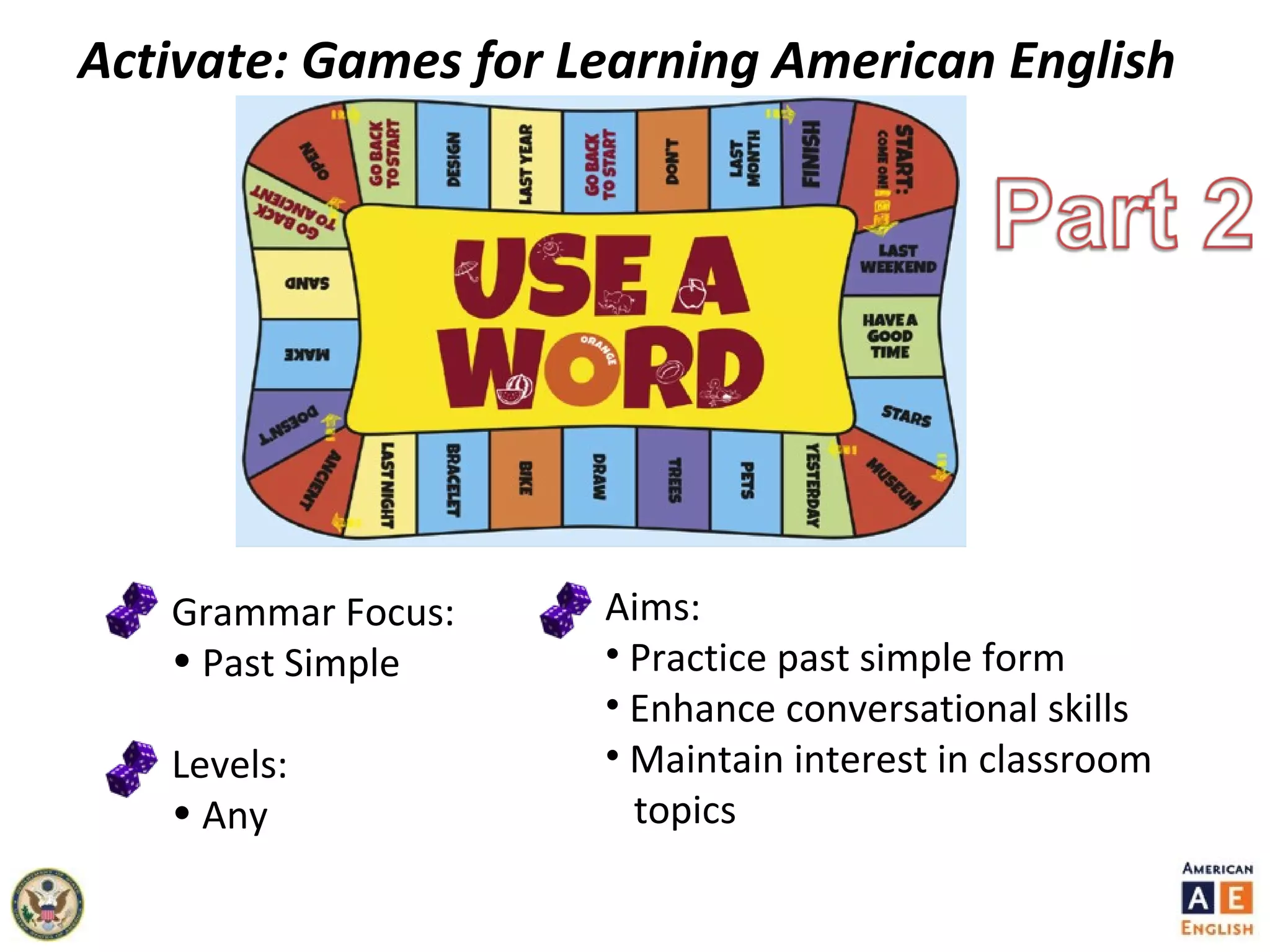

Activate: Games for Learning American English
Grammar Focus:
• Past Simple
Levels:
• Any
Aims:
• Practice past simple form
• Enhance conversational skills
• Maintain interest in classroom
topics
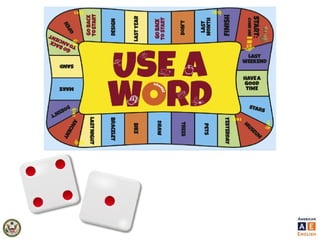
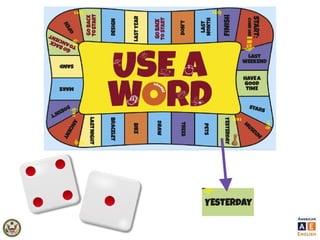
The Truth About Me
Step One: Students get into groups of 3 - 4.
Step Two: Students decide who will take the first turn. They will
play in clockwise order thereafter.
Step Three: Students move their game pieces along the path
according to the number indicated by the dice.
Step Four: Students read the word that they land on to the group.
Step Five: Players then use the word to make a true sentence
about themselves.
Group Grammar
Group Grammar
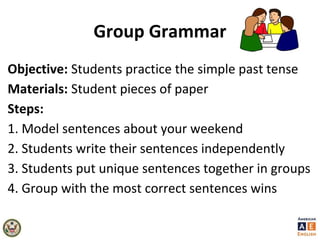
Objective: Students practice the simple past tense
Materials: Student pieces of paper
Steps:
1. Model sentences about your weekend
2. Students write their sentences independently
3. Students put unique sentences together in groups
4. Group with the most correct sentences wins
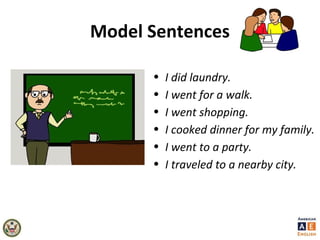
Model Sentences
• I did laundry.
• I went for a walk.
• I went shopping.
• I cooked dinner for my family.
• I went to a party.
• I traveled to a nearby city.
Students Write Independently
• Give students a few
minutes to write their
own sentences
• Encourage students to
use as many different
verbs as possible
• Mistakes are acceptable
at this stage
Students Work in Groups
• Have students get
together in groups and
share their sentences
• At this time, students
can correct each other’s
mistakes
• Students then create a
list of all their weekend
activities
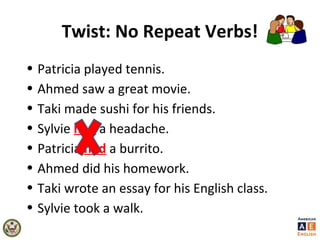
Twist: No Repeat Verbs!
• Patricia played tennis.
• Ahmed saw a great movie.
• Taki made sushi for his friends.
• Sylvie had a headache.
• Patricia had a burrito.
• Ahmed did his homework.
• Taki wrote an essay for his English class.
• Sylvie took a walk.
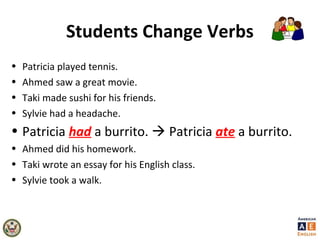
Students Change Verbs
• Patricia played tennis.
• Ahmed saw a great movie.
• Taki made sushi for his friends.
• Sylvie had a headache.
• Patricia had a burrito.  Patricia ate a burrito.
• Ahmed did his homework.
• Taki wrote an essay for his English class.
• Sylvie took a walk.
Group with the most correct
sentences wins!
What’s the best way to correct
student sentences for this game?
• Teacher checks each
group’s sentences as
they work on other
activities
• Students correct
themselves
• Students correct other
groups’ sentences
• Students correct all
sentences as a class
What other questions or prompts
could you use for…?
- the simple present tense
Example: What do you usually do
after school?
- the present perfect tense
Example: What have you learned
about this school year?
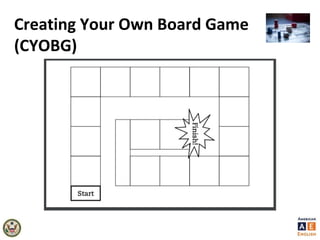
Creating Your Own Board Game
(CYOBG)
Board Game - Considerations
Be familiar with board games in your class.
• Reflect on what works and what doesn’t
• Establish classroom routines for board games
• Model play to the whole class before dividing
students into groups
• Monitor groups to answer questions and to
ensure fairness
CYOBG – Teacher Steps
1. Choose a theme
• Grammar pattern or topic
1. Create questions, prompts or
cues for each space
• Add chance and surprise by
adding prompts like “Lose a turn,”
“Go back # spaces,” etc.)
CYOBG – Teacher Steps
3. Test the game before you play in
class
4. Model for your students
5. Have students play the game
6. Revise if necessary
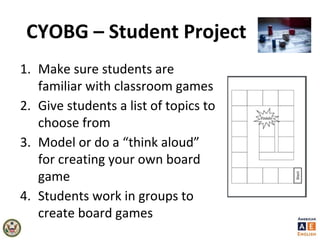
CYOBG – Student Project
1. Make sure students are
familiar with classroom games
2. Give students a list of topics to
choose from
3. Model or do a “think aloud”
for creating your own board
game
4. Students work in groups to
create board games
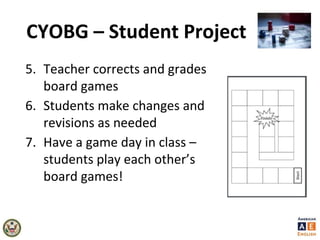
CYOBG – Student Project
5. Teacher corrects and grades
board games
6. Students make changes and
revisions as needed
7. Have a game day in class –
students play each other’s
board games!
CYOBG – Student Handout
Student Names: ___________________________
Grammar Theme: __________________________
Objective(s): ________________________
Rules: 1. ________________________
2. ________________________
3. ________________________
Prompts/Questions (for game spaces):
•_______________________________________________________
•_______________________________________________________
•_______________________________________________________
•_______________________________________________________
CYOBG – Example Handout
Student Names: Mamadou, Kyoto, Lindsey, Greta, Jose
Grammar Theme: Modal verbs
Objectives: Practice giving advice using modal verbs and make it to the end first.
Rules: 1. Roll the dice to move forward spaces.
2. Respond to each scenario in the game board spaces. You must use a
modal verb to give advice. (Should, ought to, had better [not])
3. Follow the other prompts (lose a turn, go forward or backwards, etc.)
4. The first person who makes it to the end wins!
Prompts/Questions (for game spaces):
•Your friend feels sick today but it’s a school day. What should she do?
•Your friend just got a new pet. What should he do to take care of it?
•Your friend wants to travel to a new city. What should he bring in his suitcase?
•Your friend has a job interview tomorrow. What should she do to prepare?
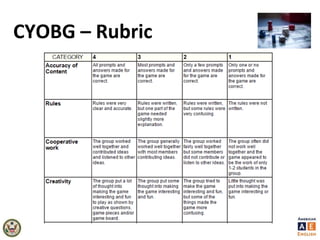
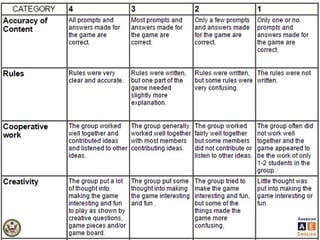
CYOBG – Rubric
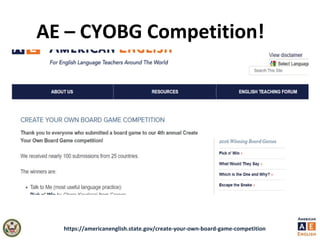
AE – CYOBG Competition!
https://americanenglish.state.gov/create-your-own-board-game-competition
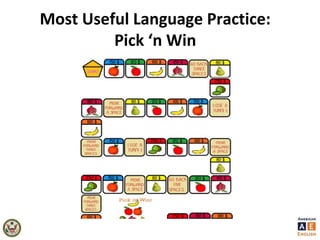
Most Useful Language Practice:
Pick ‘n Win
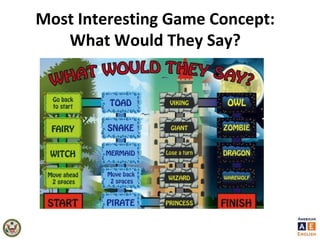
Most Interesting Game Concept:
What Would They Say?
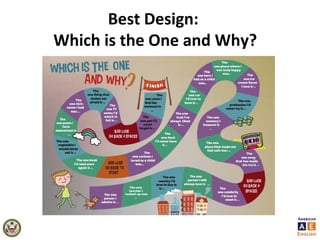
Best Design:
Which is the One and Why?
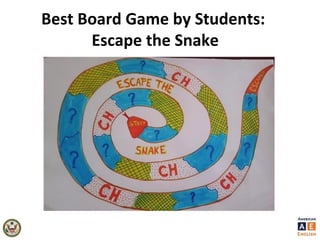
Best Board Game by Students:
Escape the Snake
Webinar Recap
• We talked about why games are a great way
to practice grammar.
• We showed you many examples of games
you can use in your classroom.
• We gave you some ideas for creating your
own board games or having students create
their own games.
Thank you!
americanenglishwebinars.com
americanenglish.state.gov
facebook.com/AmericanEnglishatState
facebook.com/AmericanEnglishforEducators

funwithgrammar ning_part2

  • 1.
    Activate: Games forLearning American English Grammar Focus: • Past Simple Levels: • Any Aims: • Practice past simple form • Enhance conversational skills • Maintain interest in classroom topics
  • 2.
    The Truth AboutMe Step One: Students get into groups of 3 - 4. Step Two: Students decide who will take the first turn. They will play in clockwise order thereafter. Step Three: Students move their game pieces along the path according to the number indicated by the dice. Step Four: Students read the word that they land on to the group. Step Five: Players then use the word to make a true sentence about themselves.
  • 6.
  • 7.
    Group Grammar Objective: Studentspractice the simple past tense Materials: Student pieces of paper Steps: 1. Model sentences about your weekend 2. Students write their sentences independently 3. Students put unique sentences together in groups 4. Group with the most correct sentences wins
  • 8.
    Model Sentences • Idid laundry. • I went for a walk. • I went shopping. • I cooked dinner for my family. • I went to a party. • I traveled to a nearby city.
  • 9.
    Students Write Independently •Give students a few minutes to write their own sentences • Encourage students to use as many different verbs as possible • Mistakes are acceptable at this stage
  • 10.
    Students Work inGroups • Have students get together in groups and share their sentences • At this time, students can correct each other’s mistakes • Students then create a list of all their weekend activities
  • 11.
    Twist: No RepeatVerbs! • Patricia played tennis. • Ahmed saw a great movie. • Taki made sushi for his friends. • Sylvie had a headache. • Patricia had a burrito. • Ahmed did his homework. • Taki wrote an essay for his English class. • Sylvie took a walk.
  • 12.
    Students Change Verbs •Patricia played tennis. • Ahmed saw a great movie. • Taki made sushi for his friends. • Sylvie had a headache. • Patricia had a burrito.  Patricia ate a burrito. • Ahmed did his homework. • Taki wrote an essay for his English class. • Sylvie took a walk.
  • 13.
    Group with themost correct sentences wins!
  • 14.
    What’s the bestway to correct student sentences for this game? • Teacher checks each group’s sentences as they work on other activities • Students correct themselves • Students correct other groups’ sentences • Students correct all sentences as a class
  • 15.
    What other questionsor prompts could you use for…? - the simple present tense Example: What do you usually do after school? - the present perfect tense Example: What have you learned about this school year?
  • 16.
    Creating Your OwnBoard Game (CYOBG)
  • 17.
    Board Game -Considerations Be familiar with board games in your class. • Reflect on what works and what doesn’t • Establish classroom routines for board games • Model play to the whole class before dividing students into groups • Monitor groups to answer questions and to ensure fairness
  • 18.
    CYOBG – TeacherSteps 1. Choose a theme • Grammar pattern or topic 1. Create questions, prompts or cues for each space • Add chance and surprise by adding prompts like “Lose a turn,” “Go back # spaces,” etc.)
  • 19.
    CYOBG – TeacherSteps 3. Test the game before you play in class 4. Model for your students 5. Have students play the game 6. Revise if necessary
  • 20.
    CYOBG – StudentProject 1. Make sure students are familiar with classroom games 2. Give students a list of topics to choose from 3. Model or do a “think aloud” for creating your own board game 4. Students work in groups to create board games
  • 21.
    CYOBG – StudentProject 5. Teacher corrects and grades board games 6. Students make changes and revisions as needed 7. Have a game day in class – students play each other’s board games!
  • 22.
    CYOBG – StudentHandout Student Names: ___________________________ Grammar Theme: __________________________ Objective(s): ________________________ Rules: 1. ________________________ 2. ________________________ 3. ________________________ Prompts/Questions (for game spaces): •_______________________________________________________ •_______________________________________________________ •_______________________________________________________ •_______________________________________________________
  • 23.
    CYOBG – ExampleHandout Student Names: Mamadou, Kyoto, Lindsey, Greta, Jose Grammar Theme: Modal verbs Objectives: Practice giving advice using modal verbs and make it to the end first. Rules: 1. Roll the dice to move forward spaces. 2. Respond to each scenario in the game board spaces. You must use a modal verb to give advice. (Should, ought to, had better [not]) 3. Follow the other prompts (lose a turn, go forward or backwards, etc.) 4. The first person who makes it to the end wins! Prompts/Questions (for game spaces): •Your friend feels sick today but it’s a school day. What should she do? •Your friend just got a new pet. What should he do to take care of it? •Your friend wants to travel to a new city. What should he bring in his suitcase? •Your friend has a job interview tomorrow. What should she do to prepare?
  • 24.
  • 26.
    AE – CYOBGCompetition! https://americanenglish.state.gov/create-your-own-board-game-competition
  • 27.
    Most Useful LanguagePractice: Pick ‘n Win
  • 28.
    Most Interesting GameConcept: What Would They Say?
  • 29.
    Best Design: Which isthe One and Why?
  • 30.
    Best Board Gameby Students: Escape the Snake
  • 31.
    Webinar Recap • Wetalked about why games are a great way to practice grammar. • We showed you many examples of games you can use in your classroom. • We gave you some ideas for creating your own board games or having students create their own games.
  • 32.