UNIT V
MULTI-USER RADIO COMMUNICATION
Global System for Mobile Communications
(GSM) - Code division multiple access (CDMA)
– Cellular Concept and Frequency Reuse -
Channel Assignment and Handover Techniques -
Overview of Multiple Access Schemes - Satellite
Communication - Bluetooth.
Global System for Mobile Communications
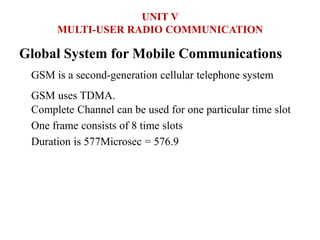
GSM is a second-generation cellular telephone system
GSM uses TDMA.
Complete Channel can be used for one particular time slot
One frame consists of 8 time slots
Duration is 577Microsec = 576.9
UNIT V
MULTI-USER RADIO COMMUNICATION
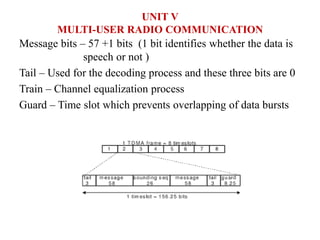
Message bits – 57 +1 bits (1 bit identifies whether the data is
speech or not )
Tail – Used for the decoding process and these three bits are 0
Train – Channel equalization process
Guard – Time slot which prevents overlapping of data bursts
UNIT V
MULTI-USER RADIO COMMUNICATION
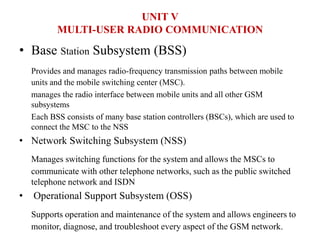
Architecture of GSM
UNIT V
MULTI-USER RADIO COMMUNICATION
• Base Station Subsystem (BSS)
Provides and manages radio-frequency transmission paths between mobile
units and the mobile switching center (MSC).
manages the radio interface between mobile units and all other GSM
subsystems
Each BSS consists of many base station controllers (BSCs), which are used to
connect the MSC to the NSS
• Network Switching Subsystem (NSS)
Manages switching functions for the system and allows the MSCs to
communicate with other telephone networks, such as the public switched
telephone network and ISDN
• Operational Support Subsystem (OSS)
Supports operation and maintenance of the system and allows engineers to
monitor, diagnose, and troubleshoot every aspect of the GSM network.
UNIT V
MULTI-USER RADIO COMMUNICATION
Basic parameters of GSM
1. GMSK modulation (Gaussian MSK)
2. 50-MHz bandwidth:
890-MHz to 915-MHz mobile transmit band (reverse channel)
935-MHz to 960-MHz base station transmit band (forward channel)
3. FDMA/TDMA accessing
4. Eight 25-kHz channels within each 200-kHz traffic channel
5. 200-kHz traffic channel
6. 992 full-duplex channels
7. Supplementary ISDN services, such as call diversion, closed user
groups, caller identification, and short messaging service (SMS),
which restricts GSM users and base stations to transmitting
alphanumeric pages limited to a maximum of 160 seven-bit ASCII
characters while simultaneously carrying normal voice messages.
UNIT V
MULTI-USER RADIO COMMUNICATION
Advantages
Low power consumption
Value added services like GPRS
Better quality
Roaming services are allowed
Easier to implement
Suitable for network with robust pitfall
Disadvantages
Charge for roaming is higher
Calls can be tampered
Maximum call size range is 35 km, that is very limited
UNIT V
MULTI-USER RADIO COMMUNICATION
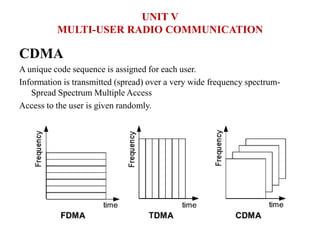
CDMA
A unique code sequence is assigned for each user.
Information is transmitted (spread) over a very wide frequency spectrum-
Spread Spectrum Multiple Access
Access to the user is given randomly.
UNIT V
MULTI-USER RADIO COMMUNICATION
Advantages
Maximum Utilization of the channel
Synchronization is not necessary
Disadvantages
Data Collision
Protocols are to be implemented to avoid collision
Forward Channel :
The base station simultaneously transmits user data from all current mobile
units in that cell by using different spreading sequences for each user’s
transmissions.
Reverse Channel :
All mobile units respond in an asynchronous manner (i.e., no time or
duration limitations) with a constant signal level controlled by the base
station.
UNIT V
MULTI-USER RADIO COMMUNICATION
Frequency-hopping spread spectrum
• break a message into fixed-size blocks of data with each block transmitted
in sequence except on a different carrier frequency
• a pseudorandom code is used to generate a unique frequency-hopping
sequence
Direct-sequence spread spectrum
• a high-bit-rate pseudorandom code is added to a low-bit-rate information
signal to generate a high-bit-rate pseudorandom signal
UNIT V
MULTI-USER RADIO COMMUNICATION
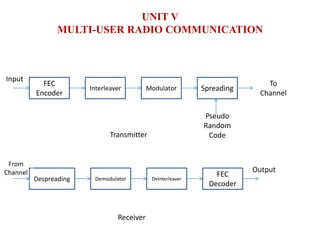
FEC
Encoder
Interleaver Modulator Spreading
To
Channel
Pseudo
Random
Code
Input
Despreading Demodulator DeInterleaver
FEC
Decoder
From
Channel Output
UNIT V
MULTI-USER RADIO COMMUNICATION
Transmitter
Receiver
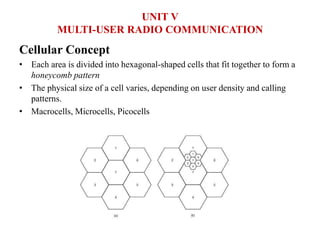
Cellular Concept
• Each area is divided into hexagonal-shaped cells that fit together to form a
honeycomb pattern
• The physical size of a cell varies, depending on user density and calling
patterns.
• Macrocells, Microcells, Picocells
UNIT V
MULTI-USER RADIO COMMUNICATION
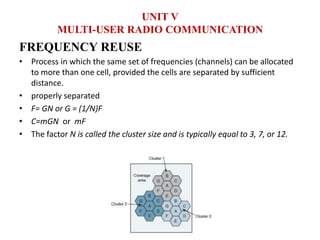
FREQUENCY REUSE
• Process in which the same set of frequencies (channels) can be allocated
to more than one cell, provided the cells are separated by sufficient
distance.
• properly separated
• F= GN or G = (1/N)F
• C=mGN or mF
• The factor N is called the cluster size and is typically equal to 3, 7, or 12.
UNIT V
MULTI-USER RADIO COMMUNICATION
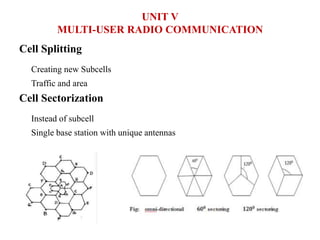
Cell Splitting
Creating new Subcells
Traffic and area
Cell Sectorization
Instead of subcell
Single base station with unique antennas
UNIT V
MULTI-USER RADIO COMMUNICATION
Channel Assignment
Fixed Channel
Every cell has fixed number of voice channel
Borrowing cell
Dynamic Channel
No fixed channels
Channels are allocated based on real time data
Advantages
Increased Channel Utilization
Reduced Call blocking
All the channels are available to the cells
Disadvantages
Storage medium is required
Computational load is higher
UNIT V
MULTI-USER RADIO COMMUNICATION
Handoff
No discontinuation when moving from one cell to other cell
Sufficient signal strength is required
Hard handoff - break before- make process
Soft handoff - A flawless handoff
(1) Initiation
(2) resource reservation,
(3) Execution
(4) completion.
UNIT V
MULTI-USER RADIO COMMUNICATION
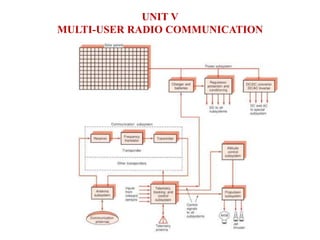
Satellite Communication
celestial body that orbits around a planet
military, governmental, private, and commercial subscribers
communications satellite is a microwave repeater in the sky
Transmissions to and from satellites are categorized as
either bus or payload.
Passive and Active Satellites
UNIT V
MULTI-USER RADIO COMMUNICATION
KEPLER’S LAWS
govern satellite motion
describe the shape of the orbit, the velocities of the planet,
and the distance a planet is with respect to the sun
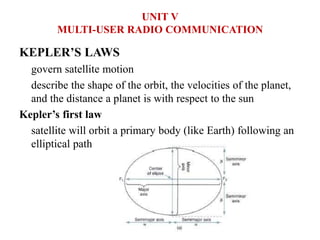
Kepler’s first law
satellite will orbit a primary body (like Earth) following an
elliptical path
UNIT V
MULTI-USER RADIO COMMUNICATION
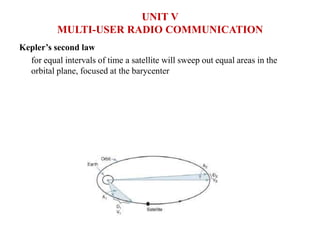
Kepler’s second law
for equal intervals of time a satellite will sweep out equal areas in the
orbital plane, focused at the barycenter
UNIT V
MULTI-USER RADIO COMMUNICATION
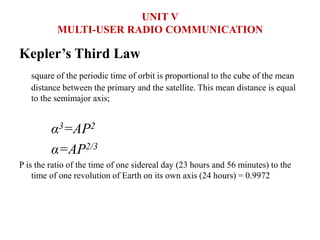
Kepler’s Third Law
square of the periodic time of orbit is proportional to the cube of the mean
distance between the primary and the satellite. This mean distance is equal
to the semimajor axis;
α3=AP2
α=AP2/3
P is the ratio of the time of one sidereal day (23 hours and 56 minutes) to the
time of one revolution of Earth on its own axis (24 hours) = 0.9972
UNIT V
MULTI-USER RADIO COMMUNICATION
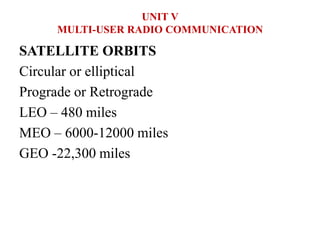
SATELLITE ORBITS
Circular or elliptical
Prograde or Retrograde
LEO – 480 miles
MEO – 6000-12000 miles
GEO -22,300 miles
UNIT V
MULTI-USER RADIO COMMUNICATION
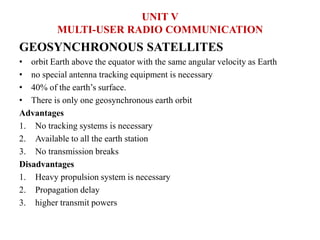
GEOSYNCHRONOUS SATELLITES
• orbit Earth above the equator with the same angular velocity as Earth
• no special antenna tracking equipment is necessary
• 40% of the earth’s surface.
• There is only one geosynchronous earth orbit
Advantages
1. No tracking systems is necessary
2. Available to all the earth station
3. No transmission breaks
Disadvantages
1. Heavy propulsion system is necessary
2. Propagation delay
3. higher transmit powers
UNIT V
MULTI-USER RADIO COMMUNICATION
UNIT V
MULTI-USER RADIO COMMUNICATION
Bluetooth
PAN
Ericsson
hands-free cell phone operation
frequency-hopping spread spectrum
hops over 79 frequencies spaced 1 MHz apart from 2.402 to 2.480 GHz
The actual data rate is 723.2 kbps simplex or 433.9 kbps duplex.
1 mW, 2.5 mW, 100mW
piconet
Bluetooth 2.0 – Enhanced Data Rate – 3mbps.
Bluetooth 4.0 - Bluetooth Low Energy
UNIT V
MULTI-USER RADIO COMMUNICATION
Bluetooth Applications
• cordless headsets for cell phones and hands-free voice systems in cars and
trucks.
• connection between smart phones and the accessory smart watches.
• Wearables for medical or fitness monitoring.
• wireless human interface devices (HIDs) such as keyboards, mice and
game controllers.
UNIT V
MULTI-USER RADIO COMMUNICATION

EC8394 MULTI USER RADIO COMMUNICATION UNIT V

  • 1.
    UNIT V MULTI-USER RADIOCOMMUNICATION Global System for Mobile Communications (GSM) - Code division multiple access (CDMA) – Cellular Concept and Frequency Reuse - Channel Assignment and Handover Techniques - Overview of Multiple Access Schemes - Satellite Communication - Bluetooth.
  • 2.
    Global System forMobile Communications GSM is a second-generation cellular telephone system GSM uses TDMA. Complete Channel can be used for one particular time slot One frame consists of 8 time slots Duration is 577Microsec = 576.9 UNIT V MULTI-USER RADIO COMMUNICATION
  • 3.
    Message bits –57 +1 bits (1 bit identifies whether the data is speech or not ) Tail – Used for the decoding process and these three bits are 0 Train – Channel equalization process Guard – Time slot which prevents overlapping of data bursts UNIT V MULTI-USER RADIO COMMUNICATION
  • 4.
    Architecture of GSM UNITV MULTI-USER RADIO COMMUNICATION
  • 5.
    • Base StationSubsystem (BSS) Provides and manages radio-frequency transmission paths between mobile units and the mobile switching center (MSC). manages the radio interface between mobile units and all other GSM subsystems Each BSS consists of many base station controllers (BSCs), which are used to connect the MSC to the NSS • Network Switching Subsystem (NSS) Manages switching functions for the system and allows the MSCs to communicate with other telephone networks, such as the public switched telephone network and ISDN • Operational Support Subsystem (OSS) Supports operation and maintenance of the system and allows engineers to monitor, diagnose, and troubleshoot every aspect of the GSM network. UNIT V MULTI-USER RADIO COMMUNICATION
  • 6.
    Basic parameters ofGSM 1. GMSK modulation (Gaussian MSK) 2. 50-MHz bandwidth: 890-MHz to 915-MHz mobile transmit band (reverse channel) 935-MHz to 960-MHz base station transmit band (forward channel) 3. FDMA/TDMA accessing 4. Eight 25-kHz channels within each 200-kHz traffic channel 5. 200-kHz traffic channel 6. 992 full-duplex channels 7. Supplementary ISDN services, such as call diversion, closed user groups, caller identification, and short messaging service (SMS), which restricts GSM users and base stations to transmitting alphanumeric pages limited to a maximum of 160 seven-bit ASCII characters while simultaneously carrying normal voice messages. UNIT V MULTI-USER RADIO COMMUNICATION
  • 7.
    Advantages Low power consumption Valueadded services like GPRS Better quality Roaming services are allowed Easier to implement Suitable for network with robust pitfall Disadvantages Charge for roaming is higher Calls can be tampered Maximum call size range is 35 km, that is very limited UNIT V MULTI-USER RADIO COMMUNICATION
  • 8.
    CDMA A unique codesequence is assigned for each user. Information is transmitted (spread) over a very wide frequency spectrum- Spread Spectrum Multiple Access Access to the user is given randomly. UNIT V MULTI-USER RADIO COMMUNICATION
  • 9.
    Advantages Maximum Utilization ofthe channel Synchronization is not necessary Disadvantages Data Collision Protocols are to be implemented to avoid collision Forward Channel : The base station simultaneously transmits user data from all current mobile units in that cell by using different spreading sequences for each user’s transmissions. Reverse Channel : All mobile units respond in an asynchronous manner (i.e., no time or duration limitations) with a constant signal level controlled by the base station. UNIT V MULTI-USER RADIO COMMUNICATION
  • 10.
    Frequency-hopping spread spectrum •break a message into fixed-size blocks of data with each block transmitted in sequence except on a different carrier frequency • a pseudorandom code is used to generate a unique frequency-hopping sequence Direct-sequence spread spectrum • a high-bit-rate pseudorandom code is added to a low-bit-rate information signal to generate a high-bit-rate pseudorandom signal UNIT V MULTI-USER RADIO COMMUNICATION
  • 11.
    FEC Encoder Interleaver Modulator Spreading To Channel Pseudo Random Code Input DespreadingDemodulator DeInterleaver FEC Decoder From Channel Output UNIT V MULTI-USER RADIO COMMUNICATION Transmitter Receiver
  • 12.
    Cellular Concept • Eacharea is divided into hexagonal-shaped cells that fit together to form a honeycomb pattern • The physical size of a cell varies, depending on user density and calling patterns. • Macrocells, Microcells, Picocells UNIT V MULTI-USER RADIO COMMUNICATION
  • 13.
    FREQUENCY REUSE • Processin which the same set of frequencies (channels) can be allocated to more than one cell, provided the cells are separated by sufficient distance. • properly separated • F= GN or G = (1/N)F • C=mGN or mF • The factor N is called the cluster size and is typically equal to 3, 7, or 12. UNIT V MULTI-USER RADIO COMMUNICATION
  • 14.
    Cell Splitting Creating newSubcells Traffic and area Cell Sectorization Instead of subcell Single base station with unique antennas UNIT V MULTI-USER RADIO COMMUNICATION
  • 15.
    Channel Assignment Fixed Channel Everycell has fixed number of voice channel Borrowing cell Dynamic Channel No fixed channels Channels are allocated based on real time data Advantages Increased Channel Utilization Reduced Call blocking All the channels are available to the cells Disadvantages Storage medium is required Computational load is higher UNIT V MULTI-USER RADIO COMMUNICATION
  • 16.
    Handoff No discontinuation whenmoving from one cell to other cell Sufficient signal strength is required Hard handoff - break before- make process Soft handoff - A flawless handoff (1) Initiation (2) resource reservation, (3) Execution (4) completion. UNIT V MULTI-USER RADIO COMMUNICATION
  • 17.
    Satellite Communication celestial bodythat orbits around a planet military, governmental, private, and commercial subscribers communications satellite is a microwave repeater in the sky Transmissions to and from satellites are categorized as either bus or payload. Passive and Active Satellites UNIT V MULTI-USER RADIO COMMUNICATION
  • 18.
    KEPLER’S LAWS govern satellitemotion describe the shape of the orbit, the velocities of the planet, and the distance a planet is with respect to the sun Kepler’s first law satellite will orbit a primary body (like Earth) following an elliptical path UNIT V MULTI-USER RADIO COMMUNICATION
  • 19.
    Kepler’s second law forequal intervals of time a satellite will sweep out equal areas in the orbital plane, focused at the barycenter UNIT V MULTI-USER RADIO COMMUNICATION
  • 20.
    Kepler’s Third Law squareof the periodic time of orbit is proportional to the cube of the mean distance between the primary and the satellite. This mean distance is equal to the semimajor axis; α3=AP2 α=AP2/3 P is the ratio of the time of one sidereal day (23 hours and 56 minutes) to the time of one revolution of Earth on its own axis (24 hours) = 0.9972 UNIT V MULTI-USER RADIO COMMUNICATION
  • 21.
    SATELLITE ORBITS Circular orelliptical Prograde or Retrograde LEO – 480 miles MEO – 6000-12000 miles GEO -22,300 miles UNIT V MULTI-USER RADIO COMMUNICATION
  • 22.
    GEOSYNCHRONOUS SATELLITES • orbitEarth above the equator with the same angular velocity as Earth • no special antenna tracking equipment is necessary • 40% of the earth’s surface. • There is only one geosynchronous earth orbit Advantages 1. No tracking systems is necessary 2. Available to all the earth station 3. No transmission breaks Disadvantages 1. Heavy propulsion system is necessary 2. Propagation delay 3. higher transmit powers UNIT V MULTI-USER RADIO COMMUNICATION
  • 23.
  • 24.
    Bluetooth PAN Ericsson hands-free cell phoneoperation frequency-hopping spread spectrum hops over 79 frequencies spaced 1 MHz apart from 2.402 to 2.480 GHz The actual data rate is 723.2 kbps simplex or 433.9 kbps duplex. 1 mW, 2.5 mW, 100mW piconet Bluetooth 2.0 – Enhanced Data Rate – 3mbps. Bluetooth 4.0 - Bluetooth Low Energy UNIT V MULTI-USER RADIO COMMUNICATION
  • 25.
    Bluetooth Applications • cordlessheadsets for cell phones and hands-free voice systems in cars and trucks. • connection between smart phones and the accessory smart watches. • Wearables for medical or fitness monitoring. • wireless human interface devices (HIDs) such as keyboards, mice and game controllers. UNIT V MULTI-USER RADIO COMMUNICATION