OpenBTS® Mini-
                             Workshop
                            OpenBTS is a registered trademark of Range Networks, Inc.
                                                       1
Saturday, August 6, 2011                                                                1
GSM Basics
                               2
Saturday, August 6, 2011                2
GSM History
                     •     1982 - CEPT establishes GSM group
                     •     1987 - Basic parameters selected
                     •     1989 - GSM standardization process moved to ETSI
                     •     1990 - Phase 1 spec frozen
                     •     1992 - First commercial service
                     •     1995 - Phase 2 spec frozen
                     •     2001 - 500M GSM users world-wide
                     •     2009 - Accounts for about 80% of all cellular service
                     •     2011 - 3G UMTS displacing 2G GSM in some places, but all 3G
                           UMTS phones still support 2G GSM
                                                         3
Saturday, August 6, 2011                                                                 3
GSM Layers
                     • Layers similar to OSI model.
                     • L1 - physical layer - bits and waveforms
                     • L2 - data link layer - makes the link reliable
                     •     L3 - connection management layer - where
                           most of the cellular telephone application
                           happens
                                              4
Saturday, August 6, 2011                                                4
Physical Layer (L1)
                                    5
Saturday, August 6, 2011                         5
Cellular Concepts:
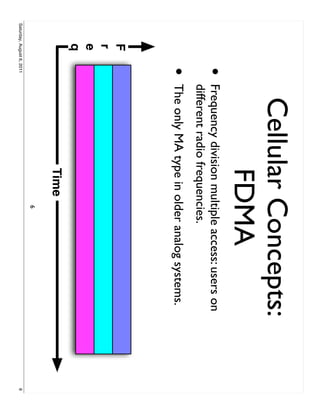
                                   FDMA
                     •     Frequency division multiple access: users on
                           different radio frequencies.
                     •     The only MA type in older analog systems.
         F
         r
         e
         q
                                           Time
                                                  6
Saturday, August 6, 2011                                                  6
Cellular Concepts:
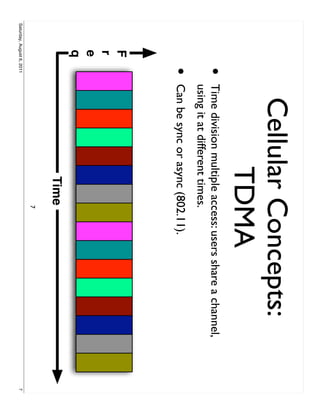
                                   TDMA
                     •     Time division multiple access: users share a channel,
                           using it at different times.
                     •     Can be sync or async (802.11).
            F
            r
            e
            q
                                              Time
                                                    7
Saturday, August 6, 2011                                                           7
Cellular Concepts:
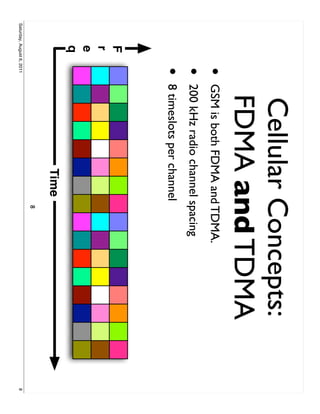
                             FDMA and TDMA
                     •     GSM is both FDMA and TDMA.
                     •     200 kHz radio channel spacing
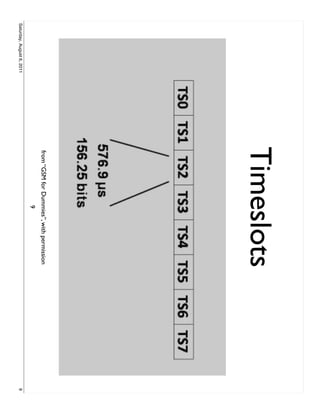
                     •     8 timeslots per channel
          F
          r
          e
          q
                                           Time
                                                     8
Saturday, August 6, 2011                                   8
Timeslots
                           from “GSM for Dummies”, with permission
                                             9
Saturday, August 6, 2011                                             9
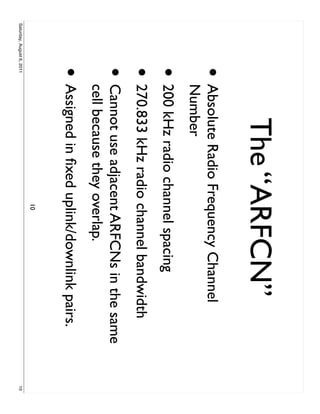
The “ARFCN”
                     •     Absolute Radio Frequency Channel
                           Number
                     • 200 kHz radio channel spacing
                     • 270.833 kHz radio channel bandwidth
                     •     Cannot use adjacent ARFCNs in the same
                           cell because they overlap.
                     • Assigned in fixed uplink/downlink pairs.
                                            10
Saturday, August 6, 2011                                            10
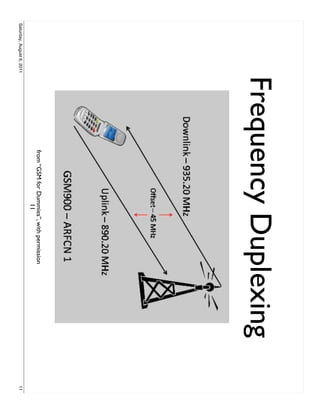
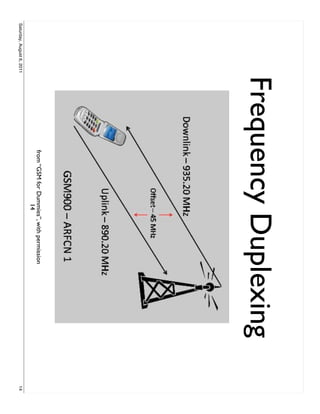
Frequency Duplexing
                                from “GSM for Dummies”, with permission
                                                 11
Saturday, August 6, 2011                                                  11
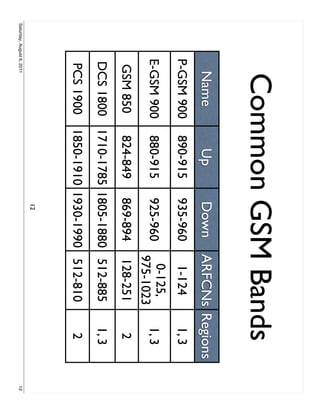
Common GSM Bands
                      Name       Up      Down      ARFCNs Regions
                 P-GSM 900     890-915   935-960    1-124     1, 3
                 E-GSM 900     880-915   925-960     0-125,   1, 3
                                                   975-1023
                   GSM 850     824-849   869-894    128-251    2
                  DCS 1800 1710-1785 1805-1880 512-885        1, 3
                   PCS 1900   1850-1910 1930-1990 512-810      2
                                         12
Saturday, August 6, 2011                                             12
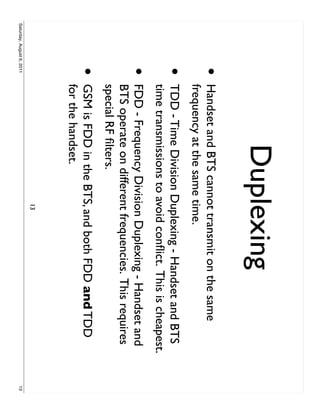
Duplexing
                     •     Handset and BTS cannot transmit on the same
                           frequency at the same time.
                     •     TDD - Time Division Duplexing - Handset and BTS
                           time transmissions to avoid conflict. This is cheapest.
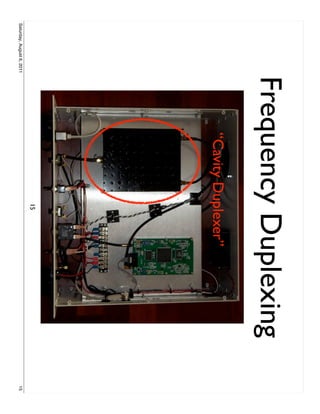
                     •     FDD - Frequency Division Duplexing - Handset and
                           BTS operate on different frequencies. This requires
                           special RF filters.
                     •     GSM is FDD in the BTS, and both FDD and TDD
                           for the handset.
                                                  13
Saturday, August 6, 2011                                                            13
Frequency Duplexing
                                from “GSM for Dummies”, with permission
                                                 14
Saturday, August 6, 2011                                                  14
Frequency Duplexing
                               “Cavity Duplexer”
                                         15
Saturday, August 6, 2011                           15
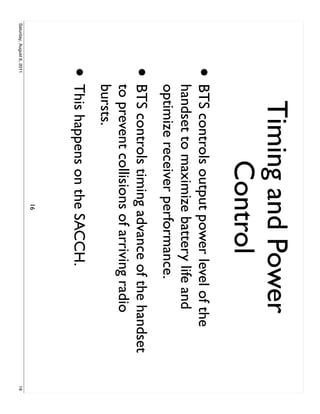
Timing and Power
                                 Control
                     •     BTS controls output power level of the
                           handset to maximize battery life and
                           optimize receiver performance.
                     •     BTS controls timing advance of the handset
                           to prevent collisions of arriving radio
                           bursts.
                     • This happens on the SACCH.
                                             16
Saturday, August 6, 2011                                                16
Link Layer (L2)
                                  17
Saturday, August 6, 2011                     17
The Link Layer
                     •     L3 has variable-length messages and
                           assumes reliable delivery.
                     •     L1 has fixed-length frames and loses them
                           sometimes.
                     • L2 connects these so that L3 can use L1.
                                             18
Saturday, August 6, 2011                                              18
Connection
                           Management Layer
                                 (L3)
                                  19
Saturday, August 6, 2011                      19
GSM Layer 3
                     •     This is where things start to look like a
                           telephone system.
                     • Sublayers:
                           • Radio Resource (RR)
                           • Mobility Management (MM)
                           • Call Control (CC)
                           • Short Message Service (SMS)
                                               20
Saturday, August 6, 2011                                               20
GSM L3 RR
                     • Radio Resource management.
                     • Assign and release radio channels.
                     • Page handsets for service.
                     • Generate the beacon.
                     •     Data elements are descriptions of physical
                           layer parameters.
                                              21
Saturday, August 6, 2011                                                21
GSM L3 MM
                     • Mobility Management.
                     •     Keep track of what part of the network is
                           serving a given handset.
                     • Authenticate users.
                     •     Data elements are subscriber identities and
                           authentication tokens.
                                              22
Saturday, August 6, 2011                                                 22
GSM L3 CC
                     • Call Control.
                     •     Connect the handset to the telephone
                           switch.
                     • Nearly identical to ISDN’s Q.931.
                     •     Data elements are phone numbers, call
                           status codes and bearer capability
                           descriptions.
                                             23
Saturday, August 6, 2011                                           23
GSM L3 SMS
                     •     SMS L3 is just a connection layer for SMS
                           L4.
                     •     Just a pass-through. Nothing really happens
                           in SMS until you hit L5.
                                              24
Saturday, August 6, 2011                                                 24
Addressing in GSM
                     •     IMSI: International Subscriber Mobile
                           Identity. A 14- 15-digit number in the SIM
                           that uniquely identifies the subscriber.
                           Encodes identity of issuing carrier, too.
                     •     TMSI: Temporary Subscriber Mobile
                           Identity. A 32-bit number assigned by the
                           network that uniquely identifies the
                           subscriber within that network.
                                              25
Saturday, August 6, 2011                                                25
Addressing in GSM
                                 (cont.)
                     •     IMEI: International Mobile Equipment
                           Identity. A 15-digit number that uniquely
                           identifies the handset. Encodes
                           manufacturer and model. Not used much in
                           GSM except for fraud detection.
                     •     MSISDN: The subscriber’s telephone
                           number.
                                             26
Saturday, August 6, 2011                                               26
Addressing in GSM
                                 (cont.)
                     •     The MSISDN-IMSI association exists only in
                           the network, not in the handset.
                     • There is no MSISDN-IMEI association.
                     •     If a phone is “locked” that usually means
                           that it will accept SIMs only from a specific
                           carrier.
                                              27
Saturday, August 6, 2011                                                  27
Introduction to VoIP
                                    28
Saturday, August 6, 2011                          28
The Old Analog PSTN
                     •     Phone numbers form an address space, like any
                           other address space.
                     •     A phone line’s address is determined by where it is
                           physically connected to the network.
                     •     Dialed numbers (“signaling”) are encoded as tones
                           in the audio stream (“in-band signaling”).
                     •     The switch decodes signaling to connect completed
                           physical circuits between phones.
                     •     “Circuit Switched Telephony”
                                                  29
Saturday, August 6, 2011                                                         29
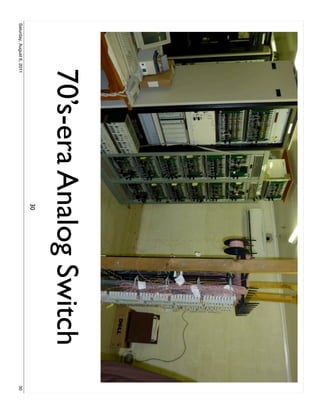
70’s-era Analog Switch
                               30
Saturday, August 6, 2011                      30
SS7
                     •     Signaling System 7 (SS7) replaced analog lines with
                           synchronous digital ones, but it’s still circuit-switched.
                     •     Signaling and media travel on different logical channels
                           (“out-of-band signaling”).
                     •     Telephony is just an application in the SS7 network.
                     •     ...so is the GSM core network.
                     •     The switch is just a computer, shuffling frames between
                           media channels as instructed by the signaling.
                     •     Phone numbers are no longer physical addresses, but
                           entries in a routing database.
                                                       31
Saturday, August 6, 2011                                                                31
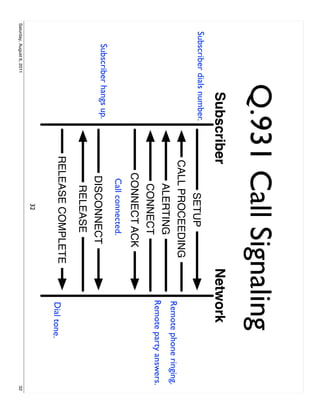
Q.931 Call Signaling
                           Subscriber                     Network
   Subscriber dials number.                SETUP
                                    CALL PROCEEDING
                                                              Remote phone ringing.
                                        ALERTING
                                                              Remote party answers.
                                         CONNECT
                                        CONNECT ACK
                                        Call connected.
         Subscriber hangs up.
                                        DISCONNECT
                                         RELEASE
                                   RELEASE COMPLETE           Dial tone.
                                              32
Saturday, August 6, 2011                                                              32
VoIP
                     •     Replace circuit-switched SS7 with packet-switched
                           IP.
                     •     Signaling and media can follow entirely different
                           paths and use entirely different protocols.
                     •     Telephony is an application running on the internet.
                     •     The switch is just a computer shuffling packets as
                           directed by the signaling.
                     •     IP network gives additional layer of addressing.
                                                  33
Saturday, August 6, 2011                                                          33
VoIP Specifics: SIP & RTP
                     •     Session Initiation Protocol (SIP), RFC-3261,
                           for signaling.
                     • SIP header design similar to HTTP.
                     •     Real-Time Protocol (RTP), RFC-3550, for
                           media.
                     •     Both protocols already used internally by
                           many telecom carriers, all renamed “IMS”.
                                              34
Saturday, August 6, 2011                                                  34
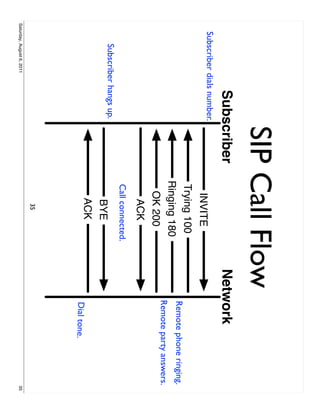
SIP Call Flow
                           Subscriber                     Network
   Subscriber dials number.
                                          INVITE
                                        Trying 100
                                                              Remote phone ringing.
                                        Ringing 180
                                                             Remote party answers.
                                          OK 200
                                           ACK
                                        Call connected.
         Subscriber hangs up.
                                           BYE
                                           ACK
                                                              Dial tone.
                                             35
Saturday, August 6, 2011                                                              35
Putting it Together:
               OpenBTS = GSM + VoIP
                           36
Saturday, August 6, 2011                36
OpenBTS Design
                                Principles
                     •     Put as little functionality as possible into
                           the GSM-specific software.
                     •     Translate protocols to open standards
                           whenever possible.
                     •     Exploit external applications whenever
                           possible.
                                                37
Saturday, August 6, 2011                                                  37
OpenBTS Design
                                Principles
                     •     Terminate L3 RR inside OpenBTS to
                           eliminate the need for a BSC.
                     •     Translate MM, CC and SMS to SIP and let
                           the VoIP software deal with them.
                     •     Most new features will be external modules
                           on socket interfaces.
                                             38
Saturday, August 6, 2011                                                38
OpenBTS VoIP Principles
                     •     OpenBTS itself is invisible. The VoIP
                           network sees only the phones.
                     •     Each handset appears as a SIP endpoint at
                           the IP address of its serving BTS.
                     •     Each handset is a SIP user called
                           “IMSIxxxxxxxxxxxxxxxx”, where
                           “xxxxxxxxxxxxxxx” is the IMSI of the SIM
                           in the handset.
                                               39
Saturday, August 6, 2011                                               39
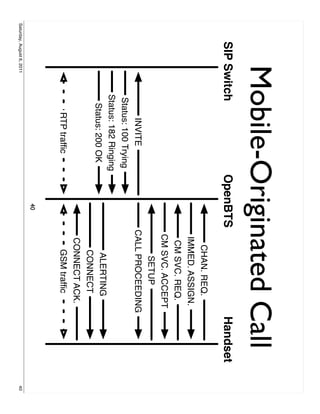
Mobile-Originated Call
        SIP Switch                               OpenBTS                     Handset
                                                             CHAN. REQ.
                                                            IMMED. ASSIGN.
                                                             CM SVC. REQ.
                                                           CM SVC. ACCEPT
                                                               SETUP
                                 INVITE                    CALL PROCEEDING
                           Status: 100 Trying
                           Status: 182 Ringing
                             Status: 200 OK                   ALERTING
                                                              CONNECT
                                                            CONNECT ACK.
                               RTP traffic                     GSM traffic
                                                    40
Saturday, August 6, 2011                                                               40
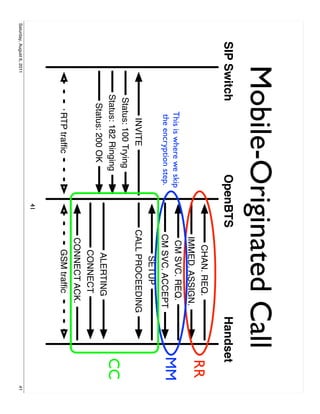
Mobile-Originated Call
        SIP Switch                               OpenBTS                      Handset
                                                              CHAN. REQ.
                                                             IMMED. ASSIGN.
                                                                                    RR
                               This is where we skip          CM SVC. REQ.
                                the encryption step.        CM SVC. ACCEPT          MM
                                                                SETUP
                                 INVITE                     CALL PROCEEDING
                           Status: 100 Trying
                           Status: 182 Ringing                                      CC
                             Status: 200 OK                    ALERTING
                                                               CONNECT
                                                             CONNECT ACK.
                               RTP traffic                      GSM traffic
                                                       41
Saturday, August 6, 2011                                                                 41
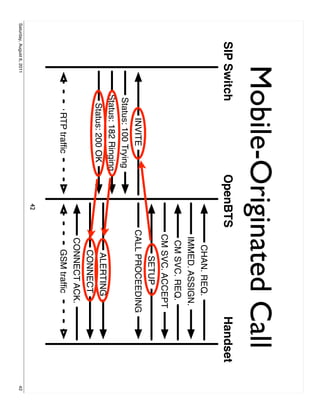
Mobile-Originated Call
        SIP Switch                               OpenBTS                     Handset
                                                             CHAN. REQ.
                                                            IMMED. ASSIGN.
                                                             CM SVC. REQ.
                                                           CM SVC. ACCEPT
                                                               SETUP
                                 INVITE                    CALL PROCEEDING
                           Status: 100 Trying
                           Status: 182 Ringing
                             Status: 200 OK                   ALERTING
                                                              CONNECT
                                                            CONNECT ACK.
                               RTP traffic                     GSM traffic
                                                    42
Saturday, August 6, 2011                                                               42
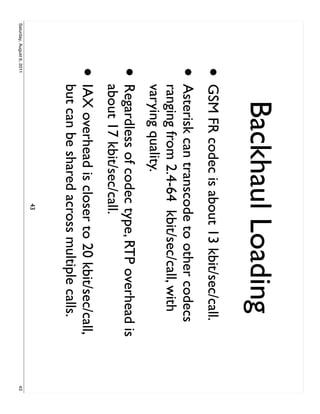
Backhaul Loading
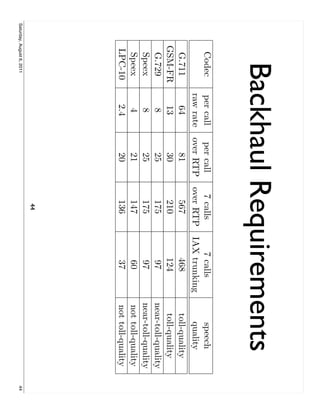
                     • GSM FR codec is about 13 kbit/sec/call.
                     •     Asterisk can transcode to other codecs
                           ranging from 2.4-64 kbit/sec/call, with
                           varying quality.
                     •     Regardless of codec type, RTP overhead is
                           about 17 kbit/sec/call.
                     •     IAX overhead is closer to 20 kbit/sec/call,
                           but can be shared across multiple calls.
                                               43
Saturday, August 6, 2011                                                 43
Backhaul Requirements
able 6.1: Backhaul bandwidth for various codec/trunking configurations. All rates in kbit/sec and a
 ming 20 ms framing.
                   Codec         per call    per call     7 calls      7 calls          speech
                                 raw rate   over RTP    over RTP    IAX trunking       quality
                 G.711              64         81          567          468          toll-quality
                GSM-FR              13         30          210          124          toll-quality
                 G.729               8         25          175           97        near-toll-quality
                 Speex               8         25          175           97        near-toll-quality
                 Speex               4         21          147           60        not toll-quality
                LPC-10             2.4         20          136           37        not toll-quality
                                                           44
      Saturday, August 6, 2011                                                                         44
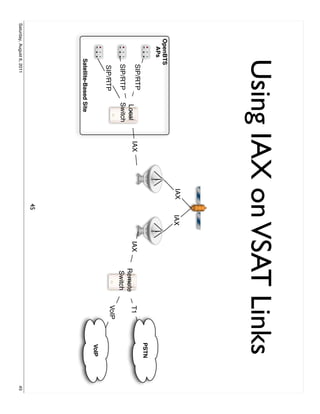
Using IAX on VSAT Links
                                                 IAX        IAX
       OpenBTS
         APs
                                                                                           PSTN
                   SIP/RTP                IAX                     IAX
                                 Local                                           T1
                                                                        Remote
                   SIP/RTP       Switch                                 Switch
                                                                                 VoIP
                    SIP/RTP
                                                                                           VoIP
                 Satellite-Based Site
            Figure 6.5: Paired OpenSwitch servers for IAX trunking in satellite-based applications.
                                                       45
Saturday, August 6, 2011                                                                              45
Subscriber Registry
                                    46
Saturday, August 6, 2011                         46
The Authentication
                                 Problem
                     • The IMSI is exposed in many places.
                     •     Making a SIM with a controlled IMSI is
                           trivial.
                                              47
Saturday, August 6, 2011                                            47
GSM Authentication
                     •     Challenge-Response based on shared secret key Ki.
                     •     Network generates 128-bit random string (RAND)
                           to send to phone.
                     •     Phone encrypts RAND with Ki and a hash function
                           (A3) to produce SRES.
                     •     Network performs identical SRES calculation with
                           same RAND, Ki and A3.
                     •     Phone returns SRES and network compares results.
                                                48
Saturday, August 6, 2011                                                       48
Cache-Based
                                  Authentication
                     •     Can be used in OpenBTS when you don’t know Ki
                           or A3 for a SIM.
                     •     Perform RAND-SRES exchange and save the result.
                     •     Assume the first exchange is valid and allow access.
                     •     Use the same RAND for subsequent exchanges
                           and see if you get the same SRES.
                     •     Not full authentication, but better than nothing.
                                                  49
Saturday, August 6, 2011                                                         49
SIM Parameters
                     •     To perform RAND-SRES authentication, you must
                           know Ki and the A3 algorithm used by the SIM.
                     •     SIMs do not disclose Ki; it is normally known only
                           by the party that issues the SIM.
                     •     A3 is usually a variant of COMP-128; the current
                           industry standard is v3.
                     •     To perform full authentication you must by able to
                           issue SIMs and have the software to implement
                           the A3 in those SIMs.
                                                 50
Saturday, August 6, 2011                                                        50
Subscriber Registry
                     •     “Realtime” Asterisk using external
                           databases.
                     •     Core is an sqlite3 database file, /var/lib/
                           asterisk/sqlite3dir/sqlite3.db.
                     • HTTP interface for remote access.
                     • SIP interface for registration.
                     • Caching Behavior.
                                               51
Saturday, August 6, 2011                                                51
Subscriber Registry
                                sip_buddies Table
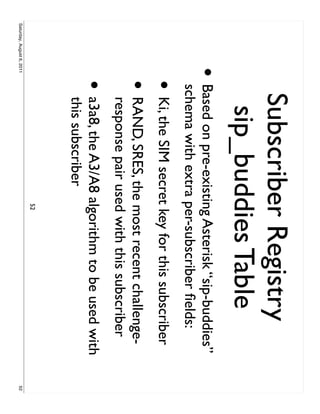
                     •     Based on pre-existing Asterisk “sip-buddies”
                           schema with extra per-subscriber fields:
                           • Ki, the SIM secret key for this subscriber
                           •   RAND, SRES, the most recent challenge-
                               response pair used with this subscriber
                           •   a3a8, the A3/A8 algorithm to be used with
                               this subscriber
                                               52
Saturday, August 6, 2011                                                   52
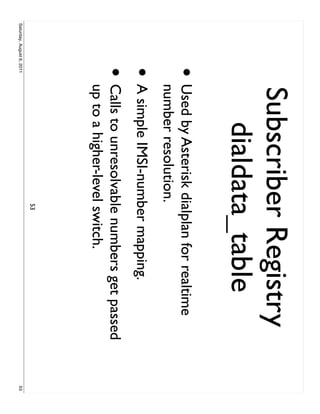
Subscriber Registry
                             dialdata_table
                     •     Used by Asterisk dialplan for realtime
                           number resolution.
                     • A simple IMSI-number mapping.
                     •     Calls to unresolvable numbers get passed
                           up to a higher-level switch.
                                              53
Saturday, August 6, 2011                                              53
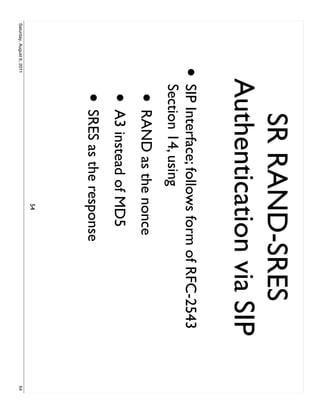
SR RAND-SRES
                           Authentication via SIP
                     •     SIP Interface; follows form of RFC-2543
                           Section 14, using
                            • RAND as the nonce
                            • A3 instead of MD5
                            • SRES as the response
                                              54
Saturday, August 6, 2011                                             54
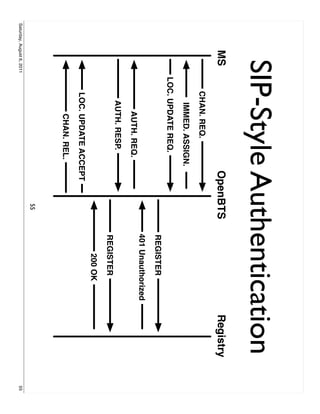
SIP-Style Authentication
            MS                                   OpenBTS                      Registry
                              CHAN. REQ.
                                IMMED. ASSIGN.
                           LOC. UPDATE REQ.
                                                           REGISTER
                                                           401 Unauthorized
                                  AUTH. REQ.
                               AUTH. RESP.
                                                           REGISTER
                                                               200 OK
                              LOC. UPDATE ACCEPT
                                  CHAN. REL.
                                                     55
Saturday, August 6, 2011                                                                 55
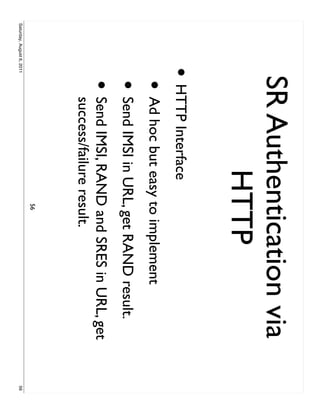
SR Authentication via
                                  HTTP
                     • HTTP Interface
                           • Ad hoc but easy to implement
                           • Send IMSI in URL, get RAND result.
                           • Send IMSI, RAND and SRES in URL, get
                             success/failure result.
                                             56
Saturday, August 6, 2011                                            56
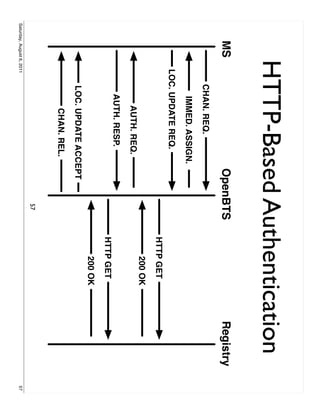
HTTP-Based Authentication
        MS                                    OpenBTS               Registry
                           CHAN. REQ.
                             IMMED. ASSIGN.
                      LOC. UPDATE REQ.
                                                        HTTP GET
                                                           200 OK
                               AUTH. REQ.
                            AUTH. RESP.
                                                        HTTP GET
                                                           200 OK
                           LOC. UPDATE ACCEPT
                               CHAN. REL.
                                                  57
Saturday, August 6, 2011                                                       57
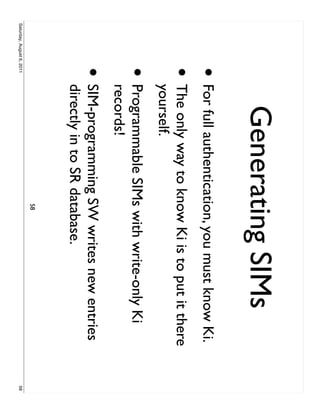
Generating SIMs
                     • For full authentication, you must know Ki.
                     •     The only way to know Ki is to put it there
                           yourself.
                     •     Programmable SIMs with write-only Ki
                           records!
                     •     SIM-programming SW writes new entries
                           directly in to SR database.
                                              58
Saturday, August 6, 2011                                                58
SIM Security
                     • COMP128 and cracking
                     • SIM protection
                     • COMP128v3
                     • Fraud detection
                                       59
Saturday, August 6, 2011                      59
Network Security
                     • SR caching makes isolated nodes robust.
                     •     SR caching also moves a lot of sensitive
                           information around the network.
                     • Securing the backhaul is critical.
                                              60
Saturday, August 6, 2011                                              60
Subscriber Security
                     • C2.8 generates TMSIs on a per-BTS basis.
                           • Good: TMSIs not globally significant
                           • Bad: Lots of TMSI reassignments
                     •     C2.8 does not support A5/x. Future
                           versions will.
                           • A5/1 export restrictions
                           • A5/2 depreciation
                                               61
Saturday, August 6, 2011                                           61
SMS Text Messaging
                                   62
Saturday, August 6, 2011                        62
GSM SMS
                     •     Session-less transfer over Dm channel.
                     •     Address is ISDN/E.164 or e-mail.
                     •     Maximum payload is 140 bytes, 160 characters
                           in GSM 7-bit alphabet.
                     •     SMSC acts as a store-and-forward server, since
                           handsets are only intermittently connected.
                     •     SMS defined in 5 layers on Um, but 2 of them
                           are just relays.
                                               63
Saturday, August 6, 2011                                                    63
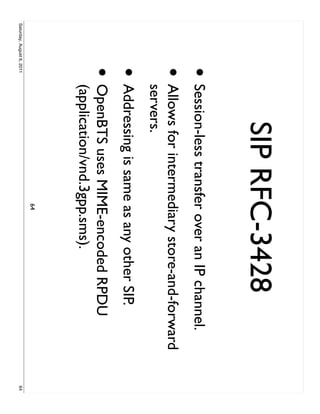
SIP RFC-3428
                     • Session-less transfer over an IP channel.
                     •     Allows for intermediary store-and-forward
                           servers.
                     • Addressing is same as any other SIP.
                     •     OpenBTS uses MIME-encoded RPDU
                           (application/vnd.3gpp.sms).
                                             64
Saturday, August 6, 2011                                               64
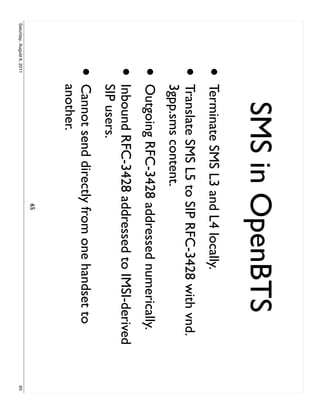
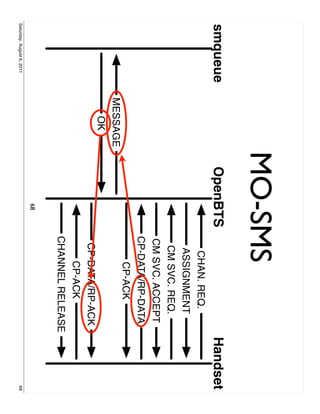
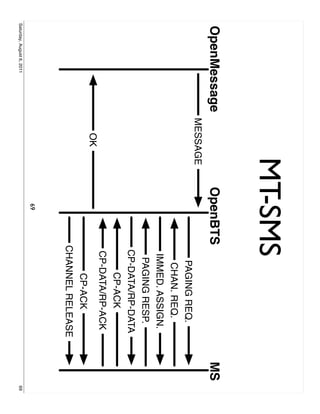
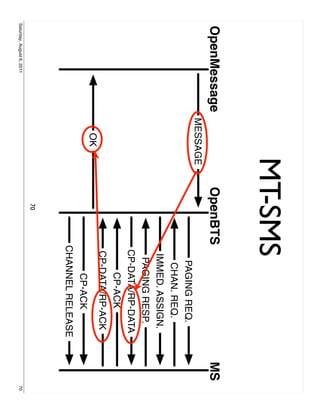
SMS in OpenBTS
                     •     Terminate SMS L3 and L4 locally.
                     •     Translate SMS L5 to SIP RFC-3428 with vnd.
                           3gpp.sms content.
                     •     Outgoing RFC-3428 addressed numerically.
                     •     Inbound RFC-3428 addressed to IMSI-derived
                           SIP users.
                     •     Cannot send directly from one handset to
                           another.
                                               65
Saturday, August 6, 2011                                                65
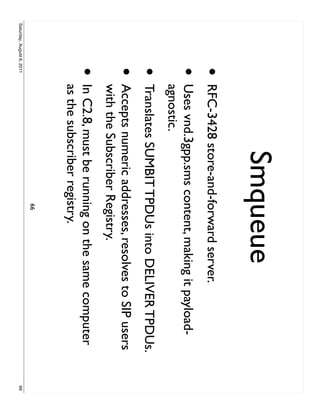
Smqueue
                     •     RFC-3428 store-and-forward server.
                     •     Uses vnd.3gpp.sms content, making it payload-
                           agnostic.
                     •     Translates SUMBIT TPDUs into DELIVER TPDUs.
                     •     Accepts numeric addresses, resolves to SIP users
                           with the Subscriber Registry.
                     •     In C2.8, must be running on the same computer
                           as the subscriber registry.
                                                66
Saturday, August 6, 2011                                                      66
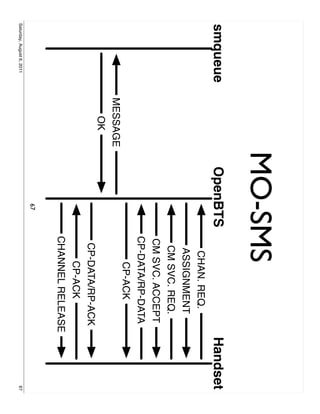
MO-SMS
smqueue                              OpenBTS                     Handset
                                                 CHAN. REQ.
                                                 ASSIGNMENT
                                                CM SVC. REQ.
                                               CM SVC. ACCEPT
                                               CP-DATA/RP-DATA
                                                   CP-ACK
                           MESSAGE
                              OK
                                                CP-DATA/RP-ACK
                                                   CP-ACK
                                               CHANNEL RELEASE
                                         67
Saturday, August 6, 2011                                               67
MO-SMS
smqueue                              OpenBTS                     Handset
                                                 CHAN. REQ.
                                                 ASSIGNMENT
                                                CM SVC. REQ.
                                               CM SVC. ACCEPT
                                               CP-DATA/RP-DATA
                                                   CP-ACK
                           MESSAGE
                              OK
                                                CP-DATA/RP-ACK
                                                   CP-ACK
                                               CHANNEL RELEASE
                                         68
Saturday, August 6, 2011                                               68
MT-SMS
 OpenMessage                         OpenBTS                     MS
                           MESSAGE
                                                  PAGING REQ.
                                                  CHAN. REQ.
                                                IMMED. ASSIGN.
                                                 PAGING RESP.
                                               CP-DATA/RP-DATA
                                                    CP-ACK
                                               CP-DATA/RP-ACK
                             OK
                                                   CP-ACK
                                               CHANNEL RELEASE
                                       69
Saturday, August 6, 2011                                              69
MT-SMS
 OpenMessage                         OpenBTS                     MS
                           MESSAGE
                                                  PAGING REQ.
                                                  CHAN. REQ.
                                                IMMED. ASSIGN.
                                                 PAGING RESP.
                                               CP-DATA/RP-DATA
                                                    CP-ACK
                                               CP-DATA/RP-ACK
                             OK
                                                   CP-ACK
                                               CHANNEL RELEASE
                                       70
Saturday, August 6, 2011                                              70
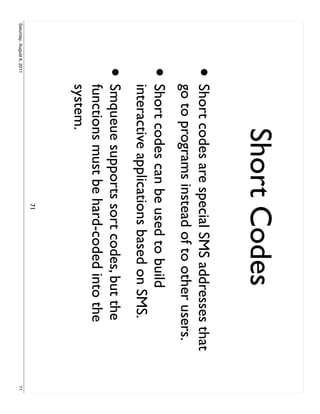
Short Codes
                     •     Short codes are special SMS addresses that
                           go to programs instead of to other users.
                     •     Short codes can be used to build
                           interactive applications based on SMS.
                     •     Smqueue supports sort codes, but the
                           functions must be hard-coded into the
                           system.
                                              71
Saturday, August 6, 2011                                                71
Short Code Example:
                            Auto-Provisioning
                     •     Short code function adds a new SIP user
                           and a new dialplan entry in the Subscriber
                           Registry.
                     •     Can be used for automatic provisioning in
                           some applications.
                     •     Only effective if used with open
                           registration.
                                              72
Saturday, August 6, 2011                                                72
Connecting SMS to the
                         Outside World
                     •     Email gateways
                           •   the return address problem
                     •     SIP RFC-3428 gateways
                           •   the registration problem
                     •     SMPP
                           •   The dual-address problem.
                     •     New trends in combined VoIP services (Voxbone
                           and Voxeo).
                                                   73
Saturday, August 6, 2011                                                   73
Connecting to the
                                PSTN
                                   74
Saturday, August 6, 2011                       74
VoIP Carrier Services
                     •     Route outbound calls to the PSTN
                           (“origination”)
                     •     Lease DID (“direct inbound dialed”) E.164
                           addresses (“telephone numbers”)
                     •     Route inbound calls from PSTN to DIDs
                           (“termination”)
                     • Generate billing records (CDRs)
                                             75
Saturday, August 6, 2011                                               75
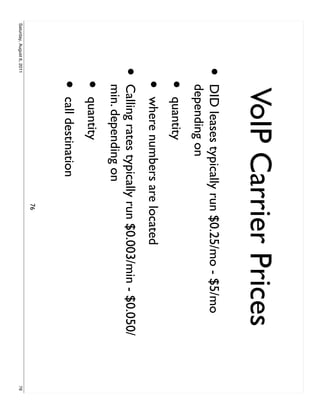
VoIP Carrier Prices
                     •     DID leases typically run $0.25/mo - $5/mo
                           depending on
                           •   quantity
                           •   where numbers are located
                     •     Calling rates typically run $0.003/min - $0.050/
                           min. depending on
                           •   quantity
                           •   call destination
                                                  76
Saturday, August 6, 2011                                                      76
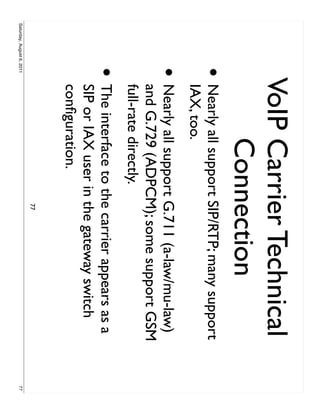
VoIP Carrier Technical
                                Connection
                     •     Nearly all support SIP/RTP; many support
                           IAX, too.
                     •     Nearly all support G.711 (a-law/mu-law)
                           and G.729 (ADPCM); some support GSM
                           full-rate directly.
                     •     The interface to the carrier appears as a
                           SIP or IAX user in the gateway switch
                           configuration.
                                              77
Saturday, August 6, 2011                                               77
Putting It All Together
                                      78
Saturday, August 6, 2011                             78
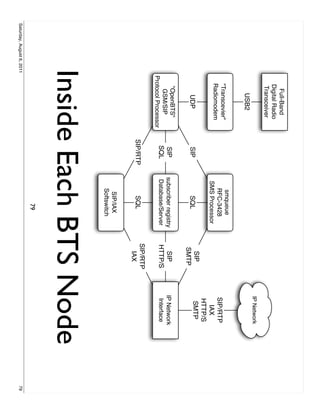
Full-Band
                             Digital Radio
                             Transceiver
                                                                                          IP Network
                                 USB2
                                                             smqueue
                             "Transcevier"
                                                             RFC-3428                     SIP/RTP
                             Radiomodem
                                                           SMS Processor                    IAX
                                                                                          HTTP/S
                                                                                 SIP       SMTP
                                 UDP              SIP           SQL
                                                                                SMTP
                              "OpenBTS"
                                                 SIP      subscriber registry    SIP      IP Network
                                GSM/SIP
                                                 SQL       Database/Server      HTTP/S     Interface
                           Protocol Processor
                                                                                SIP/RTP
                                                SIP/RTP         SQL
                                                                                  IAX
                                                               SIP/IAX
                                                              Softswitch
                      Inside Each BTS Node
                                                                   79
Saturday, August 6, 2011                                                                               79
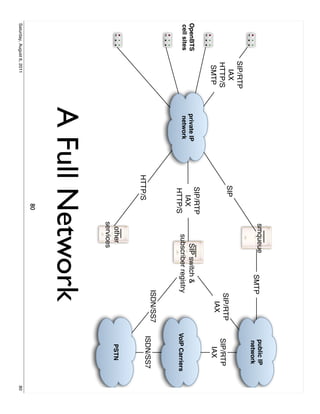
smqueue                              public IP
                                                                       SMTP                 network
                  SIP/RTP
                    IAX                    SIP
                  HTTP/S                                                        SIP/RTP    SIP/RTP
                   SMTP                                                           IAX        IAX
                                           SIP/RTP
OpenBTS                     private IP                      SIP switch &
cell sites                   network
                                             IAX
                                                          subscriber registry             VoIP Carriers
                                           HTTP/S
                                                                            ISDN/SS7
                                                                                          ISDN/SS7
                                         HTTP/S
                                                        other                                PSTN
                                                       services
                            A Full Network
                                                  80
Saturday, August 6, 2011                                                                                  80
Mobility
                              81
Saturday, August 6, 2011              81
Some Confusion
                     •     Handover - The ability to transfer a live
                           call from one cell to another. And in GSM
                           it’s call “handover”, not “handoff”.
                     •     Roaming - The ability to integrate call
                           routing and billing with other carriers.
                     •     Mobility - The ability to transfer service
                           as a handset moves from one cell to
                           another.
                                              82
Saturday, August 6, 2011                                                82
Dependencies
                     •     You need mobility to support handover.
                           •   You do not need handover to support
                               mobility.
                     •     You need mobility to support roaming.
                           •   You do not need handover to support
                               roaming.
                           •   You do not need roaming to support
                               mobility.
                                                83
Saturday, August 6, 2011                                             83
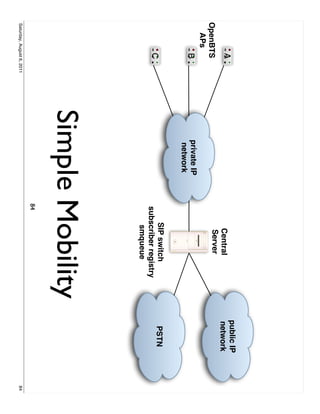
public IP
              A                                Central          network
OpenBTS                                        Server
  APs
              B              private IP
                              network
                                             SIP switch          PSTN
              C                           subscriber registry
                                              smqueue
                           Simple Mobility
                                          84
Saturday, August 6, 2011                                                    84
Good
                     •     Leverages existing dynamic-host support
                           for SIP users.
                     •     SIP core network needs no information
                           about the BTS units.
                     •     RTP traffic can still be shortest-path
                           routing.
                                              85
Saturday, August 6, 2011                                             85
Not So Good
                     •     Handsets must register every time they
                           change cells.
                     • Central server is a central point of failure.
                     • Loss of backhaul shuts down a cell.
                                             86
Saturday, August 6, 2011                                               86
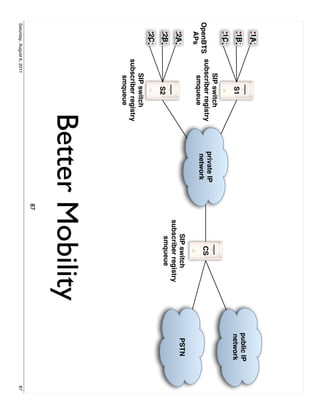
1A
                                                                               public IP
    1B                     S1                                                  network
    1C
           SIP switch
                                       private IP
OpenBTS subscriber registry             network
                                                                CS
  APs       smqueue
    2A                                                      SIP switch          PSTN
                                                         subscriber registry
    2B                                                       smqueue
                           S2
    2C
                    SIP switch
                 subscriber registry
                     smqueue
                                 Better Mobility
                                                    87
Saturday, August 6, 2011                                                                   87

29c3 OpenBTS workshop - Mini-Workshop

  • 1.
    OpenBTS® Mini- Workshop OpenBTS is a registered trademark of Range Networks, Inc. 1 Saturday, August 6, 2011 1
  • 2.
    GSM Basics 2 Saturday, August 6, 2011 2
  • 3.
    GSM History • 1982 - CEPT establishes GSM group • 1987 - Basic parameters selected • 1989 - GSM standardization process moved to ETSI • 1990 - Phase 1 spec frozen • 1992 - First commercial service • 1995 - Phase 2 spec frozen • 2001 - 500M GSM users world-wide • 2009 - Accounts for about 80% of all cellular service • 2011 - 3G UMTS displacing 2G GSM in some places, but all 3G UMTS phones still support 2G GSM 3 Saturday, August 6, 2011 3
  • 4.
    GSM Layers • Layers similar to OSI model. • L1 - physical layer - bits and waveforms • L2 - data link layer - makes the link reliable • L3 - connection management layer - where most of the cellular telephone application happens 4 Saturday, August 6, 2011 4
  • 5.
    Physical Layer (L1) 5 Saturday, August 6, 2011 5
  • 6.
    Cellular Concepts: FDMA • Frequency division multiple access: users on different radio frequencies. • The only MA type in older analog systems. F r e q Time 6 Saturday, August 6, 2011 6
  • 7.
    Cellular Concepts: TDMA • Time division multiple access: users share a channel, using it at different times. • Can be sync or async (802.11). F r e q Time 7 Saturday, August 6, 2011 7
  • 8.
    Cellular Concepts: FDMA and TDMA • GSM is both FDMA and TDMA. • 200 kHz radio channel spacing • 8 timeslots per channel F r e q Time 8 Saturday, August 6, 2011 8
  • 9.
    Timeslots from “GSM for Dummies”, with permission 9 Saturday, August 6, 2011 9
  • 10.
    The “ARFCN” • Absolute Radio Frequency Channel Number • 200 kHz radio channel spacing • 270.833 kHz radio channel bandwidth • Cannot use adjacent ARFCNs in the same cell because they overlap. • Assigned in fixed uplink/downlink pairs. 10 Saturday, August 6, 2011 10
  • 11.
    Frequency Duplexing from “GSM for Dummies”, with permission 11 Saturday, August 6, 2011 11
  • 12.
    Common GSM Bands Name Up Down ARFCNs Regions P-GSM 900 890-915 935-960 1-124 1, 3 E-GSM 900 880-915 925-960 0-125, 1, 3 975-1023 GSM 850 824-849 869-894 128-251 2 DCS 1800 1710-1785 1805-1880 512-885 1, 3 PCS 1900 1850-1910 1930-1990 512-810 2 12 Saturday, August 6, 2011 12
  • 13.
    Duplexing • Handset and BTS cannot transmit on the same frequency at the same time. • TDD - Time Division Duplexing - Handset and BTS time transmissions to avoid conflict. This is cheapest. • FDD - Frequency Division Duplexing - Handset and BTS operate on different frequencies. This requires special RF filters. • GSM is FDD in the BTS, and both FDD and TDD for the handset. 13 Saturday, August 6, 2011 13
  • 14.
    Frequency Duplexing from “GSM for Dummies”, with permission 14 Saturday, August 6, 2011 14
  • 15.
    Frequency Duplexing “Cavity Duplexer” 15 Saturday, August 6, 2011 15
  • 16.
    Timing and Power Control • BTS controls output power level of the handset to maximize battery life and optimize receiver performance. • BTS controls timing advance of the handset to prevent collisions of arriving radio bursts. • This happens on the SACCH. 16 Saturday, August 6, 2011 16
  • 17.
    Link Layer (L2) 17 Saturday, August 6, 2011 17
  • 18.
    The Link Layer • L3 has variable-length messages and assumes reliable delivery. • L1 has fixed-length frames and loses them sometimes. • L2 connects these so that L3 can use L1. 18 Saturday, August 6, 2011 18
  • 19.
    Connection Management Layer (L3) 19 Saturday, August 6, 2011 19
  • 20.
    GSM Layer 3 • This is where things start to look like a telephone system. • Sublayers: • Radio Resource (RR) • Mobility Management (MM) • Call Control (CC) • Short Message Service (SMS) 20 Saturday, August 6, 2011 20
  • 21.
    GSM L3 RR • Radio Resource management. • Assign and release radio channels. • Page handsets for service. • Generate the beacon. • Data elements are descriptions of physical layer parameters. 21 Saturday, August 6, 2011 21
  • 22.
    GSM L3 MM • Mobility Management. • Keep track of what part of the network is serving a given handset. • Authenticate users. • Data elements are subscriber identities and authentication tokens. 22 Saturday, August 6, 2011 22
  • 23.
    GSM L3 CC • Call Control. • Connect the handset to the telephone switch. • Nearly identical to ISDN’s Q.931. • Data elements are phone numbers, call status codes and bearer capability descriptions. 23 Saturday, August 6, 2011 23
  • 24.
    GSM L3 SMS • SMS L3 is just a connection layer for SMS L4. • Just a pass-through. Nothing really happens in SMS until you hit L5. 24 Saturday, August 6, 2011 24
  • 25.
    Addressing in GSM • IMSI: International Subscriber Mobile Identity. A 14- 15-digit number in the SIM that uniquely identifies the subscriber. Encodes identity of issuing carrier, too. • TMSI: Temporary Subscriber Mobile Identity. A 32-bit number assigned by the network that uniquely identifies the subscriber within that network. 25 Saturday, August 6, 2011 25
  • 26.
    Addressing in GSM (cont.) • IMEI: International Mobile Equipment Identity. A 15-digit number that uniquely identifies the handset. Encodes manufacturer and model. Not used much in GSM except for fraud detection. • MSISDN: The subscriber’s telephone number. 26 Saturday, August 6, 2011 26
  • 27.
    Addressing in GSM (cont.) • The MSISDN-IMSI association exists only in the network, not in the handset. • There is no MSISDN-IMEI association. • If a phone is “locked” that usually means that it will accept SIMs only from a specific carrier. 27 Saturday, August 6, 2011 27
  • 28.
    Introduction to VoIP 28 Saturday, August 6, 2011 28
  • 29.
    The Old AnalogPSTN • Phone numbers form an address space, like any other address space. • A phone line’s address is determined by where it is physically connected to the network. • Dialed numbers (“signaling”) are encoded as tones in the audio stream (“in-band signaling”). • The switch decodes signaling to connect completed physical circuits between phones. • “Circuit Switched Telephony” 29 Saturday, August 6, 2011 29
  • 30.
    70’s-era Analog Switch 30 Saturday, August 6, 2011 30
  • 31.
    SS7 • Signaling System 7 (SS7) replaced analog lines with synchronous digital ones, but it’s still circuit-switched. • Signaling and media travel on different logical channels (“out-of-band signaling”). • Telephony is just an application in the SS7 network. • ...so is the GSM core network. • The switch is just a computer, shuffling frames between media channels as instructed by the signaling. • Phone numbers are no longer physical addresses, but entries in a routing database. 31 Saturday, August 6, 2011 31
  • 32.
    Q.931 Call Signaling Subscriber Network Subscriber dials number. SETUP CALL PROCEEDING Remote phone ringing. ALERTING Remote party answers. CONNECT CONNECT ACK Call connected. Subscriber hangs up. DISCONNECT RELEASE RELEASE COMPLETE Dial tone. 32 Saturday, August 6, 2011 32
  • 33.
    VoIP • Replace circuit-switched SS7 with packet-switched IP. • Signaling and media can follow entirely different paths and use entirely different protocols. • Telephony is an application running on the internet. • The switch is just a computer shuffling packets as directed by the signaling. • IP network gives additional layer of addressing. 33 Saturday, August 6, 2011 33
  • 34.
    VoIP Specifics: SIP& RTP • Session Initiation Protocol (SIP), RFC-3261, for signaling. • SIP header design similar to HTTP. • Real-Time Protocol (RTP), RFC-3550, for media. • Both protocols already used internally by many telecom carriers, all renamed “IMS”. 34 Saturday, August 6, 2011 34
  • 35.
    SIP Call Flow Subscriber Network Subscriber dials number. INVITE Trying 100 Remote phone ringing. Ringing 180 Remote party answers. OK 200 ACK Call connected. Subscriber hangs up. BYE ACK Dial tone. 35 Saturday, August 6, 2011 35
  • 36.
    Putting it Together: OpenBTS = GSM + VoIP 36 Saturday, August 6, 2011 36
  • 37.
    OpenBTS Design Principles • Put as little functionality as possible into the GSM-specific software. • Translate protocols to open standards whenever possible. • Exploit external applications whenever possible. 37 Saturday, August 6, 2011 37
  • 38.
    OpenBTS Design Principles • Terminate L3 RR inside OpenBTS to eliminate the need for a BSC. • Translate MM, CC and SMS to SIP and let the VoIP software deal with them. • Most new features will be external modules on socket interfaces. 38 Saturday, August 6, 2011 38
  • 39.
    OpenBTS VoIP Principles • OpenBTS itself is invisible. The VoIP network sees only the phones. • Each handset appears as a SIP endpoint at the IP address of its serving BTS. • Each handset is a SIP user called “IMSIxxxxxxxxxxxxxxxx”, where “xxxxxxxxxxxxxxx” is the IMSI of the SIM in the handset. 39 Saturday, August 6, 2011 39
  • 40.
    Mobile-Originated Call SIP Switch OpenBTS Handset CHAN. REQ. IMMED. ASSIGN. CM SVC. REQ. CM SVC. ACCEPT SETUP INVITE CALL PROCEEDING Status: 100 Trying Status: 182 Ringing Status: 200 OK ALERTING CONNECT CONNECT ACK. RTP traffic GSM traffic 40 Saturday, August 6, 2011 40
  • 41.
    Mobile-Originated Call SIP Switch OpenBTS Handset CHAN. REQ. IMMED. ASSIGN. RR This is where we skip CM SVC. REQ. the encryption step. CM SVC. ACCEPT MM SETUP INVITE CALL PROCEEDING Status: 100 Trying Status: 182 Ringing CC Status: 200 OK ALERTING CONNECT CONNECT ACK. RTP traffic GSM traffic 41 Saturday, August 6, 2011 41
  • 42.
    Mobile-Originated Call SIP Switch OpenBTS Handset CHAN. REQ. IMMED. ASSIGN. CM SVC. REQ. CM SVC. ACCEPT SETUP INVITE CALL PROCEEDING Status: 100 Trying Status: 182 Ringing Status: 200 OK ALERTING CONNECT CONNECT ACK. RTP traffic GSM traffic 42 Saturday, August 6, 2011 42
  • 43.
    Backhaul Loading • GSM FR codec is about 13 kbit/sec/call. • Asterisk can transcode to other codecs ranging from 2.4-64 kbit/sec/call, with varying quality. • Regardless of codec type, RTP overhead is about 17 kbit/sec/call. • IAX overhead is closer to 20 kbit/sec/call, but can be shared across multiple calls. 43 Saturday, August 6, 2011 43
  • 44.
    Backhaul Requirements able 6.1:Backhaul bandwidth for various codec/trunking configurations. All rates in kbit/sec and a ming 20 ms framing. Codec per call per call 7 calls 7 calls speech raw rate over RTP over RTP IAX trunking quality G.711 64 81 567 468 toll-quality GSM-FR 13 30 210 124 toll-quality G.729 8 25 175 97 near-toll-quality Speex 8 25 175 97 near-toll-quality Speex 4 21 147 60 not toll-quality LPC-10 2.4 20 136 37 not toll-quality 44 Saturday, August 6, 2011 44
  • 45.
    Using IAX onVSAT Links IAX IAX OpenBTS APs PSTN SIP/RTP IAX IAX Local T1 Remote SIP/RTP Switch Switch VoIP SIP/RTP VoIP Satellite-Based Site Figure 6.5: Paired OpenSwitch servers for IAX trunking in satellite-based applications. 45 Saturday, August 6, 2011 45
  • 46.
    Subscriber Registry 46 Saturday, August 6, 2011 46
  • 47.
    The Authentication Problem • The IMSI is exposed in many places. • Making a SIM with a controlled IMSI is trivial. 47 Saturday, August 6, 2011 47
  • 48.
    GSM Authentication • Challenge-Response based on shared secret key Ki. • Network generates 128-bit random string (RAND) to send to phone. • Phone encrypts RAND with Ki and a hash function (A3) to produce SRES. • Network performs identical SRES calculation with same RAND, Ki and A3. • Phone returns SRES and network compares results. 48 Saturday, August 6, 2011 48
  • 49.
    Cache-Based Authentication • Can be used in OpenBTS when you don’t know Ki or A3 for a SIM. • Perform RAND-SRES exchange and save the result. • Assume the first exchange is valid and allow access. • Use the same RAND for subsequent exchanges and see if you get the same SRES. • Not full authentication, but better than nothing. 49 Saturday, August 6, 2011 49
  • 50.
    SIM Parameters • To perform RAND-SRES authentication, you must know Ki and the A3 algorithm used by the SIM. • SIMs do not disclose Ki; it is normally known only by the party that issues the SIM. • A3 is usually a variant of COMP-128; the current industry standard is v3. • To perform full authentication you must by able to issue SIMs and have the software to implement the A3 in those SIMs. 50 Saturday, August 6, 2011 50
  • 51.
    Subscriber Registry • “Realtime” Asterisk using external databases. • Core is an sqlite3 database file, /var/lib/ asterisk/sqlite3dir/sqlite3.db. • HTTP interface for remote access. • SIP interface for registration. • Caching Behavior. 51 Saturday, August 6, 2011 51
  • 52.
    Subscriber Registry sip_buddies Table • Based on pre-existing Asterisk “sip-buddies” schema with extra per-subscriber fields: • Ki, the SIM secret key for this subscriber • RAND, SRES, the most recent challenge- response pair used with this subscriber • a3a8, the A3/A8 algorithm to be used with this subscriber 52 Saturday, August 6, 2011 52
  • 53.
    Subscriber Registry dialdata_table • Used by Asterisk dialplan for realtime number resolution. • A simple IMSI-number mapping. • Calls to unresolvable numbers get passed up to a higher-level switch. 53 Saturday, August 6, 2011 53
  • 54.
    SR RAND-SRES Authentication via SIP • SIP Interface; follows form of RFC-2543 Section 14, using • RAND as the nonce • A3 instead of MD5 • SRES as the response 54 Saturday, August 6, 2011 54
  • 55.
    SIP-Style Authentication MS OpenBTS Registry CHAN. REQ. IMMED. ASSIGN. LOC. UPDATE REQ. REGISTER 401 Unauthorized AUTH. REQ. AUTH. RESP. REGISTER 200 OK LOC. UPDATE ACCEPT CHAN. REL. 55 Saturday, August 6, 2011 55
  • 56.
    SR Authentication via HTTP • HTTP Interface • Ad hoc but easy to implement • Send IMSI in URL, get RAND result. • Send IMSI, RAND and SRES in URL, get success/failure result. 56 Saturday, August 6, 2011 56
  • 57.
    HTTP-Based Authentication MS OpenBTS Registry CHAN. REQ. IMMED. ASSIGN. LOC. UPDATE REQ. HTTP GET 200 OK AUTH. REQ. AUTH. RESP. HTTP GET 200 OK LOC. UPDATE ACCEPT CHAN. REL. 57 Saturday, August 6, 2011 57
  • 58.
    Generating SIMs • For full authentication, you must know Ki. • The only way to know Ki is to put it there yourself. • Programmable SIMs with write-only Ki records! • SIM-programming SW writes new entries directly in to SR database. 58 Saturday, August 6, 2011 58
  • 59.
    SIM Security • COMP128 and cracking • SIM protection • COMP128v3 • Fraud detection 59 Saturday, August 6, 2011 59
  • 60.
    Network Security • SR caching makes isolated nodes robust. • SR caching also moves a lot of sensitive information around the network. • Securing the backhaul is critical. 60 Saturday, August 6, 2011 60
  • 61.
    Subscriber Security • C2.8 generates TMSIs on a per-BTS basis. • Good: TMSIs not globally significant • Bad: Lots of TMSI reassignments • C2.8 does not support A5/x. Future versions will. • A5/1 export restrictions • A5/2 depreciation 61 Saturday, August 6, 2011 61
  • 62.
    SMS Text Messaging 62 Saturday, August 6, 2011 62
  • 63.
    GSM SMS • Session-less transfer over Dm channel. • Address is ISDN/E.164 or e-mail. • Maximum payload is 140 bytes, 160 characters in GSM 7-bit alphabet. • SMSC acts as a store-and-forward server, since handsets are only intermittently connected. • SMS defined in 5 layers on Um, but 2 of them are just relays. 63 Saturday, August 6, 2011 63
  • 64.
    SIP RFC-3428 • Session-less transfer over an IP channel. • Allows for intermediary store-and-forward servers. • Addressing is same as any other SIP. • OpenBTS uses MIME-encoded RPDU (application/vnd.3gpp.sms). 64 Saturday, August 6, 2011 64
  • 65.
    SMS in OpenBTS • Terminate SMS L3 and L4 locally. • Translate SMS L5 to SIP RFC-3428 with vnd. 3gpp.sms content. • Outgoing RFC-3428 addressed numerically. • Inbound RFC-3428 addressed to IMSI-derived SIP users. • Cannot send directly from one handset to another. 65 Saturday, August 6, 2011 65
  • 66.
    Smqueue • RFC-3428 store-and-forward server. • Uses vnd.3gpp.sms content, making it payload- agnostic. • Translates SUMBIT TPDUs into DELIVER TPDUs. • Accepts numeric addresses, resolves to SIP users with the Subscriber Registry. • In C2.8, must be running on the same computer as the subscriber registry. 66 Saturday, August 6, 2011 66
  • 67.
    MO-SMS smqueue OpenBTS Handset CHAN. REQ. ASSIGNMENT CM SVC. REQ. CM SVC. ACCEPT CP-DATA/RP-DATA CP-ACK MESSAGE OK CP-DATA/RP-ACK CP-ACK CHANNEL RELEASE 67 Saturday, August 6, 2011 67
  • 68.
    MO-SMS smqueue OpenBTS Handset CHAN. REQ. ASSIGNMENT CM SVC. REQ. CM SVC. ACCEPT CP-DATA/RP-DATA CP-ACK MESSAGE OK CP-DATA/RP-ACK CP-ACK CHANNEL RELEASE 68 Saturday, August 6, 2011 68
  • 69.
    MT-SMS OpenMessage OpenBTS MS MESSAGE PAGING REQ. CHAN. REQ. IMMED. ASSIGN. PAGING RESP. CP-DATA/RP-DATA CP-ACK CP-DATA/RP-ACK OK CP-ACK CHANNEL RELEASE 69 Saturday, August 6, 2011 69
  • 70.
    MT-SMS OpenMessage OpenBTS MS MESSAGE PAGING REQ. CHAN. REQ. IMMED. ASSIGN. PAGING RESP. CP-DATA/RP-DATA CP-ACK CP-DATA/RP-ACK OK CP-ACK CHANNEL RELEASE 70 Saturday, August 6, 2011 70
  • 71.
    Short Codes • Short codes are special SMS addresses that go to programs instead of to other users. • Short codes can be used to build interactive applications based on SMS. • Smqueue supports sort codes, but the functions must be hard-coded into the system. 71 Saturday, August 6, 2011 71
  • 72.
    Short Code Example: Auto-Provisioning • Short code function adds a new SIP user and a new dialplan entry in the Subscriber Registry. • Can be used for automatic provisioning in some applications. • Only effective if used with open registration. 72 Saturday, August 6, 2011 72
  • 73.
    Connecting SMS tothe Outside World • Email gateways • the return address problem • SIP RFC-3428 gateways • the registration problem • SMPP • The dual-address problem. • New trends in combined VoIP services (Voxbone and Voxeo). 73 Saturday, August 6, 2011 73
  • 74.
    Connecting to the PSTN 74 Saturday, August 6, 2011 74
  • 75.
    VoIP Carrier Services • Route outbound calls to the PSTN (“origination”) • Lease DID (“direct inbound dialed”) E.164 addresses (“telephone numbers”) • Route inbound calls from PSTN to DIDs (“termination”) • Generate billing records (CDRs) 75 Saturday, August 6, 2011 75
  • 76.
    VoIP Carrier Prices • DID leases typically run $0.25/mo - $5/mo depending on • quantity • where numbers are located • Calling rates typically run $0.003/min - $0.050/ min. depending on • quantity • call destination 76 Saturday, August 6, 2011 76
  • 77.
    VoIP Carrier Technical Connection • Nearly all support SIP/RTP; many support IAX, too. • Nearly all support G.711 (a-law/mu-law) and G.729 (ADPCM); some support GSM full-rate directly. • The interface to the carrier appears as a SIP or IAX user in the gateway switch configuration. 77 Saturday, August 6, 2011 77
  • 78.
    Putting It AllTogether 78 Saturday, August 6, 2011 78
  • 79.
    Full-Band Digital Radio Transceiver IP Network USB2 smqueue "Transcevier" RFC-3428 SIP/RTP Radiomodem SMS Processor IAX HTTP/S SIP SMTP UDP SIP SQL SMTP "OpenBTS" SIP subscriber registry SIP IP Network GSM/SIP SQL Database/Server HTTP/S Interface Protocol Processor SIP/RTP SIP/RTP SQL IAX SIP/IAX Softswitch Inside Each BTS Node 79 Saturday, August 6, 2011 79
  • 80.
    smqueue public IP SMTP network SIP/RTP IAX SIP HTTP/S SIP/RTP SIP/RTP SMTP IAX IAX SIP/RTP OpenBTS private IP SIP switch & cell sites network IAX subscriber registry VoIP Carriers HTTP/S ISDN/SS7 ISDN/SS7 HTTP/S other PSTN services A Full Network 80 Saturday, August 6, 2011 80
  • 81.
    Mobility 81 Saturday, August 6, 2011 81
  • 82.
    Some Confusion • Handover - The ability to transfer a live call from one cell to another. And in GSM it’s call “handover”, not “handoff”. • Roaming - The ability to integrate call routing and billing with other carriers. • Mobility - The ability to transfer service as a handset moves from one cell to another. 82 Saturday, August 6, 2011 82
  • 83.
    Dependencies • You need mobility to support handover. • You do not need handover to support mobility. • You need mobility to support roaming. • You do not need handover to support roaming. • You do not need roaming to support mobility. 83 Saturday, August 6, 2011 83
  • 84.
    public IP A Central network OpenBTS Server APs B private IP network SIP switch PSTN C subscriber registry smqueue Simple Mobility 84 Saturday, August 6, 2011 84
  • 85.
    Good • Leverages existing dynamic-host support for SIP users. • SIP core network needs no information about the BTS units. • RTP traffic can still be shortest-path routing. 85 Saturday, August 6, 2011 85
  • 86.
    Not So Good • Handsets must register every time they change cells. • Central server is a central point of failure. • Loss of backhaul shuts down a cell. 86 Saturday, August 6, 2011 86
  • 87.
    1A public IP 1B S1 network 1C SIP switch private IP OpenBTS subscriber registry network CS APs smqueue 2A SIP switch PSTN subscriber registry 2B smqueue S2 2C SIP switch subscriber registry smqueue Better Mobility 87 Saturday, August 6, 2011 87