Case study
• A 35-year-old man is brought to the Ebola screening
center in juba teaching hospital with a 3-day history of
diarrhea, vomiting, and fever. He reports that he
attended the funeral of a family member who died from
bleeding 2 weeks ago. He developed dysphagia and
hiccups 24 hours ago, but had been eating normally
until then. He has no symptoms of bleeding. On exam,
he is found to have mild conjunctival injection, a faint
maculopapular rash over his trunk, mild epigastric
tenderness, and hepatomegaly. His vital signs on
admission are a temperature of 101.5°F (38.3°C), heart
rate 100 bpm, blood pressure 115/62 mmHg, respiratory
rate 25 breaths per minute, and oxygen saturation 99%.
• What is your differential diagnose?
• What was the causes of the disease?
• How will you manage?
EBOLA VIRUS PRESENTATION
• BY TUTOR : HUEIDA HASHIM
• LOCATION : JUBA TEACHING HOSPITAL ( CPS/ JUBA)
• TARGET GROUP : 20 CLINICAL OFFICERS
• DATE : Wednesday 28th JUN. 2023
• TIME ALOCATED : 90 MINS.
• Meeting link :
https://echo.zoom.us/j/82439141995?pwd=RzA2dklwZ
0x4NXZhZVBxSHVoM3cvZz09
• Meeting ID & password :Meeting ID: 824 3914 1995
Password: 665048
Ebola virus disease
Competency:
Ability to identify the suspected cases of Ebola virus disease .
Objectives:
• Define Ebola virus disease
• State the causes of Ebola virus disease
• Outline the clinical features of Ebola virus disease
• Describe the various management processes of Ebola virus
disease
What is Ebola virus ?
Definition
Ebola virus is complex zoonosis that highly virulent (infectious) in human.
Ebola Virus Disease (earlier known as Ebola hemorrhagic fever) is a
severe, often fatal disease in humans and nonhuman primates (such as
monkeys, gorillas, and chimpanzees).
Ebola disease is the term for a group of deadly diseases in people caused
by four ebolaviruses within the genus Ebolavirus. There are occasional
Ebola disease outbreaks in people, occurring primarily on the African
continent.
•What are the causes of
Ebola virus diseases?
Etiology of Ebolavirus
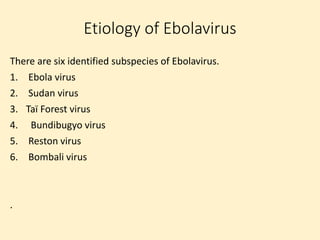
There are six identified subspecies of Ebolavirus.
1. Ebola virus
2. Sudan virus
3. Taï Forest virus
4. Bundibugyo virus
5. Reston virus
6. Bombali virus
.
The name of each of the four ebolaviruses that cause illness
with their associated viral species and disease name:
Human
1- Ebola virus (species Zaire ebolavirus) causes Ebola virus
disease
2- Sudan virus (species Sudan ebolavirus) causes Sudan virus
disease
3- Taï Forest virus (species Taï Forest ebolavirus, formerly Côte
d’Ivoire ebolavirus) causes Taï Forest virus disease
4- Bundibugyo virus (species Bundibugyo ebolavirus) causes
Bundibugyo virus disease
There are two additional ebolaviruses that are not known to
cause disease in people.
Non human
• Reston virus (species Reston ebolavirus) is known to cause
illness in nonhuman primates and pigs, but not in people.
• Bombali virus (species Bombali ebolavirus) was recently
identified in bats, but it is unknown if it causes illness in either
animals or people.
Etiology
The first Ebolavirus species was discovered in 1976 in the Democratic
Republic of Congo near the Ebola River , in (1976 -2012) about 24
outbreaks have appeared sporadically mostly in Central African
countries of Democratic Republic of the Congo (DRC),Gabon, South
Sudan, Ivory Coast, and Uganda
The current outbreak is in west Africa involving countries of Guinea,
Liberia, Sierra Leone and Nigeria (as on 6th August 2014).
The present outbreak in West Africa is by the Zaire ebolavirus
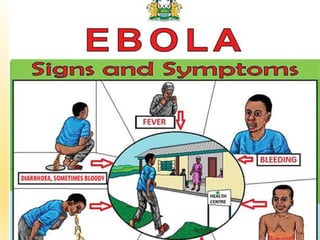
What are signs &
symptoms of Ebola
virus ?
suspected case vs
Confirmed case
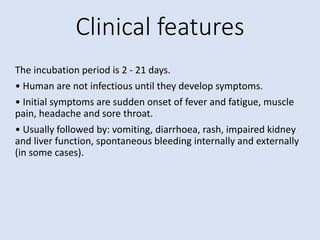
Clinical features
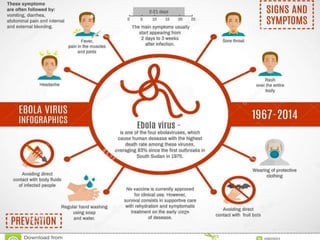
The incubation period is 2 - 21 days.
• Human are not infectious until they develop symptoms.
• Initial symptoms are sudden onset of fever and fatigue, muscle
pain, headache and sore throat.
• Usually followed by: vomiting, diarrhoea, rash, impaired kidney
and liver function, spontaneous bleeding internally and externally
(in some cases).
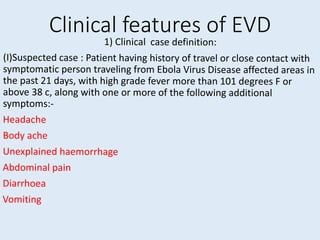
Clinical features of EVD
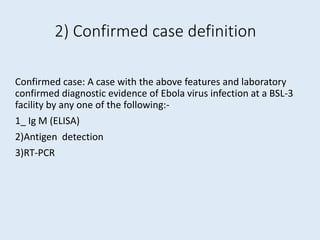
2) Confirmed case definition
Confirmed case: A case with the above features and laboratory
confirmed diagnostic evidence of Ebola virus infection at a BSL-3
facility by any one of the following:-
1_ Ig M (ELISA)
2)Antigen detection
3)RT-PCR
•How do clinical offers
help in management of
Ebola virus diseases in
PHCC?
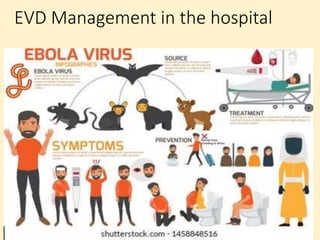
EVD Management in the hospital
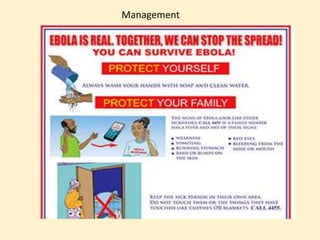
Management
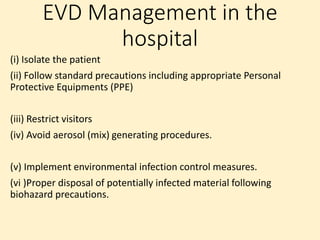
EVD Management in the
hospital
(i) Isolate the patient
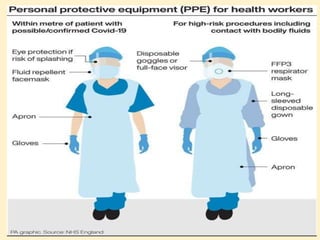
(ii) Follow standard precautions including appropriate Personal
Protective Equipments (PPE)
(iii) Restrict visitors
(iv) Avoid aerosol (mix) generating procedures.
(v) Implement environmental infection control measures.
(vi )Proper disposal of potentially infected material following
biohazard precautions.
Treatment of patients with suspected or
confirmed EVD
1- Treatment of patients in ECU/CCC follows a ‘syndromic approach’,
which means an approach based on patients’ symptoms and signs.
Principles of treatment in ECUs/CCCs(emergence care units/critical
condition centure)
2- Provide basic care such as food and water. If a patient cannot eat or
drink, help them to take frequent small If it is difficult to access safe
water, tea, soup, rice water or any locally preferred drink (not alcohol)
can be provided.
3- Patients with fever, especially those with diarrhoea and vomiting,
should be encouraged to drink fluids and as much oral rehydration
solution (ORS) as can be tolerated.
Oral rehydration is the mainstay of EVD treatment for patents
suffering from severe gastro-intestinal symptoms such as nausea,
vomiting and diarrhea. Frequent watery diarrhoea is the hallmark of
the ongoing EVD outbreak which causes severe dehydration and
results in kidney dysfunction, hypovolemic shock and multi organ
failure.
Reports from ETCs suggest successful rehydration can greatly
increase a patient’s chance of survival. More information about
rehydration by a special hydration formula developed.
4- Malaria treatment should be provided to all patents with fever, in
accordance with national guidelines
5- Medicines to control symptoms can be given orally, as described in
the ‘managing symptoms’. Injections increase the risk of staff
infection, and can be given only if appropriately trained staff are
assigned to the ECU/CCC.
6- If sufficient oversight (such as a trained nurse) is available, oral
antibiotics may be given to treat apparent bacteria infections such as
bacterial pneumonia or bacterial enteritis.
7- Take and record the patient’s temperature once per shift with a
calibrated infrared thermometer.
Summary
Ebola Virus Disease (earlier known as Ebola hemorrhagic
fever) is a severe, often fatal disease in humans and
nonhuman primates
suspected case present with history of been in epidemic
area, high fever vomiting ,diarrhea and unexplained
bleeding.
Management of Ebola virus is syndromic approach and
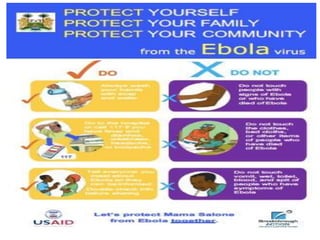
PPE Prevention isolate and avoid direct contact with the
case.
Abbreviation
• ECUs/CCCs (emergence care units/critical condition
centure)
• PPE personal protection equipment
References
Manual for the care and management of
patients inEbola Care Units/Community Care
CentresInterim emergency guidanceJanuary
2015.
Introduction to Ebola diseaseManaging
infectious hazards
WHO Ebola outbreak responsehandbook for
health and safety in the field
eck.org/factsheets/factsheetwhatiseboa/
http://www.science
Uganda Clinical Guidelines 2020 National
Guidelines for Management of Common
Conditions

Ebola virus presentation slides -2.pptx

  • 1.
    Case study • A35-year-old man is brought to the Ebola screening center in juba teaching hospital with a 3-day history of diarrhea, vomiting, and fever. He reports that he attended the funeral of a family member who died from bleeding 2 weeks ago. He developed dysphagia and hiccups 24 hours ago, but had been eating normally until then. He has no symptoms of bleeding. On exam, he is found to have mild conjunctival injection, a faint maculopapular rash over his trunk, mild epigastric tenderness, and hepatomegaly. His vital signs on admission are a temperature of 101.5°F (38.3°C), heart rate 100 bpm, blood pressure 115/62 mmHg, respiratory rate 25 breaths per minute, and oxygen saturation 99%.
  • 2.
    • What isyour differential diagnose? • What was the causes of the disease? • How will you manage?
  • 3.
    EBOLA VIRUS PRESENTATION •BY TUTOR : HUEIDA HASHIM • LOCATION : JUBA TEACHING HOSPITAL ( CPS/ JUBA) • TARGET GROUP : 20 CLINICAL OFFICERS • DATE : Wednesday 28th JUN. 2023 • TIME ALOCATED : 90 MINS. • Meeting link : https://echo.zoom.us/j/82439141995?pwd=RzA2dklwZ 0x4NXZhZVBxSHVoM3cvZz09 • Meeting ID & password :Meeting ID: 824 3914 1995 Password: 665048
  • 4.
    Ebola virus disease Competency: Abilityto identify the suspected cases of Ebola virus disease . Objectives: • Define Ebola virus disease • State the causes of Ebola virus disease • Outline the clinical features of Ebola virus disease • Describe the various management processes of Ebola virus disease
  • 5.
  • 6.
    Definition Ebola virus iscomplex zoonosis that highly virulent (infectious) in human. Ebola Virus Disease (earlier known as Ebola hemorrhagic fever) is a severe, often fatal disease in humans and nonhuman primates (such as monkeys, gorillas, and chimpanzees). Ebola disease is the term for a group of deadly diseases in people caused by four ebolaviruses within the genus Ebolavirus. There are occasional Ebola disease outbreaks in people, occurring primarily on the African continent.
  • 7.
    •What are thecauses of Ebola virus diseases?
  • 8.
    Etiology of Ebolavirus Thereare six identified subspecies of Ebolavirus. 1. Ebola virus 2. Sudan virus 3. Taï Forest virus 4. Bundibugyo virus 5. Reston virus 6. Bombali virus .
  • 9.
    The name ofeach of the four ebolaviruses that cause illness with their associated viral species and disease name: Human 1- Ebola virus (species Zaire ebolavirus) causes Ebola virus disease 2- Sudan virus (species Sudan ebolavirus) causes Sudan virus disease 3- Taï Forest virus (species Taï Forest ebolavirus, formerly Côte d’Ivoire ebolavirus) causes Taï Forest virus disease 4- Bundibugyo virus (species Bundibugyo ebolavirus) causes Bundibugyo virus disease There are two additional ebolaviruses that are not known to cause disease in people. Non human • Reston virus (species Reston ebolavirus) is known to cause illness in nonhuman primates and pigs, but not in people. • Bombali virus (species Bombali ebolavirus) was recently identified in bats, but it is unknown if it causes illness in either animals or people.
  • 10.
    Etiology The first Ebolavirusspecies was discovered in 1976 in the Democratic Republic of Congo near the Ebola River , in (1976 -2012) about 24 outbreaks have appeared sporadically mostly in Central African countries of Democratic Republic of the Congo (DRC),Gabon, South Sudan, Ivory Coast, and Uganda The current outbreak is in west Africa involving countries of Guinea, Liberia, Sierra Leone and Nigeria (as on 6th August 2014). The present outbreak in West Africa is by the Zaire ebolavirus
  • 11.
    What are signs& symptoms of Ebola virus ?
  • 13.
  • 14.
    Clinical features The incubationperiod is 2 - 21 days. • Human are not infectious until they develop symptoms. • Initial symptoms are sudden onset of fever and fatigue, muscle pain, headache and sore throat. • Usually followed by: vomiting, diarrhoea, rash, impaired kidney and liver function, spontaneous bleeding internally and externally (in some cases).
  • 15.
  • 16.
    2) Confirmed casedefinition Confirmed case: A case with the above features and laboratory confirmed diagnostic evidence of Ebola virus infection at a BSL-3 facility by any one of the following:- 1_ Ig M (ELISA) 2)Antigen detection 3)RT-PCR
  • 17.
    •How do clinicaloffers help in management of Ebola virus diseases in PHCC?
  • 18.
    EVD Management inthe hospital
  • 21.
  • 22.
    EVD Management inthe hospital (i) Isolate the patient (ii) Follow standard precautions including appropriate Personal Protective Equipments (PPE) (iii) Restrict visitors (iv) Avoid aerosol (mix) generating procedures. (v) Implement environmental infection control measures. (vi )Proper disposal of potentially infected material following biohazard precautions.
  • 23.
    Treatment of patientswith suspected or confirmed EVD 1- Treatment of patients in ECU/CCC follows a ‘syndromic approach’, which means an approach based on patients’ symptoms and signs. Principles of treatment in ECUs/CCCs(emergence care units/critical condition centure) 2- Provide basic care such as food and water. If a patient cannot eat or drink, help them to take frequent small If it is difficult to access safe water, tea, soup, rice water or any locally preferred drink (not alcohol) can be provided.
  • 24.
    3- Patients withfever, especially those with diarrhoea and vomiting, should be encouraged to drink fluids and as much oral rehydration solution (ORS) as can be tolerated. Oral rehydration is the mainstay of EVD treatment for patents suffering from severe gastro-intestinal symptoms such as nausea, vomiting and diarrhea. Frequent watery diarrhoea is the hallmark of the ongoing EVD outbreak which causes severe dehydration and results in kidney dysfunction, hypovolemic shock and multi organ failure. Reports from ETCs suggest successful rehydration can greatly increase a patient’s chance of survival. More information about rehydration by a special hydration formula developed.
  • 25.
    4- Malaria treatmentshould be provided to all patents with fever, in accordance with national guidelines 5- Medicines to control symptoms can be given orally, as described in the ‘managing symptoms’. Injections increase the risk of staff infection, and can be given only if appropriately trained staff are assigned to the ECU/CCC. 6- If sufficient oversight (such as a trained nurse) is available, oral antibiotics may be given to treat apparent bacteria infections such as bacterial pneumonia or bacterial enteritis. 7- Take and record the patient’s temperature once per shift with a calibrated infrared thermometer.
  • 27.
    Summary Ebola Virus Disease(earlier known as Ebola hemorrhagic fever) is a severe, often fatal disease in humans and nonhuman primates suspected case present with history of been in epidemic area, high fever vomiting ,diarrhea and unexplained bleeding. Management of Ebola virus is syndromic approach and PPE Prevention isolate and avoid direct contact with the case.
  • 28.
    Abbreviation • ECUs/CCCs (emergencecare units/critical condition centure) • PPE personal protection equipment
  • 29.
    References Manual for thecare and management of patients inEbola Care Units/Community Care CentresInterim emergency guidanceJanuary 2015. Introduction to Ebola diseaseManaging infectious hazards WHO Ebola outbreak responsehandbook for health and safety in the field eck.org/factsheets/factsheetwhatiseboa/ http://www.science Uganda Clinical Guidelines 2020 National Guidelines for Management of Common Conditions