Lesson objectives:
1. Introductionlaboratory safety
2. Roles and responsibility of the
employers/employees
3. Describe the hierarchy of controls as it relates to
personal protective equipment.
4. Identify types of personal protective equipment
utilized in general industry
5. Explain personal protective equipment training
requirements.
6. Discuss in brief method for hazard identification
3.
Why does itmatter?
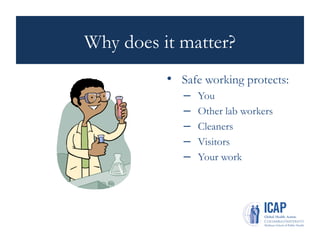
• Safe working protects:
– You
– Other lab workers
– Cleaners
– Visitors
– Your work
4.
Introduction
aboratory safety isthe key to reducing injury and illness.
here are many exposures in the laboratory that pose a hazard to your
health and you may have never considered them as a hazard before.
t is important to have proper training so you, as the employee, are
aware of the potential dangers that may threaten your health or life.
5.
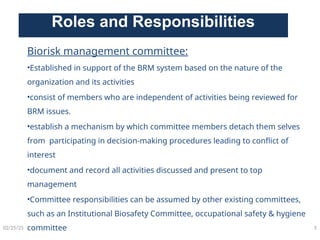
Roles and Responsibilities
Bioriskmanagement committee:
•Established in support of the BRM system based on the nature of the
organization and its activities
•consist of members who are independent of activities being reviewed for
BRM issues.
•establish a mechanism by which committee members detach them selves
from participating in decision-making procedures leading to conflict of
interest
•document and record all activities discussed and present to top
management
•Committee responsibilities can be assumed by other existing committees,
such as an Institutional Biosafety Committee, occupational safety & hygiene
committee
02/25/25 5
6.
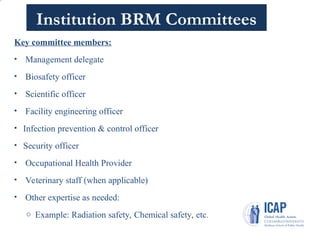
Institution BRM Committees
Keycommittee members:
• Management delegate
• Biosafety officer
• Scientific officer
• Facility engineering officer
• Infection prevention & control officer
• Security officer
• Occupational Health Provider
• Veterinary staff (when applicable)
• Other expertise as needed:
o Example: Radiation safety, Chemical safety, etc.
6
7.
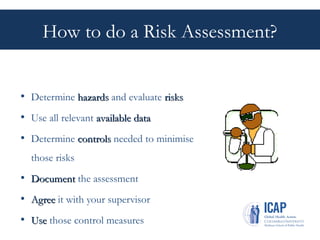
How to doa Risk Assessment?
• Determine hazards
hazards and evaluate risks
risks
• Use all relevant available data
available data
• Determine controls
controls needed to minimise
those risks
• Document
Document the assessment
• Agree
Agree it with your supervisor
• Use
Use those control measures
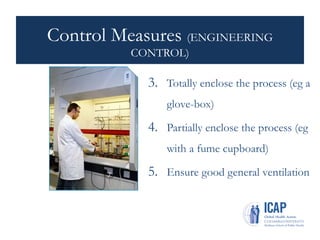
Control Measures (ENGINEERING
CONTROL)
3.Totally enclose the process (eg a
glove-box)
4. Partially enclose the process (eg
with a fume cupboard)
5. Ensure good general ventilation
11.
Control Measures (ADMINISTRATIVE
CONTROL)
6.Safe systems of work
7. Reduce exposure times,
increase distance, reduce
volumes
8. Personal protective equipment
(as a last resort for primary protection)
12.
Safe Practices
These safepractices should be followed to ensure safe working
conditions:
Do not use chipped or cracked glassware
When working with hazardous materials, have a second person
nearby
Know emergency procedures
Keep the laboratory neat and clean
Use hazardous chemicals under a fume hood and biohazardous
materials under a biosafety cabinet (BSC)
Decontaminate as needed
All procedures should be performed to minimize aerosol
13.
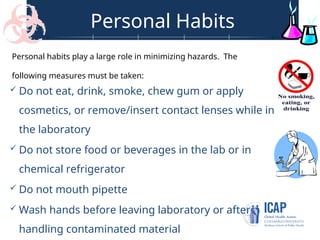
Personal Habits
Donot eat, drink, smoke, chew gum or apply
cosmetics, or remove/insert contact lenses while in
the laboratory
Do not store food or beverages in the lab or in
chemical refrigerator
Do not mouth pipette
Wash hands before leaving laboratory or after
handling contaminated material
Personal habits play a large role in minimizing hazards. The
following measures must be taken:
14.
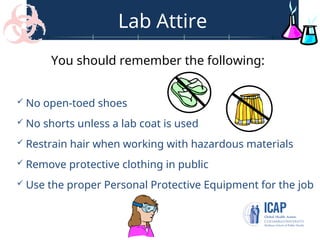
Lab Attire
Noopen-toed shoes
No shorts unless a lab coat is used
Restrain hair when working with hazardous materials
Remove protective clothing in public
Use the proper Personal Protective Equipment for the job
You should remember the following:
15.
PPE
• PPE isall equipment which protects a person against
one or more risks
• It is the last resort in controlling risk
• Blue signs indicate mandatory PPE requirements
• PPE should be:
– Checked before use
– Kept in Good condition (clean/maintained)
– Worn Correctly
– Any defects reported
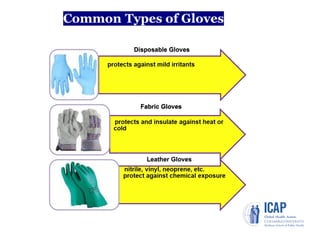
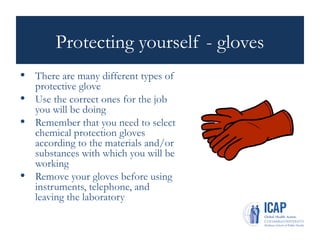
Protecting yourself -gloves
• There are many different types of
protective glove
• Use the correct ones for the job
you will be doing
• Remember that you need to select
chemical protection gloves
according to the materials and/or
substances with which you will be
working
• Remove your gloves before using
instruments, telephone, and
leaving the laboratory
18.
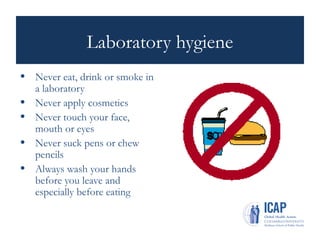
Laboratory hygiene
• Nevereat, drink or smoke in
a laboratory
• Never apply cosmetics
• Never touch your face,
mouth or eyes
• Never suck pens or chew
pencils
• Always wash your hands
before you leave and
especially before eating
What are thegeneral hazards in a
laboratory?
• Fire
• Breakage of glassware
• Sharps
• Spillages
• Pressure equipment & gas cylinders
• Extremes of heat & cold
• Chemical hazards
• Biological hazards
• Radiation
And many more!
And many more!
21.
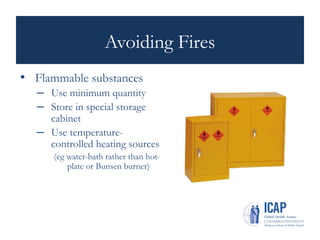
Avoiding Fires
• Flammablesubstances
– Use minimum quantity
– Store in special storage
cabinet
– Use temperature-
controlled heating sources
(eg water-bath rather than hot-
plate or Bunsen burner)
22.
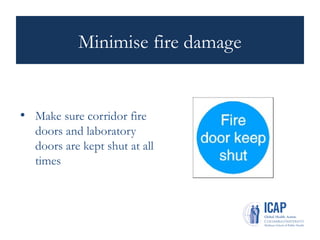
Minimise fire damage
•Make sure corridor fire
doors and laboratory
doors are kept shut at all
times
23.
Fire Safety
• Makesure that you know
what to do:
– If you have a fire
– If you hear a fire alarm
• If you are a member of
staff you must attend fire
training annually. Post
graduates should also
seriously consider doing so.
24.
Spillages
• Clear upspillage promptly
• You will already have
determined how to do this as
part of your risk assessment
• Dispose of any hazardous
material as toxic waste
Messy workers are usually poor
Messy workers are usually poor
workers!!
workers!!
25.
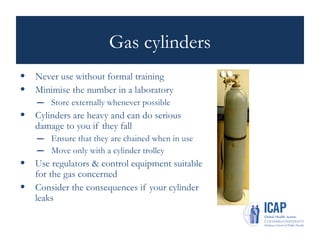
Gas cylinders
• Neveruse without formal training
• Minimise the number in a laboratory
– Store externally whenever possible
• Cylinders are heavy and can do serious
damage to you if they fall
– Ensure that they are chained when in use
– Move only with a cylinder trolley
• Use regulators & control equipment suitable
for the gas concerned
• Consider the consequences if your cylinder
leaks
26.
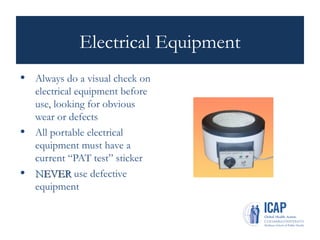
Electrical Equipment
• Alwaysdo a visual check on
electrical equipment before
use, looking for obvious
wear or defects
• All portable electrical
equipment must have a
current “PAT test” sticker
• NEVER
NEVER use defective
equipment
27.
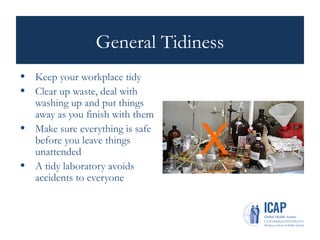
General Tidiness
• Keepyour workplace tidy
• Clear up waste, deal with
washing up and put things
away as you finish with them
• Make sure everything is safe
before you leave things
unattended
• A tidy laboratory avoids
accidents to everyone
X
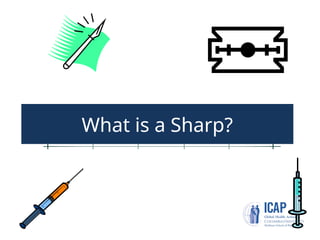
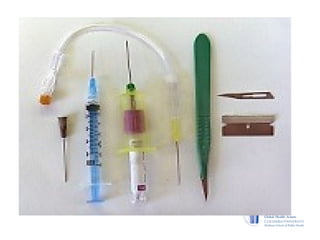
What is a“Sharp”?
A sharp is defined as any instrument, tool, or item that has
rigid, acute edges, protuberances or corners capable of
cutting, piercing, ripping or puncturing such as syringes,
blades, and broken glass. Items that have the potential
for shattering or breaking are also considered sharps.
http://www.ehrs.upenn.edu/training/bloodborne/bloodborne.html
31.
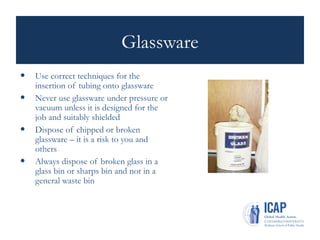
Glassware
• Use correcttechniques for the
insertion of tubing onto glassware
• Never use glassware under pressure or
vacuum unless it is designed for the
job and suitably shielded
• Dispose of chipped or broken
glassware – it is a risk to you and
others
• Always dispose of broken glass in a
glass bin or sharps bin and not in a
general waste bin
32.
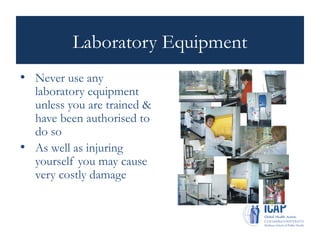
Laboratory Equipment
• Neveruse any
laboratory equipment
unless you are trained &
have been authorised to
do so
• As well as injuring
yourself you may cause
very costly damage
33.
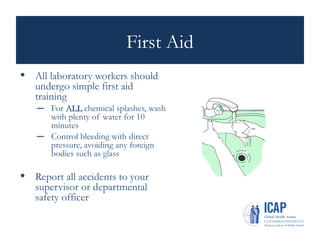
First Aid
• Alllaboratory workers should
undergo simple first aid
training
– For ALL
ALL chemical splashes, wash
with plenty of water for 10
minutes
– Control bleeding with direct
pressure, avoiding any foreign
bodies such as glass
• Report all accidents to your
supervisor or departmental
safety officer
34.
Protecting your health
•If you have an allergy to
lab materials or suffer
from a medical
condition which may
affect you in the
laboratory (eg diabetes
or epilepsy), ensure that
your supervisor knows
35.
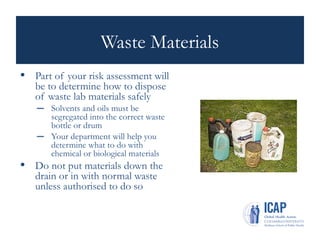
Waste Materials
• Partof your risk assessment will
be to determine how to dispose
of waste lab materials safely
– Solvents and oils must be
segregated into the correct waste
bottle or drum
– Your department will help you
determine what to do with
chemical or biological materials
• Do not put materials down the
drain or in with normal waste
unless authorised to do so
36.
Working outside normalhours and at
weekends
• You will need to attend
training courses and have
permission from your Head
of Department before
working outside normal
hours
• Most experimental work is
not permitted
• Your supervisor will explain
the requirements in more
detail
37.
When in doubt– ASK!!!
• Do not carry out a new
or unfamiliar procedure
until you have been fully
trained & understand
the precautions
necessary for safe
working
• DO NOT GUESS!!!!
DO NOT GUESS!!!!
38.
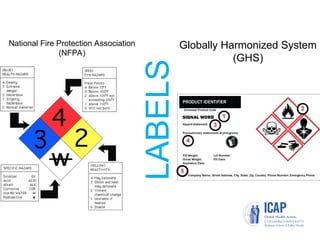
Signs
Signs are away of communicating
important information. It is a way to
heighten awareness about hazards that
exist.
There may be signs on laboratory
refrigerators reminding you that no food or
drink can be stored in it. There may be
radioactive or biological materials that could
possibly be absorbed in food.
There may also be signs which denote that
PPE must be used.
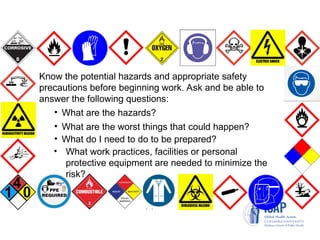
Know the potentialhazards and appropriate safety
precautions before beginning work. Ask and be able to
answer the following questions:
• What are the hazards?
• What are the worst things that could happen?
• What do I need to do to be prepared?
• What work practices, facilities or personal
protective equipment are needed to minimize the
risk?
#2 Objectives:
Describe the hierarchy of controls as it relates to personal protective equipment.
Identify types of personal protective equipment utilized in General Industry
Explain personal protective equipment training requirements.
Explain the responsibilities of the employer regarding personal protective equipment.
Explain the responsibilities of the employee regarding personal protective equipment.
#6 This committee will vary in membership depending on the level of facility. But at all times management should be represented.
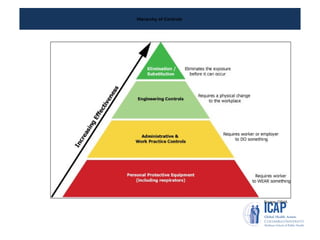
#8 The Hierarchy of Control Methods
Graphic illustrates the effectiveness of the systems used to prevent and control hazards.
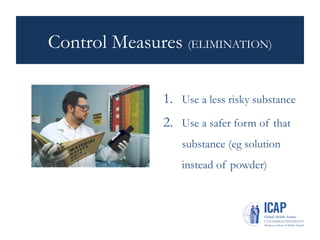
Elimination/substitution
Provides the highest level of protection against hazards.
The hazard is eliminated from the workplace or a safer item/substance is substituted for the more hazardous item/substance.
Engineering controls are the second most effective means of protecting employees from hazards, followed by administrative and work practice controls.
PPE - last resort; it is least effective