Paktia
university
Engineering faculty
Civil engineering
department
Prepared by fazalrahman
rang
Steel
design
Chapter 1: Introduction
 Why Structural Steel
 Structural Design
 Loads
 Building Codes
 Design Specifications
 Structural Steel
 Standard Cross Sectional Shapes
Advantage and disadvantage
of steel structure
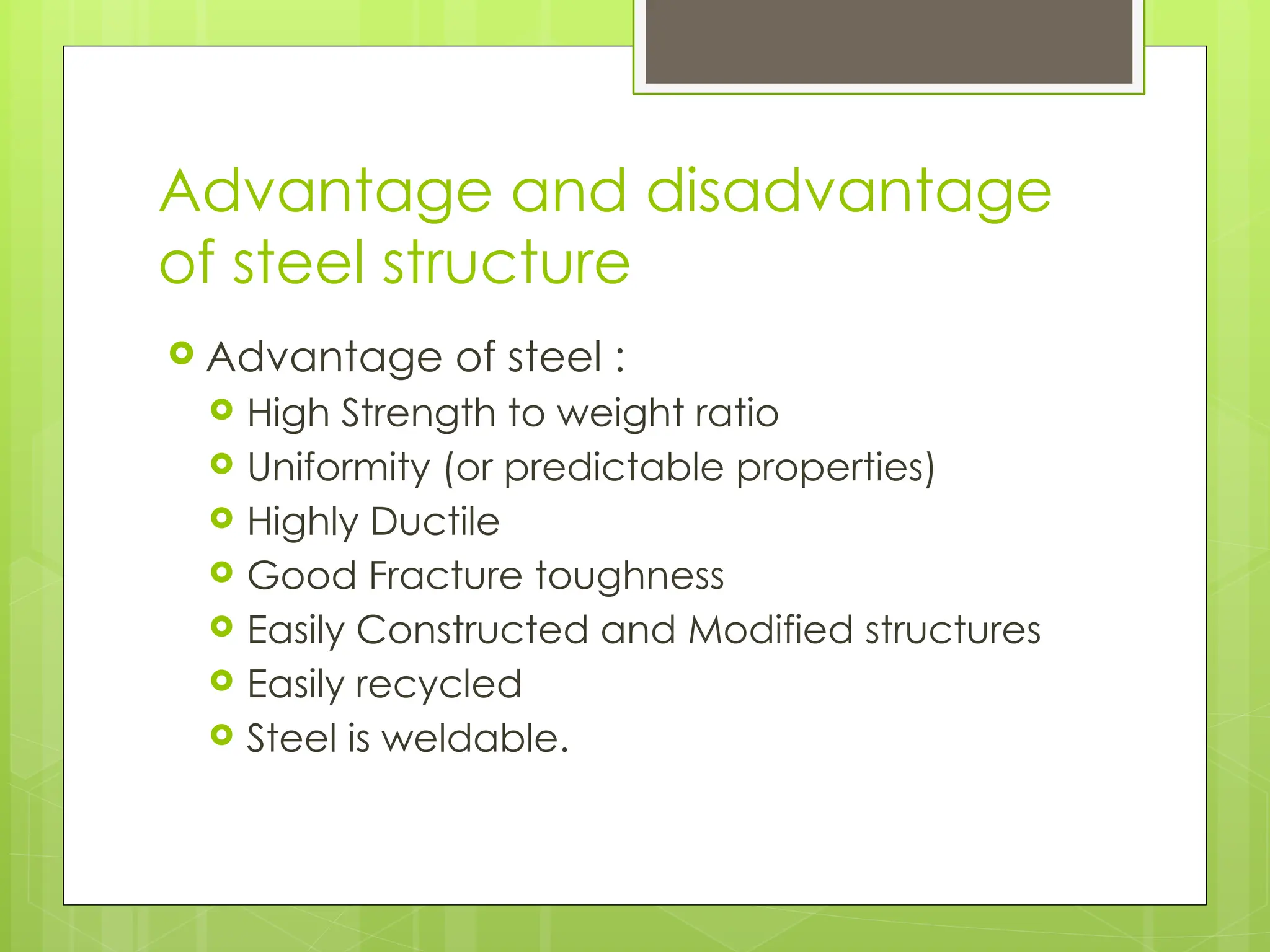
 Advantage of steel :
 High Strength to weight ratio
 Uniformity (or predictable properties)
 Highly Ductile
 Good Fracture toughness
 Easily Constructed and Modified structures
 Easily recycled
 Steel is weldable.
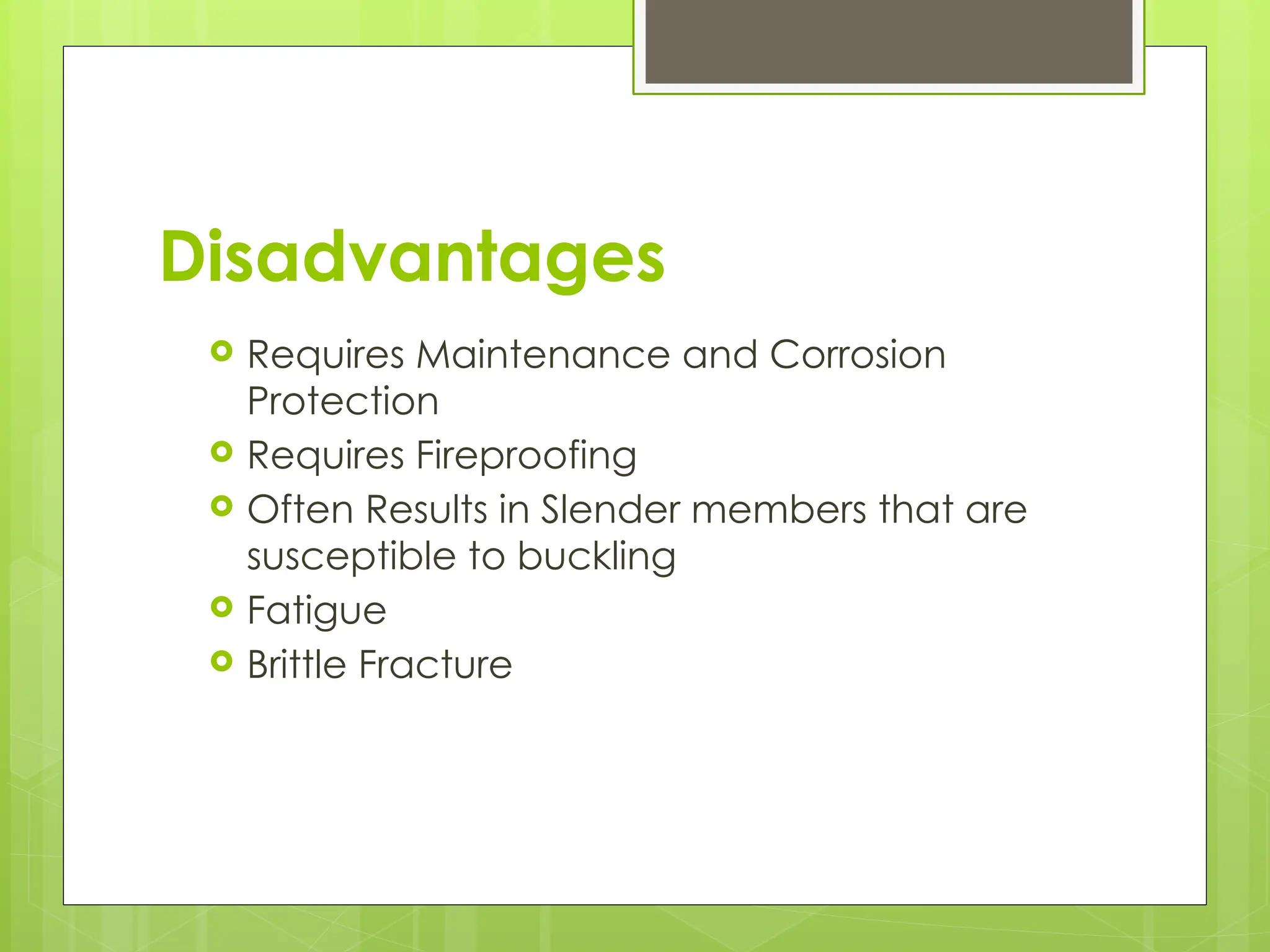
Disadvantages
 Requires Maintenance and Corrosion
Protection
 Requires Fireproofing
 Often Results in Slender members that are
susceptible to buckling
 Fatigue
 Brittle Fracture
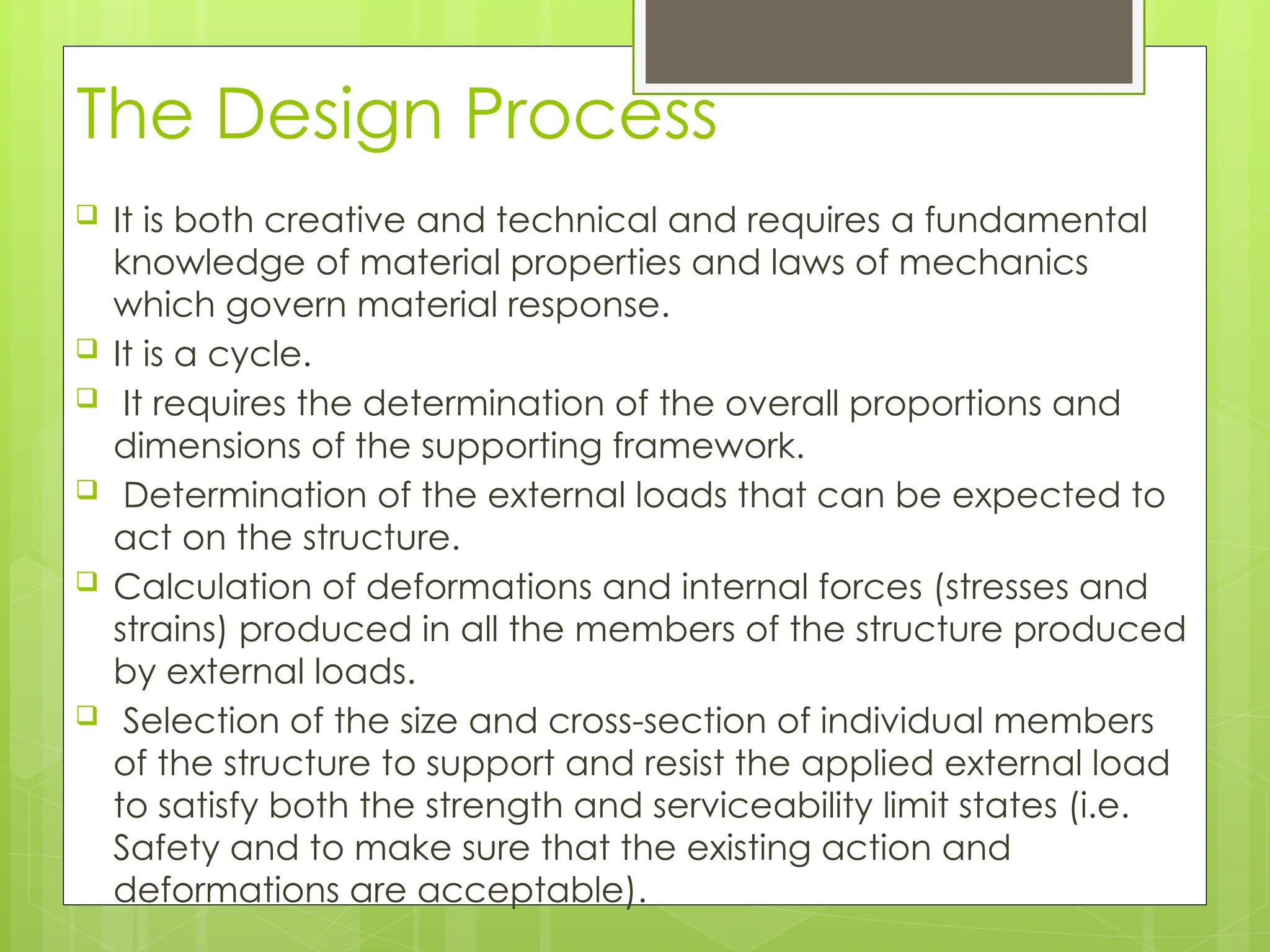
The Design Process
 It is both creative and technical and requires a fundamental
knowledge of material properties and laws of mechanics
which govern material response.
 It is a cycle.
 It requires the determination of the overall proportions and
dimensions of the supporting framework.
 Determination of the external loads that can be expected to
act on the structure.
 Calculation of deformations and internal forces (stresses and
strains) produced in all the members of the structure produced
by external loads.
 Selection of the size and cross-section of individual members
of the structure to support and resist the applied external load
to satisfy both the strength and serviceability limit states (i.e.
Safety and to make sure that the existing action and
deformations are acceptable).
Elements of Design Process
 Selection of the type of structural form to be used and
the material out of which the structure is to be made.
 Determination of the external loads that can be
expected to act on the structure.
 Calculation of the internal forces (actions) and
deformations that are produced in individual
members of the structure by the external loads.
 Determination of the size of the individual members so
that the existing actions and deformations are
acceptable (i.e. satisfy the strength and serviceability
limit states).
Steps of the Design Process
 Identify the Constraints.
 Select form and material.
 Create geometric model of structure.
 Determine loads and load paths.
 Conduct structural analysis.
 Select member size based on limit state
(strength, serviceability, fatigue, etc. )
 Check compliance with code
 If needed, repeat or iterate to solution.
Design Responsibilities
 Safety
– Adequate strength during and after construction
– Resistance to progressive collapse
– Perceived as safe by users
Serviceability
– Deflection control
– Vibration control
 Practicality
– Can it be built as designed
– Reasonable tolerances must be allowed
– Is the construction unreasonably complex or dangerous
Design Responsibilities
 Economy
– Use readily available sections and materials - talk
to suppliers!
– Consider the total cost of the structure:
material and fabrication.
– Use only as many elements as needed – it cost
money to handle each element.
– Use the simplest details that are appropriate and
take advantage of repetition
Loads
Loads: Loads are forces that act on a
structure.
 Loads must be determined before
designing a structure.
 Applied loads can either be :
 Static (gravity type loads)
 Dynamic (earthquake type loads, due to
inertia of the mass of structure).
Loads
 Common Types of loads:
 Dead Loads - stationary loads of constant
magnitude (caused by the weight of the
structure).
 Live Loads - moving loads or loads that vary in
magnitude (people, furniture, vehicles, etc.).
 Wind Loads
 Snow Loads
 Earthquake Loads
Loads
 Other Types of loads:
 Hydrostatic
 Soil Pressure
 Blast
 Temperature Changes
 Differential Settlement of the Foundations
 Moving loads (moving trucks on highway
bridges)
Building Codes
 Are legislative documents that make the model
specifications “legal” requirements, regulating
building construction.
 Establish the minimum acceptable requirements
for preserving the public safety and welfare in a
built environment.
 Adopted by Government Legislative Authorities
for Buildings Within Their Jurisdiction.
 Applies to New Construction, rehab or alteration.
Model Building Codes
 Uniform Building Code (UBC-1997): by the
International Conference of Building Officials, ICBO.
 National Building Code (NBC-1999): by the Building
Officials and Code Administrators, BOCA.
 Standard Building Code (SBC-1999): by the Southern
Building Code Congress International, SBCCI.
 International Building Code (IBC-2012): by the
International Code Council
 ASCE 7-10 load provisions.
Design Specifications
 Give more specific guidance for the design of
structural members and their connections.
 Are recommendations of good practice
based on the accepted body of knowledge.
1. American Institute of Steel Construction (AISC):
2. American Association of State Highway and
Transportation Officials (AASHTO):
3. American Railway Engineering and
Maintenance-of-Way Association (AREMA):
4. American Iron and Steel Institute (AISI):
Structural Steel
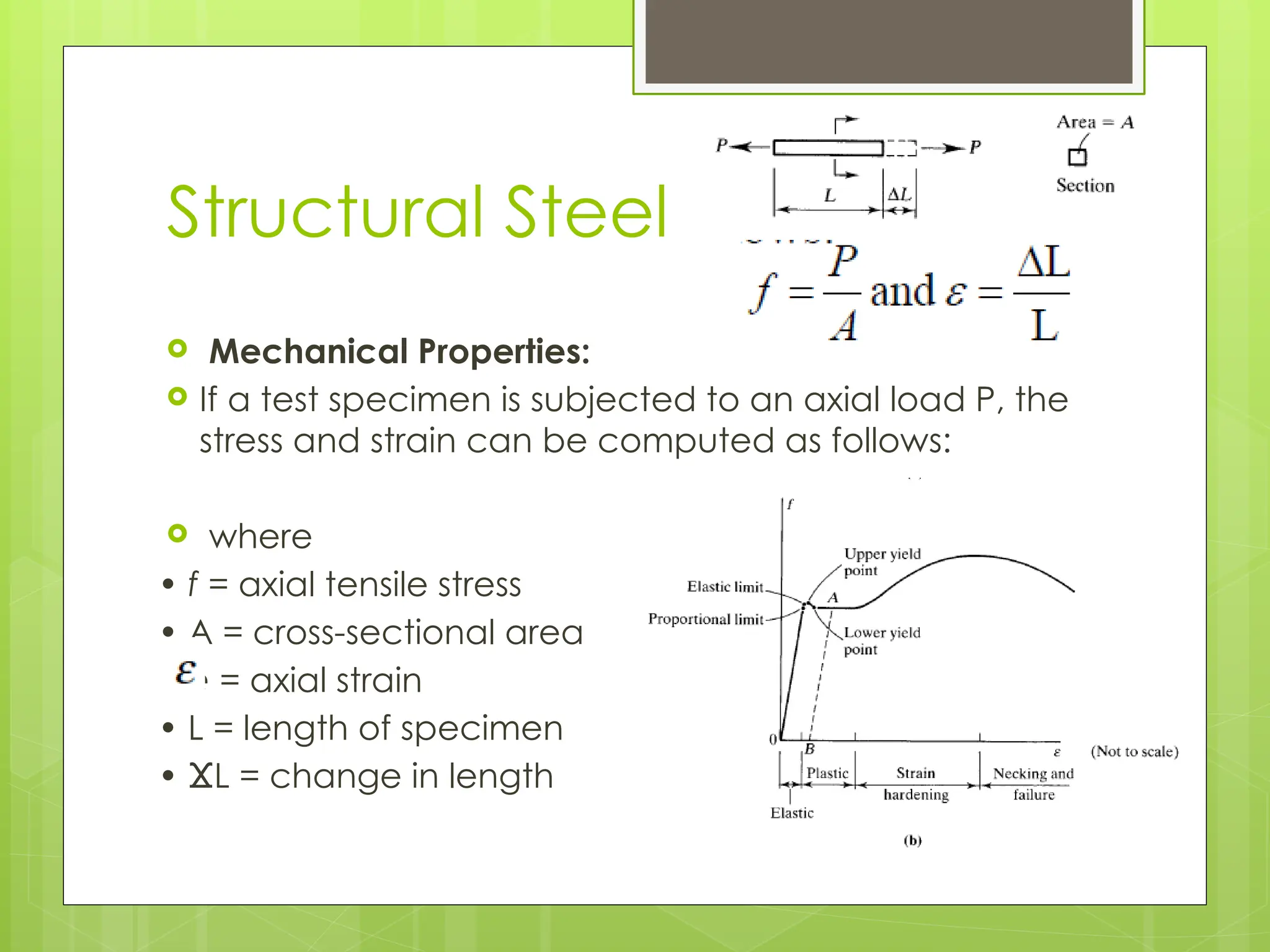
 Mechanical Properties:
 If a test specimen is subjected to an axial load P, the
stress and strain can be computed as follows:
 where
• f = axial tensile stress
• A = cross-sectional area
• e = axial strain
• L = length of specimen
• L = change in length
Ϫ
Structural Steel
 Material Properties:
 Steel is an alloy made by combining molten iron with other
elements to obtain specific properties.
 Carbon is the main strengthening element in steel. However,
increased carbon content can reduce ductility, toughness
and weldability.
 Chromium and copper both increase resistance to
atmospheric corrosion, and are used in weathering steels.
Weathering steels form a protective oxide film on the
surface early on, which will help protect the remainder of
the steel.
 Sulfur has an undesirable effect on surface quality, ductility,
toughness and weldability. However, sulfur improves
machinability.
 Manganese can control the harmful effects of sulfur. It also
increases hardness and strength (but not as much as
carbon).
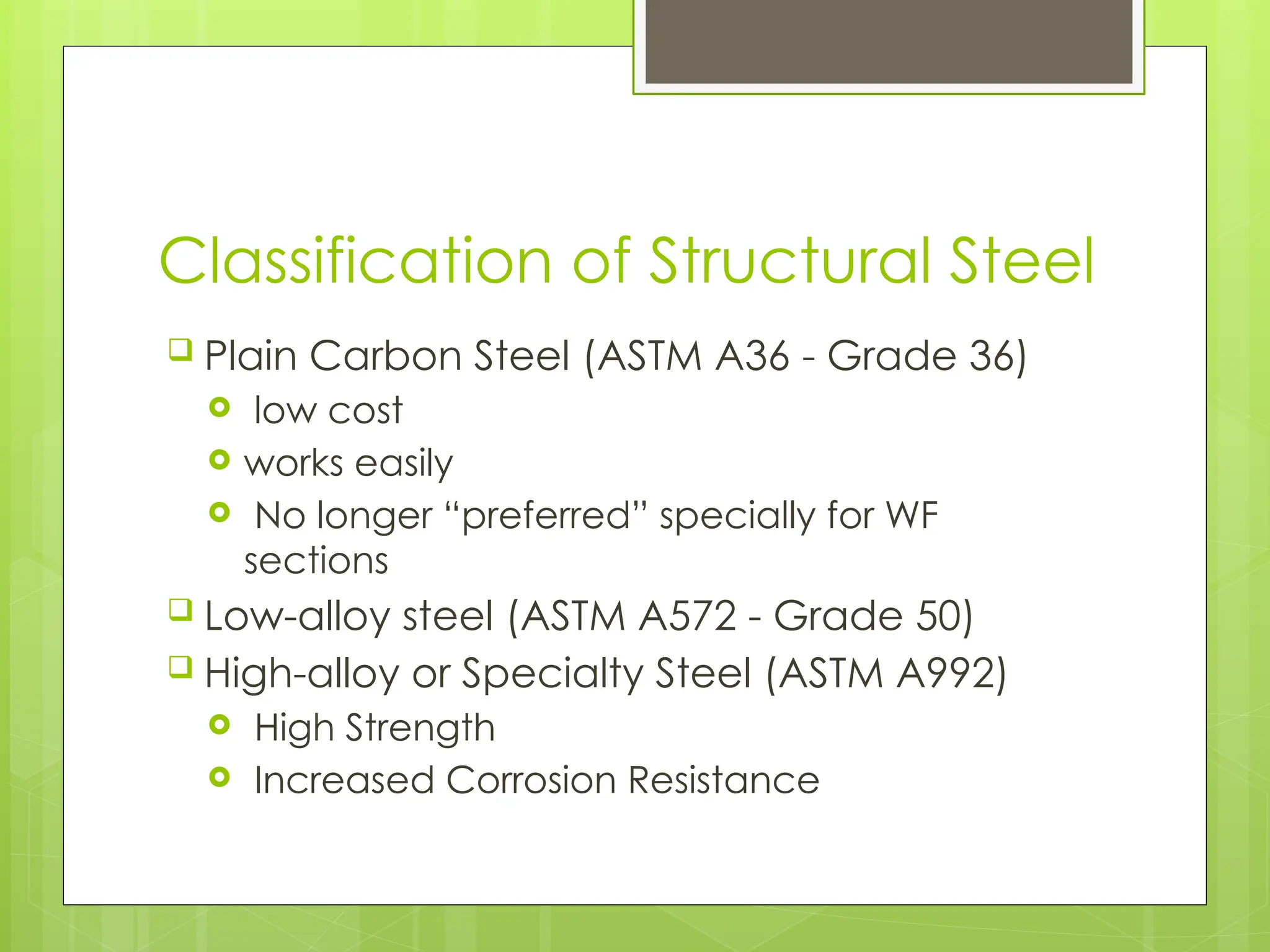
Classification of Structural Steel
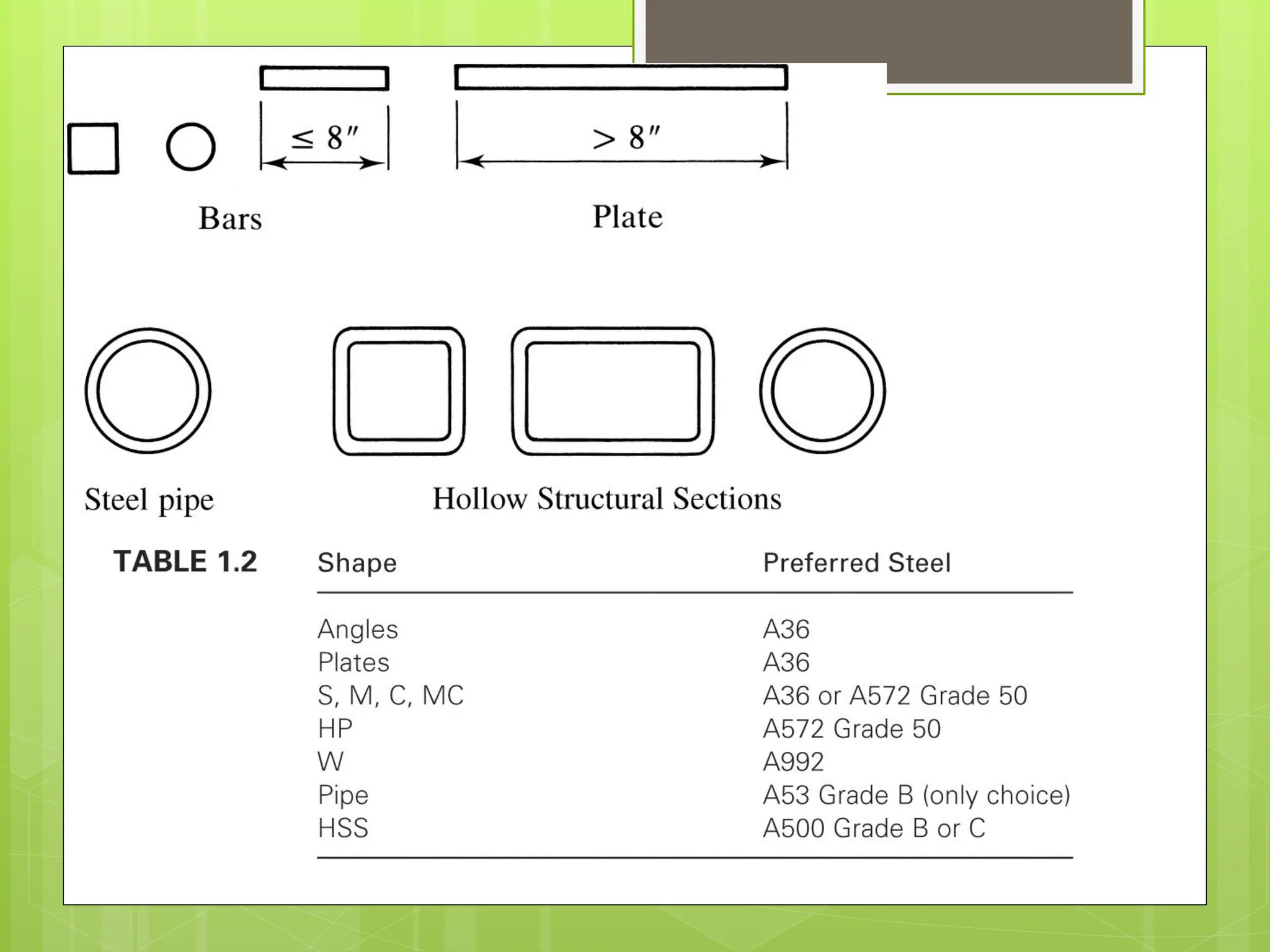
 Plain Carbon Steel (ASTM A36 - Grade 36)
 low cost
 works easily
 No longer “preferred” specially for WF
sections
 Low-alloy steel (ASTM A572 - Grade 50)
 High-alloy or Specialty Steel (ASTM A992)
 High Strength
 Increased Corrosion Resistance
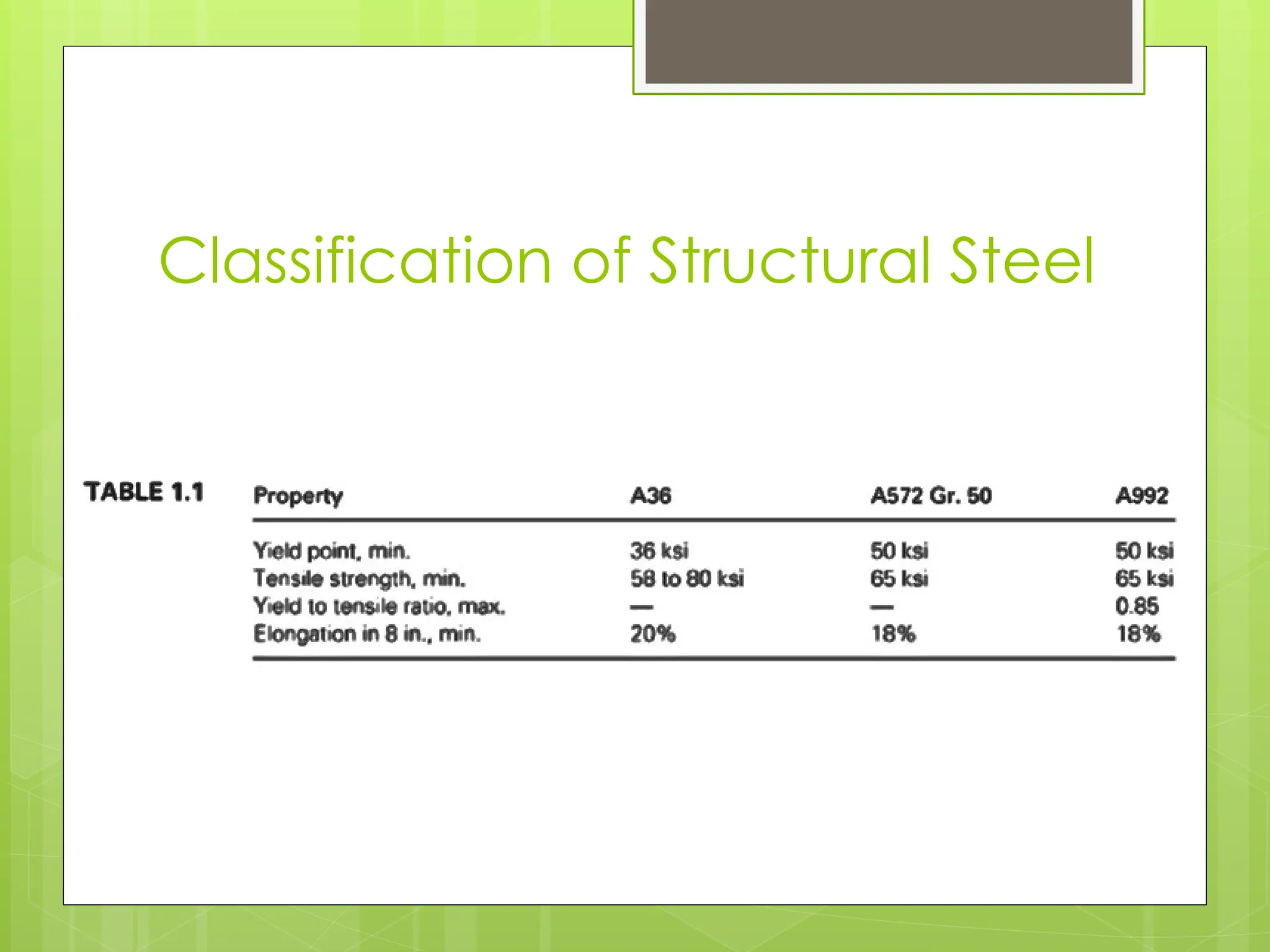
Classification of Structural Steel
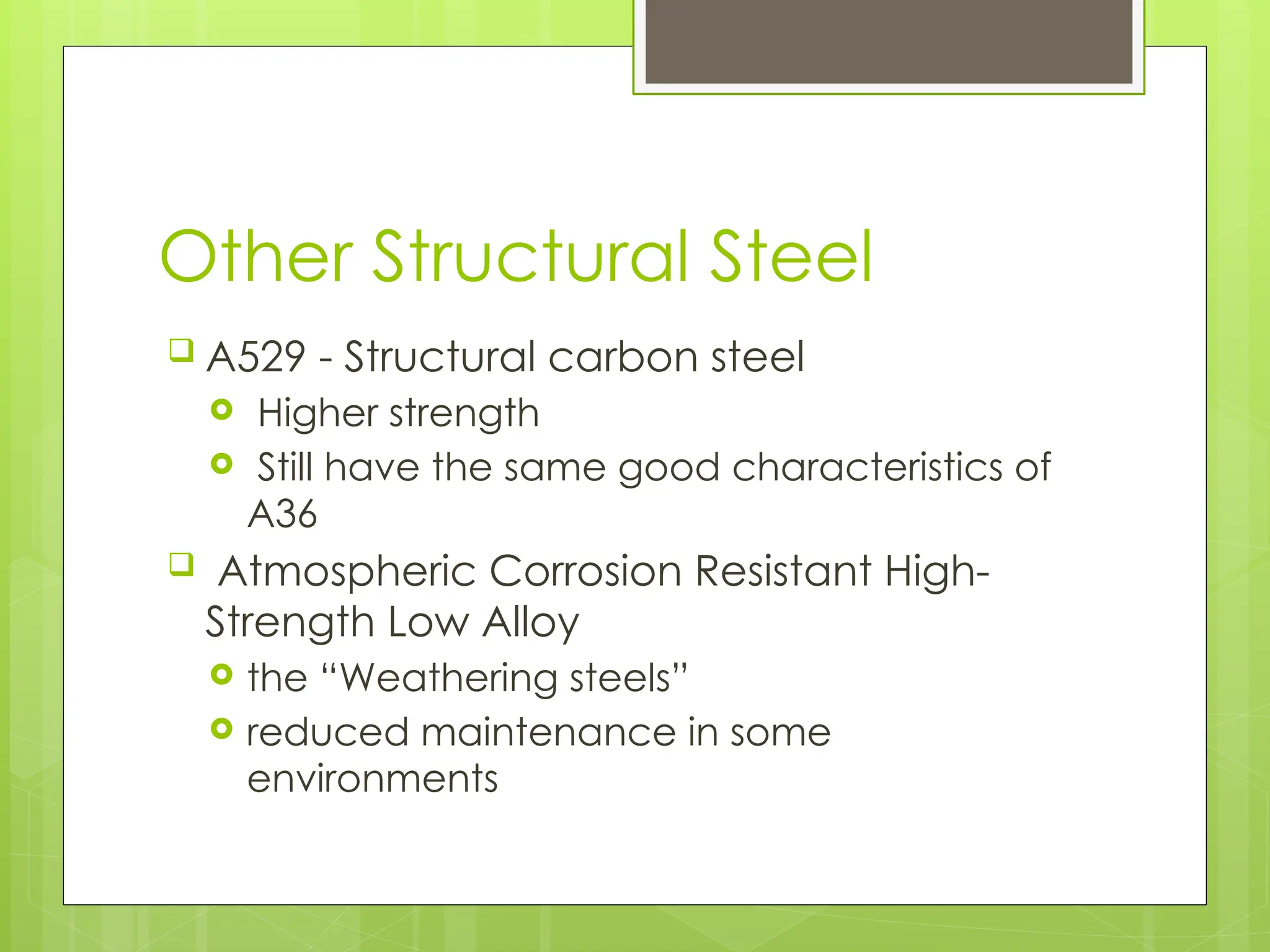
Other Structural Steel
 A529 - Structural carbon steel
 Higher strength
 Still have the same good characteristics of
A36
 Atmospheric Corrosion Resistant High-
Strength Low Alloy
 the “Weathering steels”
 reduced maintenance in some
environments
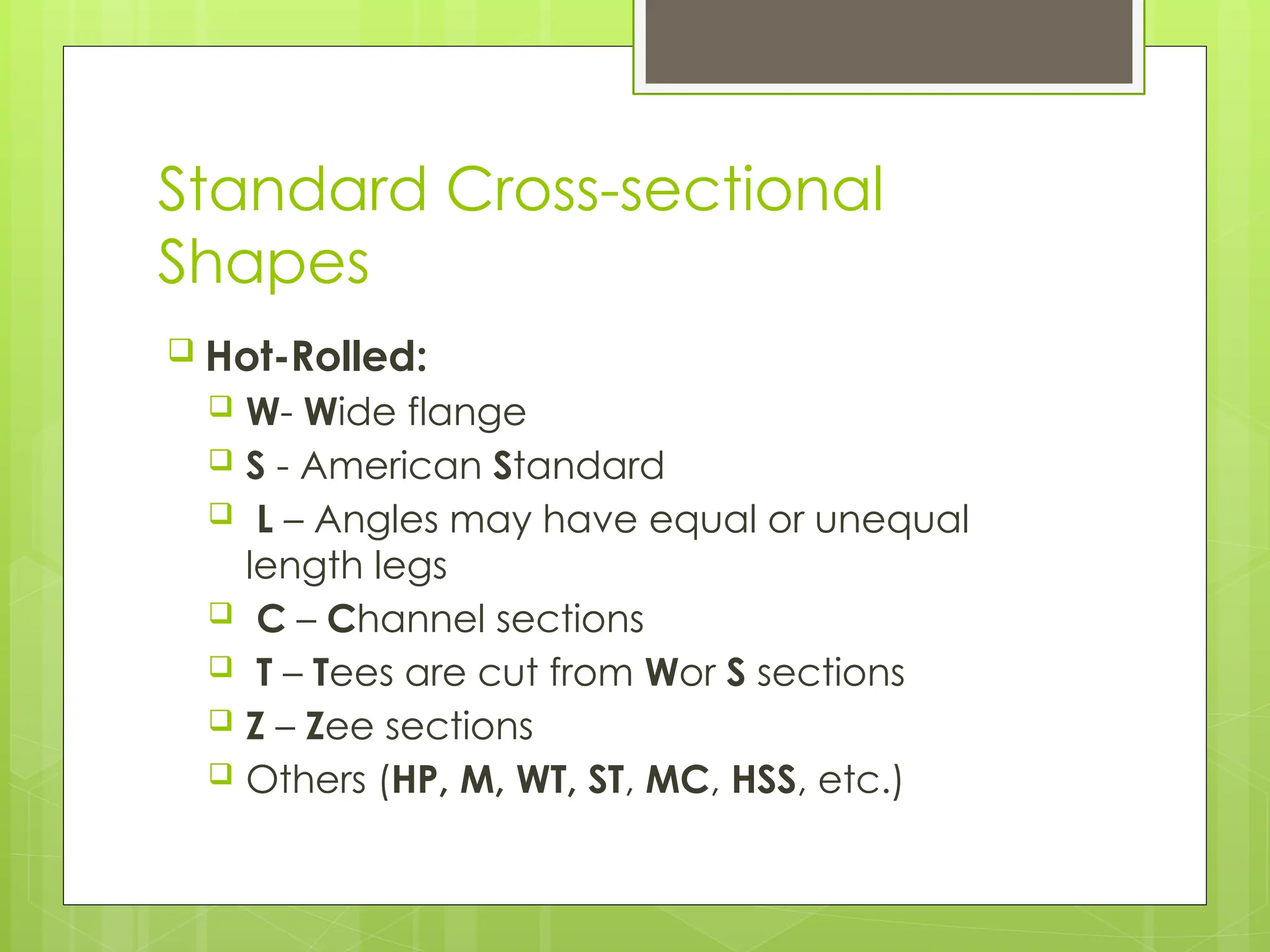
Standard Cross-sectional
Shapes
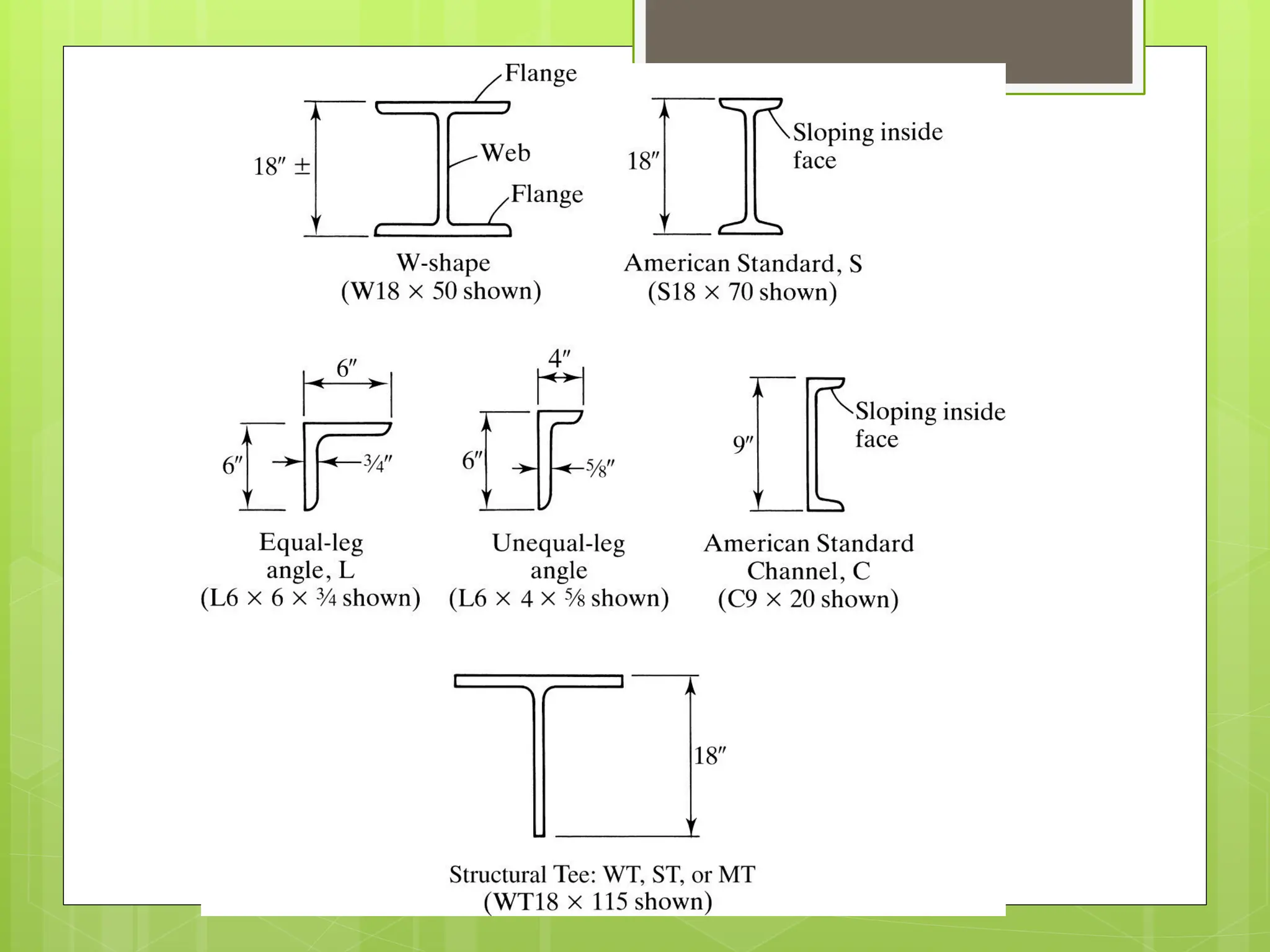
 Hot-Rolled:
 W- Wide flange
 S - American Standard
 L – Angles may have equal or unequal
length legs
 C – Channel sections
 T – Tees are cut from Wor S sections
 Z – Zee sections
 Others (HP, M, WT, ST, MC, HSS, etc.)
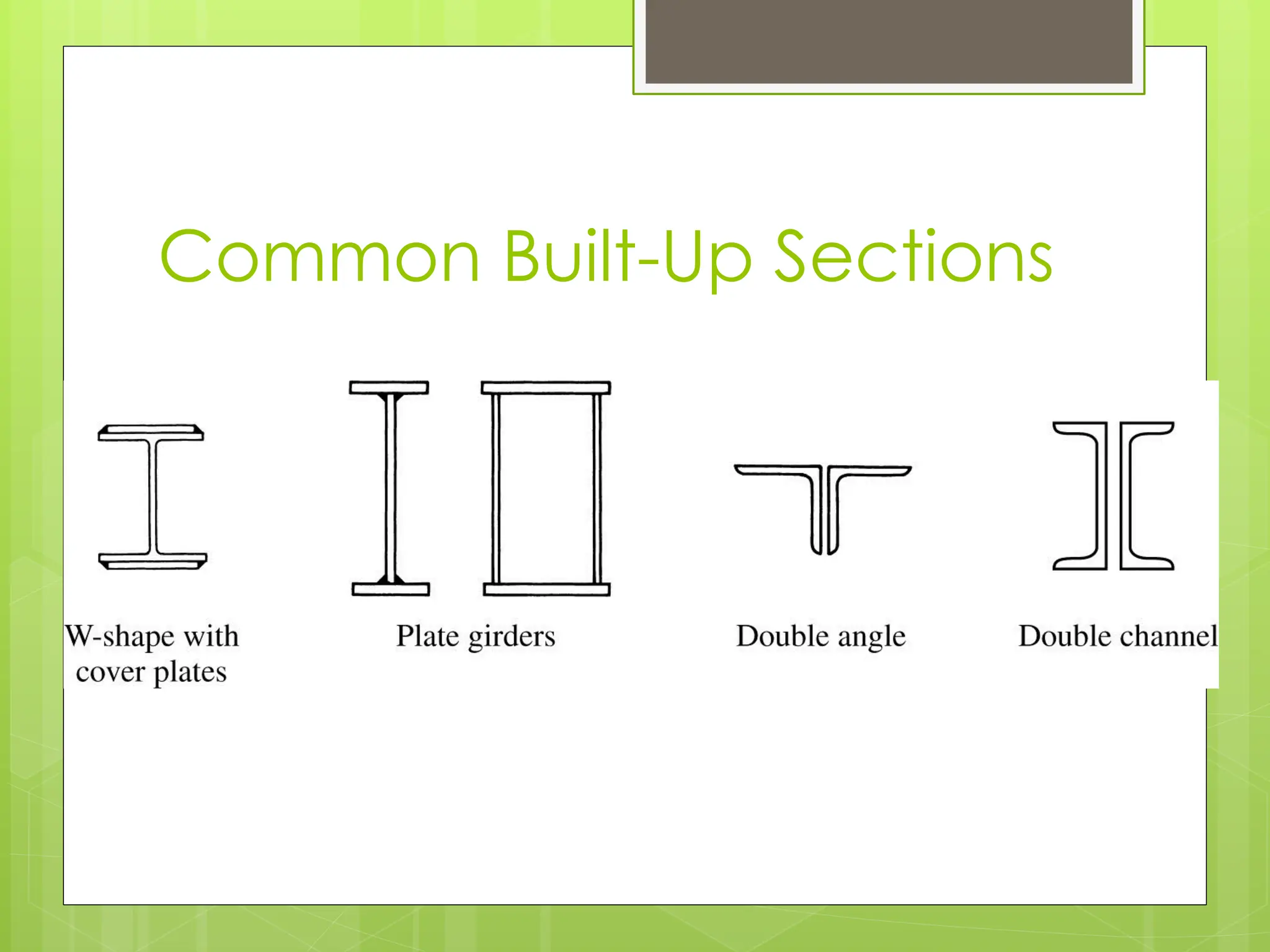
Common Built-Up Sections
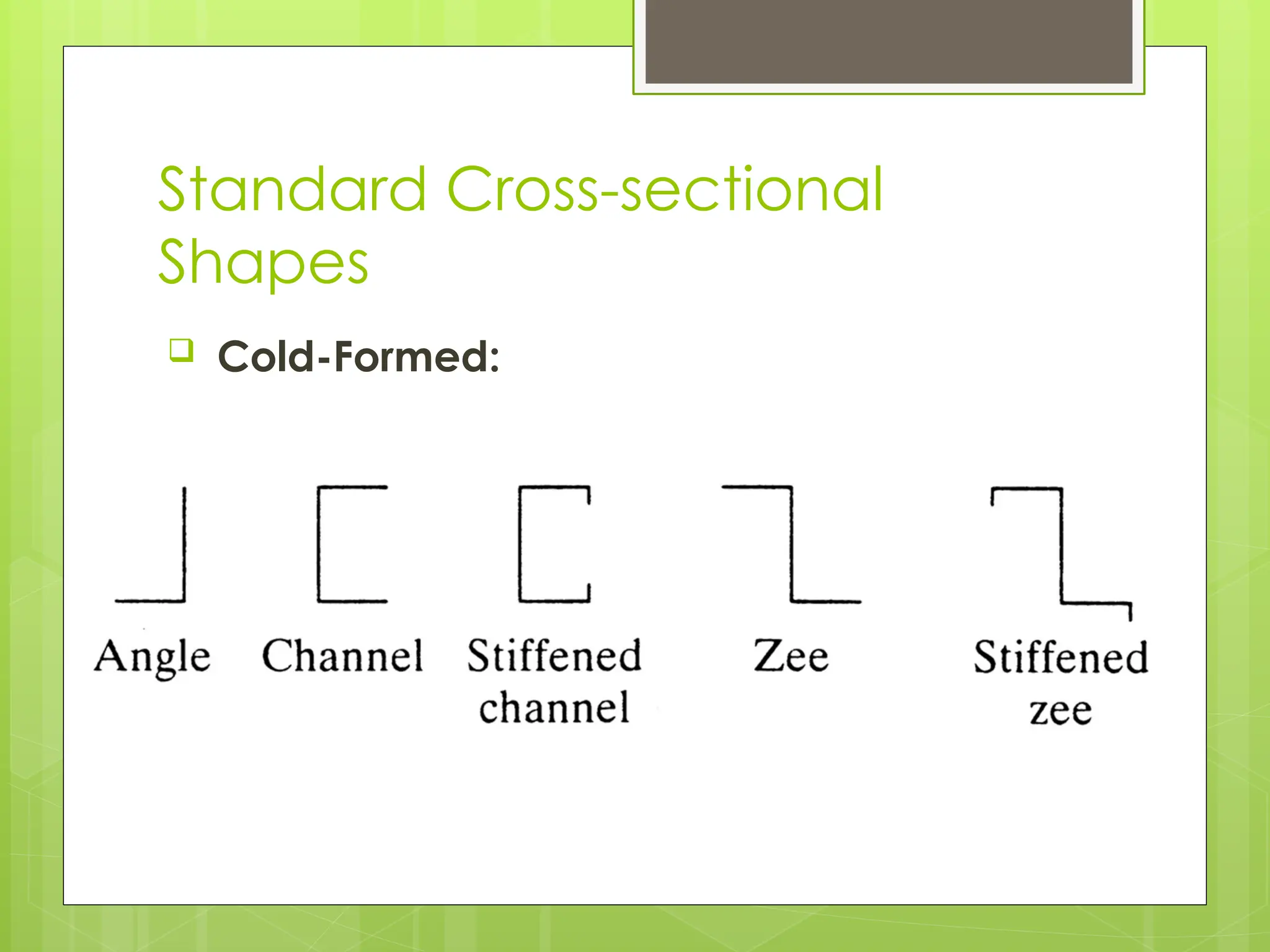
Standard Cross-sectional
Shapes
 Cold-Formed:
Main References
 Steel Design, Segui, W. T., 5th Ed. (2013),
Cengage Learning, USA.
 Manual of Steel Construction, 13th Ed.
(2005), American Institute of Steel
Construction (AISC).
 Structural Steel Design: Lecture Notes
(2013), Dr. Mohammad AlHamaydeh
Amarican University of sharjehUAE.

Introduction to steel structure design based on AISC

  • 2.
  • 3.
  • 4.
    Chapter 1: Introduction Why Structural Steel  Structural Design  Loads  Building Codes  Design Specifications  Structural Steel  Standard Cross Sectional Shapes
  • 5.
    Advantage and disadvantage ofsteel structure  Advantage of steel :  High Strength to weight ratio  Uniformity (or predictable properties)  Highly Ductile  Good Fracture toughness  Easily Constructed and Modified structures  Easily recycled  Steel is weldable.
  • 6.
    Disadvantages  Requires Maintenanceand Corrosion Protection  Requires Fireproofing  Often Results in Slender members that are susceptible to buckling  Fatigue  Brittle Fracture
  • 7.
    The Design Process It is both creative and technical and requires a fundamental knowledge of material properties and laws of mechanics which govern material response.  It is a cycle.  It requires the determination of the overall proportions and dimensions of the supporting framework.  Determination of the external loads that can be expected to act on the structure.  Calculation of deformations and internal forces (stresses and strains) produced in all the members of the structure produced by external loads.  Selection of the size and cross-section of individual members of the structure to support and resist the applied external load to satisfy both the strength and serviceability limit states (i.e. Safety and to make sure that the existing action and deformations are acceptable).
  • 8.
    Elements of DesignProcess  Selection of the type of structural form to be used and the material out of which the structure is to be made.  Determination of the external loads that can be expected to act on the structure.  Calculation of the internal forces (actions) and deformations that are produced in individual members of the structure by the external loads.  Determination of the size of the individual members so that the existing actions and deformations are acceptable (i.e. satisfy the strength and serviceability limit states).
  • 9.
    Steps of theDesign Process  Identify the Constraints.  Select form and material.  Create geometric model of structure.  Determine loads and load paths.  Conduct structural analysis.  Select member size based on limit state (strength, serviceability, fatigue, etc. )  Check compliance with code  If needed, repeat or iterate to solution.
  • 10.
    Design Responsibilities  Safety –Adequate strength during and after construction – Resistance to progressive collapse – Perceived as safe by users Serviceability – Deflection control – Vibration control  Practicality – Can it be built as designed – Reasonable tolerances must be allowed – Is the construction unreasonably complex or dangerous
  • 11.
    Design Responsibilities  Economy –Use readily available sections and materials - talk to suppliers! – Consider the total cost of the structure: material and fabrication. – Use only as many elements as needed – it cost money to handle each element. – Use the simplest details that are appropriate and take advantage of repetition
  • 12.
    Loads Loads: Loads areforces that act on a structure.  Loads must be determined before designing a structure.  Applied loads can either be :  Static (gravity type loads)  Dynamic (earthquake type loads, due to inertia of the mass of structure).
  • 13.
    Loads  Common Typesof loads:  Dead Loads - stationary loads of constant magnitude (caused by the weight of the structure).  Live Loads - moving loads or loads that vary in magnitude (people, furniture, vehicles, etc.).  Wind Loads  Snow Loads  Earthquake Loads
  • 14.
    Loads  Other Typesof loads:  Hydrostatic  Soil Pressure  Blast  Temperature Changes  Differential Settlement of the Foundations  Moving loads (moving trucks on highway bridges)
  • 15.
    Building Codes  Arelegislative documents that make the model specifications “legal” requirements, regulating building construction.  Establish the minimum acceptable requirements for preserving the public safety and welfare in a built environment.  Adopted by Government Legislative Authorities for Buildings Within Their Jurisdiction.  Applies to New Construction, rehab or alteration.
  • 16.
    Model Building Codes Uniform Building Code (UBC-1997): by the International Conference of Building Officials, ICBO.  National Building Code (NBC-1999): by the Building Officials and Code Administrators, BOCA.  Standard Building Code (SBC-1999): by the Southern Building Code Congress International, SBCCI.  International Building Code (IBC-2012): by the International Code Council  ASCE 7-10 load provisions.
  • 17.
    Design Specifications  Givemore specific guidance for the design of structural members and their connections.  Are recommendations of good practice based on the accepted body of knowledge. 1. American Institute of Steel Construction (AISC): 2. American Association of State Highway and Transportation Officials (AASHTO): 3. American Railway Engineering and Maintenance-of-Way Association (AREMA): 4. American Iron and Steel Institute (AISI):
  • 18.
    Structural Steel  MechanicalProperties:  If a test specimen is subjected to an axial load P, the stress and strain can be computed as follows:  where • f = axial tensile stress • A = cross-sectional area • e = axial strain • L = length of specimen • L = change in length Ϫ
  • 19.
    Structural Steel  MaterialProperties:  Steel is an alloy made by combining molten iron with other elements to obtain specific properties.  Carbon is the main strengthening element in steel. However, increased carbon content can reduce ductility, toughness and weldability.  Chromium and copper both increase resistance to atmospheric corrosion, and are used in weathering steels. Weathering steels form a protective oxide film on the surface early on, which will help protect the remainder of the steel.  Sulfur has an undesirable effect on surface quality, ductility, toughness and weldability. However, sulfur improves machinability.  Manganese can control the harmful effects of sulfur. It also increases hardness and strength (but not as much as carbon).
  • 20.
    Classification of StructuralSteel  Plain Carbon Steel (ASTM A36 - Grade 36)  low cost  works easily  No longer “preferred” specially for WF sections  Low-alloy steel (ASTM A572 - Grade 50)  High-alloy or Specialty Steel (ASTM A992)  High Strength  Increased Corrosion Resistance
  • 21.
  • 22.
    Other Structural Steel A529 - Structural carbon steel  Higher strength  Still have the same good characteristics of A36  Atmospheric Corrosion Resistant High- Strength Low Alloy  the “Weathering steels”  reduced maintenance in some environments
  • 23.
    Standard Cross-sectional Shapes  Hot-Rolled: W- Wide flange  S - American Standard  L – Angles may have equal or unequal length legs  C – Channel sections  T – Tees are cut from Wor S sections  Z – Zee sections  Others (HP, M, WT, ST, MC, HSS, etc.)
  • 26.
  • 27.
  • 28.
    Main References  SteelDesign, Segui, W. T., 5th Ed. (2013), Cengage Learning, USA.  Manual of Steel Construction, 13th Ed. (2005), American Institute of Steel Construction (AISC).  Structural Steel Design: Lecture Notes (2013), Dr. Mohammad AlHamaydeh Amarican University of sharjehUAE.