GURUVIGNESH N 1
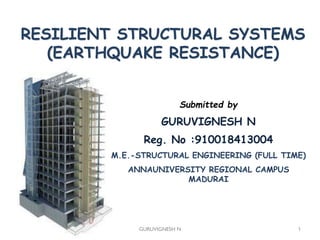
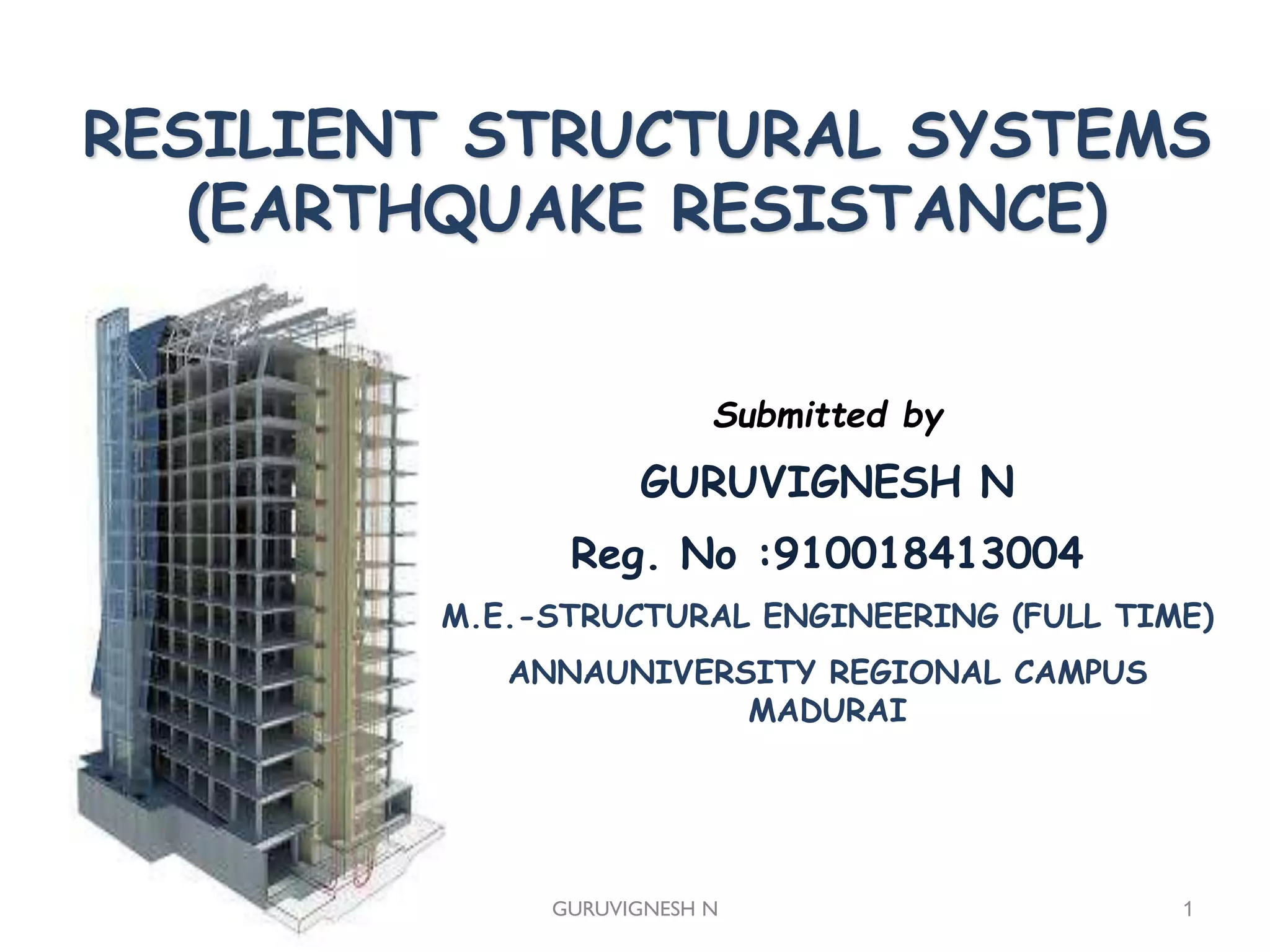
RESILIENT STRUCTURAL SYSTEMS
(EARTHQUAKE RESISTANCE)
Submitted by
GURUVIGNESH N
Reg. No :910018413004
M.E.-STRUCTURAL ENGINEERING (FULL TIME)
ANNAUNIVERSITY REGIONAL CAMPUS
MADURAI
INTRODUCTION
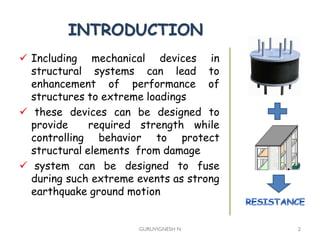
 Including mechanical devices in
structural systems can lead to
enhancement of performance of
structures to extreme loadings
 these devices can be designed to
provide required strength while
controlling behavior to protect
structural elements from damage
 system can be designed to fuse
during such extreme events as strong
earthquake ground motion
GURUVIGNESH N 2
EARTHQUAKES WORK
GURUVIGNESH N 3
One of the most terrifying phenomena
Until recently - unsubstantiated guesses as to what
caused earthquakes
Today – much clearer understanding
 Identified forces of earthquakes
 Technology that can tell an earthquake’s
magnitude
 Technology that can tell an origin
OBJECTIVES
 To find a way of predicting earthquakes
 To find way to protect people and property
THEORY OF PLATE TECTONICS
GURUVIGNESH N 4
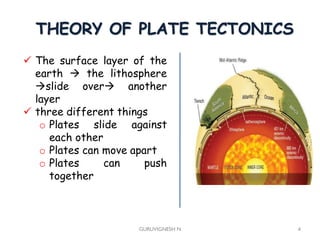
 The surface layer of the
earth  the lithosphere
slide over another
layer
 three different things
o Plates slide against
each other
o Plates can move apart
o Plates can push
together
SEISMIC WAVES
GURUVIGNESH N 5
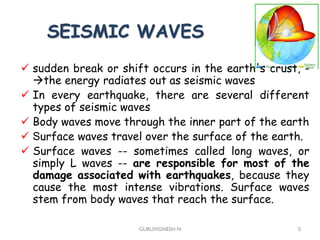
 sudden break or shift occurs in the earth's crust, -
the energy radiates out as seismic waves
 In every earthquake, there are several different
types of seismic waves
 Body waves move through the inner part of the earth
 Surface waves travel over the surface of the earth.
 Surface waves -- sometimes called long waves, or
simply L waves -- are responsible for most of the
damage associated with earthquakes, because they
cause the most intense vibrations. Surface waves
stem from body waves that reach the surface.
CAUSES OF EARTHQUAKE
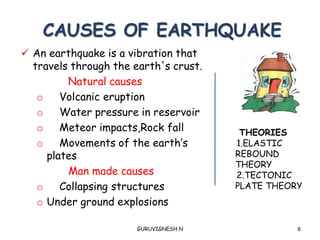
 An earthquake is a vibration that
travels through the earth's crust.
Natural causes
o Volcanic eruption
o Water pressure in reservoir
o Meteor impacts,Rock fall
o Movements of the earth’s
plates
Man made causes
o Collapsing structures
o Under ground explosions
GURUVIGNESH N 6
THEORIES
1.ELASTIC
REBOUND
THEORY
2.TECTONIC
PLATE THEORY
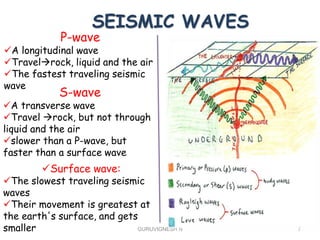
Surface wave:
The slowest traveling seismic
waves
Their movement is greatest at
the earth's surface, and gets
smaller
P-wave
A longitudinal wave
Travelrock, liquid and the air
The fastest traveling seismic
wave
S-wave
A transverse wave
Travel rock, but not through
liquid and the air
slower than a P-wave, but
faster than a surface wave
7GURUVIGNESH N
SEISMIC WAVES
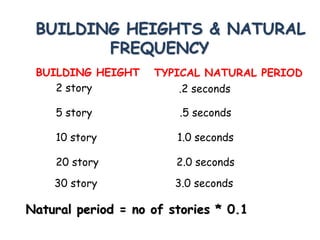
BUILDING HEIGHT TYPICAL NATURAL PERIOD
2 story .2 seconds
5 story .5 seconds
10 story 1.0 seconds
20 story 2.0 seconds
30 story 3.0 seconds
BUILDING HEIGHTS & NATURAL
FREQUENCY
Natural period = no of stories * 0.1
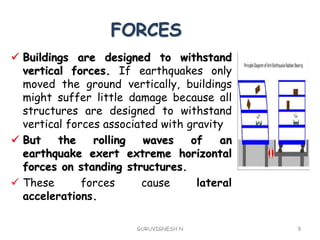
 Buildings are designed to withstand
vertical forces. If earthquakes only
moved the ground vertically, buildings
might suffer little damage because all
structures are designed to withstand
vertical forces associated with gravity
 But the rolling waves of an
earthquake exert extreme horizontal
forces on standing structures.
 These forces cause lateral
accelerations.
GURUVIGNESH N 9
FORCES
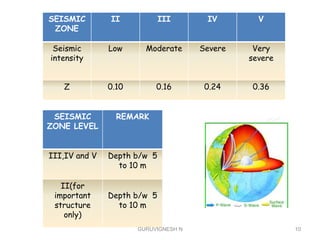
SEISMIC
ZONE
II III IV V
Seismic
intensity
Low Moderate Severe Very
severe
Z 0.10 0.16 0.24 0.36
SEISMIC
ZONE LEVEL
REMARK
III,IV and V Depth b/w 5
to 10 m
II(for
important
structure
only)
Depth b/w 5
to 10 m
10GURUVIGNESH N
SEISMOLOGY
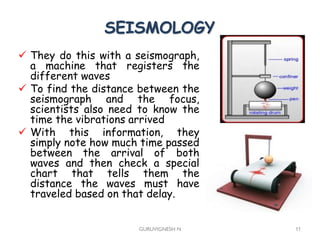
 They do this with a seismograph,
a machine that registers the
different waves
 To find the distance between the
seismograph and the focus,
scientists also need to know the
time the vibrations arrived
 With this information, they
simply note how much time passed
between the arrival of both
waves and then check a special
chart that tells them the
distance the waves must have
traveled based on that delay.
GURUVIGNESH N 11
 These two ratings describe the power of the
earthquake from two different perspectives.
o The Richter Scale is used to rate the
magnitude of an earthquake -- the amount of
energy it released
o This is calculated using information gathered
by a seismograph.
 Mercalli ratings only give you a rough idea of
the actual impact of an earthquake
MAGNITUDE – NUMBER-ENERGY RELATED
INTENSITY -NOTATION – DAMAGE RATE
GURUVIGNESH N 12
RICHTER SCALE RATING AND
MERCALLI SCALE RATING
EARTHQUAKE RESISTANT
BUILDINGS
Earthquakes can cause buildings to vibrate
Every building has a number of ways, or
modes, in which it can vibrate naturally. In
each mode, the building vibrates to a
particular distorted shape called its mode
shape.
Earthquakes usually make buildings vibrate
most strongly in their fundamental mode, the
mode of vibration with the lowest frequency
GURUVIGNESH N 13
STRENGTHENING BUILDINGS
FOR EARTHQUAKES
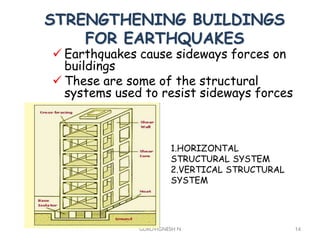
 Earthquakes cause sideways forces on
buildings
 These are some of the structural
systems used to resist sideways forces
GURUVIGNESH N 14
1.HORIZONTAL
STRUCTURAL SYSTEM
2.VERTICAL STRUCTURAL
SYSTEM
HORIZONTAL STRUCTURAL
SYSTEMS
Usually floors and roofs
They share the sideways forces on
the building between its vertical
structural members.
They include:
Diaphragms
Trussing
GURUVIGNESH N 15
HORIZONTAL DIAPHRAGMS
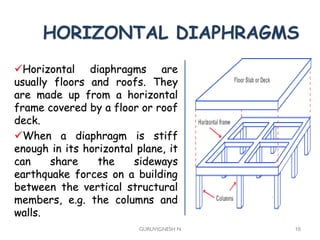
Horizontal diaphragms are
usually floors and roofs. They
are made up from a horizontal
frame covered by a floor or roof
deck.
When a diaphragm is stiff
enough in its horizontal plane, it
can share the sideways
earthquake forces on a building
between the vertical structural
members, e.g. the columns and
walls.
GURUVIGNESH N 16
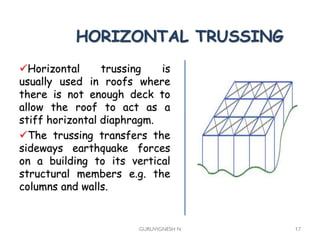
HORIZONTAL TRUSSING
Horizontal trussing is
usually used in roofs where
there is not enough deck to
allow the roof to act as a
stiff horizontal diaphragm.
The trussing transfers the
sideways earthquake forces
on a building to its vertical
structural members e.g. the
columns and walls.
GURUVIGNESH N 17
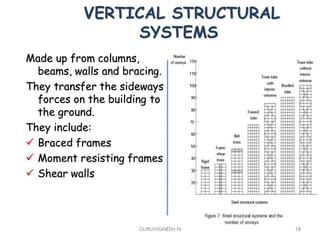
VERTICAL STRUCTURAL
SYSTEMS
Made up from columns,
beams, walls and bracing.
They transfer the sideways
forces on the building to
the ground.
They include:
 Braced frames
 Moment resisting frames
 Shear walls
GURUVIGNESH N 18
GURUVIGNESH N 19
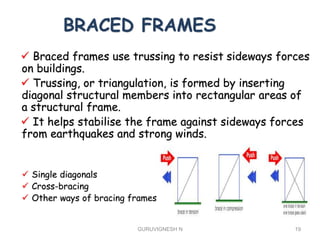
 Braced frames use trussing to resist sideways forces
on buildings.
 Trussing, or triangulation, is formed by inserting
diagonal structural members into rectangular areas of
a structural frame.
 It helps stabilise the frame against sideways forces
from earthquakes and strong winds.
BRACED FRAMES
 Single diagonals
 Cross-bracing
 Other ways of bracing frames
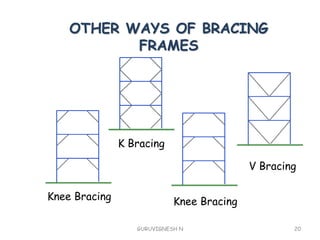
OTHER WAYS OF BRACING
FRAMES
GURUVIGNESH N 20
Knee Bracing
V Bracing
K Bracing
Knee Bracing
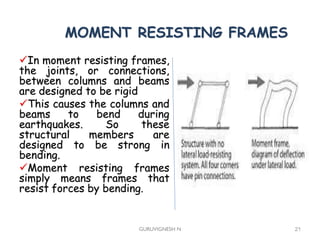
MOMENT RESISTING FRAMES
In moment resisting frames,
the joints, or connections,
between columns and beams
are designed to be rigid
This causes the columns and
beams to bend during
earthquakes. So these
structural members are
designed to be strong in
bending.
Moment resisting frames
simply means frames that
resist forces by bending.
GURUVIGNESH N 21
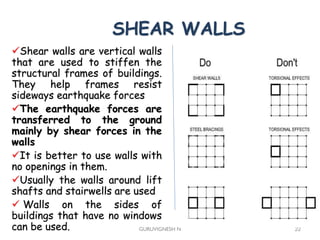
SHEAR WALLS
Shear walls are vertical walls
that are used to stiffen the
structural frames of buildings.
They help frames resist
sideways earthquake forces
The earthquake forces are
transferred to the ground
mainly by shear forces in the
walls
It is better to use walls with
no openings in them.
Usually the walls around lift
shafts and stairwells are used
 Walls on the sides of
buildings that have no windows
can be used. GURUVIGNESH N 22
Techniques to be Adopt on
Skyscrapers
Base isolation
Rubber bearings
Friction dampers
Metallic dampers
Friction pendulum
Viscous dampers
GURUVIGNESH N 23
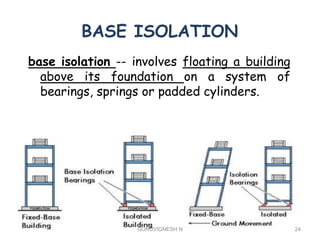
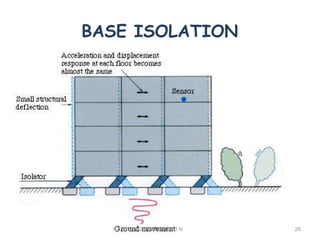
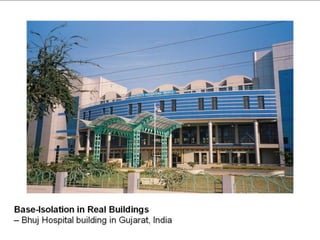
base isolation -- involves floating a building
above its foundation on a system of
bearings, springs or padded cylinders.
24GURUVIGNESH N
BASE ISOLATION
BASE ISOLATION
25GURUVIGNESH N
RUBBER BEARINGS
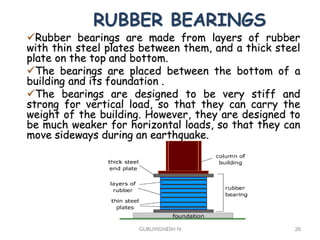
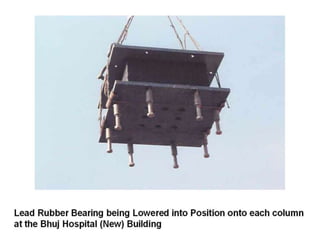
Rubber bearings are made from layers of rubber
with thin steel plates between them, and a thick steel
plate on the top and bottom.
The bearings are placed between the bottom of a
building and its foundation .
The bearings are designed to be very stiff and
strong for vertical load, so that they can carry the
weight of the building. However, they are designed to
be much weaker for horizontal loads, so that they can
move sideways during an earthquake.
GURUVIGNESH N 26
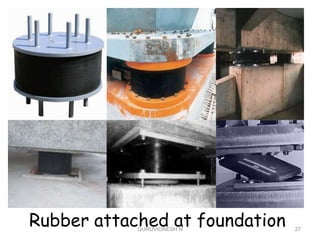
Rubber attached at foundation 27GURUVIGNESH N
METALLIC DAMPERS
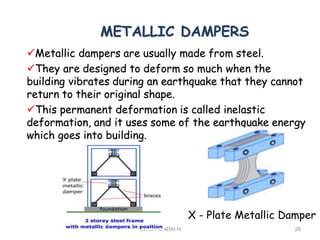
Metallic dampers are usually made from steel.
They are designed to deform so much when the
building vibrates during an earthquake that they cannot
return to their original shape.
This permanent deformation is called inelastic
deformation, and it uses some of the earthquake energy
which goes into building.
GURUVIGNESH N 28
X - Plate Metallic Damper
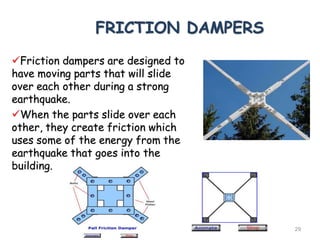
FRICTION DAMPERS
Friction dampers are designed to
have moving parts that will slide
over each other during a strong
earthquake.
When the parts slide over each
other, they create friction which
uses some of the energy from the
earthquake that goes into the
building.
GURUVIGNESH N 29
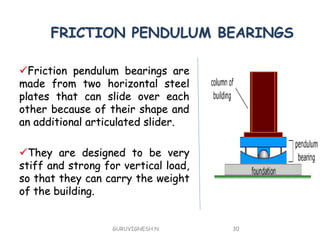
FRICTION PENDULUM BEARINGS
Friction pendulum bearings are
made from two horizontal steel
plates that can slide over each
other because of their shape and
an additional articulated slider.
They are designed to be very
stiff and strong for vertical load,
so that they can carry the weight
of the building.
GURUVIGNESH N 30
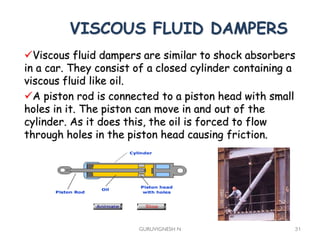
VISCOUS FLUID DAMPERS
Viscous fluid dampers are similar to shock absorbers
in a car. They consist of a closed cylinder containing a
viscous fluid like oil.
A piston rod is connected to a piston head with small
holes in it. The piston can move in and out of the
cylinder. As it does this, the oil is forced to flow
through holes in the piston head causing friction.
GURUVIGNESH N 31
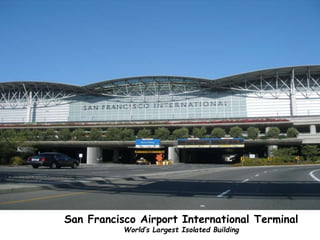
San Francisco Airport International Terminal
World’s Largest Isolated Building
GURUVIGNESH N 35
THANK YOU…

EARTHQUAKE RESISTANCE STRUCTURE

  • 1.
    GURUVIGNESH N 1 RESILIENTSTRUCTURAL SYSTEMS (EARTHQUAKE RESISTANCE) Submitted by GURUVIGNESH N Reg. No :910018413004 M.E.-STRUCTURAL ENGINEERING (FULL TIME) ANNAUNIVERSITY REGIONAL CAMPUS MADURAI
  • 2.
    INTRODUCTION  Including mechanicaldevices in structural systems can lead to enhancement of performance of structures to extreme loadings  these devices can be designed to provide required strength while controlling behavior to protect structural elements from damage  system can be designed to fuse during such extreme events as strong earthquake ground motion GURUVIGNESH N 2
  • 3.
    EARTHQUAKES WORK GURUVIGNESH N3 One of the most terrifying phenomena Until recently - unsubstantiated guesses as to what caused earthquakes Today – much clearer understanding  Identified forces of earthquakes  Technology that can tell an earthquake’s magnitude  Technology that can tell an origin OBJECTIVES  To find a way of predicting earthquakes  To find way to protect people and property
  • 4.
    THEORY OF PLATETECTONICS GURUVIGNESH N 4  The surface layer of the earth  the lithosphere slide over another layer  three different things o Plates slide against each other o Plates can move apart o Plates can push together

  • 5.
    SEISMIC WAVES GURUVIGNESH N5  sudden break or shift occurs in the earth's crust, - the energy radiates out as seismic waves  In every earthquake, there are several different types of seismic waves  Body waves move through the inner part of the earth  Surface waves travel over the surface of the earth.  Surface waves -- sometimes called long waves, or simply L waves -- are responsible for most of the damage associated with earthquakes, because they cause the most intense vibrations. Surface waves stem from body waves that reach the surface.
  • 6.
    CAUSES OF EARTHQUAKE An earthquake is a vibration that travels through the earth's crust. Natural causes o Volcanic eruption o Water pressure in reservoir o Meteor impacts,Rock fall o Movements of the earth’s plates Man made causes o Collapsing structures o Under ground explosions GURUVIGNESH N 6 THEORIES 1.ELASTIC REBOUND THEORY 2.TECTONIC PLATE THEORY
  • 7.
    Surface wave: The slowesttraveling seismic waves Their movement is greatest at the earth's surface, and gets smaller P-wave A longitudinal wave Travelrock, liquid and the air The fastest traveling seismic wave S-wave A transverse wave Travel rock, but not through liquid and the air slower than a P-wave, but faster than a surface wave 7GURUVIGNESH N SEISMIC WAVES
  • 8.
    BUILDING HEIGHT TYPICALNATURAL PERIOD 2 story .2 seconds 5 story .5 seconds 10 story 1.0 seconds 20 story 2.0 seconds 30 story 3.0 seconds BUILDING HEIGHTS & NATURAL FREQUENCY Natural period = no of stories * 0.1
  • 9.
     Buildings aredesigned to withstand vertical forces. If earthquakes only moved the ground vertically, buildings might suffer little damage because all structures are designed to withstand vertical forces associated with gravity  But the rolling waves of an earthquake exert extreme horizontal forces on standing structures.  These forces cause lateral accelerations. GURUVIGNESH N 9 FORCES
  • 10.
    SEISMIC ZONE II III IVV Seismic intensity Low Moderate Severe Very severe Z 0.10 0.16 0.24 0.36 SEISMIC ZONE LEVEL REMARK III,IV and V Depth b/w 5 to 10 m II(for important structure only) Depth b/w 5 to 10 m 10GURUVIGNESH N
  • 11.
    SEISMOLOGY  They dothis with a seismograph, a machine that registers the different waves  To find the distance between the seismograph and the focus, scientists also need to know the time the vibrations arrived  With this information, they simply note how much time passed between the arrival of both waves and then check a special chart that tells them the distance the waves must have traveled based on that delay. GURUVIGNESH N 11
  • 12.
     These tworatings describe the power of the earthquake from two different perspectives. o The Richter Scale is used to rate the magnitude of an earthquake -- the amount of energy it released o This is calculated using information gathered by a seismograph.  Mercalli ratings only give you a rough idea of the actual impact of an earthquake MAGNITUDE – NUMBER-ENERGY RELATED INTENSITY -NOTATION – DAMAGE RATE GURUVIGNESH N 12 RICHTER SCALE RATING AND MERCALLI SCALE RATING
  • 13.
    EARTHQUAKE RESISTANT BUILDINGS Earthquakes cancause buildings to vibrate Every building has a number of ways, or modes, in which it can vibrate naturally. In each mode, the building vibrates to a particular distorted shape called its mode shape. Earthquakes usually make buildings vibrate most strongly in their fundamental mode, the mode of vibration with the lowest frequency GURUVIGNESH N 13
  • 14.
    STRENGTHENING BUILDINGS FOR EARTHQUAKES Earthquakes cause sideways forces on buildings  These are some of the structural systems used to resist sideways forces GURUVIGNESH N 14 1.HORIZONTAL STRUCTURAL SYSTEM 2.VERTICAL STRUCTURAL SYSTEM
  • 15.
    HORIZONTAL STRUCTURAL SYSTEMS Usually floorsand roofs They share the sideways forces on the building between its vertical structural members. They include: Diaphragms Trussing GURUVIGNESH N 15
  • 16.
    HORIZONTAL DIAPHRAGMS Horizontal diaphragmsare usually floors and roofs. They are made up from a horizontal frame covered by a floor or roof deck. When a diaphragm is stiff enough in its horizontal plane, it can share the sideways earthquake forces on a building between the vertical structural members, e.g. the columns and walls. GURUVIGNESH N 16
  • 17.
    HORIZONTAL TRUSSING Horizontal trussingis usually used in roofs where there is not enough deck to allow the roof to act as a stiff horizontal diaphragm. The trussing transfers the sideways earthquake forces on a building to its vertical structural members e.g. the columns and walls. GURUVIGNESH N 17
  • 18.
    VERTICAL STRUCTURAL SYSTEMS Made upfrom columns, beams, walls and bracing. They transfer the sideways forces on the building to the ground. They include:  Braced frames  Moment resisting frames  Shear walls GURUVIGNESH N 18
  • 19.
    GURUVIGNESH N 19 Braced frames use trussing to resist sideways forces on buildings.  Trussing, or triangulation, is formed by inserting diagonal structural members into rectangular areas of a structural frame.  It helps stabilise the frame against sideways forces from earthquakes and strong winds. BRACED FRAMES  Single diagonals  Cross-bracing  Other ways of bracing frames
  • 20.
    OTHER WAYS OFBRACING FRAMES GURUVIGNESH N 20 Knee Bracing V Bracing K Bracing Knee Bracing
  • 21.
    MOMENT RESISTING FRAMES Inmoment resisting frames, the joints, or connections, between columns and beams are designed to be rigid This causes the columns and beams to bend during earthquakes. So these structural members are designed to be strong in bending. Moment resisting frames simply means frames that resist forces by bending. GURUVIGNESH N 21
  • 22.
    SHEAR WALLS Shear wallsare vertical walls that are used to stiffen the structural frames of buildings. They help frames resist sideways earthquake forces The earthquake forces are transferred to the ground mainly by shear forces in the walls It is better to use walls with no openings in them. Usually the walls around lift shafts and stairwells are used  Walls on the sides of buildings that have no windows can be used. GURUVIGNESH N 22
  • 23.
    Techniques to beAdopt on Skyscrapers Base isolation Rubber bearings Friction dampers Metallic dampers Friction pendulum Viscous dampers GURUVIGNESH N 23
  • 24.
    base isolation --involves floating a building above its foundation on a system of bearings, springs or padded cylinders. 24GURUVIGNESH N BASE ISOLATION
  • 25.
  • 26.
    RUBBER BEARINGS Rubber bearingsare made from layers of rubber with thin steel plates between them, and a thick steel plate on the top and bottom. The bearings are placed between the bottom of a building and its foundation . The bearings are designed to be very stiff and strong for vertical load, so that they can carry the weight of the building. However, they are designed to be much weaker for horizontal loads, so that they can move sideways during an earthquake. GURUVIGNESH N 26
  • 27.
    Rubber attached atfoundation 27GURUVIGNESH N
  • 28.
    METALLIC DAMPERS Metallic dampersare usually made from steel. They are designed to deform so much when the building vibrates during an earthquake that they cannot return to their original shape. This permanent deformation is called inelastic deformation, and it uses some of the earthquake energy which goes into building. GURUVIGNESH N 28 X - Plate Metallic Damper
  • 29.
    FRICTION DAMPERS Friction dampersare designed to have moving parts that will slide over each other during a strong earthquake. When the parts slide over each other, they create friction which uses some of the energy from the earthquake that goes into the building. GURUVIGNESH N 29
  • 30.
    FRICTION PENDULUM BEARINGS Frictionpendulum bearings are made from two horizontal steel plates that can slide over each other because of their shape and an additional articulated slider. They are designed to be very stiff and strong for vertical load, so that they can carry the weight of the building. GURUVIGNESH N 30
  • 31.
    VISCOUS FLUID DAMPERS Viscousfluid dampers are similar to shock absorbers in a car. They consist of a closed cylinder containing a viscous fluid like oil. A piston rod is connected to a piston head with small holes in it. The piston can move in and out of the cylinder. As it does this, the oil is forced to flow through holes in the piston head causing friction. GURUVIGNESH N 31
  • 32.
    San Francisco AirportInternational Terminal World’s Largest Isolated Building
  • 35.