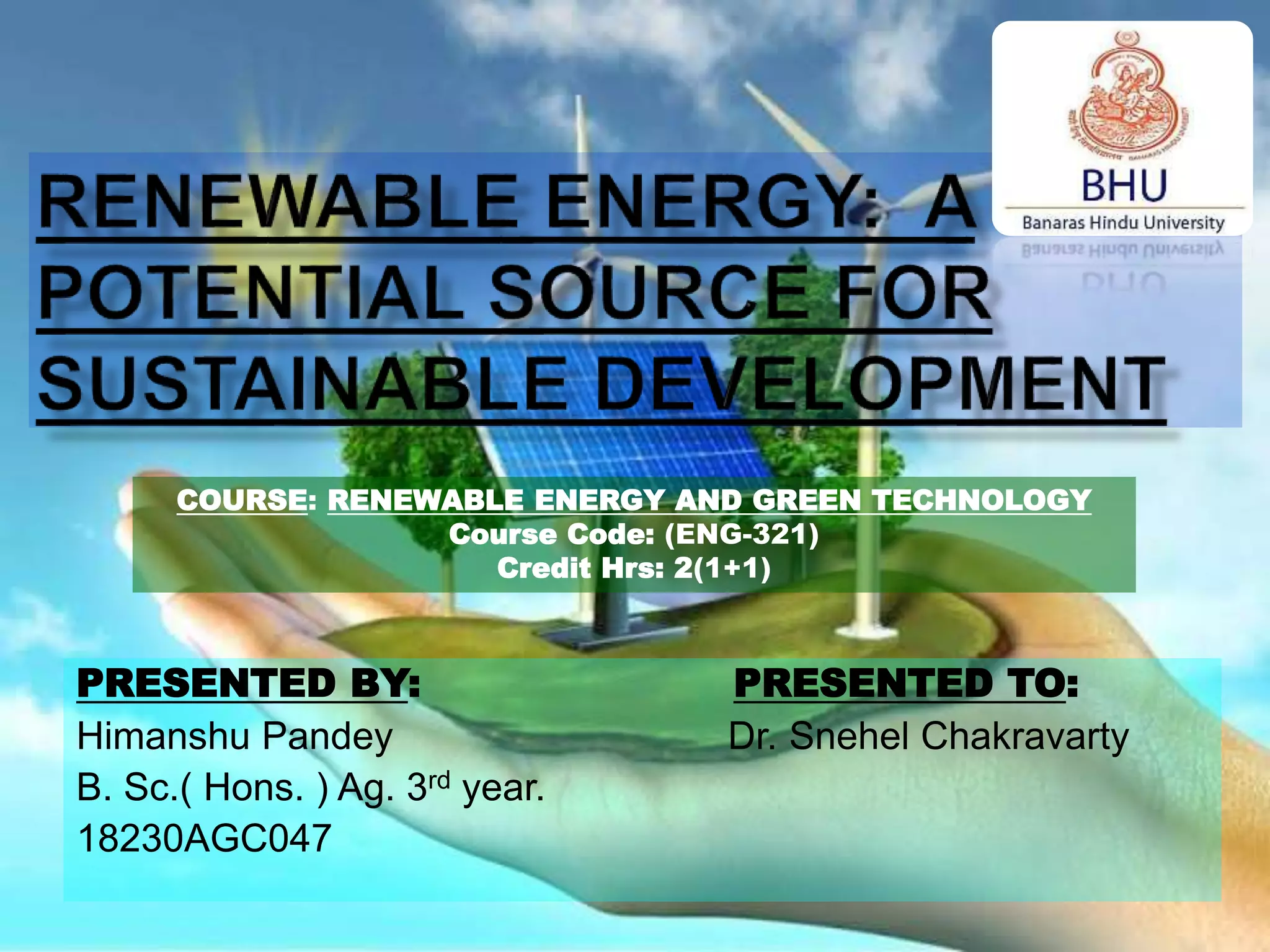
PRESENTED BY: PRESENTED TO:
Himanshu Pandey Dr. Snehel Chakravarty
B. Sc.( Hons. ) Ag. 3rd year.
18230AGC047
COURSE: RENEWABLE ENERGY AND GREEN TECHNOLOGY
Course Code: (ENG-321)
Credit Hrs: 2(1+1)
Energy is one of the most vital building
blocks in human development and a key factor
influence the sustainable development of any
nation.
The conventional sources of energy have
major intimidation to our existing and future
global safety environmental values, health and
society. So, the renewable energy in power
sector of India for sustainable development
gets a very significant role.
 It is energy that comes from resources. Replenished
such as wind, rain, sunlight, waves, etc. [The new
renewables, suggests a greater focus on modern and
sustainable forms of renewable energy, in particular
modern biomass, energy, geothermal seat and electricity
small scale hydropower, low temp. solar heat, wind
electricity, solar photovoltaic and thermal electricity &
Energy].
 About 16% of global energy comes from renewable
resources.
10% of all energy from traditional biomass
 3.4% - hydroelectricity
 3% - new renewables
The concept of sustainable development has
it’s roots in the idea of a sustainable society
(Brown, 1381) and in the management of
renewable & non-renewable resources.
The concept of SD is defined as “ development
that meets the needs of the present without
compromising the ability of future generations
to meet their own needs.
Sustainable development emphasizes the evolution of
human society from the responsible economic point of
view, in accordance with environmental & natural
processes. So the energy sources must meet some of the
basic criteria :
 Should have minimal or no negative environmental or
social impact.
There should be no depiction of natural resources
 Should meet the needs of people today and in the
future an accessible, equitable and efficient manner.
should protect air, land and water.
 Should be safe today and also there should be no
burden on the future generations with unncessary risks.
 The renewable energy, is one of such energy source
which we can find directly linked to sustainable
development.
Prior to the development of coal in the mid 19th
century nearly all energy was renewable.
By 1873, concerns of running out of coal
promoted experiments using Solar energy.
Development of Solar engines continued until the
outbreak of World War 1st.
In the 1970’s enviromentalist promoted the
development of renewable energy for replacement
of oil and decreasing dependence on oil leading to
the first electricity generating Wind Turbine.
1970’s energy crisis led to the establishment of the
COMISSION FOR ADDITIONAL SOURCES OF
ENERGY(CASE) in the Department of Science and
Technology in Mach 1981.
In 1982, a new department was created in the
Ministry of Energy i.e. Department of Non-
conventional Energy Sources(DNES).
A decade later in 1992, DNES became Ministry of
Non-conventional Energy Sources(MNES) and in
October 2006 it gained its current name as Ministry
of New and Renewable Energy.
Every country relies on the natural resources, like coal, Oil or natural gas
which are also called non renewable energy resources.
Due to it’s large extensive usage for satisfying population need it is getting
diminished, if not used in limited & conservative amount.
Although, these resources are expensive, but they are damaging the
environment as well, which proves it as a shabby option.
According to news, the world is revolving around the prices of Fossil fuels
especially the oil
The burning of fossil fuels, emit immense amount of toxic gaces that are
alermingly damaging out ecosystem.
Energy security of these sources is very less.
 These resources are owned by very a few countries. So their transportation is
difficult and costly. And any accident securing at their transportation times, it
causes huge damage to environment.
Even the process to harness these resources in costly lead to irreversible
damage to the adjoining environment.
Thus, there a number of other issue and short comings of these resources, it
becomes a great necessity at present to utilize natural or organic substitute like
renewable resources for sustainability.
Sinking the effect of global warming: searching & using the energy
sources will provide us with a solution to save our Earth from ecological
disaster which is caused by global warming.
Cost-Power plant maintenance definitely cost for renewable energy as
the availability is abundant on earth & the invested amount can be
refurbished after some time of its establishment.
Renewable energy sources have lower environmental impact.
This energy has the potential to provide clean sources of power
generation that is also affordable for both home owners and businesses.
This energy reduces the carbon footprints that remain in the last after
burning of fossil fuels.
This energy also reduces pollution.
Unlike non renewable resources, these energy resources will never run
out, so there is an unlimited supply.
The replenishable nature of renewable resource of energy make them the
most suitable energy. resources for achieving sustainable development.
Reasons for changing in diversion to
Renewable Energy Resources
There are many sources of renewable energy, but
all of them, except geothermal energy, are more
or less directly related to the sun: the main source
of clean and sustainable energy for the earth.
Solar energy
Wind energy
Hydropower (water power )
Biofuels
Geothermal energy
Apart from the everyday applications of solar energy,
such as room lighting, it is harnessed by two quite
different methods: photovoltaics and solar thermal.
Photovoltaics (PV): the
application of solar cells to
convert sunlight directly into
electricity. When PV cells are
assembled, they form a PV
module (or panel). An
installation of panels is called a
PV array.
Solar cells are often made from
wafers: slices of semiconductor
material, such as silicon crystal.
Solar thermal energy
(STE): a energy technology
that uses solar energy to
produce thermal, i.e. heat.
There are low-, medium-,
and high-temperature
solar thermal collectors.
This technique is known as
concentrated solar power
(CSP).
The energy of wind is
harnessed with wind
turbines. They are usually
grouped in wind farms
(sometimes called
wind parks). There are
onshore farms (which,
however, are often near
water); nearshore farms (on
land or on sea within several
km (10 km or more from
land).
Wind energy currently
generates only 1% of all electricity
on a global scale, but its share is
growing rapidly. In Denmark, for
example, wind already accounts for
19% of the total electricity
production.
Since wind is intermittent,
turbines can't constantly work at
their full capacities. The ratio of
actual annual productivity to the
theoretical maximum capacity is
called capacity factor. It typically
reaches 20% to 40%.
Hydropower (also called
hydraulic or water power) is
derived from the force of moving
water. Since water is much denser
than air, its movement
generates more energy than wind
does.
Electricity generated with
hydropower is called
hydroelectricity.
Hydropower was harnessed with
water wheels to operate watermills,
sawmills, textile machines and
others long before electric power
came into use.
Hydropower supplies some
19% of all electricity in the
world. It is generally far
cheaper than fossil
fuels or nuclear energy.
Hydroelectricity is mostly
generated in dams. Water is first
collected in dams, then let flow
through turbines. A great
advantage of this technology is
that the amount of energy
produced can be easily adjusted to
the level of demand by controlling
the outflow of water.
Tidal power technologies convert
the energy of tides into electricity.
Their biggest advantage is the fact
that tides are much more predictable
than wind or solar energy. However,
tidal power is not very common yet.
Tidal energy is captured with tidal
stream systems which use the
kinetic energy f moving water to
drive turbines. A less popular
technology to capture tidal energy
are barrages (similar to dams),
which use the water's potential
energy. Barrages are not preferred
because of higher costs and bad
environmental effects.
Another up-and-coming electric
source is wave power. One wave
power technology employs
buoyant objects that the waves
move, creating electricity. With
wind turbines, the air
fluctuations caused by the
moving water can also be used to
produce power. A project that
uses the movement of the water
below its surface has also been
developed.
World leaders in
hydropower use: China, Brazil,
Canada, USA, India
Biomass consists of living or recently dead organisms or other
biological material, i.e. carbon. Biomass is used to produce biofuel. The
most common material for biofuels are photosynthetic plants. A plant
especially grown to be used for biofuel manufacturing is known as an
energy crop.
Biodiesel is a very common
biofuel. It is made from oils
(extracted from maize, soy,
rapeseed, sunflower, palm
fruit and sometimes from
animal products) that
undergo chemical
processing. Used edible
vegetable oil is sometimes
transformed into
blodiesel too.
Biodiesel is mixed with
mineral diesel to
be used in diesel
engines.
Biogas is produced by the
biological breakdown of organic
matter in the absence of oxygen.
The biodegradable materials in
question can be manure,
sewage, green waste (plant
parts), household and industrial
waste. Biogases are rich in
methane. They can be used to
generate heat, electric or
mechanical energy, or as fuel for
vehicles.
Biogas is produced in facilities.
for biological treatment of
waste. It is also formed naturally
in landfills where it contributes
to the greenhouse effect.
Bioalcohol (or alcohol
fuel) is produced with
the help of fermentation
inducing
microorganisms.
The most common is
ethanol fuel (or
bioethanol) that is
widely used instead of
petrol to power cars in
some countries,
predominantly Brazil.
Several metres under
the earth's surface the
temperature is between 10°
and 16°C. In winter
this heat can be
brought to buildings
with pipes. Another
technology uses deep wells
in hot rock in which fluid is
heated to produce. steam,
which then drives turbines
to generate electricity. plants.
The facilities that enable this
process are called dry steam,
flash, steam and binary-cycle
plants.
This type of energy is obtained by tapping the heat of the earth,
which is mostly in the form of hot water and steam. Various
technologies are used to get to the heat under the earth's surface at
different depths.
Geothermal power
stations are
expensive to build
but their operating
costs are low. A
significant
advantage is that
geothermal energy
is not dependent on
weather conditions.
A major
disadvantage is the
risk for land
stability in the
region where such
a plant is
constructed.
In some areas of the
planet
geothermal energy is
closer to the surface and
therefore easier to
concentration of
volcanoes. Geothermal
sources account for 19% of
Iceland's electricity
production, and
geothermal heating is
used in 87% of homes in
the country. Iceland also
plans to go fully fossil fuel
free in the near future.
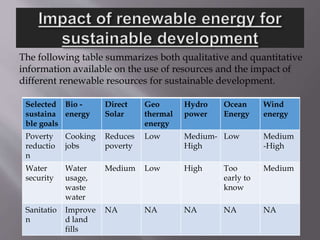
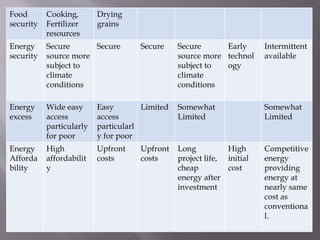
The following table summarizes both qualitative and quantitative
information available on the use of resources and the impact of
different renewable resources for sustainable development.
Selected
sustaina
ble goals
Bio -
energy
Direct
Solar
Geo
thermal
energy
Hydro
power
Ocean
Energy
Wind
energy
Poverty
reductio
n
Cooking
jobs
Reduces
poverty
Low Medium-
High
Low Medium
-High
Water
security
Water
usage,
waste
water
Medium Low High Too
early to
know
Medium
Sanitatio
n
Improve
d land
fills
NA NA NA NA NA
Food
security
Cooking,
Fertilizer
resources
Drying
grains
Energy
security
Secure
source more
subject to
climate
conditions
Secure Secure Secure
source more
subject to
climate
conditions
Early
technol
ogy
Intermittent
available
Energy
excess
Wide easy
access
particularly
for poor
Easy
access
particularl
y for poor
Limited Somewhat
Limited
Somewhat
Limited
Energy
Afforda
bility
High
affordabilit
y
Upfront
costs
Upfront
costs
Long
project life,
cheap
energy after
investment
High
initial
cost
Competitive
energy
providing
energy at
nearly same
cost as
conventiona
l.
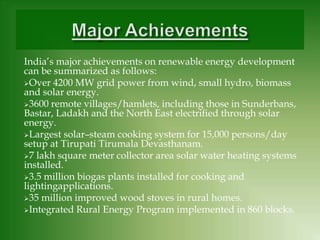
India’s major achievements on renewable energy development
can be summarized as follows:
Over 4200 MW grid power from wind, small hydro, biomass
and solar energy.
3600 remote villages/hamlets, including those in Sunderbans,
Bastar, Ladakh and the North East electrified through solar
energy.
Largest solar–steam cooking system for 15,000 persons/day
setup at Tirupati Tirumala Devasthanam.
7 lakh square meter collector area solar water heating systems
installed.
3.5 million biogas plants installed for cooking and
lightingapplications.
35 million improved wood stoves in rural homes.
Integrated Rural Energy Program implemented in 860 blocks.
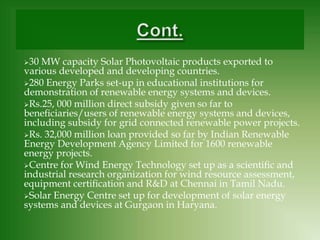
30 MW capacity Solar Photovoltaic products exported to
various developed and developing countries.
280 Energy Parks set-up in educational institutions for
demonstration of renewable energy systems and devices.
Rs.25, 000 million direct subsidy given so far to
beneficiaries/users of renewable energy systems and devices,
including subsidy for grid connected renewable power projects.
Rs. 32,000 million loan provided so far by Indian Renewable
Energy Development Agency Limited for 1600 renewable
energy projects.
Centre for Wind Energy Technology set up as a scientific and
industrial research organization for wind resource assessment,
equipment certification and R&D at Chennai in Tamil Nadu.
Solar Energy Centre set up for development of solar energy
systems and devices at Gurgaon in Haryana.
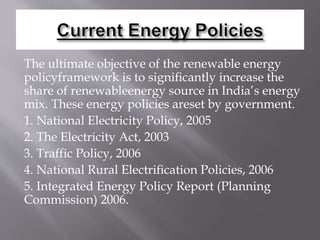
The ultimate objective of the renewable energy
policyframework is to significantly increase the
share of renewableenergy source in India’s energy
mix. These energy policies areset by government.
1. National Electricity Policy, 2005
2. The Electricity Act, 2003
3. Traffic Policy, 2006
4. National Rural Electrification Policies, 2006
5. Integrated Energy Policy Report (Planning
Commission) 2006.
1. District Advisory Committees (DAC),
2. Akshay Urja Shops (renewable energy shops),
3. Energy parks,
4. Rajiv Gandhi Aloshy Urja Diwas (Rajiv Gandin
Renewable Energy Day),
5. Akshay Una Newsletter (Renewable Energy
Newsletter),
6. Renewable Energy Clubs.
India has a bright future in context of
Renewable Energy development as its lot of
potential still developing to be used.
For further advancement India would also have
to look for international cooperation in renewable
energy sector through well defined R&D projects
with proper division of labour & equitable
financial burden & credit sharing arrangements.
Amo. of governtment & private organisations
suches MNRE, CWET, Uni's, 19Ts, N9TS, 9OCL &
TER9 are involved in R&D of renewable
resources.
Renewable energy is the most elegant choice to
make for meeting our energy demand, ensuring
sustainable development and help human race to
continue, at least not make an end from energy
crisis, as it meets, the shortcomings. of non-
renewable energy sources. Though renewable
energy industry is now capital intensive, its
increasing use will surely decrease it's cost. Each
and every investment done in reneevable energy
ensures, sustainable development for future.
Renewable Energy

Renewable Energy

  • 1.
    PRESENTED BY: PRESENTEDTO: Himanshu Pandey Dr. Snehel Chakravarty B. Sc.( Hons. ) Ag. 3rd year. 18230AGC047 COURSE: RENEWABLE ENERGY AND GREEN TECHNOLOGY Course Code: (ENG-321) Credit Hrs: 2(1+1)
  • 2.
    Energy is oneof the most vital building blocks in human development and a key factor influence the sustainable development of any nation. The conventional sources of energy have major intimidation to our existing and future global safety environmental values, health and society. So, the renewable energy in power sector of India for sustainable development gets a very significant role.
  • 3.
     It isenergy that comes from resources. Replenished such as wind, rain, sunlight, waves, etc. [The new renewables, suggests a greater focus on modern and sustainable forms of renewable energy, in particular modern biomass, energy, geothermal seat and electricity small scale hydropower, low temp. solar heat, wind electricity, solar photovoltaic and thermal electricity & Energy].  About 16% of global energy comes from renewable resources. 10% of all energy from traditional biomass  3.4% - hydroelectricity  3% - new renewables
  • 4.
    The concept ofsustainable development has it’s roots in the idea of a sustainable society (Brown, 1381) and in the management of renewable & non-renewable resources. The concept of SD is defined as “ development that meets the needs of the present without compromising the ability of future generations to meet their own needs.
  • 5.
    Sustainable development emphasizesthe evolution of human society from the responsible economic point of view, in accordance with environmental & natural processes. So the energy sources must meet some of the basic criteria :  Should have minimal or no negative environmental or social impact. There should be no depiction of natural resources  Should meet the needs of people today and in the future an accessible, equitable and efficient manner. should protect air, land and water.  Should be safe today and also there should be no burden on the future generations with unncessary risks.  The renewable energy, is one of such energy source which we can find directly linked to sustainable development.
  • 6.
    Prior to thedevelopment of coal in the mid 19th century nearly all energy was renewable. By 1873, concerns of running out of coal promoted experiments using Solar energy. Development of Solar engines continued until the outbreak of World War 1st. In the 1970’s enviromentalist promoted the development of renewable energy for replacement of oil and decreasing dependence on oil leading to the first electricity generating Wind Turbine.
  • 7.
    1970’s energy crisisled to the establishment of the COMISSION FOR ADDITIONAL SOURCES OF ENERGY(CASE) in the Department of Science and Technology in Mach 1981. In 1982, a new department was created in the Ministry of Energy i.e. Department of Non- conventional Energy Sources(DNES). A decade later in 1992, DNES became Ministry of Non-conventional Energy Sources(MNES) and in October 2006 it gained its current name as Ministry of New and Renewable Energy.
  • 8.
    Every country relieson the natural resources, like coal, Oil or natural gas which are also called non renewable energy resources. Due to it’s large extensive usage for satisfying population need it is getting diminished, if not used in limited & conservative amount. Although, these resources are expensive, but they are damaging the environment as well, which proves it as a shabby option. According to news, the world is revolving around the prices of Fossil fuels especially the oil The burning of fossil fuels, emit immense amount of toxic gaces that are alermingly damaging out ecosystem. Energy security of these sources is very less.  These resources are owned by very a few countries. So their transportation is difficult and costly. And any accident securing at their transportation times, it causes huge damage to environment. Even the process to harness these resources in costly lead to irreversible damage to the adjoining environment. Thus, there a number of other issue and short comings of these resources, it becomes a great necessity at present to utilize natural or organic substitute like renewable resources for sustainability.
  • 9.
    Sinking the effectof global warming: searching & using the energy sources will provide us with a solution to save our Earth from ecological disaster which is caused by global warming. Cost-Power plant maintenance definitely cost for renewable energy as the availability is abundant on earth & the invested amount can be refurbished after some time of its establishment. Renewable energy sources have lower environmental impact. This energy has the potential to provide clean sources of power generation that is also affordable for both home owners and businesses. This energy reduces the carbon footprints that remain in the last after burning of fossil fuels. This energy also reduces pollution. Unlike non renewable resources, these energy resources will never run out, so there is an unlimited supply. The replenishable nature of renewable resource of energy make them the most suitable energy. resources for achieving sustainable development. Reasons for changing in diversion to Renewable Energy Resources
  • 10.
    There are manysources of renewable energy, but all of them, except geothermal energy, are more or less directly related to the sun: the main source of clean and sustainable energy for the earth. Solar energy Wind energy Hydropower (water power ) Biofuels Geothermal energy
  • 11.
    Apart from theeveryday applications of solar energy, such as room lighting, it is harnessed by two quite different methods: photovoltaics and solar thermal. Photovoltaics (PV): the application of solar cells to convert sunlight directly into electricity. When PV cells are assembled, they form a PV module (or panel). An installation of panels is called a PV array. Solar cells are often made from wafers: slices of semiconductor material, such as silicon crystal. Solar thermal energy (STE): a energy technology that uses solar energy to produce thermal, i.e. heat. There are low-, medium-, and high-temperature solar thermal collectors. This technique is known as concentrated solar power (CSP).
  • 12.
    The energy ofwind is harnessed with wind turbines. They are usually grouped in wind farms (sometimes called wind parks). There are onshore farms (which, however, are often near water); nearshore farms (on land or on sea within several km (10 km or more from land). Wind energy currently generates only 1% of all electricity on a global scale, but its share is growing rapidly. In Denmark, for example, wind already accounts for 19% of the total electricity production. Since wind is intermittent, turbines can't constantly work at their full capacities. The ratio of actual annual productivity to the theoretical maximum capacity is called capacity factor. It typically reaches 20% to 40%.
  • 13.
    Hydropower (also called hydraulicor water power) is derived from the force of moving water. Since water is much denser than air, its movement generates more energy than wind does. Electricity generated with hydropower is called hydroelectricity. Hydropower was harnessed with water wheels to operate watermills, sawmills, textile machines and others long before electric power came into use. Hydropower supplies some 19% of all electricity in the world. It is generally far cheaper than fossil fuels or nuclear energy. Hydroelectricity is mostly generated in dams. Water is first collected in dams, then let flow through turbines. A great advantage of this technology is that the amount of energy produced can be easily adjusted to the level of demand by controlling the outflow of water.
  • 14.
    Tidal power technologiesconvert the energy of tides into electricity. Their biggest advantage is the fact that tides are much more predictable than wind or solar energy. However, tidal power is not very common yet. Tidal energy is captured with tidal stream systems which use the kinetic energy f moving water to drive turbines. A less popular technology to capture tidal energy are barrages (similar to dams), which use the water's potential energy. Barrages are not preferred because of higher costs and bad environmental effects. Another up-and-coming electric source is wave power. One wave power technology employs buoyant objects that the waves move, creating electricity. With wind turbines, the air fluctuations caused by the moving water can also be used to produce power. A project that uses the movement of the water below its surface has also been developed. World leaders in hydropower use: China, Brazil, Canada, USA, India
  • 15.
    Biomass consists ofliving or recently dead organisms or other biological material, i.e. carbon. Biomass is used to produce biofuel. The most common material for biofuels are photosynthetic plants. A plant especially grown to be used for biofuel manufacturing is known as an energy crop. Biodiesel is a very common biofuel. It is made from oils (extracted from maize, soy, rapeseed, sunflower, palm fruit and sometimes from animal products) that undergo chemical processing. Used edible vegetable oil is sometimes transformed into blodiesel too. Biodiesel is mixed with mineral diesel to be used in diesel engines. Biogas is produced by the biological breakdown of organic matter in the absence of oxygen. The biodegradable materials in question can be manure, sewage, green waste (plant parts), household and industrial waste. Biogases are rich in methane. They can be used to generate heat, electric or mechanical energy, or as fuel for vehicles. Biogas is produced in facilities. for biological treatment of waste. It is also formed naturally in landfills where it contributes to the greenhouse effect. Bioalcohol (or alcohol fuel) is produced with the help of fermentation inducing microorganisms. The most common is ethanol fuel (or bioethanol) that is widely used instead of petrol to power cars in some countries, predominantly Brazil.
  • 16.
    Several metres under theearth's surface the temperature is between 10° and 16°C. In winter this heat can be brought to buildings with pipes. Another technology uses deep wells in hot rock in which fluid is heated to produce. steam, which then drives turbines to generate electricity. plants. The facilities that enable this process are called dry steam, flash, steam and binary-cycle plants. This type of energy is obtained by tapping the heat of the earth, which is mostly in the form of hot water and steam. Various technologies are used to get to the heat under the earth's surface at different depths. Geothermal power stations are expensive to build but their operating costs are low. A significant advantage is that geothermal energy is not dependent on weather conditions. A major disadvantage is the risk for land stability in the region where such a plant is constructed. In some areas of the planet geothermal energy is closer to the surface and therefore easier to concentration of volcanoes. Geothermal sources account for 19% of Iceland's electricity production, and geothermal heating is used in 87% of homes in the country. Iceland also plans to go fully fossil fuel free in the near future.
  • 17.
    The following tablesummarizes both qualitative and quantitative information available on the use of resources and the impact of different renewable resources for sustainable development. Selected sustaina ble goals Bio - energy Direct Solar Geo thermal energy Hydro power Ocean Energy Wind energy Poverty reductio n Cooking jobs Reduces poverty Low Medium- High Low Medium -High Water security Water usage, waste water Medium Low High Too early to know Medium Sanitatio n Improve d land fills NA NA NA NA NA
  • 18.
    Food security Cooking, Fertilizer resources Drying grains Energy security Secure source more subject to climate conditions SecureSecure Secure source more subject to climate conditions Early technol ogy Intermittent available Energy excess Wide easy access particularly for poor Easy access particularl y for poor Limited Somewhat Limited Somewhat Limited Energy Afforda bility High affordabilit y Upfront costs Upfront costs Long project life, cheap energy after investment High initial cost Competitive energy providing energy at nearly same cost as conventiona l.
  • 19.
    India’s major achievementson renewable energy development can be summarized as follows: Over 4200 MW grid power from wind, small hydro, biomass and solar energy. 3600 remote villages/hamlets, including those in Sunderbans, Bastar, Ladakh and the North East electrified through solar energy. Largest solar–steam cooking system for 15,000 persons/day setup at Tirupati Tirumala Devasthanam. 7 lakh square meter collector area solar water heating systems installed. 3.5 million biogas plants installed for cooking and lightingapplications. 35 million improved wood stoves in rural homes. Integrated Rural Energy Program implemented in 860 blocks.
  • 20.
    30 MW capacitySolar Photovoltaic products exported to various developed and developing countries. 280 Energy Parks set-up in educational institutions for demonstration of renewable energy systems and devices. Rs.25, 000 million direct subsidy given so far to beneficiaries/users of renewable energy systems and devices, including subsidy for grid connected renewable power projects. Rs. 32,000 million loan provided so far by Indian Renewable Energy Development Agency Limited for 1600 renewable energy projects. Centre for Wind Energy Technology set up as a scientific and industrial research organization for wind resource assessment, equipment certification and R&D at Chennai in Tamil Nadu. Solar Energy Centre set up for development of solar energy systems and devices at Gurgaon in Haryana.
  • 21.
    The ultimate objectiveof the renewable energy policyframework is to significantly increase the share of renewableenergy source in India’s energy mix. These energy policies areset by government. 1. National Electricity Policy, 2005 2. The Electricity Act, 2003 3. Traffic Policy, 2006 4. National Rural Electrification Policies, 2006 5. Integrated Energy Policy Report (Planning Commission) 2006.
  • 22.
    1. District AdvisoryCommittees (DAC), 2. Akshay Urja Shops (renewable energy shops), 3. Energy parks, 4. Rajiv Gandhi Aloshy Urja Diwas (Rajiv Gandin Renewable Energy Day), 5. Akshay Una Newsletter (Renewable Energy Newsletter), 6. Renewable Energy Clubs.
  • 23.
    India has abright future in context of Renewable Energy development as its lot of potential still developing to be used. For further advancement India would also have to look for international cooperation in renewable energy sector through well defined R&D projects with proper division of labour & equitable financial burden & credit sharing arrangements. Amo. of governtment & private organisations suches MNRE, CWET, Uni's, 19Ts, N9TS, 9OCL & TER9 are involved in R&D of renewable resources.
  • 24.
    Renewable energy isthe most elegant choice to make for meeting our energy demand, ensuring sustainable development and help human race to continue, at least not make an end from energy crisis, as it meets, the shortcomings. of non- renewable energy sources. Though renewable energy industry is now capital intensive, its increasing use will surely decrease it's cost. Each and every investment done in reneevable energy ensures, sustainable development for future.